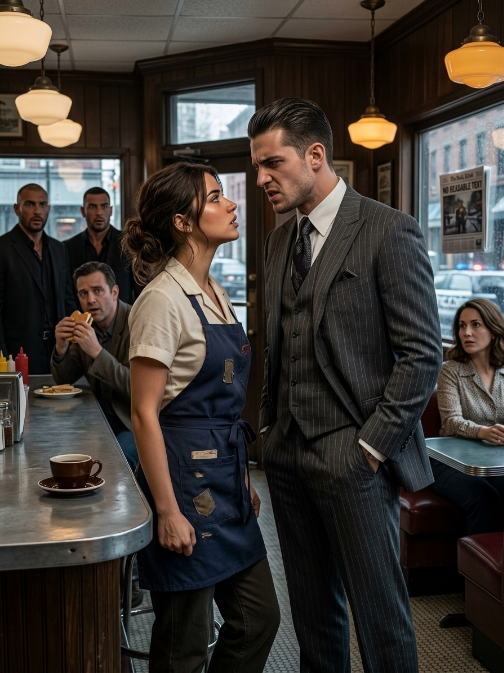
She Rode Alone to Marry a Stranger the Whole Town Called a Killer — Then Her Own Past Rode In Behind Her

PART 1
The wind off the Rockies cut through Blackwater like a promise and a threat.
Eliza Hart stood behind the counter of Morrow’s General Store at four in the morning, the way she always did, her hands white with flour, watching that wind rattle the windows like it wanted in. Bread first. Then rolls. Then the pies that brought customers from two towns over, because even Morrow admitted her Parker House rolls were the only reason half his regulars still walked through his door.
He paid her three dollars a week and let her sleep in the storage room behind the flour sacks. It wasn’t charity. She’d made sure of that.
“You’re too good for this place, Miss Hart,” old Jim Wheelen told her that morning, counting coins out of arthritic fingers. “Someone ought to marry you proper.”
She gave him the smile she’d practiced in seven different towns — pleasant, distant, final. “I do fine on my own, Mr. Wheelen.”
She didn’t tell him that *fine* meant twenty-six years old with no family, no friends, and a door she checked twice before sleeping. She didn’t tell him that the church women looked through her like she was made of glass, or that some of the husbands looked at her in ways their wives pretended not to notice.
Then the bell over the door jangled, and three women spilled in at once, red-faced and breathless with the kind of news that couldn’t wait.
“Rhett Callahan is looking for a wife,” Sarah Pritchard announced, slapping a notice on the counter like she was laying down a winning hand.
Eliza picked it up. Good paper. Precise handwriting.
*Man of property seeks wife. Must be strong, honest, and willing to work. No drunkards, no gossips, no fragile temperaments. Life will be hard but fair. Compensation, security, respect, share in all holdings. Serious inquiries only. — R. Callahan, Callahan Ranch, North Boundary.*
“Like ordering a plow from a catalog,” Mary Chen said, delighted and scandalized in equal measure.
“Everyone knows Callahan,” Constance added, wrinkling her nose. “Huge. Mean. Doesn’t talk to anyone. Killed a man once.”
“Beat him to death with his bare hands,” Sarah whispered, like it was the best part of the story.
“That was self-defense,” Eliza said, before she could stop herself. “The man drew on him first.”
Three heads turned toward her at once.
“How do *you* know that?”
“I heard Sheriff Dawson talking about it. It was ruled lawful.”
“Lawful or not,” Sarah said, snatching the notice back, “the man’s a savage. Six and a half feet tall, built like a bull, works that ranch alone because nobody will work for him.”
“Sounds like he minds his own business,” Eliza said quietly.
They left in a cloud of giggles, already deciding who else needed to hear about it. By noon, the whole town knew. The saloon crowd called it pathetic. The church ladies called it scandalous. The merchants called it bad for business — if some fool woman ran off from Callahan’s ranch mid-winter, they’d lose whatever coin he still spent in town.
Eliza kept kneading dough and tried not to listen to any of it. But that evening, after she’d swept the floor and locked the door and gone back to her storage room, she pulled a small wooden box out from under the floorboard. Inside: her savings. A deed to land in Kansas she’d never seen. A silver locket she couldn’t bring herself to pawn. And a newspaper clipping she never had to unfold, because she already knew every word of it by heart.
*Woman sought in fraud investigation.*
She put the box away. Took out a fresh sheet of paper instead.
And began to write.
The ride to Callahan Ranch took four hours — north road to the fork, west trail to the boundary markers, then the creek until the valley opened up like something out of a painting. Grassland. Water. Timber. And in the middle of it, a ranch that looked less like a homestead and more like a small kingdom nobody had told the rest of the territory about.
Eliza’s hands tightened on the reins. She had rehearsed this a dozen times in her head, and now that the ranch was in front of her, every rehearsed word had evaporated.
*Turn around,* her mind whispered. *This is insane.*
But she had spent three years running from insanity. Maybe it was time to run toward something instead.
Smoke rose from the chimney in a straight, steady line. Someone was home.
She rode down into the valley — and didn’t yet know that the man waiting there would ask her only one real question, the kind no one had asked her in years:
*What are you running from?*
—
PART 2
“Does it matter?” Eliza asked.
“Might,” Rhett Callahan said, wiping his hands on a rag, studying her the way a man studies a horse he isn’t sure he can trust yet. “The law?”
“No.”
He believed her. Couldn’t have said why. But he did.
“Disappointed someone,” she said instead. “Made choices people didn’t approve of. Got tired of explaining myself.”
He told her flatly what the town said about him — mean, dangerous, a killer — and asked if it bothered her.
It didn’t. And that, more than anything, seemed to be the answer he’d been waiting for.
By the time she rode back toward Blackwater three hours later, something had shifted in her chest that she didn’t have a name for yet. He hadn’t offered romance. He’d offered *partnership* — half of everything, legally, in writing, if she was willing to earn it. It was the least sentimental proposal she had ever heard, and somehow it had made her want to cry.
She had three days to answer.
She didn’t need three days. By the time she reached town, a rock had already gone through the front window of Morrow’s store — someone’s opinion about her *personal business* — and Morrow himself was waiting with a week’s pay and an apology he didn’t really mean.
“I’ll be out by tonight,” she told him.
That night, from the boarding house, she sent one telegram.
*R. Callahan — Callahan Ranch — stop — answer is yes — stop — Hart.*
The reply came three hours later: *Come tomorrow. Stop. Bring everything.*
She thought that was the hard part. She thought riding into a stranger’s life with nothing but a wooden box and a folded newspaper clipping was the biggest risk she would ever take.
She was wrong.
Because two days later, standing outside the land office as husband and wife, papers signed, a judge’s blessing still fresh in her ears, Sarah Pritchard stepped in front of the crowd with a smile like a blade.
“Did you tell him, Eliza,” she said, loud enough for forty people to hear, “about why you keep moving? Why you never stay anywhere long?”
Eliza’s stomach dropped straight through the ground.
“I have a cousin in Kansas,” Sarah went on. “She writes very detailed letters.”
Rhett went still beside her. And for the first time since she’d ridden into that valley, Eliza understood that the past she’d spent three years outrunning hadn’t stayed behind her at all.
It had simply been riding four hours behind, the whole time, waiting to arrive.
—
PART 3
*”You might want to ask your new wife about her past, Mr. Callahan,”* Sarah had called after them, *”before you find out the hard way.”*
Rhett didn’t answer her. He took Eliza’s arm — gentle, but immovable — and steered her toward the horses. They rode out of Blackwater at a trot that became a canter, Sarah’s voice chasing them the whole way. *Running again, Eliza? How long before you run from him too?*
They didn’t speak until the ranch appeared on the horizon.
“Is it true?” Rhett finally asked.
“It’s complicated.”
“That’s not an answer.”
Eliza pulled her horse to a stop, hands shaking on the reins. “Yes. Part of it.”
“Which part?”
She told him — not everything, not yet, but enough. A bank in Topeka. A supervisor named Richard Vaughn who had mentored her, courted her trust, then turned that trust into something uglier. Locked doors. Unwanted suggestions. Her refusal. And three days later, an investigation that had started not into him, but into her.
“I worked there as a clerk,” she said. “He was moving money between accounts, falsifying records. When I figured it out, I reported it. He had connections. I didn’t. By the time investigators arrived, he’d made it look like I was the one stealing.”
“Were you?”
“No.”
“Can you prove it?”
“No. He destroyed the evidence. His word against mine, and his word carried more weight.”
Rhett said nothing for a long time. When he finally spoke, his voice had gone low and careful, like a man testing ice before he put his full weight on it. “You lied to me.”
“I didn’t lie. I just didn’t tell you everything.”
“Same thing.”
“Is it?” Her voice cracked despite everything she did to hold it steady. “If I’d told you in the beginning, would you have let me come here? Would you have married me?”
“I don’t know.”
The honesty of it cut deeper than anger would have.
“I understand if you want to end this,” she said. “I’ll leave. You won’t hear from me again.”
“Where would you go?”
“I don’t know. Somewhere else. I’m good at that.”
He studied her for a long moment, and whatever he was searching for in her face, she couldn’t tell if he found it. “Come on,” he said finally. “It’s getting cold.”
That night, in the kitchen, he asked her the only question that mattered. “Did you steal that money?”
“No.”
“Would you steal from me?”
“Never.”
“How do I know that?”
“You don’t,” she said, meeting his eyes. “You have to decide whether to trust me. Same way I had to decide whether to trust you.”
“That’s different.”
“How? I haven’t been running from the law. You’ve been running from people’s opinions, from their fear. You said so yourself.” She stepped closer. “You think I don’t understand what that’s like? Being judged before anyone knows you?”
Something in his expression shifted. He didn’t answer that night. He asked for space instead, and she gave it to him, lying awake in the guest room listening to him pace downstairs until well past midnight, working through something she couldn’t see.
By morning he’d already ridden out to check the north fence. He left a note. *Back by afternoon. Coffee is hot.*
It wasn’t forgiveness. But it wasn’t a door slamming shut, either.
That afternoon, mucking stalls side by side in a silence that had finally stopped feeling like a verdict, Rhett spoke first.
“I thought about what you said. About both of us running.”
Eliza leaned on her pitchfork and waited.
“You’re right,” he said. “I’ve been hiding here same as you’ve been hiding by moving. Different methods, same result.” He drove the fork into a pile of hay. “I want to believe you about Kansas. But I can’t verify it. Can’t prove it one way or the other. So I have to choose.” He looked at her directly. “And I’m choosing to trust you. Not because I’m sure. Because if I can’t trust my wife, then nothing else matters.”
“Thank you,” she said, and meant it more than she’d ever meant anything.
“Don’t thank me yet. Trust works both ways. I’m trusting you with this ranch, with everything I’ve built. You need to trust me back.”
So she told him the rest — Vaughn’s name, the dinners at his house, the demands that had turned private and cruel, the moment she’d refused him and the moment, three days later, that his revenge had arrived dressed as an investigation.
“He’s still in Kansas,” she said. “I don’t know if he’s still at the bank. I haven’t looked back.”
Rhett’s jaw went tight in a way she was learning meant something dangerous was working itself loose in him. “He’s still out there,” he said. “Still capable of doing it to someone else.”
They didn’t know yet how right that sentence would turn out to be.
—
Three weeks after the wedding, they rode into Blackwater together — Rhett’s decision, not Eliza’s. *We go together,* he’d said. *Show them we’re solid.* The town had gone cold and watchful the moment they arrived; a new clerk at Morrow’s refused to meet Eliza’s eyes while he tallied their order and lied badly about being out of nails he clearly had in the back room.
It was Sheriff Dawson who found them loading the wagon, a folded telegram in his hand and something careful in his expression.
“This came through two days ago,” he said. “Marshal’s office in Kansas. Looking for a woman named Eliza Jane Hart. Wanted for questioning in a fraud case.” His eyes settled on her. “You wouldn’t happen to know anything about that.”
Eliza’s mouth went too dry to answer.
“I didn’t steal anything,” she finally managed.
“That so.” Dawson refolded the paper slowly. “I could wire them back, hold you here till they send someone to collect you. That’d be by the book.” He looked at Rhett, then back at her. “But I’ve known Rhett ten years. Never gave me a moment’s trouble. So I’m inclined to give you the benefit of the doubt.” His eyes narrowed slightly. “Also, Sarah Pritchard’s been in my office every other day demanding I investigate you. When Sarah wants something that bad, it usually means she’s wrong.”
“Why are you really helping?” Eliza asked.
“Twenty thousand dollars is a lot of money,” Dawson said. “If you’d really stolen that much, you wouldn’t be living on a ranch mucking stalls. You’d be in Denver living high.” He tucked the telegram away. “I’ll wire Kansas that the inquiry came to nothing. But if this comes back on me, I won’t be able to help you twice. And Mrs. Callahan — if you’re really innocent, running only works for so long. You might want to think about clearing your name.”
They rode home in silence, the number twenty thousand sitting between them like a stone neither of them wanted to lift.
“You should have told me it was that much,” Rhett said finally.
“Would it have mattered?”
“Yeah. Makes it harder to believe you’re innocent.”
But that night, at the kitchen table, it was Rhett who reached for paper and pen. “We need a plan,” he said. “Something better than you running and me pretending I didn’t know.”
“What kind of plan?”
“The kind where we prove you didn’t do it.”
They wrote to the Pinkerton Agency’s Denver office that week — a careful letter, not too desperate, not too vague, requesting an investigation into possible ongoing embezzlement at First National Bank of Topeka. They didn’t mention Eliza’s name. *Let them find the connection on their own,* Rhett said. *If we seem too invested, they’ll charge more.*
The reply came faster than either of them expected. The agency would take the case. Fifty dollars retainer, an agent already stationed in Kansas, ready to start immediately — but they needed a full, detailed statement from Eliza. Everything. Dates, amounts, names, made official and sworn.
“That means writing it all down,” she said. “Making it real.”
“It happened whether you write it or not,” Rhett said. “Question is whether you want to fix it or keep running.”
It took her three days to compose it. Each page reopened something she’d spent three years trying to keep sealed shut. When she finished, Rhett read it in silence, his expression darkening with every line.
“He really did set you up perfectly,” he said when he reached the end.
“Now you understand why I ran.”
“Now I understand why you need to stop.”
—
Eight weeks later, Rhett rode back from town at a hard gallop, dust trailing behind him, an envelope from the Pinkerton Agency clutched in his coat. Marcus Webb, the agent assigned to the case, had found exactly what they’d hoped and feared in equal measure. Vaughn was still at the bank — promoted now, vice president, with friends on the board. Webb had posed as an auditor and found irregularities in twelve accounts. Same pattern. Small withdrawals, always beneath the threshold that would trigger review. Thirty-two thousand dollars over three years.
He hadn’t stopped. He’d gotten better at it.
But there was a catch, and it was the one neither of them had wanted to hear. Webb needed the sealed files from the original investigation to prove the pattern matched. And those files required a sworn deposition — under oath, in person, in Topeka.
Which meant Eliza going back.
“They’ll arrest you,” Rhett said, reading the letter twice like the words might change if he looked hard enough.
“Maybe. Webb thinks he can arrange immunity first.”
“Then you don’t go.”
“There is no other way, Rhett. Without the connection to the old case, Vaughn just sets up another scapegoat. Someone else’s life, ruined the way mine was.” She stepped closer to him. “I’m tired of running. You were right about that — fear just follows you. I want to face it.”
“Not if it means prison.”
“Then what? I stay here pretending everything’s fine until someone besides Dawson makes the connection and I don’t get a choice anymore?”
He turned away, braced his hands against the fence rail, and for a long moment said nothing at all. When he finally spoke, his voice had gone rough. “This is my fault. I pushed for the investigation.”
“It’s not your fault. It’s *his*.” She reached for his hand. “Come with me.”
He looked at her, startled.
“To Kansas,” she said. “I don’t want to do this alone. I’m terrified, Rhett. And you’re the only person I trust.”
“All right,” he said quietly. “I’ll come. But we do this smart. Immunity agreement in writing before we leave. A lawyer who represents *you*, not the prosecutors. You’re not walking into this unprotected.”
—
The train to Topeka took three days, each mile pulling Eliza back toward a version of herself she’d spent three years trying to outrun. Marcus Webb met them at the station — sharp-eyed, efficient, already carrying the immunity papers a judge had approved that morning. Full testimony in exchange for a clean record. No prosecution. No jail.
“What’s the catch?” Rhett asked.
“No catch. Prosecutor wants Vaughn more than he wants her. But she needs to testify within forty-eight hours or the deal expires. Vaughn’s lawyer is already making noise.”
The deposition took two hours the first day, three the second. Daniel Pierce, the prosecutor, walked her through everything — the mentorship that had turned into demands, the locked doors, the falsified ledgers with her clerk code stamped on transactions she’d never authorized. Vaughn’s attorney tried twice to paint her as an unreliable witness, a woman who’d run rather than face justice. Pierce overruled it both times.
When it was over, Richard Vaughn leaned close as he passed her chair, his voice pitched low enough that only she could hear it.
“You think this changes anything? I’ve been untouchable for three years. I’ll be untouchable when this farce ends.”
“We’ll see,” Eliza said.
He smiled like a man who still believed it.
Outside the courthouse, Rhett pulled her into his arms and she finally let herself feel everything she’d been holding back for two hours. “It’s done,” she said into his shirt. “I did it.”
“I know. I’m proud of you.”
The case, they were told, would take a week to move through the grand jury. It moved faster than that — four days later, Marcus Webb arrived at their hotel with news that changed the shape of everything. Vaughn had tried to access his office files after hours. Security had stopped him. When they searched him, he had fifty thousand dollars in cash and a train ticket to Mexico.
His bail was revoked within hours. He spent that night, and every night after, in a county jail cell.
Pierce also had one more piece of news — the bank’s former president, Samuel Morrison, had been located in San Francisco, and he was willing to testify that the original investigation three years earlier had been rushed, incomplete, closed under pressure from Vaughn’s father-in-law on the board. He’d had doubts even then. Doubts he’d buried, and had apparently regretted burying for three years.
“The grand jury convenes tomorrow,” Pierce told them. “I expect indictment by afternoon.”
He was right. Richard Vaughn was indicted on eighteen counts of embezzlement, fraud, and falsifying bank records. Trial was set for late September — four months away, enough time to bring in the harvest, prepare the ranch for another change of season, and try, for a little while, to live like ordinary people.
—
They went home that spring to a valley that felt, for the first time, entirely theirs.
Something had shifted between them on the long train ride back — not love exactly, not yet, but the foundation of it, the recognition that what they’d built together was worth keeping. The night they returned, Eliza moved her few belongings out of the guest room and into the master bedroom, and Rhett met her in the doorway with a question in his eyes she didn’t need him to voice.
“You sure?” he asked anyway.
“I’m sure. We’re married legally. Might as well make it real in all the ways.”
He kissed her slowly, carefully, like a man who’d been waiting far longer than he’d ever admit. That night, for the first time, they were not just partners bound by paper, but two people who had chosen each other.
The town noticed the change too. At the Saturday market that summer, Eliza sold out six varieties of bread and four kinds of pie before noon. Sarah Pritchard appeared at the wagon afterward, her usual sharpness gone soft with something close to shame.
“I heard about Kansas,” she said. “About the trial.” A pause. “I may have been wrong about you. About some things.”
It wasn’t quite an apology. Eliza decided to take it anyway. “We all make mistakes. Some worse than others.”
“If you need character witnesses for the trial,” Sarah said, “I’d be willing.”
Eliza stared at her, genuinely startled. “Why would you do that?”
“Because I was cruel and wrong, and I’d like to make it right if I can.”
—
September came, and with it, the trial. Nine days in a packed Topeka courtroom. Webb’s documentation of the recent fraud. The two bank clerks who’d witnessed suspicious transactions. Samuel Morrison, whose testimony about the compromised original investigation landed harder than anyone expected. And on the sixth day, Eliza herself, walking through her story one final time while Richard Vaughn watched from across the room, thinner now, older, but his eyes just as cold.
“Why did you come back?” Pierce asked her.
“Because running didn’t work. I was only delaying the inevitable. And because Mr. Vaughn needed to face consequences for what he did — even if it meant risking prison myself.”
Vaughn’s attorney spent two hours trying to unravel her on cross-examination, painting her flight from Kansas as an admission of guilt rather than an act of survival. She held her ground through every question, but that night in the hotel she collapsed onto the bed, certain she’d failed.
“He made me look like a liar,” she told Rhett.
“That’s his job,” Rhett said. “Doesn’t mean the jury believed him.”
The jury deliberated for two days. On the afternoon of the second, word came that a verdict had been reached. Eliza sat rigid in the gallery, Rhett directly behind her, as the foreman rose.
“On count one, embezzlement. How do you find?”
“Guilty.”
Guilty on seventeen of eighteen counts. Richard Vaughn sat frozen at the defense table as his attorney immediately moved for appeal. The judge denied it on the spot and set sentencing for three weeks out.
Outside the courthouse, Daniel Pierce shook Eliza’s hand. “Congratulations, Mrs. Callahan. Justice served. This case sets precedent for prosecuting bank fraud. We couldn’t have done it without you.”
That evening, over wine at a restaurant neither of them could really afford, Rhett raised his glass.
“To freedom,” he said.
Eliza clinked her glass against his, and tested the word in her mind like she was trying on a coat that had never quite fit before. *Free.* Free from running. Free from hiding. Free from a fear that had followed her across seven towns and three years and had finally, finally run out of road.
—
Richard Vaughn was sentenced to twenty-two years in the territorial prison. His appeals were denied. The letter confirming it arrived at the ranch the following January, and Eliza read it twice before burning it in the fireplace, watching the paper curl black and disappear into ash.
“That’s it, then,” Rhett said, watching it burn beside her.
“Over,” she agreed. “Completely over.”
Spring brought new calves, a thriving garden, and a discovery Eliza had suspected for weeks before she let herself believe it — she was pregnant, due that September. When she told Rhett, this enormous, careful man who had built a kingdom out of nothing and had once posted a blunt, unromantic notice because he couldn’t stand one more year of silence, he swept her into his arms with a gentleness that undid her completely.
“We’re having a baby,” he said, like he was testing whether the words were real.
“We are.”
“I’m going to be a father.” He laughed, unsteady. “Terrified yet?”
“Completely.”
“Good,” he said. “Me too.”
Their daughter came early, healthy and loud, and they named her Sarah — not for Sarah Pritchard, but for Rhett’s mother, though the coincidence made Eliza smile every time she said the name aloud. Two more children followed in the years after: Thomas, named for the ranch hand who’d proven himself indispensable, and Margaret, who would grow up to turn her mother’s bread recipes into a restaurant famous across the state.
Two years after the trial, a final letter arrived from Kansas. The bank had recovered most of the stolen money from accounts Vaughn had hidden across three states, and as the case’s central witness, Eliza was entitled to a reward — five thousand dollars, more money than she had ever imagined holding at once.
“What should we do with it?” Rhett asked. “It’s yours. You earned it.”
She thought about it for a week. Then she made her choice.
“I want to put it into the ranch,” she said. “Buy that adjacent land you’ve been eyeing. Build Sarah a proper schoolroom. Hire another hand.”
“You could do anything with that money.”
“I’m doing what I want,” she said. “Investing in our future.”
They bought the land — eight hundred acres of prime grazing that pushed the ranch past four thousand acres, among the largest in the territory. They built the schoolroom. Eliza’s small bakery stall grew into a business, then a bakery in town, then, eventually, into her daughter Margaret’s restaurant. Rhett’s cattle became the standard other ranchers tried and failed to copy. Together, without either of them fully noticing when it happened, they built something that lasted.
—
On their tenth anniversary, they stood on the porch watching their children play in the yard — Sarah teaching Thomas to rope, Margaret toddling determinedly after both of them.
“You ever think about Kansas?” Rhett asked.
“Sometimes. Not like before.”
“What’s different?”
“It doesn’t hurt anymore,” she said. “It’s just something that happened. Part of the story. Not the whole story.”
He pulled her close, the valley gold in the late light below them. “What’s the whole story, then?”
“Still being written, I think.”
“What chapter are we in now?”
She smiled up at him — this careful, enormous man who had once been so certain no one would ever answer his notice that he’d stopped expecting anyone to try.
“The good one,” she said.
—
Rhett Callahan died at seventy-two, peacefully, in his sleep, Eliza’s hand in his until the very end.
“Thank you,” she whispered to him, “for believing me. For choosing me.”
His fingers tightened weakly around hers one last time. “Best decision I ever made.”
She lived eight more years without him — long enough to watch their grandchildren grow, long enough to know the ranch would go on, long enough to understand that everything they had built together would outlast them both. On her last afternoon, sitting on the porch with her daughter Sarah beside her, Eliza looked out one final time at the valley that had become, against every rational expectation, home.
“You did good, Ma,” Sarah said. “Everything you built. Everything you fought for. It worked.”
“We did good,” Eliza corrected gently. “Your father and I, together. That was the secret.”
“What was?”
“Finding someone who sees you for who you really are,” Eliza said, “not who you’re running from, or who you’re trying to be. Just you. And choosing them anyway.”
She died that night, in the bed she had shared with Rhett for nearly fifty years. Her last thought was of a notice nailed to a land office wall, of a four-hour ride she’d almost turned back from twice, of the single word that had convinced her to keep going when every instinct told her to run.
*Respect.*
The ranch continued long after. The valley remained, unchanged in all the ways that mattered. And somewhere in the quiet records of Montana’s territorial history sits a small, easily missed footnote about a woman who stopped running, stood up to a man who thought himself untouchable, and won — not because the world became fair, but because she finally found one person willing to stand beside her while she made it so.
It was, in every way that counted, a good story.
THE END