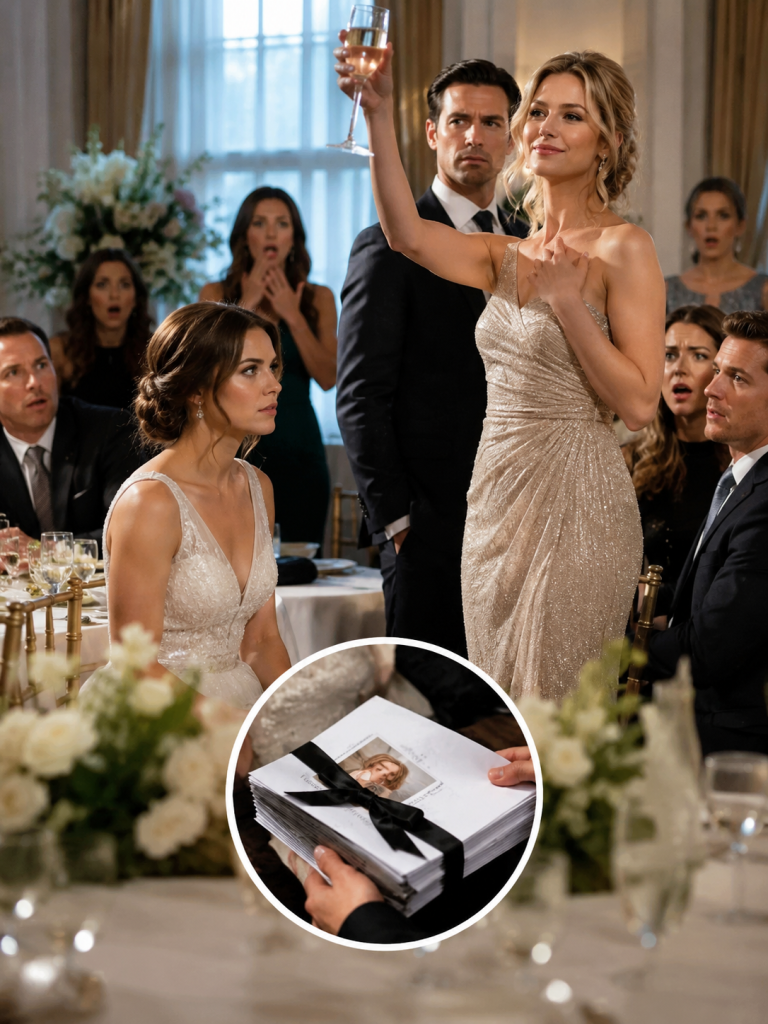
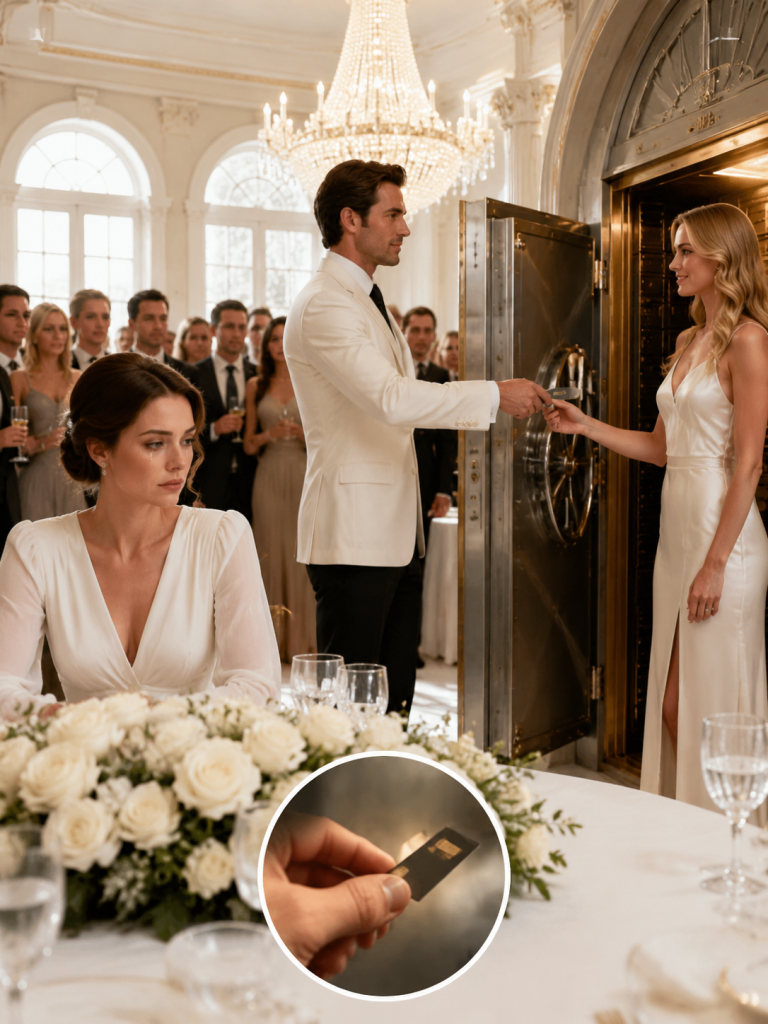
The Mafia Boss Forced His “Traitor Wife” to Clean His Empire—Then Her Mop Exposed the Secret That Destroyed Him

**PART 1**
She had been living under a different name for seven years when he found her.
The name on her diner badge said *Anna.* The name on her apartment lease said *Anna Reese.* The name her coworkers used when they asked her to cover the Sunday closing shift was Anna, and Anna was the name her brother Tobias called her when he was being careful, which was always, because at fourteen he understood their situation with a clarity that should have belonged to someone twice his age.
Her real name was Mia Calloway.
And on a gray Thursday morning in October, standing outside the oncology clinic on Tremont Street with a paper bag of Tobias’s medications in one hand and his thin shoulder under her other, she saw the man she had spent seven years believing she would never see again.
He was across the street.
He wasn’t looking at traffic or his phone or any of the things people looked at on Tremont Street on gray October mornings. He was looking at her. Still as a man who had rehearsed the moment and found it lived up to the rehearsal.
Mia’s hand tightened on Tobias’s shoulder.
“Mia,” Tobias said quietly, using her real name the way he did only when something was already wrong. “Who is that?”
“Nobody.”
“You only call people nobody when they’re the opposite.”
The man across the street raised two fingers to the edge of his jaw — not a wave, something smaller and more deliberate, a gesture from eight years ago that she had once found tender — and then he got into the black car at the curb and was gone.
Tobias looked at the empty space. “We’re moving again.”
“We’re going home.”
“I have a follow-up in three weeks.”
“I know.”
“And I just found a library that lets me check out twelve books at a time.”
“Tobias.”
He looked at her with the steady, infuriating composure of a teenager who had spent his whole life watching his sister manage crises and had concluded that calm was contagious if applied consistently enough.
“Tell me,” he said.
“Not here.”
He nodded once and didn’t ask again, which was both the best and the most heartbreaking thing about him.
—
His name was Luca Ashby when she knew him. He’d been twenty-three, the second son of a family that ran Boston’s construction corridors from the inside, and he had been trying, in those days, to be the version of himself that didn’t require the family’s methods. She had believed in that version. She had been nineteen and working the counter of a medical supply office, and he had come in three times a week on various pretexts until the pretexts wore thin and he asked her to dinner instead.
She had loved him.
That was the most important and most useless fact about the whole thing.
He was Luca Ashby now in a different way — not the younger son trying to find a different door out of the same house, but the head of the Ashby organization, the man Boston’s development lawyers called before they called city council, whose name appeared in federal documents exclusively in the phrase *insufficient evidence.* Eight years of grief and blame had made him into the thing his father had always wanted him to be.
He also believed she had sold information to the Marchetti family on the night his father died.
She hadn’t.
But the evidence had been assembled by someone who understood that a nineteen-year-old girl with a sick eight-year-old brother and no allies was the perfect person to carry a crime that needed a face on it.
The next morning arrived the way bad mornings did — all at once, every wall simultaneously.
Her manager at the diner called before she had finished her coffee. He was sorry. He wouldn’t meet her eyes through the phone call. She had been the best early-shift worker he’d had in two years and he was sorry.
By ten, an eviction notice was taped to the apartment door.
By noon, the bank had flagged her account for *irregular activity.*
By two, Tobias’s treatment coordinator left a message: payment verification required before his next infusion.
She sat in the bathroom with the door closed and one hand over her mouth so Tobias, who was reading in the next room, wouldn’t hear her understand what was happening.
Then her phone rang again. A collection agency. Tobias’s full medical history — four years of treatments, infusions, consultations, three emergency admissions — had been acquired by a private firm.
She already knew the name before they said it.
Ashby Medical Holdings.
Luca didn’t need guns. He never had. He bought the structure of a life and removed the load-bearing parts.
A knock at the bathroom door.
“Mia,” Tobias said. “Don’t do the thing where you go quiet and then pretend you weren’t quiet.”
She opened the door.
He stood in the hallway holding his book closed with one finger marking his page, the way he always did when he was worried but didn’t want to make it bigger by putting the book down entirely.
“I’m handling it,” she said.
“You’re going to him.”
“I don’t have another door.”
“There’s always another door.”
“He bought the building, Tobias. He bought the job. He reached the clinic.” She looked at him. “He can access everything I need to keep you alive.”
Tobias’s jaw tightened in the way it did when he was sixteen and trying not to cry and refusing to let either thing show. “I don’t want treatment that costs you—”
“Stop.” She crouched so he had to look directly at her face. “You do not get to make yourself smaller so my situation has more room. You live. That is not a negotiation. Say you understand.”
A long pause.
“I understand,” he said.
“Say it like you mean it.”
“I understand,” he said again, and this time it sounded like he did, though it also sounded like it hurt.
She stood. “Good.”
“What if he hurts you?”
She thought about Luca across the street, two fingers at his jaw, the patience of a man who had planned this for longer than she knew.
“He already knows how,” she said.
—
She took the T to Ashby Tower because her account was frozen and pride wouldn’t let her ask Tobias for his emergency twenty.
The tower was everything it was supposed to be — forty floors of dark glass above Atlantic Avenue, lit internally the way buildings were lit when they wanted you to understand something about the person who owned them. She entered through the main lobby soaking wet from the rain that had started two blocks back. The marble floor was warm beige and her boots left dark prints.
The security desk already knew her name.
Of course they did.
In the elevator’s mirrored walls, she saw herself clearly for the first time in months: wet hair, exhausted eyes, secondhand coat. The woman she had become in the years of running — functional, invisible, extremely tired.
Luca’s office was the full top floor.
He was standing at the window when she came in, looking at the harbor, and he turned when she entered with the specific quality of a man who had been listening for the sound of the elevator.
He didn’t cross to his desk. He stayed by the window. She remembered that he had always done that — occupied a room from its edges.
“I expected it to take longer,” he said.
“Restore Tobias’s treatment.” No preamble. No asking.
He studied her. Eight years had sharpened his jaw, settled his eyes into something harder to read, removed whatever had still been open in his face when she’d last seen it. Only his voice was the same, which was somehow worse than if it hadn’t been.
“Tobias Calloway,” he said. “Fourteen. Leukemia diagnosis fourteen months ago, currently in remission but requiring maintenance treatment. Every decision you make organized around his survival.”
“Don’t.”
“Don’t what?”
“Don’t recite him like he’s a file.”
Luca crossed to his desk and pushed a folder across the surface. She didn’t need to open it. She had seen its contents before — or their equivalents: Mia outside the Langham Hotel with Enzo Marchetti’s lieutenant, money in an account under her legal name, a recording of her voice saying the things she had been told to say, a statement from someone who had watched her do the things she had been directed to do.
Evidence built to outlast the person who assembled it.
“I didn’t betray you,” she said.
His smile was the most painful thing in the room. “Eight years is a long time to maintain a lie that size.”
“It was built to be maintained. That’s why it worked.”
“By whom?”
Her throat closed.
Tobias, eight years old, crying behind a locked door. A man’s voice telling her exactly where to stand, what to say, what it would cost if she deviated.
“I can’t tell you that,” she said.
His expression changed. Not softened — sharpened, in a different direction. “Can’t. Or won’t.”
“Both.”
He held her gaze for a moment, then opened a drawer and produced a contract.
“Tobias’s treatment resumes within the hour,” he said. “The debt is cleared. The eviction is rescinded. Your account is unfrozen. He sees a specialist this week.”
She looked at the contract. “For what.”
“Marry me.”
The silence was total.
Then she laughed — one sound, no humor in it. “You hate me.”
“Yes.”
“Then find someone you can stand looking at.”
“This isn’t about standing. It’s about what every man who works for me needs to understand.”
She looked at the second clause.
*Building Services. Maintenance Rotation. Ashby Tower.*
“Your wife cleaning your floors,” she said.
“My wife wearing my name while doing it.”
Her face burned — not from shame, because she had cleaned everything there was to clean in seven years and honest work had never once shamed her. She had cleaned hospital bathrooms and restaurant kitchens and the public restrooms of a bus station at 4 a.m. Work was work.
He knew that.
Which was why he had chosen the audience.
“Tobias’s life as collateral for my humiliation,” she said.
“Tobias’s care in exchange for your honesty about what you cost me.”
She stepped close enough that rain from her coat dripped onto the contract. “You were never this calculated about pain when you were nothing.”
“And you were never this certain about your own innocence when you were accepting money to disappear.”
She picked up the pen. “One condition.”
“You have no position to set conditions.”
“Then watch me put this pen through your desk.”
Something passed through his eyes that she recognized — the same thing she had recognized from across Tremont Street. Not satisfaction. Something more complicated.
“What condition,” he said.
“Tobias’s care is untouchable. If I do everything you ask, if I do nothing you ask, if I walk out tomorrow — he receives treatment. Full, uninterrupted, for as long as he needs it. Not connected to my behavior. Not subject to removal as consequence.”
He looked at her for a long time.
“Agreed,” he said.
She signed.
*Mia Calloway.* Her real name, after seven years. It looked like evidence on the paper.
“You’re part of this house now,” Luca said.
“No,” she said quietly, already turning toward the door. “You purchased my compliance. Those are different things.”
—
**PART 2**
The wedding happened at dawn, in a private chapel forty minutes outside Boston.
Rain. No one she loved present. Tobias too sick to stand for long, so she had kissed his forehead in the clinic the night before and he had looked at her hand like he could already see the ring coming.
The chapel was cold. The dress delivered by Luca’s staff was ivory and beautiful and felt designed to mean something she refused to let it mean.
At the chapel entrance, a man stepped directly into her path.
He was in his late sixties, silver-haired, wearing a charcoal suit that had been tailored for a person who wanted to be mistaken for warmth. He used a cane with the practiced affectation of someone who’d decided it gave him a particular quality of menace at family occasions. His name was Aldo Ashby.
Luca’s uncle.
The man who had held Tobias’s name in his mouth eight years ago while telling her exactly what words to say.
He took her hand before she could decide against it.
“Mia Calloway.” His voice was pleasant, reminiscent, as if she were a memory he was glad to have returned. “I was hoping you’d come back eventually.”
He leaned close.
“Still running errands for Ashby men, little sparrow?”
*Little sparrow.* The name from the phone call. Tobias’s crying audible in the background.
She smiled because there were armed men in the room and the kind of smile that looked like composure was the only weapon available. “What a kind family you are. Coming to welcome me.”
Luca’s voice, from near the altar: “Uncle.”
Aldo released her hand with theatrical pleasure. “Every marriage should have witnesses who remember the beginning.”
Luca watched her face as she looked away from his uncle’s eyes, and the speed of it — she knew he noticed. She knew that speed would become something he thought about later.
The vows were brief. The priest spoke words that deserved a different occasion. Luca put a ring on her finger and his thumb moved across her knuckle, and the body’s memory was faster than grief — eight years of trying to forget, and the touch of that thumb recalled in precise, unwanted detail the version of him that had been trying to get out of his family when she met him.
She kept her hand still.
When the ceremony ended, Boston had a story by nightfall:
*Ashby Don Marries Traitor.*
*The Woman Who Sold Him.*
*The Revenge Wife.*
The next morning, Mia entered Ashby Tower through the staff entrance in a gray maintenance uniform.
*Mia Ashby. Building Services.* The badge was plastic, the name newly hers and already wrong.
She pushed the cleaning cart through corridors she had never been meant to see the inside of. Employees managed their expressions with varying competence. One man near the legal department said something with just enough volume to be heard.
Mia stopped.
She turned. She walked toward him until he found something urgent to look at on the floor.
“Full sentences,” she said. “Anything shorter is just noise.”
She went back to her cart.
At noon, from the mezzanine, Luca watched her move through the lobby in the uniform he had ordered. She had expected to see satisfaction on his face and found instead the quality of stillness that made her want to understand what he was actually thinking, which was the most dangerous impulse she’d had all week.
She looked away first.
That evening she was assigned to clean his office.
He was there. Of course he was.
She cleaned methodically, gave him nothing, and was moving to empty the bin beside his desk when she crouched and saw a torn scrap of paper on the floor beneath it.
She recognized the hotel letterhead before she could stop herself.
The Langham. The hotel from eight years ago. The one she had been photographed outside.
A fragment of a typed line was still visible:
*Authorized: A.A.*
A.A.
Aldo Ashby.
The room narrowed to a single point.
Luca was at the desk. His head came up.
“Put it down,” he said.
She closed her hand around the paper. “Put what down?”
His gaze dropped to her fist. “Your shift is over.”
“As an employee, or as your wife?”
“Both.”
She walked out.
In the supply closet on the forty-first floor, she sat on the floor with the door locked and the paper in her hands and forced herself to breathe slowly. Her hand shook once. She made it stop.
He had put her in a gray uniform and expected it to diminish her.
He had given her access to every room that mattered.
She had just found the first evidence that the wall built around her life eight years ago had a crack in it.
—
**PART 3**
Over the following week, Mia learned the building the way she had learned every place she had needed to survive: from the inside out, through physical presence and patience and the specific visibility that came from being the person others forgot to perform in front of.
The cameras with the three-second delay before they completed a rotation. The archive floor’s access log, kept in physical binders that no one had digitized because the previous head of building management had been old-fashioned and his successor hadn’t bothered to change it. The supply closets that held maintenance records going back fifteen years. The staff who talked openly near her because they had decided, without consciously deciding, that the woman pushing the cart didn’t count as an audience.
Luca watched her on the security feeds more than he would have admitted.
His security director, a quiet man named Owen who had been with the family for twelve years, stood beside him watching the same footage and said: “She moved the cart to block the camera on thirty-eight for eleven seconds. Long enough to look at the cable panel.”
“What’s in the cable panel?”
Owen paused. “Old maintenance logs. Contractor access history. Pre-renovation.”
Luca looked at the frozen footage. “She knew to look there.”
“She may have been paying attention for longer than we have,” Owen said, and didn’t elaborate.
Luca confronted her that night in the records room on thirty-six. She was holding a contractor access binder when he came through the door.
“Taking things from me,” he said.
“Recovering things that were hidden here before I arrived.”
He moved into the room. “The log fragment you found doesn’t say what you want it to say.”
“The initials on the Langham authorization are A.A.” She held the binder out. “Your uncle’s initials appear on the access log for your father’s private floor, three hours after your father died. The outage that deleted the security footage was manually authorized. Same initials.”
The room changed.
“A.A. could be—”
“In your family’s archive? In your father’s private system?” She looked at him steadily. “Aldo Ashby.”
His jaw was tight. “Say it directly.”
Her throat closed.
*Little sparrow. Say the words or the boy doesn’t see morning.*
“I can’t,” she said.
“Can’t or—”
“I have told you the answer to that question. It hasn’t changed.”
He stepped closer, one hand on the shelf near her head. Not a threat — a pressure. “Who are you protecting by staying silent?”
She looked at him. “Isn’t that an interesting question from someone who spent eight years not asking it.”
Something moved in his expression.
His phone rang.
Hospital tone. She recognized it from two rooms away.
He answered. His face went flat and specific. “Full authorization, my code. Nothing requires anyone else’s approval. Call me directly if there’s any question.”
He ended the call.
She pushed the binder into his hands. “You don’t get anything from me for approving what you should never have threatened.”
“I know.”
The admission — no defense, no qualification — arrived wrong. It didn’t feel like winning. It felt like something that should have happened years ago and now had to fit into a shape that had been formed without it.
Then his voice dropped. “I am beginning to think the woman I punished and the woman who actually cost me something are not the same person.”
Eight years late.
The next morning, Aldo entered the service elevator while she was alone.
He looked at the camera above the door and smiled, knowing there was no audio feed.
“You’ve been in the archive,” he said.
“You’ve been watching me.”
“Careful, little sparrow. Hospital wards are very easy to rearrange.”
He stepped off two floors later and left a photograph on her cart.
Tobias in his clinic bed. Sleep-heavy, the way he looked after an infusion. Unaware.
On the back, in Aldo’s handwriting: *Breathing courtesy of my patience.*
She made it to the supply closet.
Her knees did the thing they did in emergencies. She managed the door, managed the lock, and stood with one palm against the wall until the worst of it passed.
The door opened.
Luca.
She got the photo behind her back before she was finished turning. He was faster. He read the back of it. His face went to a place she had not seen it go before — not anger, not the controlled stillness, something colder and more fundamental.
“Aldo gave you this.”
She reached for it.
He held it for one moment — not possessively, more as if he was making sure he had read it correctly — and then gave it back.
She took it. The edge caught the webbing of his thumb. A thin line appeared, red against the skin.
The smell reached her before she understood why it mattered: antiseptic, faint, the specific hospital-corridor smell of the thirty-ninth floor, which she cleaned every Thursday.
And then, without permission, she was in a supply closet on the building’s lower level, eight years ago, her work apron already ruined, her hands pressing folded cloth against a wound she had not expected to find because she had come downstairs to get cleaning supplies and found a man instead, half-conscious on the floor behind the service entrance, bleeding through a shirt that had been expensive once.
She had stayed with him for forty minutes.
She had talked to him when his eyes started to close because she understood that staying awake was the important thing. She had told him he was not allowed to leave. She had said: you can hate me for whatever you believe I’ve done, but not tonight, not in this room, not while I’m the only person who knows you’re here.
His phone had been in his jacket.
She had considered using it to call someone.
Then her own phone had rung, and Tobias’s crying came through the speaker before Aldo’s voice did, and the choice reduced to its simplest form.
She looked at the blood on Luca’s thumb.
She looked away.
He said, very quietly: “That was memory.”
“Don’t.”
“Of what?”
She was still looking at the wall. “Of your blood on my hands.”
Silence.
“After the ambush,” she said. “You were in the service entrance on the lower level. The supply closet on B2. I came down for cleaning materials and found you instead.” She stopped. Started again. “You were half-conscious. I used my apron to stop the bleeding. I told you that you could blame me for everything later but I was not going to let you die in a building I was responsible for cleaning.”
Luca was completely still.
“I woke up bandaged,” he said. “The incident report attributed it to one of my men.”
“Your uncle wrote the incident report.”
“How do you know that?”
“Because he called me while your blood was still on my hands. He had already figured out I was there. He played Tobias crying through the phone and told me if I said a word to you — about where I’d been, about what I knew, about anything that contradicted the story he was building — Tobias would be in a hospital bed that no one was paying for by morning.”
Luca looked like something structural had given way.
“You saved my life,” he said.
“Yes.”
“And I punished you for eight years for betraying me.”
“Yes.”
“And I made you wear my name on a badge—”
“Yes.”
He took one step back. Just one. The distance of a man who understood he didn’t have the right to close the space between them yet.
“Tobias’s protection is absolute starting now,” he said. “Aldo cannot reach him. My personal rotation only.”
“You don’t get credit for correcting what you caused.”
“I know.”
Two words. No defense. No reframing.
It sounded, against all odds, like he did.
—
The truth assembled quickly once the first piece was real.
Luca’s analyst traced the planted money to a discretionary account that Aldo controlled. The recording’s splice point was audible once someone listened for it; a recovered segment underneath revealed Mia’s full sentence: *You said Tobias would be safe if I did this. You told me he wouldn’t be touched.* The Langham Hotel’s security footage, which had been logged as reviewed and inconclusive, had never been fully accessed — the log showing it reviewed was in Aldo’s handwriting.
The hardest thing was the video from the night Luca’s father died.
Mia stood beside Luca when Owen played it.
Grainy. Timestamp corrupted but recoverable. The building’s private entrance. Richard Ashby, Luca’s father, alive after the ambush — alive, on the floor, but moving. Aldo entering. Kneeling beside his brother with an expression of concern that performed itself for thirty seconds before something happened that required no audio to understand.
Luca watched it without speaking.
“He was alive,” he said.
“Yes.”
“My uncle killed him.”
“Yes.”
“He used me to eliminate everyone who might know it.”
She was quiet for a moment. “You were a grieving son who was given a complete and credible story. That part I understand.” She met his eyes. “But you were also a man who had power and used it without asking what it was for. That part I don’t excuse.”
“No,” he said. “You shouldn’t.”
—
The council meeting Aldo had called — framed as a question of Luca’s fitness to lead, citing his compromised judgment in marrying a known traitor — was scheduled for the following evening.
Aldo expected to find Luca defensive and isolated.
He found Mia instead.
She walked into the council room wearing the gray maintenance uniform. The room’s reaction was the specific silence of people encountering something that refuses to behave as expected.
Aldo’s face arranged itself into comfortable disappointment. “My dear. Still in uniform.”
“Exactly,” she said.
She placed the contractor badge on the table. Then the access logs. Then the recovered recording, which Owen played from a tablet at the far end of the table.
Her own voice, terrified and young, came through the speaker. Then Aldo’s voice: *Say the words, little sparrow.*
She spoke to the room without theater. No trembling. No performance of vulnerability.
She told them what had been done and how it had been done and what it had required of her. She told them about Tobias. She told them about the supply closet on B2 where she had kept a man alive who had spent eight years believing she had tried to have him killed.
She placed the full financial trail on the table — the planted account, the spliced recording, the falsified access logs, the security footage.
When she finished, Luca stepped to stand beside her. Not in front. Beside.
“Mia Calloway did not betray this family,” he said. “She protected my life at the cost of her own freedom. I used my grief and his story as weapons against a woman who had done nothing except be convenient for someone else’s ambition.”
The room was very quiet.
Aldo smiled. “She has made you sentimental.”
“No,” Luca said. “She made me see what I let grief hide.”
Aldo’s mask slipped.
The lights went out.
Gunfire from the corridor.
Mia was already moving, maintenance keys in her hand.
Luca caught her arm. “Stay with Owen.”
“Aldo won’t use the main corridors.” She looked at him. “He’ll use service routes.”
“You know them?”
“You put me in this building for three weeks,” she said. “You made sure I did.”
That landed on him. She watched it land.
He released her arm.
“Beside me,” she said. “Not in front.”
He looked at her for a moment. “Beside you.”
They ran.
Through the service corridors she had learned by pushing a cart through them in the early morning, past the cable panels and the supply rooms and the old maintenance closets that the building’s legitimate employees had never needed to know about. She corrected their route twice, without apology. Luca didn’t argue.
Aldo’s men tried to intercept them once near the laundry corridor. A second time near the mechanical room on thirty. The second time, Luca moved into the path of something aimed at her shoulder and took it across the arm instead.
She stopped and pressed a clean cloth from the supply shelf against the graze and looked at him.
“I said beside.”
“That was a interpretation error.”
“It was not.”
“You’re right,” he said, with blood on his sleeve and something in his face that she had not seen there since he was twenty-three and still trying to be someone different. “It wasn’t.”
—
The medical control room on the building’s private lower level.
Aldo at the terminal. Tobias’s treatment records open on the screen.
Mia put herself between him and the keyboard.
“You always ran toward whatever tethered you,” Aldo said, pleasantly. “It was the cleanest leverage I ever held.”
“You called it leverage,” she said. “I called it knowing what I loved.”
“It amounts to the same thing.”
“It amounts to me still being here.” She looked at him steadily. “You used the same tool for eight years. At some point you should have noticed it wasn’t breaking me.”
His eyes moved past her to Luca. “She’s already ruined you once.”
“No,” Luca said. “You ruined me. She’s the reason there was anything left to find.”
Aldo moved — the cane, the blade inside it, the specific swiftness of a man who had been hiding capability inside performance for decades.
Mia threw the cleaning spray from her belt. Aldo’s eyes caught it. Luca was already moving; he caught his uncle’s wrist before the blade completed its arc, and the knife fell, and Owen came through the door with four men who had spent two days being very certain about what side of this they were on.
Luca’s hand was at his uncle’s throat.
Mia watched him hold it there.
Then watched him let go.
“You don’t get the ending you want,” Luca said. “You don’t get rage or blood or anything that ends this quickly.” He stepped back. “You get to live long enough to watch everything you controlled become public record.”
Aldo’s face did something interesting and terrible.
Owen took him.
—
Dawn came gray and cold over Boston Harbor.
By morning, the tower was secured. Aldo’s associates were in the process of making various decisions about their futures. Tobias was in the private medical wing under guards Mia had looked at individually and approved.
In Luca’s office, with rain moving quietly against the harbor-facing glass, he set documents on the desk.
“The marriage contract is dissolved,” he said. “Tobias’s care is permanently funded through a trust that only you control. The debt is cleared. Your accounts are restored. Your name is publicly cleared. The apartment is yours.” He paused. “If you want the legal marriage ended, it ends.”
Mia looked at him.
“What do you want?” she asked.
He took his wedding ring off and placed it on the desk.
“You free,” he said. “Even from me, if that’s what free means.”
Her throat tightened in a way she hadn’t expected.
Every powerful person she had encountered in the past eight years had held something over her head and called it care. Luca had just put the last thing on the desk and moved away from it.
She picked up the documents.
She did not take off her ring.
Not today.
—
Three months later, on a Friday morning in January, Mia returned to Ashby Tower.
Not through the staff entrance. Through the front.
The lobby went quiet and then went normal again, which was different from before and better.
Luca met her at the elevator.
“The foundation opens in thirty minutes,” he said. “The main corridor is prepared. No maintenance routes.”
She looked at him. “Very proud of learning about doors.”
“Extremely,” he said, without irony.
She almost smiled.
Before the ceremony, she asked to see the B2 supply closet.
He came with her. He walked beside her, not ahead.
The closet had been cleared, painted, and fitted with new shelving and proper lighting. On the back wall, a small brass plate:
*For the labor that held this building up.*
*Everyone who works here is seen.*
She read it twice.
“A plate doesn’t repair anything,” he said.
“No.”
“Wages are restructured. Benefits extended to all service staff. No employee can be assigned punitive work by personal directive, including mine. Owen has standing authority to report any violation directly to legal.”
She looked at him. “You changed the structure.”
“Yes.”
It was not romantic. It was better. It was the kind of thing that could be verified.
“Repair isn’t forgiveness,” she said.
“I know.” His voice was quiet. “But it is the only honest starting point.”
—
The foundation ceremony was for families whose access to pediatric care had been made conditional — on debt, on connection, on whether the right people found it convenient. Mia spoke first. Her voice broke at the start and steadied when she found Tobias at the back of the room in a blue sweater he’d chosen himself, looking better than he had in two years.
She said children were not leverage. She said illness was not a moral failure. She said care could not belong only to people powerful men happened to value.
Luca spoke after her. Briefly.
“This foundation exists because harm was done in my family’s name. Mia Calloway identified the structure that made repair possible. I funded what I owed.”
He stepped away from the microphone and gave her back the room.
Later, when the room was empty and the harbor showed through the windows in the long January dark, he approached slowly.
“May I?” he asked.
The question still did something.
“Yes,” she said.
He stood beside her.
“Vincent,” she said.
“Aldo.”
“Right.” She’d been calling him Vincent in her head for three months, which was a different story’s name and a mistake that told her something about how long she’d been carrying this. “What happens to him.”
“He lives. He faces the family tribunal and then the public legal process that requires his testimony to complete the federal case his activities enabled.” Luca looked at the harbor. “He spent his life controlling the story. He lives long enough to become public record instead.”
“You wanted him dead.”
“I still do,” Luca said. “But death ends the accounting. He loses nothing if he dies. He loses everything if he lives and the story belongs to the record instead of to him.”
She turned toward him.
“I don’t forgive all of it,” she said.
“I’m not asking you to.”
“Some of it I may never forgive.”
“That belongs to you.”
“You don’t get me because you’re sorry.”
“No.”
She moved closer. Her heel touched the edge of his shoe.
“You get the chance to earn me,” she said. “Because I came back.”
Something gave way in his face — not the controlled stillness he had maintained for the entire three months, something underneath it that she recognized from before everything went wrong.
He raised his hand and stopped near her cheek.
Asking.
“Yes,” she said.
His fingers touched her face with the care of someone who understood the weight of what they were touching. When he kissed her it wasn’t closure and it wasn’t ownership and it wasn’t a debt being settled.
It was a question that had been asked and was being answered, and the answer was yes, for now, because she chose it.
—
His ring was still on the desk when she went to collect her coat.
He didn’t move toward it.
She crossed to the desk. Picked it up. His breathing went shallow.
She took his hand and put the ring back.
“Not promising easy,” she said.
“I never wanted easy from you.”
“You wanted obedient.”
His eyes didn’t waver. “Yes. I did.”
“And now?”
“Now I want the truth,” he said. “Even when it costs.”
She held his hand for a moment. “Good.”
That night she went home to Tobias, because home was still the apartment and the brother who made bad jokes about her decision-making and ate all the good cereal and was alive and getting better and had opinions about every show she suggested.
Two months later, his best labs since diagnosis. He called her from the clinic with a voice that was trying to sound casual and failing.
She cried in the kitchen with the door closed and then made pasta for dinner.
That weekend, she packed two bags.
Tobias appeared in the doorway holding his current book and his stuffed narwhal — he claimed it was ironic, she had stopped arguing — with the expression of someone who had already made peace with the situation.
“You’re folding that like it did something wrong,” he said.
“It has wrinkles.”
“It has feelings about being folded, probably.”
She looked at him. “You’re sure.”
He rolled his eyes in the specific way that meant he had been sure for longer than she’d been asking. “He has a medical ward. He has people who keep bringing me tea I didn’t request and being polite about it when I tell them I prefer coffee. He let me tell him everything that was wrong with his building’s security setup for forty-five minutes and took notes.”
She laughed.
Then he grew serious in the way he did when he meant something completely.
“You love him,” he said.
She looked at the sweater in her hands.
It no longer felt like loss.
“Yes,” she said. “I do.”
—
The elevator opened.
Luca was alone in the corridor. No performance around it. Just him, his ring on his hand, the harbor visible at the far end through the floor-length windows.
Tobias stepped out first and looked at him with the assessment of a person who had been conducting a long-running evaluation.
“The tea situation is unresolved,” he said.
“Coffee in the morning, tea by request only,” Luca said. “I was told to fix it.”
Tobias narrowed his eyes. “By whom.”
“Owen.”
“Owen is correct.” He looked at Luca for another moment. “Adequate.”
Then Mia walked out of the elevator with two bags and the specific quality of someone arriving rather than arriving *at* something.
Everything in the corridor changed.
“Two bags,” she said.
“Bring twenty.”
“I keep the apartment.”
“Yes.”
“For as long as I need.”
“Yes.”
“And if I need distance?”
“The door opens,” he said. “Not closes.”
No qualification. No waiting period attached.
Tobias said, from behind her, “I’m emotionally present in this hallway.”
Neither of them looked at him.
She walked to Luca. Not to a captor, not to the architecture of eight years of grievance, not even to the boy she had loved at nineteen. To the man he was working at being — imperfect, accountable, still the kind of person Boston built its power structures around, but no longer pointing any of that at her.
“I’m home,” she said.
He reached for her. Stopped before contact.
Still asking.
She stepped into his arms.
Behind her, Tobias announced he was going to find the kitchen and resolve the beverage situation personally. Luca’s hand came up slowly and held her, careful, like something he was aware of the weight of.
He said, against her hair: “You’re here because you chose it.”
“Yes.”
“If you choose to leave?”
“I leave.”
His arm tightened once. Released. “And if you choose to come back?”
“You open the door.”
She felt the exhale move through him.
The harbor was dark outside the windows. The city moved below them. In the supply closet on B2, a small brass plate read its sentence in the dark, unhurried, permanent.
And Mia Calloway — not Mia Ashby, not Anna Reese, not *little sparrow*, not the name anyone else had put on her — stood in a building she had cleaned on her knees and felt, for the first time in a very long time, like a woman who held her own keys.
She had come back.
Because she chose to.
That distinction was everything.
That was the whole of it.
That was enough.