The Mafia Boss Demanded an Heir—But the Bride He Bought Refused to Be Controlled

**PART 1**
The thing my father didn’t understand about selling me was that I had been paying his debts my entire life.
Not with money. With silence. With the particular discipline of a girl who learned young that her father’s moods were weather, and weather could be endured if you knew when to come inside. I had watched him gamble and apologize and gamble again since I was twelve years old. I had covered for him at school events, told my mother the car was in the shop when it had been repossessed, explained to my younger brother Danny why the power kept going out.
I had been managing the damage for ten years.
I thought I was prepared for anything he could do to us.
I was not prepared for him to sit down at the kitchen table in Columbus and tell me my name was on a debt transfer document.
“The man’s name is Damian Volkov,” my father said. He was looking at his hands. He hadn’t looked at me since he started talking. “He’s agreed to forgive the full amount. Two point three million. In exchange for—”
“Don’t,” I said.
“Mara.”
“Don’t say it like it’s a business arrangement.”
He finally looked at me. His eyes were wet, which I recognized as the precursor to the version of my father who genuinely could not see what he had done. “It is a business arrangement. That’s the point. You marry him, your mother and Danny are protected, everything—”
“Everything goes away? The debt disappears?”
“Yes.”
“And what about me?”
He opened his mouth.
“What about me, Dad?”
He looked back at his hands.
I thought about running. I thought about the exact distance to the door, the car in the drive, the highway. I thought about taking Danny with me, getting somewhere far enough that my father’s world couldn’t follow.
Then I thought about what men like Damian Volkov did to people who embarrassed them.
“If I don’t go,” I said.
“Then the debt stays. And the men he sends to collect it—”
“Collect from Mom. From Danny.”
My father said nothing.
That was the answer.
I packed one bag. I chose carefully: three changes of clothes, my mother’s photograph, the book I had been reading the night this all happened, and a small amount of cash I had been saving for the past year in an envelope in my winter coat. The cash was not enough for anything. I kept it anyway because it was mine and I needed one thing that was.
My mother held me in the doorway for a long time without speaking. Danny stood behind her and tried not to cry, which made it worse. He was seventeen and furious in the specific way of someone too young to have any power over the circumstances destroying his family.
“I’ll call,” I told him.
“When you can,” my mother said. Not when you want to. When you can. She already knew what that meant.
I got into the car my father had arranged.
I did not look back.
—
Columbus to Chicago was four hours if you pushed it.
The driver did not speak. The car smelled of leather and something chemical underneath it, like cleaning products that had been applied too recently. I watched Ohio become Indiana become Illinois from the back seat, and I held my book without opening it, and I thought about the difference between surviving and living and whether those two things had to be separate.
Damian Volkov’s estate sat north of the city behind iron gates that were taller than any fence I had seen that was not a prison. Security cameras tracked us on the approach. The house beyond the gates was pale stone and dark glass, set back on its own grounds with a circular drive and a covered entrance that would keep you dry in any weather because it had been designed by someone for whom being caught in rain was an inconvenience to engineer around.
It was not a house.
It was a proof of concept.
A man in a black suit opened my door before I could reach for the handle.
“Miss Halden,” he said.
My father’s name. Not yet his.
“I can carry my own bag,” I said.
He looked at me with the patience of someone who had been instructed to treat me like cargo and was making his best effort to do it politely.
He took my bag.
Inside, the mansion had the particular smell of serious money — polished wood, expensive flowers, and something colder running underneath it like groundwater. The woman waiting at the end of the entrance hall had gray-streaked dark hair and eyes that took your measure in one pass.
“I’m Daria,” she said. “I run this house. You listen to me, you find things easier.”
“Thank you,” I said.
She looked mildly surprised that I had said thank you.
“Come.”
She led me through corridors and past rooms that looked unlived-in, beautiful the way hotel lobbies are beautiful — designed to impress rather than to inhabit. At the end of a long hallway, two men stood outside a pair of closed doors. One knocked once without being asked to.
A voice said, “Come in.”
The voice was unhurried. It was the voice of someone who had long ago stopped needing to raise it.
The doors opened.
I walked in.
The office was large, bookshelved, with tall rain-wet windows behind a desk built from dark walnut. I looked at the chair behind the desk first, automatically, because I was expecting old. My father had told me Damian Volkov was “probably in his fifties, maybe older,” which I had understood was my father’s way of telling me there was some mercy in the arrangement.
The man standing by the window turned.
He was not in his fifties.
He was thirty, thirty-two at most — tall, broad-shouldered, dark-haired, dressed in a gray suit that fit the way expensive things do when someone has stopped being surprised by them. He had a face that was striking in the way a fault line is striking: beautiful and also the sign of something that might break.
His eyes were very dark and entirely without warmth.
They settled on me like a calculation being performed.
“Mara Halden,” he said.
The accent was slight, softened by years in America, but present.
“Damian Volkov,” I said.
Behind him, someone inhaled sharply. I had apparently broken a rule I hadn’t been told about.
Damian’s expression did not change.
“Sit.”
I looked at the chair. Looked back at him.
“I’d rather stand.”
The room went quiet in the specific way that told me this did not happen often.
He looked at me for a moment.
“Stand, then.”
I hated that. Hated that even the small refusal operated within his permission. But I held the ground I had.
He crossed to his desk, opened a folder. “Your father owes two point three million. The debt cannot be repaid. He offered an arrangement.”
“He offered me.”
“Yes.”
“And you accepted.”
“I did.”
“Why?”
He closed the folder. The question seemed to interest him slightly.
“Because I need a wife.”
The words were so flat, so stripped of any pretense toward romance, that for a moment I could only look at him.
“A wife,” I repeated.
“A wife,” he said, “and eventually, an heir.”
The word dropped like something heavy falling from a significant height.
I felt my face go still.
Damian stepped around the desk, and I made myself hold my ground, though every instinct said retreat.
“You will marry me within the week. You will live in this house. You will appear beside me at events when required. You will not contact your family without my approval. You will not leave this property without authorization. You will not ask questions about my business.” His eyes held mine without blinking. “And you will not attempt to leave.”
I breathed through my nose.
“And if I do?”
“Your father’s debt becomes active again.”
There it was. The complete architecture of the cage.
I thought of Danny trying not to cry in the doorway.
I looked directly at the man who had just arranged my life into a sentence.
“You said *eventually* an heir,” I said.
His gaze sharpened.
“I did.”
“Then I want to understand what that means.”
Something moved across his expression — complicated, and buried quickly.
“It means what this world requires.”
I laughed once, short and without humor.
“I’m not property.”
“No,” he said, and his voice was so quiet it was almost its own kind of threat. “Property can be replaced. That is not the situation.”
I stared at him.
“Is there anything else, or can I go to wherever I’m supposed to sleep tonight?”
He looked at me for another moment, long enough to be its own kind of answer.
“One more thing,” he said. “Weakness in this house draws danger. If you want to survive here, learn that quickly.”
“I’ve been surviving men’s decisions my entire life,” I said. “I don’t need the lesson.”
Something happened then — not quite expression, not quite a softening, but a very brief and well-controlled version of being seen.
“Yes,” he said. “You may go.”
Daria was waiting in the hallway.
She did not comment on how long I had been in the office, or on the fact that I emerged without crying, which I suspected most people didn’t manage.
“Your room,” she said.
I followed her.
—
**PART 2**
The wedding happened six days later.
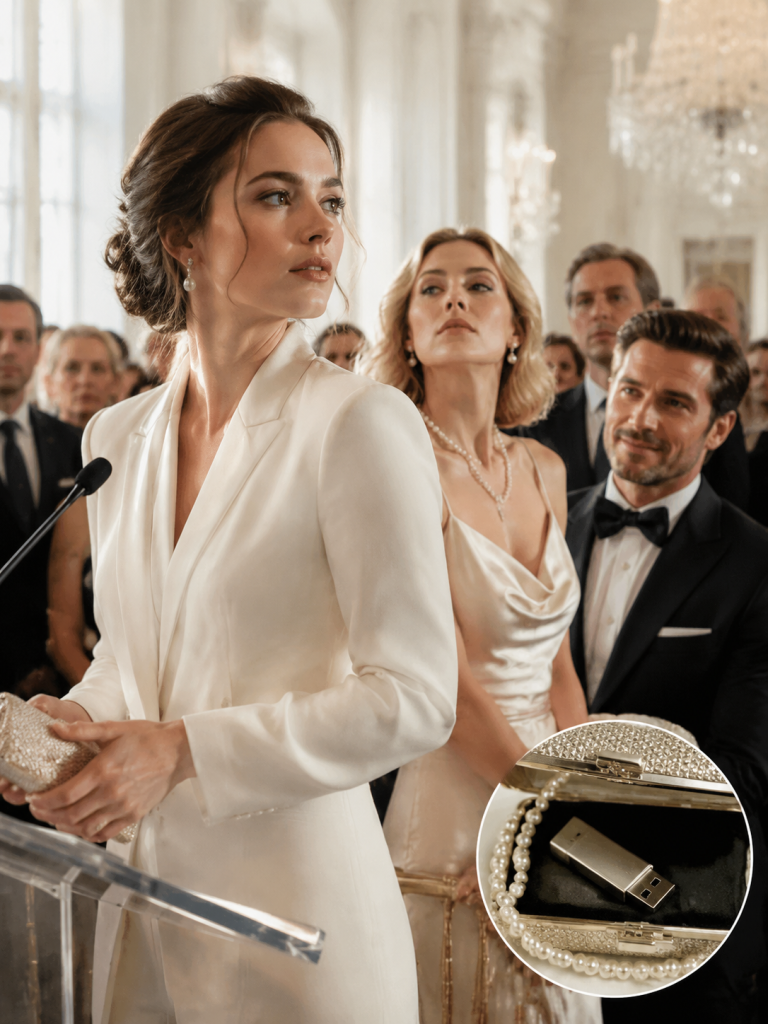
No invitation had been sent and none had been received, because this was not that kind of wedding. Cook County courthouse, before business hours. A judge who had clearly been chosen for his willingness not to make eye contact. Two witnesses I had never met. Daria, standing near the door with the expression of someone who had attended too many of these and had developed a professional equanimity about them.
I wore a dress Daria had chosen. It was well-made and fit precisely and felt nothing like mine.
There were no flowers. No music. The judge read the words with the pace of someone working through a procedure, and when he reached my name, I looked at Damian.
He looked back.
“Do you take Damian Volkov to be your husband?”
I thought about my mother’s hands on my shoulders.
I thought about Danny’s expression at the door.
I thought: *I’m doing this so they don’t have to.*
“I do,” I said.
His “I do” was steady. Everything about him was steady, which I was beginning to understand was not the same as feeling nothing.
When it was over, he signed first. Then handed me the pen.
I wrote *Mara Volkov* in my own handwriting and watched myself disappear into someone else’s story.
That night, I sat on the edge of an enormous bed in a silk robe I hadn’t chosen, looking at rain-dark gardens below a window I didn’t recognize, and I counted my options with the focused attention of a person who has learned that feeling things can come later, after survival is established.
I heard footsteps in the corridor and stood before the door opened.
Damian came in. He stopped just inside the threshold.
He looked at me — at the robe, at the way I had positioned myself standing up, at my hands, which were steady — and then he said the thing I had not prepared myself to hear:
“I won’t touch you.”
I stared at him.
“What?”
“Not tonight. Not any night unless you choose it.”
I searched his face for the trick.
“But the heir—”
“Was said for ears that needed to hear it.” He moved to the window and stood there with his back to the room. “My brother was murdered eight months ago. My father is dead. Men inside my own organization are watching to see whether I’m stable, whether I have roots. A man without a wife looks temporary to them. Unanchored. A liability.”
“So you bought a wife to look stable.”
His jaw shifted. “I bought time.”
“No,” I said. “You bought me. Be accurate.”
He turned.
“Yes,” he said. “I did.”
The honesty arrived without defense, without charm, without the self-justification I had been bracing against.
It was, somehow, the most honest thing a man had said to me in years.
I wrapped my arms around myself. “Why tell me you won’t touch me?”
“Fear makes people stupid. I need you functional, not fractured.”
“That’s the least romantic thing ever said in a bedroom.”
His mouth almost moved.
“Don’t mistake this arrangement for safety,” he said. “You are here because I need you here. The danger around me is real.”
“I understand danger.”
“Not this kind.”
He turned toward the door.
“Damian,” I said.
He stopped.
“If you ever decide that arrangement means something it doesn’t,” I said, “I will make you regret it in ways you haven’t considered.”
One eyebrow lifted.
“You don’t have the skills.”
“Yet.”
The smallest pause.
“Tomorrow morning. Seven o’clock. Basement level.” He opened the door. “Dress for a fall.”
He was not joking about the fall.
—
The man downstairs was named Gregor, built like load-bearing architecture, and possessed of a permanent expression that suggested he had audited humanity and found it wanting. He handed me gloves and told me to fight.
I told him I didn’t know how.
He said that was my problem.
For the next hour, I learned several things about myself: I had terrible footwork, I telegraphed every punch, and I had a threshold for embarrassment that was significantly higher than I had previously understood. I also got back up every time.
Damian was watching from the doorway when Gregor finally released me.
I wiped blood from my lower lip and looked across the room.
“Training to be a spectator?”
“You got up every time,” he said.
“I didn’t see a better alternative.”
“There is always an alternative,” he said. “Getting up anyway is a choice.”
It was the first thing he had said to me that didn’t feel like management.
“Same time tomorrow?” I asked.
“Yes.”
I walked past him toward the stairs.
Training became the shape of my days. Language sessions — his accent’s origin language, which I asked for specifically, and which made Daria look at me with something approaching respect. Long evenings reading through documents Damian brought without explanation, which I learned to interpret as questions he was asking me to answer without asking directly.
I noticed that he drank black coffee and answered messages at hours that suggested he either did not sleep or had restructured his relationship with it. I noticed that people mentioned a man named Constantin Grell the way you mention a storm — not casually, not dramatically, just with a particular care in the voice. I noticed that the locked rooms in the east wing were locked for reasons no one explained, and that the guards who rotated there were never the same guards twice.
I paid attention to all of it.
Because no one thought I would.
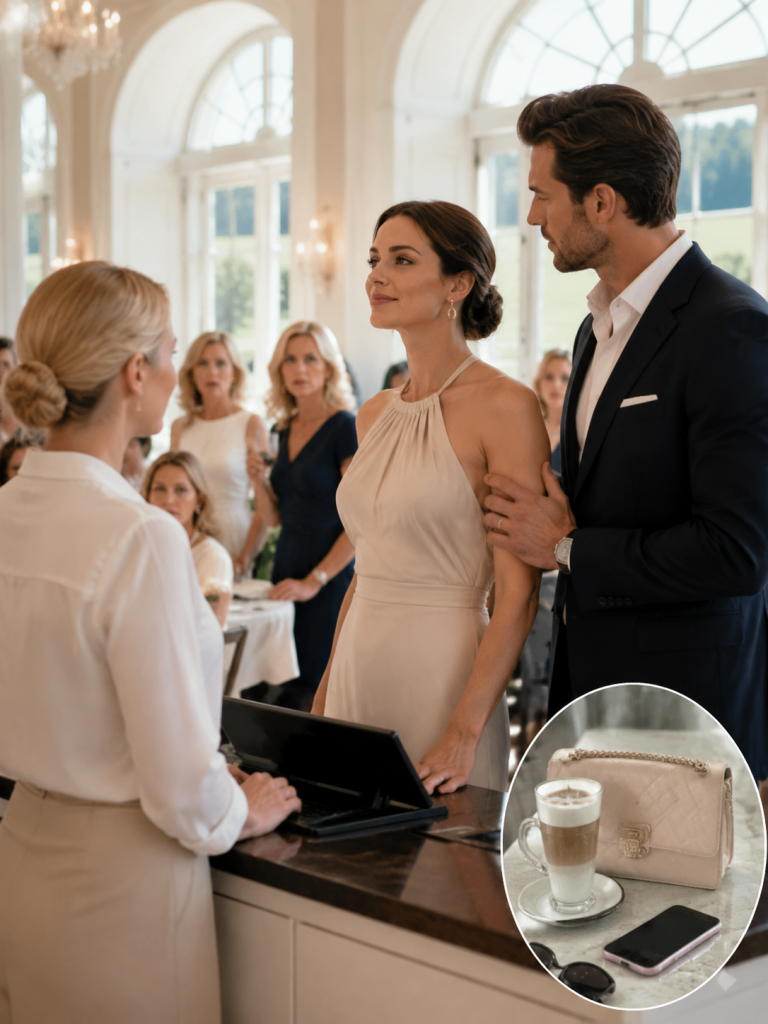
At a charity gala in November — black tie, ballroom, a view of the city that cost something — Damian introduced me as his wife to a room full of people who were evaluating us both with the specific focused politeness of people deciding whether a new arrangement changes their position.
Constantin Grell found us near the bar.
Silver-haired, handsome in the polished way of men who have had years to curate their presentation, with blue eyes that were friendly the way a camera is friendly — watching everything, recording, giving nothing back.
“Damian,” he said warmly. “I hear congratulations are in order.”
Damian’s hand rested at my lower back. Light. A flag.
“Grell,” he said. “This is Mara.”
Grell’s smile turned to me.
“So young,” he said. “You must be very brave or very unlucky.”
Every nearby conversation paused.
I could have stayed quiet. That was what was expected.
“Men usually say unlucky,” I said, “when they want to know whether you understand your own position.”
Silence.
Grell blinked once. Then he laughed — genuinely, surprised.
“Sharp.”
“Specific,” I corrected.
Damian’s hand pressed once at my spine. Warning. Or something else.
Later, in the car, he said: “That was reckless.”
“He was testing whether you’d married someone manageable.”
“And?”
“Now he knows you haven’t.”
Damian was quiet.
“You knew that,” he said.
“I knew it.”
“You weren’t afraid of the answer.”
“I was afraid,” I said. “I just thought the alternative was worse.”
He looked at me across the dark interior of the car.
“Yes,” he said. “It usually is.”
He started bringing me files after that. Not explaining them. Just setting them on the table near where I was reading and going back to his own work. I started annotating them in pencil, lightly, questions or notes in the margins. He never mentioned the annotations. He kept bringing files.
One evening I found a discrepancy in a set of financial records that his own accountant had apparently missed.
“This vendor doesn’t exist,” I said, sliding the paper across his desk. “And the company that does exist was incorporated forty-eight hours before this invoice.”
Damian read in silence.
“My financial director spent three weeks on this.”
“I had two hours and no assumptions.”
He looked up.
“Maybe you should hire differently,” I said.
Something moved in his expression.
“Maybe,” he said.
That evening, Daria made tea and brought it to the study without being asked, which I had come to understand was her version of approval.
—
**PART 3**
The pregnancy was not planned.
Which was both obvious and also, under the circumstances, the least useful observation available.
I was in the kitchen at six in the morning when the nausea arrived, distinct from tiredness, specific in the way that made Daria set down the kettle and look at me with an expression she had not worn before.
“You need a test,” she said.
“No.”
“Yes.”
We argued briefly and she won, which was how most of my arguments with Daria ended.
Three tests later, I sat on the bathroom floor holding the irrefutable evidence of something I did not know how to think about clearly.
Damian found me there.
He came in quietly — he moved quietly by default, which I had stopped noticing and now noticed again — and took one look at my face, then at the tests arranged on the tile, and the color went out of him in a way I hadn’t seen before. Not his controlled stillness. Something underneath that.
“Is this—” He stopped.
“Yes,” I said.
“Are you—” He stopped again.
“I don’t know,” I said honestly. “Ask me a question I can answer.”
He crouched down to my level, which was not a thing I had seen him do before, and looked at me.
“Do you want this?” he asked.
Those four words undid something in my chest.
Not *what does this mean for us.* Not *good, the heir.* Not any of the things I had been bracing for since the word *eventually* on my first day in this house.
*Do you want this.*
My eyes filled, which I was furious about, but I couldn’t stop it.
“I don’t know how to be a mother,” I said.
“I don’t know how to be a father.” His voice was rough at its edges. “I barely know how to be a person in ways that don’t damage things.”
I looked at him.
He looked like what he was: a man who had constructed his entire world around power and was now confronted with something six weeks old that none of his power had any application to.
“We figure it out,” I said. It was more question than statement.
“Yes,” he said. Like a decision.
I cried, which I had been working to avoid, but it turned out the body makes its own schedule. Damian sat beside me on the bathroom floor in a suit that cost more than my college semester, and he stayed there without fixing anything or managing anything or deciding anything on my behalf. He just stayed.
That mattered.
The pregnancy changed the house.
Damian doubled the security detail, which led to four days of sustained conflict that ended when he acknowledged, through his teeth, that some of his reactions were “exceeding what the situation required.” I told him bulletproof glass in a nursery for a child not yet the size of an orange was precisely what I meant by that.
He installed it anyway.
“For when she is the size of an orange,” he said.
He said *she* without thinking. I noted that.
The news moved, as news does in that world — through inference, observation, and the specific attention paid to powerful men’s domestic arrangements. Damian Petrov had a wife. His wife was pregnant. Something was changing in the Volkov succession structure.
Constantin Grell started moving in November.
A warehouse fire near the west side. Three men. A shipment that disappeared between facility and destination in a window too small for coincidence. Damian spent three days in his office, and when he came out he had that particular economy of movement that I had learned meant he was managing something too large to put down.
I came downstairs at two in the morning with one hand on my visible stomach and sat across from him at the desk he hadn’t left in six hours.
“Tell me,” I said.
He looked up.
“Grell.”
“What does he want?”
“Half the operation. Proof that I can be pressured. Proof that I’m soft now.”
“Because of me.”
“Because of what I chose,” he said. “That’s different.”
I looked at him across the desk and felt something that I had been avoiding naming for months.
“You have something on him,” I said. “Not soldiers. Not money. *Something.*”
His jaw shifted.
I waited.
He opened the bottom drawer and removed a folder.
Bank records. Shipping documents. Payment trails to officials, judges, two city council members, a federal agent. Men whose names I had seen at charity galas standing next to their wives in photographs.
“This ends him,” I said.
“And exposes half of what I built.”
“Not if we choose what the exposure looks like.” I turned a page. “You showed me financial structures for months. You let me read the documents and ask questions in the margins. You didn’t do that because you needed a reader.” I looked at him directly. “You were building a plan and waiting to see if I would find the same one.”
He was very still.
“Grell’s allies don’t fear him,” I continued. “They depend on him. If they see documentation that makes that dependency a liability — evidence he kept of *their* arrangements, not just his own — they’ll leave him before you have to move.”
“That’s not how this world operates.”
“That’s why it might work.” I closed the folder. “You need a leverage delivery that protects you as the sender. An anonymous channel. Legal, technically — information to the right investigators, timed before the press.”
Damian looked at me for a long time.
“I have a list,” he said slowly, “of three attorneys who would know how to structure that.”
“Then I need to meet one of them.”
“You’re eight months pregnant.”
“I’m aware. I’m also the only person in this house who has been reading financial structure documents for six months without a horse in the race.” I met his eyes. “Use what you built.”
Before he could answer, the door opened.
Gregor came in without knocking, which never happened.
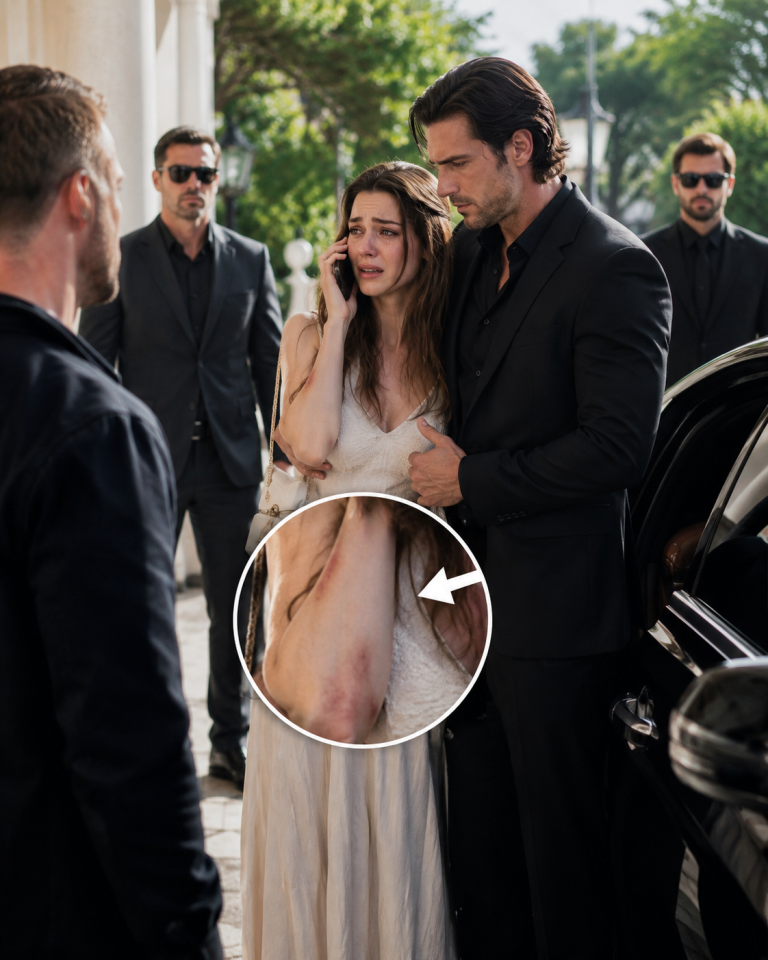
“There’s a man at the perimeter,” he said. “He says his name is David Halden.”
The air left the room.
My father.
Damian’s expression went to ice.
I stood up before anyone could stop me.
—
My father looked old.
That was the first thing. He had aged a decade in eight months, or I had simply stopped filtering him through the lens of familiarity that had let me not-see things my whole life. He was standing in the room Gregor used for exactly this kind of arrival, and he looked small inside his coat, and his eyes were red, and I knew the expression on his face — the wet, pleading openness of it — because I had been reading it since I was twelve years old.
It was the face he wore when he had done something that needed forgiveness before the consequence arrived.
“Mara,” he said.
“You told someone where we were,” I said. Not a question.
He closed his eyes.
“He said he only wanted to—”
“Grell.”
“He called me. I don’t know how he got my number. He said he only wanted to talk to you. That if I told him where you’d gone — it was a temporary location, he said, nobody would get hurt—”
“My child was in this house.”
He flinched.
“I was scared,” he said.
I had heard that sentence so many times across so many situations that it had stopped feeling like a reason and started feeling like a pattern. Fear, as my father used it, was not a feeling. It was an explanation that arrived after the act and was intended to replace judgment of the act.
“You sold me once,” I said. “Now you sold my location.”
“I’m sorry—”
“I know you are.” My voice was very steady. “That’s the part I’ve never doubted. You’re always sorry. You’re sorry every time. And every time you’re sorry, something else has happened that required the apology.”
Damian stood near the doorway. He looked at me, not at my father.
*What do you want done,* his expression said.
I thought about rage. I had enough of it, banked across months and years, that I could have used it. I thought about what my father deserved in the accounting of consequences.
Then I thought about what I wanted to carry.
“He needs treatment,” I said. “Real treatment, not something he can leave in a week. And my mother and Danny need to be financially independent of him — not of us, of him. I don’t want them depending on someone who collapses under pressure and calls it being scared.”
Damian nodded once.
“And you,” I said to my father. “If you come near any of us while you’re still making decisions like this one, I will not protect you from the consequences. Not from his and not from mine.”
My father wept.
I did not.
Gregor took him out.
Daria appeared with tea I hadn’t asked for, which was her way of witnessing without commenting.
Damian came and stood beside me.
“You showed him mercy,” he said.
“I showed myself mercy,” I said. “If I’d let what he did turn me cruel, he would still be owning part of me.”
Damian was quiet for a moment.
Then: “You’re the most clear-headed person I have ever been afraid of.”
I laughed — genuinely, surprised.
He looked at me when I laughed, with an expression so open it was almost alarming.
“I love you,” he said.
The words came out slightly at war with themselves, like they had gotten loose without a plan.
“I don’t know how to do it correctly,” he continued. “I know that. I learned love as a strategy before I learned it as anything else. But what I feel for you is not strategic. It is — inconvenient, and specific, and it doesn’t fit inside any category I was trained to operate in.”
My eyes filled.
“You don’t have to be good at it immediately,” I said.
“I know.”
“But you have to try. And you have to let me tell you when you’re getting it wrong without turning that into a threat.”
“Yes.”
“And the beginning—”
“Was wrong,” he said. “I know what the beginning was. I don’t intend to ever suggest it wasn’t.”
I put my hand in his.
“Then we start from here,” I said. “Both of us choosing.”
“Yes,” he said. “Every day.”
—
We used Grell’s own documents against him.
It took two weeks to structure cleanly. The attorney was exactly who Damian said she would be — unsentimental, precise, and deeply interested in the architecture of how information moved. She helped us build a delivery that arrived as three simultaneous packages: one to federal investigators, one to a financial crimes reporter at a national outlet, one to a sealed evidence repository that would activate on specific triggers.
Grell’s allies received something different — a private accounting of the specific ways their names appeared in his documentation, along with a clear statement that they had forty-eight hours to make their positions understood before the wider release.
Twenty-two of them moved in the first twenty-four hours.
Grell called Damian once.
I was in the room.
“You’re letting your wife run your business now?” His voice was smooth and cold.
Damian looked at me across the desk.
“No,” he said. “I’m running it with her.”
Grell was arrested eleven days later at an airport, attempting a private departure that the federal investigators had known about since the documents arrived. There was no theater in it, no final confrontation, no satisfying violence. Just federal agents and handcuffs and a man who had spent decades believing he had made himself untouchable discovering that paper moved faster than he did.
Damian watched the news footage in silence.
“Does it bother you?” I asked.
“That it ended this way?”
“That it didn’t end the old way.”
He looked at the screen for a moment.
“Part of me still wanted the old way,” he said. “I think that part will always exist.” He turned off the screen. “But it’s not the part I listen to anymore.”
—
Our daughter was born on a Tuesday morning in February, arriving several days early and entirely on her own schedule, during a meeting Damian had been conducting with port logistics managers who evacuated with remarkable speed when Daria appeared at the conference room door.
Labor was long and loud and nothing like what I had read, and at some point I informed Damian that his continued physical presence in the room was entirely his fault, and he said he was aware, and I said he was not allowed to be calm right now, and he said he would try to be less calm, and neither of us was actually arguing.
At four-seventeen in the morning, Petra Volkov was born.
She was eight pounds and completely unimpressed by the world she had arrived in.
Damian held her first. His hands, which had managed contracts and confrontations and consequences across years of a life built on controlled force, held our daughter as though she was the most fragile and significant thing he had ever been trusted with.
He cried.
He was not embarrassed by this.
That, I thought, was its own kind of progress.
“Hello,” he said to her, in a voice I had never heard from him. Low and wondering and entirely undefended.
She stared at him with the unfocused seriousness of someone deciding whether to trust.
“She has your eyes,” I said.
“She has your expression,” he said. “Evaluating everything.”
“Is that a complaint?”
“No,” he said. “It’s the thing I find most extraordinary about you.”
—
The years that followed were not simple.
Damian didn’t transform overnight. He learned fatherhood with the same focused effort he applied to everything — imperfectly, stubbornly, with occasional reversions to control-as-protection that required honest conversations neither of us found comfortable. We had those conversations anyway.
I built a foundation for families caught in debt cycles and predatory arrangements, which was funded in part from assets recovered in the Grell investigation and which employed, among others, a lawyer who had once helped my family understand that they had options my father never told them about. My mother called me when the first family they assisted closed on a home.
I sat in my office and cried for ten minutes and then went back to work.
Damian dismantled the parts of his empire that couldn’t survive sunlight, slowly and with the strategic caution of someone who understood the risks. Some men called him soft. Those men were given clear evidence that they had misread the situation. He kept the things that were legitimate, built more, and hired people whose competence didn’t depend on fear.
Daria retired when Petra was four and Gregor started teaching her chess, which she played with the concentrated aggression of someone who had inherited traits from both sides.
My father completed treatment. He was not the same man afterward, which was the point. He was quieter and more honest about what he didn’t know how to do. We had coffee once a year. He asked about Petra and listened when I answered. He didn’t ask for anything. I thought that might be the best version of him that was available.
Danny became an engineer. He visited on holidays and referred to Damian as “the guy” for three years and then, at Petra’s fifth birthday party, helped Damian build a complicated cardboard fortress under the dining table and emerged having apparently reached some understanding.
He calls him Damian now.
One Sunday evening ten years after the car ride from Columbus, I sat in the backyard watching Petra argue with the boy from next door about the structural integrity of a birdhouse they were building. Her logic was impeccable and her delivery was confident and she had absolutely no concept that the world had been designed to underestimate her.
We had made sure of that.
Damian came out of the house with two coffees and stood beside me.
“She’s going to be terrifying,” he said.
“She already is.”
“In the best way.”
“In the best way,” I agreed.
He handed me the coffee and stood there, and I leaned into him, and we watched our daughter explain load-bearing principles to a boy who was too interested to argue back.
“Do you ever think about the cab ride?” I asked.
His arm tightened around me.
“Yes.”
“Do you regret how it started?”
He was quiet for a moment.
“I regret the harm it did you,” he said. “I will never stop regretting that.” His voice was even and direct. “But I don’t regret that it led here. Which is a distinction I’ve had to think about carefully.”
“Me too,” I said.
We stood like that while Petra’s birdhouse took shape and the evening light moved across the yard and somewhere inside the house Lucas, two years old and not yet aware that anything in the world had ever been difficult, was probably disassembling something Daria had specifically asked him not to.
“She’s going to need to know,” I said.
“Petra.”
“Someday. When she’s old enough to understand that love stories don’t always begin cleanly.”
“What will you tell her?”
I thought about the notebook I had been keeping — not a diary, a record. The truth without softening it.
“I’ll tell her that her father and I began in a place that was wrong,” I said. “And that what happened after — the choosing, the honesty, the work of becoming people worth choosing — that was what made it real.” I looked at him. “And I’ll tell her that who you become matters more than where you started, and that no one gets to decide where your story ends but you.”
Damian looked at me.
The man who had looked at me in that office ten years ago like a calculation had been performed — he was still there, underneath. But he was also this: silver at his temples and lines at the corners of his eyes and a man who had built something worth having out of the ruins of what he used to be.
He bent and kissed my temple.
“The ending is still being written,” he said.
“Every day,” I said.
Across the yard, Petra declared the birdhouse structurally sound and moved on to planning its aesthetic.
Her laugh, when she was pleased with herself, sounded like a door opening onto something good.
We listened to it.