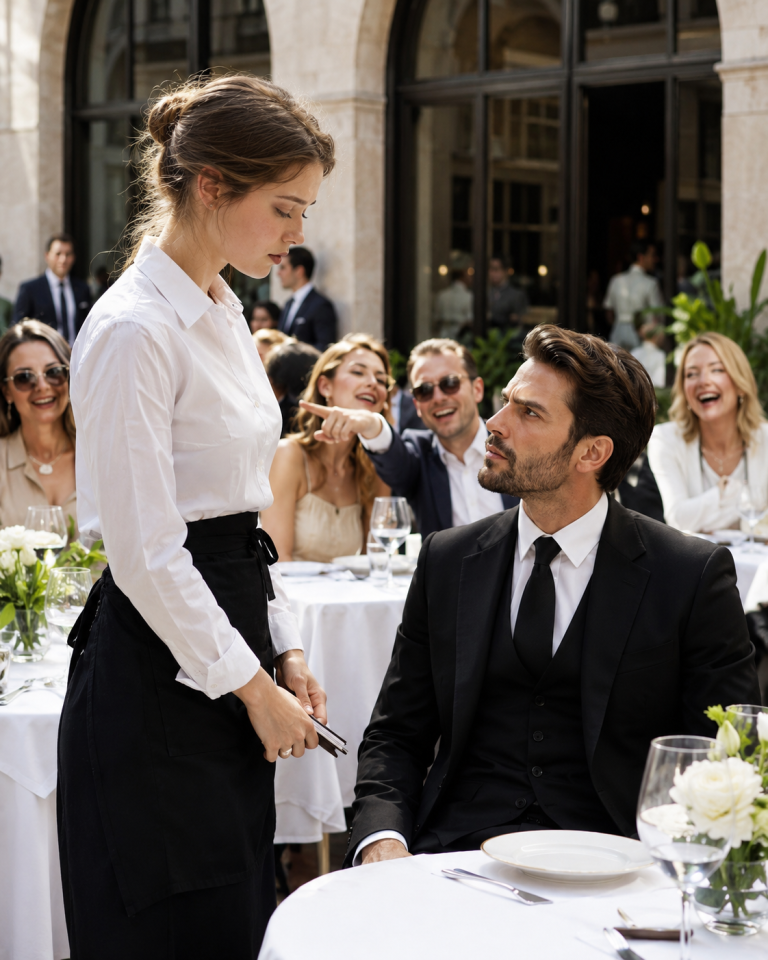
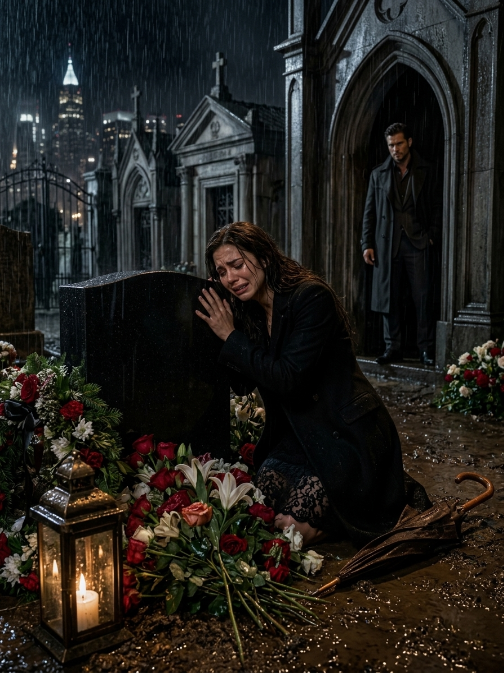
“He Came to the Wrong House,” She Warned the Mafia Boss—Until His Golden-Eyed Twins Revealed Three Years of Betrayal

## PART 1
She had been measuring her life in flour and early mornings for three years when the knock came that wasn’t a knock at all.
She heard the car first. A sound that didn’t belong here—an engine with too much money under it, too precisely maintained, the kind of mechanical confidence that said the driver had never once worried about what something cost. It passed her street. Slowed. Stopped.
Elena Voss was standing at the kitchen sink when she heard the footsteps stop at her gate.
She did not go to the window immediately. She made herself finish washing the mug in her hands, dry it, set it in the cabinet. She gave herself those eight seconds because the children were still asleep upstairs and she needed to be solid before she let herself look.
She looked.
He was standing at the gate with one hand resting on the post, not pushing it open. Just standing there in a dark coat that was too fine for this road, looking at her house the way a man looks at something he expected to find but couldn’t quite believe had been waiting.
Three years had changed him in the way weather changed stone—not the essential structure, but the surface. He looked worn. He looked certain. And he was looking directly at her window with eyes that had already found her through the glass.
Elena stepped back.
She pressed both hands flat against the counter behind her, because the counter was real and solid and for one terrible second the room had tilted.
The children moved upstairs. Mira first—she heard the bare feet crossing the floor with the distinctive directional energy of a child who woke up already having opinions. Then Soren, quieter, the way he always was, the particular silence of a boy who listened before he spoke.
They would be downstairs in minutes.
Elena moved.
She was at the front door before she had decided to be, one hand on the knob. Through the narrow window beside the frame she could see him still at the gate. Not coming forward. Not retreating. She had imagined this moment for three years—had planned it, had rehearsed it, had told herself in a hundred dark mornings what she would say and how her voice would sound when she said it.
None of it was ready.
She opened the door.
He looked at her and his face did something she had not expected: it came undone. Not in a dramatic way. Not with any of the demonstrations of power she had braced for. Just a small, involuntary fracture—the jaw tightening, the breath that didn’t quite arrive properly—the expression of a man who has been traveling toward something for a long time and has not prepared for the moment of arrival.
“Elena.” Her name came out of him like something broken.
She said nothing.
He took one step forward. Then the door behind her swung open wider and she heard Mira—three years old, utterly fearless, always first—pad out onto the step beside her mother.
Elena watched his face.
She watched the exact moment it happened.
Mira looked up at the stranger with the natural curiosity of a child who had never been taught yet that the world was dangerous. His gaze dropped to her. And then—
The particular amber of his eyes. The shade she had spent three years being startled by every morning.
He went completely still.
Not frozen with shock. Still the way deep water is still—everything contained, nothing on the surface, but a current moving underneath that had no name yet.
Soren appeared beside his sister. Smaller. Quieter. He looked at the stranger with the measuring attention that had been his from the very first week—the look that gathered information before it offered trust.
Dark hair. Patient eyes. A stillness already too old for a three-year-old.
The man at the gate looked from one child to the other, and something moved through his face that Elena had never seen there before.
He opened his mouth.
She spoke first.
“They don’t know you,” she said. Her voice came out steadier than her body felt. “And you came to the wrong house.”
The lie was very specific. She had always intended it to be specific—to make a door she could close, a version of reality the children could hold without being crushed by it.
He looked at her.
“Elena,” he said, and this time the word was barely sound at all. “Those are—”
“Go inside,” she said to the children.
Mira squinted at the stranger with the profound dissatisfaction of someone being denied information. Soren didn’t move immediately. He looked at the man at the gate for one more moment—that contained, assessing look—and then looked at his mother, and something in what he saw made him take his sister’s hand and go.
The door closed between them.
Elena descended the two porch steps and walked to the gate and stopped on her side of it.
“You shouldn’t be here,” she said.
Three years. She had earned the right to say those words without apology. Three years of flour-dusted mornings and clinic visits and fever nights and birthday cakes she made alone and never once called him. Three years of looking at Mira’s eyes and Soren’s stillness and carrying the weight of what they represented without bending.
“I looked for you,” he said.
“You found me.”
She held the gate between them. “Now go.”
She walked back up the steps and inside and closed the door.
She locked it.
Stood with her back against the wood and her eyes closed and her children watching her from the kitchen doorway.
“Mama,” Mira said. “Why is the man still at the gate?”
Elena opened her eyes.
She turned around and looked through the glass.
He was still there. He had not moved. He stood at the gate with his hands at his sides, in the drizzling morning, with nothing on his face that looked like pride or anger or the kind of dangerous entitlement she had spent three years bracing for.
He looked like a man who had finally arrived somewhere and found he had no idea what to do with his own presence.
Soren came to stand beside her, pressed his shoulder against her hip, and looked out the window.
“He has eyes like Mira,” he said.
He said it simply. The way children state things they observe without yet knowing their full weight.
Elena pressed her hand to the glass and did not answer.
—
## PART 2
She did not sleep that night.
The morning after his arrival, she stood at the kitchen window in the dark before the children woke and watched the gate. He was not there yet. He had left in the evening—she’d watched through the curtain—but with a slowness that contained its own message. Not storming away. Not calculating. Just leaving, like a man setting something down carefully rather than dropping it.
He came back at six.
He sat on the low wall across from her house, in the mist, without calling for her. He had coffee in one hand and he drank it looking at nothing in particular and waited.
Mira found him before noon.
Elena had turned away for five minutes to manage a spilled bottle of milk and the noise that followed, and when she looked back through the window Mira was at the gate talking to the man across the road with the complete openness of a child who had not yet understood that some conversations were her mother’s to authorize first.
Elena was outside in seconds.
“Inside,” she said.
Mira looked deeply wronged by this. “But I was just—”
“Inside.”
She watched her daughter retreat, then turned back to find him standing now, having crossed at some point without her noticing, close enough that the gate was between them but not much else.
“I’m not here to take anything,” he said.
“You were never here before,” Elena said. “You don’t get to decide what that means.”
His jaw tightened. “I know.”
“Do you know why you weren’t here?”
“Yes.”
Something in the way he said it stopped her.
Not defensive. Not justifying. The kind of yes that carries a long distance in it.
“I found out what happened,” he said. “What really happened that night.”
Elena felt the ground tilt in a way that had nothing to do with the uneven road.
“I know what I saw.”
“I know what you saw too.” He looked at her steadily. “I need you to know it wasn’t what it was made to look like.”
She stared at him.
Everything she had organized her life around—every decision made downstream of that particular night, that door opening, that bedroom scene—pressed against her ribs from the inside like something that had been compressed too long.
“My sister,” she said.
“Was paid.” His voice was level. “By a family that needed me compromised. They used her. Arranged the timing. Arranged what you would find. Arranged that you’d find it at exactly the right moment.”
The morning air was cold. She couldn’t feel her hands.
“That’s convenient,” she said.
“Yes.” He looked at her without flinching. “I know how it sounds.”
“Then why are you telling me.”
“Because your children deserve to know their father was not who you had to believe I was.” A pause. “And because you deserve to know you didn’t leave over a lie.”
Elena pressed her hand flat against the gate and felt the cold metal against her palm.
“She’s gone,” he said quietly. “The family that arranged it is gone. I spent eighteen months making sure of it.”
She looked at him. At the scar on his jaw she had never asked about. At the exhaustion he had given up pretending not to carry.
“You expect me to believe you,” she said.
“No,” he said simply. “I expect you to hate hearing it.”
She went back inside.
She did not tell him to leave.
That silence was its own answer. He stayed on the wall. The morning passed. By evening her daughter had learned his name without being told anything, by the direct route of asking him directly, and her son had sat on the porch step in visible proximity to him for forty minutes without speaking.
Elena watched all of it from the kitchen and did not intervene.
Because her children were already beginning to recognize something she had been refusing to look at.
And because somewhere in her chest, behind three years of careful architecture, something had just shifted that she couldn’t shift back.
—
## PART 3
His name was Cael Varro.
The town that had sheltered Elena for three years—Millhaven, population eight hundred, one road, a bakery, a clinic, a church whose bell was heard by no one important—learned this in the gradual way small places learned everything. By observation. By the hardware store owner who watched him carry two sacks of flour to the bakery without being asked. By the clinic doctor who adjusted to his presence near Mira and Soren’s checkups with the practical acceptance of a man who did not ask for details that weren’t his. By the woman who ran the bakery, Bette, who had hired Elena on sight three years ago and knew more than she ever mentioned, and who watched Cael Varro the way you watched the first warm day after a long winter—aware that warmth could deceive you, but noting it anyway.
He rented a room from a family on the far edge of town. No guards. No vehicles beyond the one car he’d arrived in. He walked to the bakery every morning at the same time, bought the same coffee, and sat at the outside table when the weather allowed, which it did not reliably.
He did not attempt to enter Elena’s house.
He did not push at the children beyond whatever they offered first.
That was the thing Elena watched most carefully—how he behaved when she wasn’t managing him. A man performing patience behaved differently when he thought no one measured it. Cael did not perform. He sat with Mira when she approached and answered her questions with a direct honesty that occasionally made Elena wince because Mira’s questions had no filters. He waited when Soren’s silences required waiting. He did not rush toward either of them, and he did not retreat from them either.
He was simply present.
Elena sat with that fact and tried to find a comfortable place to put it. There wasn’t one.
She told him the first real thing on the fifth evening. She had brought him tea—not as softening, but because standing at the gate with empty hands felt worse than standing there with something to hold—and he had taken it with both hands and said nothing.
“Tell me about the sedative,” she said.
His expression shifted. “Who told you—”
“No one. I started thinking about that night differently after you said what you said.” She looked at him. “Your voice. The way your eyes looked when the door opened. I had filed that away as guilt, but it wasn’t guilt, was it.”
He was quiet for a moment.
“No. It was horror.” He looked at his hands. “And confusion. I had pieces of the evening but not all of it. I didn’t understand until weeks later what I had been given.”
“In your drink.”
“Yes.”
She had thought, standing in front of the mirror in the service corridor of the estate with a bag over her shoulder and her mother’s locket in her pocket, that she understood what had happened completely. She had held that understanding like a weapon for three years. The certainty of it.
“Your sister was placed,” he said carefully. “Not reluctantly. She understood the arrangement.”
“She wanted me gone.”
He didn’t answer immediately.
“She wanted what you had,” he said finally. “That’s not the same thing. But she made a choice about what to do with it.”
Elena looked past him at the street. A light had come on across the road. The hardware store owner was locking up.
“Where is she now.”
The pause was its own answer.
She had known, she supposed. Had known from the specific way he’d said *gone* three days ago—not the word you used for someone who had moved away or been quietly exiled, but the word you used when there was no address to trace.
“I’m not going to pretend I should feel something about that,” she said.
“I wouldn’t ask you to.”
She went back inside.
But she did not sleep easily, because something that had been solid in her grief for three years had become porous, and porousness was its own kind of suffering—the suffering of a wound that can’t decide whether it’s healing or reopening.
—
The thing that broke it open was Soren.
Three weeks after Cael’s arrival, Mira had developed an ear infection that kept the whole house awake for two nights running, and on the second night, at two in the morning, she climbed into Elena’s bed and stayed there. Soren, who slept lightly even on good nights, came in from his room and sat on the foot of the mattress and watched his mother manage his sister with the observational gravity he brought to everything.
After Mira finally fell back to sleep, in the particular heavy breathing of a child past fever, Soren looked at his mother.
“He came because of us,” he said.
Elena’s throat tightened.
“What makes you think that.”
“Because he looks at us the way you look at us.” Soren was three years old. He said it with the simple directness of someone who had not yet learned that this kind of observation was supposed to wait for adulthood. “Like we’re the most important thing in the room.”
Elena pressed her lips together.
“Go back to sleep,” she said quietly.
But she lay awake for a long time after.
She called Cael’s number just before dawn—the number she had for the children, the one he’d given her in the first week with the explicit statement that it was only for emergencies involving Mira or Soren and she was free to ignore it otherwise. She called it now because Mira’s fever had climbed again just past three and she had already called the clinic and been told the on-call doctor was handling two other cases and would arrive when he could.
He picked up on the second ring.
He was there in eight minutes.
He took Mira from her arms with the unhesitating efficiency of someone who had decided that competence was the only acceptable response here, and she let him, and then spent three seconds surprised at herself for letting him. He held the child and walked, which was a thing Elena had learned helped with fever discomfort, and he spoke very quietly to Mira the whole time—not anything important, just a low continuous calm that a sick child could borrow.
By the time the doctor arrived, Mira’s temperature had dropped by half a degree. Not from the walking. From contact, the doctor said. From not being alone with it.
When Elena thanked him, Cael shook his head.
“Don’t,” he said.
She looked at him.
“That’s not a favor,” he said. “That’s just being here.”
She understood the difference he meant.
Favors could be repaid and thereby concluded. Being here was not a transaction. It had no invoice. It was simply presence sustained past the point where it was convenient.
He had been present for three weeks. Quietly. Without demanding anything from it.
She sat down at her kitchen table after the doctor left and Mira was settled and Soren had finally gone back to sleep, and she put her head in her hands and stayed there for a long time.
—
She tested him in increments that she recognized as tests even while she administered them.
She asked him questions he couldn’t have rehearsed—details from that night, names of people she had half-remembered being near him, specific moments she had filed away and never spoken about. He answered without embellishment. When he didn’t know something, he said he didn’t know. When her anger surfaced inside a question, he didn’t deflect from it.
She told him once, in the middle of an ordinary afternoon while the children played in the yard, that she wasn’t sure she could ever fully believe him.
He said: “You don’t have to.”
She waited for the rest of the sentence. The qualifier. The *but*.
There wasn’t one.
She had spent three years with the armor of perfect certainty—the knowledge that she had seen what she had seen and therefore the anger was clean and the decision to leave had been just. Cael’s presence was eroding the certainty without replacing it with anything clean. What he was offering instead was something more complicated and less comfortable: the possibility that she had been deceived, that her grief had been engineered, that the life she had built in the aftermath of that night was the correct response to the wrong event.
That possibility was harder to carry than the original wound.
Because at least the wound had made sense.
She said this to him, eventually. Not softened. Exactly as it sat.
He listened the way he had learned to listen. Without rushing it.
Then he said: “Your pain doesn’t become less real if the cause wasn’t what you thought.”
She stared at him.
“You still lost three years. You still raised them alone. You still carried everything alone. That happened. Me not having chosen it doesn’t undo any of it.”
She turned away, because the inside of her chest was doing something she hadn’t decided to permit.
“Then what are you asking for,” she said.
“Time,” he said. “Whatever you’ll give.”
—
By the time summer moved through Millhaven, Cael had become part of its furniture in the way that takes longer to notice than to accomplish.
Bette from the bakery had put him to work during a busy Saturday three months in—not asked, simply handed him an apron in the manner of a woman who equated usefulness with trustworthiness—and he had complied with an expression of confusion that Soren later described as funnier than anything he’d seen. He was terrible at the delicate parts. He was fine at the heavy lifting. Bette kept him.
He helped the hardware store owner with a fence repair during the first autumn storm. He arrived at the clinic once with Soren’s bookshelf, which the boy had requested moved to a new wall, and built the additional shelving Soren needed without being asked but also without making a production of it.
He sat with the children in the evenings when Elena invited it, which she did more often as the months moved. He told Mira stories that involved more plot complication and fewer redemption arcs than any book she owned, which she found deeply satisfying. He played the long slow games with Soren—strategy games, puzzle variations, anything requiring patience—with an attention that Soren extended back to him by increment.
Soren called him Cael first. Then one evening, home late from the bakery, Elena heard Mira from the upstairs hallway saying *Papa* with the casual certainty of a child who had decided something and implemented it, and the sound of it stopped her on the stairs.
She heard Cael’s voice, very quiet.
Then Mira, chattering on about something entirely unrelated.
Elena went back downstairs and stood in the kitchen with both hands around the counter edge and breathed until the tightness in her throat resolved itself into something she could carry.
She did not correct Mira.
—
The conversation she had been delaying arrived on its own terms on an October evening when the children were asleep and the rain had found its autumn rhythm against the windows.
She was at the kitchen table with her hands around a cup of tea going cold. Cael was in the chair across from her—he had been there for an hour, they had been talking about ordinary things, and then the ordinary things had run out and what was underneath them was waiting.
“I’m still angry,” she said.
“I know.”
“Not at you, exactly. But not not at you either.”
“I know.”
She looked at him. “That’s not an easy thing to live beside.”
“No,” he agreed. “It isn’t.”
She turned the cup in her hands. Outside, rain tapped at the glass with the focused consistency of something that was not going to stop.
“My sister,” she said. “I want to understand that part. What you told me. I don’t want to understand it because it helps me forgive her. I want to understand it because—” She paused. “Because Mira and Soren are going to have questions one day. About her. About where she is. And I need to be able to hold that truth in a way that doesn’t require lying to them.”
He looked at her steadily.
“Envy,” he said. “That’s what I think it was, at its origin. Whether it became something colder later—by the time she agreed to what she agreed to, whatever her reasons had begun as had long since become a choice.”
“She would have known what would happen to her.”
“Yes.”
“She did it anyway.”
“Yes.”
Elena sat with that. The room was very quiet. After a while she said: “I spent a long time being angry at myself for not seeing it.”
“You trusted her.”
“That’s what I mean.”
He leaned forward slightly. “Trusting people who betray you isn’t a failure. It’s the correct thing to do with people you love, until the evidence says otherwise. She made sure the evidence didn’t exist until it was too late.”
Elena’s throat ached.
“I would have given her anything she asked for,” she said.
“I know you would have.”
“That’s the part that doesn’t stop hurting.”
He did not tell her it would. He didn’t offer her a timeline. He simply nodded, and that acknowledgment—plain, undressed—was somehow more accurate than comfort would have been.
She looked at him across the table in her small kitchen in the town she had chosen because it was the kind of place power forgot to notice. The man the world knew as dangerous and relentless and capable of things she understood better now than she had wanted to. The man her children were beginning to trust in the unreserved way of children who hadn’t yet learned to be strategic about love.
“Do you want to stay,” she said. “In Millhaven.”
He looked at her.
“I want to be where they are,” he said. “Where you are, if you’ll have that.”
“It wouldn’t be what it was,” she said.
“No.”
“The first version of this—” She paused. “I was younger. I didn’t know what I was trusting. This would be different.”
“Yes.”
“Harder, in some ways.”
“I know.”
“Because I know more now,” she said. “About what you are. The full version of it. I’ve seen enough of your world to understand what it is I’d be choosing.”
“And do you understand it?” he asked quietly.
She thought about the phone calls he stepped outside to take, and the way his voice changed register and then changed back. About the day three months ago when he’d received a message and something had moved across his face before he controlled it, and she had not asked, and he had not explained, and they had both understood that there were parts of his life that would remain adjacent rather than shared.
“Enough,” she said.
He was very still.
“I’m not ready to use the word *forgiveness*,” she said. “I may never be. But I’ve stopped needing you to carry the version of things I thought was true. That’s different.”
“It’s enough,” he said.
She shook her head. “I don’t know yet what it is. But I know I’m done spending energy on keeping you out.”
She stood. He stood.
She walked around the table and stopped in front of him and looked at him at close range for the first time without the gate between them, without anger sharpening her peripheral vision, without the practiced distance she had maintained as survival.
His eyes on hers. The amber she saw every morning in Mira. The patience she watched Soren inherit.
She reached up and put her hand to his face—her palm against his jaw—and felt the tension in him, held with enormous care, a man who had learned to wait.
“One thing at a time,” she said.
He put his hand over hers. Just that. Just the weight of it.
“Yes,” he said.
—
Spring came.
Mira lost a tooth and conducted the associated negotiations with the tooth fairy at a volume that woke the entire house. Soren finished a puzzle of three hundred pieces over four days with the focused concentration of someone who understood that patience was its own form of power.
Cael built them a swing in the yard on a Saturday, with the hardware store owner’s assistance and considerably more cursing than the occasion warranted, and Soren sat with him the whole time and offered observations that were occasionally correct and always noted.
Elena watched from the kitchen window, her hands around a coffee she’d let go cold.
She had stopped waiting for the other shoe to drop. Not because she had decided to trust the floor—you didn’t fully trust a floor that had given way once—but because standing indefinitely, waiting for the collapse, was its own kind of damage. At some point you chose to walk, knowing the risk, because the alternative was not to move.
One evening near the end of summer, all four of them sat on the porch as the light fell behind the mountains and painted the road in warm amber. Mira was explaining her theory about why swallows flew in pairs—she had a theory, she had several theories, she had been born with theories about everything—and Soren was reading beside Cael’s arm, pressed gently against him in the way he pressed against the things he trusted.
Elena looked at the sky and thought about the clinic in the city where her children had been born. The storm that night. The solitary weight of two small bodies in her arms. The choice she had made the following morning to get up, feed them, and continue.
Cael said something quietly to Mira that made her laugh, a sound as sharp and present as a bell.
Elena looked at the three of them. Then at him specifically—the man the world kept files on and told cautionary tales about, sitting on a porch in a town that barely appeared on maps, arguing with her daughter about swallow aerodynamics.
He looked over and caught her watching.
She didn’t look away.
“What?” he said.
“Nothing,” she said.
But she was almost smiling, and he saw it, and something settled in his expression that she had never seen there before and recognized now as peace—not the peace of a man who had won something, but the peace of a man who had arrived somewhere he hadn’t known he needed to be.
She looked back at the sky.
The first love had been faith: believing without evidence, offering herself whole.
The second love was different. It had scar tissue in it. It had knowledge and calculation and three years of solitary mornings. It had the specific weight of choosing something you understood fully, including its costs.
That made it harder. It also made it hers in a way the first had not quite been.
They were not the people they had been before the night the bedroom door opened. That was true and permanent. She had stopped asking for those people back.
What they were now—scarred, chosen, complicated, present—was something neither of them could have built deliberately. It had grown in the spaces between locked doors and rainy porches and small hands offering half a biscuit.
It belonged to both of them.
Mira interrupted her thoughts by climbing into her lap without preamble, the way she climbed into everything she decided to occupy. She settled against Elena’s chest with the comfortable confidence of a child who had never doubted the reliability of that particular place in the world.
“Tell the one about the wolf,” she said.
“You’ve heard it forty times,” Elena said.
“I know,” Mira said. “That’s why I want it.”
Elena looked at Soren, who had looked up from his book.
He raised one eyebrow, which was a thing he had learned from his father and deployed with great precision.
“Fine,” Elena said.
And when she began, her voice went out into the street and the mountains and the small ordinary evening, and the story was the same one it had always been—about the wolf who lost because he underestimated what mothers were capable of—but it had a different weight now.
Because it was no longer only a story she told to keep fear at a distance.
It was a story she told because she was here. Because she had built something from the wreckage. Because the people she loved were around her on this porch, and the porch was theirs, and the story, like everything else in her life that mattered, had been earned.
She told it to the end.
Then the light went finally and fully behind the mountains, and the town settled into its good ordinary dark, and they sat together in it.
Not healed of everything. Not promised anything that reality couldn’t take back.
But present.
Together.
Choosing this, every single day, on purpose.
And for people who had survived what they had survived—the betrayal and the exile and the long years of solitude and the slow difficult work of coming back—that was not a small thing.
That was everything.