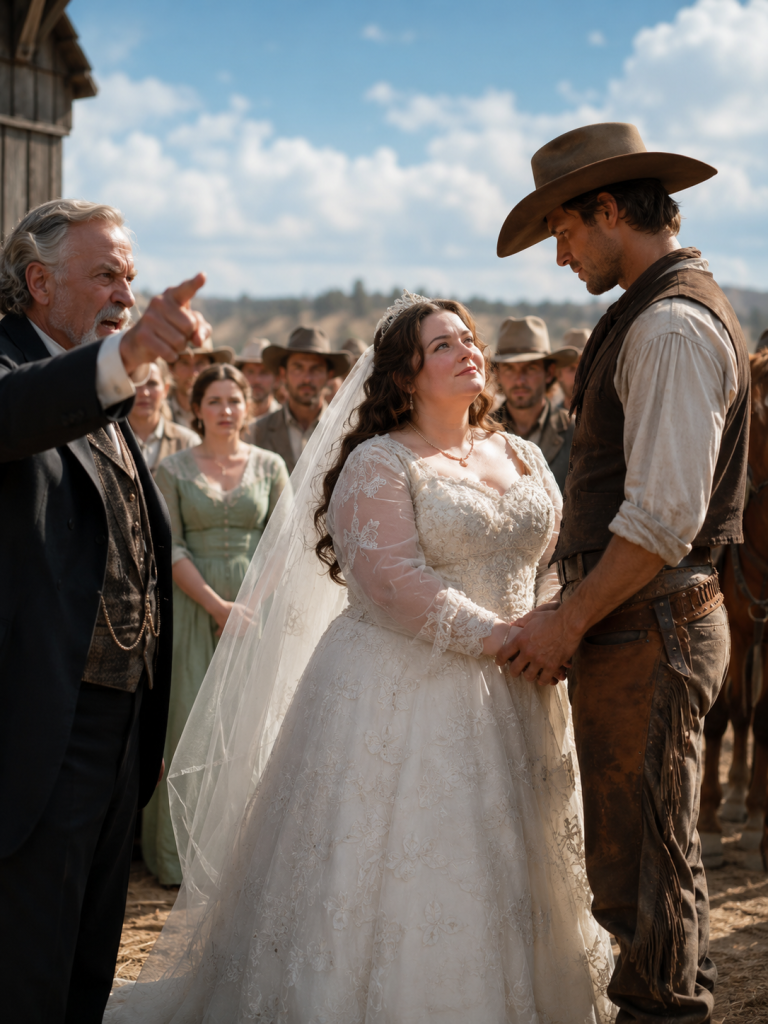
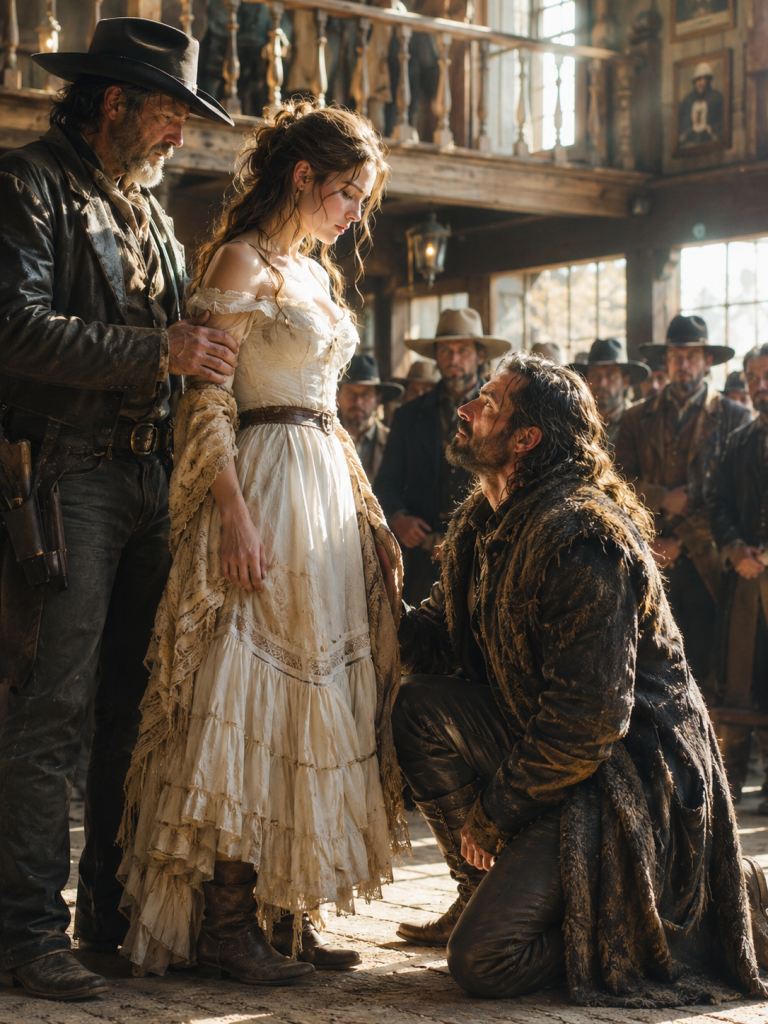
A THE MOST WANTED OUTLAW IN THE TERRITORY RODE INTO TOWN AND FOUND A MOB SHAVING A CRYING SIX-YEAR-OLD’S HEAD IN THE SNOW

PART 1
The wind came first.
It rolled down out of the mountains like a warning nobody in Hollow Bend cared to hear, dragging thin blades of snow across the frozen road and hissing against the wooden storefronts. Winter had settled in early that year, and most travelers with any sense had already given the town a wide berth once the storms began closing the passes. But Wade Colton was not most men, and common sense had stopped governing his life long before the first wanted poster ever carried his name across three territories.
He rode into Hollow Bend with the particular stillness of a man long used to being watched.
His horse moved slow through the storm, hooves crunching against packed snow. Wade sat easy in the saddle, shoulders relaxed under a weathered coat, hands loose near the reins, eyes quiet beneath a hat that had seen too many territories and too many hard seasons to count. The town didn’t notice him right away. Its attention sat fixed somewhere else entirely, and Wade clocked that fact before he’d even finished crossing the first row of buildings.
He knew the feel of a town when something in it had gone wrong.
Frontier settlements ran on their own rhythms. In winter, streets usually went half dead by late afternoon — men retreating into saloons or feed stores, women keeping close to their stoves, children vanishing indoors where somebody could keep them warm. But Hollow Bend was crowded in a way that felt unnatural. Near half the town stood out in the cold, drawn toward the center of the street by something stronger than weather.
Wade slowed his horse.
A low murmur drifted over the wind — angry voices, interested voices, not shocked, not frightened. The particular sound of people gathered not to stop cruelty, but to witness it up close.
He tied his horse outside the general store, stepped down into the snow, pulled his coat tighter around his shoulders. Nobody paid him much mind. That suited him fine. A wanted man learned early that silence kept him safer than introductions ever could, and invisibility served him better than pride.
He moved toward the crowd.
The townspeople stood in a broad circle with the hard, expectant posture of spectators. Men with stiff faces. Women with narrow mouths. A few children tucked close against their mothers’ skirts, peering out with frightened curiosity. None of them looked ready to step in. Whatever had drawn them there, they’d already decided their part in it was to watch.
Then Wade heard it.
A child, crying. Not the sharp theatrical crying of a spoiled kid denied a sweet, but the small, broken sobs of someone genuinely afraid. That sound reshaped his attention entirely. He stepped between two farmers at the circle’s edge and got his first clear look at its center.
A little girl stood barefoot in the snow.
She couldn’t have been older than six. Her thin dress offered next to no protection from the cold. Her cheeks were wet with tears. Her fair hair — what remained of it — had been hacked into jagged, uneven strips, one whole side of her scalp already shaved bare. Behind her sat a plain wooden chair, and beside the chair stood a tall, hard-faced woman holding a pair of heavy shears.
For a moment, Wade didn’t move.
He’d seen hanging trees and battlefield trenches. Seen men gutted over poker hands, trains robbed, lawmen shot down through closed doors, the whole ugly theater of frontier justice played out in more towns than he could count anymore. But something about a little girl standing alone in the snow while respectable people watched her suffer struck him differently. Not because it outdid everything else he’d seen — because it was smaller. Meaner. Colder. The particular kind of cruelty that hides behind morality and calls itself righteousness.
The woman with the shears stepped forward, her face long and severe, like weathered wood carved into permanent disapproval.
“Hold still, girl,” she snapped.
The child shook her head weakly. “I didn’t do anything.”
“Your father did.”
A murmur of agreement rippled through the crowd.
Wade’s eyes shifted, not to the girl, but to the people ringed around her. None of them looked ashamed. A few looked satisfied. Others wore the particular expression of people who’d talked themselves into believing that cruelty, once made communal enough, turned into virtue.
The woman grabbed the child by the shoulder and shoved her back into the chair. “You carry the shame of your blood,” she announced, loud enough for the whole street to hear.
The girl’s voice cracked. “Please. I want my papa.”
Something cold moved through Wade’s stomach. He stayed still and listened. That had been the first thing life ever taught him, and the last useful skill it had left him — listen before you move, watch before you choose. It kept men alive. It also kept innocent people from getting hurt by the wrong kind of interference at the wrong moment.
The shears snapped open with a metallic click. Another lock of pale hair dropped into the snow.
A man beside Wade leaned toward his companion. “That Vance girl,” he muttered. “Serves her right. Her father was a thief.”
The other spat into the street. “Stole from half this town before Sheriff Pike hanged him.”
Wade’s gaze sharpened. *Hanged him.*
The girl’s sobs went on while the woman behind her kept cutting, taking what remained of the child’s hair in fistfuls.
“Let this be a lesson,” the woman said, raising her voice like she was addressing a congregation instead of a mob, “to all who bring shame down on Hollow Bend.”
The child squeezed her eyes shut as snowflakes landed against the raw skin of her scalp.
“I miss my papa,” she whispered.
That was when something final shifted loose inside Wade Colton. Not rage — not yet. Rage was hot, clumsy, mostly useless. What moved through him ran older than rage and a good deal harder. A line getting crossed. A decision assembling itself out of memory, instinct, and a tiredness so deep it had once convinced him he was through stepping in for anybody.
Behind him came the sound of horses. He didn’t turn his head, but he noted it — two riders, too quiet, too deliberate. They didn’t belong to the town, and they weren’t passing through harmlessly either. Wade knew the shape of bounty hunters the way some men knew the shape of coming rain. If they’d trailed him here, and if they made him in this crowd, the situation wasn’t going to stay contained much longer.
Still. The child came first.
He shifted slightly, caught a clearer look at the riders down at the far end of the street. One of them, broad-shouldered in a dark duster, stepped down off his horse and adjusted the rifle across his back. Even at that distance, Wade knew him.
Cyrus Vale.
Patient, relentless Cyrus Vale, who’d been circling Wade’s trail on and off for the better part of a year now.
*Wonderful timing,* Wade thought, without a trace of humor.
The shears snapped again. The woman — Mrs. Abernathy, someone in the crowd had called her — tilted the girl’s chin up and said, “You’ll remember this day. You’ll remember what happens when a Vance brings shame down on Hollow Bend.”
The child’s voice shook. “My papa didn’t steal.”
The woman slapped the back of the chair hard enough to make the girl flinch. “Silence.”
Wade’s jaw tightened. He saw then what he’d maybe known from the start — nobody in that crowd was going to stop this. Not the men muttering approval. Not the women looking away and then back again. Not the sheriff, wherever he’d gotten to. Not one decent citizen waiting on the right moment to finally get brave. The right moment had come and gone and come around again, and every last one of them had already made their choice.
He stepped forward.
Not dramatically. Not with any swagger people would later like to remember. Just one quiet step into the open, then another, while the last of the girl’s hair fell into the snow and the ring of townspeople slowly caught on that a stranger had decided to cross the line they’d all pretended wasn’t there.
Mrs. Abernathy shoved the girl off the chair. The child stumbled, dropped to her knees in the snow, and the cruelest of the onlookers laughed.
“Look at her now,” somebody called out. “Like a plucked chicken.”
PART 2
The laughter had barely died when Wade Colton stepped into the center of the circle.
His boots crunched softly in the snow. Nothing more. No grand speech, no hand drifting to his revolver — just a tall stranger walking toward a terrified child.
Mrs. Abernathy frowned. “This is town business.”
Wade ignored her. He stopped beside the little girl, shrugged off his heavy wool coat, and draped it around her trembling shoulders. It swallowed her whole. She looked up at him with wide blue eyes.
“You’re cold,” he said quietly.
She nodded. “My feet hurt.”
He looked down — bare feet, already going red against the snow. Without hesitation he crouched and pulled off his own boots. Someone in the crowd gasped. He set them gently over her tiny feet.
“They’ll be big on you.”
“Thank you,” she whispered.
He stood, and only then looked at Mrs. Abernathy. “She’ll catch her death.”
“That isn’t your concern.”
“Became my concern the second grown people started punishing a six-year-old.”
Murmurs moved through the crowd. Mrs. Abernathy lifted her chin. “Her father was Elias Vance.”
“I heard.”
“He robbed this town.”
“So you shaved his daughter.”
“She bears his shame.”
Wade’s gray eyes went colder. “No.” The single word carried farther than shouting would have. “She bears yours.”
Silence dropped over the street.
“How dare—”
“You hanged a man.”
“I did not.”
“You watched.” Her face paled. “You watched him die.” He glanced around the ring of onlookers. “So did the rest of you.” Nobody answered, because nobody could.
PART 3
For a long moment after Mrs. Abernathy shoved the girl from the chair, nobody in Hollow Bend moved at all. The wind kept working at the loose hair scattered across the snow, lifting strands of it a few inches and setting them down again, as if even the weather couldn’t decide what to make of what it was watching. Wade knelt in the cold beside Josie and let her lean her weight into him, and for the space of a few breaths the only sound in the street was her ragged crying and the creak of the general store’s sign swinging on its chains overhead.
Sheriff Walter Pike finally pushed through the crowd. “What seems to be the trouble here?”
Mrs. Abernathy pointed. “This drifter is interfering.”
The sheriff looked at Wade. Recognition flickered across his face, then vanished just as fast.
“Sir,” Pike said carefully, “perhaps you ought to move along.”
Wade didn’t. Instead he asked, “Did Elias Vance get a trial?”
Pike hesitated. “Yes.”
“A jury?”
Another hesitation. “The town council.”
“So no jury.”
Pike said nothing.
“Evidence?”
“He confessed.”
“Under oath?”
Silence again. Wade nodded slowly, like a man confirming something he’d already suspected the moment he’d heard the word *hanged* fall so easily off a stranger’s tongue.
“You strung a man up on a confession nobody swore to,” he said, “and then you let his daughter get scalped in the street for it. That about the shape of things, Sheriff?”
Pike’s mouth opened, then closed again. His eyes went briefly to Mrs. Abernathy, then to the crowd, then down at his own boots, the same place a man’s gaze tends to land when the truth has gotten too heavy to carry upright. “It isn’t that simple,” he finally managed.
“Seems simple to me,” Wade said. “Man’s dead. Girl’s freezing. Everybody standing here decided that was fair.”
Nobody in the crowd answered that either. A baby somewhere behind the general store began to fuss, and its mother hushed it too quickly, too sharply, the way people do when they’d rather not be the only sound left in a silence like that one.
A voice called suddenly from the edge of the street. “There he is!”
Everyone turned. Cyrus Vale stepped forward with a second bounty hunter beside him, rifle resting across one shoulder, a smile that never once reached his eyes.
“Well, I’ll be damned.” He looked straight at Wade. “Colton.”
The name rippled through the crowd like a struck match catching dry grass. *Colton.* The outlaw. The most wanted cowboy between Wyoming and Montana. Sheriff Pike’s hand drifted instinctively toward his own revolver. Mrs. Abernathy took a step backward. Somebody whispered, “That’s him…”
Cyrus smiled wider. “Five thousand dollars.”
The whole crowd looked at Wade differently in that instant — fear, greed, quick calculation, all of it moving across their faces at once.
“Stand aside,” Cyrus said.
Nobody moved.
“I said stand aside.”
Still nothing. Wade sighed. “Was hoping for one peaceful afternoon.”
Cyrus laughed. “You’ve never had one of those in your life.”
The little girl tugged gently at Wade’s sleeve. “Mister?”
“Yes?”
“They’re gonna hurt you.”
He looked down at her. “What’s your name?”
“Josie.”
“How old are you, Josie?”
“Six.”
He smiled faintly, adjusting the coat around her small shoulders. “Well, Josie — grown men don’t scare me half as much as little girls standing barefoot in the snow.”
Cyrus drew first. Not at Wade. At Josie.
The rifle swung toward the child, and Wade moved before anybody in that street had time to breathe. One violent step, his revolver clearing leather, a single shot shattering the frozen afternoon air. Cyrus’s rifle spun clean out of his hands into the snow — the bullet had struck the barrel dead center.
The whole street froze. Cyrus stared down at his ruined weapon. “You still shoot like that.”
“Still don’t miss,” Wade answered, calm as still water.
The second bounty hunter lunged. Wade sidestepped, threw one punch, and the man dropped unconscious into the snow. Cyrus reached for a second pistol at his belt.
“Enough!” Sheriff Pike shouted. Nobody listened.
Wade drew again. Cyrus stopped — not because he wanted to, but because he finally understood the math of it. If he moved, he’d die there in the street.
“You won’t shoot a lawman,” Cyrus tried.
“You’re not a lawman.”
Cyrus smiled, bitter. “No.”
“I won’t kill you.” Cyrus blinked, caught off guard. “But I will make sure you never chase me again.”
The next shot shattered Cyrus’s holster belt clean through. His revolver hit the snow. Wade kicked it away across the street.
“Leave.”
Cyrus looked at him a long moment, then swung up into his saddle. “Next time.”
“There won’t be one.”
The bounty hunters rode off into the gray afternoon, and the street let out a breath it seemed to have been holding the whole time.
For a moment nobody quite knew what to do with themselves. A man who’d been part of the crowd not five minutes earlier, calling for a child’s humiliation with the same voice he might use to order a beer, now stood very still with his hat in his hands, staring at the churned-up snow like it might tell him something about who he’d been just a minute before. A woman near the boardwalk wiped her palms on her apron over and over, though there was nothing on them to wipe away. Sheriff Pike held his own revolver loosely at his side, not quite pointed anywhere, as though he’d forgotten he was holding it at all.
Wade holstered his gun without ceremony, crouched, and gathered up his boots from beside the overturned chair, only to find Josie still wearing them, her small stockinged feet swallowed to the ankle in leather meant for a grown man. He left them where they were.
“Keep those a while,” he told her. “I’ve walked barefoot on worse ground than this.”
She looked down at the boots like she wasn’t sure they belonged to her yet, then back up at him with an expression that had already stopped being purely frightened and started becoming something closer to wonder.
After the dust settled, Josie quietly slipped her hand into Wade’s. “Can I ask you something?”
“Yes.”
“Was my papa really bad?”
The question landed harder than any bullet had. Wade crouched down beside her. “What did your father tell you?”
“He said—” her voice trembled “—good people don’t always win.”
Wade nodded slowly. “That sounds like an honest man to me.”
Sheriff Pike spoke up suddenly, his voice unsteady. “He wasn’t guilty.”
Every head in the street turned. Mrs. Abernathy stared. “What?”
Pike pulled the badge off his own coat, hands shaking. “I knew. I always knew.” His voice cracked down the middle. “The money wasn’t stolen. It belonged to the railroad company.” A murmur of confusion moved through the crowd. “They seized Vance’s ranch illegally. Elias only took back his own payroll.” Gasps rippled outward. “He wasn’t stealing. He was trying to pay his ranch hands before winter set in.”
Mrs. Abernathy’s voice came out barely above a whisper. “Then… why was he hanged?”
Pike closed his eyes. “Because Judge Ashford owned railroad stock.”
The truth spread through the crowd like fire catching in dry grass. An innocent man. Killed. His child humiliated in the street to protect a lie that had made certain men rich.
Mrs. Abernathy’s hand opened slowly, and the shears dropped into the snow. She looked at Josie, then down at the pile of golden hair scattered across the white ground, and her knees simply gave out from under her.
“Oh God,” she whispered.
Josie watched her fall without a trace of hatred in her face. Only sadness.
Sheriff Pike didn’t wait for anyone to tell him what came next. He turned on his heel and walked straight to the telegraph office, badge still in his hand, and sent word to the territorial marshal’s office in the county seat before the sun had gone another hour lower in the sky. It took eleven days for two federal men to arrive on the morning stage, both of them quiet, careful sorts who asked more questions than they answered and wrote everything down in matching leather notebooks.
What they found, once they’d gone through the railroad’s own ledgers and the seizure papers filed against the Vance ranch, was worse than even Pike had let on in the street that day. Judge Ashford hadn’t simply owned railroad stock. He’d been paid outright, in gold delivered quietly to his home twice over the course of that autumn, to make certain the seizure of Elias Vance’s land went through without a hitch and that any man who objected too loudly to it found himself facing a rope instead of a courtroom. Two other ranchers, it turned out, had lost land the same way in years prior, though neither of those men had lived to tell anybody about it either.
Judge Ashford was arrested at his breakfast table three weeks later, still in his shirtsleeves, and Hollow Bend watched him ride out of town in irons on the same road Elias Vance had once been marched down to the gallows. Nobody laughed this time. Nobody gathered to watch. The street stayed near empty, and what few people did come out to see it happen stood well back, silent, the way people stand when they’ve finally understood what their own silence had helped build.
Mrs. Abernathy did not leave Hollow Bend, though plenty expected she would. Instead she stayed, and for the better part of that winter she could be found most mornings on the Vance porch — the little house Elias had left behind, which the bank had seized right alongside the ranch and which now, by order of the territorial marshal, sat returned to Josie’s name in trust until she came of age. Mrs. Abernathy scrubbed those floors the same way she’d once scrubbed her own conscience clean of any doubt, on her knees, without being asked, without expecting thanks. She never once tried to explain herself to Josie, and Josie, for her part, never once demanded an explanation. Some mornings the older woman simply sat on the porch steps with a cup of coffee going cold in her hands and watched the girl play in the yard, saying nothing at all, and that seemed, somehow, to be its own kind of penance.
Wade stayed in Hollow Bend longer than he’d meant to. A week became two, then a month, and he told himself each time that it was only on account of the snow, that the passes wouldn’t clear till spring regardless of where he chose to sit out the cold. Sheriff Pike, who by then had been asked by the territorial marshal’s office to keep his badge a while longer despite everything, offered to look the other way regarding the wanted posters still nailed up in three neighboring counties, at least until the thaw. Wade accepted the offer without much comment, though everyone who saw him chopping wood at the Vance house most afternoons, or mending the fence line that had gone to ruin since Elias’s death, understood well enough that the snow wasn’t the only thing keeping him there.
Josie’s hair grew back slowly, in soft uneven patches at first, pale as new wheat. She wore Wade’s old boots long after her feet no longer needed the extra room, simply because she liked the weight of them, and because some part of her, she’d admit years later, wasn’t ready yet to stop feeling looked after. She followed Wade around the ranch most days, asking him questions the way children do when they’ve decided a person is safe enough to be curious around again — whether outlaws ever got scared, whether horses remembered kindness the way people did, whether her papa could see her now from wherever he’d gone.
Wade never once gave her an easy answer to that last question. He’d crouch down to her height, the way he always did when a question mattered enough to deserve his full attention, and tell her the truth as best as he understood it. “I don’t know where your papa is now, Josie. But I know the kind of man who tries to pay his hands before winter instead of himself first. That kind of man doesn’t just disappear. He leaves something behind in the people he loved.” And she’d nod at that, slow and serious, the way she nodded at most things Wade told her, like she was tucking it away somewhere safe to take out again later.
The townspeople buried Elias Vance properly one week later. They raised a new headstone, one that finally read the truth plain:
*ELIAS VANCE — An Honest Rancher — Wrongfully Executed*
Josie laid wildflowers beneath it, small fingers careful with the stems. Wade stood several yards off, giving her the space to grieve on her own terms. She ran to him once it was done.
“Where will you go now?”
He smiled. “Somewhere else.”
“Will people chase you?”
“Probably.”
She frowned up at him. “Are you really an outlaw?”
He looked off toward the mountains a moment before answering. “I’ve broken some bad laws in my time.” Then he looked back down at her. “But never the right ones.”
She hugged him tight around the middle. “So you’ll always be good?”
He rested one broad, careful hand on the bare skin of her healing scalp. “I’ll keep trying, Josie. That’s about the best any of us can promise.”
He left the following morning, before most of the town had risen, though Josie was awake to see him off, standing on the porch in a coat two sizes too large for her, Mrs. Abernathy’s hand resting light on her shoulder. Sheriff Pike had come to see him out as well, and the two men shook hands the way men do when neither one quite trusts the other yet but has come to respect him anyway.
“You could stay,” Pike offered, not for the first time that winter. “Territorial marshal’s already put in a word about what happened here. Might be there’s a way to see the old charges looked at again, given the circumstances.”
Wade shook his head, settling his hat lower against the morning light. “Man like me doesn’t get to stop being wanted just because he did one decent thing in a snowstorm, Sheriff. Doesn’t work that way, and I wouldn’t trust it if it did.” He looked past Pike to where Josie stood on the porch, watching him with the same wide, careful eyes she’d had the day he first saw her in the snow. “Besides. There’s other towns out there that could stand a visit.”
He rode out of Hollow Bend the way he’d ridden in, unhurried, unremarkable to anyone who didn’t already know what to look for, and the town watched him go the same way it had watched him arrive — though this time, at least, nobody in that crowd looked away out of shame.
He came back twice more over the following years, always in winter, always without warning, riding in out of some storm or another like the weather itself had appointed him to it. The first time, Josie was nine, and she nearly knocked him flat running across the yard to meet him. The second time she was thirteen, taller than he remembered, with her hair grown long enough to braid, and she’d made him sit through an entire supper while she told him everything he’d missed — the new schoolhouse, the fence he’d mended that had finally given out and been rebuilt twice since, the calf she’d raised herself and named, with a certain grim humor Wade appreciated, Cyrus, after the bounty hunter whose horse had spooked so badly the day of the gunfight that it had thrown him clean into a horse trough on its way out of town.
Between those visits, letters came and went as best the territorial post allowed, addressed to no fixed place, entrusted to whichever traveler seemed likely to cross paths with a man who moved as much as Wade Colton did. Not all of them found him. Enough did.
Years later, when Josie Vance had long since grown into a strong young woman with hair that fell clear to the middle of her back, people around that part of the territory still told the story of the winter afternoon the most wanted cowboy in three states rode into Hollow Bend and refused to keep riding past what he found there.
Some remembered the gunfight best. Some remembered the two bounty hunters riding off empty-handed. But Josie remembered something else entirely — a stranger who’d given a freezing little girl his own coat, his own boots, and the very first kindness she’d received since the day she lost her father.
When people asked her, later in life, whether Wade Colton had truly been the dangerous outlaw the newspapers loved to write about, she always smiled the same way.
“He was.”
They’d look confused at that.
She’d only continue, unhurried. “He was dangerous.” A pause, the smile never quite leaving. “To every cruel person who ever mistook their own power for justice.”
And that, she liked to say, was exactly why the best men so often carried the highest price on their heads — because the world rarely knows what to do with a man who refuses to look away.
By the time Josie was grown enough to run the Vance ranch on her own, the story had traveled well past Hollow Bend’s borders, carried out along the cattle trails and the stage routes the way these things always seemed to travel, gathering embellishments with every retelling until barely a soul south of the territory line could agree on the particular facts of it. Some versions had Wade Colton facing down a dozen bounty hunters instead of two. Some had the whole town turning on Mrs. Abernathy with pitchforks, which never happened, and which Josie herself was always quick to correct whenever she heard it told that way in a trail-stop saloon or a stranger’s kitchen. She had no taste for a version of the story that traded one kind of mob cruelty for another, not even in Mrs. Abernathy’s direction, not even after everything.
What never changed in the telling, no matter how far the story wandered from the truth of that afternoon, was the coat. And the boots. Josie made certain of that much herself, whenever she was the one doing the telling, because to her mind those two plain, unglamorous facts mattered a great deal more than any gunfight ever could. A gunfight only proved a man was fast and unafraid. A coat pulled off a stranger’s own back in a snowstorm proved something else entirely, something Josie had spent the rest of her life trying to live up to in her own quiet way — feeding drifters who came asking at her gate, taking in more than one hard-luck ranch hand who showed up with nowhere else to go, never once turning away a child who came to her door cold and frightened, whatever the reason.
Sheriff Pike wore his badge another eleven years after that winter, and folks said he ran the fairest court Hollow Bend had ever seen, though he never did manage to fully forgive himself for the eleven days it had taken him to send that telegram. Mrs. Abernathy lived out the remainder of her years in the same small house at the edge of town, and when she died, it was Josie, grown by then and married with children of her own, who saw to her burial, and who stood at the graveside a long while afterward, turning over in her mind all the complicated, unfinished business of forgiving someone who had never once asked to be forgiven outright, only shown, morning after morning, on her knees on a stranger’s porch floor, that she meant to try.
As for Wade Colton, the newspapers kept his name in circulation for years afterward, attached to robberies he’d committed and more than a few he hadn’t, the wanted posters growing more exaggerated with each new printing until the man on the paper barely resembled the one who’d once knelt in the snow to pull the boots off his own feet for a stranger’s child. But in Hollow Bend, at least, the story people told their own children on cold winter nights was never about the outlaw.
It was about the coat.
THE END