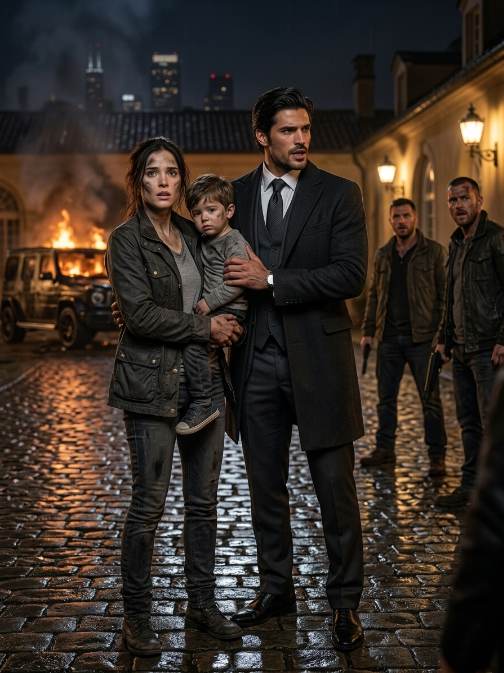
The Mafia Boss Saw Her Fired for Protecting His Autistic Daughter—Then Bought the Store to Expose the Real Monster

## PART 1
The thing about working in a place like Harlow & Voss is that you learn very quickly which sounds belong and which don’t.
The sounds that belong: the soft percussion of heels on Italian marble. The discreet rustle of tissue paper around a purchase. The low, practiced laugh of a woman who has decided she is being charming. The particular register of a price whispered rather than stated, because stating it would imply the sum required consideration.
I had been folding a silk blouse behind the accessories counter for three years. I knew every sound in that store the way you know the breathing patterns of a house you’ve lived in too long.
So when the silence fell, I felt it before I understood it.
Not a pause. Not a lull.
A cut.
The music kept playing — something cool and European from the in-ceiling speakers — but the human noise of Harlow & Voss simply stopped. The conversations. The careful negotiations between client and associate. The crystal sound of a champagne flute being set down. All of it went at once, replaced by the specific, uncomfortable quiet of people who have witnessed something they would prefer not to have.
Then the child screamed.
It wasn’t a startled sound, or a tantrum, or the theatrical crying of a child who wants something denied. I knew those sounds too. This was different. This was the sound of a nervous system in full revolt — the raw, involuntary cry of a person for whom the world had simply become too much all at once.
I came around the counter fast.
She was on the floor near the back wall, the one lined floor to ceiling with display bags under recessed spotlights — the section we called the gallery, because that was what the director wanted customers to feel they were inside. The little girl had curled herself as small as she could get, knees drawn up, both hands pressed flat over her ears, dark curls spread across the polished floor. Her velvet shoes — the expensive kind, the kind with the satin ribbon at the ankle — scraped against the marble as she rocked.
“Stop it stop it stop it,” she choked, though whether she was speaking to the room or to herself or to something only she could hear, I could not tell.
Around her, the boutique’s clientele had rearranged itself at a careful distance, the way people position themselves around a spill.
A woman in an ivory blazer murmured to her companion: “Where on earth is her nanny?”
Someone else: “Should someone call the front desk?”
No one moved toward her.
I knew that kind of not-moving. I had seen it my whole life — the collective, practiced hesitation of people who have decided that another person’s distress is not their category of problem.
My foster brother, Marcus, used to have episodes like this.
The grocery store. Movie theaters. His seventh birthday party, which we’d had to end early when the singing became too much and he’d locked himself in the upstairs bathroom for two hours. People called it behavior. People called it a phase. People called it spoiled, difficult, a parenting failure.
I called it what it was, which was pain — the kind that happened to certain kids when the volume of the world exceeded what their nervous system could process, and which required neither punishment nor an audience.
It required quiet. Patience. Someone willing to get on the floor.
Behind me, I heard the click of Miranda Ashworth’s heels — Harlow & Voss’s director of client experience, which was the title the company used for what every other store called a manager. Miranda ran the boutique like a precision instrument and dressed like she had been assembled from components selected by committee. She came through the room at the specific velocity that meant she had assessed the situation and reached a conclusion.
“Elena.” Her voice found me before she did. “Step back.”
I didn’t.
“Elena Voss.”
“She needs a minute,” I said. “She needs the lights turned down and she needs everyone to stop staring.”
A few customers exchanged glances.
Miranda arrived at my shoulder. She was not a cruel woman, exactly. She was a woman who had been given a specific mandate — protect the experience of paying clients — and who pursued that mandate without much range for anything that fell outside it.
“I need you to return to your station,” she said. “This is a security matter.”
“She’s a child having a sensory overload. That’s a welfare matter.”
Miranda’s expression did not change, which was its own kind of answer.
“The gallery spotlight,” I said. “Let me turn it off. Just that one. It’s directly above her and it’s—”
“Those lights are on a system that requires facilities authorization to adjust.”
“There’s a manual override behind the panel.”
Miranda paused. “How do you know that?”
“Because I’ve been here three years and I pay attention.”
The girl had stopped screaming but was still rocking, still gasping, the high-speed breathing of someone who has come down from the peak but hasn’t found ground yet. Her cheeks were blotchy. There was a small wet patch on the marble where she’d been.
I made a decision.
I walked to the wall panel behind the bag display, flipped the cover, and switched off the gallery spotlight.
The sharp white cone of light above the little girl vanished.
She gasped.
The rocking slowed.
One of the watching customers made a small, involuntary sound — relief, maybe, or surprise that something so simple had worked.
Miranda said my name in a tone that I recognized as a warning with a countdown attached.
I was already on the floor.
Not beside the child — not yet, not close enough to crowd her. A few feet away, cross-legged on cold marble, at her eye level.
“Hi,” I said. Very quietly. “I’m Elena. I’m not going to touch you. I’m just going to sit here.”
The girl opened one eye.
“The loud light is off,” I said. “The music is still going but it’s quieter over here by the wall. I can’t make the perfume go away, I’m sorry about that, but we can breathe through our mouths and it helps a little.”
She was looking at me now. Both eyes.
From the accessories display behind me, I reached back and lifted a folded throw — cashmere, pale gray, the kind that cost more than my weekly take-home. I set it on the floor between us.
“That’s just there if you want it,” I said. “I’m not putting it on you. It’s yours to take or not take.”
Her fingers moved.
Reached.
Touched the edge of the cashmere with two small fingertips, the way you test something you suspect might disappear.
“Soft,” she breathed.
“Very,” I said.
Behind me, Miranda said: “Elena Quinn, you will stand up right now or you will not have a job to return to.”
I kept humming.
I don’t know when I’d started. It was something I used to do for Marcus — not a real song, just a low, even sound, a frequency that seemed to work like a hand on the shoulder. He called it the gray-sky sound because he said it felt like an overcast afternoon in the best possible way — no sun glare, no bright edges, just soft and manageable.
The little girl’s breathing slowed.
She pulled the cashmere wrap against her chest.
And then she whispered a name.
Not mine.
One word, barely audible, spoken into the gray wool like a prayer.
“Papa.”
—
## PART 2
Her name was Sofia.
She told me this after the breathing slowed and the rocking stopped and she had arranged the cashmere wrap around her shoulders in a way that satisfied some internal requirement. She told me the way exhausted children tell things — matter-of-factly, without preamble, as if the panic had cleared out a space and left room for honesty.
“Sofia,” I repeated. “That’s a really good name.”
She considered this seriously. “My papa chose it.”
“He has good taste.”
She looked at me with the evaluating eyes of a child who has been patronized enough times to recognize it and check for it automatically. I held her gaze and didn’t look away.
“You turned the bad light off,” she said.
“Yes.”
“The other lady wanted to take me out.”
“I know.”
“I don’t like being taken.”
“Nobody does.”
Sofia pulled the cashmere tighter. Behind us, Miranda was speaking in a low, controlled voice into her phone — calling security, or her supervisor, or both. Two associates had drifted back to their stations with the careful studied blankness of people distancing themselves from a situation with unclear consequences.
I should have been calculating. I should have been thinking about my rent, about my sister’s tuition, about the very specific way the debt collector from the hospital paused before speaking when he called, as if giving me time to prepare for numbers he had clearly said before.
Instead I was thinking about the weight of the cashmere in Sofia’s hands and the way her breathing had found its rhythm, and how strange it was that something so small could matter so much.
Miranda ended her call.
“The security team is on their way from the lobby,” she said. “Elena, this is your final warning.”
I stood slowly, keeping myself positioned between Miranda and Sofia. The girl’s fingers, I noticed, had moved from the cashmere to the hem of my uniform jacket. She wasn’t gripping. Just touching. Contact maintained, like a tether.
“You’ll want to reconsider the security team,” I said.
Miranda’s eyes sharpened. “I beg your pardon?”
“She just came down from an episode. If unfamiliar men in uniforms walk toward her right now—”
“I am not taking instruction from a sales associate about crisis management.”
“No,” I said. “You’re taking information. What you do with it is up to you.”
Miranda stared at me for a long moment.
“Your employment with Harlow and Voss is terminated, effective immediately,” she said. “The cashmere wrap she’s holding will be charged against your final settlement. Please collect your belongings from the staff room.”
The words landed the way those words always land — not like a blow but like a floor giving way, that sudden nothing beneath your feet where solid ground was supposed to be.
Fired.
I did the math automatically, because I always did the math, because the math was always there, always requiring attention, always one bad month from tipping into something we couldn’t recover from.
Rent. June’s registration deadline. The hospital account. The utilities. The automatic calculation of what this particular domino would knock over on its way down.
Sofia’s fingers pressed tighter against my jacket.
I looked down at her.
She was watching Miranda with wide, careful eyes — the expression of a child who understood, with the particular clarity children develop in certain environments, that something bad had just happened to someone on her behalf.
“I made it bad,” Sofia whispered.
“You didn’t make anything,” I said.
“You lost your job.”
“That was my choice.”
She looked up at me, and I saw in her face something I recognized from Marcus in his clearer moments — the specific exhaustion of being a person whose needs regularly cost other people things they couldn’t afford.
“My papa will fix it,” she said.
“Sofia,” I said gently, “you don’t need to—”
The doors opened.
Not the automated glide of a customer entering. Something different in the way the room reacted — a subtle, collective shift in posture, a slight adjustment in the quality of attention, the kind of atmospheric change that happens when authority enters a space.
Three men walked into Harlow & Voss.
The two flanking him moved the way people move when their primary purpose in any room is to understand all the ways something could go wrong. Eyes to corners. Hands free. The particular ease of trained men who have made peace with the possibility of sudden action.
The man between them walked as if the room’s dimensions had been designed to accommodate him.
Dark coat. Dark suit beneath it. Hair that had gone silver at the edges in the way that looks like an achievement rather than an age. A face assembled from controlled angles, the kind of face that gave nothing away by default, every expression a deliberate allocation.
He stopped just inside the threshold.
His eyes moved over the room once — Celeste, the associates, me, the scattered customers — and then found Sofia on the floor with cashmere around her shoulders and my jacket hem in her hand.
Something happened to his face then.
Not a collapse. Not a performance of relief. Just the briefest, most involuntary dissolution of the architecture he maintained, a half-second where the controlled man disappeared and left behind only a father.
“Papa,” Sofia said.
She let go of my jacket and ran.
He crossed the floor in four strides and caught her with both arms before she had fully arrived, lifting her against his chest in a motion so practiced and automatic that it had clearly been performed ten thousand times before. He pressed his face into her curls. He closed his eyes.
The room was very quiet.
When he opened his eyes, they were on me.
Gray. Steady. The kind of eyes that were accustomed to reading a situation fully before engaging with it.
“You’re the one who helped her,” he said.
It was not a question.
I was standing in a boutique where I no longer worked, in stockings with a run up the left knee, beside a cashmere throw that was apparently going to appear as a line item on my final paycheck.
“Yes,” I said.
He looked at me for a long moment.
Sofia said something into his coat that I couldn’t fully hear, but I caught two words.
*She hummed.*
His expression shifted by a single, unreadable degree.
“I’d like to speak with you,” he said.
Behind him, Miranda opened her mouth.
He turned his head toward her — just slightly, without hurry — and Miranda closed it again.
Then he looked back at me, and I realized I didn’t know his name, and it occurred to me that I should probably find out before I agreed to anything.
“Who are you?” I asked.
Sofia lifted her head from his shoulder and answered for him, with the matter-of-fact certainty of a child stating the most obvious thing in the world:
“That’s my papa. Everyone knows him.”
—
## PART 3
His name was Cristian Vale.
I learned this the way I learned most things about him in those first hours — slowly, in pieces, each one arriving with a weight I had not anticipated.
Cristian Vale. Founder and principal of Vale Maritime Group, which, depending on which description you read, was either one of the most significant privately held logistics operations in the Northern Hemisphere, or the reason certain federal prosecutors had developed persistent tension headaches. The papers had been writing about him for fifteen years in two completely different tones, sometimes in the same paragraph.
None of that was what I thought about when he sat across from me in the manager’s office — vacated by Miranda, who had retreated to somewhere else in the store with the specific efficiency of someone who has recalculated their position — and looked at me the way I imagined he looked at things he was trying to fully understand.
What I thought about was Sofia.
She had fallen asleep in the armchair in the corner, wrapped in the cashmere that had cost me a portion of a paycheck I was no longer going to receive, her dark curls spread across the armrest and her small chest rising and falling with the peaceful regularity of a child who has finally reached safe harbor.
“She’s seven,” Cristian said.
“I know.”
He looked at his daughter for a moment. “Most people — when she has an episode in public — the response is removal. They want her out of the space as quickly as possible, preferably with someone else’s hands doing the removing.”
“I know that too.”
He returned his gaze to me. “You have experience with this.”
It was the way he said it — not *you seemed to know what you were doing* or *where did you learn that*, but the precise, direct statement of a man who had already observed the evidence and was confirming rather than asking.
“My foster brother,” I said. “Marcus. He’s twenty-three now. He has auditory and sensory processing differences. When he was small, the world was very loud.” I paused. “People made it louder, mostly.”
“By reacting.”
“By treating the reaction as the problem instead of the cause.”
Cristian was quiet for a moment. Outside the office door, I could hear the boutique resuming its careful hum, customers redirected toward other corners, associates recalibrated.
“Sofia’s mother died three years ago,” he said. Not as explanation, not as context-seeking, just as fact. “Since then, certain environments have become more difficult for her. We’ve worked with specialists. We’ve adapted.” He looked at his hands briefly. “But there are still days when the world is louder than she can manage, and the people around her respond to that in ways that make it worse.”
I thought of the woman in the ivory blazer stepping away as if proximity to distress were contagious.
“She just needed the light off,” I said. “And someone to sit still.”
“Yes.” His voice had something in it that was not quite sadness. “It usually is something that small.”
A knock at the door.
One of his men — the quieter of the two — opened it and exchanged a few words with Cristian in low Italian that I didn’t catch. Cristian nodded and the door closed again.
“Your manager has lodged a complaint with the building’s retail office about the incident,” he said. “Specifically about you.”
“I assumed.”
“She’s also attempting to have the cost of the cashmere deducted at full retail value from whatever final payment you’re owed.” He said this without inflection, but something in his jaw tightened slightly. “She has also, in the last twenty minutes, told two clients that you were dismissed for erratic behavior.”
I exhaled slowly.
The math was running again, automatically. Rent. June. The hospital. The way the numbers never quite balanced no matter how carefully I arranged them.
“I made a choice,” I said. “I’d make it again.”
Cristian looked at me for a long moment.
“I know,” he said. “That’s the problem.”
I frowned. “The problem?”
“People who make choices they’d repeat regardless of consequence are either fools or principled. You don’t seem like a fool.”
“I’m not always sure about principled either. Sometimes it’s just that I can’t make myself do the other thing.”
Something moved across his face — brief, unguarded. “That,” he said, “is exactly what principled means.”
He stood and moved to the window that looked out over the boutique floor, his back to me, hands in his pockets. From this angle, with Sofia asleep in the corner and the afternoon light coming through the high windows, he looked less like the subject of a federal investigation and more like a man who was tired in the specific way that being responsible for other people makes you tired.
“I want to offer you a position,” he said.
I waited.
“Sofia has a team — a specialist who works with her twice weekly, a household coordinator, a nanny, and a driver who is cleared for her specific needs.” He turned back to face me. “What she doesn’t have is someone who responds to her the way you did today. Not professionally. Just — correctly.”
“You want to hire me to be her companion?”
“I want to hire you in a support capacity within the household. Daily schedule coordination. Accompanying her to appointments, social engagements, any environment where she might need someone who understands how to read a room’s sensory demands before they become a crisis.” He paused. “The role isn’t named yet. We’d define it together.”
I looked at Sofia.
Her fingers, even in sleep, were still loosely curled around the edge of the cashmere.
“I’m not a specialist,” I said.
“I’m not asking for a specialist.”
“I don’t have formal credentials in anything related to what happened today.”
“You turned off a light and sat on the floor and hummed until my daughter could breathe again.” He looked at me directly. “I have consultants with three degrees each who have never done anything that useful.”
I was quiet.
The math was doing something different now — not the usual subtraction but a different kind of calculation, the kind that involves intangibles. Stability. Sofia’s face when she said *soft*. The way the cashmere had worked in her hands like an anchor.
“What happened with Miranda,” I said. “I need to understand — if I work for you, and a situation arises where I disagree with someone in a position of authority about what Sofia needs—”
“Then you tell me,” Cristian said. “And I handle it.”
“You’d take my word over—”
“Over someone who wanted to have my seven-year-old removed from a public space by security while she was in distress?” His voice was even, but there was an edge beneath it, clean and cold. “Yes. Without hesitation.”
I looked at him.
He looked at me.
“The cashmere,” I said. “Miranda’s going to try to charge me for it.”
“She won’t succeed.”
“I wasn’t asking you to fix it.”
“I know,” he said. “I’m informing you of an outcome.”
There was a sound from the armchair — Sofia stirring, one hand moving to check the presence of the cashmere before she was fully awake.
“Elena,” she murmured, eyes still closed.
Cristian’s expression shifted again in that brief, involuntary way.
I crossed to the armchair and knelt beside it.
“I’m here,” I said. “You’re okay.”
“Are we leaving?” Sofia asked, still not opening her eyes.
“Soon.”
“Can the gray thing come?”
“I’ll ask.”
She considered this. “Papa will say yes.”
She said it with absolute certainty, the serene confidence of a child who has one irrefutable fixed point in a world that is otherwise very loud and very unpredictable.
I looked over my shoulder at Cristian.
He was watching both of us.
“She’s right,” he said. “The gray thing can come.”
—
I accepted the position.
Not immediately — I took three days and called my sister June, who said *do it* with the speed of someone who had already decided before I finished the sentence. I spoke to Marcus, who asked practical questions about benefits and notice periods and then said, quiet and serious: “She’s lucky it was you.” I thought about the specific texture of courage — how it rarely felt like courage from inside, how it usually felt more like being unable to make yourself do the other thing, the smaller thing, the thing that preserved the peace at someone else’s expense.
Then I called Cristian Vale and said yes.
—
The first month was an education in how the other architecture of a city operates.
The Vale residence occupied the top three floors of a building in the Gold Coast, and it had been designed — quietly, without the ostentatious grandeur that wealth sometimes deployed — for Sofia. The lighting was adjustable in every room. The kitchen ran on a schedule that minimized surprise. Certain textures were everywhere: linen, cashmere, cotton that had been washed soft. The sound system in the main rooms could be lowered to below-ambient without technical complexity. These were not recent adjustments. They were structural, considered, the work of years.
Someone had paid enormous attention.
I understood within my first week that this was primarily Cristian’s work. Not delegated to an interior designer or contracted to a specialist — his. He had done the research. He had made the adjustments. He had, in the three years since Sofia’s mother died, rebuilt the physical environment of his daughter’s life around the specific architecture of what she needed.
What he had not been able to rebuild was the world beyond the residence.
And that was where I came in.
Sofia and I developed our own vocabulary for it. We called the sensory environment of a new place its *weather* — some days the weather was fine, some days it was heavy, and the goal before entering any new room was to read the forecast. Too many competing scents? We waited outside until the group moved. Overhead fluorescent lighting? We found the side of the room farthest from the fixtures. Unexpected loud sounds? We established, together, a signal — her hand on my wrist, twice, quickly — that meant *I need a moment* without requiring words.
It was not complicated. None of it was complicated, once you understood what you were actually managing.
What you were managing was the gap between a world designed for average sensory input and a child for whom the average was genuinely too much. The solution was not to remove Sofia from the world. It was to give her tools for navigating it that the world itself was too indifferent to provide.
I told Cristian this one evening when Sofia was in bed and we were sitting in the library going over her calendar for the following week — school events, a specialist appointment, a friend’s birthday party that we were strategizing around.
“She doesn’t need less world,” I said. “She needs the right entrance points.”
Cristian looked up from the calendar.
“Marcus taught me that,” I added. “He’s doing well now. He has a job he likes. He lives alone. Most people wouldn’t know anything is different about him unless they knew what to look for.” I paused. “Because somewhere along the way, someone stopped trying to make him less and started helping him manage more.”
Cristian was quiet.
“You did that,” he said.
“I did some of it. He did most of it.”
“Who taught you?”
I thought about this. “Necessity, mostly. And watching what worked and what made it worse. And being angry — for a long time I was very angry on his behalf, at all the people who called it bad behavior and tried to correct it instead of understand it.”
Cristian set down his pen. He looked at me the way he sometimes did — with the full, unhurried attention of someone who was accustomed to evaluating situations quickly but had decided this one was worth slowing down for.
“You gave up a job today,” he said. It took me a moment to realize he was referring to Harlow & Voss, which felt in some way like a different era. “For a child you didn’t know. In a room full of people who were waiting for someone else to act.”
“You make it sound heroic.”
“I make it sound rare,” he said. “Which is what it is.”
I was quiet.
Outside the library windows, Chicago was doing what Chicago does in autumn — burning the last of the light out of the sky in long horizontal bands of gold and copper, the lake going dark at the edges while the center held the color.
“I want to ask you something,” Cristian said.
I looked at him.
“Why did you stay?” he said. “After Sofia calmed down. After the threat was clear — Celeste, the firing, all of it. Why did you stay on that floor?”
I thought about it honestly. Not for long. The answer was immediate, the way things are when they belong to a layer underneath strategy.
“Because she looked up at me,” I said. “And I could see she was checking whether I was still there. Whether I was going to leave now that the loudest part was over.” I paused. “I know what it feels like to be the person people leave when it stops being simple.”
Cristian looked at me for a long moment.
Then he said, very quietly: “I know what it feels like to be the person who couldn’t stay when staying was what was needed.”
I didn’t ask. It was not the kind of sentence that invited a question. It was the kind you said when you had finally found someone you thought might understand it.
We sat in the library in the autumn light for a while longer, going over Sofia’s calendar and not going over it, and I thought about the strange geography of trust — how it was built not in significant gestures but in small ones, accumulated over time, each one a confirmation that the person across from you was doing what they said they were doing.
—
Months later, we went to a gallery opening.
Sofia’s idea, not ours. She had been studying an artist at school — large abstract works, texture-heavy, the kind that begged to be touched — and had asked to go see them in person with a determination that we had both learned meant the request was serious.
We did our pre-entry weather check in the car. Cristian, Sofia, and I, parked half a block from the gallery, going through the list. Lighting: probably adjustable, but we’d assess. Sound: live music was listed on the program, which meant we’d position ourselves away from the source and have an exit route pre-identified. Scent: gallery, which usually meant neutral. People density: moderate, manageable if we arrived at opening rather than peak.
“What’s our signal?” I asked Sofia.
“Two taps.” She demonstrated on my wrist.
“And if we need to leave immediately?”
“I say *rain.*”
“Good.”
She looked at the gallery entrance. Lights visible through the tall windows. People moving inside.
“Ready?” Cristian asked.
Sofia considered.
“Ready,” she said.
She took one of my hands and one of his. Not because she was afraid. Not because she needed to be held up. Because she had learned, in the months since a stranger had sat down on cold marble and turned off a light and hummed a low, structureless sound, that the world was navigable — not always comfortable, not always kind, but navigable — if you entered it with the right people beside you.
We went in together.
The works were extraordinary. Sofia moved through the gallery slowly, studying each canvas with a focus that other visitors noticed and gave space to without being asked. At one piece — a large field of layered gray-blue, textured like water in low light — she stood for a long time without moving.
“It sounds like the gray-sky sound,” she said finally.
I looked at the painting.
She was right.
Cristian was standing on her other side. I glanced at him across the top of her head.
He was looking at me.
Not at the painting.
At me.
And in his face, in the careful, controlled architecture of it, I saw something that had been there for a while and that I had been noting without naming — a specific kind of attention that had nothing to do with employment and nothing to do with Sofia and everything to do with the particular recognition of finding someone who speaks a language you thought was only yours.
I looked away before either of us had to account for it.
Sofia took my hand again, twice, quickly.
Not the distress signal.
Something else. Something she had invented, apparently, on the spot, because she pressed it into my palm and then said, without looking up from the painting: “That means *I’m glad you’re here.*”
I pressed back.
Once.
Which, as far as I was concerned, meant the same thing.
—
There is a version of this story that is about rescue — the powerful man, the imperiled woman, the child as the axis on which everything turns. I understand why people tell it that way. It’s cleaner. It has a legible architecture.
But that is not quite what happened.
What happened is that a woman who had spent three years learning which sounds belonged in a boutique learned something more important: that the sound of a child in distress belongs to whoever is close enough to respond, regardless of their station, their stockings, their bank balance, or the precarious arrangement of obligations they’re trying to hold together.
What happened is that she made a choice — the kind that couldn’t be unmade and wouldn’t have been — and it cost her something, and then it gave her something else, something she hadn’t been able to name or plan for or anticipate.
What happened is that Sofia Vale, age seven, pressed her hand against a cashmere wrap and said *soft* as if it were a discovery, and a woman on the floor of a store where she used to work said *yes, very,* and from that moment the shape of several lives began, quietly and without announcement, to change.
The gray-sky sound.
Soft.
Very.
**THE END.**