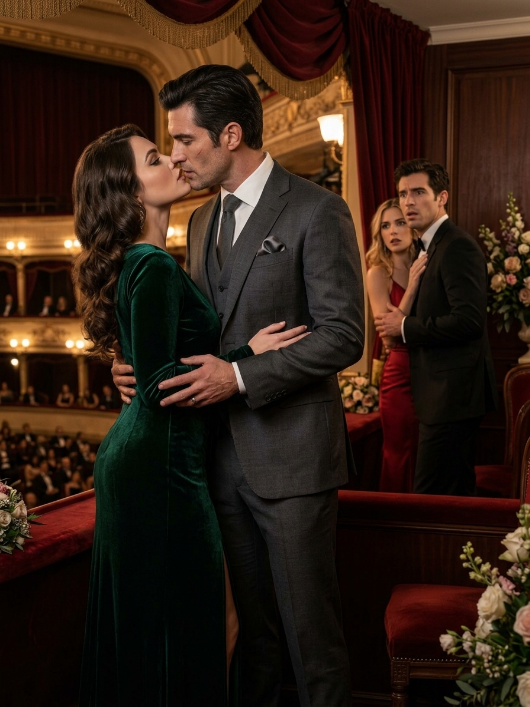
She Hired a Fake Boyfriend for Her Ex’s Wedding—Then Realized He Was the Mafia Boss Everyone Feared

## PART 1
She had practiced not flinching.
For seven months, that had been her private discipline — the way other people ran in the mornings or meditated before work. Maya Voss rehearsed stillness. She stood in her bathroom mirror and tried on Elliot’s name in her mouth — *Elliot’s engagement, Elliot’s wedding, Elliot’s chosen one* — until the words lost enough of their bite that she could hold them without bleeding.
She was not sure she had succeeded.
But she was standing in the rehearsal dinner at Alderhall Estate, so.
Partial credit.
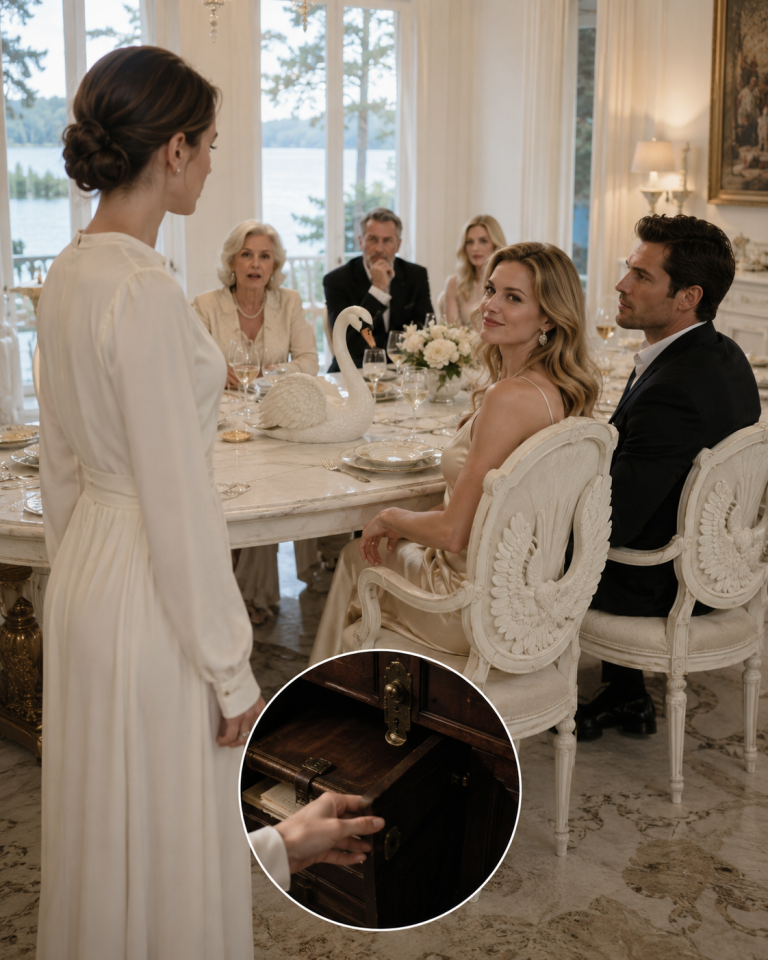
The estate occupied a peninsula of Connecticut shoreline that old money had purchased specifically to prevent new money from building anything nearby. The event rooms had been turned over to white peonies and gold candleholders and the particular brand of understated decoration that required a very large budget to achieve. A quartet played near the windows. The Long Island Sound glittered faintly beyond the glass, indifferent to all of it.
Maya was halfway through her first champagne when Elliot Ashworth found her.
He always found her.
That was one of his talents.
“Maya.” He said her name like a toast. Like something he was setting down. “I have to say, I admire the nerve.”
She looked at him.
Seven months had not changed much. He was still elegant in the sharp, architectural way of men who had been told since adolescence that they were exceptional. His fiancée Isobel’s family had better real estate but less liquidity; Elliot’s family had the liquidity. It was, by all accounts, a practical arrangement dressed in romance.
“Nerve,” she repeated.
“Coming here. Most women in your position would find an excuse.”
“I was invited.”
“I know.” He smiled the way wealthy people smiled at statements that were both true and beside the point. “Still. I think it says something admirable about you. That you can watch this and not…” He moved his free hand in the air. “Collapse.”
Maya held his gaze.
She had promised herself three things about this weekend. First, that she would not justify herself to him. Second, that she would not explain the man beside her. Third, that she would not let Elliot Ashworth make her the smaller person in any room he occupied.
She turned her head.
The man she had brought was standing three feet to her right, apparently examining a painting of the Connecticut coast with genuine attention, a champagne flute suspended from his fingers like a question mark.
He was tall. He had the specific quality of physical stillness that came not from passivity but from discipline — the kind that made rooms adjust around it without knowing why. His suit was charcoal, impeccably fitted, and he wore it the way men wore things they had not chosen for an occasion but simply because it was what they wore.
He had told her, at the Alderhall lobby bar forty minutes ago, that his name was Nikolai.
The agency had told her his name was James.
She had noticed the discrepancy immediately and decided she did not have time to resolve it before the evening began.
“And who is this?” Elliot asked.
The man turned from the painting.
“Nikolai,” he said.
Not *Nikolai something*. Just the name, offered as if Elliot could do what he liked with it.
Elliot’s eyes moved over him with the assessing calm of a man who believed he already knew the outcome.
“Nikolai,” Elliot repeated. “Do you have a surname?”
“Varov.”
Something in the room adjusted.
Not loudly. Not everyone. But a man near the fireplace — gray suit, watchful, connected to Isobel’s side of the family — lowered his glass by one inch and did not raise it again. A woman across the room who had been mid-sentence paused and then resumed, slightly faster.
Elliot did not catch it.
Elliot, for all his social precision, did not see certain things. He had never learned to look for the reactions of people below him, and men like Nikolai existed, in Elliot’s taxonomy, in a category that had not been assigned full humanity.
“Varov,” Elliot said. “That’s Eastern European.”
“Georgian, primarily.”
“And what do you do?”
Nikolai looked at him.
Just looked.
For long enough that Elliot’s smile grew uncertain at the edges.
“I manage assets,” Nikolai said.
The answer was both accurate and designed to end questioning.
Elliot tried once more.
“For whom?”
“For the people who require it.”
Then Elliot did the thing Maya had spent seven months bracing for.
He turned toward her, away from Nikolai, as if the man had already been dismissed.
“Maya,” he said, voice softening into something she recognized as theatrical concern, “you’ve always had a flair for the dramatic. I hope this weekend isn’t about making a point. We all know the story ended, and honestly, I think the most dignified thing now is to—”
“Elliot.”
Nikolai said his name once.
It stopped him cold.
Nikolai moved to stand beside Maya — not in front, not between. Beside. And he looked at Elliot with an expression that was completely without performance.
“You invited her here,” Nikolai said. “You should ask yourself why.”
Elliot frowned. “I beg your pardon?”
“Inviting an ex-fiancée to your wedding weekend serves one of two purposes. Genuine peace.” He paused. “Or an audience for a performance where she loses.”
The quartet continued playing.
Someone near the terrace laughed at something unrelated.
Elliot’s face had not changed, exactly, but the certainty in it had thinned.
“That’s quite an interpretation,” he said.
“It is,” Nikolai agreed. “I’d be curious which one it was.”
Elliot looked to Maya for the reaction he expected — embarrassment, a deflecting smile, the old trained instinct to smooth things over.
She looked back at him.
He had been trying to train her in that direction for three years, and she had not refused then.
She was refusing now.
“Excuse me,” Elliot said, and left toward the Davenport guests with his champagne and his composure, both slightly less intact than before.
Maya looked at Nikolai.
“You weren’t supposed to say anything,” she said.
“I wasn’t supposed to be here at all,” he replied.
She turned fully toward him.
“What does that mean?”
He looked at the painting again.
Then, into the interior pocket of his jacket, he reached — slowly, clearly — and removed a slim black folder.
“My name is not James,” he said.
“I gathered.”
“I was not sent by the agency.”
Maya’s pulse accelerated.
“Then why are you here.”
“Because the man who was supposed to come to you tonight — to this town, in this way — did not survive to do it.”
The quartet played something in a minor key.
Maya looked at the folder in his hands.
“What is that?” she asked.
He looked at Elliot’s back, across the room.
“The reason,” Nikolai said carefully, “that Elliot Ashworth’s wedding will not happen this weekend.”
—
## PART 2
He did not open the folder.
Not in the middle of the room, not during the cocktail hour, not while Isobel Crane and her mother floated past in identical shades of champagne-colored silk. He held it at his side, and Maya held every question inside her, and the evening moved forward with the surreal quality of a dinner theater performance in which only two people in the cast understood the play.
She had come to Connecticut to survive a weekend.
That was the full scope of the plan.
Survive the toasts. Survive the photographs. Survive Isobel’s gracious, practiced smile. Survive Elliot’s careful performance of a man who had made a mature decision for mature reasons and bore Maya no ill will whatsoever.
She had booked the companion as armor.
She had not booked a crisis.
After dinner was called, she and Nikolai found a seat at a side table occupied by a structural engineer from Isobel’s university years and his husband, who both seemed entirely relieved to have someone unconnected to either family to speak with. Maya spent twenty minutes discussing bridge load tolerances without knowing why and found it the most genuinely pleasant part of the evening.
Under the table, Nikolai’s hand found her wrist once — not to hold, just to contact, a signal. She looked up.
Elliot was moving toward them.
With his father.
Carter Ashworth was sixty-three, silver-haired, and built with the specific density of a man who had spent decades being considered correct. He moved through rooms the way rivers moved, without appearing to choose a direction.
“Mr. Varov,” Carter said, as if the name were something he had already researched.
“Mr. Ashworth,” Nikolai replied.
Carter looked at his son, then back.
“I don’t believe we’ve met through normal channels.”
“We haven’t.”
“Then I’d be curious how you came to be at my son’s rehearsal dinner.”
“Vivian invited me,” Nikolai said, and then corrected himself fractionally: “Maya.”
Carter’s gaze landed on her.
“Maya. Yes.” He smiled the way Elliot smiled, but colder — the version his son had not yet perfected. “We’ve always been fond of Maya. Even after things didn’t work out.”
*Even after* was doing tremendous work in that sentence.
Maya held still.
Carter continued. “I suppose it’s admirable that she’s found someone. Though I will say, Mr. Varov, your family name is not unfamiliar to me. Varov Holdings. The Montenegro proceedings.” He lowered his voice without losing volume. “I hope you understand that certain associations could be uncomfortable for everyone this weekend.”
Nikolai said, “The Montenegro proceedings were concluded in my favor.”
Carter looked at him.
“Officially.”
“Officially,” Nikolai agreed.
It was a strange kind of agreement.
Not capitulation. Not challenge. Just two men naming the same thing with different implications and letting the gap between them breathe.
Carter put his hand on Elliot’s shoulder.
“We should circulate,” he said.
After they left, Maya turned to Nikolai.
“Montenegro proceedings,” she said.
“Resolved.”
“What were they?”
“Money. And who it belonged to.” He looked toward the doors. “The man who was supposed to be here tonight was a courier. He was bringing documentation to a federal contact who uses this part of Connecticut for certain meetings.”
“What documentation?”
Nikolai placed the folder on the table between them.
“Proof,” he said simply, “that Ashworth Capital has been laundering money through Isobel Crane’s family trust for four years. And that Carter Ashworth has been using a political liaison to block the investigation.”
The quartet’s music seemed too bright for this sentence.
Maya looked at the folder.
Then at Elliot, visible across the room, laughing at something his best man had said, easy in the way of men who had not yet heard what was in the folder.
“Why did the courier not make it,” she said.
Nikolai was quiet for a moment.
“Because someone found out he was coming.”
“Someone connected to Ashworth.”
“Yes.”
The word landed.
Maya’s hands were flat on the table.
She looked at her own hands, then at the folder, then at Nikolai.
“The man who was supposed to be here tonight,” she said slowly. “Your courier.”
“Yes.”
“He never made it to you.”
“No.”
“But I did.”
Nikolai’s expression was very still.
“You arrived at the meeting point twenty minutes after the courier was to have been there,” he said. “You sat across from me. You spoke about documents. You mentioned having copies of financial records from the engagement period.”
Maya’s breathing stopped.
“I mentioned that to my best friend Camille,” she said. “Who told me to come here. Who helped me find the agency.”
She opened her mouth.
Closed it.
“Camille,” she said.
Nikolai waited.
“Camille works in compliance,” Maya said. “At a firm that audits hedge funds.”
The folder sat between them like a door.
“She told me to bring someone,” Maya said. “She told me what kind of man. She told me which agency.”
“She sent the wrong address,” Nikolai said quietly. “For the original courier. Not by enough to matter at first. Enough to matter at the end.”
Maya understood.
Not completely.
But enough.
The person who had arranged her presence here had not been protecting her.
They had been using her as a replacement.
And somewhere in the folder on the table were documents that would dismantle the most powerful family at this rehearsal dinner — and implicate the courier’s failure in the same structure.
Nikolai said, quietly: “If you’d like to leave, I’ll arrange—”
“No,” Maya said.
He looked at her.
“I’ve been positioned as a prop in this story twice,” she said. “Once by Elliot, and apparently now by someone I trusted.”
She reached for the folder.
“I am not leaving until I understand what I’ve been carrying.”
—
## PART 3
She read the documents under the table, her phone’s screen illuminating the pages Nikolai fed her one by one, while the rehearsal dinner proceeded around them with its champagne and its performances and its careful social choreography.
It was worse than she expected.
Not in a dramatic sense. In the specific, meticulous way that documents were worse than stories — no villain’s monologue, no single galvanizing moment, just numbers moving through corporate shells and routing entries and a paper trail that required patience to follow and, once followed, could not be ignored.
Ashworth Capital had been using the Crane family trust as a pass-through vehicle for four years, processing money from three sources Nikolai named in the margin notes of the last page. The trust was legitimately structured, properly registered, and had never been examined because Isobel Crane’s family had the right relationships with the right regulatory contacts, and Carter Ashworth had spent considerable money ensuring those relationships remained current.
The political liaison was a man named Grange, who sat on a sub-committee that controlled audit trigger thresholds for family trust structures.
Grange was at the rehearsal dinner.
He had been at the bar when they arrived.
Maya looked up.
“He’s the one,” she said.
Nikolai followed her gaze.
“Yes.”
“Did Elliot know.”
Nikolai was quiet for a moment.
“The transfers required his signature.”
Maya absorbed this.
She had not loved Elliot perfectly — she knew that, had known it before the breakup made it easier to admit. She had loved the version of him she had constructed from good moments and selective attention, which was a different thing. She had stayed longer than she should have because she had been trained, by years of Elliot’s particular gravity, to believe that her perception of things was less reliable than his.
But she had always known the money moved strangely.
She had mentioned it once, during the engagement, when she saw a transfer description that did not match any project she was aware of.
Elliot had called her anxious.
The word had done its work.
She looked at the folder.
“What happens now,” she said.
Nikolai reached into his jacket again.
A phone, this time.
He typed a message.
“I contact the federal attorney who was supposed to receive this,” he said. “Not through the original channel, which has been compromised.”
“You know another way.”
“I have been navigating around compromised channels for eleven years.”
She looked at him.
The rumors she had not looked up before the dinner, the things Camille had not told her and that had therefore not frightened her away — she could see them now in the controlled economy of how he moved, the way he spoke to Carter without flinching, the particular patience of a man accustomed to rooms where the official version was not the real version.
“Are you a criminal?” she asked.
He looked at her.
“I inherited a position that required criminal actions to maintain,” he said. “I spent five years documenting those actions and removing myself from them. That is the accurate answer.”
“It’s a long answer.”
“It’s an honest one.”
“Are you cooperating with federal investigators.”
“Yes.”
“Is this folder part of that cooperation.”
“It became part of it when the courier didn’t arrive.”
Maya set the papers down.
“Camille sent you the courier address. She knew where he would be.”
“Yes.”
“Which means someone she’s connected to—”
“Yes.”
“She warned Elliot.”
“I believe she warned someone who warned Elliot. The chain is longer.”
Maya closed her eyes for one second.
Not from devastation.
From the specific exhaustion of having her instincts confirmed seven months too late and by the wrong mechanism.
She had spent a year in that engagement feeling something was wrong.
She had been told she was anxious.
She had believed it because believing it was easier than the alternative.
“Tell me what to do,” she said.
Nikolai looked at her.
“I can handle the rest myself,” he said. “The documents are sufficient. You can leave.”
“That’s not what I asked.”
He held her gaze.
“You can give a statement,” he said carefully. “About the financial records you noticed during the engagement. You can identify the transfer description. That corroborates the timeline and places your access period correctly.”
“Will it matter.”
“It will make the timeline airtight.”
She thought about the word anxious.
About three years of being told her perception was unreliable. About Elliot’s voice, kind and patient and relentless, explaining her own reactions back to her until she stopped trusting them.
“Yes,” she said.
“Maya—”
“Yes,” she said again. “I’ll give the statement.”
Nikolai looked at her for a moment.
Then he typed the second message.
The federal attorney arrived at eleven-fifteen, through the service entrance, with two agents who had been positioned in the adjacent county for a meeting that had been rescheduled twice already. They came quietly. They did not disrupt the rehearsal dinner immediately.
They did not need to.
The disruption came from Isobel.
She had found Grange near the fireplace fifteen minutes earlier and noticed, because Isobel Crane was not careless in the way powerful women were not careless, that he had been looking toward the service entrance three times in twenty minutes.
She asked him a question that sounded social.
He answered badly.
She excused herself, found her family attorney in the library, and spent seven minutes in a conversation that left her the color of old marble.
When she returned to the main room, she went directly to her father.
Her father went directly to Carter.
Carter went to his phone.
By the time the federal attorney reached the room, the Ashworths were no longer the most composed people in it.
Elliot found Maya near the window.
His face had shed its architecture.
Underneath was something younger and considerably less certain.
“What did you do?” he said.
“I arrived when I was invited,” she said.
“You brought—” He looked toward Nikolai, who was speaking quietly with an agent. “Who is he?”
“Someone who was looking for a different person and found me instead.”
“Maya.” His voice dropped, and for a moment she heard the tone he used when he was asking her to cooperate with something she had not agreed to. “This can be contained. If you don’t make a statement—”
“Elliot.”
He stopped.
She looked at him.
“I told you the money moved strangely,” she said. “You called me anxious.”
“I—”
“That was the last time,” she said. “The last time you will name my perceptions for me.”
She stepped away.
Isobel Crane was standing near the window on the other side of the room, watching Elliot with the expression of a woman who had just been handed a very different story about her own life.
She looked at Maya.
Their history was competitive and thin.
What they shared now was the same man and the same lie.
Maya crossed the room.
She did not know what she was going to say.
Isobel spoke first.
“He chose me because my family’s trust could hold the accounts,” she said. “That’s what my father says.”
It was not a question.
Maya said, “I think he believed something else in addition to that. Feelings and calculations often coexist.”
Isobel looked at her.
“You’re being kind.”
“I’m being accurate.”
Isobel picked up a glass from the nearest table.
“I want to cancel,” she said. “The wedding.”
“Yes,” Maya said. “I think you should.”
“My family will think I’m the one who—” She stopped.
Maya said, “Your family will think whatever you tell them. You get to choose the narrative now.”
Isobel stared at her.
“You came here expecting to be humiliated,” she said.
“Yes.”
“And instead—”
“Instead I ended up with documents and an unplanned federal operation.”
Isobel made a sound that was almost a laugh.
“I’m sorry,” she said. “For the invitation. I knew why he wanted you here.”
Maya looked toward Elliot, who was now speaking very quickly to his father in a corner of the room.
“I know you knew,” she said. “But I also think you believed the version of the story that made you the winner instead of the tool. That’s not uniquely your mistake.”
The federal attorney approached.
“Ms. Voss?”
Maya turned.
“Ready,” she said.
She gave her statement in the estate’s library, seated across from a woman who introduced herself as AUSA Chen and who asked questions with the careful precision of someone who had reviewed the documents already and was confirming what she knew against what Maya had seen.
The transfer description Maya had noticed.
The date.
The fund name.
The conversation in which she had raised it.
Elliot’s response.
The NDA he had proposed after the breakup, which Maya had not signed and had retained the draft of.
She had kept the draft because her instinct said it was unusual and her instinct was frequently right.
“The reason I didn’t sign,” Maya told the AUSA, “was that the language was broader than any standard confidentiality provision. It covered ‘all financial observations arising from the relationship.’ I asked what financial observations meant.”
“What did he say?”
“He said it was standard language. Boilerplate.”
“And?”
“And I recognized it wasn’t because I’d reviewed actual boilerplate in a prior contracts position. I kept the draft because I thought I might want a different attorney to look at it.”
AUSA Chen made a note.
“That was good thinking,” she said.
“It was anxiety,” Maya said. “Apparently.”
Chen looked up.
“Ms. Voss,” she said, “in my experience, the people called anxious for noticing things usually noticed correctly.”
Maya sat with that for a moment.
—
The indictments came in phases.
Carter Ashworth first, then two associates, then Grange. Elliot was charged with knowing participation rather than direction, which was factually accurate and significantly less comfortable than it sounded. Camille — Maya had been right about the chain — was identified as a source of information passed to Ashworth Capital through an intermediary she had believed was protecting her in some obscure professional sense. The reality was more transactional. She cooperated and received a cooperation agreement that did not feel like safety.
Maya did not speak to her again.
That was the part that cost the most.
Not Elliot. Elliot had been leaving for some time, and the leaving she had processed. Camille was the one she had trusted after. The friend who had turned *I should come to this weekend* into *I should be useful at this weekend.* The one who had positioned Maya as a vehicle without telling her she was moving.
She had a month of anger about it.
Then, because she was someone who needed to understand things properly, she called Camille once.
Camille said, “I thought it would help you too. I thought if it all came out, you’d be—”
“Collateral benefit.”
“Maya—”
“I understand the mechanics,” Maya said. “That’s not the same as forgiveness.”
She hung up.
She did not call again.
Nikolai testified for nine days.
The press called him by his full patronymic in some outlets — Nikolai Andreevich Varov — in the particular way that journalists named foreign men to signal danger. He was photographed twice: once arriving at the courthouse, once leaving. In both photographs, he was looking somewhere other than the camera.
Maya watched a portion of the congressional follow-on hearing from her laptop in the office she had recently signed a lease for.
She had left her firm six months after Alderhall to start her own practice.
Specifically: a risk and financial advisory practice that worked with individuals and organizations navigating disclosures, compliance irregularities, and the particular moment when a person realized they had been used as a vehicle for someone else’s concealment.
She was very good at it.
The framed document on the wall was not her law degree or her professional certification, though both were present. It was a single line, printed on white paper, from a brief she had written during the proceedings:
*Instinct is data. It should be documented, not apologized for.*
Isobel Crane canceled the wedding via a statement that said almost nothing in exactly the right number of words. She was not Maya’s friend. She was the other person in the room who had stopped performing, and that was a meaningful thing without needing to be a meaningful relationship.
Isobel did start a foundation — something about financial literacy for women navigating wealth structures post-relationship — and sent Maya an invitation to its inaugural event.
Maya sent a donation and a note that said: *Good work.*
That was enough.
—
Nikolai found her at the office two weeks after his final testimony date.
Not at her building. He had her address from the documents she had submitted, which felt appropriately ironic.
He was standing outside when she came out.
Dark coat. Rain light on his shoulders. The same quality of stillness she had observed at Alderhall, except now it was without purpose — not waiting for anything, just existing in a space with the patient competence of someone who knew how to be somewhere.
“You’re done,” she said.
“The testimony is done.”
“How does it feel.”
He looked at the wet street.
“Strange,” he said. “I have spent eleven years organizing my life around a destination. Now I am standing past it.”
“That sounds disorienting.”
“Yes.”
She adjusted her bag on her shoulder.
“What will you do now?”
“I don’t know yet.”
“That’s unusual for you.”
“It is.”
She looked at him.
She had not known him at Alderhall. She knew him better now — not intimately, but in the specific way you knew someone who had seen you in an impossible situation and not moved in front of you, who had stood beside you when it would have been easier and more natural to manage you.
“I looked up the Montenegro proceedings,” she said.
He waited.
“You were right. They were resolved in your favor.”
“Officially.”
“Is the unofficial version complicated?”
“Yes.”
“Are you going to tell me?”
“If you want.”
She considered.
“Not tonight,” she said. “Tonight I have a deposition prep call at six.”
“Then another time.”
“Another time,” she agreed.
He inclined his head slightly — not a bow, more like an acknowledgment.
He turned to leave.
“Nikolai.”
He turned back.
She looked at him.
The man who had arrived as a stranger in a place she had gone to be humiliated. Who had held a folder without opening it until the right moment. Who had said *I was never James* and let the truth be what it was.
“You asked before if I wanted to leave,” she said. “At the estate. Before you opened the folder.”
“Yes.”
“I think about that sometimes.”
He waited.
“You gave me the choice,” she said.
“Yes.”
“Most of the men in that room didn’t.”
“No.”
“That mattered.”
He looked at her the way he had looked at the coastal painting in Alderhall — with the focused attention of someone finding something worth understanding.
“Good,” he said.
She smiled.
Small.
Real.
“Tomorrow,” she said. “I have coffee at eight and a client at nine-thirty. If you want to tell me the complicated version, there’s a thirty-minute window.”
He looked at her for a long moment.
“I’ll be on time,” he said.
“You’d better be.”
She walked back inside.
Years later, when people asked how the Ashworth case had started, the official record said it began with a courier who never arrived. The press called it a chance encounter between a wronged ex-fiancée and a federal cooperator at a wedding rehearsal.
Maya’s version was different.
It started with a wedding invitation.
Not the cream cardstock with the gold lettering that Elliot had sent.
But the one she had accepted from herself.
The one that said: *You are not going there to apologize for existing. You are going there because it is your right to stand in any room you are asked to enter. Go. Stand. Remember who you are when powerful men expect you to diminish.*
Elliot had built her an audience.
He had expected her to break in front of it.
Instead, she had given the audience something to witness.
She had not needed Nikolai to do it.
But she was glad he had been beside her when she did.
Not because she needed protection.
Because she had chosen it.
And choosing was the only kind of company worth keeping.