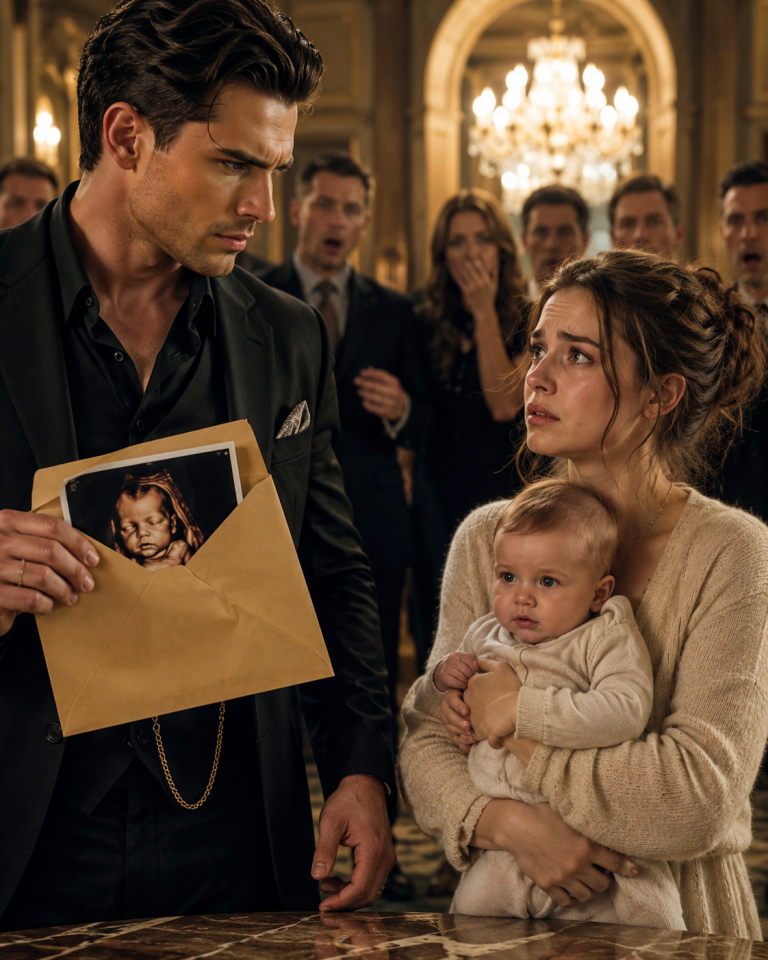
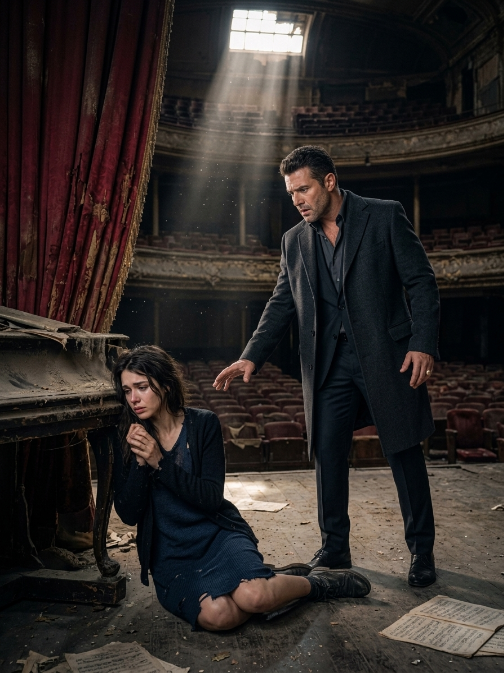
He Entered Furious—The Mafia Boss Saw a Maid Guarding His Son With a Broken Mop

## PART 1
I had rehearsed this night a hundred different ways.
The call coming at midnight. The SUV cutting through rain-slicked streets. Walking into a hospital with a loaded gun and the cold certainty that someone was going to bleed before morning.
But in not one version of it — not one — did I imagine her.
My name is Roman Valenti. And by the time I reached Room 614 at St. Alban’s Medical Center, I had already decided that whoever touched my son would not see daylight.
She was not a shooter.
She was not a rival.
She was a hospital janitor standing in the center of the room with a shattered broomstick raised in both hands and blood running freely down the side of her face, painting the collar of her blue uniform dark.
Between her and the door — which I had just kicked off its hinges — was my son.
Seven-year-old Luca, unconscious and small beneath white cotton blankets, oxygen tubes taped beneath his nose, heart monitor casting pale green light across the room.
The woman did not drop the broomstick.
She pointed the jagged end at my throat.
“One step,” she said, barely above a whisper, “and I open your neck.”
I had men killed for less than a threat.
I still didn’t move.
—
Forty minutes earlier, I had been seated at a private table inside Corsa on the forty-second floor of a Midtown tower, watching two men from a Chicago faction smile too widely while they lied about territory disputes. The rain outside turned the city into smeared paint. The bourbon in my glass was excellent. The company was not.
Then my phone rang.
Not the business line.
The private one. The one only three people had.
My attorney.
My driver.
And Nora — the woman who had raised Luca since he was three weeks old.
Her name lit the screen and something in my chest tightened before I even answered.
“Nora.”
She could not speak in full sentences. What came through the phone were fragments — *collapsed*, *ambulance*, *his heart* — stitched together by her weeping.
I was already standing.
The bourbon glass hit the tablecloth. Neither man across from me spoke. They had enough survival instinct for that, at least.
My driver, Marco, had the armored car at the curb before I reached the lobby. My head of security, Dante, was on his phone beside me in the elevator, already locking down the hospital floor.
Luca had been born with a structural defect in his left ventricle. Minor, the specialist had said. Correctable with time. Not immediately dangerous.
I had not believed that for one single day of Luca’s life.
I had hired private cardiologists. Installed remote monitoring equipment in the apartment. Replaced Luca’s school twice when the security arrangements weren’t adequate.
I had done everything a man with money and fear at his disposal could do.
He still ended up in an ambulance while I was making small talk with criminals.
The drive to St. Alban’s took eleven minutes. Long enough for fear to harden into something more useful. Dante coordinated with our men already en route. I watched rain pull at the windows and said nothing.
“Seal the pediatric wing,” I told him quietly. “Remove anyone we haven’t cleared ourselves.”
“Done.”
“If anyone on that floor isn’t staff — ”
“I understand.”
I had not survived twenty years in this city by leaving gaps.
At triage, a nurse began explaining visiting protocols. I placed a card on the desk and said my son’s name. She looked at the card, looked at my face, and pointed me toward the elevator without another word.
Sixth floor. Room 614.
Inside the elevator, Dante checked his weapon.
The doors opened to silence.
Wrong kind of silence.
One of our men was slumped against the nurses’ station, breathing but unconscious. Another was on the floor near the water fountain, a thin line of blood tracing his jaw.
“Take the stairs,” I told Dante. “Anyone fleeing goes to ground, not a cell.”
Then I walked to Room 614 and put my shoulder through the door.
The lock exploded.
The woman screamed — not in fear, but in warning — and stepped directly in front of Luca’s bed with her improvised weapon raised.
She was slight. A cut above her left eye had swollen badly, and the bruising along her jaw looked fresh. Her right shoulder of her uniform was saturated. Her gloves, blue latex, were torn across the knuckles.
Her eyes were not afraid.
“There were two men,” she said, voice cracking at the edges. “I hit the alarm. Police are on the way.”
“Who are you?” I asked.
She did not lower the broomstick.
“My name is Clara Reyes. And someone just tried to murder your son.”
Dante appeared in the doorway behind me.
I held up a hand.
“Say that again,” I said carefully.
Clara’s jaw tightened. “I came in to mop. There were two men at his bedside disconnecting his oxygen. One had a syringe at the IV line.” She exhaled unevenly. “I hit the first one with the bucket. The second one hit me. I locked the door.”
The world went silent in a specific way I recognized — the silence before everything changed.
“And the syringe?” I said.
Clara’s free hand moved slightly toward the IV stand beside Luca’s bed.
“I think he got some of it in before I stopped him.”
Luca’s heart monitor chose that exact moment to shift.
Not flatline. Not stable.
Something in between — frantic, stuttering, wrong.
Clara’s head snapped toward it.
Down the hallway, three gunshots cracked through the quiet.
Then Dante’s voice, controlled but tight:
“Roman. They’re still on this floor.”
—
## PART 2
The monitor’s rhythm broke into something jagged and fast.
Clara moved before I did.
She was at the IV line with shaking hands before I crossed the room, checking the connection, reading the drip chamber with the focused attention of someone who had learned to pay attention to things other people walked past.
“The bag was switched,” she said.
I looked at the IV hanging above Luca’s head. Clear fluid. Printed label. Official barcode.
“What?”
“Before I came in. The man with the syringe — he didn’t just inject it. He replaced the bag.” She pulled the line loose from the port with a sharp tug. “I don’t know when. I don’t know how long it’s been running.”
My hand tightened around my gun until the knuckles ached.
Dante stepped inside and sealed the ruined door as far as the broken frame allowed. Another shot rang out from down the hall — closer this time.
“Get a doctor,” I said.
Dante looked at Clara, then at me.
“Now,” I said.
He went.
In the stillness that followed, the monitor’s distorted rhythm filled the room. Clara leaned over Luca with her blood-stained hands hovering near his face, not touching — just watching his color, his breathing, the faint tremble of the oxygen tube.
“What are you looking for?” I asked.
“Anything that looks worse than before.”
“Are you a nurse?”
She almost laughed. “I clean floors.”
I stared at her.
“I’ve cleaned this floor for three years,” she said quietly. “I know every doctor’s voice. I know every medication protocol on the chart outside this door. I know your son is allergic to acetaminophen because I heard Dr. Farris tell you so in November, and I know he sleeps better after Nora reads to him because he told me so himself.”
Luca had always spoken to the invisible people in rooms.
Clara pressed gauze against the disconnected IV port. Luca’s small face shifted — a wince, a sound, the barest protest from somewhere unconscious.
“Little fighter,” she whispered.
Down the hall, footsteps thundered. Heavy, coordinated. Not police. Wrong rhythm entirely.
Dante shoved through the broken door, dragging a doctor by the wrist. Young, glasses crooked, sweating through his coat.
“Tell me what he was given,” the doctor said immediately.
Clara thrust the detached IV line at him. “I disconnected it. Whatever they put in started maybe twelve minutes ago, possibly less.”
The doctor’s hands moved fast — pupils, pulse, monitor readings. A nurse followed seconds later carrying a crash kit, face pale and eyes too wide.
“His rhythm is dysrhythmic,” the doctor said. “We need to know the compound.”
Two bullets tore through the wall.
The nurse hit the floor. Plaster rained down over Luca’s blanket.
I pulled Clara down by the back of her uniform and put myself between her and the wall. She landed hard against my arm, gasping, the broken broomstick clattering away across the tiles.
Dante returned fire through the doorway.
Three shots.
A body fell somewhere beyond the nurses’ station.
Then Luca’s monitor screamed.
Not beeped.
Not stuttered.
Screamed — a long, continuous, mechanical shriek that meant the worst thing.
“He’s coding,” the doctor said.
I heard those words and felt something rearrange itself permanently inside my chest.
The nurse scrambled upright. The doctor climbed the bed rail and began compressions on my son — my seven-year-old son, who still refused to sleep without the small ceramic dog Nora had bought him at a street market when he was four.
“Move back!” the doctor shouted.
I couldn’t.
Clara shoved me.
Not hard. Not cruel. But her hands on my chest were unmistakably firm.
“Protect the door,” she said. “That’s what you do. That’s what you’re for right now.”
Something in the words broke the freeze.
I turned.
I stepped into the hallway.
And for the next several minutes, I stopped being a father and became what I had always been good at being.
When it was over — when Dante and I had cleared the hall, when the two masked men in coordinated tactical gear were down — I turned back toward Room 614.
Behind the glass panel in the door, Clara was standing at the foot of Luca’s bed, hands over her mouth, tears cutting through the blood drying on her face.
The doctor said something.
The nurse began crying.
The monitor found a rhythm.
Fragile.
Weak.
But there.
Clara closed her eyes, and her whole body swayed like something that had been holding a door shut for a very long time had finally been allowed to let go.
“We have a pulse,” the doctor said. “Faint. We need ICU.”
Dante touched my arm. “Police response is being held.”
“Why?”
“Bomb threat called in to the front entrance. NYPD is locked to perimeter.”
I looked at the wall.
Someone had built this night the way architects build buildings — load-bearing points, contingencies, backup plans. The first team to silence Luca. The second team to finish when the first failed. A false crisis at the entrance to hold the police. A poisoned drip to make the death look cardiac.
This was not improvisation.
This was a blueprint.
“There’s a service elevator,” Clara said from inside the room.
I looked at her.
She was already standing, one hand on the wall for balance, the other pressed to her injured shoulder.
“Behind the housekeeping storage on this floor. Camera’s been broken for eight months. It’s on the maintenance request list. Nobody fixes anything unless administration gets a complaint.” She met my eyes steadily. “I can get him to ICU without using the main corridors.”
Dante looked at me.
I looked at Luca.
“Lead the way,” I said.
And Clara Reyes — bleeding, exhausted, still without her broomstick — moved to the door like a woman who had already decided this was not the night she stopped.
—
## PART 3
The service corridor behind housekeeping smelled of bleach, rubber wheels, and the particular staleness of spaces that exist only to be forgotten. Institutional yellow walls. Exposed piping overhead. Wire shelving lined with industrial cleaning supplies, folded linens, blue plastic bins.
No plaques. No donor names. No polished calm.
Just the hidden architecture of a building trying to pretend it ran itself.
Clara led us through two turns, then stopped at a gray steel door marked STAFF ONLY. A numeric keypad glowed red beside it.
She entered the code.
Red light.
Dante leaned in. “Again.”
“I am again,” she said flatly, and tried twice more.
Red. Red.
“Code changed,” Clara said, and the words came out tightly, like she was holding something back through sheer discipline.
The doctor’s voice was controlled and frightened in equal measure. “His pressure is dropping.”
Dante raised his gun toward the keypad.
Clara put her hand on his arm without looking at him. “Shoot it and you jam the lock permanently.”
Dante looked at me.
Clara looked at me.
Then the elevator cables groaned somewhere above us.
The steel door slid open on its own.
Inside the elevator car, taped to the back wall at eye level, was a phone.
Small. Black. Old. A prepaid burner, the kind that existed so nothing could be traced back.
It was ringing.
Every weapon in that corridor pointed at it simultaneously.
I stepped inside and picked it up.
I recognized the voice immediately.
Not because I had heard it recently.
Because there are voices that live in the locked rooms of memory no matter how many years pass — and this one had a key.
“Hello, Roman.”
My sister.
Mara.
Mara Valenti, who had died seven years ago in an explosion outside a parking structure in Newark. Whose ring and dental records I had personally identified. Whose death I had spent two years trying to avenge before I understood who had actually ordered it and why.
“Mara,” I said.
Dante went absolutely still.
Clara looked between us.
“You always sound most like yourself when you’re frightened,” Mara said.
“You’re dead.”
“Death,” she said, “is more of a suggestion in our family.”
The doctor’s voice cut through: “We need to move now.”
“I know,” Mara said. She had heard him. “Press six.”
The elevator doors began to close.
We moved — gurney first, then doctor, then nurse, then Dante, then Clara. I stepped in last, phone still at my ear.
“Why?” I asked.
“Because you built an empire on blood and forgot that blood remembers where it came from.”
“You orchestrated tonight.”
“I intercepted tonight,” she said. “There is a difference.”
“You sent men into my son’s room.”
“I sent men to create a situation you would have to enter personally. If I wanted Luca dead, Roman, he would not be breathing.”
The floor numbers climbed.
Mara’s voice dropped lower.
“Tell me — did you ever wonder why the same hospital janitor has been cleaning your son’s ward for three years? Did you ever notice the woman who mopped around your security detail and memorized his medication chart and learned the name of his stuffed ceramic dog?”
Clara’s head moved slightly.
I put the phone on speaker.
Clara stiffened.
Mara’s voice filled the elevator.
“Her name is Clara Reyes,” Mara said. “And her brother, Mateo, was sixteen years old when he was killed in the East River because he saw a delivery he wasn’t supposed to see and couldn’t be trusted to stay quiet about a name.”
Clara stopped breathing.
I said nothing.
Because the truth had been buried for so long that speaking it aloud felt like pressing a wound.
Mateo Reyes. Sixteen. Fast kid. Quiet eyes. He had carried messages for one of my capos before I took control of the family. He had been in the wrong warehouse at the wrong time, had heard a name attached to a shipment that was supposed to stay invisible. He was found two days later.
I had not ordered it.
But the man who gave the order had stayed operational under my organization for two more years because he was useful and the war that year demanded utility over justice.
Clara turned toward me slowly.
The elevator opened on six.
“Did you know my brother?” she asked.
“Yes.”
“Did you kill him?”
“No.”
“Did you protect the man who did?”
The doctor shoved the gurney forward. “We are out of time — move!”
We burst into the sixth-floor service hall and ran.
Behind me, Mara’s voice followed from the speaker.
“Clara has been assigned to this ward for three years, Roman. She requested the placement herself. She wanted to understand the man whose organization her brother died for. And what she found instead was a seven-year-old boy who said thank you every time she mopped.”
“I didn’t know,” Clara said. Her voice was barely sound. “I knew his name. I knew yours. I didn’t know about Mateo — not specifically, not until tonight.” She stopped walking for half a step. “He used to save me the good orange from his lunch tray.”
Luca had always done that.
He had been that way since he was old enough to notice other people existed.
We reached ICU. The staff inside froze at the sight of us. The doctor began issuing orders and medicine took over with the merciless efficiency of people trained to stop asking questions and start saving lives.
Doors opened. Luca disappeared behind glass.
A nurse stepped in front of me. “You wait here.”
I let her.
Clara leaned against the wall beside me, the broken broomstick gone, both hands at her sides. She looked as though someone had removed something structural from inside her.
Dante took the phone from my hand. “Mara. Where are you?”
A pause.
“Somewhere you haven’t thought to look yet.” Her voice shifted — something softer beneath the surface. “Ask him about Vincent Kane, Dante. Ask him what happened to your father.”
Dante’s face changed.
Mara laughed softly.
The line went dead.
For a long moment, the hallway held only the sound of the ICU monitors, muffled through glass, and the distant scream of police sirens that had arrived too late to matter.
Then I spoke.
“The man who gave the order to kill your brother was named Aldo Carini.”
Clara looked at me.
“He worked under me.”
“Worked.”
“He’s been dead for four years.”
“But not immediately.”
“No.”
“You let him live.”
“I was consolidating control. He ran thirty men I needed during the Atlantic City dispute.”
Clara closed her eyes.
“Your brother was sixteen,” I said.
“I know that,” she whispered.
“So do I.”
She opened her eyes. They were not wet. They were something more precise than grief — the look of a person who has been carrying an exact weight for so many years they have learned its dimensions perfectly.
She reached for the broken broomstick and swung it.
The wood cracked across my face with enough force to split the inside of my cheek against my teeth.
My men raised weapons.
“Down,” I said.
They stared.
“Lower them.”
They did.
Clara stood in front of me, breathing hard, the useless length of broken wood in her hand.
“I should have stepped out of the way,” she said.
But even as the words left her, she looked through the ICU glass at the shape beneath the blankets.
The lie died there.
We both knew it.
—
The cardiologist came out fourteen minutes later.
She was direct. Efficient. The kind of tired that comes from holding precision together under pressure.
“He’s alive. Critical, but stable. We identified a compound affecting cardiac rhythm — synthetic, targeted. We’re addressing it.” She looked at Clara. “You disconnected the IV?”
Clara nodded faintly.
“You likely saved his life.”
Clara pressed her lips together and said nothing.
The cardiologist returned inside.
Then Dante’s radio crackled.
A voice from our man in the parking structure below: static, then — “Boss. We found the nanny.”
My stomach dropped. “Nora? Is she — ”
“Alive. But sir — she’s asking for Ms. Reyes.”
Every eye in the hallway went to Clara.
Clara’s expression shifted into something unreadable.
Before anyone could speak, the sixth floor’s lighting convulsed — once, twice — and then the emergency PA system opened overhead, calm and mechanical:
*”Code Black. Full security lockdown. All exits secured.”*
Metal shutters descended across the corridor exits with a sound like a closing mouth.
Dante ran for the stairwell fire door. It sealed before he reached it.
My phone buzzed.
Unknown number.
A video file.
I opened it.
Nora appeared on screen — gray hair loose, face bruised, bound to a chair in what looked like the parking structure’s maintenance level. Alive. Frightened. Alive.
Beside her stood a woman in a dark coat.
Mara.
Older than my memory of her. Thinner. The scar along her neck — the one an explosion leaves when it decides not to finish — visible above her collar.
She leaned toward the camera.
“Hello again, Roman.”
Clara moved to see the screen, and Mara’s gaze seemed to find her.
“Clara.” Mara’s voice had shifted — something almost gentle in it, and somehow that was worse. “I’m sorry about Mateo. I mean that. But his death is the reason Luca is still breathing tonight.”
Clara’s voice was very small. “What does that mean?”
Mara lifted something into frame.
A child’s medical bracelet. Small, silver, engraved. Old enough that the metal had begun to dull.
*LUCA VALENTI. BLOOD TYPE: B-. CONGENITAL CARDIAC DEFECT.*
She turned it over.
On the back, scratched into the silver in tiny uneven letters:
*MATEO REYES.*
Clara made a sound I had never heard before and hope never to again.
I felt the floor do something impossible beneath my feet.
Mara looked directly into the camera.
“You have taken many things, Roman. Territory. Money. Futures. But the first life you stole — the first one that mattered — was not from an enemy.”
A pause.
Then:
“Luca was never your son.”
The video ended.
The hallway had no air in it.
Behind the ICU glass, the small shape under the blankets lay surrounded by machines — pale, alive, breathing.
Clara stared at him the way people stare at things they cannot process.
Dante stared at me as if asking a question he already suspected the answer to.
And I stood in a locked-down hospital corridor with blood in my mouth and the first fracture of a truth that had the weight and shape of everything I had built my life upon.
Then Luca stirred behind the glass.
His head turned.
Not toward the doctor. Not toward the window.
Toward the woman standing in the hallway with blood drying on her face.
And through the glass, through the tubes and machines and the distance of seven stolen years, my son pressed his hand weakly to the surface and whispered a word I could not hear but could read.
*”Mama?”*
—
### PART 3 — The Boy Who Always Said Thank You
He said it a second time.
I watched his lips form the shape of it again — soft, certain, instinctive — and Clara Reyes put both hands over her mouth and leaned against the wall as though the bones in her legs had quietly made a different decision.
“No,” she breathed. “No, that’s not — I’m not — ”
Inside the ICU, the cardiologist moved to calm Luca, adjusting his oxygen, checking the monitor. He strained against her hands, still pressing his palm to the glass.
The ICU door opened.
The cardiologist looked at Clara directly. “He’s asking for you. His vitals are responding to distress. If you can calm him, come in.”
Clara looked at me.
I stepped aside.
She walked through that door the way people walk into things they have no map for — slowly, and with everything.
She approached the bed rail and stopped there, not touching him. As if the last step was the one she didn’t have permission for.
Luca’s fingers moved.
Clara reached out and let him hold one of hers.
The monitor found a cleaner rhythm within seconds.
A nurse whispered something to the cardiologist.
The cardiologist nodded, watching.
Clara bent over the bed rail and wept without sound — the kind of crying that happens in people who have practiced being quiet for too long.
“I’m here,” she said softly. “I’m right here, little fighter.”
I stood outside the glass and watched my son hold a stranger’s hand and settle like a boat finding harbor, and I understood with the clarity of something permanent that I was looking at a truth no amount of money or fear had ever been able to manufacture.
—
My phone rang.
Mara.
I stepped away from the glass to answer.
“Tell me what you want,” I said.
“What I’ve always wanted. The same thing Mateo wanted when he was sixteen years old and alone and afraid.” Her voice was steady. “Accountability.”
“You could have come to me.”
“You would have buried it.”
She wasn’t wrong.
“There is a flash drive taped under Nora’s chair,” Mara said. “It contains birth records, the clinic transfer documents, the bribe payments, the full paper trail on Aldo Carini’s trafficking arrangement, and documentation on what happened to Mateo.”
“Trafficking arrangement.”
“Luca wasn’t the only child moved through that network.”
The word sat in my chest like a coal.
“Where are you?” I asked.
A beat.
“The place where our father first handed you a gun and called it a promotion.”
The parking structure on the second sub-level. I had been seventeen. Father had been celebrating.
“Come alone,” Mara said.
Dante was already shaking his head.
“Bring whoever you need,” she added, as if she could see him. “But understand — Nora’s air runs out in nine minutes. Move now or don’t move at all.”
The line cut.
“It’s a frame,” Dante said immediately.
“Yes.”
“She wants you emotional and underground.”
“I know.”
“Then don’t go.”
I looked through the ICU glass.
Clara sat at Luca’s bedside, her head bowed slightly, his hand still folded around her fingers. The monitor read steadily. For the first time since I had arrived at St. Alban’s, Luca looked not like a crisis but like a child who had found where he was supposed to be.
“Stay here,” I said. “Protect them both.”
Dante caught my arm. “Roman.”
For twenty-one years, he had called me boss. Never my name.
“She wants you to come apart,” he said. “That’s the entire architecture.”
“She has Nora.”
He was silent.
“And she has something else,” I said. “She has the truth. And I need that more than I need the advantage.”
I checked my gun, wiped blood from my lip, and walked toward the service stairs.
Behind me, Clara’s voice reached me before the door closed.
“Valenti.”
I turned.
She was in the ICU doorway, Luca asleep behind her, her face still carrying everything the night had done to it.
“Whatever she tells you,” Clara said. “Bring it back.”
“Mara?”
“No.” Her eyes went to Luca briefly. “The truth. Whatever it is. Bring it back whole.”
—
The parking structure’s second sub-level smelled of exhaust and old concrete and the particular cold that seeps up from underground spaces regardless of season.
Emergency lighting pulsed red at intervals. Every shadow between the concrete pillars had a shape. I moved low and steady, gun at my side, listening.
Drip of water from a pipe joint.
Hum of ventilation.
Then Nora’s voice, strained and small.
“Mr. Valenti?”
She was in a maintenance room off the ambulance bay — tied to a chair, wrists abraded, gray hair loose around her bruised face. She started weeping the moment she saw me. Not for herself.
“Luca — is he — ”
“Alive. He’s asking for you.”
Her whole body buckled with relief.
I cut the ropes.
She said, “Behind you.”
I turned.
Mara stood under a broken fluorescent tube with a gun in her hand and eight years of resurrection in her face.
She was thinner than memory. The scar along her neck had faded but not gone. Her hair, once black as mine, had threaded through with silver she hadn’t tried to hide. She looked like someone who had spent seven years learning how to survive without a safety net.
She did not raise the gun.
That frightened me more than if she had.
“Hello, little brother,” she said.
I raised mine.
“You sent men to stop Luca’s heart.”
“I sent men to create a crisis you couldn’t solve from a distance.” Her voice was flat. “You were in Midtown negotiating with Chicago while your son’s IV was being swapped.”
“People died tonight.”
“People die around you every week.”
I could not argue with that.
She stepped forward slowly. “Carlo Vescari killed Mateo. You know that. What you never knew — or chose not to investigate — is that Carini’s operation extended beyond messages. He was moving children. Quietly. Through private adoption brokers. Using the clinic network your family had been paying off for years.”
The fluorescent light buzzed and pulsed.
“Clara Reyes gave birth to twins seven years ago,” Mara said. “In a clinic in the Bronx. Complications. Hemorrhaging. She was unconscious for two days and woke to being told both infants were stillborn.”
Nora, behind me, whispered something.
“She was lied to,” Mara continued. “One of the infants — the boy — was taken by Carini before any birth record was filed. I found out six months later, after I had already been declared dead. I stole the child back.”
“You gave him to me.”
“I had no one else.” Her voice cracked, the first time. “I was being hunted. Father was having me watched. You were the only fortress I trusted and the only person I could not tell without destroying everything.”
“What did you tell me?”
“That his mother had died in childbirth. That the father was unknown. That the family needed you to raise him quietly.”
I remembered the night. The storm. Margaret — now Nora — arriving at the back entrance with a blue blanket and a story I accepted because I had wanted a child and because my sister had asked me to believe her.
“And the second twin?” I said.
Mara reached into her coat.
She held up a photograph.
A little girl, maybe six years old, dark curls pulled back with a yellow clip, serious eyes above a gap-toothed smile. A school photograph — the kind taken against paper-roll backdrops in gymnasium hallways.
She looked like Clara.
She looked like Luca.
“Her name is Valentina,” Mara said. “Private placement through the same broker. Adoptive family in Brooklyn. She doesn’t know. They don’t know.” Her voice tightened. “Carini’s old network found her two weeks ago. Tonight’s attack on Luca was a distraction and a demonstration — they wanted me to understand they still had reach.”
“Why not come to me directly?”
“Because you would have buried it,” she said again, more gently this time. “You would have handled it quietly and efficiently and Carini’s network would have dispersed and Clara Reyes would have spent the rest of her life cleaning floors twenty feet from her son and never knowing why she recognized his laugh.”
I lowered my gun.
Mara watched my face with the tired attention of someone who has been waiting a long time for a specific moment.
“You have a choice, Roman. You take the drive, manage the information, make it disappear the way Father taught us. Or you use it.”
“Use it how.”
“There is a federal task force that has been building a case against what remains of Carini’s network for six years. They need primary source documentation and a credible witness. I have the documents. You are the witness.”
Nora made a quiet sound behind me.
I looked at the photograph in Mara’s hand — the little girl with the serious eyes — and then I thought about Luca at the ICU glass, pressing his palm to the surface, saying a word he should have had no reason to know.
Then Mara said a name.
“The agent coordinating the task force is Marcus Kane.”
Dante’s brother.
The man Dante believed had died in a raid nine years ago. The man I had been told was killed by a mistake in our own operation.
My phone buzzed.
Dante.
I answered.
His voice was careful and controlled in the way that meant the opposite. “Roman. We have a problem.”
“Tell me.”
“Clara heard Luca say another name.”
My blood slowed.
“In his sleep,” Dante continued. “He said ‘Valentina.’ Clara asked me what it meant. I didn’t answer fast enough.”
I closed my eyes.
“She’s gone,” Dante said. “Took a security badge from the desk and left through the service stairs while the lockdown reset.”
Behind me, Nora whispered, “God help her.”
Mara’s expression shifted — not surprise. Something more like grief for an inevitability.
“She’s going to Brooklyn,” I said.
“Yes,” Mara said.
“And Carini’s people are already moving on the girl.”
“Yes.”
I looked at my sister.
She looked back.
“Then we go,” I said.
—
We found Clara in Brooklyn Heights on a dark block across from a brick apartment building, standing under a dead awning in the rain without a coat, staring up at the lit windows of the third floor.
She had been standing there long enough that the rain had soaked through her uniform entirely.
I stepped out of the car alone.
She did not look at me.
“I woke up in a clinic,” she said. “The nurse told me both my babies were gone. No explanation. No paperwork. Just — gone.” Her voice was entirely level, which was worse than if it had shaken. “I believed her. For seven years I believed her. And all that time I was mopping floors twenty feet from — ” She stopped.
“Clara.”
“Don’t.”
“I didn’t know.”
“You didn’t ask.”
No argument to make. No argument I deserved.
“You raised him in silk,” she said. “And I scrubbed blood off tile. And I told myself I didn’t resent him because none of it was his fault.” She turned to look at me. “It wasn’t.”
“No.”
“But it was yours.”
“Yes.”
She searched my face for something. I didn’t try to manufacture whatever it was. Either it was there or it wasn’t.
Across the street, a dark van crawled past the building entrance.
Too slowly.
“We see it,” Dante said in my ear.
Clara saw it too.
Before I could speak, she ran.
“Clara — ”
The van doors opened before it had fully stopped. Two men hit the sidewalk moving fast. The first headed for the building entrance. The second turned toward Clara with a weapon up.
I fired from the street.
The shot caught his shoulder and spun him hard into a parked car.
Clara didn’t slow.
A third man came around the back of the van and grabbed her by the waist. She drove her elbow into his throat, used the rebound to slam his head against the van’s side panel, and took his gun before he hit the ground.
Dante’s voice in my ear: “I might actually respect her.”
The building lobby exploded into chaos.
A woman screamed from the third floor.
Clara heard it.
So did I.
We went in together.
The stairwell was cramped and smelled of old paint. Footsteps pounded above us. Clara hit the second-floor landing ahead of me, took the turn without slowing, and reached the third-floor hallway as a masked man backed out of an apartment doorway dragging a small girl by the wrist.
The girl had dark curls and a yellow hair clip.
She was kicking with everything she had.
Clara raised the stolen gun in both hands.
Her hands were shaking badly.
The man pulled the girl tighter.
“Drop it,” he said.
Clara’s eyes found the girl’s.
Something happened between them that I have no proper language for. Recognition, maybe, of the specific kind that doesn’t require memory or introduction — the kind that lives in the body before the mind catches up.
The girl bit the man’s forearm to the bone.
He screamed.
I shot him once in the kneecap.
He released her and dropped.
Valentina ran directly to Clara.
No hesitation. No pause.
As if she had been waiting for a specific set of arms and had just found them.
Clara caught her and went to her knees on the hallway floor, and the sound she made — the sound of seven years of grief and loss and a lie that had been told so thoroughly it had restructured her entire life — was not a word.
It was older than words.
A woman in pajamas stumbled from the apartment, face white, eyes moving from the armed men on the floor to Clara to me to the child wrapped around Clara’s neck.
“My daughter,” she said. “Please — ”
Clara’s face, over Valentina’s shoulder, changed.
She held the girl tighter for one raw, impossible moment.
Then she loosened her arms.
She lowered Valentina carefully to the floor and kept both hands on her shoulders and looked at her with the expression of someone who has had to practice every hard thing they’ve ever done.
“I’m not going to hurt you,” Clara told her. “I just needed to know you were real.”
Valentina looked at her — studying, serious, unhurried. A child with an old soul.
“You smell like my dream,” Valentina said.
The hallway went completely silent.
Then Dante’s shout from the stairwell: “Down!”
Gunfire ripped through the corridor.
—
We made it out through the fire escape — Rebecca Hale, Valentina’s adoptive mother, proving her worth when she dropped a terracotta pot from the third-floor landing onto a shooter in the alley below with an accuracy that impressed even Dante.
We drove to a church in Queens.
Old building. Fire-scarred. A basement that had been reinforced during an earlier decade by men who believed every institution should have a place to disappear into.
Mara had arranged it. She had arranged most of it — including the medical transport that brought Luca from St. Alban’s under private care to a portable cardiac setup in the basement.
He was awake when we arrived.
Barely. Pale. Still tethered to monitors.
But awake.
He saw Valentina first.
She walked toward him carefully, the way children approach things they recognize from dreams.
“You’re real,” he said.
“So are you,” she said.
She placed her hand against his palm.
The monitor’s rhythm steadied into something clean and even.
The attending doctor looked up with an expression caught between scientific skepticism and surrender.
Mara crossed herself quietly in the corner.
Clara knelt beside both children and wept in a way that had no performance in it — just the dissolution of seven years of a particular kind of alone.
Rebecca Hale stood three feet away, holding her own arms, devastated and kind enough not to interrupt.
I stayed at the edge of the room.
That was where I belonged. I understood that now.
But Luca’s eyes found me across the space.
“Dad?”
Elena stiffened.
Rebecca looked at me.
Mara watched.
I walked to his bedside slowly.
His hand reached for mine.
Clara did not stop him.
That gesture — that restraint, that mercy — was more than I deserved and more complicated than forgiveness.
“Don’t fight,” Luca said.
I looked at the room. At all of it.
“I’m trying,” I said.
—
Three weeks later, Dante handed me a phone in a federal building on the fourth floor and his brother Marcus was on the other end, and the first thing Marcus said was: “I heard you were the one who came forward.”
“I had help,” I said.
In the room behind me, Mara sat with a federal prosecutor and a stack of documents she had spent seven years collecting. I had spent the morning adding my own testimony to hers.
I named Carini. I named the clinic payments. I named the men I had protected and the men I had ordered harmed and the men I had allowed to continue harming others because they were useful.
I named everything.
The prosecutor called it cooperation.
The papers called it what they liked.
Luca called it “Dad being less frightening.”
I kept that.
—
The birth certificates took six weeks to correct.
*Luca Reyes-Valenti.*
*Valentina Reyes-Hale.*
No court attempted to cut love into clean halves. Love, it turns out, is not divisible by court order. Rebecca remained Valentina’s mother. Clara became her mother too. I remained Luca’s father. Clara became his mother — not because genetics required it, but because Luca did, and because the body keeps score of things the mind is too young to file.
The first afternoon all four of them sat together in Riverside Park, Luca and Valentina chased pigeons with the focused strategy of small generals. Rebecca and Clara sat on a bench, awkward and then not, then laughing at something Valentina said about a particularly aggressive bird having “organized crime energy.”
I stood twenty feet away with Dante.
“You going to stand back there forever?” Clara called.
“Probably,” Dante answered for me.
Clara looked at me. “Come here, Valenti.”
I came.
Not as anything I had been before.
Just as a man learning what to do with his hands when they weren’t holding something designed to cause damage.
Luca climbed carefully into my lap. Valentina leaned against Clara. Rebecca took photographs. Dante stood near the hot dog cart with his brother Marcus, both of them pretending the conversation they were finally having was ordinary.
Mara watched from a bench across the path, alive and impossible and drinking terrible park coffee.
—
Months later — after court hearings, custody filings, medical follow-ups, and therapy appointments, and one extraordinary afternoon when Valentina informed a federal investigator that his tie was ugly and his questions were repetitive — Luca’s cardiac surgery was scheduled.
The night before, I found Elena outside the pre-op room, standing against the wall in the corridor where this had all begun.
Different floor. Different hospital. Different world.
“You’re pacing again,” she said.
“I don’t pace.”
“You’re wearing through the linoleum.”
I stopped.
She stood beside me.
For a while neither of us said anything.
Then she said: “I hated you.”
“I know.”
“I still do. Some mornings.”
“I know.”
“But Luca loves you.”
My throat tightened.
“And Valentina told me last week that you’re funny when you’re uncomfortable.” A pause. “She’s very perceptive.”
“She gets that from you.”
Clara looked at me.
The longest look.
“You didn’t steal him on purpose,” she said.
“No.”
“But you kept a world where that was possible.”
“Yes.”
She breathed out.
“Then help me build one where it isn’t.”
—
I did.
Not with guns or silence or the calculated management of information.
With testimony. With money redirected from protection rackets into missing-child units, witness support programs, legal clinics, the kind of infrastructure that helps people who are invisible to the systems that were supposed to see them.
People said I was purchasing absolution.
Maybe.
But Carini’s network collapsed. Records opened. Children were found. Mothers received phone calls that gave them back something they thought had been permanently removed from the world.
And on a Tuesday morning in spring, Luca’s surgeon came out of the operating room smiling.
Rebecca collapsed into Mara’s arms. Clara sat on the floor in the waiting room corridor and put her face in her hands. Margaret — Nora — cried so loudly that a nurse came to check on her. Dante sat down heavily on a bench and took out his phone and called his father.
I went into the recovery room alone.
Luca opened his eyes.
“Dad?”
“Here.”
“Clara?”
“Here.”
“Valentina?”
“Here.”
He relaxed back against the pillow with the absolute trust of a child who has received exactly the answer he needed.
“Good,” he said. “Everybody stayed.”
—
They still tell the story wrong.
They say the most feared man in New York kicked in a hospital door looking for killers and found a janitor with a broken broomstick.
They say she made him freeze.
All true.
But not complete.
The complete version is this:
Clara Reyes — who had lost a brother, two children, and years of her life to a machine she never asked to be part of — stood between a seven-year-old boy and everything that wanted him gone, held the line with a piece of broken wood, and refused to be moved.
And in doing so, she moved everything.
She moved a crime family toward collapse.
She moved a dead sister back into the light.
She moved a man who had forgotten what staying cost into finally paying it.
The mop handle lives now in a glass case in the children’s foundation office downtown. Valentina wrote the plaque herself, in the careful printing of a seven-year-old who takes things seriously:
*THE FIRST WEAPON WAS COURAGE.*
One spring afternoon, Luca and Valentina ran ahead through the park chasing the bubbles Rebecca bought from a sidewalk vendor. Nora walked with Mara behind them, arguing about whether espresso was appropriate for the technically undead. Dante stood near the hot dog cart with Marcus. Rebecca took pictures of everything.
Clara sat beside me on a bench.
She handed me half of her coffee without looking.
I stared at the cup.
“Peace offering,” she said.
“Is it — ”
“Not today. Probably.”
I took it.
She watched the children run.
Then Luca turned back and shouted across the grass: “Dad! Mom! Valentina says pigeons are just tiny criminals!”
We answered at exactly the same moment.
“What?”
The children burst into laughter — Luca’s high and bright, Valentina’s lower and deliberate, the sound of two people who had been looking for each other across the dark for seven years and had finally, improbably, found each other in the sunlight.
I sat in that sound and understood something I had spent my entire life refusing to understand:
The most dangerous thing I ever did was not violence.
It was not strategy.
It was not power.
It was this.
Staying.
Learning to stay.
**THE END.**