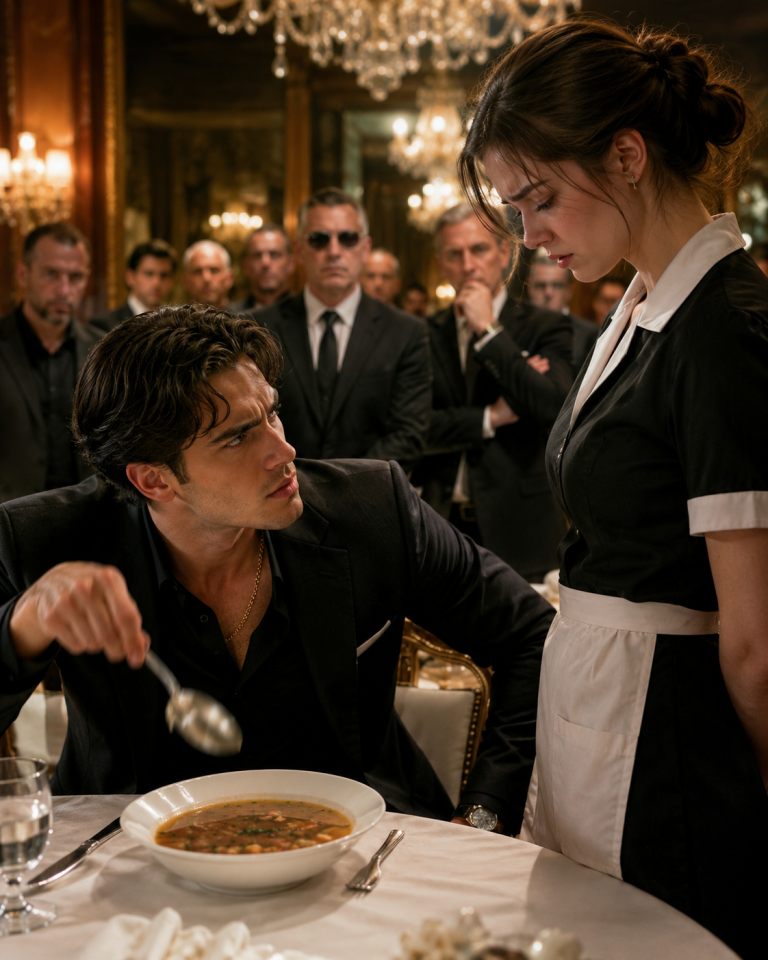
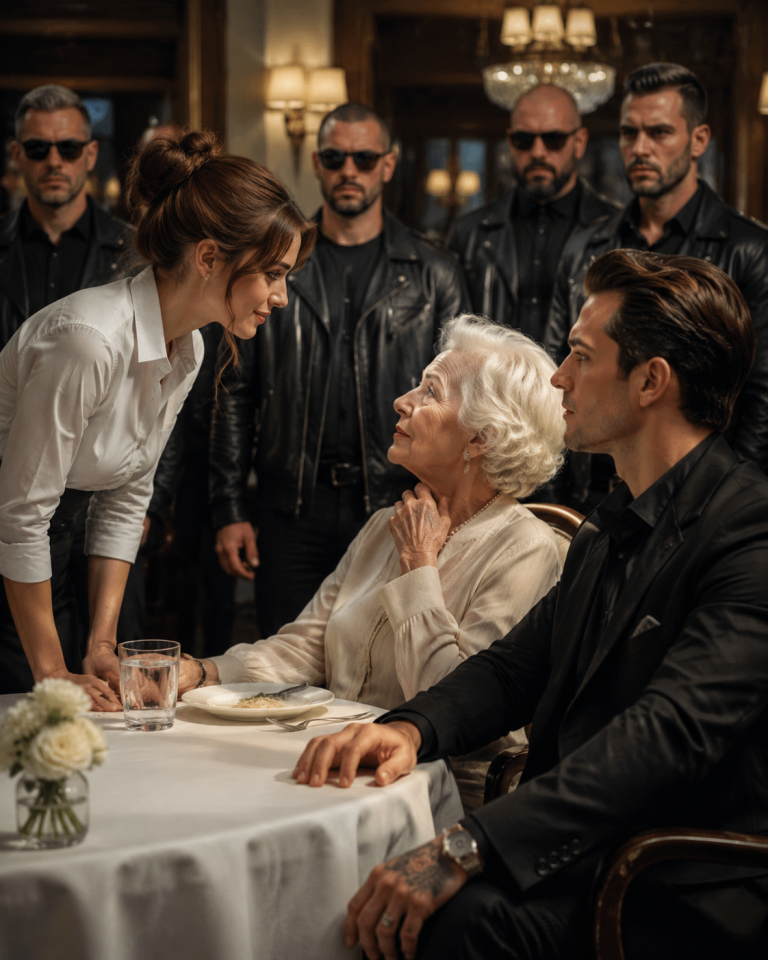
She Went to End a Six-Week Pregnancy—Then the Mafia Boss Discovered She Was Carrying His Triplets

## PART 1
The ultrasound machine made a sound like a slow tide.
I had been staring at the ceiling tile — water-stained, shaped approximately like a swan — for two minutes while the technician moved the wand and said nothing, which was the kind of nothing that had its own specific weight.
The tile, the tide, the nothing.
I had been trying to find something to look at besides the screen, because I was not yet ready to see what was on the screen, and the ceiling had been working fine until the technician stopped moving.
“Ms. Okafor.”
Her voice had changed.
I looked.
On the monitor, in the particular gray-and-black language of early pregnancy imaging, three separate shapes pulsed in the dark.
Three.
I pressed my lips together.
My name is Imara Okafor. I was twenty-six years old, I was in a Boston clinic on a Tuesday morning in November, I had forty-three dollars in my checking account and a studio apartment in Dorchester with a bathroom door that didn’t fully close, and I had come here because I had found a pregnancy test in the back of my bathroom cabinet seven days ago and the two lines had appeared before I finished reading the directions.
Three.
I sat up.
The technician’s expression was doing something careful.
“I need to get the physician,” she said.
“I understood you the first time,” I said, which was unkind, and then I said, “I’m sorry,” because even in the middle of a crisis I couldn’t stop apologizing for things.
The doctor came. She looked at the screen. She used the word *triplets* in the way people used words when they were genuinely unsure whether the receiving person would remain conscious.
I remained conscious.
I put both hands flat against my thighs and breathed through my nose and thought: *this was the November that ended everything.*
Eleven weeks earlier, at a charity gala in Cambridge I had been hired to coordinate, I had met a man named Sable Vance at the edge of the terrace while the string quartet played something nobody was actually listening to.
He had handed me a glass of champagne I hadn’t asked for and said, in a voice that managed to sound like an apology and a dare simultaneously: *you’re the only person here who looks like they’d rather be somewhere else.*
I had said: *I’m working.*
He had said: *I know. I asked about you.*
At twenty-six, having spent most of the previous three years not being asked about, I had found this particular sentence difficult to recover from.
I knew who he was in the abstract — the name Vance carried the particular resonance of old Boston money in the same way certain buildings carried the smell of previous centuries. But knowing who he was and sitting on the terrace with him while the October cold settled in were different categories of experience.
By morning, he was gone.
He left before I woke. I didn’t know whether to be relieved or insulted, and then I decided to be neither, and then November arrived and I found the test in the back of the cabinet.
I had not told anyone.
I had come to this clinic to make a decision.
Now I sat with three impossible heartbeats and a physician who was saying words about prenatal care while I stared at the water stain on the ceiling and thought about forty-three dollars.
The door to the exam room burst open.
Not the physician. Not a nurse.
Two men in dark coats who moved wrong — wrong for a medical building, wrong for a Tuesday morning, wrong in the specific way of people who were deployed rather than arriving.
The physician said: “This is a private—”
The first man looked at me.
“Ms. Okafor. We need you to come with us.”
“No,” I said.
“That wasn’t a request.”
I slid off the table and walked past him through the still-open door, which was not a plan so much as a reflex. The corridor had another man in it. I turned left, found a supply closet, got inside, and locked it behind me before my brain caught up to what my body was doing.
Through the door: voices. Movement. Someone saying a name.
*Vance needs her now.*
Vance.
I stood in the dark between shelves of gauze and latex gloves and understood that the October terrace had been more complicated than I knew.
Above the utility sink, a small window.
I climbed.
The alley behind the building smelled of wet concrete and restaurant exhaust and I landed on my hands and knees and did not stop moving.
I made it two blocks before the black car arrived.
It didn’t screech or lurch. It simply appeared at the corner and stopped, precise and inevitable, as if it had always been going to be there.
A woman stepped out.
I had expected another man in a dark coat. Instead: tall, late thirties, hair cut short, the kind of professional competence that wore a dark suit the way other people wore armor.
“Ms. Okafor,” she said. “My name is Dara Kline. I work for Sable Vance.”
“Then we have nothing to discuss.”
“Three heirs to the Vance succession are worth more than any leverage anyone has ever used against him.” She said it without warmth, without cruelty, simply as information. “Someone else just learned you were pregnant. Someone who arrived at that clinic before us.”
I stopped walking.
“Who.”
“Get in the car and I’ll tell you.”
“That’s not how trust works.”
“No,” she said. “It isn’t. But the other car at the north end of the alley is not ours.”
I looked.
At the far end of the alley, a second vehicle sat with its engine running.
Neither of us moved for three seconds.
Then I got in Dara’s car, because the alternative required a different kind of courage than I currently had available.
The door closed.
The car pulled out.
And on the screen of Dara’s phone, where she had set it on the seat between us, a message was already waiting.
*Congratulations, brother. Three is considerably better than one.*
Sable Vance’s face, reading over my shoulder, went the color of old stone.
—
## PART 2
The estate materialized from the November fog like something that had decided to be there and hadn’t asked permission.
I had expected opulence — the particular kind that announced itself loudly to compensate for how recently it had been earned. What I found was older. Stone and iron and the quiet arrogance of things that had simply outlasted everything else.
Dara brought me inside.
The housekeeper — a woman named Mrs. Adeyemi who had the bearing of someone who had weathered considerable weather and found it insufficient to change her fundamental opinions — appeared with tea and what appeared to be prenatal vitamins on a small tray.
I looked at the vitamins.
“How did you know what week I was in?”
Mrs. Adeyemi’s expression didn’t shift. “Mr. Vance maintains thorough records.”
I set down the tray.
Sable appeared in the doorway.
He looked like the terrace version of himself, only slightly wrong in the way photographs were wrong — accurate and somehow missing the dimension that made the real thing convincing. He was watching me with the expression of a man trying to decide how to carry something very heavy.
“You had me followed,” I said.
“I had you protected.”
“You left without leaving a number.”
“To protect you.”
“You keep using that word like it explains things.”
He crossed the room and stopped where I could have reached him or stepped back from him with equal ease. He was doing this deliberately, I understood. Giving me the choice of the geometry.
“I left,” he said, “because being seen with me makes people targets.”
“By whom.”
He looked at the phone Dara had set on the table.
*Three is considerably better than one.*
“My brother,” he said.
“You don’t have a brother.”
His silence contained multitudes.
“You have a dead brother,” I said.
The correction landed and he absorbed it.
“We believed he was dead,” he said. “The fire at the north docks. Three years ago. A body was found with his identification.”
“Identification can be moved.”
“Yes.”
I thought about the second car in the alley. The timing. The way Dara had said *someone else learned you were pregnant* with the particular urgency of information that had arrived seconds too late to be comfortable.
“He was at the clinic,” I said.
Sable’s jaw tightened. “Before us, yes.”
“He knew I was there.”
“Yes.”
“Which means someone told him.”
He looked at Dara.
Dara said, “We’re working on that.”
I looked at the vitamins on the tray and thought about three pulses in a dark room and a decision I had come to make that was no longer simple.
“What does he want,” I said.
“What he has always wanted,” Sable said. “The Vance succession. The assets. Everything my father built and left to me instead of him.”
“And my children give him that.”
“If he can claim them before they’re born, before I can establish paternity through legitimate channels, yes. He can create a succession challenge that would take years to untangle.”
“Years.”
“Or,” Dara said quietly, “something more permanent.”
The room was cold in a way that had nothing to do with the November outside.
I had come to this clinic alone that morning.
I was still alone, technically.
But the world had just revealed how large a crowd alone could be.
“I want an attorney,” I said.
“I have—”
“*My* attorney,” I said. “Someone who works for me. Someone who has never been in this building.”
Sable looked at me for a moment.
“Yes,” he said.
“Tonight.”
“Yes.”
“And then you’re going to tell me everything. From the beginning.”
He didn’t negotiate. He didn’t explain. He simply said: “Yes.”
Which was either the most dangerous thing he had ever said to me, or the first honest one.
The lights went out.
All at once, every lamp in the room died, and in the sudden dark, from somewhere deep in the estate, I heard a sound that made no sense.
A music box. Playing a lullaby I had not heard since my mother died.
—
## PART 3
The lights came back thirty seconds later.
The music box did not continue.
I stood in the center of the room trying to determine whether I was afraid or simply very, very awake.
Sable was already at the door, speaking to Dara in a low voice that meant something was wrong that he was choosing not to describe to me immediately.
“What was that?” I said.
He turned.
“A lullaby,” I said. “Where did it come from.”
“The east wing. It’s been sealed.”
“Sealed since when.”
“Since my brother died.”
The way he said *died* was doing something complicated, and I was beginning to understand that Sable Vance communicated a great deal through the spaces around words rather than inside them.
“His rooms are in the east wing.”
“His rooms and one other.”
“Whose?”
He looked at me with the expression of a man deciding, finally, that the cost of the truth was less than the cost of continuing to owe it.
“A woman named Adaeze Okafor lived in the east wing for fourteen months.”
My hearing narrowed.
“That’s my mother’s name.”
“Yes.”
“My mother died four years ago.”
“Yes.”
“In Lagos.”
“That is where she had been sent.”
The room performed a slow rotation that had nothing to do with the physical structure of the building.
“Sent,” I said.
“By my father. For her protection. After she discovered what my brother was doing.”
I sat down.
Not because I decided to. Because my legs made the decision before I did.
Sable sat across from me.
Not beside me. Across, where I could see his face.
“Your mother,” he said carefully, “was employed by the Vance Foundation for three years. She was an accountant. She found discrepancies. My brother was using Foundation accounts to move money through several networks.”
“And your father sent her away.”
“My father was afraid she would be killed if she stayed. He thought sending her back was safety.”
“She died four years ago of a cardiac event.”
Sable’s face told me what he was deciding not to say.
“Was it natural,” I said.
“We don’t know.”
“Do you suspect.”
A long pause.
“My brother’s people had networks in Lagos.”
I pressed both hands to my knees.
Outside the windows, November pressed against the glass.
I had spent four years grieving a woman who died too young of a heart event in a city where she was supposed to be safe. I had worked my way through her estate, the small apartment, the careful savings she had left me, the handwritten notes in margins of books about accounting and integrity and doing the right thing regardless of who was watching.
She had been watching.
She had been found.
“She knew about me,” I said. “And you.”
Sable looked at the floor, then back at me.
“My father arranged the gala. He invited you specifically. He had been watching your career — you were already doing exceptional work in event coordination, and your name was on the Foundation’s donor thank-you list. He told me only that someone remarkable would be there.” A pause. “He died six weeks later. I don’t know everything he planned.”
“But he wanted us to meet.”
“Yes.”
“Because of the bloodline.”
“Because of the blood agreement.”
The words arrived like something old and heavy being set down on a table.
“Explain,” I said.
Mrs. Adeyemi appeared with tea I had not asked for and which I accepted because my hands needed something to hold.
Sable walked to the far shelf and removed a flat wooden box, small, latched with brass. He placed it on the table.
Inside: a document. Two pages, handwritten in two different hands. At the bottom, two signatures, dated twelve years ago.
One was Sable’s father.
The other was my mother’s.
I read it slowly, because it deserved that.
The agreement was simple in its structure and enormous in its implications. The Vance and Okafor families had a long professional entanglement — the Foundation, the shipping networks, the legitimate businesses. In the event that a direct descendant of Adaeze Okafor bore children with a direct Vance heir, the legal control of the Vance estate’s legitimate holdings would pass not to the male heir but to the mother of those children, held in trust until the children reached adulthood.
A matrilineal succession clause.
Hidden inside a private document for twelve years.
“My mother wrote this with your father,” I said.
“She proposed it. He agreed. He had been watching what his younger son was becoming, and he wanted a mechanism that would remove the prize my son could fight over.” Sable’s voice was quiet. “If the succession goes to the mother — not to me, not to my brother, but to you — then there is nothing to fight over. The prize belongs to someone neither of them can claim through blood.”
“And your brother knows about this.”
“He found the document three years ago. Before the fire.”
“Before he supposedly died.”
“Yes.”
“He faked his death to escape prosecution and spent three years planning his return.”
“Yes.”
I looked at the two signatures.
My mother’s handwriting was the same as the marginalia in her books.
Careful. Precise. Thinking ahead.
“She knew,” I said.
“She hoped,” Sable said. “She didn’t know it would be you, specifically. She knew the terms she had written.”
“She prepared a trap and put me in it.”
“She prepared a door,” he said. “And chose whether I walked through it.”
That distinction mattered.
I stayed with it.
Dara knocked and entered.
Her face was doing the controlled-alarm thing.
“Rhys is in the building,” she said.
Sable stood.
Rhys. Not *my brother*. Not *the threat*. A name. Specific, particular, belonging to a person rather than a concept.
“How.”
“East passage. Someone left a door open.”
“Who.”
Dara’s expression gave me the answer before her words could.
“The kitchen assistant,” she said. “New. We’re still verifying who hired him.”
The room understood what that meant.
The leak was inside.
Sable looked at me. “You need to go to the safe room.”
“Tell me where it is and I’ll go myself.”
“Dara will—”
“I heard you the first time. I don’t need to be escorted like furniture.”
Something shifted in his face. Not offense.
Recognition.
“East wing. Third corridor. Steel door, code is my mother’s birthday.” He said the numbers. “Do you have them?”
“Yes.”
“Go.”
I went.
The east wing was cold and largely dark, lit only by emergency strips along the floor that threw everything into shadow and unflattering angles. The third corridor smelled of old wood and a faint floral scent that might have been my imagination.
Or might not.
The steel door was where he said it would be.
I entered the code.
The door opened.
And Rhys Vance was already inside.
He looked like Sable the way a photocopy looked like an original — the shape was correct but something in the quality was different, flatter, the paper thinner. He was thirty-eight or forty, handsome in a way that had recently become harder.
He was sitting in the only chair.
“Ms. Okafor,” he said. “I’ve been wanting to speak with you since the clinic.”
I held the door open behind me.
“Then speak quickly.”
“I want to offer you something. My brother will tell you the succession document gives you power. That’s true. He won’t tell you it also makes you the single most threatened person in New England.” His voice was pleasant. “I can make that threat disappear.”
“In exchange for.”
“A simple legal declaration. That the pregnancy is medically unviable and that you waive all Vance inheritance claims.”
“On behalf of children I haven’t delivered yet.”
“Yes.”
“You want me to legally abandon children who are currently alive.”
“Medically unviable is the standard—”
“To you,” I said. “Not to me. And I’m the mother.”
His pleasantness thinned.
“Ms. Okafor.”
“I know what this is,” I said. “You faked your death to escape what your mother’s accountant found. You spent three years waiting. You arrived at a clinic this morning hoping to reach me before your brother did.” I looked at him steadily. “You need my signature on paper because you cannot touch those children without it. And the reason you cannot touch them without it is because my mother spent three years building a document that made sure of exactly that.”
Rhys stood.
“Your mother is dead.”
“Her work isn’t.”
He reached inside his coat.
I stepped back and let the door swing fully open.
Dara was in the corridor.
With three people I did not recognize who turned out, when identified properly later, to be federal investigators from two jurisdictions.
Rhys looked at the door.
Then at me.
Then at the federal agents.
“The room has been live-recording since I entered,” I said. “I pressed the button on the inside panel when I came in.” I had not known what the button was. I had pressed it because it was the only button available and pressing something felt better than standing still. Mrs. Adeyemi told me later it was precisely what it was. “Whatever you just said about waiving inheritance claims on living children belongs to the federal record now.”
Rhys said nothing.
His expression was doing several things at once, none of them pleasant.
I stepped into the corridor.
Dara touched my arm briefly.
“Good,” she said.
“I aimed at the wall,” I said.
She almost smiled.
—
The next several months were not clean.
Nothing about the dismantling of a carefully built criminal network was clean. There were hearings I had to attend in rooms with fluorescent lights and institutional carpet, where men in suits asked me to describe conversations I had recorded on accident and would have preferred not to have had. There were frozen accounts and legal motions and a period of three weeks in which Rhys’s people attempted to contest the succession document on grounds of duress.
The judge reviewed the document.
She noted that the date was twelve years prior.
She noted the signatures were independently verified.
She noted that the claim of duress required a party to demonstrate they had been under duress twelve years ago, which Rhys’s legal team found difficult to establish, given that his official position was that he had been dead for three of those years.
The claim was dismissed.
My attorney, a woman named Folake Adisa who I had found through a professional referral and who had never met a Vance before I sat down across her desk, built the succession case with the methodical patience of someone who genuinely enjoyed watching inherited power evaporate.
“You’re going to control significant assets,” she told me.
“I know.”
“Have you thought about what you want to do with them.”
“I’ve thought about very little else,” I said. “For three months.”
Sable and I did not speak for forty-one days after Rhys’s arrest.
Not because we were angry.
Because I needed to understand what I thought about all of it without anyone else’s influence in the room.
My mother had built a document designed to end a family war. She had built it as protection, then been removed from the city for the same reason. She had died — whether naturally or not, the investigation was ongoing — four years later, and she had left behind a daughter who didn’t know any of it.
I was angry.
I was also proud of her.
Those two things lived inside me simultaneously with the discomfort of things that are both true.
On the forty-second day, Sable called.
I let it ring twice.
Then I answered.
“I’m not going to apologize for the gala,” he said. “Because I didn’t know the full design. I thought my father was introducing me to someone interesting.”
“He was.”
“He was.”
“He was also engineering a succession outcome.”
“Yes.”
“Which benefited you too.”
“It removes the prize from contention,” he said. “You’ve read the document. If you control the legitimate assets and the trust, there’s nothing for Rhys to take. There’s nothing for me to take either.”
“I know.”
“Is that why you’re angry.”
“I’m angry,” I said, “because my mother died in a city she was sent to for safety, and for four years I thought it was a coincidence.”
His voice was quiet. “I know.”
“And because I went to that clinic to make a decision in private and I found out in a car with a stranger that nothing about my life was private.”
“Yes.”
“Both of those things were done to me by men trying to manage outcomes.”
“Yes.” A pause. “I am one of those men.”
“I know.”
“What do you want me to do.”
I looked at the ultrasound photo on my desk.
Three little shadows.
Three futures that were not yet decided.
“I want you,” I said, “to stop managing outcomes and start being honest about them. There’s a difference.”
“Yes,” he said. “There is.”
“We’re going to figure out what we are,” I said. “Slowly. On terms I set. And if at any point those terms are violated, I have Folake Adisa’s number memorized and she already knows your full financial history.”
He was quiet for a moment.
“I understand.”
“Good.”
“Imara.”
I waited.
“I went looking for you in October because my father told me to. I stayed on that terrace for three hours because I wanted to.”
The thing about Sable Vance was that he was occasionally honest in a way that cost him something. This was one of those moments.
I noted it.
“I’ll call you Thursday,” I said.
I hung up.
—
I gave birth on a Sunday in March when a late-season storm was making the city rethink its preparations.
Folake drove faster than she ever admitted to in professional settings.
My cousin Amara was at the hospital when we arrived, having flown in from London three days early on a feeling she could not explain and which turned out to be correct.
Sable arrived twenty minutes after I did, slightly damp, eyes open a fraction too wide.
I grabbed his sleeve when he came close.
“You did this.”
“Yes.”
“I have complicated feelings about that.”
“I know.”
“Don’t leave.”
“Not unless you tell me to.”
The first child arrived at 3:42 a.m.
A boy.
Dark eyes, furious expression, lungs that immediately established the quality and volume of his opinions.
The second arrived at 4:18.
A girl.
Calm, observant, looking at the room with the focused attention of someone taking notes.
The third arrived at 4:51, while the storm began its half-hearted retreat and the first gray light of Sunday pressed against the window.
Another girl.
She looked at me.
Just looked.
I named them in the order they arrived.
The boy I called Jude.
The first girl I called Ada — for Adaeze, my mother’s name in full, the name before the shortened one she used in Boston boardrooms and university accounting departments and the handwritten margins of the books she left behind.
The second girl I called Maike.
Sable looked at me when I said Ada.
“Yes,” I said.
He nodded once.
He held her for a very long time without saying anything, which I suspected was the most honest thing he had done in years.
—
The trust documents were finalized in June.
Folake gathered everyone in a conference room: me, Sable, Amara as my representative, two independent trustees, a federal court observer, and a judge who seemed to have arrived already tired and become more tired upon learning the details.
Folake read the relevant clause.
*The trust may not be controlled, accessed, or directed by any Vance male heir, any appointed successor, any company or person controlled by or acting on behalf of the preceding, or any institution that has received consideration from the Vance family in the prior ten years. Control passes to the birth mother of the qualifying heirs and is held in her name until the youngest heir reaches majority.*
The judge looked at me over her glasses.
“You’re aware of the scope of the assets.”
“Yes.”
“And you have representation.”
“Ms. Adisa has been representing me throughout.”
“And your intentions for the trust.”
I had been thinking about this for seven months.
“Legitimate operations continue under existing management with oversight from the trust. All assets connected to the networks my mother documented are surrendered to the federal seizure process. The remaining legitimate capital — the Foundation, the construction companies, the property holdings — gets restructured under a community development charter.”
The judge looked at Folake.
Folake looked at the table.
“Specifically,” I said, “we’re beginning with housing. Emergency transitional housing for women in circumstances similar to mine seven months ago. Women who don’t have forty-three dollars.”
The judge was quiet for a moment.
“Your mother would have approved,” she said.
I looked at the table.
“She designed the mechanism,” I said. “I’m just the accountant.”
—
A year after the clinic, I stood in the east wing of the Vance estate.
The rooms had been opened and cleaned and repurposed. The sealed corridors now connected to what would become the operational center of the Cole Foundation — which was not its official name, but what we called it, after the word in my mother’s language for *home.*
Mrs. Adeyemi came in with tea I didn’t particularly need and which I accepted because some habits were worth keeping.
Sable was somewhere in the building. He had taken a small office in the north wing, where he managed the legitimate company operations under trust oversight, and he was reportedly good at it and reportedly very boring at parties now that he had nothing to hide.
I found him in the garden with Ada.
She was eight months old and had opinions about grass, specifically that it was interesting and should be put in her mouth, a position Sable was quietly but firmly negotiating against.
He looked up when I came around the hedge.
“She’s determined,” he said.
“She gets that from her grandmother,” I said.
He looked at Ada.
She looked back at him with the measuring attention she brought to everything.
“Imara.”
“Yes.”
“I loved you badly at first. I want to do it better.”
I sat down on the stone bench beside him.
Ada immediately redirected her grass interest toward my sleeve.
“You can start,” I said, “by being boring in the ways that matter and interesting in the ways that don’t.”
He thought about this.
“What does that mean, specifically.”
“Show up. Tell the truth. Change the diapers that need changing.”
“All three.”
“All three.”
Ada made a sound of specific approval.
Sable looked at her.
Then at me.
The morning light came through the garden at the angle that made everything look like the beginning of something.
It was.
My mother had built a door out of legal language and patience and the particular courage of a woman who knew she might not be there to see it open.
I had walked through it carrying more than I knew.
On the other side was not a throne.
Not an empire.
Not a name that made grown men lower their voices.
Just three children growing steadily louder, and a garden in the morning, and the beginning of the first day of a story that belonged entirely to us.
*THE END*