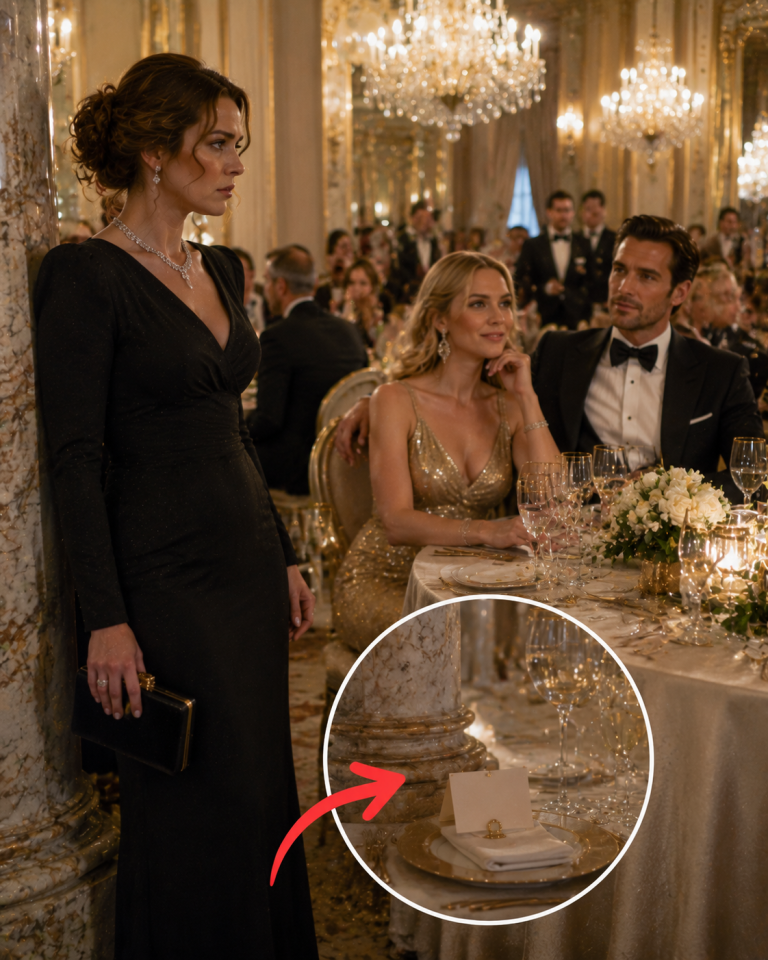
The Mafia Boss Found Her Chained in the Basement—Inside His Brother’s House

## PART 1
The first thing she noticed when she woke up was the smell.
Not the sound of the chain. Not the weight of it around her ankle. Not the dark so complete it pressed against her eyes like a physical thing. The smell came first: damp stone, rust, the particular cold of a room that had never been warm. It entered her lungs before fear did, and for one disoriented second it was simply the most real thing in the world.
Her name was Caitlin Park. Twenty-nine years old. Emergency room nurse at Boston Medical, seven-year veteran of twelve-hour shifts, two cups of coffee minimum before seven a.m., and a reputation for staying calm in exactly the kind of situations that made other people’s hands shake.
She had no memory of how she had arrived here.
The last clear thing she carried was the parking garage. November cold. Her ID badge still clipped to her scrubs. The sound of her own footsteps on concrete and then — nothing. A gap so complete it felt surgical.
After that: darkness. Metal around her ankle. Concrete under her cheek.
She had screamed in the beginning.
Of course she had. Anyone would. She had screamed until her voice shredded and then kept going on something past sound — pure desperate noise that her body produced because it had not yet accepted that no one was coming. The first days she had wept, counted, tried to reason her way toward rescue through sheer force of internal argument. She had catalogued symptoms the way a nurse does — dehydration timeline, caloric deficit, the early tingling in her fingers that meant circulation was being impaired by the chain’s weight — because clinical thinking was the only thinking she trusted not to break her.
The man who brought food wore a mask.
He never spoke.
She tried six times. Different approaches: calm, then pleading, then angry, then clinical — describing her medical condition with professional detachment, hoping competence might function where emotion had not. He set the food down and left. Always the same routine. Always that particular silence that felt less like cruelty than like a person following instructions they had already decided not to question.
She stopped counting days somewhere around the second month.
Not from despair. From a different calculation: counting days required energy, and energy had become currency she could not afford to spend on anything but staying present. Staying alert. Staying, in every way that mattered, herself.
On the night everything changed, she heard voices above her for the first time.
Not one voice. Several. Overlapping and urgent, with the clipped rhythm of people communicating through a crisis already in progress. Heavy movement. A crash that sent dust sifting from the ceiling. Then something that sounded like a command — sharp, absolute, not quite audible through the floorboards but unmistakably structured.
Caitlin pressed herself into the corner. Chain scraping. Heart loud enough to embarrass her.
The door at the top of the stairs burst open.
Light — even just flashlight — was agony after months of dark. She threw her arm across her face and felt tears run from pure physical reflex.
Boots on the stairs.
Two sets.
A shape stopping several feet away.
She waited for the worst.
Instead, silence.
Then: “God.”
One word. Low, almost inaudible. Spoken not to her but to the room itself, as if the room required an acknowledgment of what it contained.
“Get the cutters. Call Dr. Esposito. My house, forty minutes. I don’t care what he has tonight.”
His accent was Italian. Boston-inflected, but underneath that, older. His voice had the particular quality of someone who had long since learned to contain whatever he felt when something required containing.
He crouched.
He kept distance between them — deliberately, she registered. Not the distance of someone who found her threatening. The distance of someone who understood that his size and her condition created a geometry that could be frightening regardless of intent.
“I’m not here to hurt you,” he said.
She believed him.
Not from logic. Logic had no data on this man yet. She believed him because when you have been genuinely afraid for three months, the body learns to distinguish between the fear of danger and the fear of the unknown, and what she felt right now was the second kind.
“My name is Dante,” he said. “Dante Morvillo.”
The name did something to the air.
Even through terror, even through months of isolation, even with her brain running on depletion — Morvillo. She had heard that name in hospital corridors. In the way certain men declined to give their surnames at intake. In the careful silence that fell around it when it surfaced.
“Tell me yours,” he said.
“Caitlin.” Her voice came out fractured and unfamiliar. “Caitlin Park.”
He pulled his phone from his jacket. Typed something. Looked up.
“You’re a nurse. Boston Medical.”
“I was.”
“You are,” he said. The correction was quiet but complete.
His second man appeared at the bottom of the stairs carrying bolt cutters and stopped so completely still when he saw the room that Dante said, without turning: “Yes. I see it.”
The chain snapped with a sound that shook through her whole body. The absence of weight was dizzying. She swayed, and Dante’s hands closed around her upper arms — not gripping, not restraining, not anything except making sure she didn’t hit the floor.
That distinction. That small, careful, immediately legible distinction.
“When did you last eat?” he asked.
She tried to calculate. Couldn’t.
He said something low in Italian and then lifted her. She wanted to say she didn’t need it. Her body had no interest in that argument. It had been three months. Pride required more infrastructure than she currently had.
He carried her upstairs.
Above the basement, she saw a house that made no sense against what was below it. Marble. Warm light. Expensive things arranged with the comfortable confidence of someone who had never lived any other way. Men moving through rooms with military purpose. Art on walls. A kitchen with a professional range.
Someone had lived above her.
For months.
The rain was loud on the driveway. He wrapped his jacket around her before putting her in a black car, and the warmth of it — the simple, animal warmth of cloth that had been against a body — made her close her eyes and breathe.
“Where are you taking me?” she managed.
“My home. You need a doctor. Food. Time.”
He turned to the driver and began giving instructions in a voice that expected compliance and got it. Names. Properties. Surveillance records. Contractors. Visitors.
Then: “Find Emilio. Tonight.”
Emilio.
The name moved through her like something electric and terrible.
Dante’s head turned.
He saw her face.
“You know that name.”
Not a question.
Caitlin swallowed.
“Eight months ago,” she said. “He came into the ER. A fall — minor concussion, wrist fracture. I was his primary nurse for four hours.”
Dante was very still.
“He wanted my number. I said no. He came back the next day with flowers at the nursing station. I had security remove him.” She stopped. “He smiled when they escorted him out. Like I’d made a decision he planned to revisit.”
Silence filled the car from the inside.
Then Dante said, with the careful precision of someone constructing a sentence around something that could detonate: “Emilio Morvillo is my younger brother.”
The words arranged themselves in front of her like a before and after.
The man who had chained her underground.
And the man who had just cut that chain.
Brothers.
“Was,” Dante said. His voice had changed. “After what he did to you, that word covers less than it used to.”
Caitlin stared at him.
And in the silence that followed, the only sound was the rain and the city sliding past outside and the specific internal noise of a person trying to decide whether the danger she had just escaped was smaller or larger than the one she was currently riding toward.
She did not know the answer yet.
But she noticed he had not moved away from her side.
And she noticed, because she was a nurse and noticing was how she survived, that his hands — resting now on his knees, fingers loose — were shaking.
Not from weakness.
From something held very tightly that needed somewhere to go.
—
## PART 2
The Morvillo estate appeared behind iron gates in the rain like something built to end arguments.
Three stories. Stone and glass. Grounds lit from below so the trees became architecture. Guards at the perimeter moving with the trained visibility of people who wanted to be seen as deterrence rather than threat.
The gates closed behind the car.
That sound — the heavy, hydraulic finality of it — made Caitlin’s breath stop.
Dante noticed.
“I know what that sounds like right now,” he said. “But the lock is on this side. You can leave whenever you are physically able. That is not a comfortable arrangement for my security team. I have chosen to make it one.”
She looked at him.
He did not look away.
An older woman waited at the front entrance, and her face when she took in Caitlin’s condition went through several things before arriving at something Caitlin could only describe as quiet fury — not at her, but at the fact of her.
“Rosa,” Dante said. “The east room. Dr. Esposito. Fluids and broth on arrival.”
“Already calling.”
The house inside was warm and smelled of something familiar — lemon and clean linen — in a way that made her eyes sting unexpectedly. Dante carried her to a bedroom with high ceilings and soft light and set her on the bed with the same care he had shown in the basement, as if he had established a protocol for handling her and intended to maintain it.
“Rosa will stay with you,” he said. “The doctor will be here within the hour. I’ll be in the hall.”
“Why the hall?”
“Because I am not welcome in your room without your invitation, and you have not given one.”
She stared at him.
“You’ll stand in the hallway all night?”
“If necessary.”
Caitlin searched his face for the angle — the performance of consideration disguising something else. She found nothing she could name as performance.
“Stay until the doctor comes,” she said.
He sat in the chair by the door without question.
And that night, after Dr. Esposito confirmed infection beginning, mild malnutrition, early nerve damage at the ankle, and the particular clinical findings that no one writes down directly but that mean a person has been afraid for a very long time — Dante sat in that chair while Rosa changed Caitlin’s bandages, and he did not speak, and he did not leave.
When she finally slept, it was the first sleep without jerking awake in three months.
She didn’t understand why until morning, when she woke and found the chair empty but the door still open — like a proof left behind.
He had kept his word.
And somewhere in the night, without deciding to, she had trusted that he would.
The question she couldn’t answer yet was what that meant, and whether trust in this house was something she had chosen or something three months of darkness had made her desperate enough to manufacture.
She needed to know which one it was before it mattered more than it already did.
—
## PART 3
The first week passed in fragments.
Sleep. Medicine. Rosa’s hands, steady and warm, changing the dressing on her ankle every morning without comment. Dr. Esposito’s calm assessments delivered in the manner of a man who had seen things he preferred not to editorialize about. Broth that tasted expensive and then simple food that tasted like the concept of food rather than any specific ingredient — exactly right for a body relearning how to receive nutrition.
Dante stayed beyond the doorway.
He did not push. He did not appear and disappear in ways designed to demonstrate his restraint. He was simply present in the house in the way people are present in spaces they actually inhabit — voices in corridors, the particular weight of footsteps on stairs she began to recognize, the sound of him on calls in his study giving orders in two languages.
On the fifth morning, Caitlin got up before Rosa arrived.
The clothes laid out fit. Someone had taken her measurements at some point, which she filed under the category of things she would address later when she had more energy for outrage. She dressed and found a small dining room and sat down at a table with eggs and coffee and the particular brightness of a room whose windows had been cleaned recently.
Dante appeared in the doorway a few minutes later.
Different in daylight. Still controlled, but the darkness around his eyes was visible now — the specific exhaustion of someone who had not been sleeping and was managing it through discipline rather than resolution. White shirt. Sleeves rolled. No jacket.
“May I?” He indicated the chair across from her.
She nodded.
He poured coffee and did not speak immediately. She had expected questions the moment he sat down. Instead, the silence stretched for nearly a full minute, and it was not uncomfortable. It had a quality she recognized from long shifts — the silence of two people operating in the same space who have briefly agreed not to make the other perform.
“You have questions about Emilio,” she said.
“Yes.”
“And you’re going to tell me you won’t force me to answer them.”
“I’m going to tell you exactly that.”
“But the sooner you understand the sequence of events—”
“The sooner I find him,” he said. “Yes.”
Caitlin wrapped both hands around the mug.
She told him. April. The ER. The fall. The four hours of professional attention she had given a man she would not recognize as dangerous until it was too late to matter. The request for her number, declined twice. The flowers the following day. Security. The smile.
“He has always hated the word no,” Dante said when she finished.
“Your father’s influence?”
Dante’s expression shifted into something controlled and complicated. “My father’s permission. There is a difference. I stopped extending that permission when I took over. Emilio considered it a betrayal.”
“What kind of organization?”
He looked at her directly. “You already know the answer.”
“I want to hear your version.”
“My version is: organized crime with a long history and an ongoing attempt at legitimacy. Some of what we do cannot survive examination. Other parts of it are—” He paused. “More defensible than the whole.”
“That’s careful language.”
“I choose careful language when the careless kind would be dishonest.”
She studied him.
“What kind of man takes his family’s criminal empire and tries to make it legitimate?”
“A man who inherited a choice he didn’t make and is trying to make different ones.” He set his cup down. “I know that answer is insufficient. I’m not asking you to find it satisfactory. I’m asking you to find it true.”
She did.
That was the part she kept returning to over the following days — not the power, not the house, not the particular danger of his world pressing against the edges of every conversation. But the fact that she kept testing his honesty and finding it hold.
The nights were still bad.
She woke screaming on the third night and then again on the sixth, and both times there were footsteps in the hall within seconds that stopped outside the door without coming through it. The second time she said, through the door, “You can come in.”
He did.
He sat in the armchair across the room. Not crowding. Not speaking. Just the particular solidity of another person present in the dark.
“Does this happen to you?” she asked once.
“The nightmares?”
“Waking up and not knowing where you are.”
“Yes,” he said. “Different reasons.”
“What do you do?”
“I remind myself of the specific facts of the room. The ceiling height. What floor I’m on. The sound outside the window.”
Caitlin looked at the ceiling.
“Twelve feet,” she said quietly. “Second floor. Rain on the glass.”
“Yes.”
She breathed.
It helped.
Before dawn, when she looked over, his eyes were closed — not quite asleep, she thought, but resting in the way of someone who had allowed themselves to temporarily stop watching.
She let him.
—
Two weeks after the rescue, Dr. Esposito cleared her for full mobility and declared the infection resolved.
That clinical improvement created a question neither of them had been ready to address while crisis provided structure: what now?
She found Dante in his study, which looked like an operations center wearing the skin of a private library. Monitors on one wall. Maps. Files. A desk where papers were organized with the precise logic of someone who thought best through physical arrangement.
“Dr. Esposito cleared me,” she said.
“I know.”
“So we need to talk about what comes next.”
He turned to face her fully. “What do you want?”
The question arrived so simply that for a moment she couldn’t locate an answer. No one had asked her that in months. In the basement, wanting had been compressed to survival. In this house, recovering had been the only available agenda.
“I don’t know yet,” she said. “My apartment is probably gone. My job is — I don’t know. My colleagues think I’m dead.”
“They did,” he said. “There was a service.”
A service.
She sat down.
“I can restore your legal identity,” Dante said. “Alive, in recovery, trauma survivor — my lawyers can handle the documentation. Within weeks you’re officially back.”
“And Emilio?”
“Still not found.”
“So I return to my old life and wait for your brother to find me again?”
“No.” His voice was flat. “That is not the plan.”
“Then what is?”
He looked at her.
“There is another option. Not hiding. Not a guest arrangement. Something with actual structure.” He leaned back. “I have men in this house who have not seen a doctor in years because they trust no system except this one. I have connections across the city to people who need medical care and can’t access it safely. You are one of the best emergency nurses Boston Medical has employed in a decade — I checked your record.”
“You investigated me.”
“I investigate everything that matters to me. Yes.”
She absorbed that.
“You’re offering me work,” she said.
“I’m offering you purpose while you figure out what comes next. Clinic space, supplies, proper compensation, controlled access. You build what you need. You decide when you’re ready for something else. The door remains yours.”
“The door remains mine,” she repeated. “You’ve said that before. In different ways.”
“Because I mean it.”
Caitlin looked at him for a long moment.
“One condition.”
“Name it.”
“Nothing about Emilio is managed without telling me first. No decisions made on my behalf while I’m kept in comfortable ignorance. I spent three months in the dark. I won’t go back into any version of it.”
He held out his hand across the desk.
“Agreed.”
His grip was firm and brief, and she noticed — because she always noticed such things now — that he released first.
—
Work reorganized her.
That was the right word. Not healed. Not erased. Reorganized — the way a muscle changes after an injury, not returning to its former shape but building into something that can bear different weight.
The men in Dante’s household arrived at her clinic door slowly and then all at once once word moved through the organization that she was competent and that Dante expected anyone who needed care to use it. Old injuries. Ignored chronic conditions. A shoulder that had been dislocated and improperly healed three years ago. Hypertension across the board, which she addressed with the same directness she’d brought to the ER.
A man named Tomas came in with blood pressure that made her immediately pull a second reading and look at him hard.
“How long has this been happening?”
“How long have what been happening.”
“Tomas. Your blood pressure is high enough to cause a stroke. How long have you had headaches.”
He told her reluctantly: months. She put him on a treatment plan, checked him every three days for two weeks, and called his primary care physician — he had one, he had simply stopped going — to coordinate.
Dante read her notes the following week.
“You may have saved his life,” he said.
“I did what I’m trained for.”
“You noticed what had been invisible to everyone around him for years.” He paused. “That is not nothing.”
He also restored her documents. A full envelope left on the clinic table one morning: social security number, driver’s license, medical license reinstated, a letter from the Massachusetts nursing board confirming her status. She held it with hands that were steadier than she expected.
“What did this cost?”
“Less than what was taken from you.”
“That’s not an answer.”
“You owe me nothing,” he said. “My brother’s actions are my family’s debt. This is a down payment.”
“Debt doesn’t work like that.”
“In my world it does.”
She kept arguing. He kept declining to revise his position. It was, she discovered, a pattern between them: she pushed, he held steady without becoming a wall. He gave ground where it was reasonable and held it where it wasn’t, and after two weeks she had begun to map which was which with surprising accuracy.
Boston Medical reached out through Dante’s lawyers.
They knew she was alive. They wanted to meet. To apologize and discuss returning.
The thought of those automatic doors, that parking garage, her old badge — it entered her chest and sat there, heavy and complicated.
“That hospital was my home for seven years,” she told Dante. “But Emilio knew my schedule. He knew which car was mine. He had help from inside — I think about that every time I imagine going back.”
“You think it was a staff member.”
“I think someone gave him access they shouldn’t have had.”
“We’re looking into that,” Dante said. “If there’s a name to find, we’ll find it.”
That was the first time she realized the investigation hadn’t stopped. It had been running continuously, in the background, with the patience of an organization that knew how to wait.
—
Emilio made contact six weeks after the rescue.
He wanted terms. Information in exchange for leaving the country cleanly.
Dante knew immediately it was a setup. He also did not tell Caitlin until forty minutes before the meeting was supposed to happen.
She found out because she overheard Tomas in the hall.
She walked into Dante’s study and closed the door behind her.
“When were you going to tell me.”
Not a question.
“After,” Dante said.
“After.”
“I was trying to protect—”
“I know what you were trying to do.” Her voice was steady and very clear. “I’ve been doing this with you for six weeks. I have told you in this room, at that desk, that I will not be managed around my own situation. And you chose to tell me after.”
The silence was different from the ones she had learned over the previous weeks.
“You’re right,” he said.
“I’m not asking for an apology. I’m asking for it to not happen again.”
“It won’t.”
She sat down.
“Tell me everything.”
He did.
The plan, the trap he was already building inside the one Emilio was setting. The federal contacts who had been brought in quietly. The evidence package that had been assembled over six weeks. Roberto was not going to walk into a negotiation and walk out free — he was going to walk into a room that had been prepared for him with extreme care.
“I can’t be there,” Caitlin said.
“No.”
“But I want real-time information. Not a summary after. Live.”
“Tomas will be with you. I’ll have a direct line open.”
“And Emilio—”
“Alive if possible. Prosecution if possible. I want you to have a trial.”
She looked at him.
“Not a back alley.”
“Not a back alley,” he confirmed. “You deserve to say what happened in a room where it becomes official record.”
—
Emilio was taken on a Thursday morning.
The trap had been built on every vulnerability he thought he was exploiting. Dante came in not hot with rage but with evidence, with law enforcement coordination, with the kind of patience that had been assembling itself for six weeks.
Emilio smiled when he first saw his brother.
He stopped smiling when he understood the room.
Tomas stood beside Caitlin in the study of the northern house and relayed each update in real time. She sat with her hands flat on the desk and listened to Emilio run out of moves and then sat there a moment longer just breathing.
“Got him,” Tomas said.
She nodded.
“You okay?”
“I will be.”
Inside the debrief afterward, the inside source was confirmed: a logistics coordinator named Vega who had been inside Dante’s organization for eleven years and had been feeding Emilio information about Caitlin’s schedule, her car, her route. Not from ideology. From money. Emilio had paid very well for very specific access.
Dante handed Vega to federal authorities along with documentation of crimes that existed independently of Caitlin’s case and were more than sufficient.
“Revenge is easy,” he told her later. “Consequences that survive you are harder to build. I chose harder.”
Caitlin testified three weeks later.
She gave her account in a conference room with federal agents and attorneys and a court reporter and a bottle of water Dante had placed on the table before she entered and then left without comment. She spoke for two hours and forty minutes. She described everything she remembered in the specific, clinical, organized language of a medical professional who had been trained to observe and report.
When she came out, Dante was in the hallway.
He didn’t ask if she was okay. He had learned by then that the question required more than she had available in that moment, and what she needed was not a question but a presence.
He stood beside her.
She breathed.
Eventually she said, “He’s going to prison for a very long time.”
“Yes.”
“Good.”
They stood there a minute longer.
“I want to go back to the house,” she said.
“Yes.”
“And then tomorrow I want to talk about the clinic.”
“I’ll have Rosa make coffee.”
She almost smiled.
That almost-smile was the most her face had moved in three hours.
—
The clinic opened on a Wednesday.
Caitlin named it herself and put no names on the door. It occupied a renovated storefront on the west side of Boston, chosen for access — public transit, walkable, near the two neighborhoods where she had already identified the largest gap between need and available care. She hired two nurses she knew from Boston Medical who had left under different circumstances. A part-time physician who had done residency with her and worked now without the kind of institutional protection that sometimes made medicine more cautious than it needed to be. A social worker named Priya who described her own credentials as “professionally inconvenient to anyone who ignores structural problems.”
Dante funded it and did not put his name on anything.
That had been her first condition and remained non-negotiable.
The first week was slow. The second week less so. By the fourth week, word had moved through the neighborhood through the channels that actually carry information in communities with good reasons to be cautious of institutions: neighbor to neighbor, family to family, the particular endorsement of having been seen without being managed.
A woman came in with a child and no insurance.
Caitlin treated the child’s respiratory infection, identified the beginning of an asthma presentation that had gone undiagnosed, wrote the scripts, connected the mother to two resources she didn’t know existed, and walked out the back door at the end of her shift to find Dante’s car parked across the street.
He got out when he saw her.
“How was it?”
She looked back at the lit windows of the clinic.
“I stopped being the woman from the basement today,” she said. “I was just a nurse again.”
Dante was quiet.
“Not the same nurse. But still a nurse.”
“That sounds like the beginning of something,” he said.
“Yes,” she agreed. “I think it is.”
—
They did not become simple.
There was no clean turn where past ceased to be present. Mornings still existed where the sound of a lock — any lock, anywhere — could arrive in her chest before her rational brain caught up. There were conversations about his world that went too late into the night and ended unresolved because some things genuinely required ongoing negotiation rather than a single satisfying agreement. There were times she needed to tell him that protecting her was starting to look like deciding for her, and he needed to hear it, and he did, and then he failed again three weeks later and had to hear it again.
He learned. Imperfectly. Persistently.
So did she.
She learned that the fear she felt around his power was not always evidence of danger — that some of it was the residue of three months underground, a filter she had developed for survival that did not automatically deactivate when the conditions changed. She learned to ask herself: is this threat, or is this the memory of threat? And she learned that the answer was not always immediately available, and that Dante, to his credit, had learned to wait for it.
He had been moving legitimate portions of his business forward for years before she arrived. Her presence accelerated something in that. Not because she asked him to — she was careful not to make herself into his conscience or his reformer, which was a role she had no interest in and he had no need of. But something about being seen clearly by someone who had no reason to flatter him seemed to make certain choices easier to make.
He told her this once.
“You don’t ask anything of me,” he said.
“I ask quite a lot.”
“About honesty. About respect.” He paused. “Those are things I am willing to be asked for. The other things — the choices about where my business goes, what I step away from — those are mine. But when I make them in a house where someone I respect can see them, they feel more real.”
“That is either very healthy,” she said, “or a very sophisticated way of making me responsible for your decisions.”
He thought about it.
“Probably some of both,” he admitted.
That honesty was the thing she kept returning to. Not the power. Not the protection. The fact that he said the uncomfortable thing when it was true rather than the comfortable thing when it was available.
—
One year after the night he found her, Caitlin went back to the building on Marlowe Street.
Dante came with her.
The property had been seized and emptied. The house above had been cleared of everything that had made it a home — furniture, art, the expensive trappings of a man who had used aesthetics as cover. Without all of that, it was just a building. Walls, light, the particular smell of old construction.
The basement door was unlocked.
She went down.
The pipe was there. The drain. The marks she had scratched into the wall in the early days before she stopped counting — she found them still, four and a half rows of lines in the east corner, each one a day she had survived before she stopped needing to prove it.
She stood in the center of the room.
Dante stood at the bottom of the stairs and did not come further.
She looked at the marks. At the pipe. At the corner where she had made herself small and tried to take up as little space as possible because space felt like something she had to earn.
She was angry.
The anger was clean and appropriate and present, and she let it be.
Then she turned to Dante.
“I thought this was where I disappeared,” she said.
“You didn’t.”
“No.” She looked around the room one more time. “I waited here. That’s different.”
They were quiet for a moment.
“Are you ready to leave?” he asked.
She looked at the marks on the wall. At the rust-stained concrete. At the door she had once heard close above her and not known if it would ever open again.
“Yes,” she said.
She walked up the stairs first.
He followed.
The door shut behind them.
—
The proposal happened in the clinic.
Not in the garden. Not over dinner. Not with Lucia and fairy lights and a prepared speech.
He came in on a Tuesday evening at the end of her shift. The last patient had gone twenty minutes earlier. She was restocking the supply closet and had her back to the door when she heard him come in.
“You’re late,” she said. “We said six.”
“I know.”
She turned around.
He was standing in the middle of the waiting room with his hands in his jacket pockets, which she had learned meant he was bracing himself for something.
“What’s wrong?”
“Nothing.” He took his hands out of his pockets. One of them held a small case. “I’ve been trying to decide where to do this, and I realized I was trying to find a location that would do the work for me. Something grand enough that the setting would carry weight I wasn’t sure the words could.”
“Dante.”
“This is the right place,” he said. “This is where you became yourself again. This is where I see who you are when no one is asking you to be anything specific.”
She put down the box of gauze she was holding.
“What I want to ask you,” he said, “is to let me belong beside you. Not in front of you. Not managing the perimeter of your life. Beside you. As your partner, your equal, your family, in whatever form that takes as long as you’re willing.”
She looked at him.
This man with complicated history and careful hands. This man who had learned to ask before protecting and was still learning and probably always would be. This man who had found her in a basement and spent a year proving that finding her had been the beginning of something, not the completion of it.
“Yes,” she said.
She said it once, clearly.
That was enough.
He crossed the room and put the ring on her finger and kissed her in the supply closet of a community health clinic with overhead fluorescents and the smell of antiseptic, and it was the least romantic possible setting and entirely, perfectly right.
—
The day the Morvillo Community Health Initiative won a regional award for underserved population access, Caitlin gave the acceptance remarks.
She spoke about the gap between need and available care. She spoke about what it means to see patients as people whose entire context matters. She spoke about the nurses she had hired and the outcomes they had produced together.
She did not mention the basement.
She did not mention Dante.
Both of those things belonged to her, and she had decided how much of them were hers to keep.
Afterward, outside the venue in the November cold — almost two years to the date since the parking garage, the scrubs, the keys — Dante stood beside her.
November cold.
The same month.
“Are you thinking about it?” he asked.
“Yes.”
“What does it feel like?”
She watched her breath become vapor in the air and then disappear.
“Like something that happened to me,” she said. “Not something I still am.”
He took her hand.
They stood there for a moment.
Then she said, “Let’s go home.”
And they did.
—
Emilio’s sentence came through four months later.
Decades. No possibility of early release given the accumulated evidence. Federal case, clean documentation, a trial that had not given him the sympathy narrative he had attempted to construct.
Caitlin received the notification on a Tuesday morning between patients.
She read it at the clinic desk. Put the phone face-down. Saw the next patient. Came out and saw Dante in the doorway where he had arrived to take her to lunch.
“It came through,” she said.
“I know.”
“How long?”
He told her.
She nodded.
“Okay,” she said.
“Okay?”
“Okay.” She picked up her bag. “Let’s go eat.”
He studied her.
“That’s it?”
“What else should it be?” She met his eyes. “I spent a year wanting justice. Now it’s been given. I don’t need to make it larger than that to prove it mattered.”
They went to lunch.
She ordered coffee with two sugars and cream, hot but not scalding, the same as always.
He ordered black, the same as always.
They talked about the clinic’s expansion, a second location she was beginning to plan for. About a nurse she wanted to hire who had been working nights at Boston Medical for six years without proper recognition. About a conversation she’d had with Priya about the social work team’s caseload.
The day moved on.
The city outside moved on.
And Caitlin Park, who had once been scratching marks into a basement wall and trying to survive through precision and discipline, ate her lunch and made plans for the following month and held the hand of the man across from her, and felt, with a clarity that had taken a long time to become available:
Alive.
Not as paperwork. Not as relief. Not as the absence of danger.
Just alive — in the way that means forward, and present, and chosen.
The basement had not defined her.
It had only been the place where she learned how much she refused to be defined.
And the man who found her there had not saved her.
He had opened a door.
She had walked through it herself.
—