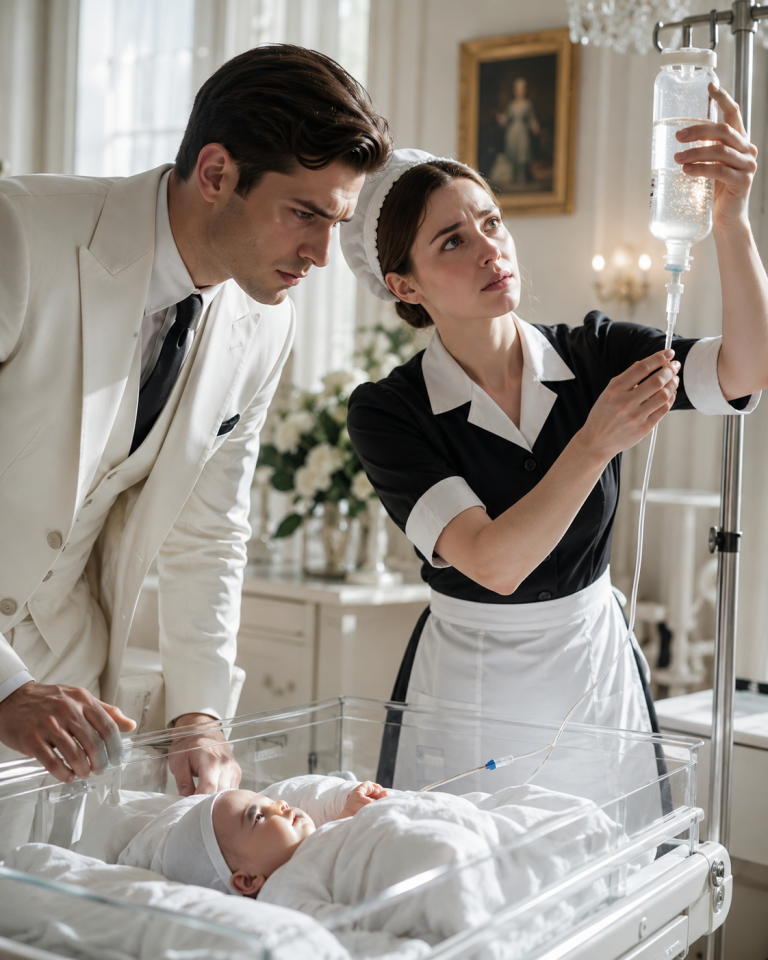
The Nurse Opened the Mafia Boss’s Son’s Pillow—And Discovered a Monster Inside

## PART 1
She found the needles because of a drop of blood on her thumb.
Not because she was looking. Not because she suspected. Because she pressed her palm into a child’s pillow and something pierced her, and the sting was too sharp and too specific to be a coincidence, and she was the kind of woman who did not mistake coincidence for accident.
That was the moment Mara Solano understood she had not been hired to care for a sick boy.
She had been hired to watch someone finish killing him.
—
Three weeks earlier, the envelope had arrived on the worst possible Tuesday.
Mara had just finished a twelve-hour pediatric trauma shift at St. Genesius Medical Center in Boston. The parking garage smelled like exhaust and damp concrete and the particular exhaustion she carried in her bones by shift’s end. She was thinking about nothing except her shoes and whether the Thai place on Commonwealth was still open.
Two men in charcoal suits appeared from between parked cars.
They did not touch her.
They stepped into her path, precise as brackets, and one of them extended an ivory envelope the way you might offer something formal and irrefusable.
Inside: a cashier’s check for sixty thousand dollars. A non-disclosure agreement with three pages of redactions. A four-week private care contract. And a file.
A child. Eight years old. Undiagnosed neurological episodes. Acute pain. Functional decline. Multiple specialists. No answers.
Mara’s better judgment told her to hand the envelope back.
Her clinical instinct read the file instead.
Something about the case felt wrong in a specific way — not incomplete, but arranged. Symptoms too dramatic, too varied, too resistant to every standard intervention. Like someone had written a list of dramatic presentations and assembled them deliberately, rather than the crooked randomness of genuine disease.
She got into the black SUV.
An hour later she was standing in the foyer of a Beacon Hill estate that looked less like a home than an argument about power. Marble floors. Fourteen-foot ceilings. A staircase that rose with the confidence of something that had never doubted itself. Guards at the exterior doors, more in the corridors, all of them carrying the contained alertness of men trained for threats rather than guests.
The estate belonged to Marco Falcone.
Mara had heard the name. Boston was a smaller world than people pretended. Marco Falcone ran a shipping and logistics company with a portfolio reaching into three New England ports. He sat on a hospital board. He had attended the governor’s inauguration. And beneath all that legitimate surface, if the careful rumors were accurate, he had arrangements that predated all of it.
He was not the kind of man who asked twice.
He entered the study ten minutes after she did, and the air reorganized itself around him.
Late thirties. Dark-haired. Broad through the shoulders, with the deliberate stillness of someone who had learned that motion was power and stillness was more. He was handsome in the way dangerous things were sometimes handsome — the aesthetic was real, but it wasn’t the point.
When he spoke, his voice was quiet, and quiet was the most authoritative thing in that room.
“Ms. Solano. You were recommended by the chief of pediatric neurology at Children’s Hospital. He said you’ve never lost a patient in the PICU who had a fighting chance.”
“Dr. Ames is generous,” Mara said. “What has your son been told about his illness?”
Marco looked at her steadily. “He’s been told he’s getting better.”
“Is that true?”
“It is what I need him to believe.” A pause. “For now.”
Then he told her about Luca.
Eight weeks of pain. Sudden violent episodes, always nocturnal. Spasms in his neck and shoulders. A low-grade fever that wouldn’t break. Two neurologists, a pediatric immunologist, and his personal physician had seen the boy. Three separate treatment protocols had been tried. None had made a difference.
Luca was declining.
When Marco said that last sentence, his voice did not change. But something in the set of his jaw did — a tightening that was not composure so much as composure’s effort. The crack behind the wall.
“Save him,” he said. “I will give you any resource in my possession.”
Mara heard the word *save* with clinical precision. Not *treat*. Not *help*. Save — the word people used when they already understood the alternative.
She took the contract.
—
Luca Falcone was small for his age and exhausted in the specific way of children who have been hurting for a long time. His eyes were his father’s — dark, watchful — but where Marco’s held calculation, Luca’s held something simpler and sadder. He had learned to wait for the next bad thing.
His room occupied the entire east wing’s corner: enormous windows, expensive furnishings, a custom orthopedic bed his father had imported from a specialist in Geneva, supposedly designed to correct some minor spinal irregularity.
Mara noted the bed.
She noted the specific pillow it contained, molded from high-density memory foam, curved to cradle the neck.
She noted that the boy’s pain was always, always worst in the morning.
In the first week, she read every chart, every test result, every medication log. The data told a story that didn’t hold together. The prescribed medications — a rotating combination of muscle relaxants and sedatives — were aggressive enough to suppress most neurological complaints but had done nothing for Luca. Dr. Renato Voss, the family’s private physician, attributed this to the “complex” nature of the condition.
Dr. Voss was sixty, immaculate, condescending in the way of men who had been unchallenged long enough to mistake that absence for intelligence. He treated Mara’s questions as static.
Marco’s wife, Serena, treated Mara herself as static.
Serena Falcone was thirty-one and behaved like a woman who had won something she was afraid of losing. She moved through the estate in tailored neutrality, charming to visitors and cold to anyone she couldn’t use. She was, at close examination, never interested in Luca’s condition. She was interested in how the condition was managed, who was present for it, and whether any information reached Marco that hadn’t passed through her first.
She also had a particular relationship with Dr. Voss.
Not romantic, Mara decided. More like two people who had made an arrangement and both understood its terms.
By the second week, Mara’s suspicion had a direction.
Luca’s episodes happened at night.
Only at night.
And only after he had been in the bed for more than two hours.
One evening, when the house was quieter, Luca caught her hand as she was adjusting the light. His fingers were thin and hot with low fever.
“Mara,” he whispered. “Something bites me when I’m sleeping.”
She kept her voice even. “Show me where.”
He pointed to the base of his skull, below the hairline.
She parted his hair carefully. Beneath it, along the occipital ridge, was a cluster of small raised marks. Pink. Slightly inflamed. Consistent spacing.
Dr. Voss had documented them as a contact dermatitis reaction to detergent.
Mara looked at those marks for a long time.
Then she looked at the pillow.
She told Luca she was going to get him a glass of water and be right back. She went to the bathroom, snapped a glove over her right hand, and pressed her palm into the center of the foam.
The first pass: nothing.
She pressed deeper, held it, felt the slow resistance of dense material.
A sharp point broke the surface of the glove.
Then another.
She pulled her hand away. One needle-fine point had gone through the latex. She turned her hand over in the bathroom light and looked at the puncture on her gloved palm with the detached focus of a woman whose body had learned to slow panic into precision.
She went back to Luca.
“Let’s try a different pillow tonight,” she said. “This one feels lumpy.”
He nodded and didn’t argue because he trusted her, and that trust was the most important thing in the room.
She tucked him in with a spare pillow from the closet and sat beside him until he fell asleep.
Then she took the original pillow to the bathroom and opened it.
Her trauma shears went through the casing first, then the foam.
What she found inside changed everything.
A grid of monofilament mesh, embedded two inches below the surface, invisible to any casual inspection. Threaded through it at regular intervals: dozens of fine steel needles, surgical-grade, oriented at the precise angle that would pierce upward as a child’s head sank into sleep. The tips were coated with a dark, viscous compound that smelled, faintly, of something organic and bitter.
Not illness.
Not bad luck.
Not a mysterious condition that baffled specialists.
A mechanism.
Engineered, calibrated, patient.
Someone had not been waiting for Luca to die from some terrible disease.
Someone had been administering his death, night by night, in doses too small to detect and too slow to trace.
Mara sat on the edge of the bathtub with the destroyed pillow in her lap and allowed herself ten seconds to feel the full weight of what she was holding.
Then she stood, washed her hands, and began moving.
She did not go to Dr. Voss.
She did not go to any guard.
She did not know which of them were safe, and in a house like this, the wrong choice was the last one.
She went back to Luca’s room, checked his vitals — his breathing was already cleaner against the clean pillow — and settled into the chair beside his bed with her trauma kit open and her phone in her hand.
One number.
Marco’s direct emergency line, given to her on day one with instructions she had never forgotten: for life or death only.
She had not expected to use it on day fourteen.
She sat with the phone in her lap and the open pillow on the table and the sleeping boy in front of her, and she ran through everything she knew.
Dr. Voss had provided the pillow, presented it as a therapeutic device.
Serena had overseen its placement and encouraged the heaviest sedation schedule.
Serena had access. Serena had motive — she was not Luca’s mother, Luca’s existence tied Marco to a previous life, and Luca stood between Serena and every form of inheritance that came after grief.
And Serena had, three days ago, requested an “updated dosage” for Luca’s sedatives. Dr. Voss had provided it. Mara had looked at the new dose, looked at Luca’s body weight, and declined to administer it.
She had not told anyone she’d declined.
She had told Luca it was a vitamin.
Outside the window, October rain moved in off the harbor. She could hear it against the glass, soft and persistent. Inside the house, the corridor lights were on a dimmer at this hour, the guards rotating on a schedule she had memorized by watching, the cameras covering the main halls but not the east-wing bedroom’s interior.
She looked at the phone.
Then the bedroom door moved.
Not the handle. The door itself — a slight shift in the gap at the base, as though something was being adjusted on the other side.
Mara was on her feet before the movement finished, placing herself between the door and the bed.
The handle turned.
She had not locked it.
That was the first and last mistake she was going to make tonight.
Dr. Renato Voss stepped into the room.
He was dressed as if he’d been awake for hours — suit jacket on, no tie, the absence of it the only thing out of place. His eyes went to the bed first, found Luca sleeping, then registered the chair empty and swiveled to find Mara standing in the center of the room.
Then his gaze dropped to the table.
The opened pillow.
The needles catching the light.
The compound still dark on the torn foam.
His expression ran through five things in two seconds before it settled.
“Mara,” he said, voice measured. “You should have left this alone.”
She looked at him without any pretense of the professional courtesy she had maintained for two weeks.
“You’ve been poisoning him,” she said. “Through the pillow. Microdose neurotoxin, slow release through the skin. That’s why nothing you prescribed ever worked — the medications weren’t supposed to work. They were supposed to look like you were trying.”
He came fully into the room and closed the door.
In his hand, brought from behind his back, was a syringe.
The liquid inside was amber.
“I want you to understand,” he said, moving toward her with the specific patience of someone confident in his outcome, “that this situation is much larger than a medical dispute. Walk away. I can arrange significant compensation. What’s happened to the boy is already irreversible — the neurological impact is cumulative. You can’t undo it.”
“I can slow it,” Mara said.
“It won’t matter by morning.”
“It will matter to him.”
He lunged.
Mara had spent four years in the pediatric trauma unit of one of Boston’s busiest hospitals. She had restrained adults in psychotic breaks, managed combative patients twice her size, and once talked a man out of a window ledge at three in the morning because the psychiatric staff hadn’t arrived yet. She was not a fighter.
But she was a woman who had learned that the body under threat was faster than the mind at war with itself.
She sidestepped.
She grabbed his extended wrist with both hands and twisted hard, redirecting the syringe away from her face, and she used the heavy ceramic lamp from Luca’s bedside table the way she had been calculating since the door opened — swinging it up and across and letting physics finish the argument.
The impact connected with the side of Voss’s head.
He went down. Completely, immediately, his legs deciding before his mind did.
The syringe skidded across the floor and stopped at the baseboard.
Luca stirred.
“Mara?” he whispered, blinking.
“I dropped something,” she said. “Go back to sleep.”
He closed his eyes.
She looked at Voss on the floor, at the syringe by the wall, and she made four decisions in rapid sequence: secure Voss, move Luca, get out through the servants’ stair, call Marco.
She had thirty seconds, maybe less, before someone in this house noticed the disruption.
She used all of them.
—
## PART 2
Luca woke when she lifted him, but he didn’t make a sound.
She had told him two nights ago, while reading to him before sleep, that brave people were the ones who stayed quiet when it mattered most. She had said it casually, the way adults plant things in children they hope the children will never need. He had nodded seriously and gone back to his book.
He remembered now.
He pressed his face against her shoulder and was silent.
She wrapped him in the heavy wool throw from the foot of his bed — dark charcoal, it would swallow the white of his pajamas — and moved to the door.
The corridor was dim. She had counted the night guard rotation: eighteen minutes between passes on this hall. She had eight minutes.
She used the servants’ stair because it was the one space in the house that the camera grid didn’t fully cover — she had identified the gap in the first week, not because she expected to need it, but because she was the kind of person who identified exits before she needed them.
She was halfway to the ground floor when she heard Serena’s voice below.
Not panicked. Controlled. Issuing instructions.
“—needs to happen before he lands. If the nurse has already found it, bring me the boy and leave her in the east wing. I don’t want complications.”
Mara stopped.
The space behind her was a narrow alcove where cleaning supplies were stored. She moved into it, pulling Luca with her, and pressed them both against the wall behind a rolling shelf.
Through a crack in the door, she could see down into the connecting corridor: Serena, fully dressed in dark clothes at two in the morning, flanked by two of the estate’s guards with weapons unholstered.
“Dr. Voss isn’t responding,” one of the guards said.
Serena’s expression didn’t shift.
“Then something’s already gone wrong,” she said. “Find her. Find the boy. And make sure there’s nothing left in that room for anyone to examine.”
They split and moved toward the stairs.
Mara counted to ten, then moved again.
The house had a climate-control room in the basement — a reinforced space housing the HVAC systems, accessible from the service corridor, with a steel door and a single internal lock. She had noted it the first week because it was the one room in the basement that appeared on no household diagram she’d been given and yet clearly existed, and unexplained rooms in guarded estates were worth knowing about.
She got them there in four minutes.
She locked the door from inside and set Luca down on a padded equipment shelf.
His eyes were wide in the darkness, his breathing fast but controlled.
“You’re doing so well,” she told him.
“Is my dad coming?” he asked.
She pulled out the phone.
—
The line rang once.
“Solano.” Marco’s voice was immediately alert, no sleep in it at all.
“Mr. Falcone,” she said, and she kept her voice as level as she could. “It’s not a neurological condition. The pillow — a custom therapeutic pillow, provided by Dr. Voss — contained a grid of toxin-coated needles. Slow neurotoxin, administered during sleep. I have the physical evidence. Voss came into the room with a loaded syringe. He’s unconscious on the floor of Luca’s room. Serena has compromised at least two guards and she is looking for us right now.”
Silence.
Not surprise.
Not confusion.
A silence that was pure, concentrated, absolute.
When Marco spoke again, he sounded like someone different than the worried father who had hired her.
“Where are you in the house?”
“Basement service room. Northeast corner. The HVAC space.”
“Barricade the door. Let no one in. Not guards, not police, no one.”
“Luca needs medical support. The toxin—”
“I have a medical team with me.” A pause. She heard engines behind his voice, and the sound beneath them: rotors. “I’ve been forty minutes out since midnight. A contact told me the situation was developing.”
“Who?”
“Someone inside this house who loves my son.” A brief pause. “Keep him breathing, Mara. I will be there.”
Then: “You did this alone. In the dark. With no weapons and no backup.”
“I had the lamp,” she said.
Something passed through the line.
Not quite a sound.
“Eight minutes,” he said. “Lock it down.”
She ended the call and looked at Luca.
“Your dad’s almost here,” she said.
He exhaled slowly, and the relief in it was the most purely innocent thing she had heard in three weeks.
She pulled her trauma kit open and began working.
The toxin’s effects were cumulative — she didn’t have the specific compound but she had her education and her instincts and every emergency protocol she had run in the PICU for four years. High-dose antihistamines for the inflammatory cascade. Activated charcoal she had been quietly carrying since day six when she first started wondering. Saline IV to dilute whatever was circulating. A careful watch on his airway.
She narrated every step quietly, not because he needed to hear it but because a calm voice in the dark was its own medicine.
Outside, she heard Serena somewhere in the basement.
“She’s in the lower level,” Serena said to someone. “There’s nowhere to go. The only exterior door down here opens to the loading court.”
Banging against the steel door.
Three strikes. Heavy.
“Mara.” Serena’s voice through the metal was controlled and pleasant in the way of someone who had decided pleasantness was efficient. “I know this looks serious. I understand why you’re frightened. But you’ve misread the situation. Renato was acting outside my knowledge. I had no part in what he did. Open the door. Let me see Luca.”
Mara said nothing.
She kept her hand on Luca’s IV line and watched his color.
“I’m his stepmother,” Serena said. “I love him. You have my word.”
Luca looked at Mara.
Mara shook her head once.
He pressed his lips together and said nothing.
“Have it your way,” Serena said.
A shotgun blast went through the lock mechanism.
The door shuddered.
A second blast.
The frame cracked.
Mara moved her body between Luca and the door.
Not because she had a plan.
Because there was no other position.
She held the trauma shears in one hand and Luca’s hand in the other and she was going to be the last thing between them and this door for exactly as long as she was standing.
A third impact. Then kicking. The frame splintering.
“Why are you doing this?” Mara shouted, buying seconds. “He’s a child. He’s Marco’s blood.”
Serena’s answer came through the gap as the door bent inward.
“That is precisely why.”
The words were calm. Explanatory. The tone of someone stating an obvious thing.
As long as Luca lived, the Falcone estate had an heir. As long as the heir lived, Marco’s attention had an anchor that predated Serena. As long as Marco grieved a first life, a second one could not fully begin. The estate, the assets, the position — all of it led through the boy.
Through the boy.
Or around him.
“You’re wrong about him,” Mara said. “He will not be broken by this. He will come for you.”
“He is an hour away in a helicopter,” Serena said. “I have thirty minutes.”
Mara heard the rotors before Serena finished the sentence.
Not distant.
Close.
Descending.
The kicking at the door stopped.
Serena’s voice changed. “What is—”
Then the sound of the estate above them shifted completely. Not the house at night. Something else — the specific violent percussion of a building being entered by people who were very good at it.
Shouts. A crash of glass. Two suppressed shots, controlled, deliberate. The thunder of boots on marble.
Then silence.
Then footsteps on the basement stairs.
Steady. Even.
Unhurried.
A voice through the door, low and certain:
“Mara.”
She pulled the broken barricade aside.
The door swung open.
Marco Falcone stood in the threshold in his shirtsleeves, his jacket gone, rain in his hair, a bruise forming along his jaw. Behind him stood four men in tactical black. In the corridor, one of the compromised guards was zip-tied to a pipe.
His eyes found Luca first.
The color in his face went somewhere complicated.
He came across the room in three steps and sank to his knees on the concrete and took his son’s face in both hands.
“Papà,” Luca said.
That one word, and Marco Falcone — who ran three port operations and controlled significant parts of this city and had not shown visible fear to anyone since he was nineteen years old — made a sound that belonged only to fathers.
“I’m here,” he said, forehead to forehead with his son. “The monsters are gone. I have you.”
He held him for a long moment.
Then he looked up at Mara.
She was standing at the edge of the room with dried medical tape on her hands and the trauma shears still in her grip and what she recognized as the delayed onset of her own adrenaline crash beginning at the backs of her knees.
“He needs Northwestern’s toxicology unit,” she said. “Neurotoxin exposure, cumulative over several weeks. I’ve done initial mitigation but he needs a full neuro workup and I want an independent tox screen before anything else enters his system.”
Marco nodded once, already standing, already lifting Luca.
“Silvio,” he said to one of the men behind him. “Private ambulance to the south gate. Medical team on the roof entrance at Northwestern. Full lockdown on the VIP floor.”
He passed his son to Mara for one moment while he spoke to another man.
Luca rested his head against her shoulder.
“I knew you’d keep me safe,” he said quietly.
She tightened her hold on him and did not speak for a moment because the alternative was crying in a basement in front of armed men, which she was going to avoid.
“Of course,” she said. “That was the job.”
—
## PART 3
They found Dr. Renato Voss where Mara had left him, conscious and badly frightened, handcuffed to the bathroom radiator in Luca’s room by the zip tie she had used before she evacuated.
He talked within forty seconds of Marco entering the room.
Everything. The compound — a slow-release organophosphate derivative, synthesized through a contact in Eastern Europe. The delivery mechanism — his design, implemented over three weeks while the household believed he was managing the boy’s mysterious symptoms. The arrangement — eighteen months in the planning, the initial approach from Serena coming shortly after their relationship became more than professional.
He talked as though the words were water he’d been holding and could no longer contain.
Marco listened.
He did not yell. He did not strike the man. He stood very still and listened with the focused patience of someone constructing something precise.
When Voss was done, Marco was quiet for a moment.
Then he said two sentences to the man standing beside him.
He said them quietly, as though discussing logistics.
Mara did not need to hear both sentences to understand their meaning.
She did not look at Voss again.
Serena was in the foyer, on her knees on the marble floor she had walked across in tailored confidence for eighteen months, her composure finally gone. She looked small without it — that was what struck Mara as she passed through on her way out. Not monstrous. Not calculating. Just a frightened woman who had found one terrible route to what she wanted and had walked it all the way to the end.
“Dominic, please,” Serena said — using the wrong name in her panic, reaching for something she had planned to be that she never quite managed. “It was Renato. He manipulated me. I didn’t know how far he’d go. I love Luca. I swear to God I love him.”
Marco did not answer.
He had Luca in his arms, the boy’s face turned away from the room. He pressed his hand over his son’s ear as they passed.
He looked at Serena once.
The look was brief and complete, and Mara found she could not watch it.
She kept her eyes on Luca’s back until they were through the front door and into the wet October night.
—
The VIP floor of Northwestern Memorial smelled like antiseptic and controlled air and the particular quiet of a place that had been secured.
Marco had bought out the floor. His men were at both stairwell doors. The nursing staff on shift had been triple-vetted and briefed. It was the most heavily guarded hospital suite in Boston, and the boy sleeping in the middle of it looked, for the first time in three weeks, simply like a child.
Mara sat in the corridor on a padded bench, her trauma kit closed beside her feet, her hands loose in her lap. The adrenaline had drained completely now. In its place was the specific hollow exhaustion of a long crisis successfully ended — not joy, not yet, just the empty space where the worst-case scenario had been.
The suite door opened and Marco came out.
He sat beside her.
Not across from her. Beside her.
Neither of them spoke for a while.
“The tox panel is back,” he said finally. “Organophosphate derivative, as Voss said. They’ve identified the compound. Full protocol is underway.”
“Timeline for neurological assessment?”
“Seventy-two hours for an initial picture. The attending says the intervention you ran in the basement may have significantly changed the outcome.”
“May have,” she said.
“He said ‘significantly.'” Marco’s voice was quiet. “He was being conservative because you were in the room.”
She looked at her hands.
“Luca asked for you before they sedated him for the first round of treatment,” Marco said. “He wanted to tell you something.”
“What?”
“He said: ‘Tell Mara the brave ones stay quiet.'” Marco paused. “I didn’t fully understand it.”
Mara did.
She nodded without explaining.
Marco looked at the floor between their feet. He had blood on the cuff of his left sleeve — not his, he’d told her in the ambulance, one of Serena’s guards who had resisted. His hair was still damp from the rain. He looked like a man who had come through something and had not yet fully arrived on the other side.
“I owe you a debt I don’t know how to calculate,” he said.
“You paid me,” she said. “There’s no debt.”
“You were not paid to fight a man twice your size and hide in a basement and administer emergency toxicology protocols by phone light.”
“I was paid to keep him alive.” She looked at the suite door. “I kept him alive.”
“At risk to your own life.”
She didn’t answer.
Marco turned toward her. “You could have run. The moment you found the pillow, you could have called the police from outside and walked away. No one would have faulted you for it.”
“Luca would have been dead before they arrived.”
“That is not your problem to solve.”
“It was tonight.”
He was quiet for a moment.
“I need to understand something,” he said carefully. “Why did you take this case? The men who came for you — anyone with common sense would have recognized what they represented.”
Mara looked at the wall across the corridor. “The file. The symptoms were wrong in a specific way. Not random — arranged. I’ve seen things arranged to look like illness before.”
“In your work.”
“In pediatric trauma, yes. You learn what organic disease looks like and you learn what manufactured suffering looks like, and they’re different if you’ve seen enough of both. I saw the file and I couldn’t not go.”
“That is either courage or compulsion,” he said.
“Usually the same thing,” she said.
He studied her face. Not the way he had when she first arrived — assessing, cataloging, processing — but differently. As though he were looking for something he had not expected to find.
“I contacted three other nurses before your name was given to me,” he said. “All three declined. The money was the same.”
“The money was significant,” she said.
“Yes.”
“But they saw the same thing in the file I saw.”
“Presumably.”
“And they were smarter than I was,” she said. “About their own safety.”
“Smarter,” he said. “Or more certain that survival was worth more than a stranger’s child.”
She didn’t respond.
“You are neither of those things,” he said.
It landed differently than she expected — not as a compliment, not as a challenge, but as an observation. The specific quality of being seen accurately.
She turned to look at him.
“Your son is going to be fine,” she said. “The compound clears in seventy-two hours if the treatment holds. His long-term neurological picture is going to be determined by the tox panel and the next week’s monitoring. But the trajectory tonight shifted. He has a strong baseline.”
“Because of what you did.”
“Because his father came back when he said he would.”
Marco looked at her for a moment.
“That contact,” she said. “The one who told you the situation was developing. Someone inside the house.”
“My household manager,” he said. “She has been with me for eleven years. She did not trust Serena from the beginning. She said she noticed things, small things, over the last two months. She came to me four days ago. I was already en route when you called.”
“She saved him,” Mara said. “Before I even knew there was something to save him from.”
“She started the chain that ended with you,” Marco said. “Both of you saved him.”
He said it with the precision of someone giving credit where it belonged.
The corridor was quiet.
Outside the window at the end of the hall, Boston was doing what Boston did at three in the morning in October — settling into its own gray dark, water on stone, bridges glowing over the harbor, the city indifferent and continuous.
“What happens now?” Mara asked. “To you. To the estate.”
Marco leaned back slightly. “Investigations. There will be involvement from law enforcement at several levels that I have certain relationships with. The cases against Voss and against Serena will be — comprehensive.”
“Will you go to prison?”
The question was direct enough that he looked at her.
“Some of what comes out of this investigation will be focused on Voss and Serena and the networks they used,” he said. “My cooperation will be meaningful. My attorneys are experienced.”
“That’s not an answer.”
“No,” he said. “It isn’t.”
She nodded.
“I have been what I am for a long time,” he said. “The world I built — I built it for specific reasons that made sense when I was twenty-six and had nothing and people I loved were not safe. It has not always remained what I intended.” He paused. “Luca knows none of it. I have protected him from it completely.”
“He’ll know eventually.”
“Yes.” Marco looked at the suite door. “I intend to be the one who tells him. When he’s old enough to hold it.” His jaw tightened slightly. “After tonight, the world he grows up in is going to be different.”
“Different how?”
“Less convenient for the things I’ve let myself ignore.”
Mara heard the weight in that sentence.
“That is also not a specific answer,” she said.
“No.” He glanced at her, and something in his expression moved. “You are not afraid of me.”
“Not currently.”
“Most people in your position tonight would be.”
“Most people in my position tonight wouldn’t have stayed.” She paused. “I stopped being afraid of you when I watched you with Luca in the basement. Men who look at their children the way you looked at him — the fear of them becomes something else.”
“What does it become?”
She thought about it honestly.
“Complicated,” she said.
He almost smiled.
“I need you to stay on,” he said. “Through the treatment period. His recovery will require monitoring over several weeks. The toxicology team will handle the medical protocols, but Luca needs a constant presence he trusts. He trusts you.”
“I know.”
“I will pay whatever you require.”
“I know that too.” She looked at him. “I’ll stay because he needs the continuity of care. Not because of the payment.”
“I know,” he said quietly. “That is why I asked.”
Over the next week, the hospital suite became its own small world.
Luca improved in stages — first the fever breaking, then the morning pain subsiding, then, on the fourth day, the particular brightness returning to his eyes that Mara had not seen once in three weeks. He asked her questions about everything: how IVs worked, why the machines made that specific sound, what the difference was between a nurse and a doctor, whether she had ever been scared at work.
“Sometimes,” she said.
“Were you scared last night? In the basement?”
She considered lying. “Yes.”
“But you stayed.”
“Yes.”
He thought about this.
“That’s the brave part,” he said. “Not the not being scared. The staying.”
She looked at this eight-year-old boy, who had spent eight weeks being slowly poisoned in his sleep and had come through it with his character intact, and she understood that whatever his father was or had been, this child had been built from something good.
Marco was there every morning before seven and stayed until Luca was asleep. He brought books, terrible at picking them the first two days and then, after Mara made a list, considerably better. He sat in the corner of the suite and worked quietly while Luca slept, and on the evenings Mara came to check on them at the end of her shift, she found him where she expected: present, unhurried, attentive.
He brought her coffee on the third morning without asking whether she wanted any.
She drank it without remarking on the presumption.
On the fifth day, the senior toxicologist delivered the formal update: the compound had cleared, the neurological indicators were tracking toward full recovery, the long-term prognosis was strongly positive. Barring secondary complications, Luca Falcone would recover completely.
Mara stood in the corridor after the meeting and breathed.
Marco came to stand beside her.
“Completely,” he said, testing the word.
“Completely,” she confirmed.
He looked at the ceiling for a moment.
The composed, dangerous, controlled man who had filled every room he entered for three weeks put his hands flat against the corridor wall and pressed his forehead to it and was briefly, quietly, entirely undone.
Mara stood beside him and said nothing.
Some things didn’t require words.
After a moment, he straightened.
He turned to her.
“I want to say something and I need you to hear it without your clinical instincts engaging.”
She waited.
“I have lived in a world built on leverage,” he said. “I understand people in terms of what they want and what they fear and how those two things can be used. It is a practiced skill and it has served me for twenty years.” He looked at her directly. “I do not know how to apply any of that to you. You entered my house because you could not ignore a child in a file. You fought a man twice your size in the dark. You called me because it was the right call, not because you calculated an advantage. You stayed because a boy needed continuity of care.” He paused. “I have no category for you.”
Mara looked at him.
“I’m a nurse,” she said. “That’s the category.”
“That is not what I mean.”
“I know what you mean.”
He held her gaze.
“When this is over,” he said carefully, “when Luca is home and stable and the investigations have run their course and the world has clarified — I would like to take you to dinner. Not as payment. Not as a continuation of this arrangement. As two people who have been through something together and know each other better than most people know anyone.”
Mara was quiet for a moment.
“When this is over,” she said.
“Yes.”
She looked toward the suite.
“He’s going to need structured follow-up care for the next six weeks,” she said. “A consistent provider. Reduced stimulation. Monitored sleep patterns. A neurological check at week four.”
“I know,” he said.
“I’m the consistent provider,” she said.
“I know.”
“So technically this isn’t over for six weeks.”
“Technically,” he agreed.
She looked at him.
“Ask me again in six weeks,” she said.
Something in his expression settled — not relief, not triumph, something quieter than either.
“Six weeks,” he said.
On the day Luca was discharged, he walked out of the hospital on his own feet, which the attending said was slightly ahead of schedule and which Mara attributed to the fact that he had decided he was ready and had simply declined to be otherwise.
In the hospital entrance, he took Mara’s hand on one side and his father’s on the other.
Marco looked at her over his son’s head.
She looked back.
Outside, it was a clear November morning, the harbor catching light at the end of the street, Boston going about its ordinary business entirely unaware that a small boy had been saved three weeks ago by a woman with a pair of trauma shears and a ceramic lamp and the particular refusal to leave that some people are made of.
Luca pulled them both forward through the door.
—
The weeks that followed were not uncomplicated.
The investigation into Serena and Voss moved through channels that were partially visible and partially not. Mara learned what she learned through Marco’s straightforward answers to her direct questions — he did not volunteer information she didn’t ask for, but he also did not hide from what she asked.
Serena was charged. Voss cooperated with authorities and received a reduced arrangement that Marco described as insufficient and tolerated because the alternative was a process he had agreed not to interfere with. Two of the compromised guards were prosecuted. The estate was subject to a security audit conducted by people Marco trusted.
Mara’s non-disclosure agreement was formally released by Marco’s attorneys, with a note that she was free to discuss any aspect of the case she chose, in any context, without limitation.
She told him she didn’t need the release.
He said it was hers regardless.
She took it.
On a Saturday in early December, six weeks and two days after Luca’s discharge, Marco knocked on the door of her apartment in Cambridge.
He was in a dark coat and carrying nothing except his own company, which she had come to understand was considerable.
“Dinner,” he said.
“I know,” she said. “I’ve been ready for four days.”
“I was giving you space.”
“I live alone with a large collection of medical texts and no dinner plans,” she said. “What I had was time.”
He looked at her for a moment with the expression she had first seen in the basement of his estate — the one that meant he was working out where to put something he didn’t have a category for.
“You are consistently the strangest combination of practical and remarkable I have encountered,” he said.
“I’m a nurse,” she said, and got her coat.
The restaurant was quiet and warm, which she had suspected he would choose, understanding her correctly after six weeks in the same exhausting proximity. They ate food that was better than she pretended and talked about things that had nothing to do with the previous month, and when they talked about things that did — carefully, slowly, the way you approach something that carries weight — it was with the specific ease of two people who had already seen each other at their most unguarded.
“Luca asked me this week,” Marco said, “whether you were going to become part of our family.”
Mara looked up from her glass.
“He asked very seriously,” Marco continued. “The way he asks things he has already decided are important. He had a follow-up question prepared.”
“What was the follow-up?”
“Whether I had asked you yet.”
“What did you tell him?”
“That I was working up to it.”
Mara looked at the man across the table — who ran port operations and had complicated arrangements with several levels of law enforcement and had sent people to a warehouse at the docks for what they had done to his son, and who also arrived at his son’s bedside every morning before seven and had learned to pick children’s books and had pressed his forehead to a hospital corridor wall when he heard the word *completely.*
“He’s going to be disappointed in your timeline,” she said.
Marco looked at her.
“I was working up to it,” he said.
“Six weeks is a long time to work up to something.”
“I was being careful.”
“I know.” She held his gaze. “You can stop.”
The restaurant continued around them, pleasant and indifferent. Outside, December had settled over Boston with the particular authority of a city that had survived harder things.
Inside, the most dangerous man in Boston reached across the table and took the hand of the woman who had held a ceramic lamp like a weapon in the dark and refused to let go of his son.
He held it carefully.
Not claiming.
Choosing.
And she let him.
—