From Nap to Nuptials—A Poor Girl Wakes Up Married to the Mafia Boss

# PART 1
She had not meant to fall asleep.
That was the part that mattered, later, when she tried to reconstruct the exact sequence of decisions that had dismantled her life. Not the job. Not the flight. Not even the man whose shoulder had been warm enough to believe in. The decision that started everything was the one she made at three in the morning in a diner bathroom, when she looked at herself in the cracked mirror above the sink and thought: *You can’t keep doing this.*
And so she booked the ticket.
And then she fell asleep.
And then everything changed.
—
Lena Ricci had been awake for close to forty hours by the time the plane left the gate.
She had closed out the diner at two, cleaned for an hour, walked to the office tower two blocks over where she picked up a contract cleaning shift at four that ran until seven. Then the bus. Then the airport. The backpack on her lap held everything portable that mattered: a phone with a crack running diagonally across the screen, the last forty dollars of cash she had, a boarding pass for a city where she knew one person — her college roommate, who had offered her a couch and said the job market was better than whatever Lena was running away from.
She was not running away.
She was starting over.
The distinction felt important at the time.
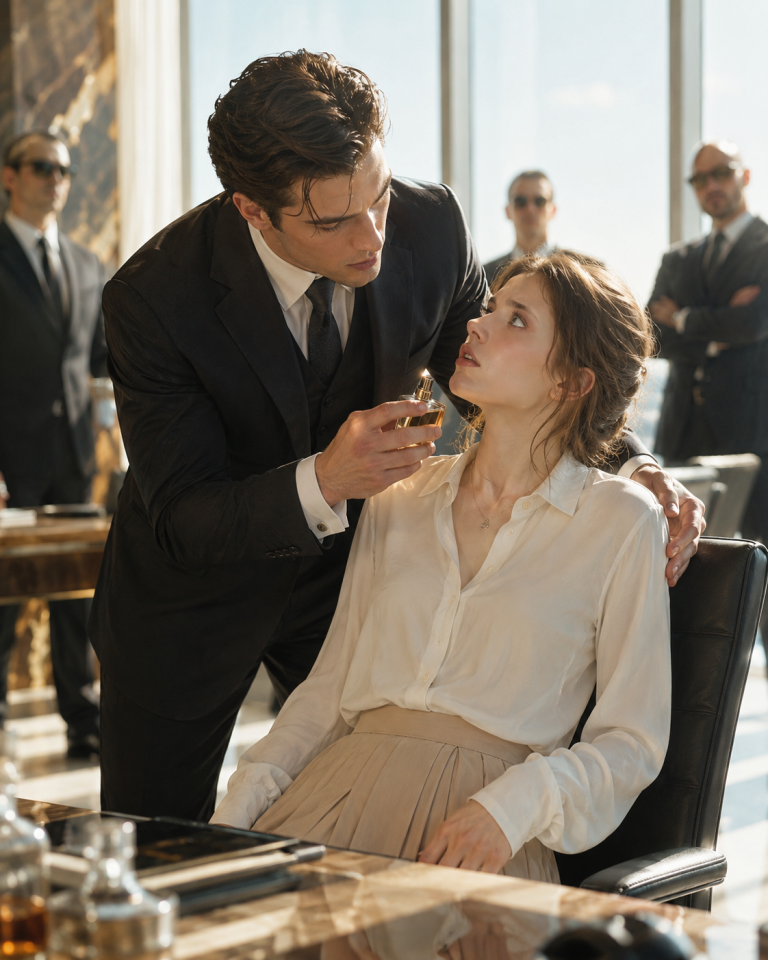
The man beside her was wrong for coach in the way certain things are wrong for their context — not violently out of place, just precise in a way that called attention to itself. His suit was dark and well-fitted. His watch was the kind that told time without advertising the cost of doing so. He sat with his shoulders against the seat, not hunched forward like someone who was used to flying cheap, and when the plane reached cruising altitude he opened a folder and read with the concentrated attention of someone who was never on a flight without work.
He had not looked at her.
That was what made her look at him.
Men who did not look at her were rare in her experience of men. Her experience was mostly the other kind: men at the diner who wanted refills and her phone number in the same breath, men at the cleaning jobs who treated an apron as permission to make suggestions, men who confused access with welcome.
This man read his folder and did not glance at her once.
She looked at the window.
The city fell away beneath them, the grid of it catching evening light like a circuit board. Somewhere down there were two jobs she had quit without notice and an apartment whose rent she could no longer carry. She pressed her forehead against the cool plastic and watched the clouds swallow the city.
Her body made the decision before she did.
She was gone within minutes.
When she woke, it was not to the plastic wall.
It was to warmth. Solid. Human. Familiar in the way warmth is familiar to anyone who has been cold for long enough.
Her head was on the stranger’s shoulder.
The embarrassment was immediate and physical — a flush across her whole face, her hands scrambling to straighten herself. She made a small, mortified sound.
His arm adjusted slightly.
Not around her. Not claiming. Just a small correction that prevented her from jerking upright and hitting her head on the overhead bin.
He did not speak.
He did not look at her.
He simply let her stay.
That was the dangerous thing. Not his face, which was precise and quiet and would have been handsome if she’d had the capacity to think about anything beyond humiliation. Not his cologne, which was faint and cold, like winter air over something older. The dangerous thing was the ease of it — the way he had let a sleeping stranger rest on him without performing discomfort, without demanding gratitude, without making the moment into something she would owe him later.
She said, very quietly, “I’m sorry.”
He did not answer.
She could have moved away then.
She didn’t.
One more minute, she thought, the way she thought *one more shift* and *one more week* and every other postponed version of taking care of herself. One more minute of warmth before she had to go back to holding her own head up.
She did not see the man three rows back lean forward with an envelope.
She did not see it pass from hand to hand.
She did not hear the quiet exchange in Italian, or the instruction that came after, or the name that was being attached to her while she slept.
She was on a flight to Orlando.
She arrived in Palermo.
—
She did not notice the city change.
That was how exhaustion worked — it smoothed the edges off reality until nothing seemed implausible. She half-woke when the plane descended over the wrong kind of blue. She half-woke again when men in dark clothes moved through the jetway with the practiced calm of people whose movement was never accidental. She felt the stranger’s hand at her elbow and heard a voice say *there’s a car, you need rest, we’ll sort the connection in the morning*, and she thought: *yes, okay, the connection, the couch, sleep first.*
She slept again before the car door closed.
The room she woke in was not a hotel.
It was too quiet for a hotel. Too specific. The sheets were not institutional white but a deep, rich cream, the kind of color that came from someone choosing it. The furniture was dark wood, old in the way that expensive things were old — maintained rather than replaced. Through the gap in the curtains, she could see hills. Not Florida hills. Not American hills. These were arranged like a painting, with a town scattered across them and light falling in an angle that had nothing to do with the direction of Orlando.
Lena sat up.
Her backpack was in the corner.
Her shoes were beside the door.
There was a folder on the table near the window.
Her name was on it.
*Lena Ricci.*
Her hands shook as she opened it.
Photographs slid out.
A woman in white, face obscured by a short veil. Beside her, a man in a dark suit. The chapel behind them was small, old stone, light coming through a window at the angle of late afternoon. The certificate beneath the photographs was heavy paper, official seal, two signatures.
*Bride: Lena Ricci.*
*Groom: Nico Ferrante.*
She stared at the document until the words stopped making sense as individual words and became only shapes on paper.
Then the door opened.
He came in like the room had expected him.
She knew his face. Not well — she had barely looked at it on the plane. But she knew the shape of him: the deliberate stillness, the dark suit, the way he took in the room’s current state as if cataloguing it without appearing to assess anything at all.
“You’re awake,” he said.
His English was precise and nearly without accent.
“Where am I?” Her voice came out steadier than she expected. She filed that away.
“Sicily.”
“I had a connection to Orlando.”
“You were rerouted.”
“I didn’t agree to that.”
“No,” he said. “You didn’t.”
The absence of defense in the admission made her stop.
“What is this?” She held up the certificate.
He looked at it. Then at her.
“Documentation,” he said. “Necessary.”
“For whom?”
“For your survival,” he said, “and mine.”
She looked at him.
The photographs.
The certificate.
The wrong country.
The right answer formed before she asked the question: *You did this deliberately. This was never an accident.*
“Who are you?”
“Nico Ferrante.”
She recognized the name the way you recognize something you have heard said in a particular tone — the tone people use for things they are afraid of but not supposed to say.
“And who am I?” she said.
Something moved behind his eyes.
“You are Lena Ricci,” he said. “And you are the last living daughter of the Ricci line. And until approximately forty-eight hours ago, every powerful family in Southern Italy believed that line was extinct.”
The room tilted.
She gripped the edge of the folder.
“I’m a waitress,” she said. “I clean offices at four in the morning.”
“Yes,” he said. “Because they made sure you would be.”
The silence that followed was the loudest thing she had ever heard.
—
# PART 2
She did not scream.
She would think about that later — that her first response to waking up married in the wrong country to a man she had never spoken to was not to scream, but to sit very still and take inventory.
It was a survival skill.
She had a lot of those.
“The police,” she said.
“Would not help you faster than I can harm you,” Nico said. Not cruelly. Like a man stating the weather.
“That is not reassuring.”
“I was not trying to reassure you. I was trying to be accurate.”
She looked at him.
“You forged this,” she said, indicating the certificate.
“The chapel was real. The witnesses were paid. The clerk was reliable.” He paused. “Your signature was—”
“Forged.”
“A legal document at the airport. You signed what you were told was a travel form.”
“By your man.”
“Yes.”
The honesty of him was more frightening than a lie would have been. Men who lied to cover wrongdoing could be argued with. Men who stated their wrongdoing as operational procedure were a different category.
“Why?” she said. “Not the bloodline explanation. The real reason. Why me, specifically, on that specific plane?”
He looked at her with the attention of someone recalibrating.
“Because we had information that the Carbone family had located you,” he said. “And because Luca Carbone was on the flight two rows behind you.”
She turned cold.
She had not noticed a man two rows behind her.
She had been asleep.
“He would have taken you before you landed,” Nico said. “This way — ”
“This way you took me first.”
“This way,” he said, “the certificate made you untouchable. Ferrante wife. Ferrante blood. A claim no other family could challenge without declaring war on mine.”
“And if I hadn’t fallen asleep on your shoulder?”
“The plan would have been more complicated,” he said. “But the outcome would have been the same.”
Lena put the folder down on the bed.
She looked at her hands for a moment.
Then she said: “I want to understand the full scope of what you know about my family. Not a summary. Not what you think I can handle. Everything.”
He studied her.
“Everything?”
“I spent my life being kept ignorant for someone else’s convenience,” she said. “That’s over.”
Something shifted in his expression.
It was not quite respect.
It was the precursor to it.
He sat down in the chair across from her and began to speak.
—
# PART 3
The Ricci family had controlled shipping routes and a network of financial intermediaries across the Mezzogiorno for three generations. Not crime, exactly. More accurately: the space between law and power that every functioning system eventually develops, the unofficial architecture of how things actually moved.
When the family collapsed — a betrayal from inside, a prosecution that was less about justice than about removing a competitor from the board — Lena’s father had made the decision that ended him. He sent his infant daughter away under a different name, through channels so carefully arranged that the people trying to find her could only follow the original name.
The people who arranged her disappearance were not enemies.
They were allies who had decided a hidden heir was more useful than a visible one.
Nico laid this out with the measured specificity of a man who had spent years assembling pieces of a history someone else had obscured.
Lena listened.
When he finished, she was quiet for a while.
“So my poverty was engineered,” she said.
“Your invisibility was engineered,” he said. “The poverty was a side effect of the arrangement.”
“That distinction doesn’t make it less.”
“No.”
“And the families who did this — they know I exist now?”
“Yes. Carbone confirmed it three weeks ago through a source inside the records office.”
“And if Carbone had reached me first, on the plane—”
“You would have been leverage,” Nico said. “Useful while Luca needed the Ricci claim to pressure certain judges. Not useful after.”
She sat with that.
“You’re not much better,” she said.
“No,” he said. “But I am honest about what I am.”
She looked at the certificate on the bed.
“I want to negotiate terms,” she said.
He paused.
“Terms.”
“If I am to be documented as your wife, the documentation will reflect an actual agreement. Not a forged one. I will not be a paper claim. I will have access to the information about my own family, including what the Ricci assets actually consist of. I will be able to move without a keeper. I will be told the truth when I ask for it.”
Nico was very still.
“And if I agree?”
“Then I will consider whether your protection is worth staying inside it,” she said. “And we will see what I can build once I understand what I’ve been kept away from.”
He studied her for a long time.
“You are not what I expected,” he said.
“You expected a waitress.”
“I expected someone frightened enough to cooperate.”
“I am frightened,” she said. “And I am cooperating. Those aren’t the same thing as being manageable.”
The ghost of something moved across his face.
“I’ll have papers drawn up,” he said.
—
They moved her to a room in the estate’s guest wing, which had its own entrance and its own lock, and the key went to her.
That was the first honest thing he did.
The second was the file he left on her desk the following morning. The complete Ricci family documentation — assets, networks, betrayals, the names of the men who had arranged her disappearance, the current status of what remained and who controlled it.
She read it in one sitting.
Then she read it again.
Her father’s world was not what she had imagined it might be in the way people imagine the families they came from. Not clean, not corrupt in the simple way, but intricate — a structure that had worked because it understood what official structures pretended not to need.
She had grown up studying official structures from below, carrying their trash and making their coffee and restocking their soap dispensers. She knew exactly what they pretended not to need.
She began keeping notes.
Not a diary.
A map.
She moved through the estate with the careful attention of someone who had been invisible long enough to understand what people said when they thought no one was listening. She learned Italian by necessity, first through context and then through a tutor Nico arranged without her asking because he had noticed her watching the news each morning with her jaw set in the specific way of someone parsing language just beyond their reach.
She sat in on meetings.
Not silently. Not as decoration.
She asked questions.
The first time she corrected a factual error in a financial discussion — a misattributed debt number that would have affected a negotiation — the room went briefly quiet. Nico did not look at her. He looked at the document.
“She’s right,” he said.
The room moved on.
After the meeting, he found her in the library.
“You noticed the error,” he said.
“You had the wrong year on the original consolidation. It changed the penalty calculation.”
“How did you know?”
“I read the file you gave me,” she said. “All of it. Including the footnotes.”
Something in his face shifted.
“The men in that room have been doing this for twenty years,” he said.
“They’ve been doing it their way for twenty years,” she said. “I’m learning from their way and their mistakes simultaneously. That’s a different thing.”
He looked at her for a moment.
Then he said, “I would like to show you something.”
He took her to a room in the east wing she had not been given access to. Inside were three locked cabinets, a map table, and a photograph on the wall.
The photograph was old. A man, middle-aged, standing at a harbor with a child on his shoulders. The child was perhaps two years old.
Lena looked at the photograph for a long time.
“Your father,” Nico said. “And you.”
She had no memory of him. She had been too young when she was sent away.
“Where did you get this?”
“It was part of a private archive I acquired three years ago,” he said. “I was already looking for you before the Carbone network located you.”
“Why?”
He was quiet for a moment.
“Because the Ricci situation was unfinished,” he said. “Because a child sent away to survive in someone else’s system is not a resolution. It is a debt left unpaid by the people responsible for it.”
“You’re saying you wanted to find me on principle.”
“I’m saying,” he said carefully, “that I recognized the injustice before I calculated the utility of correcting it. Which is not something I can say about everything I have done.”
Lena looked at the photograph.
At the child on the man’s shoulders, so small and so unaware.
“I’m going to take back what belongs to the Ricci family,” she said.
“Yes,” he said. “I know.”
“I will need access I don’t currently have.”
“I’ll arrange it.”
“And I will need the families who benefited from my disappearance to understand that the accounting has been reopened.”
He was very still.
“That will require a confrontation,” he said.
“Yes.”
“With men who will not receive it gently.”
“I didn’t ask for gentle,” she said. “I asked for what I’m owed.”
—
Luca Carbone’s attempt to challenge the Ferrante claim came six weeks after Lena’s arrival.
He arrived at a meeting of family representatives held at a neutral estate outside Trapani, elegant and smiling, with the specific confidence of a man who had spent years controlling the outcome of rooms.
Lena arrived with Nico and a folder.
She had prepared the folder herself.
It contained the documentation of how the Ricci assets had been redistributed after the family’s collapse. Who had benefited, in what amounts, over what period. Which current holdings in multiple families could be traced directly to resources that were Ricci-origin. And, most specifically, a communication chain between Carbone’s grandfather and the people who had arranged Lena’s disappearance — payments made, arrangements confirmed, a decades-long agreement to keep the Ricci heir unaware of her inheritance while the beneficiaries used it.
Luca Carbone looked at the folder across the table.
Then at Lena.
“Where did you get these?” he asked.
“From the archive your grandfather didn’t think was important enough to destroy,” she said. “He was wrong about what would matter later.”
Luca’s eyes moved to Nico.
“Call off your wife,” he said.
“I don’t call her off,” Nico said. “She makes her own decisions. I advise when asked.”
Luca looked back at Lena.
“You’re a waitress,” he said. “You cleaned offices.”
“Yes,” she said. “I’ve cleaned a lot of things that other people assumed were beneath their notice. I find it makes you very good at understanding what people hide in the corners.”
The room did not laugh.
But it adjusted.
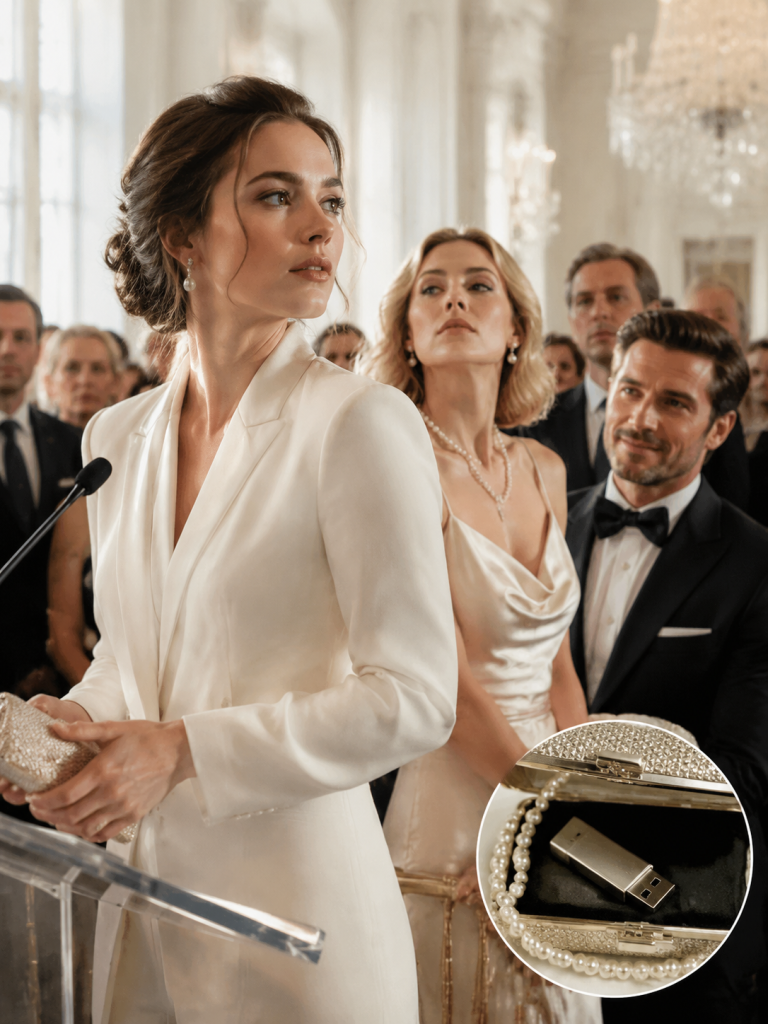
“The assets traced in this folder,” Lena continued, “represent approximately forty percent of what should be under Ricci control. I am not asking for a return today. I am providing notice that the calculation has been reopened. Anyone who cooperates in an orderly transition will be treated accordingly. Anyone who attempts to accelerate their position by force or legal obstruction will discover that the documentation in this folder has already been prepared in triplicate and distributed to three separate addresses.”
Luca stood.
“You can’t—”
“I already did,” she said. “Two days ago.”
The room was very quiet.
Nico was looking at her.
Not as a possession.
Not with the calculated evaluation she had seen in him on the plane.
With something more complicated.
Later, outside in the courtyard, he stood beside her while the other family representatives filed out.
“You didn’t tell me about the distribution,” he said.
“No,” she said.
“You used resources without informing me.”
“I used resources that were mine,” she said. “Which is the point.”
He looked at her for a long moment.
“You could have asked me.”
“I could have,” she said. “And then you would have known in advance, and your face in that room would have told Luca that you knew, and it would have been your move instead of mine.” She held his gaze. “This needed to be my move.”
He was quiet.
“You’re right,” he said.
“I know.”
He looked toward the hills.
“I think I owe you an apology,” he said.
“You owe me several,” she said. “I’ll accept them over time.”
The ghost of a smile crossed his face.
She looked away before she returned it.
—
The annulment conversation happened on a night when the sea was visible from the estate’s lower terrace, flat and dark and lit only by the moon.
Lena had been thinking about it for three weeks. Preparing the terms. Deciding what she wanted.
She found Nico at the terrace railing.
She put the document on the railing beside him.
“What is this?” he said.
“Annulment papers,” she said. “I drew them up. Outside counsel reviewed them. They’re clean.”
He looked at them.
“You want out.”
“I want to choose,” she said. “Which is different. The current arrangement was created by you, under conditions I didn’t consent to. Before I can decide whether to stay inside it, I need to step outside it and decide from there.”
He picked up the papers.
“If you sign these,” he said, “the Ferrante protection ends officially.”
“I know.”
“The Carbone response will—”
“I’m not without resources now,” she said. “You know that.”
He looked at her.
“Yes,” he said. “I know that.”
He signed.
Lena signed.
She put the papers in her coat pocket.
Then she looked at him.
“Now,” she said. “Ask me properly.”
He went very still.
She watched him recalibrate — watched the calculation drop away and something less armored appear underneath.
“You want me to—”
“I want you to ask,” she said. “Not claim. Not arrange. Ask.”
He turned from the railing.
He looked at her for a long time.
“I don’t know how,” he said. “Not this way.”
“No,” she said. “Neither do I. So we’ll both figure it out.”
He reached out.
Not a claim. More like a question.
She took his hand.
“I’m not staying because you’re powerful,” she said. “And I’m not staying because I’m grateful. I’m staying because I’ve seen what you’re capable of when you’re honest, and I want to find out what we’re capable of together.”
“That might not go well,” he said.
“Probably parts of it won’t,” she said. “I’m staying anyway.”
—
They married again in late autumn.
An old church on a hill above the Palermo coast, doors open to the November wind and the sound of the sea. Stone floors. Candles instead of chandeliers. The guests were few and chosen carefully — people from both their worlds who had earned the trust required to witness something that meant what it was supposed to mean.
Lena wore white, which she had chosen herself for the simple reason that she wanted to.
When the priest asked for her vow, she looked at Nico and said, in Italian she had learned over twelve months of necessity and stubbornness:
“I choose this. I choose you. And if you ever mistake choosing for surrendering, I will be very clear about the difference.”
Nico said, “I would expect nothing else.”
Someone in the back row made a sound that might have been a laugh or might have been relief.
Afterward, standing outside the church with the sea below and the sound of the reception beginning inside, Lena held her signed name on the new certificate and thought about the girl who had boarded a flight with forty dollars and a cracked phone screen and the intention to start over.
She had started over.
It had not looked like she expected.
It had cost things she had not planned to pay.
But the woman who had stood in that conference room with a folder and made Luca Carbone understand that an accounting had been reopened — she was not the same as the woman who had fallen asleep on a stranger’s shoulder because her body had simply run out of the will to stay awake.
She was still tired sometimes.
That had not changed.
But she was tired in a different direction now. The exhaustion of building rather than the exhaustion of surviving. The difference was that one of them felt like it was leading somewhere.
—
Years later, the Ricci assets were returned through a combination of legal proceedings, negotiated transfers, and the specific kind of attrition that happened when documentation was thorough and patients was maintained and the people responsible for an injustice understood that the cost of denial kept rising.
Lena ran the foundation that administered the family’s philanthropic work — not as a front, not as leverage, but as an actual organization, with auditors, a public board, and a mission that funded legal support and housing for people who had been made invisible by systems that were more interested in their usefulness than their existence.
She knew something about that.
She could build for it.
Nico complained about the foundation’s operational costs exactly twice.
Lena showed him the return on investment in political capital and community trust.
He did not raise the subject a third time.
Their daughter was born in spring. She had Lena’s eyes and Nico’s obstinate jaw and, at three months, an opinion about everything.
“She has your temper,” Nico observed.
“She has your inability to accept a situation without analyzing it,” Lena replied.
“That’s the same trait.”
“It’s a good one.”
On the anniversary of the flight, Lena found herself in an airport for the first time since Sicily.
Nico was beside her with their daughter asleep against his shoulder. The child had one small fist in his collar and the complete, uncomplicated trust of someone who had never had reason to doubt.
Lena watched them.
She thought about the flight. The stranger’s shoulder. The warmth. The trap that had opened into something she had not planned and had not asked for and had taken back anyway, one document and one negotiation and one honest conversation at a time.
“Do you ever think,” she said, “that it was worth it?”
Nico looked at her.
“Define worth it,” he said.
“Given what it cost.”
“What it cost me,” he said, “was the belief that I could arrange other people’s lives and call it protection.” He looked at their daughter. “What it gave me was considerably larger.”
“And me?”
“What did it give you?”
She thought about the folder on the first morning. The certificate with her forged name. The terror of a world she had not known existed. The years of learning her own history. The slow, hard work of turning a stolen beginning into something built on actual terms.
“It gave me my name back,” she said. “The real one. With all of what it means.”
Nico put his free arm around her shoulders.
She leaned into him.
Below the terminal windows, a plane taxied slowly toward the runway.
She watched it go.
Once, she had boarded a flight with forty dollars and a cracked screen and the intention to run toward something unnamed. She had landed in the wrong country in someone else’s story. She had taken that story apart and rebuilt it around the truth.
She was not the same girl.
That girl had needed rescue.
This woman did not.
This woman had learned to rescue things herself.
And if people told the story wrong — if they said *a poor girl married a powerful man and became powerful herself*, which was the simple version that left out the negotiations and the documents and the years of learning — she did not correct them in public.
She let them have their simple version.
And kept the accurate one for the people who deserved to know it.
—
*THE END*
—
—