“You’re Choosing Her?” The Cowboy Defied His Powerful Family—Then One Quiet Decision Changed All Their Lives

PART 1
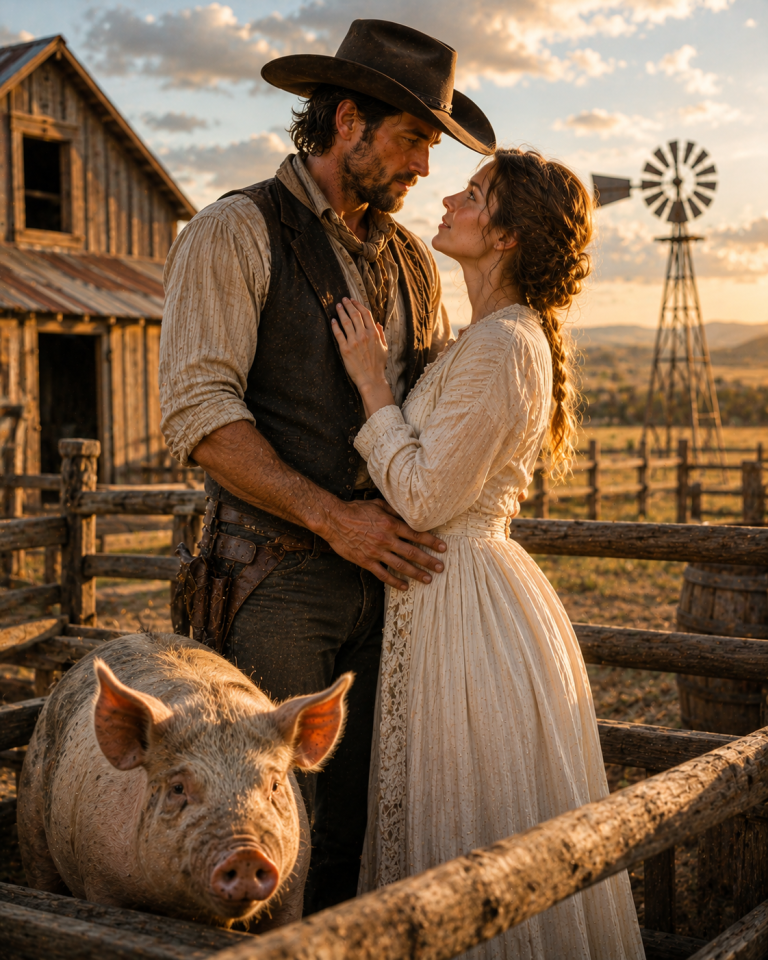
The February wind came down off the Montana ridgeline like something with a grudge, and Emma Whitmore felt every mile of it through her coat as she hauled the last armload of firewood toward the kitchen door. Her fingers had stopped working properly twenty minutes ago. She didn’t stop to think about that. There wasn’t room for thinking about her own comfort in a day that had guests in it.
Through the frost-fogged window she could see the parlor already transformed — her mother pinning the hem of an emerald dress while her younger sister Lydia turned in slow, practiced circles, checking the fall of the fabric in the mirror. Lydia had been born knowing how to be looked at. Emma had been born knowing how to disappear.
“Emma.” Her father’s voice cracked through the kitchen, sharp with the particular impatience he saved for her. “Where’s that wood?”
She didn’t answer. She kicked the door open instead and let the load fall beside the stove, bark scattering across the floor she’d scrubbed at dawn. Her mother appeared in the doorway a moment later, lips already thinning with disapproval.
“Clean that up. And use the back entrance from now on — Mr. Brooks will be here within the hour.”
“Mr. Brooks has seen worse than wood chips, Mama.”
“Not in this house he hasn’t.” Her mother’s eyes moved over her — coat, boots, the dirt worked permanently into her knuckles — with the specific disappointment reserved only for Emma. “Go make yourself presentable. Lydia can’t be the only daughter anyone sees tonight.”
Emma almost laughed. Presentable. As if there were a dress in the house that could turn twenty-six years of ranch work into something worth a stranger’s second glance. She’d tried that game once, a long time ago, before she understood the rules. Some daughters were raised to be displayed. Others were raised to make sure the display didn’t fall apart.
“I’ll wash up,” she said. “I’m not changing. If Mr. Brooks wants to see the Whitmore family, he can see all of it — even the part that lives in the barn.”
She meant it as defiance. She didn’t expect it to matter.
The arrangement had been three months in the making, negotiated in careful letters between her father and James Brooks — the empire builder, the man whose cattle outnumbered most territories’ entire populations. The Whitmore ranch, meanwhile, was dying by degrees: debts stacked like winter snow, cattle prices collapsed, a water-rights dispute with the neighboring Hendersons bleeding them dry in legal fees they couldn’t afford. A marriage was cheaper than admitting defeat. Lydia, beautiful and cultivated, was the obvious currency. Emma was simply the daughter who kept the stoves lit.
When Wyatt Brooks arrived that evening, dark-haired, broad-shouldered, uncomfortable in a suit that clearly wasn’t his idea, Emma watched from the stairs as her sister glided forward to greet him — every motion measured, every smile calibrated to charm without appearing to try. It was, Emma thought, a kind of artistry. She had never once resented Lydia for having it. She had simply never expected to be asked to compete with it.
Then Wyatt’s eyes lifted from Lydia’s outstretched hand and found Emma on the stairs, in her work coat, in boots that had never once pretended to be anything but practical. Something shifted in his expression. Not attraction — Emma wasn’t foolish enough to mistake it for that. Recognition, maybe. The way a person’s eyes catch on something that doesn’t belong in the frame and can’t stop returning to it.
“And this is—” her father started.
“My older daughter. Emma.” Her father’s jaw had gone tight. “She was just bringing in firewood.”
The silence that followed was the kind that has weight. Lydia’s smile didn’t move, but her eyes went cold. James Brooks looked at Emma the way a man looks at an insect in his dinner.
Wyatt only asked, “In this weather? That can’t be easy work.”
“It’s work,” Emma said. “Same as any other.”
By evening’s end, the script had mostly held — Lydia charming, her father steering every conversation toward the alliance disguised as a social call, Emma pouring coffee and staying invisible except when usefulness demanded otherwise. But every time she crossed the room, she felt Wyatt watching her, not with hunger, but with the focus of a man trying to solve something that didn’t fit the shape he’d expected.
Near the door, as the Brooks men prepared to leave, Wyatt turned back.
“Miss Emma. Do you ride?”
The room froze.
“Someone has to check the fence lines,” she said carefully.
“Then perhaps you could show me the property tomorrow. If your father permits.”
“I’m sure Lydia would be delighted to give the tour,” her father said quickly.
“I’d like Miss Emma to show me,” Wyatt said, polite, and immovable. “If she’s the one who actually knows the land, it makes sense she’d be the one to walk it.”
That night the house exploded the moment the door shut behind the Brooks men. Her father’s face had gone the color of a bruise. *What were you thinking, coming down dressed like that.* Her mother insisting it meant nothing. Lydia, quiet and wounded in a way Emma had never heard from her before — *he kept looking at her.*
“You’ll fix this tomorrow,” her father told Emma, voice dropping into something dangerous. “You’ll take him on that tour, and you’ll make sure his attention lands where it belongs. Do you understand me?”
Emma nodded, because there was no version of arguing that would end well. But lying in her narrow bed that night, listening to the window rattle in its frame, she let herself turn the day over one more time — Wyatt Brooks’s eyes finding her on the stairs, the strange, deliberate way he’d said her name. *Maybe he saw something the others didn’t,* a small voice offered, and she crushed it immediately. That kind of hope was dangerous. She’d learned that a long time ago.
She had no way of knowing that in less than twenty-four hours, she would be standing in that same parlor while her father called her a thief of her own sister’s future — and that the man everyone expected to marry Lydia Whitmore would instead be looking straight at her, saying words that would tear her whole world open.
PART 2
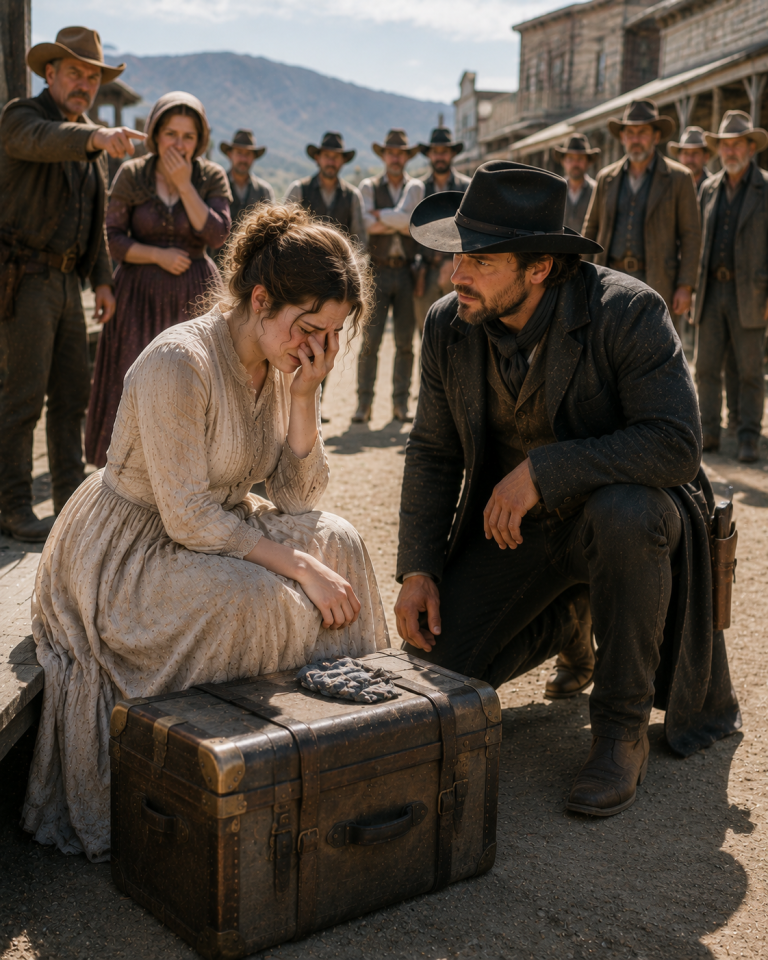
“You’re choosing her — the stable girl — over my daughter.”
The words cracked through the parlor like a whip, and every eye in the room fixed on Wyatt Brooks. He didn’t flinch.
“I’ve informed both our fathers,” he said, chin level, “that if this alliance is to proceed, Emma is the daughter I intend to marry. Not Lydia.”
The floor seemed to drop away beneath Emma. *No. That’s not — you can’t.* Her father’s voice climbed toward hysteria, demanding she refuse him, insisting the arrangement was for Lydia, as it always should have been. Emma felt twenty-six years of swallowed silence crack open inside her chest, and for the first time in her life, she said the word that mattered.
“No. If Mr. Brooks wants to marry me, I accept.”
James Brooks stormed out into the night, disgusted. Her father ordered her out of his house within the hour. And by midnight Emma was riding beside a man she’d known for exactly one day, leaving behind the only life she’d ever had, toward an empire she couldn’t yet imagine surviving.
The Brooks ranch, when it rose out of the darkness, wasn’t a ranch at all — it was a small kingdom, buildings lit against the night like a city that didn’t sleep. James Brooks was waiting on the porch with a scotch in hand and eyes that priced her like livestock at auction.
“You realize this is suicide for the alliance,” he told his son. “Richard Whitmore won’t honor anything now. You’ve humiliated his favored daughter and stolen the wrong one.”
“I didn’t steal anyone,” Wyatt said. “Emma made her own choice.”
“Did she.” James turned that same assessing look on Emma. “Welcome to the Brooks ranch, Miss Whitmore. I do hope you understand what you’ve gotten yourself into.”
Alone in a guest room bigger than her entire bedroom back home, still smelling of horses and cold night air, Emma sat on the edge of an impossibly soft bed and let the terror finally catch up to her. Twelve hours ago she’d been invisible and miserable, but at least familiar with her own misery. Now she was engaged to a stranger, standing inside a house that felt like a museum built to remind visitors exactly how much power the family holding it commanded.
She didn’t yet know that James Brooks’s cold eyes and colder study held more than contempt for an unsuitable daughter-in-law. She didn’t know about the portrait of his dead wife that he drank in front of, alone, late at night. She didn’t know that somewhere in this territory, an old woman named Helen Marsh was keeping a promise fifteen years in the making — a satchel of letters, hidden and waiting, that would one day land in Emma’s hands and force her to decide whether the empire she’d just married into deserved to survive at all.
For now, she only knew one thing for certain: she had chosen the unknown over the familiar, and there was no road back the way she’d come.
PART 3
Dawn came too bright and too fast. Emma woke tangled in unfamiliar sheets, disoriented for one merciful second before the previous day crashed back — the fight, the proposal, the ride into darkness, James Brooks’s eyes measuring her worth and finding her lacking.
A knock. Wyatt entered already dressed for work, carrying coffee strong enough to raise the dead.
“Thought you might need this,” he said, setting it down. “How’d you sleep?”
“Like someone who just burned down her entire life.”
“Your — my father’s called a family meeting for eight. That gives us an hour.”
“For what?”
“For me to show you what you’re actually getting into.”
Twenty minutes later they were walking the main barn, and the scale of the operation made her father’s dying ranch look like a child’s toy. Dozens of horses in clean stalls, thirty-two full-time hands, four separate grazing ranges. Wyatt talked while they walked — his father’s ambitions to double the herd, push east, build something that would outlast them all — and underneath the words, Emma heard something else: a man who didn’t actually want the empire he was expected to inherit.
“I want to build something that lasts,” he said. “That’s not the same thing as building something big.”
A foreman named Tom Gardner intercepted them with news of storm damage on the north fence, and when Emma asked precise questions about materials and cattle drift, his eyebrows climbed toward his hatline.
“She actually knows ranching,” he said, half to himself.
“She actually does,” Wyatt agreed. “Which is why when my father tries to tear her apart at breakfast, I’d appreciate the men remembering who fixes the fences around here.”
The family meeting, when it came, was brutal and short. James Brooks sat at the head of a table built for twenty and currently seating three, and didn’t waste time on pleasantries.
“This marriage is not happening.”
“Yes, it is,” Wyatt said, calm as still water. “The only value in the Whitmore alliance was ever the Henderson dispute. There are other ways to handle the Hendersons.”
“By marrying the daughter nobody wanted.” James turned his attention on Emma directly. “No offense, Miss Whitmore, but you’re not what we negotiated for.”
“None taken. I’m aware I wasn’t the prize.”
“We have investors arriving in two weeks. Important men from Chicago and St. Louis. How exactly do you intend to present her?”
“As my wife,” Wyatt said. “Same as I’d present anyone.”
James’s parting shot before storming out landed harder than he probably intended: *If you’re going to ruin this family’s reputation, you might as well do it publicly.*
“That went well,” Emma said afterward, hollowed out.
Wyatt actually laughed. “That was him being restrained. You get used to it.”
“Do you?”
His smile faded. “No. But I’ve learned to survive it.”
The days that followed became a kind of war fought in silences. Emma threw herself into ranch work — riding fence with Tom, repairing equipment, proving herself with her hands rather than her manners. The hired men were skeptical at first, another boss’s project playing at rancher. By the fourth day, Tom was giving her real assignments. By the seventh, some of the hands were asking her opinion outright. James watched all of it with a contempt that never fully thawed, introducing her to visiting ranchers as *Wyatt’s project* and letting the insult hang.
Then, on the fifth morning, disaster arrived at a gallop. Cattle thieves had hit the south range overnight — forty head gone, the trail leading straight toward Henderson land, already hostile from years of water-rights litigation. Wyatt rode out with six armed men, jaw set for a fight that could easily turn into a shooting war.
Emma caught up to them three miles out, pushing her horse hard across open range.
“Go back,” Wyatt said.
“Not happening.” She held her ground. “If you cross onto Henderson land with armed men and they’re waiting with rifles, what then?”
“Then we shoot back.”
“There’s another way. Let me ride ahead alone. They won’t shoot an unarmed woman riding in openly asking to talk.”
He refused for five furious minutes before a young hand pointed out they were losing daylight either way. Emma rode ahead before Wyatt could argue further, her heart hammering the entire way to the Henderson ranch, where three armed riders met her at fifty yards.
“That’s far enough,” the eldest said. “State your business.”
“My name is Emma Whitmore. I’m here about the cattle stolen from Brooks land last night. I’m not accusing anyone — I’m asking for a conversation before this turns into something nobody wants.”
Daniel Henderson studied her for a long moment before deciding to listen. The stolen cattle, it turned out, had been driven onto Henderson land overnight by someone else entirely — found mixed with Henderson’s own herd that morning, branded clear as day, planted to provoke exactly the violence Emma had ridden out to prevent.
“Someone’s trying to escalate the water dispute,” Emma said. “Make it personal. Make it bloody. Then buy up whatever’s left once we’ve destroyed each other.”
Two hours later, both families’ men stood together at the property line as the stolen cattle were driven back across, no shots fired, no blood spilled. Daniel Henderson rode up to Wyatt afterward with something like respect in his voice.
“Your wife’s got more sense than both of us combined. She probably just saved a dozen lives.”
Back at the house, James Brooks was waiting on the porch, having already heard the outcome from a Henderson rider. He didn’t offer approval, exactly, but for the first time, he didn’t offer contempt either.
“I still think you’re completely unsuitable for this family,” he told Emma. “But I’m willing to tolerate your presence for now. Don’t make me regret it.”
It wasn’t warmth. It was the first crack in his opposition, and Emma took it for what it was worth.
The investor dinner four days later was its own kind of battlefield. Maria, the housekeeper, spent the intervening days coaching Emma through forks and posture and the art of smiling while saying nothing of substance — lessons Emma hated and mostly ignored the moment they mattered. When one of the St. Louis investors turned to her directly over dessert and asked what she thought of James’s plan to double the herd within three years, the whole table went still.
James’s warning glare was unmistakable. Wyatt’s small nod told her something different: *tell the truth.*
“I think it’s dangerous,” Emma said. “Doubling a herd means doubling grazing land, water access, winter feed capacity. This territory doesn’t have unlimited resources. My father made exactly that mistake — expanded too fast, borrowed too much, and when the market turned, he had nothing to fall back on. Now he’s losing everything. Ambition is good. Recklessness is fatal.”
For a moment she thought James might explode. Instead, one of the Chicago men started laughing. “She’s got a point. We’ve watched plenty of operations collapse from overexpansion.” By the time the guests left that night, the investment was moving forward — not despite Emma’s honesty, but because of it.
“You undermined me,” James hissed at her afterward in the hallway.
“I told them the truth. And I saved the deal. If I’d sat there nodding along with an unsustainable plan, they’d have lost confidence in this entire family.”
Wyatt backed her without hesitation, and James, furious and cornered, could only manage a warning not to embarrass him like that again. Emma walked away with her heart pounding, aware she’d just done something either very brave or very foolish for her place in this house — and unwilling to regret it either way.
The next shock arrived by letter. A young woman appeared at the servants’ entrance near midnight, asking for Emma specifically, and Emma found her sister Lydia sitting on the guest cottage steps the next morning, hair tangled, face pale from crying. Their father had arranged Lydia’s marriage to Edgar Peyton — a sixty-three-year-old Denver banker who had already buried two wives — and had already accepted twenty thousand dollars against the wedding. Lydia had stolen a horse and ridden through hostile territory in the dark rather than go through with it.
“I’m being sold, Emma. Just like cattle.”
Whatever resentment Emma might have carried for the sister who’d stayed silent through years of their father’s cruelty dissolved into something more complicated — recognition of a girl trained her entire life to be exactly what a man like Edgar Peyton wanted, and only now discovering what that training actually cost.
“You can stay,” Emma told her. “For now, until we figure something out.”
Wyatt backed the decision, over his father’s furious objections that harboring a runaway would invite a legal nightmare and poison every business relationship the family had left. “You taught me to be strong, father,” Wyatt said, quiet and immovable. “You never taught me to be cruel. There’s a difference.” James allowed it, bitterly, on the condition that Wyatt and Emma alone would handle the consequences.
Those consequences arrived four days later in the shape of Richard Whitmore himself, gaunt and half-drunk, demanding his daughter back and calling Emma a poisoner of his family’s loyalty. When his hand came up to strike her, Wyatt caught his wrist mid-swing.
“Touch her and you leave here with broken bones.”
But it was Lydia’s voice that ended it — steady despite everything, walking out from the barn to face their father directly.
“I’m not marrying Edgar Peyton. I’m not for sale anymore.”
Richard Whitmore disowned them both on the spot and rode away in a cloud of bitterness, and Emma felt nothing but a strange, empty relief that the last tie had finally been cut. James put Lydia to work managing the ranch’s books, warning her one mistake would end the arrangement. Within two weeks she’d found errors that had cost the family money for years. Within a month she’d reorganized the entire system — proof, Emma thought, of exactly how much value her father had thrown away treating his daughters as decoration.
Then came the letter that changed everything.
It arrived on an ordinary Tuesday, plain envelope, no return address, delivered to Emma by hand from a rider who wouldn’t say who’d sent it. Inside, elegant, unfamiliar handwriting: *I knew your future mother-in-law, Catherine Brooks. I have information about the Brooks ranch that you need to see. Meet me at the old Parson’s place tomorrow at noon. Come alone. What I have could destroy the Brooks family or save it. Your choice.*
Emma told no one. The following morning, she found an older woman named Helen Marsh waiting at the abandoned homestead — Catherine Brooks’s closest friend, keeper of a promise fifteen years old.
“Catherine discovered, about a year before she died, that James built this ranch through fraud,” Helen said. “Forged water-rights claims. Manipulated land documents. Families threatened into selling at unfair prices. He destroyed people to build his empire, and he did it in ways that were technically legal and morally bankrupt.”
She handed over a leather satchel — letters in Catherine’s own hand, copies of forged documents, testimonies from ruined families, and proof that the water rights at the center of the Henderson dispute had been stolen from the Hendersons two decades earlier. The bitter, years-long feud that had nearly cost lives wasn’t the Hendersons overreaching. It was them trying to reclaim what had been taken from them all along.
“Catherine tried to expose it herself,” Helen said. “But she was sick, and James had lawyers, judges, friends in every office that mattered. By the time she died, no one believed her. She made me promise to wait for the right person before I gave this to anyone. Someone who wouldn’t bury the truth to protect themselves.”
Emma rode back to the ranch with the satchel tied to her saddle and her mind in freefall. She hid it, found Wyatt, and told him everything. They spent the next three hours going through Catherine’s careful handwriting by lamplight, watching Wyatt’s face age in real time as the evidence mounted — his mother’s proof that she hadn’t been hysterical or confused, only inconvenient.
“This is my mother’s legacy,” Wyatt said finally, voice raw. “Proof she saw the truth and tried to stop it.”
“If we expose this, we destroy the ranch,” he added. “Everything my father built. Every alliance, every investment, gone.”
“If we stay silent,” Emma said, “we’re complicit in what he’s still profiting from.”
They confronted James together the next morning. He read his dead wife’s letter with shaking hands and, for a long moment, said nothing at all.
“Your wife was sick when she wrote these. Confused. I tried to help her, but—”
“Don’t,” Wyatt’s voice cracked. “Don’t you dare use her illness to dismiss this. She wasn’t confused. She saw what you were, and it broke her heart.”
James flinched like he’d been struck. What followed wasn’t the explosion Emma had braced for, but something worse — a slow collapse of the man’s defenses, decades of justification crumbling in real time. He admitted, eventually, what restitution would cost: half the ranch’s land, most of its investors, the Brooks name reduced from empire to ordinary.
“Then we’ll be honest and poor,” Wyatt said. “Better than wealthy and corrupt.”
“You sound like your mother,” James said bitterly. Then, quieter, staring at Catherine’s letter: “She asked me once if I was proud of what I’d built. If I could look at our son and honestly say I’d created something worth inheriting. I told her yes. She died believing I was a monster. Maybe she was right.”
“Then spend the years you have left proving her wrong,” Emma said.
The reckoning that followed was as brutal as promised. James personally confessed to Daniel Henderson, returning the stolen water rights along with two decades of compensation. Word spread through the territory, and the investors who had only just committed pulled out in a fury, calling James’s honesty instability, poor judgment, weakness. The ranch shrank by nearly a third almost overnight. James took the loss with a stoicism that surprised everyone who’d known him as an empire builder — no rage, no blame, only the slow work of rebuilding with what remained.
“I hope you’re watching this,” Emma once overheard him tell his dead wife’s portrait, glass raised in the dark of his study. “I hope you see that I’m trying. Probably failing. But trying.”
Months later, having watched the smaller, honest operation actually function — sustainable grazing, fair water sharing, real accountability — the investors came back, this time with conditions: Emma remained involved in every operational decision, Lydia continued managing the books, and James submitted to monthly oversight to ensure nothing slid backward into the old methods. It wasn’t the empire James had dreamed of building. It was, for the first time in fifteen years, actually his.
The wedding took place in late June under cottonwood trees that had witnessed thirty years of Brooks family history — smaller than James had once wanted, more honest than anything he’d have chosen on his own. Daniel Henderson came and stood in the back with his sons, nodding his approval when Emma and Wyatt exchanged vows. James walked Emma down the aisle himself, the man who had once called her completely unsuitable now placing her hand in his son’s with tears he didn’t try to hide.
“Catherine would have liked you,” he told her quietly. “Stubborn enough to match her.”
There was one last piece of unfinished business. Weeks after the wedding, a land-office clerk arrived at the ranch with a filing from Richard Whitmore, claiming Emma and Lydia had stolen property when they left — a horse Emma had raised from a foal, tack she’d bought with money she’d never technically been paid for her own unpaid labor. He wanted it back, or eight hundred dollars in its place.
Emma rode to her father’s failing ranch alone the next morning, against everyone’s advice, and found him drunk on the porch of a property he’d let rot since she left.
“I came to end this,” she told him, throwing the money at his feet. “Take it, keep the horse if it makes you feel powerful. This is the last time we speak. After today you’re dead to me.”
“You can’t just walk away.”
“Watch me.” She looked down at him from horseback, feeling nothing at all where twenty-six years of fear used to live. “I stopped being your daughter the moment you started treating me like property. Goodbye, father. I hope you find whatever you’re looking for at the bottom of that bottle.”
She rode away without looking back, and cried the whole way home — not from grief, but from the sheer relief of finally, completely being free.
The years that followed reshaped the Brooks ranch into something James had never planned to build: smaller, sustainable, honestly earned. Lydia found her own quiet happiness with one of the ranch hands, a man who loved numbers nearly as much as she did. James taught his granddaughter to ride with a patience he’d never once shown his own son, as if he’d finally learned that some legacies mattered more than land.
Emma gave birth on a January morning cold enough to frost the windows, to a daughter with her mother’s gray eyes and her father’s stubborn determination. They named her Catherine. It was the first time Emma ever saw James Brooks cry.
“She would have loved this,” he said, holding his granddaughter with shaking hands. “Loved all of it.”
“Then live like she’s watching,” Emma told him. “That’s how we honor her.”
Years later, standing on the same ridge where Wyatt had first chosen her — where a stranger had looked past everything the world told him to want and seen something real instead — Emma held her daughter’s hand and looked out over land that had witnessed fraud, reckoning, and the slow, difficult work of becoming something true. It wasn’t the empire James Brooks had once dreamed of. It was smaller, harder-won, and entirely honest — built not on what could be taken, but on what had finally, painfully, been made right.
“Tell me the story again,” Catherine said, the way children always do. “About how you and Papa met.”
Emma smiled, and pulled her daughter close against the Montana wind.
“Well,” she said, “it started with an impossible choice.”
THE END