The Cowboy Made Her One Dangerous Promise—Then She Discovered She Never Wanted to Run

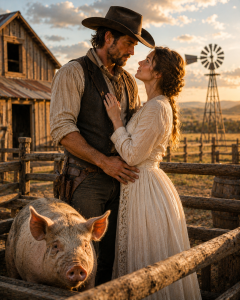
—
## PART 1
A man who knows his own trail doesn’t need a town hall sermon to guide him. One whisper from his gut moves him faster than fifty loud voices shouting advice. That was the kind of man Lucas Bridges believed himself to be — thirty-five years old, broad-shouldered, rough-handed, with a temper that could flare quicker than dry grass in a Texas summer. The day he rode into Douglas Green’s law office in Abilene, he thought he was there to sign papers and ride home richer than he’d arrived. Instead he walked into the strangest test a man could face.
The brass pendulum clock on the wall ticked slow and sharp, each swing sounding almost like a warning. Douglas Green adjusted his spectacles and unrolled the will across the oak desk.
“Your uncle left you his ranch and eight hundred dollars in gold certificates,” he said. “But only if you pass two conditions.”
Lucas leaned back, boots stretched out. “Name them.”
“You must raise one pig for nine months, alone. No help from neighbors. If the pig dies, you lose everything.”
Lucas snorted. “That’s it?”
Douglas didn’t smile. “Second condition. You must live six months with a wife. No formal complaints filed against her. Not one.”
The room felt smaller. “No complaints?” Lucas repeated.
“One written complaint filed at this office,” Douglas said, tapping the desk, “and the inheritance passes in full to your cousin Randall, per your uncle’s own instruction. He was specific about that clause. I’d ask you to read it yourself so there’s no confusion later.”
Lucas read it. His jaw tightened. Randall Bridges hadn’t spoken two civil words to him at the funeral, standing off at the edge of the churchyard with the particular stillness of a man doing arithmetic in his head while everyone else grieved. “Uncle Elias knew Randall wanted this place.”
“Your uncle knew a great many things,” Douglas said carefully. “I’ll only say this much as your attorney and not as anyone taking sides: Randall has already been in this office twice asking after the exact wording of both conditions. I’d keep that in mind over the coming months.”
The clock ticked on. Heat rose in Lucas’s chest. A pig and a wife — that was the price of forty acres and a future, with a cousin waiting in the wings hoping he’d trip over either one. His uncle had always believed discipline mattered more than muscle. Now the old man was testing him from the grave, and it seemed he wasn’t the only one watching to see whether Lucas would pass.
Lucas spat into the brass spittoon and stood. “Fine. I’ll do it.”
That same evening he rode southwest of Abilene to the ranch now waiting on his success or failure — modest, a two-room cabin with a stone chimney, a weathered gray barn, forty acres of decent pasture wrapped in cedar fencing. More than he’d had the day before, at least, and worth defending on that fact alone.
The next morning he went straight to Jeremy Cobb’s feed and supply on Cedar Street. “I need a feeder pig,” he said. “Healthy, hardy.” Jeremy scratched his beard and led him behind the store where young hogs rooted in the mud. One caught Lucas’s eye — a spotted gilt with bright eyes and steady feet.
“That one,” Lucas said, and twelve dollars later he was hauling her home in the wagon.
He built her pen himself, oak rails tight, cedar posts sunk deep, a shelter in one corner, a trough fed by the windmill. Standing at the fence afterward, he watched her explore the new space. “Well, girl,” he muttered. “Looks like it’s you and me.”
The first week went smooth — feed at sunrise, clean pen before noon heat, fresh water twice daily. Lucas even kept a notebook: weather, feed amounts, health signs. The routine calmed something in him he hadn’t known needed calming.
Then, on the third day, the pig knocked over her water trough and splashed muddy water clean across the pen. The familiar burn crept up Lucas’s neck. His fist tightened. For one long moment he wanted to kick the fence hard enough to splinter it.
Instead, he walked to the barn door where he’d nailed a small wooden sign: *Three breaths before action.* He stood still. One breath in, one out. Two. Three. The heat cooled. He walked back and fixed the trough without a single curse leaving his mouth — and noticed, only after he’d finished, that the trough’s leg hadn’t simply tipped from a clumsy hog. It had been loosened at the bolt, deliberate, the kind of thing a careless animal didn’t do to itself.
Lucas said nothing about it to anyone. He tightened the bolt, made a note in his book, and kept a sharper eye on the fence line after that than he had the first two days combined.
—
## PART 2
By October, rain flooded the county roads and cut Lucas off from town entirely. Feed ran low; he improvised a mash from cornmeal and oats, and the pig ate it well enough. Then a buried water line froze and burst, turning the pen to mud. His temper flared again. He counted again — one, two, three — and replaced the line with a barrel-and-float system that worked better than the original ever had.
The real test came two weeks later, when Lucas woke burning with fever, his head throbbing, limbs shaking, and still staggered outside to feed the pig because the will hadn’t included a clause for a man’s own sickness. Two days he lay drifting in and out. On the third morning he forced himself up and found the pig lying in her shelter, breathing fast and shallow — worse than three days of neglect alone should have left her. When Manuel Cobo, the town veterinarian, examined her in town, he frowned over more than dehydration.
“There’s a bitterness to what’s in her gut that plain mash wouldn’t put there,” Manuel said quietly, out of Lucas’s earshot at first, then plain to his face once he’d finished the exam. “Someone’s been feeding her something past what you left down, Mr. Bridges. I can’t swear to what, or who, on an empty stomach and no witness. But I’ve seen accidental sickness before, and this isn’t the same shape as that.”
Lucas rode home with that sitting cold in his chest alongside the fever still working through his own blood. He didn’t have proof enough to accuse a man by name. But he had a strong guess, and from that day on he started sleeping some nights in the barn loft instead of the cabin, rifle close, watching the tree line more than he watched the pig.
By November, the pig was thriving again despite it all. By January, Lucas had filled half a notebook and learned more about patience — and about watching his own back — than any sermon could have taught him in a decade of Sundays. Nine months passed. The pig stood sleek and strong in her pen, heavier now with a litter Jeremy Cobb’s boar had given her back in the fall, due sometime that spring. The first test was nearly complete. But the second one loomed heavier in his mind with every day that passed. Marriage.
Raising a hog was one thing, and someone out there had already shown they’d stoop to poisoning an animal to see him fail at it. Living six months with a wife, without a single complaint filed against him, with that same someone circling the whole time looking for an opening — that was going to test him in ways a trough and a water line never had.
—
## PART 3
The pig phase ended with quiet pride, but Lucas knew the harder road still lay ahead. A hog didn’t argue. A hog didn’t cry. A hog didn’t feel hurt by careless words, and a hog couldn’t be talked into signing a piece of paper that ended a man’s whole future. A wife could do all four.
He rode into town wearing his cleanest shirt and a trimmed beard. Word had already spread through Abilene about the strange will — men at the mercantile nodded at him like he was half a curiosity, women whispered behind gloved hands, and more than one person mentioned, unprompted, that Randall Bridges had been asking around about him too, casual questions dressed up as concern. At Jeremy Cobb’s store, Lucas asked plain: “Know any woman who’d agree to marry a rancher with rules attached?”
Jeremy leaned on the counter. “Emily Guzman runs a boarding house on Elm Street. Practical woman. Widowed three years back. Knows hard work.” He hesitated, then added, lower, “Randall’s been by her place twice this month too, far as I’ve heard. Might want to ask her about that yourself before you go courting.”
Lucas rode there that same afternoon, that detail sitting uneasy in his mind. Emily answered the door herself — early thirties, brown hair pinned neat, a simple blue dress, eyes steady, neither shy nor foolish.
“I heard about your uncle’s will,” she said, before he’d gotten past his hat. “And I’ve had a man named Randall Bridges in my parlor twice already, telling me what a poor bargain I’d be making if I took you up on it.”
Lucas’s jaw tightened. “What’d he say, exactly?”
“That you’d inherited your father’s temper along with his name. That any woman foolish enough to marry you for the land would regret it before the season turned.” Emily studied him a long moment. “I run a boarding house, Mr. Bridges. I’ve learned to tell a man protecting his own interest from a man protecting mine, and Randall Bridges wasn’t doing either — he was protecting his.”
“Then you know I need a wife, and I need security,” Lucas said. “And apparently I need to warn you plainer than most men would have to, that my cousin means to see me fail at this, one way or another.”
“Come inside,” she said, calm as if he’d asked to price a room rather than propose an arrangement built half on hope and half on a family feud. They sat across from each other in her tidy parlor, the smell of fresh bread in the air, more books lined along her shelf than most houses twice this one’s size held.
“I won’t be treated like a contract,” Emily said. “Marriage is a partnership. Not paperwork, and not a weapon your cousin gets to use against either of us.”
Lucas nodded. “Six months without a complaint filed, that’s the rule I’m bound by. After that, we decide together whether we suit.”
“And no rushing into anything,” she added. “Respect comes first, or none of the rest of it matters.” She hesitated, then said the rest of it plain, the way she seemed to say most things. “I should tell you, since you were honest with me about Randall — my first husband left this boarding house in debt when he died. Randall’s family holds part of that note still, bought up cheap years back from another creditor. He mentioned it, the second visit. Made sure I understood he could call it due whenever he liked.”
Lucas felt something cold settle under the heat in his chest. “He’s holding a debt over you to keep you from marrying me.”
“He’s holding it to make sure that if I do marry you, I’ve got a reason handed to me already to file a complaint the first hard week that comes along,” Emily said. “I wanted you to know exactly what you’d be riding into before you asked me anything further.”
He should have walked out then, by any sensible reckoning — one more complication stacked on a test already rigged against him. Instead he found himself more determined than before. “Then we go in with our eyes open,” he said. “Both of us.”
They set the wedding for March. The ceremony at Abilene Community Church was simple, Reverend Nelson Holland speaking soft over two witnesses, Randall Bridges notably absent from a guest list he hadn’t been sent in the first place. When Lucas said his vows his voice didn’t shake. When Emily promised to stand beside him, she meant every word of it plainly enough that even the reverend seemed to notice.
They rode back to the ranch together that afternoon, and the first weeks surprised him more than the whole of the pig test had. Emily brought order to the cabin the same way she’d apparently run her boarding house — organizing the pantry, planning meals, keeping careful records of every expense. She asked sharp, useful questions about the land and the pig without once overstepping into telling him how to run either.
“You plan everything,” she observed one evening, walking near the pen.
“Had to learn,” he said. “Discipline instead of anger.”
“That’s not nothing,” she said quietly, and he didn’t argue with that either.
Their relationship moved slow and deliberate at first — shared coffee at sunrise, reading together by lamplight, a goodnight kiss with no pressure behind it. Then one quiet night, wind soft outside and the lamp turned low, Emily reached for his hand first, and something between them shifted from careful distance into something closer to trust.
That trust got tested faster than either of them expected. In April, a letter arrived from a bank in Fort Worth Lucas had never done business with, informing Emily that a note originally issued to her late husband had been called due in full — thirty days to pay, or the boarding house building itself, which she still owned outright and rented out for income, would be seized. Emily went white reading it. “Randall,” she said. “He told me he could do this whenever he liked. I thought it was a threat for later. I didn’t think he’d move this fast.”
Lucas’s hands curled to fists before he caught himself, three breaths coming slower and harder than they had over any spilled trough. “We’ll cover it,” he said, though he had no clean idea yet exactly how, with most of his own cash tied up in the ranch itself and the pig’s sale money still months off.
They didn’t cover it easily. They sold two horses they could ill afford to lose. Emily wrote to a cousin of her own in San Antonio for a short loan, swallowing pride she hadn’t wanted to swallow in front of Lucas at all. It came together in twenty-six days, four short of the deadline, and the boarding house stayed hers — but the strain of it left a mark on both of them that didn’t simply vanish once the money cleared.
By May, Emily began waking sick, and at first she thought it was simply the exhaustion of the debt scramble finally catching up with her. Then she missed her monthly cycle entirely, and the truth settled between them plain: she was carrying a child, in the middle of everything else already stacked against them. The news filled Lucas with pride and fear in equal, tangled measure.
Morning sickness hit her hard. Money stayed tight after the loan. And into the middle of that stretched-thin summer, Randall Bridges made his next move — riding out to the ranch himself under the excuse of “neighborly concern,” finding Lucas alone at the pig pen while Emily rested inside.
“Heard you’ve had some trouble,” Randall said, all false warmth, leaning on the fence rail like he had every right to it. “Debt troubles. A sickly wife. Man under that much strain’s bound to say something he regrets sooner or later. I’d hate to see you lose the ranch over a moment you can’t take back.”
“Get off my land, Randall.”
“It’s not your land yet,” Randall said, smiling thin. “Not for one more month. Plenty can happen in a month.”
Something in Lucas broke loose that he hadn’t let slip in nine careful months. He crossed the yard fast, grabbed a fistful of Randall’s shirt, and had him half off his feet against the fence rail before the old wooden sign on the barn door caught the edge of his vision — *three breaths before action* — and he stopped himself with Randall’s collar still bunched in his fist, close enough to see the flicker of real fear finally crack through his cousin’s smugness.
He let go. Stepped back. Breathed, late, but breathed anyway. “Get off my land,” he said again, quieter this time, “before I stop counting.”
Randall straightened his shirt, shaken more than he wanted to show, and rode off without another word — but not before Emily, who’d come to the window at the sound of raised voices, had seen the whole of it from the porch.
That night was the hardest of their marriage so far. “You put your hands on him,” Emily said, not accusing exactly, but shaken. “In front of me.”
“I know,” Lucas said. “I’m not going to pretend I didn’t want to do worse. He came onto my land threatening my family, Emily, and for about three seconds I wasn’t the man I’ve spent nine months teaching myself to be.” He sat down heavy at the table. “I owe you an apology, not an excuse. I lost control. I’m sorry.”
Emily was quiet a long moment. “I’m not going to file anything over it,” she said finally. “He didn’t touch me. He didn’t touch you first, either, from what I saw, but he came here meaning to provoke exactly what he got. That doesn’t make it right that you gave it to him.” She reached across the table and took his hand anyway. “But I watched you stop yourself before you watched me watching. That matters more to me than a moment you didn’t get to have back.”
It wasn’t a clean resolution. It sat between them for days afterward, imperfectly mended rather than erased — but it was real in a way a story with no cracks in it never could have been.
Two weeks later, Lucas woke to cold water soaking the kitchen floor — a pump seal burst, two inches of water spreading fast across the boards. When he went to trace the failure, the seal itself looked worn thin in a way that matched nothing about its age; someone had been at it with a blade, shaving it down slow enough to fail on its own timing rather than all at once. Emily stood in the doorway with both hands pressed over her mouth.
“We can’t afford this,” she cried, and this time neither of them needed to say Randall’s name out loud for it to sit heavy in the room between them.
Heat rose fast in Lucas’s chest again — nine months of discipline, a debt scramble, a public loss of temper he was still making amends for, and now sabotage on top of all of it. On the kitchen table, half-hidden under a folded dish towel, lay a piece of paper he recognized instantly. A complaint letter, unfinished, needing only her signature to end the whole arrangement and hand Randall exactly what he’d been engineering for months.
For one heartbeat, Lucas wanted to grab it himself and finish what fear had started for her. Instead he walked to the barn. Three breaths. He came back and fixed the pump without a word of blame, working steady while Emily sat on the porch fighting nausea and watching him do it.
That evening she brought the letter up herself. “I started writing it before I even knew about the seal being cut,” she admitted. “I wasn’t thinking of Randall when I picked up the pen. I was thinking that everything kept breaking and I didn’t know anymore whether it was bad luck or something worse, and I was tired, Lucas, all the way through.”
“What stopped you finishing it?”
“You didn’t lose your temper over the water,” she said. “You lost it once, with Randall, and you owned it plain the same night instead of pretending it hadn’t happened. That’s not the same as a man who can’t be trusted with a bad afternoon. I filed that letter away in my own mind as unfinished business, not evidence.”
They found the shaved pump seal’s twin, unused, tucked behind a loose board in the barn a week later — proof enough for Manuel Cobo to compare against the tampered feed he’d flagged back in the winter, proof enough, once Lucas finally rode into town and laid the whole pattern out for Douglas Green, for the attorney to take it seriously rather than dismiss it as family suspicion.
“I can’t act on suspicion alone,” Douglas told him, “but I’ll tell you plain, Mr. Bridges, your uncle suspected Randall might try something along these lines, which is exactly why he had me witness and date every report you file with this office, rather than simply taking your word at the end of six months. Keep bringing me what you find. If it adds up to something provable by the deadline, it’ll matter.”
The weeks that followed tested them harder still. Summer heat turned the cabin into an oven. Emily’s belly grew round; her patience grew thin alongside it, money arguments flaring sharp between them more than once, small irritations turning to bigger ones the way they do in any real marriage rather than a storybook one. But each time, Lucas walked to the barn first. Sometimes it took more than three breaths. Once it took the better part of an hour, pacing the loft in the dark before he trusted himself to go back inside calm rather than merely quiet.
Emily missed the systems from her boarding house, the order and structure that had once been entirely hers to keep amid all this new uncertainty. “Then we build systems here,” Lucas said, and they did — early breakfast before the worst of the day’s smells could trigger her sickness, a weekly sit-down over the money instead of solitary midnight counting, a rule to wait forty-eight hours before any complaint got written down at all, giving both of them room to cool before a hard moment turned permanent on paper.
By late summer, the tension had softened, though never entirely vanished — Randall’s presence still felt at the edges, a rider spotted too often on the road past the property line, questions still circulating in town. Lucas prepared carefully for the baby’s arrival regardless: clean linens ready, water heating, the doctor informed well ahead of time. When Emily went into labor that October, he stayed beside her every hour of it, and on the same restless night, half a mile off in her pen, the pig went into labor of her own — nine piglets born before dawn while Byron drew his first breath in the cabin above. Lucas would say for years after that he’d never once in his life had a night stretch so long or matter so much.
Emily held their son close against her chest, and Lucas felt something shift inside him that had nothing to do with land or gold certificates at all. They named the boy Byron.
Two weeks after Byron’s birth, with the deadline for both conditions bearing down fast, Randall Bridges made his final move. He walked into Douglas Green’s office himself, a folded paper in hand, and set it on the very desk where Lucas’s original test had begun.
“A complaint,” Randall said, “filed on Mrs. Bridges’s behalf, describing an assault against a man on his own property back in July. I have a witness.”
Douglas read it over slow, his face giving away nothing. “This bears Emily Bridges’s signature.”
“It does.”
“Send for her,” Douglas said. “Today, if the ranch will spare her the ride with a two-week-old baby. I won’t act on a signature I haven’t confirmed myself, cousin or no cousin standing in front of me.”
Emily arrived that afternoon, Byron wrapped tight against the autumn chill, and looked at the paper Douglas laid in front of her for a long, quiet moment.
“That’s not my signature,” she said finally, calm as still water despite the color rising in her cheeks. “It’s a fair copy of my hand, I’ll grant him that much skill. But I never wrote this, and I never would have — because the man he’s describing put his hands on Randall for exactly three seconds before stopping himself cold, in front of me, and apologized the same night without me asking him to. That’s not the man this paper describes.” She looked at Randall directly. “You’ve been trying to buy or force your way into this ranch since before the funeral flowers wilted. I’d have expected better forgery from a man that determined.”
Randall’s composure cracked for the first time in the whole ordeal. “You can’t prove it’s forged.”
“I can,” Douglas said, drawing out a folder of his own. “Every report Lucas has filed with this office over the past nine months carries Emily’s countersignature where relevant, taken fresh each visit, on my instruction, precisely because your uncle anticipated exactly this kind of trouble from you, Randall. I have eleven samples of her genuine hand in this drawer. This isn’t a close match to any of them.” He set the forged letter down flat. “Combined with a tampered water pump, tampered feed a licensed veterinarian is prepared to testify to under oath, and a debt note called due suspiciously close to a wedding date, I’d say we have rather more than family suspicion now. I’d advise you to leave quietly, Randall, unless you’d like this office to involve the county sheriff in the conversation next.”
Randall left without another word, and word around Abilene afterward suggested he didn’t stay in the county much longer than the season allowed him to save face.
Two weeks later, Lucas rode into Abilene for the formal inheritance review. The same brass pendulum clock ticked on the wall of Douglas Green’s office. Lucas laid his records on the desk — nine months of pig logs, health notes, feed entries, Manuel Cobo’s signed statements about the tampering, and, most important of all, the marriage certificate with no genuine complaint ever filed against it.
Douglas examined each page slow. “No complaints,” he said, “genuine ones, at least. Your uncle’s ranch is legally yours, Mr. Bridges. And for what it’s worth, I don’t believe he’d have been surprised in the slightest by how hard you both had to fight to get here. I think that’s rather closer to what he was hoping to see than a clean nine months would have been.”
The words felt heavy, though not the way Lucas had once imagined they might. The ranch no longer felt like a prize he’d won off a cousin. It felt like something he and Emily had built the right to keep, piece by contested piece.
The pig, with her litter of nine now weaned and thriving, sold for far more than twenty-six dollars that year — Lucas kept back the two strongest piglets rather than selling the whole lot, one to breed forward on the ranch and one, on Emily’s insistence, set aside as a project for Byron the day he was old enough to want one of his own. The rest covered the doctor’s fee, the last of the San Antonio loan, and a proper well dug closer to the house so Emily wouldn’t have to walk far with a baby in her arms.
That winter passed with Byron growing strong. Spring brought new pasture growth and a quiet kind of joy neither of them had dared name too loudly during the hard months before. By the time Byron learned to crawl, Emily told Lucas she was carrying a second child, and this time neither of them mistook the news for one more crisis to survive. They planned instead — reviewed the money together, adjusted feed costs, added fruit trees along the south slope. When their second son arrived that January, loud and stubborn from his very first breath, they named him Rocky.
Three years passed before a final letter came from Douglas Green — a short note Elias Bridges had written before his death, held back until the whole test had run its course. *If you are reading this,* it said, *you have proven yourself not just as a rancher, but as a husband and a father, and I suspect you’ve done it despite Randall’s efforts rather than in the absence of them, which I confess I half expected when I wrote these conditions down. The true inheritance was never the land. It was the discipline to build something that lasts, even when someone is actively trying to knock it down around you. The attached deed transfers an additional hundred and sixty acres adjoining your property.*
Lucas stood silent a long moment. Emily read the paper over his shoulder. “More land?” she asked.
“West of here,” he said. “Where the piglets’ pen backs up against the tree line.”
Years later, the same brass pendulum clock that had once measured his test hung on their own mantle, ticking the same slow, sharp rhythm it always had, though it no longer sounded like a warning to either of them. One quiet evening, Lucas and Emily sat together on the porch watching the sunset stretch out across two hundred acres now entirely their own, Byron chasing Rocky through the tall grass while a half-grown pig — the one they’d kept back, now nearly as tame as a dog — rooted lazy near the fence line, exactly where her mother’s pen had once stood.
“You remember the first day we met?” Emily asked. “Randall in my parlor the same week, telling me what a poor bargain you’d be.”
“I remember thinking the whole thing was a business deal stacked against both of us from the start,” Lucas said.
“And now?”
“Now it’s a life. One we had to fight a cousin, a bank, and a forged letter to keep hold of.”
She laughed, the same warm sound that had carried them through every hard stretch since. “I reckon I never much wanted to escape, even when he made it easy to consider,” she said, and Lucas squeezed her hand as the sun went down behind land that had never once been handed to them easy, and was worth all the more for it.
The inheritance had ended long ago. The life it had quietly, stubbornly built — against a rival who’d never stopped trying to take it apart — was only just getting started.
**THE END**