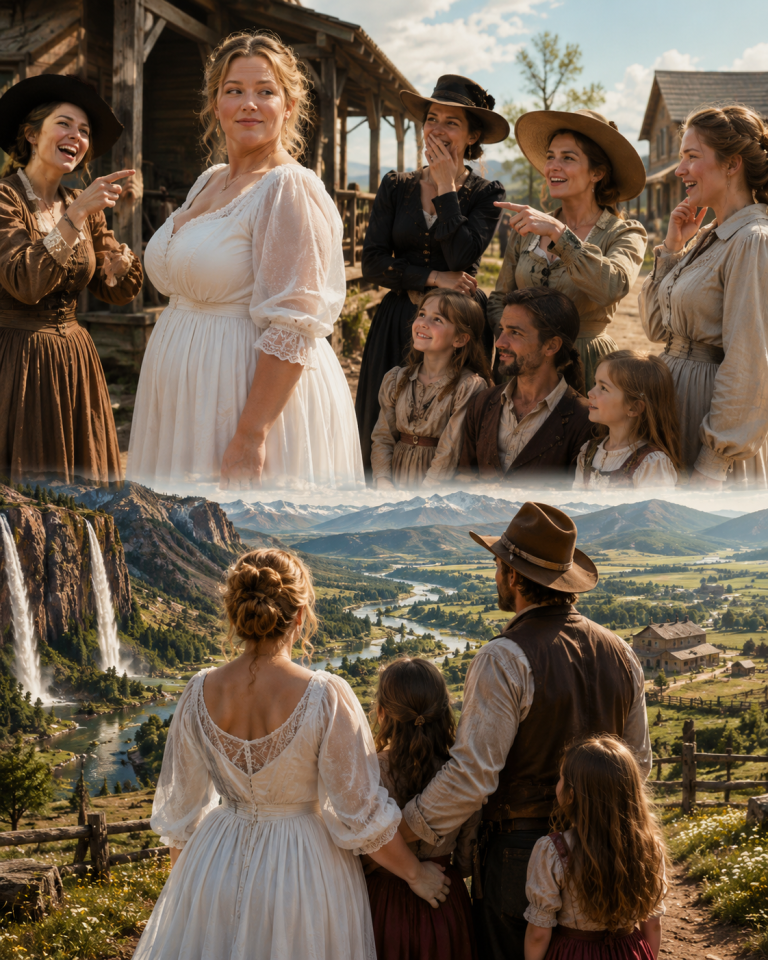
TOWNSFOLK CALLED HIM A MONSTER WHO KILLED HIS OWN WIFE — THE WOMAN THEY MOCKED MARRIED HIM ANYWAY AND FOUND OUT WHO THE REAL MONSTERS WERE

PART 1
Marigold Hutchins was on her knees scrubbing vomit off a drunk man’s boots when her sister’s fiancé leaned close enough that his breath touched her ear. “They’re taking bets at the card table,” he murmured, “on whether you’ll die alone or just eat yourself to death first.”
She didn’t cry. Didn’t look up. She wrung the rag out in the slop bucket, pressed it back to the floorboards, and kept working.
The drunk’s name was Otis Bragg. He’d emptied a night’s worth of cheap whiskey and worse decisions onto his own boots and several feet of Garrison Hutchins’s saloon floor. Sour liquor and stomach acid hung thick in the air. Around her the bar roared — men slapping the counter, someone hollering for another bucket, someone else suggesting a horse trough might suit the size of the mess, and the size of the woman cleaning it, about equally well.
Marigold knew every voice in that room. Sixteen years had taught her exactly what men sounded like when her humiliation was the evening’s entertainment.
Her father’s voice cut sharp from behind the bar. “When you’re done playing nursemaid, the cider barrels need rotating. Use the side hall. Rosa’s entertaining.”
Rosa was always entertaining. Twenty-four, honey-haired, narrow-waisted, quick to laugh and quicker to smile whenever a man was buying the next round. Rosa was the daughter Garrison Hutchins introduced to guests. Marigold was the daughter he sent down the side hall with a mop and an ash bucket.
Marigold stood. Rising from her knees always hurt, though not the way people assumed. The weight was real enough — two hundred eighty pounds on a five-foot-three frame — but the real pain sat in the half-second in between, the moment she had to choose whether to meet their eyes or spare herself the sight of just how funny they found her.
That night, she looked.
Nathaniel Cross, the banker’s son, had one arm slung over Rosa’s shoulders — thin-faced, smooth-handed, built for signatures and smirks rather than labor. Beside him stood Boyd Larkin, a slick-haired cattle agent with whiskey in his grin and cheap meanness riding just under it.
“Mari,” Nathaniel called, not bothering to lower his voice. “Come here a second.”
She didn’t move. She knew that tone — the one men used right before being clever at someone else’s expense.
“Don’t be shy,” Nathaniel said. “Got good news. Asked your sister to marry me. She said yes.”
Something cold moved through Marigold’s chest. Not surprise — Rosa had been working toward Nathaniel for months, smiling at the right men, softening her voice at the right moments. It wasn’t jealousy Marigold felt. It was something more final. Something like a lock turning shut.
“Congratulations,” she said.
“Thank you kindly,” Nathaniel said, grinning wider, feeling the crowd lean in. “Wedding’s set for October. Rosa wants you baking the cake — best hand in the territory.” He paused, savoring it. “And Boyd here was just saying he needs a date for the wedding. What d’you say, Boyd? You and Mari?”
Boyd Larkin nearly choked on his drink.
The bar exploded. Men laughed hard enough to slap the counter, one doubling clean over. Even Garrison’s mouth twitched. Rosa laughed too — a light, reflexive sound that died the instant her eyes caught Marigold’s. She looked away fast, the way a person looks away from a dog she’s just accidentally kicked.
Marigold stood there holding a rag soaked through with another man’s sickness while thirty people laughed at the very idea that anyone might want her.
She did not cry. She’d spent her whole supply of public tears at fourteen, when Tobias Reed took a five-dollar bet to walk her to the harvest dance and then marched her halfway across the square before his friends burst out laughing from behind the feed store, one of them toppling straight into the horse trough. *Sorry, big girl. Business is business.*
No. Marigold did not cry.
She walked the side hall into the back room, where the saloon noise arrived dulled and somehow meaner for the distance. She pumped water over her hands, dried them carefully, reached above the flour barrel for the loose board, and pulled out the letter.
She’d read it forty times already. She read it again.
*Miss Hutchins — I have a match. His name is Ezra Colt Barrow. He holds four hundred acres of cattle land in Ironwood Basin, Arizona Territory. He requires a wife to satisfy the terms of a territorial homestead grant. He is not a man of society. He does not write letters, does not attend church. The people of that country call him the Silence. He has been alone four years. He asks only that the woman be willing to work and unafraid of quiet. He has accepted your terms. Take the stage to Tucson, then freight wagon south to Ironwood Basin. He will meet you at the trading post on the 20th of July.*
Ezra Colt Barrow. The Silence of Ironwood Basin.
She’d asked around, quietly, careful not to seem too interested. The stories came easy. They said he stood well over six and a half feet. Said he carried a burn scar from jaw to collarbone. Said he’d killed a man in Prescott with one hand. Said his last wife had fled him in the night, too afraid to stay. Said the last fool who rode onto his land left it without his horse and short a few teeth.
And yet. He had seen her photograph — a real one, full body, no cropping, no clever pose to soften or shrink her. Two hundred eighty pounds of Marigold Hutchins, sitting straight-backed, staring dead into the camera with the look of a woman already tired of apologizing for existing.
And he had said yes.
Maybe he was blind. Maybe mad. Maybe exactly the monster everyone called him.
But he’d said yes, and in twenty-six years of living in Millhaven, Texas, that particular word had never once come her way from anybody at all.
The back door opened. Rosa stepped in, fanning herself with a lace handkerchief. “Papa wants the good whiskey up from the cellar. Nathaniel’s buying rounds for the whole bar.” Then, guilt making her fidget: “I’m sorry about what he said in there. He was only being funny.”
“Funny,” Marigold repeated.
“You know what I mean.”
“He meant exactly what he said.”
Rosa’s face tightened, and for a second something old flickered there — two girls sharing a bed the year their mother died, holding hands in the dark because the house had felt different without her ever since. Then it was gone. “Don’t make tonight about you, Mari. Please. It’s my engagement.”
“Everything’s already yours, Rosa,” Marigold said quietly. “The engagement. The front room. The attention. I’m not making anything about me. I’m the one baking the cake and using the side door.”
Rosa said nothing. She set the handkerchief down with careful precision and left.
Marigold stood alone with the letter in her hand.
Then she made her decision.
At one in the morning, once the floor was mopped and the last drunk stumbled out and Garrison had gone up without a word to either daughter, Marigold climbed to her attic room and pulled a canvas bag from under the cot. In went her mother’s Bible, her dark green dress with the let-out seams, her sewing kit, a bar of lye soap, a pouch of her mother’s herbs for fever and grief. She stitched the money she’d hidden from years of pie sales and mending — forty-seven dollars and thirty cents, every secret penny — into her corset lining.
At four in the morning she carried the bag downstairs. The saloon sat dark and sour with old smoke. She paused at the bar where her father’s ledger lay open. He kept careful books — every bottle, every debt, every name that mattered. She’d seen the entries clear enough while sweeping the week before. Under Rosa’s name: *hostess, revenue asset.* Under Otis Bragg: *regular, twelve dollars a week.* Under Marigold’s column: nothing at all.
Twelve years of labor, and her own father had never once entered her into the books as a person.
She picked up his pen and wrote, in her own careful hand, in the blank space: *Marigold Hutchins. Gone.*
She set the pen down and walked toward the door. A floorboard creaked behind her. She turned.
Garrison stood at the bottom of the stairs in his nightshirt, pale with sleep and confusion. “Where do you think you’re going?”
“Arizona,” she said. “Getting married.”
“To who?”
“Ezra Barrow. Ironwood Basin.”
Recognition crossed his face. “Barrow. The one they call the Silence. Killed a man in Prescott.”
“That’s him.”
“He’ll break you in half, Mari.”
“Maybe,” she said. “But at least he’ll see me when he does it.”
For three full seconds, Garrison Hutchins looked like a man realizing a piece of furniture he’d stepped around for years had been his daughter the whole time.
“You don’t have to do this,” he finally said.
“Yes,” Marigold answered. “I really do.”
She waited. If he’d said *stay.* If he’d said *I need you.* If he’d said one single thing suggesting she was more than free labor and a side hallway and a blank column in his ledger, she might have broken right there.
Instead he scratched the back of his neck and muttered, “Well. Take a canteen. It’s hot out there.”
That was his goodbye.
She nodded once. “I will.”
Then she stepped out into the dark Texas morning and did not look back.
PART 2
Ironwood Basin was hotter than any place had a right to be. By the time Marigold reached the trading post on the twentieth of July, her dress clung to her skin, her feet ached inside dusty boots, and every mile of desert road had chipped away a little more of her nerve.
Then she saw him.
Ezra Colt Barrow stood beside a black wagon, tall as a gallows post and twice as still. Old fire scarring pulled the skin tight down the left side of his neck, jaw to collar. His shoulders looked built for hauling stone. His hat shadowed his eyes. He didn’t smile.
Everyone at the trading post stopped pretending not to stare. Marigold lifted her chin and walked straight to him.
“Mr. Barrow?”
He looked at her — not quickly, not cruelly. Fully. Like he’d been waiting for the real woman and not the joke everyone else had spent years making of her.
“Yes.”
“I’m Marigold Hutchins.”
“I know.” His voice came low, rough, clearly not much used.
She waited for the disappointment, the surprise, the flicker men always tried and failed to hide.
It never came.
He reached for her bag. She tightened her grip. “I can carry it.”
“I know.” He let go at once.
That small piece of respect nearly undid her.
They married that same afternoon — no flowers, no music, just a circuit preacher, two bored witnesses, and heat pressing down like judgment. When the preacher told Ezra he could kiss the bride, he hesitated, then looked at Marigold — not asking the preacher, asking her. She nodded. His lips brushed her cheek, gentle, careful, almost afraid, and the monster of Ironwood Basin touched her like she was something with a choice in the matter.
His ranch sat in a red valley under jagged hills — rough, wind-scoured, isolated, but solid. Straight fences. Healthy stock. A plain, clean house built for survival. Inside, he showed her two rooms.
“You take the bedroom.”
“And you?”
“Kitchen cot.”
She frowned. “We’re married.”
His jaw tightened slightly. “Marriage doesn’t mean you owe me your fear.”
She stared at him. No man had ever said anything close to that to her before.
“I’m not afraid of you,” she said.
His eyes lifted. “No?”
“No.”
A long silence stretched, then he nodded once. “Good.”
The weeks that followed settled into their own rhythm. Ezra wasn’t warm. Wasn’t talkative. Wasn’t easy. But he was never once cruel. He rose before dawn, worked till dusk, carried water before she thought to ask, mended the porch step the day she tripped on it, sharpened her kitchen knife the moment he noticed it had gone dull. He never once commented on how much she ate. Never mocked her body, never looked at her with disgust or with hunger — only attention. Quiet, steady attention.
Marigold didn’t know what to do with that.
One evening she found him in the barn, shirt sleeve rolled up, washing blood off his knuckles.
“What happened?”
“Wolf trap.”
She caught his hand before he could hide it. He went perfectly still. The gash ran deep.
“You need stitches.”
“Had worse.”
“I didn’t ask.”
Something like amusement moved through his eyes for the first time. “No. You didn’t.”
She cleaned the wound. His hand sat huge in hers, scarred and warm, trembling faintly.
“You’re afraid of needles,” she said.
“No.”
“Liar.”
His mouth twitched — the first almost-smile she’d gotten out of him. It landed on her like sunlight.
Then trouble found them.
A woman arrived at the ranch gate three months into Marigold’s marriage — thin, gray-faced, hollow-eyed, a carpetbag in one hand and a pistol shaking in the other. Ezra saw her and went pale as bone.
Marigold stepped onto the porch. “Who is she?”
The woman answered before he could. “Josephine Fenn.”
Marigold froze. The wife everyone said had fled him.
Josephine looked at Ezra. “They found me.”
His face hardened. “Who?”
“Larkin’s men.”
Marigold’s stomach dropped straight through the floorboards. Boyd Larkin. The cattle agent from Texas. The man who’d laughed at her in her father’s saloon.
Josephine turned to Marigold. “They told the whole territory Ezra was a monster because they needed him alone out here.”
“Why?”
Ezra’s voice came flat. “My water rights.”
Josephine nodded. “Ironwood Basin sits over the only reliable spring for fifty miles. Larkin wants it. Your brother-in-law’s bank is financing the claim.”
Marigold’s blood ran cold. Nathaniel Cross. Rosa’s fiancé. Her old life had followed her clean across the territory, wearing paperwork and greed for a disguise.
Josephine’s voice shook. “I left because they threatened to burn my sister’s house if I stayed. Ezra never once hurt me.”
Marigold looked at her husband. His scarred face gave away nothing. But his eyes did — old, buried, exhausted pain.
“The last wife,” Marigold said quietly. “What happened to her.”
Ezra looked away. “Adeline.”
“What happened?”
Josephine answered instead, gentle. “She died running from Larkin’s men.”
The truth landed like a hammer. Not vanished. Not killed by Ezra’s hand at all. Killed by men who’d needed a monster to hide behind.
PART 3
By dawn, Marigold had made her decision.
She rode into town with Josephine beside her and Ezra following behind like a gathering storm. At the trading post, Boyd Larkin was waiting with six armed men and Nathaniel Cross standing among them in a linen suit far too clean for the desert.
Nathaniel’s smile curdled the instant he saw her. “Marigold.”
She stepped down from the wagon. “Mr. Cross.”
His gaze swept over her, still measuring, still mocking. “Arizona hasn’t improved your manners any.”
“No,” she said evenly. “It improved my eyesight.”
Boyd Larkin laughed. “Should’ve stayed in Texas, big girl.”
The old words landed the way they always had. But this time they didn’t bend her an inch.
Ezra started forward. Marigold lifted one hand, and he stopped.
She looked straight at Boyd. “You called my husband a monster because you needed the whole territory afraid of him.”
Boyd’s smile faded. “You’ve got no proof.”
“I do,” Josephine said, stepping up beside her.
A murmur ran through the gathered crowd. Marigold pulled a stack of copied ledger pages from her satchel — bank transfers, land claims, payments made to men sent to threaten Ezra’s brides.
Nathaniel went white.
Marigold’s voice carried clean down the street. “You laughed at me because you figured no one would ever choose me.” She looked at Ezra. “But he did.” Then back at Nathaniel. “And I chose him right back.”
The sheriff had Nathaniel in irons before noon. Boyd tried to run. Ezra caught him by the collar and lifted him clean off his feet with one hand. The whole street went still. Boyd whimpered.
Ezra looked to Marigold. Her eyes softened. “No killing.”
He sighed, then dropped Boyd headfirst into the horse trough. “Fine.”
Marigold laughed. So did half the town — and for once in her life, nobody was laughing at her. They were laughing with her.
Months later, Rosa wrote — not Nathaniel’s wife, not the saloon’s favorite daughter, just Rosa. An apology, plain and unpolished. Marigold read it twice, then folded it away. Forgiveness, she decided, didn’t always mean going back. Sometimes it just meant letting the past go hungry until it finally stopped asking to be fed.
A year after Marigold arrived in Ironwood Basin, the ranch had changed shape entirely. The kitchen smelled of fresh bread. The porch grew flower boxes. New doors hung on the barn. Ezra smiled more often now — not wide, not easy, but enough.
One evening he found her standing before the mirror in her dark green dress, looking nervous.
He frowned. “What’s wrong?”
She touched the seams. “It’s gotten tighter.”
His eyes went wide. “Mari?”
She smiled through sudden tears. “I’m carrying your child.”
Ezra Barrow stopped breathing. The Silence of Ironwood Basin, the man half the territory still feared, sank to his knees in front of her and pressed his forehead gently against her middle, shoulders shaking.
Marigold threaded her fingers through his hair. “Are you happy?”
He looked up at her like she’d just asked whether the sun gave off warmth. “You gave me a life.”
“No,” she whispered. “We built one.”
Years later, travelers still swapped stories about Ezra Barrow. But nobody called him the monster of Ironwood Basin anymore. They spoke instead of the quiet rancher with the scarred face, the wife who’d seen truth where the whole territory had only seen rumor, the woman everybody once laughed at who’d turned out to be the bravest person in the country.
Marigold never made herself small again. She stopped wanting to. She filled her home with bread, laughter, children, work, and a love that carried not one ounce of apology in it.
And Ezra spent the rest of his life looking at her exactly the way he had on that first day at the trading post. Fully. Clearly. Like every inch of her was welcome, and had always been.
They’d warned her he was a monster. Marigold Hutchins married him anyway — and in the end, she uncovered the real truth of it.
The monster had never been the scarred man waiting out in the desert.
It was a world that had spent her whole life teaching a good woman she needed to be chosen by anybody at all, before she was ever allowed to choose herself.
THE END