“Think You’re Tough?” The Mafia Boss Mocked Her—Until She Took Down Manhattan’s Most Feared Mafia Boss in Seconds

**PART 1**
She had a rule: never be the most interesting person in the room.
Calla Reyes had been working at the Vesper Club for eleven months. In that time she had learned the amber architecture of the place so completely that she moved through it the way water moved through a familiar channel — automatically, without resistance, without marking herself against the landscape. She knew which alderman wanted his bourbon poured before he asked. She knew which federal judge left his wallet in his coat and which left it in his other hand, where it was easier to skim. She knew which conversations required the specific quality of her deafness and which required the specific quality of her attention, and she had learned to distinguish between them with the accuracy of someone who had been trained to notice the difference.
Eleven months of this.
Eleven months of being the woman nobody looked at twice.
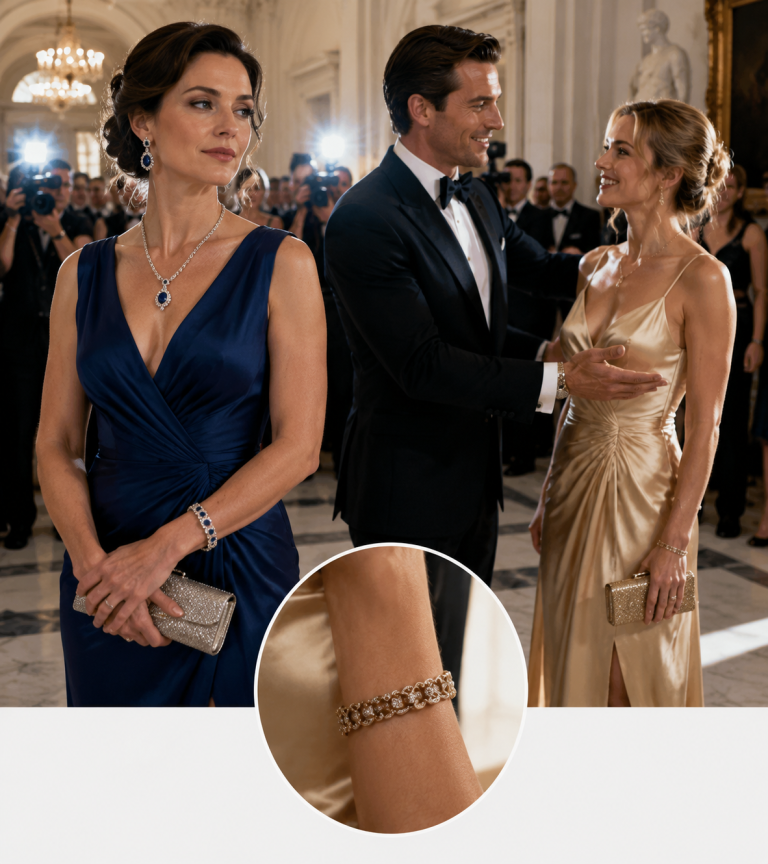
Tonight, she was carrying a tray of Highland Park and water backs toward the private alcoves at the back of the Vesper when Dante Casella made a mistake.
He was at the center table, where he always was. He had the particular stillness of men who had stopped needing to demonstrate power because the room demonstrated it for them — every nearby conversation lowered by half a decibel when he spoke, every nearby body gave him an extra inch of physical space, every nearby eye periodically checked his position the way eyes checked weather.
Dante Casella had built an empire across thirty years of specific decisions about which rules applied to him and which did not. He was fifty-one, dressed in a dark jacket that fit precisely, with the silver-gray hair of a man who had lived long enough to stop fighting the evidence of time. He was not unkind, by the standards of his world. He was simply absolute.
As she passed his shoulder, his hand closed around her wrist.
Not violently. That was the specific thing about it — there was no violence in the initial contact. It was casual in the way that certain kinds of ownership are casual, the way a man picks up something from a table he considers his without thinking about the object’s perspective on the transaction.
“Slow down,” he said, not looking up from the conversation he was having. “I’m not finished talking.”
His companion at the table laughed, which was the specific laugh of a man who found things funny when Dante found them funny, not because humor was present but because alignment was useful.
Calla stopped.
She stood completely still.
The tray stayed level.
And inside her body, in the specific territory where training lived rather than thought, something made a calculation that had nothing to do with the Vesper Club’s dress code or tipping policy.
She had two choices.
She made one of them.
The movement took approximately two seconds.
She turned into the grip rather than away from it. Her free hand located the pressure point at the base of his thumb with the ease of someone who had practiced the location ten thousand times in a different context. Her hip shifted his center of gravity before he registered that his center of gravity had been approached. And then he was moving in a direction he had not chosen, and then he was on the floor, and then she was crouching beside him with his wrist in a position that communicated several things clearly without requiring speech.
The room went absolutely silent.
Not the polite dimming of conversation that happened when someone important arrived. The specific silence of people who had witnessed something that their categories did not contain.
Calla’s face was entirely calm.
She held his wrist exactly long enough to establish the nature of what had happened — that this was not an accident, that she had made a choice, that the choice had been made with complete understanding of where she was and who she had made it about.
Then she released him.
She stood, straightened her jacket, collected the tray which had remained level throughout, and walked back toward the service bar.
Nobody stopped her.
Not because nobody thought to. Because the gap between thinking and acting had been extended by something none of them could name.
Dante Casella sat up from the floor with the specific economy of motion of a man who was going to ensure this particular display would never appear in his physical memory again if he could help it. One of his people extended a hand. He used it and then ignored the man afterward.
He stood. He brushed a crease from his sleeve.
He did not look at his companion across the table. He did not address the silence.
He looked at the back of Calla Reyes as she moved toward the far end of the room.
The room watched him not react.
He was very good at not reacting.
He turned to the man at his right shoulder, the one who handled things that required handling, a man named Savio who had been in this position for eight years and understood its scope.
“Her name, her history, everything you can get by morning,” Dante said.
He picked up his glass.
The room returned to conversation, slowly, the way a city returned to normal traffic patterns after an accident had been cleared from the intersection — everyone slightly altered in their route, unwilling to admit they had been altered.
Savio stepped away from the table.
On the other side of the room, Calla set down a bottle of gin and picked up an order slip and did not look back.
—
What the other servers at the Vesper called Calla was *careful*. Not shy — careful. There was a distinction. Shy people were managing internal fear outward. Careful people had assessed the landscape and made deliberate decisions about what to reveal and what to retain.
She was twenty-nine. She had dark hair and gray eyes and the specific quality of composure that read, to most observers, as ordinariness — nothing to stop on, nothing to catalog. She wore her hair pulled back, wore shoes that made no sound, wore no jewelry. She had three references, all of which verified employment at service industry establishments in Chicago over the past four years. She had a studio apartment in Logan Square that contained very little beyond what was functional.
She had been at the Vesper for eleven months because the Vesper was where Dante Casella held his private Thursday meetings, and the Thursday meetings were what she had been in Chicago for.
She had not planned for the wrist.
That was the part she was still sitting with as she walked home at two in the morning through streets that smelled of cold pavement and the last edge of November. The mission had been: observe, document, establish contact through legitimate channels with federal partners when the pattern was confirmed. The mission had absolutely not been: take the primary subject to the floor in front of forty witnesses.
But the wrist.
She pressed her hands into her jacket pockets and acknowledged, with the specific honesty of a person alone on a cold street, that the decision had not been strategic.
It had been older than strategy.
It had been the answer to a question about what her body believed before her mind had time to negotiate.
She had been in difficult positions before. She had operated under cover in contexts significantly more dangerous than a Chicago lounge. She had held stillness and compliance in circumstances that required more of both than any normal person would understand.
She had also been specifically, precisely trained by people who believed that there were things a person should never accept regardless of operational context, because the moment you accepted them once, the capacity to accept them again became easier, and the capacity to refuse them became something you had to rebuild from the foundation.
No one touches you and walks away as if it means nothing.
Her instructor had said that. A woman in her fifties who had been in the field for twenty years before she moved to training, who had carried herself with the specific economy of someone who had learned early what her body was worth and had never allowed the market to set a different price.
Calla had thought about that instruction many times in the eleven months at the Vesper.
She had not thought she would use it on the primary subject of a federal investigation.
—
The Vesper was on the thirty-second floor of a hotel building that belonged to a company that ultimately belonged to another company that ultimately belonged to a series of entities that a forensic accountant could trace, with sufficient patience, back to Dante Casella’s financial infrastructure. The club itself operated as a legitimate private membership lounge. This was not a performance — it was genuinely legitimate. The illegal architecture existed elsewhere, in the freight routes and the construction contracts and the relationships between the above-board Casella Group and the entities that had never been incorporated anywhere.
Calla knew this because she had spent fourteen months before arriving at the Vesper learning it.
She knew the structure of his empire from the outside in. She knew his organizational history, his family background, the trajectory of his ascent from a neighborhood-level operation to something that had grown sophisticated enough to be difficult to prosecute. She knew which of his associates were loyal and which were contractual. She knew the names of the six people in his organization who would, if the right circumstances arrived, consider cooperation.
She knew all of this.
What she had not known, and what she was assembling now on the cold walk home, was something she had not planned to need.
She had not known what he looked like when he was surprised.
She had not known that the man who never raised his voice would, when removed from the foundation of his own expectations, go briefly and completely unmasked.
He had not been angry in the floor.
He had been astonished.
And in the astonishment, something had been briefly visible that had not appeared in any of the briefing materials, any of the surveillance footage, any of the field reports. Something that was not the architect of a criminal enterprise or the possessor of forty years of learned impunity.
Something human, and possibly even something humbled.
She was still thinking about this when she arrived at her apartment, unlocked the door, and found Savio inside.
—
**PART 2**
He was sitting in the chair by the window.
Not aggressively. He was holding a glass of water that he had presumably obtained from her kitchen, and he was sitting the way a man sat when he wanted to communicate that he had been here long enough to get comfortable, which was its own kind of threat.
“Nice place,” he said.
Calla did not stop in the doorway. She came in, closed the door behind her, and set her keys on the kitchen counter.
“That took longer than I expected,” she said.
Savio looked at her.
“He wanted your history by morning. I work fast.”
“What did you find?”
“Calla Reyes. Twenty-nine. Logan Square. Four years of service industry work in Chicago, before that two years in a similar position in Milwaukee.” He paused. “All of it clean. A little too clean.”
“Meaning?”
“Meaning nobody’s that invisible without working at it.”
Calla went to the kitchen and filled her own glass of water. She came back and sat on the edge of the couch, not in the chair, keeping the coffee table between them at a diagonal.
“What do you want to know?” she said.
“What he wants to know. Who are you, why are you in his club, and what’s the move you put on him called.”
“The move doesn’t have a specific name. It’s a wrist lock into a hip throw. The combination is in the first six months of any serious training curriculum.”
“Training from where?”
“Graduate school.”
Savio looked at her.
“University of Chicago,” Calla said. “Criminal justice program. Before that, military service. Before that, a neighborhood in this city where girls who didn’t learn to carry themselves a specific way had problems.”
“So you’re a cop.”
“I’m not a cop.”
“Federal.”
She looked at him.
“I’m a woman who put a man on the floor when he grabbed her wrist without permission,” she said. “What he decides to do about that is his decision. What you’re doing in my apartment at two in the morning is a decision you’ve already made, and I want you to think carefully about whether you’re happy with it.”
Savio studied her with the careful attention of a man whose job required assessing people rapidly and accurately.
“He’s not going to hurt you,” he said.
“I know.”
“He gave a standing order. Nobody approaches you, nobody contacts you. He wanted the history and then he’ll decide what to do with it.”
“Then why are you here?”
Savio was quiet for a moment.
“Because I’ve worked for Dante Casella for eight years,” he said, “and tonight is the first time in eight years that I’ve seen someone put him on the floor and walk away, and I want to know if you understand what you’ve done.”
“Tell me what you think I’ve done.”
“Created a situation that could go three ways,” Savio said. “He decides you’re a threat and has you dealt with. He decides you’re an embarrassment and has you removed from his orbit entirely. Or he decides you’re something he’s never seen before and he wants to understand it.”
“Which one do you think he’s decided?”
Savio looked at her.
“He had me get your history by morning,” he said. “Not get rid of you by morning.”
He stood, set the water glass precisely back where he had found it on the side table, and moved toward the door.
“He’ll want to talk to you,” Savio said. “Not as a threat. He’ll find a way that’s neutral enough for you to agree to.”
“And if I don’t agree?”
Savio paused at the door.
“He’ll find that interesting too,” he said. “Possibly more.”
He left.
Calla sat in the silent apartment for a long time, listening to the city outside the window, thinking about what it meant that the man she had been watching for eleven months was now looking back.
She picked up her phone and sent a message to a contact who would not respond until morning at the earliest.
*Exposure accelerated. Primary subject is aware. Standby for assessment.*
Then she set the phone down and looked at the ceiling.
She had not planned for this.
She was going to have to plan for it now.
—
**PART 3**
The message came through the Vesper’s management office the next afternoon: Mr. Casella requested the presence of Ms. Reyes at a brief meeting, entirely at her discretion, at a neutral location of her choice.
*At her discretion.*
*Neutral location of her choice.*
Calla read the message twice and called it what it was: a man who understood that an invitation with teeth was not an invitation at all, and who had decided — whether strategically or instinctively — that she would not be approached with force.
She texted her federal contact, a woman named Harris who had been running operations out of a satellite office in the South Loop for six years: *Request meeting before I respond.*
Harris arrived in person at Calla’s apartment within the hour, which told Calla the thing she had already suspected — that the operation had been watching last night’s footage from their own surveillance inside the Vesper and had been waiting for exactly this call.
Harris was forty-three, compact, with the specific quality of someone who had spent so much time managing high-stakes situations that ordinary tension no longer registered on her face. She sat at Calla’s kitchen table and looked at her without the performance of congratulation or the performance of concern.
“The exposure was always the variable,” Harris said. “How it happened was a variable within the variable.”
“He grabbed my wrist.”
“I saw.”
“It was reflex.”
“I know.” Harris paused. “I’m not here to tell you it was wrong. I’m here to tell you it created an opening.”
Calla looked at her.
“He wants to meet you,” Harris said. “Not as an employee. As a person. That’s new for him — he doesn’t extend that kind of invitation casually, and he especially doesn’t extend it to someone who handled him the way you did.”
“What kind of opening?”
“The kind where someone who has never been challenged in a way he respected might be willing to have a conversation that doesn’t start from his usual position.”
Calla considered this.
“You want me to meet him.”
“I want you to make your own assessment. You’ve been in his orbit for eleven months. You know things about him that the briefing materials don’t contain.”
Calla thought about the floor. About the two seconds of astonishment.
“He’s not what the profile says,” she said.
Harris looked at her carefully.
“Explain that.”
“The profile describes someone who has automated the removal of anything that challenges his sense of authority. The way he responded last night was the opposite of that. He sat on the floor longer than he needed to. He didn’t reach for his phone. He didn’t look to his people for a reaction. He looked at me.”
“As a threat.”
“Not the way a threat looked,” Calla said. “The way something interesting looked.”
Harris was quiet.
“The investigation is about his financial infrastructure,” she said finally. “The freight routes, the construction contracts, the money that moves between the legitimate companies and the entities that aren’t on paper. That case is built. What we don’t have is anyone in his organization who will testify, because everyone in his organization believes he is absolutely unchanging.”
“And if he isn’t.”
“If he encounters something that shifts his relationship to his own assumptions, and if that shift reaches the people around him in the right way—” Harris stopped. “I’m not suggesting anything inappropriate.”
“You’re suggesting that the most interesting thing that could happen is a conversation with someone he doesn’t know how to categorize.”
“I’m suggesting that the investigation will proceed regardless. What I’m asking is whether you’re willing to meet him and see who he actually is before the case reaches the stage where who he is stops mattering.”
Calla looked out the window at Logan Square in the winter afternoon.
She had been in this apartment for eleven months. She had been in Chicago for fourteen. She had been in this career for seven years, which was long enough to have learned the distance between who people appeared to be in briefing materials and who they were in rooms.
The briefing materials had described Dante Casella as a man who had never been surprised.
She had surprised him.
She wanted to know what that meant.
“I’ll meet him,” she said.
—
She chose the coffee counter at the back of a bookstore on Michigan Avenue, because it was public and populated and belonged to neither of them, and because a man who was used to commanding spaces would find something clarifying about being in one that was indifferent to his presence.
Dante arrived alone.
That was the first thing she noticed, because Dante Casella, according to eleven months of observation and seven years of briefing materials, never went anywhere alone.
He wore a dark coat and no pretense.
He ordered coffee at the counter before coming to the table where she was already sitting, which told her he had thought about the choreography of this and decided that arriving with something in his hands made the power dynamic slightly less tilted in his favor.
He sat down.
For a moment, neither of them spoke.
He looked at her the way he had looked at her from the floor, with the specific attentiveness of someone who was seeing something for the first time and wanted to be accurate about what they were seeing.
“I owe you an apology,” he said.
She had not expected that.
Not because she believed he was incapable of it. Because the briefing materials suggested it would not have occurred to him to offer one.
“Yes,” she said. “You do.”
He accepted this without deflection.
“I’m told the move is called a wrist lock into a hip throw,” he said. “First six months of serious training.”
“Savio was thorough.”
“He is.”
A pause.
“He also told you something that concerned him enough to show up in your apartment at two in the morning,” Calla said.
“He told me the history he found was a little too clean,” Dante said. “Which means someone built it.”
“Or someone who doesn’t leave much of a trail builds it naturally.”
“Do you believe that?”
“No,” she said. “I built it.”
He looked at her.
“Then what are you?”
Calla held his gaze.
She had been in conversations like this before — the moment where the architecture became visible and the question was only which direction the visibility went. She had been trained for many versions of this moment. She had rehearsed the calibrated non-answers, the redirections, the ways of letting a question hang in the air until the person who asked it decided to answer it themselves.
She thought about what Harris had said.
She thought about who he actually was versus who the briefings described.
She thought about the floor.
“Someone who has been trying to understand whether the man who runs the organization I’ve been investigating is the man the organization was built to make everyone believe he is,” she said.
The silence was very clean.
He looked at his coffee.
“Federal,” he said.
“Adjacent.”
“Meaning what?”
“Meaning the investigation is federal. I’m contracted. It’s a distinction that matters for specific technical reasons and doesn’t matter for practical ones.”
Dante sat back.
She watched him process this with the focused calm of someone who had been managing dangerous information for thirty years. Not panicking. Not calculating escape. Something more like the specific patience of a man who had just received data that required recalibration and was recalibrating.
“You’ve been at the Vesper for eleven months,” he said.
“Yes.”
“You chose the Vesper.”
“Yes.”
“Because of the Thursday meetings.”
“Yes.”
He was quiet for a long moment.
“How long has this particular investigation been running?”
“I can’t answer that specifically. Long enough to have the structure of your financial organization documented in significant detail.”
“Then why are you telling me this?”
Calla looked at him.
“Because I put you on the floor in front of forty people and a federal investigation does not benefit from primary subjects who feel humiliated,” she said. “Because Savio was right that there were three ways this could go, and two of them are bad for both of us. And because I have spent eleven months watching you and I think you are not the man the case file describes.”
He looked at her.
“What does the case file describe?”
“A man who has automated the removal of everything that challenges his authority. A man who has run his empire by making everyone around him absolutely certain he will never change.”
“And you think I will?”
“I think last night was the first time in a long time something actually surprised you. And I think you chose to respond to it by trying to understand it rather than eliminate it.” She paused. “That’s not the man the case file describes.”
Dante looked at the table.
The bookstore moved around them — people browsing, children pulling paperbacks from low shelves, a quiet couple at the table beside them sharing a crossword.
“The investigation will proceed regardless,” Calla said. “I want you to know that. I’m not here to negotiate or to offer anything that isn’t mine to offer. The documentation that exists will reach the people who need to see it.”
“Then why meet me at all?”
“Because there are people in your organization who would cooperate if they believed you were capable of something other than the inevitable,” she said. “And because I think you might be.”
He was quiet for a long time.
The light in the bookstore was the winter afternoon kind — pale and specific, the kind that made everything look both more and less real than usual.
“You could have walked away last night,” he said finally. “Not the way you did it. Just — walked away. Finished the shift. Nothing had to happen.”
“No.”
“But you chose—”
“I chose not to accept something I don’t accept,” she said. “That’s all. It wasn’t about you specifically.”
“It landed specifically.”
“Yes,” she said. “It did.”
He looked at her for a moment.
“Your father’s name is Daniel Reyes,” he said. “He was a supervisor at a freight yard in South Chicago for twenty years. Your mother worked school lunches. You have a younger brother who’s a teacher in Pilsen.”
She waited.
“Your training is consistent with someone who went into the service, served in an intelligence capacity, and transitioned into contract investigative work.” He paused. “You’re very good at your job.”
“I know.”
“The apology I owe you is real,” he said. “I want you to know that. Not because of what you are professionally. Because I reached for you like you belonged to the furniture of a room I owned.”
Calla looked at him.
“I spent a long time building a world where I was the constant,” he said. “Where nothing moved unless I permitted it and nothing stopped unless I stopped it. That’s a specific kind of loneliness, I’ve learned. It looks like power from the outside.”
She said nothing.
“What happens now?” he said.
“Now the investigation moves to the next stage. What you do with that information is your decision.”
“And if I chose to cooperate.”
“Then you speak with people who have the authority to receive that cooperation. I’m not one of them.”
He nodded.
He turned his coffee cup once in his hands, looking at it.
“You said I’m not the man the case file describes,” he said. “What does that mean to you?”
Calla considered this carefully.
“It means I think you built something because the world you grew up in offered specific options and you chose among them, and you’re good enough at what you chose that it became absolute. But absolute things — when they encounter something genuine — sometimes crack.”
“Like when someone drops you on the floor of your own lounge.”
“Like that.”
He almost smiled.
It was small. It was real.
It was nothing like the way the men in his booth laughed at his jokes.
“The case has my financial architecture documented,” he said.
“Yes.”
“Enough to prosecute.”
“That’s not a question I’m qualified to answer.”
“You’re telling me that regardless of what I do, the documentation exists.”
“Yes.”
He looked at the window.
Outside, Michigan Avenue moved through its ordinary afternoon — taxis and pedestrians and the specific noise of a city that did not stop for anyone’s interior reckoning.
“I want to speak to whoever has the authority to receive cooperation,” he said.
Calla nodded once.
“I’ll make the call.”
“Today.”
“Today.”
He stood. He put on his coat. He looked at her with the steady, undefended quality of someone who had just made a decision they were going to have to live with for a long time and had decided to make it with open eyes.
“Ms. Reyes,” he said.
“Mr. Casella.”
“For the record,” he said, “I wasn’t going to hurt you last night. I want to be clear about that.”
“I know,” she said.
“You knew when it was happening.”
“Yes.”
“Then why—”
“Because it still wasn’t acceptable,” she said. “Whether harm was intended or not.”
He absorbed this.
“No,” he said. “It wasn’t.”
He walked out.
Calla sat for another fifteen minutes with her coffee, watching the bookstore’s ordinary life proceed around her.
She thought about what Harris would say when she called.
She thought about the case file and the man it described versus the man who had just apologized to her in a bookstore on Michigan Avenue and asked to speak to someone with the authority to receive his cooperation.
She thought about the wrist.
She thought about the two seconds on the floor, and the astonishment, and the way a man’s face looked when something happened that his entire world had trained him to believe was impossible.
She thought about her instructor’s voice.
*No one touches you and walks away as if it means nothing.*
No.
She had made sure of that.
And in doing so — not by plan, not by calculation, not by the careful eleven-month architecture of a federal-adjacent investigation — she had exposed a crack in something she had been hired to understand.
She had not planned to.
She had not planned for any of what had happened in the past eighteen hours.
But here was the thing about unplanned things, which she had learned over seven years in a career full of them: the unplanned moments were usually when the truth was most visible. Strategy hid truth behind the architecture of what you wanted people to see. Reflex showed what was actually there.
Her reflex had been: *this is not acceptable.*
His reflex had been: *I have never seen this before.*
Both were true.
Both mattered.
She picked up her phone and called Harris.
“He wants to cooperate,” she said.
A pause on the other end.
“How?”
“He asked me to arrange a call. Today.”
Harris was quiet for a moment.
“Calla.”
“Yes.”
“How much of this was the plan?”
Calla looked at the window, at the city moving past it, at the ordinary afternoon that had arrived on the other side of something she had not expected.
“None of it,” she said honestly. “He grabbed my wrist and I stopped allowing that.”
“And the rest?”
“Followed,” she said.
She heard Harris exhale something that was somewhere between professional assessment and something warmer.
“Alright,” Harris said. “Set the call.”
Calla set down her coffee and walked out of the bookstore into the winter afternoon.
Michigan Avenue stretched ahead of her in both directions, full of the ordinary noise of people going about their lives.
She had been in Chicago for fourteen months.
She had been invisible for eleven of them.
She walked home with her hands in her pockets and her face open to the cold air and thought: this is what it looked like when a reflex became a door.
Not planned.
Not managed.
Just: the truth, declared without negotiation, in a room that had been built entirely on the assumption that truth was something you could own.
She had not been ownable.
She had never been ownable.
The world she had been trained in — by military service, by seven years of investigative work, by a woman in her fifties who had carried herself with the specific dignity of someone who had decided early what she was worth and refused every subsequent offer to revise it downward — that world had given her the specific understanding that some things were non-negotiable not because of strategy or calculation or because they served an operational goal.
Some things were non-negotiable because you were a person.
And persons, regardless of the rooms they moved through and the trays they carried and the names they wore like costumes, had the absolute right to determine what was acceptable in their own skin.
She turned the corner toward Logan Square.
Somewhere across the city, a man who had built his empire on the certainty that nothing could surprise him was sitting with a surprise.
That was enough.
That was more than enough.
That was the beginning of something she had not been sent to Chicago to build, but which had arrived anyway — the way certain things always arrived, when someone refused to pretend that a wrong thing was acceptable just because the room expected her to.
She walked home.
The city moved around her.
She was exactly as visible as she had decided to be.
No more.
No less.
Herself, entire, in every room she walked through.
And that, in the end, was the only thing that had ever actually changed anything.