They Stole a Widow’s Little Girl — Then the Entire Frontier Learned Who the Most Feared Gunfighter Really Was

PART 1
Rattlesnake Gulch, Arizona Territory.
The sun dipped low, turning the sky the color of fresh blood, when five riders climbed the ridge above the valley and stopped like men surveying something they already considered theirs. Dust curled around the horses and settled slow. Below them, a small ranch sat quiet in the open flat, lamplight glowing gold in its windows. It looked peaceful. It looked simple. It looked, to the men on the ridge, like easy pickings.
Their leader raised a brass spyglass and studied the place the way a man studies meat before he buys it. A scar cut across his brow. His eyes, pale gray, didn’t blink.
“You sure this is the place?” the youngest rider asked. “Looks like nothing but a widow and her girl.”
Rook Mercer didn’t lower the glass. “This land sits on the only spring for miles. When the drought comes, water means power. Hollis Granger wants it.” He snapped the glass shut. “We offer to buy. She refuses. Then we apply pressure.”
His men understood exactly what pressure meant. Even the horses seemed to catch the scent of what was coming.
Inside the cabin below, Belle Knox stood at her kitchen counter kneading dough with calm, steady hands, her dark hair streaked with silver and braided tight down her back. Through the open window she watched her daughter Rowan cross the yard, gathering eggs from the hen house with the unhurried seriousness only a child gives to a chore she’s proud of.
“Ma,” Rowan called, holding up a large brown egg like a prize. “Old Bessie surprised us today.”
Belle smiled — the easy, unguarded smile of a woman who had spent six quiet years believing she’d earned it. For six years she had lived here as a widow, raising horses, teaching Sunday lessons, lending a hand to neighbors who needed one. Nobody in Rattlesnake Gulch knew the truth of who she’d been before Arizona. Nobody knew that Belle Knox had once been known clear across the frontier by another name — Quickdraw Belle, the fastest gun between Texas and Colorado.
She wiped her hands on her apron and crossed to an old chest in the corner, the one she only opened when Rowan was outside. Inside lay yellowed newspaper clippings, letters gone soft with handling, headlines about a woman quicker than lightning who ended trouble before it started. Beneath the papers rested a pair of Colt Peacemakers, ivory grips inlaid with turquoise — beautiful, and built for exactly one purpose.
She looked at them a long moment. Then she closed the lid.
She had buried that life the day her husband Ian died from a stray bullet during a robbery she hadn’t been fast enough to stop. She’d made herself a promise over his grave: Rowan would grow up knowing peace instead of gun smoke, if it was the last thing Belle ever gave her.
That was when she heard it. Hoofbeats, fast and heavy, coming on hard.
Her body reacted before her mind caught up — her hand drifting to a hip where a holster hadn’t sat in six years. The old reflex arrived with a tight, unwelcome breath. She turned to the window and watched five riders bearing straight down on the cabin.
“Rowan,” she called, voice sharp as a struck match. “Come inside. Now.”
Rowan dropped her basket and ran. Belle pulled her through the door, knelt to meet her eyes. “Root cellar. Go now. Wait for me.” Rowan hesitated a single second before she obeyed.
Belle lifted Ian’s Winchester from above the hearth and stepped out onto the porch as the riders reined in at her fence line. Rook Mercer tipped his hat, a smile on his face that carried no warmth at all in it.
“Mrs. Knox,” he said. “We’re here on behalf of Hollis Granger.”
Belle held the rifle low, ready. “What does he want?”
“Your land.” Rook’s smile didn’t move. “He’s offering double the value.”
“It’s not for sale.”
“Everything’s for sale,” Rook said. “Especially when there’s a child involved.”
He’d said it on purpose. Belle heard it land — a man testing the air for fear, the way you’d test a fence wire for a live current.
“My answer is no,” she said, and her voice stayed level even as her eyes went hard as flint.
Rook studied her face a moment too long, like he was reading something written underneath it. “We’ll be back,” he said. “And when we return, folks here might learn who you really are.”
The riders turned and rode off, dust swirling in their wake. Belle watched until the last of them vanished over the ridge, then bolted the door — her breath steady, her heart hammering against her ribs like something trying to get out.
She went to the bedroom. Knelt at the chest Rowan had never once seen open. Lifted the false bottom.
Beneath it: the gun belt she’d worn in another life. The gloves, molded to her hands years ago and somehow still shaped to them. The old journal of training notes in handwriting she barely recognized as her own anymore.
Behind her came a small, sharp gasp.
Belle turned. Rowan stood frozen in the doorway, eyes enormous, staring at the belt in her mother’s hands like it belonged to a stranger.
“Ma,” she whispered. “What is all this?”
PART 2
Belle looked at her daughter and felt six years of careful silence rise up inside her like a storm that had been waiting its whole life to break.
“There are things about me you don’t know,” she said quietly. “Things I hoped you’d never need to.”
She never got the chance to say more. Hoofbeats sounded again in the distance — louder this time, closer, men who hadn’t come back to talk. Belle’s past had stopped being something she could keep folded in a chest. It had ridden straight to her front door, and it wasn’t leaving until it got what it came for.
She closed the false bottom, strapped on the gun belt, and felt the old weight settle onto her hips like it had never left. Quickdraw Belle was back, and the men circling her home had no idea what kind of mother they were about to meet.
She didn’t sleep that night. She sat at the kitchen table with the lamp turned low, listening to every shift of wind, Rook’s warning turning over and over behind her eyes. Men like him didn’t bluff. They came back harder, and readier to take whatever they wanted.
Before dawn, she tapped the secret pattern on the root cellar door. Rowan opened it with tired eyes and stepped straight into her mother’s arms.
“Men are coming again,” Belle said, holding her close. “They want this land. If they can’t force me, they’ll try to take you.”
Rowan swallowed hard. “Will they take me, Ma?”
“They’ll try.” Belle met her daughter’s eyes and didn’t soften the truth, because softening it wouldn’t make either of them safer. “That’s why we won’t give them the chance.”
Come morning, Belle hitched the wagon and drove into town like any ordinary day, though her eyes never once rested. In the general store, Sheriff Cyrus Holt found her among the flour sacks, his voice low. “Mercer and his crew were asking questions at the saloon last night,” he said. “Not just about your land. About you.”
“People like talking,” Belle said, keeping her hands busy. “A widow draws stories.”
The sheriff didn’t smile. “These boys don’t come for stories. They come for leverage. If Mercer comes back, bring your girl into town. Let me handle it.”
Belle only looked at him, steady. “Sheriff. If those men want trouble, they won’t wait for you to be standing here.”
She drove home with the sun at her back and Holt’s warning riding with her the whole way, one thought circling louder than the rest: Mercer had already seen Rowan’s face. And men like Mercer didn’t forget what they’d seen.
PART 3
Rowan ran to her the moment the wagon rolled into the yard, trying to smile, failing to hide the fear underneath it. Belle pulled her inside and knelt to meet her eyes one more time.
“If riders come,” she said, “you go to Copper Canyon. You know the trail. You know the old mining shack. Take the Winchester. Don’t come back until I call for you.”
Rowan’s face went pale. “Ma, I can’t leave you.”
“You can.” Belle held her daughter’s face in both hands. “Because they want you more than they want me.”
That evening, the air shifted the way it does before weather turns. The animals went quiet first — Belle felt the change in her chest before her ears caught up to it. Hoofbeats. Not five this time. More.
“Go,” she whispered.
Rowan grabbed the bag she’d packed and slipped out the back door into the dark, running for the wash. She’d walked the trail to Copper Canyon a hundred times in daylight, chasing lizards, hunting for arrowheads in the wash gravel, but the dark turned every familiar rock into something she didn’t recognize, every rustle of brush into something following her. She kept the Winchester’s weight against her shoulder the way her mother had taught her — not to use, only to carry steady — and made herself walk instead of run, because running left tracks a blind man could follow.
She was three-quarters of the way to the shack when she heard hoofbeats cutting across her path from the east, too fast to be anyone friendly. She froze behind a boulder and held her breath the way Belle had shown her once, half a game back then, no game at all now. A rider passed close enough that she smelled horse sweat and gun oil. She didn’t move until long after the hoofbeats faded — and by the time she reached the shack, two men were already waiting inside it, having guessed, correctly, exactly where a frightened girl with nowhere else to go would run.
She didn’t cry out. She’d promised her mother she wouldn’t give them anything they hadn’t already taken by force, and she held to that promise even as a hand closed hard around her arm and the Winchester was wrenched from her grip and flung into the dark.
In the hours before that, while there had still been time, Belle had spent the afternoon making the ranch as hard to take as she could manage without looking like she was expecting a war. She’d moved the good lanterns within arm’s reach of the porch rail, telling herself it was only for light. She’d checked every window latch twice. She’d walked Rowan through the route to Copper Canyon one more time in full daylight, naming each landmark aloud until her daughter could recite them back without hesitation — the split boulder, the dry wash, the lightning-struck cedar. She hadn’t said the word *escape* out loud, not once, but Rowan had understood exactly what the lesson was for, and had learned it the way she learned her letters, quietly and without complaint.
Belle stood alone in the kitchen a moment, listening, feeling every old instinct she’d spent six years burying come rising back up through her like heat off a stove.
Lantern light filled the yard. Men circled the cabin the way wolves circle a dying fire. Rook Mercer sat his horse at the front of them, coat open, one hand resting near his gun like he was posing for a photograph nobody had asked to take.
“Mrs. Knox,” he called, far too calm. “We’re here to talk again.”
Belle stepped onto the porch with the Winchester low and ready. “You heard my answer.”
“We did.” Rook’s smile didn’t waver. “So we brought better persuasion.”
One of his men rode forward and tossed something into the dirt. It rolled and struck Belle’s boot before it stopped — Rowan’s egg basket, the handle snapped clean off, the shells inside cracked to pieces.
Belle’s breath caught somewhere behind her ribs. They’d searched her yard. They’d been close enough to touch what her daughter had carried that morning.
“Where’s the girl?” Rook asked, watching her face for any crack he could work into.
“Inside,” Belle lied.
“Then call her out.”
Belle lifted the rifle another inch. “Set one foot on my porch, and you won’t set another.”
Bootsteps circled the cabin — men testing doors, testing walls, hunting for the seam that would let them in. Then a shout came from the side of the house. The cellar door. Open, empty.
Panic struck Belle like a physical blow. If they knew Rowan had run, they’d track her, and Copper Canyon was hidden but not hidden enough from men who hunted people for a living.
Rook turned back to her with a slow, satisfied smile. “So the girl’s gone,” he said. “That means you’re about to do something reckless.”
Belle didn’t answer him. She stepped back inside and bolted the door, crossed straight to the chest, lifted the false bottom, and drew the gun belt onto her hips a second time — this time for good. She checked both Colts. Her hands didn’t shake. Not anymore. Not with her child somewhere out in that dark.
While Mercer’s men pounded on the front door, Belle slipped out the back — not to run, but to hunt.
The desert wrapped around her like an old, familiar coat. Moonlight laid pale silver lines across the rock and brush. She moved fast, moved quiet, every sense she’d spent six years dulling now razor-sharp again. Somewhere out there, her daughter was running, and men were chasing her, and Belle Knox — once Quickdraw Belle — intended to remind the west exactly why that name used to make outlaws step back into the shadows.
She thought, moving through the dark, of Ian. Of the last time she’d carried a gun for anything other than a coyote or a rattler — the robbery in Prescott, the crossfire she hadn’t been fast enough to stop, the stray round that had taken her husband instead of the man it had been meant for. She’d told herself for six years that if she never touched a holster again, she could somehow bargain her way free of that guilt. Moving fast and silent under a cold moon, she understood at last that she’d had it backward the whole time. Ian hadn’t died because she was too quick with a gun. He’d died the one single time in her life she hadn’t been quick enough.
She would not make that mistake twice. Not with Rowan’s life sitting in the balance.
She remembered, too, the last real job that had earned her the name folks still whispered in saloons from Texas to Colorado — a bank in Dodge, three men holding tellers at gunpoint, and Belle walking through the door alone because the marshal who’d hired her hadn’t trusted enough men to back her properly. She’d cleared the room in the time it took a man to draw one full breath, and she’d walked out afterward without a scratch on her, already thinking about nothing but the ranch she and Ian were saving up to buy. She hadn’t known then that the gun would follow her into that ranch anyway, just in a different shape — waiting quietly in a chest for six years until the night it was needed again.
She rode her buckskin horse hard until the trail turned to rock, then slipped down and led it by hand, wrapping cloth around its hooves to swallow the sound of its steps. She followed the ridge toward Copper Canyon, toward the shack she’d hoped would keep her daughter safe.
The signs told a different story. Bootprints. Scuffed gravel. A branch snapped clean. Men had been here — and they weren’t only behind her anymore. They were ahead of her too.
Her stomach twisted, but her hand stayed steady on the reins. She’d fought harder, faster, more feared men than these in her life. None of those fights had ever held her daughter’s life balanced on the outcome. That single fact made this night heavier than any she’d walked through before.
The canyon mouth opened like a dark wound in the rock. Belle tied her horse behind a stand of brush and went the rest of the way on foot, both pistols drawn, the wind carrying dust and old sweat down the narrow walls. The shack door stood cracked open. No voices. No breathing. No movement at all.
She stepped inside anyway.
The place was torn apart — blankets thrown, shelves knocked flat, cartridges scattered across the boards. Near the door lay Rowan’s scarf, twisted, the edge ripped where someone had grabbed hard and pulled. A little farther in, the Winchester lay abandoned in the corner, its stock scuffed where it had struck the wall on its way out of her daughter’s hands.
Belle knelt and lifted the scarf with fingers that, for one heartbeat, finally shook. She let herself feel the full weight of the fear — one breath, one heartbeat — and then she let it burn down into something colder and far more useful.
Pinned to the table with a knife was a folded note. *Bring the deed. Come alone. Or the girl bleeds.*
She folded it into her pocket and read the ground outside instead — four men, one girl, tracks heading south, back across the ridge toward her own ranch. They wanted to finish this on her home ground. They believed that would scare her into folding.
They were wrong about which direction fear moved in her, and they were about to learn it.
Rowan, meanwhile, had been walked back across that same ridge with her wrists bound in front of her, one man’s hand fisted in the collar of her shirt whenever she stumbled on the loose rock. She kept her eyes on the horizon rather than the men around her, the way her mother had once told her to do with a spooked horse — give it nothing to react to, and it settles faster. She didn’t feel settled. She felt hollowed out and cold clear through, but she made herself walk like she wasn’t, because the one thing she refused to hand these men, along with everything else they’d already taken, was the sight of her crying.
Belle mounted and rode hard through what remained of the night, reaching the outskirts of the ranch just as the first gray light bled up along the eastern hills. The desert cold bit through her coat, and her breath came out in pale clouds she barely noticed. She came in low along the wash, staying out of sight, every sense straining toward the ranch she’d built with Ian and rebuilt alone. Smoke drifted lazy above the corral where someone had lit a cookfire like this was just another job. Lanterns burned in the yard despite the coming dawn. Fresh hoofprints scarred the dirt where Mercer’s men had settled in to wait for her, comfortable, certain of how this would end.
She left her horse in cover, checked both Colts one final time by feel alone, and slipped out into the open on foot.
Every head in the yard turned at once. Hands drifted toward holsters. Rook Mercer stepped forward slow, his coat still hanging open, too calm, too sure of his own hand in this.
“Mrs. Knox,” he said. “You came.”
“Where else would I be.” Belle’s voice came out flat, unhurried, nothing in it for him to grab hold of.
Her eyes had already gone past him, to the porch, where Rowan stood with her wrists bound behind her back, one man’s fist locked around her arm, another pressing a knife blade near her ribs. Fear shone plain in the girl’s eyes — but her chin stayed up. She was trying, with everything an eleven-year-old had in her, to be brave for her mother, and the sight of that small, stubborn courage did something to Belle that Rook’s whole crew combined couldn’t have managed.
Something in her went hard and still and perfectly clear.
“She stays alive,” Rook said, “as long as you sign the papers.”
“Let her go.”
“After the ink dries. Hand over the deed, then you leave the valley. No trouble.”
“You’ll let a widow and a girl walk away from land you already tried to steal twice,” Belle said. “Forgive me if I don’t put much faith in that.”
Rook spread his hands, all false patience. “Then let’s just say I’m asking nicely this once.”
“Why does Granger want it so badly he’d send eight men after a widow’s spring?” Belle asked, not because she needed the answer, but because every second Rook spent talking was a second he wasn’t watching her hands.
“Every rancher between here and the Verde needs water when the drought comes,” Rook said, clearly pleased to be asked. “Whoever holds the spring holds the whole valley by the throat. Mr. Granger’s a patient man, but he don’t like being told no by nobody, least of all a woman raising chickens.”
“Then he picked the wrong woman to send you after,” Belle said.
Belle stood like stone, and while she stood there she counted — eight men across the yard, who stood steady, who stood scared, whose grip on their guns was too tight to be useful, who kept glancing sideways at Rook for instruction instead of watching her. She noted the water trough behind the second man, the shadow the barn threw across the near fence line, the lantern hanging just within reach of the porch rail. She had spent six years telling herself she’d forgotten how to see a room this way. She hadn’t forgotten a single piece of it.
It occurred to her, standing there with the whole yard watching to see what a widow would do, that every one of these men had made the same mistake Rook had made from the very first afternoon on the ridge — they’d looked at a woman baking bread and raising chickens and decided that was the whole of what she was. Men like that never learned to look twice at anything before it was too late to matter.
Then she looked at Rowan one more time, and made her choice.
“Bring me the papers,” she said.
One of Mercer’s men stepped forward with the document. Rook smiled like a man already tasting his victory. Belle didn’t look beaten. She looked thoughtful — too calm, if anyone there had known her well enough to notice it.
She stepped toward the porch and reached for the paper. Rook leaned in. “Good girl,” he said.
In that exact instant, Belle saw it — the man holding Rowan shifting his grip, his stance going soft with nerves he couldn’t quite master. Scared men made mistakes. Belle’s hand brushed past the paper entirely and closed instead around the lantern hanging on the porch rail.
Rook’s smile faltered. “What are you—”
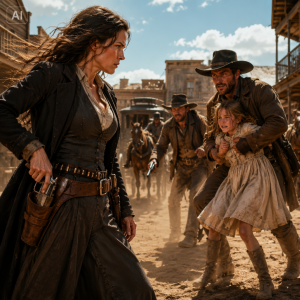
Belle threw the lantern into the yard with everything she had. Flame burst wide across the oil-soaked dirt. Horses screamed and reared. Men shouted and scattered. For one heartbeat the whole yard lit up like a second sunrise — and inside that single heartbeat of chaos, Belle moved.
Her hands cleared leather faster than thought could follow. The twin Colts barked, sharp as thunder cracking close. One shot knocked the knife clean from the hand at Rowan’s ribs. Another snapped the rope at her wrists without so much as grazing her skin. A third tore through a rifle lifted in panic. A fourth struck the dirt an inch from another man’s boot and froze him solid where he stood.
“Go!” Belle shouted. “To the cellar!”
For one dazed instant Rowan didn’t move at all, her wrists suddenly free, the knife that had hovered near her ribs gone skittering into the dirt, the whole yard lit gold and violent around her. Then some old instinct her mother had drilled into her without ever once explaining why took over, and her legs simply ran, carrying her past the burning trough and around the corner of the cabin before her mind had caught up enough to be afraid.
Belle stepped forward into the firelight, her face lit in flashes of orange and drifting smoke, moving with a terrible calm, placing every shot to break the fight rather than end a life. A bullet tore a man’s sleeve clean off his arm before he’d even leveled his rifle. Another struck a boot heel and dropped a man flat on his back in the churned-up dirt. A third man lunged for the corral gate and Belle’s fifth shot took the latch clean off in his hand, sending him stumbling backward into the very flames he’d been trying to skirt. Every round she fired had a purpose. She wasted nothing, and by the third exchange the men closest to her had stopped reaching for their guns at all and started reaching instead for cover that didn’t exist.
Rook clawed for his own gun, more out of pride than any real hope of winning the draw. Belle’s pistol answered before his cleared the holster — his weapon spun from his grip, blood spraying from his wrist, and he went down hard onto his knees in the dirt, howling, cradling the ruined hand against his chest.
“That wasn’t smart,” Belle said, her voice as steady as iron laid flat.
The remaining men froze. Some looked ready to run. Others hesitated, unsure which fear to obey. That hesitation was all the room the night needed.
Sound carries strange distances across open desert before dawn, and gunfire carries farther than most things. Elizabeth Moore, an early riser by habit, had heard the first shots rolling across the flats from her kitchen window and known exactly whose ranch lay in that direction. She’d sent her boy running for the sheriff before the second volley even sounded.
“Drop your weapons!”
Sheriff Cyrus Holt rode into the firelit yard with six armed riders at his back, rifles already raised. He swung down from his horse and strode forward without a flicker of doubt in his step.
“Throw them down!” he barked.
Mercer’s men looked around at the fire, at the woman standing with two smoking pistols still level in her hands, at the line of rifles behind the sheriff, and one by one their guns hit the dirt.
Rook Mercer glared up at Belle through his pain, his face gone white with fury. “You got no idea who she is,” he spat toward Holt. “You don’t know what she used to be.”
The sheriff studied Belle a long moment, and something shifted behind his eyes — respect, understanding, maybe something close to awe. He nodded to her. “Mrs. Knox. Are you hurt?”
“No.” Belle’s voice cracked for the first time all night. “My daughter—”
“She’s alive,” Holt said. “Your girl is safe.”
Belle holstered both pistols in one slow, clean motion, the fire behind her crackling low and dangerous and gold. She walked around back of the cabin and knocked the cellar signal — three, then four, then two. The door opened. Rowan came out shaking, her face streaked with dirt and tears, and threw herself into her mother’s arms like she never intended to let go of them again.
“I’m here,” Belle whispered into her hair. “You’re safe now.”
Rowan’s grip only tightened. “They said you’d run,” she said, muffled against Belle’s shoulder. “They said you’d fold.”
“I ran once.” Belle closed her eyes and held her daughter like she was the only solid thing left standing in the whole territory. “I’ll never run again.”
By sunrise, the whole town had heard it. The quiet widow on the east ranch wasn’t only a widow — she was Quickdraw Belle, the legend who’d once cleared out ten men in ten seconds, the woman who’d outshot every gun between Texas and Colorado. Deputies hauled Rook Mercer and what was left of his crew toward town in irons, and folks along the road watched them pass with expressions that mixed fear and something close to reverence in equal measure.
Sheriff Holt lingered a while after the wagon carrying Mercer had rattled off toward the jailhouse, standing at the fence line with his hat in his hands like a man unsure how to address someone whose name he’d only ever known half of.
“You could have told me,” he said finally.
“I could have,” Belle agreed. “Would it have changed anything last night?”
He considered that honestly, the way she’d come to expect from him. “No,” he admitted. “I suppose it wouldn’t have.”
“Then it wasn’t yours to carry,” she said, not unkindly. “It was mine.”
By midmorning, Elizabeth Moore drove out from town herself, unable to wait for gossip to reach her secondhand, and found Belle scrubbing scorch marks from the porch boards like it was any other chore on any other day. She stood at the gate a long moment, taking in the burned patch of yard, the bandaged wrist Belle hadn’t bothered to hide, before she finally spoke.
“Quickdraw Belle,” Elizabeth said slowly, testing the name like it might not fit the woman she knew. “All these years, selling me eggs and mending my Sunday dress.”
“Same woman,” Belle said, wringing out her rag. “Just a part of her you hadn’t met yet.”
Elizabeth studied her a moment longer, then surprised them both by laughing, short and disbelieving. “Well. Bessie’s eggs taste no different for it.” She squeezed Belle’s arm on her way back to the wagon, and that, more than anything the sheriff had said, told Belle exactly how the town would settle around this new truth — carefully, curiously, but without the fear Rook had promised her.
Belle stood on her porch with Rowan pressed against her side and found she didn’t care much which reaction people carried away, fear or reverence or something in between. Her daughter was alive. The spring was still hers. And she understood, finally, something she’d spent six years too afraid to look at directly.
The sky that morning had none of the blood-red color it had carried the evening Rook Mercer first climbed the ridge above her valley. It came up instead the pale gold of a fire finally allowed to burn itself out clean, and Belle stood in it a long while with her daughter’s head resting against her arm, in no hurry at all to go back inside.
Peace had never been the same thing as hiding.
Strength had never been something to be ashamed of.
And when danger came looking for her daughter, the whole west remembered exactly who Belle Knox used to be — and exactly who she still was, underneath the flour and the Sunday lessons and the six quiet years, when it mattered enough to matter.
THE END