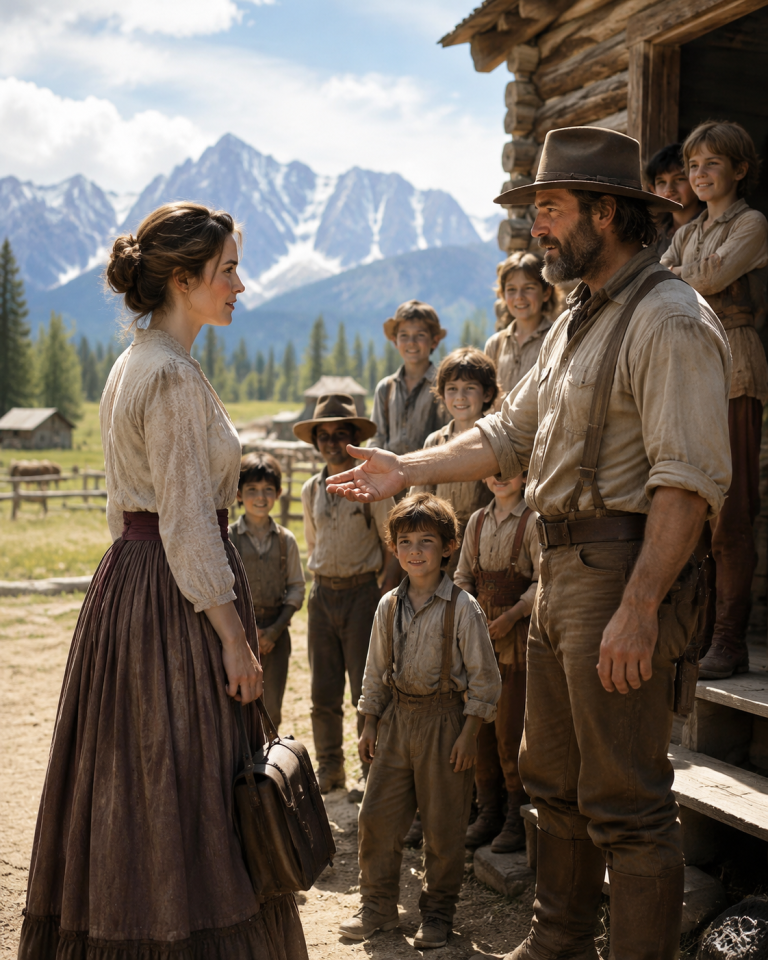
The Mail-Order Bride Collapsed at His Door With Broken Ribs, But When the Cowboy Asked “How Long?” Her Tears Revealed the Secret No Man Was Supposed to Know

Elizabeth did not ask what the telegram said. She did not need to know. What mattered was that Lawrence’s poison had been emptied into the light, and it had not destroyed her. It had only made her clearer.
That night, Helen knocked on the door of Elizabeth’s new room in James’s house on the edge of town.
“I wanted to give you this before you go,” Helen said. She held out a small leather journal. “I kept one after my own husband. It helped me understand that what happened to me was not a reflection of who I was. I thought you might need that understanding too.”
Elizabeth took the journal.
“Thank you,” she said.
“One more thing,” Helen added. “That letter from the maid. Emma. She left a forwarding address with me before she fled Philadelphia. I thought you might want to write to her. To tell her that her warning mattered. That her courage was not wasted.”
Helen pressed a small piece of paper into Elizabeth’s hand.
“Sometimes,” Helen said, “we think we are alone in these things. But we are not. There are more of us than anyone knows.”
Two weeks later, Elizabeth sat at the desk in her new home and wrote to Emma.
She wrote about the wedding. About James. About the moment when she realized that telling the truth had not destroyed her, only freed her.
She wrote: *You were braver than you knew. Your warning gave me the courage to stop hiding. If you ever need a place to go, my home is open to you. Some of us have decided that silence is a form of death, and we choose life instead.*
In the months that followed, Elizabeth learned what it meant to be married to a man who did not require her to be small.
James did not demand she smile when she did not feel like smiling. He did not ask her to pretend the past had not happened. He did not flinch when she woke from nightmares or when certain sounds made her body go rigid with fear.
Instead, he learned when to hold her hand and when to stand at a distance. He built the business slowly, without rushing her to be the kind of wife who organized social events or attended church socials she did not want to attend.
He asked her, on the evening of their one-month anniversary, if she had regrets.
“No,” Elizabeth said. “Not about marrying you. I regret many things about my life. But not about choosing to tell the truth when I could have hidden it.”
“Margaret will probably keep sending letters,” James said.
“Probably,” Elizabeth agreed. “But they will not reach me here. And if they do, the reverend has made it clear that he will not accept them.”
James took her hand.