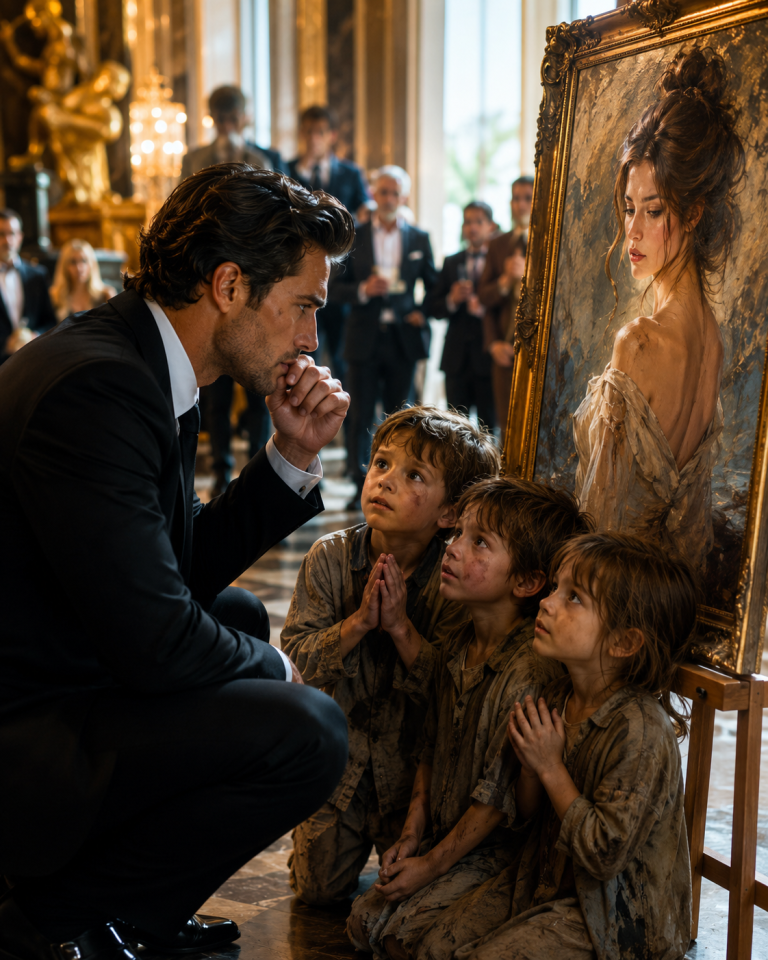
25 Experts Couldn’t Solve It—But a Poor Maid Did in 1 Minute, Leaving the Mafia Boss Speechless

# PART 1
The last thing my father ever taught me was this: a lock is not a wall. A wall tells you to stop. A lock asks you a question.
He said it the way he said most things — bent over a workbench, voice low, hands never pausing. He was rebuilding a pocket watch at the time, reassembling a tiny complications movement that had defeated three other repairers. I was eleven. I did not fully understand what he meant.
By the time I understood, he was gone.
That was eleven years ago.
Now I knelt in the underground study of the Castellano estate, wearing a gray uniform, cleaning coffee from a two-hundred-year-old Persian rug, and trying very hard not to look at the vault.
—
The room beneath the estate smelled of extinguished cigars, old espresso, and a specific variety of silence that belongs only to men who cannot afford to be angry aloud. Above my head, somewhere behind marble floors and biometric doors and perfectly manicured grounds, the Castellano mansion existed as its public self: chandeliers, oil paintings, imported stone, the polished architecture of a family that had spent three generations building the kind of respectability that required a basement.
Here was the basement.
And here was the vault.
The Meridian, they called it. I had heard the name once, in a conversation I was not supposed to retain. A brass-faced mechanism occupying an entire wall of reinforced concrete, its circular door layered with astronomical charts, tidal markings, harmonic notations, and a central mechanism so dense with nested rings that simply looking at it without preparation induced a particular species of mental humility.
I had been preparing for three months.
A man in an expensive suit was packing his instruments in the corner. Sonic scanner, thermal reader, a laptop running software that cost more than my childhood flat in Edinburgh. His hands were shaking, which men like him generally tried to avoid.
From his chair near the fireplace, Nicolas Castellano watched.
At thirty-one, Nicolas had inherited the family at an age that should have broken him. The rumors about his father’s death were various and unlikely to be fully true, but what was consistent: Edoardo Castellano had died suddenly, unexpectedly, and in possession of a vault that no one could open. Nicolas had spent eight months and roughly four million dollars in expert fees establishing this fact.
The last expert was leaving now.
Nicolas did not speak until the man reached the door.
“Impossible,” the man said, to no one in particular. “It is simply not possible through any contemporary method.”
Nicolas looked at him.
“Send the invoice,” Nicolas said. “Then never speak of this room again.”
The door closed.
The room held its breath.
I pressed the cloth against the rug and worked the coffee stain in slow, careful circles. My head was down. My shoulders were loose. Three months of practice had made the posture authentic — the particular lowered-center stillness of a person who has learned that invisibility is a craft before it is a habit.
The Castellano household ran on hierarchy so entrenched it had become atmospheric. Guests did not notice the staff. Staff did not notice each other in the ways that mattered. Everyone performed their assigned grade of furniture, and in exchange, no one asked uncomfortable questions about the furniture’s inner life.
I had taken the position because of the vault.
More specifically: because of what I believed was inside it.
My father, Dr. Emilio Farris, had been Edinburgh’s finest horological engineer — a title that sounds modest until you understand that horological genius occupies a peculiar intersection of watchmaking, architecture, cryptography, and music theory, and that the men who achieved it at his level were fewer than a dozen alive at any given moment. His commissions came from the kind of collectors who did not disclose their names. His workshop held blueprints that he rolled flat on our dining table on Sunday mornings when he thought I was asleep.
I was never asleep.
I was memorizing.
He disappeared when I was sixteen. Not a gentle disappearance — not a leaving. Men came to the flat after midnight, and there was a sound I would spend eleven years reconstructing: not a struggle, exactly, but the specific acoustic signature of furniture shifting, a breath caught, a door closing on something I was not meant to see.
I came out of my room after fifteen minutes and found his workbench undisturbed. His tools. His ledgers. His unfinished commissions.
No father.
The trail had taken years. The Castellano family had not appeared until the third year of my searching, and even then they appeared as a whisper — a contract, a sum, a commission of unusual scale placed through three intermediaries to a horologist in Edinburgh who had a weakness for debt and a daughter he would not discuss with strangers.
The Meridian vault.
Edoardo Castellano had needed something extraordinary. He had found my father. He had paid a great deal of money.
And then my father had vanished, which was what happened to people who built extraordinary things for dangerous men and then became inconvenient.
I had built a life on the assumption that I was looking for a grave.
The photograph had changed that.
Three weeks ago, buried in a file I found among the household records while ostensibly cleaning the estate manager’s office, I had seen a surveillance image: a man in a basement workshop, sitting beneath harsh light, assembling a brass gear train by hand. Silver-haired. Thinner. Older by eleven years.
Alive.
I had placed the file back exactly as I found it, walked to the servants’ hall, sat on the wooden bench, and pressed both hands against my knees until they stopped trembling.
Then I went back to work.
Now I cleaned coffee from a Persian rug in the same room as the machine my father had built, and I tried not to think about the fact that I had been sixteen squares away from the answer for three months without knowing it.
Nicolas dismissed two more people from the room.
Only Giacomo remained — his underboss, a wide-shouldered man with a scar at his jaw and the economical movements of someone who had spent years being professionally dangerous. He stood near the wall with his arms folded, watching the vault with the expression of a man who has run out of patience for something he does not understand.
“Thermal lances,” Nicolas said.
Giacomo’s head came up. “They said heat—”
“He said heat could trigger the accelerant lining.” Nicolas’s voice was controlled in the way of someone who had been controlling it for a long time at significant cost. “He said a great many things. None of them opened that door.”
“If we’re wrong about the trigger—”
“Then we were wrong. At this point I am willing to be wrong in a different direction.”
“Nicolas.” Giacomo’s voice dropped into a register that was not quite protest and not quite deference. “Everything your father built lives in there.”
“I know what lives in there.”
“If the accelerant goes—”
“I said I know.”
A vein showed at Nicolas’s temple. His knuckles were white against his knee.
On the rug, I found myself looking at the vault without meaning to.
Not at the outer rings. Not at the astronomical markings the experts had puzzled over. At the sunburst mechanism at the center — specifically at the lower left quadrant, where a tiny raised notch sat at approximately the seven o’clock position.
I had seen that notch in a blueprint.
On a Sunday morning.
Eleven years ago.
My father’s voice arrived in my memory so clearly it was almost physical: a lock is not a wall. It asks you a question. The answer is never what the lock appears to want.
The thermal lances would destroy everything inside.
I closed my eyes for one breath.
Then I said: “Don’t cut it.”
—
The silence that followed had weight.
Every person in the room processed the sentence from a different starting point. Giacomo’s hand moved toward his jacket. Nicolas turned his head with the unhurried precision of a man whose patience had recently been tested to its structural limit by people more credentialed than I was.
He looked at the floor near his shoes. Then he looked at me.
I stood.
My legs were not entirely reliable.
My voice had to be.
“The thermite charge is not heat-triggered in the conventional sense,” I said. “There is a vacuum-sealed chamber behind the brass plate. Cutting creates atmospheric pressure differential before the lance reaches the secondary steel. The glass vials inside shatter from the pressure change before the heat arrives. Everything burns.”
Nicolas’s expression was extremely still.
“Who are you?” he said.
“My name is Elisa Farris.”
Giacomo: “She’s lost her—”
“Quiet.” Nicolas did not look away from me. “I have seventeen qualified engineers, three former intelligence operatives, and one Dutch specialist on retainer who could not open that vault. You are cleaning my floors.”
“Yes.”
“You expect me to believe you can do what they couldn’t.”
“No,” I said. “I expect you to keep very still while I do it.”
The room made a sound that was not quite laughter.
Nicolas’s eyes narrowed.
He was, I realized, not angry. He was thinking.
“You have sixty seconds,” he said.
Giacomo stepped forward. “Nicolas—”
“If she fails, the lances are still an option. If she succeeds, we have a different conversation.” His eyes didn’t leave mine. “The clock started.”
I walked to the vault.
—
Every gun in the room was on me.
I did not touch the experts’ instruments. The scanners, the precision drills, the thermal readers — none of them. I placed both hands on the cold brass face, felt the metal warm against my palms, and closed my eyes.
My father did not hide answers in places where men looked. He hid them in places where men assumed there was nothing to find.
The first ring: astronomical. The experts had tried dates — Edoardo’s birthday, family anniversaries, astrological natal positions. My father would not have built a patron’s monument. He would have built a question only the right person could answer.
I turned the ring backward through seven positions.
The winter solstice in Edinburgh, the year of his commission. The sky that night, when he worked late and I brought him tea and he said the stars were engineering diagrams if you looked at them correctly.
A soft, deep click.
Someone in the room exhaled.
I moved to the second ring: harmonic notation. Not musical as the experts had interpreted it — not a melody, not a chord progression. My father did not think musically. He thought mechanically. The notations were frequency ratios for resonance points in a pendulum escapement.
I entered them as interval fractions.
A low, resonant hum moved through the brass beneath my fingers.
Giacomo muttered something.
The third mechanism.
The sunburst at the center. The experts had tried torque, rotation, various pressure combinations. They had approached it as a mechanical problem. My father had never built purely mechanical things. He built conversations.
I pressed the notch at the seven o’clock position, ran my thumb counterclockwise along the lower third of the sunburst ring, and felt the specific resistance of a pressure plate that had been waiting eleven years for the correct query.
I applied weight.
The locking bolts withdrew in sequence, one after another, each with a sound like a held breath finally released.
The Meridian opened.
Fifty-four seconds.
Cold air moved from the darkness.
The room erupted into motion — Giacomo barking instructions, men moving forward, heads craning toward the interior. Leather-bound records, sealed drives, bearer bonds, documents in multiple languages, the entire compressed archive of an empire that had been waiting, humming quietly, for someone with the right question.
Nicolas did not move.
He stood at the edge of the chaos, watching me.
I was looking at the interior of the vault when I saw, on the lowest shelf, a sealed compartment separate from the operational documents. A personal lockbox. Thumbprint-secured, not combination-based. Edoardo’s, not my father’s.
Nicolas saw me see it.
He crossed the room in five steps and opened it with his thumb without speaking.
Inside was a manila envelope.
And inside the envelope was a photograph.
Nicolas placed it on the table beside me without comment.
I was looking at the vault’s interior.
Then I looked down.
The man in the photograph was sitting in a workshop that was not his own. The light was wrong. The bench was wrong. His hands were occupied with a movement assembly, which meant his mind was occupied enough to keep the rest of him from breaking.
But his face, when he looked up at whoever had taken the photograph, was my father’s face.
Older. Pared down. Exhausted in the specific way of someone who has been surviving rather than living for a very long time.
The date stamp on the photograph was four weeks old.
I did not cry.
I made a sound that was not a word, pressed one hand over my mouth, and stood absolutely still until the room stopped moving.
Nicolas’s voice, when he spoke, was quieter than any sound I had heard from him.
“You knew the man who built it.”
Not a question.
I looked at the photograph.
“Yes.”
“Who is he to you?”
I looked up.
“He is my father.”
—
# PART 2
Giacomo drew his weapon.
The sound was distinct and immediate.
“She’s a plant,” he said. “Three months inside this house, she opens the vault, says her father built it — she’s working for someone.”
Nicolas did not look at him.
“Put it away, Giacomo.”
“She could be—”
“Put it away.”
Giacomo’s jaw tightened. The gun did not move.
Nicolas finally turned his head.
The two men looked at each other, and whatever passed between them in that moment was not made of words.
Giacomo holstered the weapon.
Nicolas turned back to me and placed the photograph on the table between us.
“Emilio Farris,” he said.
“Yes.”
“My father commissioned this vault through an intermediary in 2013. Payment of three and a half million.”
“Three point eight,” I said. “The intermediary kept four hundred thousand.”
Something shifted in Nicolas’s expression.
“My father died believing the commission was complete and the man was paid fairly and released.” A pause. “My father did not take him.”
The sentence landed differently than I had expected.
I had spent eleven years building a wall in the dark and calling it certainty. Edoardo Castellano. The commission. The disappearance. The logical sequence of a ruthless man eliminating a liability.
Nicolas opened the lockbox and removed a second sealed envelope.
Inside: a leather notebook. Handwriting I recognized the way you recognize a person’s breathing — not by feature but by rhythm.
“My father sealed this inside the vault himself,” Nicolas said. “He received it in fragments over two years and could not decode it. He sealed it here and told me the vault held a debt.” A pause. “He said, ‘If you ever open it, you owe the man who built it.'”
I touched the cover of the notebook.
My father’s gear sketches in the margins. His habit of placing small stars beside problems he hadn’t solved yet.
“It is not a cipher,” I said.
“Then what?”
“A location. Hidden in mechanical notation.” I opened to the third page. “Coordinates embedded inside balance-wheel calculations.” My voice was steadier than I had any right to expect. “He built a map home into the only thing he was still allowed to make.”
The room was very quiet.
“Who took him?” I asked.
Nicolas said a name.
It moved through the room like something combustible.
Renato Esposito.
He did not kill assets. He collected them. Kept them alive in purpose-built facilities, stripped to their function, used until the function was exhausted and the man who carried it barely remembered having a name.
“We knew Esposito had your father,” Nicolas said. “We did not know where.”
I looked at the notebook.
“He left the address here.” My finger rested on a series of numbers disguised as spring tension tolerances. “He has been telling anyone who could read him for years.”
Nicolas looked at me.
Not as a maid. Not as a tool. As a person in possession of something he needed and willing to choose what she did with it.
“What do you want?” he asked.
The answer was eleven years old and very simple.
“I want my father back,” I said. “Help me.”
He accepted that without qualification.
“Read the notebook,” he said. “Tonight. Everything.”
And for the first time since I arrived at the Castellano estate in a gray uniform with cheap shoes and a carefully constructed lack of opinions, I was handed something directly.
—
# PART 3
By four in the morning, I knew where my father was.
The notebook was not only a location. It was an architecture. My father had been building under Esposito’s control the same way he had built for Castellano — under constraint, but never without the hidden grace he considered the minimum standard for anything bearing his hands. Every design contained a redundancy that looked like an accident. Every redundancy was a door.
He had built Esposito’s vault system beneath a converted cold storage facility in Red Hook, Brooklyn. The system had three nested vaults, progressive access, pressure triggers on each door.
And on the innermost door, disguised as a ventilation seam, two initials.
E.F.
Emilio Farris.
I am here.
Nicolas stood across the drafting table at noon, reviewing what I had found.
“He designed his own prison,” he said.
“He designed it to be found.” I pointed to the ventilation note my father had embedded in the south wall specification. “This is a tidal marker. He used the Hudson River pressure cycles to encode the facility’s external security rotation.”
Giacomo, who had been standing near the window, came to the table.
He looked at the blueprint. Then at me.
“How certain are you?”
“Of the location? Entirely.” I looked at the notebook. “He was alive four weeks ago. Useful men are kept alive.”
“And men who stop being useful?”
He was not asking me to reassure him. He was asking whether I had thought it through.
“I know the risk,” I said. “I am going regardless.”
Giacomo looked at Nicolas.
Nicolas said nothing.
Giacomo looked back at me with an expression that had moved approximately half a degree from suspicion toward something I did not yet have a name for.
“If you’re wrong about the tidal rotation,” he said, “we go in during a guard cycle and everyone in that basement has a bad evening.”
“I’m not wrong.”
“If you’re wrong about the vault sequence—”
“I built my understanding of his mechanics from blueprints he showed me when I was eleven,” I said. “I have been studying his methodology for three years specifically for this. I am not wrong.”
A pause.
“You are more frightening than I expected,” Giacomo said.
“I get that from my father.”
—
The Esposito gala was held at the facility’s aboveground event space — an annual charitable arts dinner that functioned as a compressed catalogue of people who needed to be in the same room as each other with plausible deniability.
Nicolas received an invitation because certain relationships between criminal organizations were maintained through the fiction of social normalcy.
I attended because the notebook was in my head and the vault was my father’s.
Nicolas provided a dress: midnight silk, long-sleeved, high-collared, elegant enough to belong in any room without marking its wearer as belonging to any one specifically. Around my left wrist, a slim bracelet his people had assembled containing a microblade, a lock pick, and a precision pressure sensor.
“You look like you’re attending a state function,” Nicolas said, when I appeared.
“I look like I belong here,” I said. “That’s the point.”
He studied me for a moment.
“Yes,” he said. “It is.”
His hand settled at the small of my back as we entered.
I did not step away from it.
The gala was exactly what it presented itself as: beautiful, corrupt, and illuminated in a way that made everything inside it look worth preserving. A quartet played Schubert because Renato Esposito had taste, which is not a quality that excuses anything and is not required to coexist with conscience.
I identified Esposito from ten meters. Older than the photographs. Broader in the way of men whose comfort has expanded alongside their power. He stood near the center of the room, laughing with a politician whose name I recognized from three separate Castellano documents. He looked like someone’s generous uncle, which is a description I had stopped finding reassuring when I learned what it concealed.
Nicolas steered me gently away from the direct line of sight.
“Not yet,” he said.
“I know.”
“Do you?”
I looked at him.
“I waited eleven years,” I said. “I can wait until 22:40.”
The plan depended on the tidal rotation my father had encoded in his blueprint. At 22:35, the external security cycle shifted by three minutes — a gap my father had designed into the system and noted in harmonic notation only a reader of his specific methodology would recognize. At 22:38, Giacomo would create a distraction in the loading corridor. At 22:40, Nicolas and I would descend.
At 22:43, I would open my father’s door.
Everything after that would be improvised.
The elevator descended in silence.
Nicolas stood beside me, one hand close to his jacket.
“You don’t have to go further than the door,” he said.
“I do.”
He accepted this.
The doors opened onto concrete, cold air, and fluorescent light.
Two guards at the checkpoint. Nicolas handled the first through a combination of name and authority that belonged to a man whose family had been arranging these quiet understandings for three generations. Giacomo’s distraction above drew the second.
The third looked at me with the particular gender-based assessment that men in basements extend toward women in gowns — a brief calculation ending in dismissal.
I walked past him.
The vault door was at the end of the corridor.
I stopped when I saw it.
Not from fear.
From recognition.
It was not as beautiful as the Meridian. The Meridian had been built for a patron who understood that beauty had value beyond decoration. This had been built under different conditions — my father’s engineering, stripped to function, modified by men who did not understand what they were modifying and so had damaged it in ways only visible from inside the methodology.
He had built something brilliant.
They had made it merely strong.
I pressed my palm against the brass face.
The first ring.
Tidal, as he had noted in the blueprint. My father’s arrhythmia — irregular heartbeat that he had always found calming to synchronize against natural rhythms. Low tide on the Hudson, the specific day notated in the margin.
One click.
The second sequence.
Pressure intervals. My father measured stress in barometric units — not consciously, but in the way creative minds develop private grammars for the things they return to repeatedly. I entered the interval sequence he had used in three different documented commissions as a redundancy signature.
A hiss of compressed air.
The final mechanism.
I moved to the underside of the door frame’s left hinge — the place no attacker reached first, the place no commissioner thought to examine — and felt the raised inscription I already knew was there.
Two letters.
E.F.
His initials.
My initials.
Both of us.
I pressed the mark, rotated the hinge precisely ninety degrees counterclockwise, and felt the final sequence disengage.
The door opened.
The workshop behind it smelled of machine oil, old metal, and the particular human warmth of a space that has been occupied for a very long time. Benches. Lamps angled for precise work. A cot against the far wall. Shelves of components organized with the methodology of someone who needed order to stay functional.
At the center bench, an old man looked up from a gear assembly.
His hair was entirely silver now. His face had deepened. His hands, resting against the bench, were still the most precise hands I had ever seen.
He looked at me for a long moment.
He said my name.
“Elisa.”
The sound of it — my name, his voice, in this room at the end of eleven years — unmade me completely and remade me in approximately the same heartbeat.
I crossed the space between us.
He stood slowly.
His arms around me were thinner than I remembered. He smelled of metal and medicinal soap and something underneath that was just him, unchanged by captivity because the core of a person is not stored in the places that can be taken.
“My girl,” he said. “You came.”
“You left the address,” I said.
He exhaled — a sound that was not quite a laugh and not quite a sob but had elements of both.
Then an alarm pulsed red across the ceiling.
Esposito knew.
My father reached beneath his bench and produced a leather satchel without being asked.
“The satchel,” I said.
“Everything Esposito has moved through this facility for three years. Every contact, every transfer, every name.” He looked at Nicolas over my shoulder. “Castellano.”
“Yes.”
My father studied him with the focused attention of a horologist examining a movement for flaw.
“Your father paid me fairly,” he said.
“I know.”
“He was not a good man.”
“I know that too.”
“Are you?”
Nicolas’s answer came without performance.
“I am trying to be. That is the most honest thing I can tell you.”
My father considered this.
Then he picked up the satchel.
“Then let’s leave.”
—
Renato Esposito met us at the elevator.
Not running. Men like him never ran when witnesses might remember.
He stood at the far end of the hall, flanked by guards, tuxedo immaculate, expression almost amused.
He looked at the satchel. Then at my father. Then at me.
“The daughter,” he said. “I wondered when you’d show up.”
“Then you should have been better prepared.”
Esposito’s eyes moved to me with the first genuine attention he had directed at me all evening.
Nicolas raised his phone.
“Everything in that satchel has been transmitted to three separate repositories,” he said. “Federal prosecutors. International financial crimes. Two journalists with established records on organized crime.” A pause. “And a separate file has gone to the individuals you retain in each of those offices, with sufficient documentation to make their current positions untenable. They will not be absorbing this.”
Esposito’s expression did not collapse. Men like him had too much practice for visible collapse.
But his eyes moved to the satchel. Then to the elevator. Then to Giacomo at the service exit.
He was calculating.
Not whether to fight.
Whether it was worth it.
“You would expose your own family,” he said.
“I’m restructuring it,” Nicolas said. “Your leverage was part of the old structure.”
A long silence.
Esposito looked at my father.
“You were the best craftsman I ever had access to.”
My father said nothing.
That silence said everything.
Esposito stepped aside.
Not because he had forgiven or forgotten. Because the arithmetic had changed, and men whose power depends on arithmetic respond to it even when nothing else moves them.
The elevator doors opened behind us.
We walked through them.
—
The fallout was a process.
Processes are slower than justice ought to be and more durable than revenge.
Esposito’s facility was searched by federal investigators seventeen days later. His financial network began developing the kind of cracks that appear when people inside a structure realize it has become structurally unsound and quietly begin their exits. Three men who had attended the gala returned political donations within a month of the file’s distribution, citing compliance reviews.
My father entered a supervised protection arrangement that was not freedom and was not captivity and was, he told me, closer to his own kitchen in Edinburgh than anything he had lived in for eleven years.
I visited every day.
Sometimes we spoke for hours — him telling me pieces of the eleven years in the order he was ready to give them, me telling him pieces of my search in the same fragmentary way. Sometimes I sat beside him while he worked. His hands were steadier on good days. On bad days he let them rest and watched me sketch instead.
On the eighth day, I brought him the watch he had given me when I was fourteen. My mother’s watch, which he had restored from a broken movement and presented to me with a note: *imperfect timekeeping is honesty.*
He held it for a long time.
“I thought you lost this,” he said.
“I kept it on purpose.”
He looked at the worn case, the slightly scratched crystal.
“It will lose four seconds daily now,” he said. “The mainspring has fatigued.”
“I know.”
“I can fix it.”
“I know that too.”
He began disassembling it.
His hands remembered before his conscious mind did, the way true expertise lives in the body rather than the thinking parts.
“You found me,” he said.
“You left me the map.”
“In case you came.”
“I was always coming.”
He set a tiny jewel screw down precisely.
“I built that vault knowing Castellano’s family would eventually need to open it,” he said. “I built it so the opening required someone who thought like me.” He looked at me. “I told myself it was to ensure the commission lasted. But I think I was building it for you.”
“A lock that asks the right question,” I said.
He smiled.
Thin. Tired. Entirely his.
“Yes,” he said. “Exactly.”
—
Nicolas waited outside during those visits.
Not every day — business called him elsewhere, which it did with the regularity of a man whose empire was undergoing structural renovation at pace. But on the days he came, he stood in the corridor and did not enter without invitation.
That distinction mattered more than I initially admitted.
On the tenth day, my father asked to meet him properly.
Nicolas entered without flowers. He was carrying a small wooden box containing a movement assembly, each component nested precisely in cut foam.
My father looked at the box.
“What is this?”
“My grandfather’s pocket watch. The movement seized fifteen years ago. Several people have looked at it.” Nicolas set it on the table. “None of them could explain the original architecture.”
My father picked up the outermost plate.
His eyes sharpened.
“This is a nineteenth-century decimal time complication,” he said. “French. Revolutionary era.” He looked at Nicolas. “Where did your grandfather get this?”
“I have no idea. I was hoping you might tell me eventually.”
My father looked at the movement for a long time.
Then at Nicolas.
“You are not your father,” he said.
Nicolas’s jaw tightened. “No.”
“Working not to be?”
“Every day.”
My father looked back at the movement plate.
“Come back Thursday,” he said. “I’ll have looked at this properly.”
Nicolas looked at me.
I did not look away.
—
The Meridian remained open.
Nicolas had the contents moved and catalogued through a legal restructuring process that was slower and more expensive than the criminal version would have been and was, as a result, durable in a way the criminal version never managed.
He asked me, once, to consult on the estate’s security infrastructure.
I told him my terms before he finished asking: independent counsel, written scope, transparent fee, complete access to any system I was reviewing, and final authority over any design I signed.
He agreed without negotiating.
“You agreed very fast,” I said.
“Your terms are reasonable.”
“Most people push back.”
“Most people have not watched you open a vault in fifty-four seconds,” he said. “I am not most people.”
I looked at him.
“No,” I said. “You’re not.”
The staff at the Castellano estate changed after the Meridian opened. Not the people — some of the same faces, same functions. But the atmosphere: the particular suffocating invisibility that had been structural policy became, under new household protocols drafted in writing, something no longer practiced.
Staff would not be present during operations. Staff would not be tasked with cleaning anything that made them complicit or endangered. Staff were not furniture. Staff were people, and people in a household where they lived and worked were owed the minimum dignity of being treated as such.
Giacomo complained about the protocols, specifically and loudly.
I told him the protocols were not optional.
He complained to Nicolas.
Nicolas said: “She drafted them. They stand.”
Giacomo looked at me for a long moment.
“You’re more trouble than you look,” he said.
“I was invisible for three months,” I said. “You should have asked sooner.”
He considered this.
“I suppose I should have,” he said.
Not quite an apology.
Accurate enough.
—
A year after the Meridian opened, my father and I traveled to Edinburgh.
We stood across the street from the old flat in the November rain and looked at lit windows that now belonged to strangers. The stone was the same. The proportions of the door frame were the same. The tree in the small front garden had grown considerably and was now blocking the second-floor window in a way that would have bothered my father’s sense of light.
He said nothing about it.
I held an umbrella over both of us.
After a while, he said: “I kept the blueprint of your mother’s watch in my head the whole time.”
“Why?”
“Because it was the one thing I had built that had nothing to do with anyone who might take it.” He looked at the rain on the pavement. “I used to go through the movement in the dark. Mainspring. Barrel. Center wheel. The click spring. The pallet fork. All the way to the regulator.”
“Like counting,” I said.
“Like coming home,” he said.
We went to the café two streets over where the tea was still too strong and the table still wobbled, and we sat there until the rain stopped.
On the flight back, he slept in the window seat.
I watched the clouds and thought about the vault.
The Meridian had held a dead man’s secrets for eight years. Experts had failed it. A thermal lance had nearly destroyed it. And then a girl who had memorized blueprints on Sunday mornings had asked it the right question and it had opened immediately, because it had been built to.
My father had not built it for Edoardo Castellano.
He had built it for whoever came asking in the right language.
That was what he did.
Not locks.
Conversations.
In metal, in brass, in the precise encoding of everything he knew and loved and needed to survive — he had been answering a question no one had yet thought to ask.
I had asked it.
I was the answer.
—
Years later, collectors who discussed the Meridian vault attributed its design to a genius bordering on the inexplicable. They traced the commission, found my father’s name in payment records, and concluded he had been an extraordinary craftsman who had vanished, leaving behind a single masterwork.
My father was in his workshop in Edinburgh when someone read him one of these assessments.
He listened.
He turned a jewel screw in his fingers.
“They always focus on the object,” he said.
His interviewer: “What should they focus on?”
He looked across the room at the watch on the shelf. My mother’s watch, restored. Still losing four seconds a day, because he had decided that honest timekeeping mattered more than flawless timekeeping.
“The question,” he said. “Every lock is a question. The Meridian was beautiful. But the vault was not my masterwork.”
“Then what was?”
He set the jewel screw down.
“The person who came to answer it,” he said.
—
*THE END*
—
—