The Maid’s Daughter Paid a Stranger’s Cab Fare—Unaware She Was Helping the Mafia Boss’s Mother

## PART 1
There is a kind of tired that sleep does not fix.
I had been running on that kind for long enough that it had stopped feeling like deprivation and started feeling like my normal temperature. Fourteen hours most days. Sometimes sixteen. The first building across town where the management company cared about floor shine and not about whether the woman producing it had eaten since seven. Then the Kessler Tower on Michigan, where my cart smelled of lemon sanitizer and my hands had stopped feeling like mine some time around October.
I was thirty-three years old and I had gotten very good at math.
Not the theoretical kind. The other kind. The kind where you know by 9 a.m. exactly how much you have, how long it has to last, and what you will eliminate first if the gap grows wider. My daughter Iris thought I was good with money. The truth was that I was good with the absence of money, which looks like the same skill from the outside and costs something completely different from the inside.
On the night of the taxi, I had fifty-two dollars in checking until Friday.
Twenty-two for groceries, kept deliberately vague so I could flex it.
Fifteen for the gas bill, which was already three weeks past due.
The remaining fifteen for bus passes and whatever I’d missed.
Fifty-two dollars that was not money.
It was architecture. Careful, load-bearing, do-not-touch.
Iris was waiting when I pushed through the lobby’s revolving door at 10:58 p.m. She sat in the Kessler Tower’s far corner with her knees folded up and her homework spread across her lap, looking like a child who has learned to be small in spaces that were not made for her. She was thirteen, and she had the kind of patience that broke my heart every time I saw it, because that kind of patience in a child is not a virtue. It is adaptation.
“Ready?” I asked, making my voice lighter than I felt.
She gathered her things without complaint and fell into step beside me.
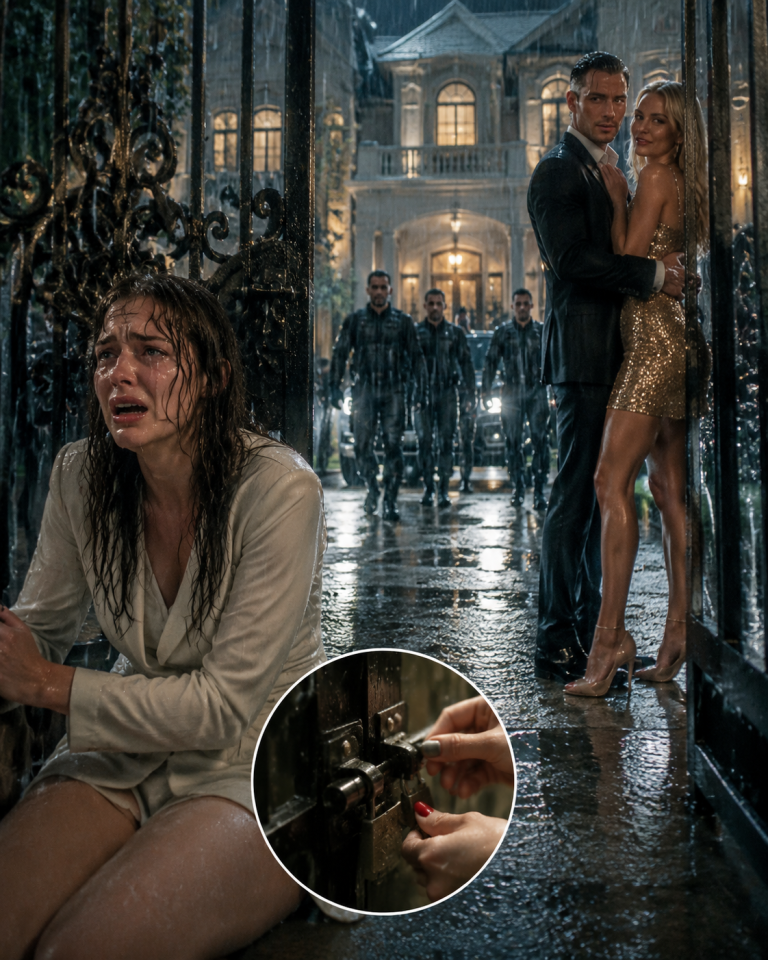
We were a block from the building when the rain intensified.
Not worsened — intensified, the way Chicago rain does in November, as if it has decided on a target. The wind came off the lake and found every gap in my coat and I pulled Iris closer because her jacket was better than mine and I had stopped pretending otherwise.
That was when I saw the woman.
She stood beneath the narrow overhang of a closed jewelry boutique — one of those places with three things in the window and a locked door and absolutely no interest in people who cleaned buildings for a living. She was older, silver-haired, soaked through at the shoulders despite what I could tell was a very expensive coat. She held a small purse pressed against her chest with both hands, and she was looking at the street in a way I recognized before I understood why I recognized it.
My grandmother had looked like that.
Near the end. When time began splitting and the present would suddenly feel foreign and my grandmother would stand in her own kitchen not knowing whose house she was in, holding a spoon, waiting for someone to orient her to the moment.
The woman stepped toward the curb and raised one hand at an approaching taxi.
The cab did not slow.
Another passed.
Then a third.
“Mom,” Iris said quietly.
“I know,” I said.
We should have kept walking.
I want to be honest about that. We should have kept walking because fifty-two dollars is not a number that allows for detours, and because the city we lived in had trained both of us to understand that generosity from people who have nothing is not romantic — it’s expensive. It costs something real.
But Iris was already moving.
And I was already following, because I had taught her to pay attention and I could not be the one who looked away when it mattered.
The woman’s name was Livia, and she spoke mostly Italian when she was frightened, which she was. A damp piece of paper had an address on Lake Shore Drive. Her son, she said in careful accented English, would be worried. She needed to get home.
Fourteen minutes and seven taxis later, standing in rain that had become a personal insult, Iris stepped off the curb directly in front of the next cab.
The driver hit the brakes.
I nearly stopped breathing.
“Iris—”
But she was already at the window, one hand on the door, her face set with an expression I had seen in mirrors my entire adult life. The one that meant: *I have decided this matters and I am not moving.*
She got the driver’s attention. She read the address from the paper. She explained that Livia was confused and needed to be walked inside the building, not just dropped at the curb.
Then the driver said the fare was thirty dollars.
The silence lasted two seconds.
Then Iris reached into her jacket pocket and pulled out two folded tens.
I knew exactly what those were.
School trip money.
Money I had given her two days ago, set aside specifically because the art museum trip was the first optional school activity she had asked to attend in six months, and I had been so quietly grateful she was asking for something again that I’d found the money before I’d found the logic.
“That’s a deposit,” Iris told the driver, with a calm that made her sound forty. “The lady’s son lives at that address. He’ll pay the rest. Look at her coat — it’s real wool.”
The driver looked at Livia.
Livia said something in Italian and patted Iris’s hand.
He took the money.
Livia caught Iris’s wrist before the door closed. She pressed a small laminated card into Iris’s palm — a saint on the front, a handwritten phone number in fading blue ink on the back — then held her own hand over it and spoke in rapid Italian that I couldn’t translate but didn’t need to. Some things arrive in register rather than language.
The taxi moved.
Red taillights dissolving into rain.
We stood on the sidewalk, soaked, watching it go.
Then I turned to my daughter.
“Iris Marie Dunn.”
She faced me with the resigned composure of a child who knows she has done something simultaneously correct and catastrophic.
“That was twenty dollars.”
“I know.”
“That was the museum trip.”
“I know.”
“We don’t have twenty dollars to give away.”
“I know.” She looked up, rain and possibly tears competing on her face. “But she was scared, Mom. Everyone just kept driving past like she didn’t exist. What if it was Grandma?”
That was the sentence.
The one I could not argue with, because it was the one I would have said myself, if someone had needed to say it to me.
I pulled her against my side.
“You should have asked me.”
“You would have said no.”
“I would have said we can’t afford it.”
“That’s what no means when you’re the one deciding.”
I held her in the rain and did not respond to that, because she was right and we both knew it.
Without the money for the bus, we walked.
Two miles in November rain.
Iris did not complain.
That hurt more than the cold.
By the time we reached our apartment, past midnight, my shoes were soaked through and the elevator was broken again and Iris climbed four flights without making a single sound that asked me to acknowledge what this cost.
I sat at the kitchen table after she showered and opened the calculator on my phone.
Fifty-two minus twenty.
Recalculate everything.
Groceries tighter.
Gas bill partial.
More walking.
More rice.
More peanut butter.
More of the mental arithmetic that had become the background music of my life.
I looked at the saint card Iris had set on the kitchen counter.
The number on the back was legible.
I told myself I would not call.
I told myself that calling to check felt like angling for reimbursement, which felt like canceling whatever the act had been.
I put the card on the nightstand and turned off the light.
Three days later, two men in dark suits met me on the forty-first floor of the Kessler Tower.
“Vera Dunn?” one said.
My stomach dropped before the rest of me caught up.
“Yes?”
“Please come with us.”
“Am I in trouble?”
“Please come with us, ma’am.”
The elevator went up.
Not down.
Past the floor I’d been cleaning.
Past the executive suites.
All the way to the penthouse level, where the lobby had real art on the walls and the carpet absorbed sound so completely the building felt like it was holding its breath.
Dark double doors.
Beyond them, a room built of glass and sky and the kind of money that doesn’t announce itself because it doesn’t have to.
And a man standing at the window who turned when I entered, and whose eyes found me before I had finished taking in the room.
Dark eyes.
Still.
The kind of attention that had weight to it.
“Ms. Dunn,” he said. “I’m Marco Santi. Thank you for coming.”
The name landed differently once I was looking at his face. Something about it suggested I should already know it. I didn’t, not then.
“I didn’t have much choice about coming,” I said.
Something moved briefly across his expression.
“Fair,” he said. “I apologize for the approach. I wasn’t sure you would agree to come if I simply asked.”
He gestured to the seating area.
I stood.
My back screamed. Standing was punishment. I stood anyway because sitting felt like ceding something I wasn’t ready to give.
“Three nights ago,” he said, “you and your daughter helped an elderly woman in the rain. The woman is my mother, Livia Santi.”
“Is she alright?” That came out before anything else, before the calculation of why I was there.
“She is safe,” he said. “Because of you and Iris.”
The relief was so immediate it moved through me visibly.
He saw it.
“She slipped away from her caregiver after an afternoon appointment,” he said. “She has early-stage Alzheimer’s. Disorientation in unfamiliar situations. We searched for two hours.”
“I’m glad she got home.”
“She got home because your daughter stepped into the street to stop a taxi.”
He opened a leather wallet and placed two folded bills on the desk.
“The twenty dollars.”
I looked at them.
Did not take them.
“We don’t want it back.”
“It isn’t charity.”
“It feels like it.”
“It’s what was spent to help my mother.”
“She gave it freely.”
His expression shifted — barely, but perceptibly, the way a room changes when a window opens.
As if I had become more present to him by refusing.
He looked at me for a long moment.
“My mother,” he said, “has asked about Iris every day since. She remembers almost nothing clearly from that night. She remembers the girl who helped her.”
He closed the wallet.
“She wants to thank her. Properly. Not through me.”
I thought about Livia’s hand over Iris’s. The Italian words I couldn’t translate but understood anyway.
“Where?” I asked.
A restaurant in Lincoln Park. Saturday afternoon. Public. One hour.
“I need a direct number,” I said. “Not an office. If I’m bringing my daughter somewhere, I need to be able to reach exactly who I’m meeting.”
He gave it to me without hesitation.
Not a business card. His phone, typed directly, screen turned toward me.
“My personal number,” he said. “Not widely held.”
“Saturday at two,” I said. “One hour. If anything feels wrong, we leave.”
“Understood.”
“And Mr. Santi.”
“Marco.”
“If this turns out to be something other than what you said—”
“You call the police,” he said. “I would expect nothing less.”
That night I searched his name.
The results made the room feel smaller.
Santi Group. Import-export, logistics, hospitality, real estate. Photographs with aldermen and charity boards. Then the other links — speculation, forum discussions that appeared and vanished, articles that suggested things carefully without saying them, the particular vocabulary of organized crime adjacent to men who had never been charged with anything.
I sat with the screen brightness low while Iris slept.
The man had been respectful. Careful with distance. He’d given me his personal number without being asked for proof of good intent.
He had also found me through the building’s security footage and sent men to collect me from a floor where I cleaned toilets.
Neither of those things cancelled the other.
Livia was real.
Iris’s certainty had been real.
On Saturday, I put Iris in her best sweater and wore black pants and a cream blouse that held together from a distance if no one looked too closely at the seams, and we took the bus to Lincoln Park.
And what happened next changed the shape of everything I thought I knew about who we were and what we were owed and what the rest of our life was going to look like.
—
## PART 2
The restaurant smelled of espresso, old wood, and warmth that had been earned rather than installed.
Livia was already seated when we arrived.
She rose when she saw Iris.
Her face opened like something had been returned to it — clarity arriving the way it sometimes does with Alzheimer’s in small, unexpected windows, a room suddenly lit before the bulb goes out again.
“The kind girl,” she said, and pulled Iris into her arms.
Iris, who had spent most of the past two years learning to ask for nothing, went still for half a second and then held on.
I watched Marco across the table.
He cut Livia’s pasta without making a ceremony of it. When she repeated herself, he answered with the same patience the second time as the first. When she called him by his father’s name, he did not correct her — he redirected gently, as if dignity mattered more than accuracy.
I noticed.
I noticed the way you notice things when you have learned to take people apart quietly, from a safe distance, to determine whether they are the kind of danger that announces itself or the kind that waits.
Livia gave Iris a leather-bound book of Italian fairy tales. Iris tried to refuse. Livia insisted with tears in her eyes and Iris accepted with the careful grace of someone who has learned that rejecting generosity from older women is sometimes its own unkindness.
After Livia stepped away with her caregiver, Marco made the offer.
Not the money.
A job.
Five afternoons a week. Companion care for Livia. Reading, conversation, cooking, garden walks. Iris welcome after school. A nurse named Petra would handle medical oversight. Marco wanted presence — the kind that couldn’t be credentialed.
He named the salary.
It was three times what double shifts produced.
I almost laughed.
“That’s too much,” I said.
“It’s what the work is worth.”
“I’m not trained.”
“My mother has had three trained companions in the past six months,” he said. “None of them made her laugh. Your daughter made her laugh within ten minutes.”
He held my gaze.
“I’m not compensating you for the rain. I’m trying to care for my mother well. Those are different things.”
One month, I told him.
Trial basis.
Nothing permanent.
I told myself it was practical.
The Santi house in Forest Glen was the kind of home that had been lived in rather than decorated. High ceilings, family photographs, a garden that still held the structure of someone’s old attention. Security hidden in landscaping and door frames, men who looked like groundskeepers until I saw them twice in places that didn’t make sense.
I learned Livia’s rhythms under Petra’s guidance. Medication schedule. What music she liked. Which memories were safe to enter and which rooms of the past opened onto grief. I read old poetry with her, helped her make pasta from muscle memory when her hands still knew what her mind had stopped tracking. I let Iris do homework at the kitchen table while Livia watched with the contented attention of someone who found children’s industry restful.
Iris bloomed.
That is the only word.
With space. Warmth. Books. An older woman who asked about her drawings as if they mattered.
Marco remained at the edges, at first.
Professional. Careful. Evening check-ins that stayed brief. But after the afternoon Livia panicked and I calmed her by humming something my own grandmother had sung — some half-remembered melody I hadn’t thought of in years — something shifted in how he looked at me.
We started talking after Livia slept and Iris finished homework.
Not about work.
About other things.
Grief. Books. What it meant to be responsible for someone who used to be responsible for you.
He listened more than he spoke, which I did not trust at first. Men who listen well can use what they learn. But Marco did not push. Did not flatter. Did not ask for pieces of me before I offered them.
Gentleness is harder to resist than pressure.
I knew that.
I stayed cautious anyway.
Then Derek called.
My ex-husband’s voice arrived like a change in temperature — something in the air shifted and my body understood before my brain caught up. Released early. Good behavior. He wanted visitation. He wanted rights. He wanted me to understand that he knew where we were now and that the court paperwork I’d filed three years ago contained language his new lawyer thought was interesting.
“You signed away custody voluntarily,” I said, standing in the hallway outside Livia’s sitting room, voice too low for anyone nearby to hear.
“Under circumstances that can be reframed,” Derek said. “I hear you’re working for a wealthy man now. A judge might find that arrangement worth examining.”
He hung up.
The messages started the next morning.
Different numbers each time.
Questions dressed as legal concern. References to Iris’s old school. The apartment building on Ashland where we’d lived before I moved us. He was methodical about it, the way he’d always been methodical — not explosive, not visible, just consistent, the kind of presence that made every ordinary moment feel like it was being monitored.
I changed Iris’s school.
I told her the new one had a better art program.
She said, “Okay,” which was worse than if she’d questioned it.
By the third day, Marco knew.
Not because I told him.
Because I was thinner in the shoulders and flinching at phones.
He asked me into his study and said my name once, quietly, the way someone says a name when they have already decided that what follows matters.
So I told him.
Derek. Prison. The threats. The custody paperwork. The way he understood legal leverage and used it the way other people used keys — to get into rooms that should have been locked to him.
Marco’s face did not change much.
His eyes went still in a way that meant something entirely different from calm.
“I know a family attorney,” he said. “One of the best in the city. Emergency paperwork can be filed tonight.”
“I can’t afford—”
“You’re not paying.”
“Marco—”
“Derek near this house puts my mother at risk. That makes it my problem as much as yours.”
It was a generous lie. I saw it. I accepted it anyway.
Aldo Cruz filed within two hours. A restraining order, expedited. The guesthouse on the property offered as temporary security while the paperwork moved.
I told Marco I would pay rent.
He looked at me for a moment.
“I can work with that,” he said.
The guesthouse had two bedrooms and windows that let in morning light and a silence that felt like waiting for something good rather than waiting for something wrong.
Iris walked through it and said: “Mom, there’s actual space.”
I reminded her it was temporary.
I reminded myself too.
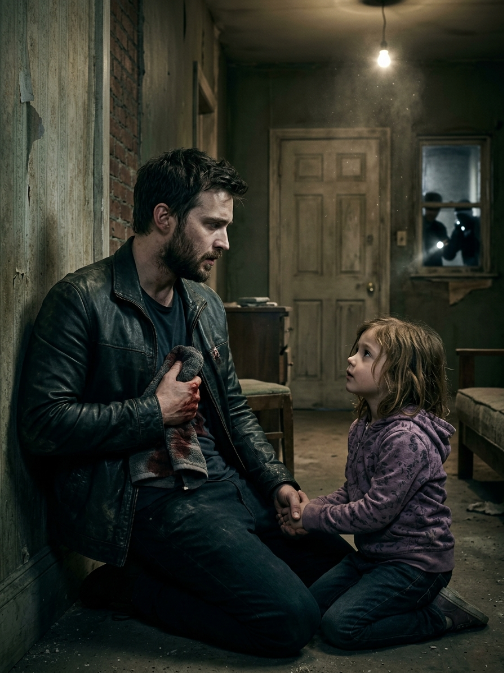
On the fourth night, at 2:14 a.m., Derek came to the guesthouse door.
Not knocking.
Hitting.
I had Iris in the bathroom with the lock turned before he finished the first sentence. My hands shook on the phone screen.
He shouted things against the door.
I will not repeat them.
Then other voices — low, firm, multiple. The hitting stopped. Silence, then the particular quiet of a situation being managed.
Marco’s call came twenty seconds later.
“Security has him. Police are on their way. Stay where you are.”
When he knocked gently five minutes later and said my name, his voice had the specific steadiness of someone who has been afraid and is not showing it.
Derek went to jail that night for restraining order violation, trespassing, and the specific category of threat that prosecutors find useful.
But the real thing — the thing that changed the shape of the past six years — came two weeks later.
Marco’s team had been pulling Derek’s financial history as part of the custody defense preparation.
What they found was not what anyone expected.
—
## PART 3
Aldo Cruz brought me the documents on a Wednesday afternoon, in the kitchen of the Santi house, with Iris at school and Livia napping and the room very quiet.
He set a folder on the table and sat across from me.
“During your marriage,” he said carefully, “accounts were opened in your name. Credit lines. Small personal loans. Two secured cards.”
I looked at the documents.
“I didn’t open these.”
“No,” Aldo said. “You didn’t.”
The signatures were mine, technically — close enough to pass basic scrutiny, familiar enough to deploy in situations where no one was looking carefully because the amounts were individually small. A card here, a loan there, nothing that would trigger immediate alarm. Collectively, over five years, they had quietly built a debt structure in my name that had been systematically defaulted.
Derek had never struggled with money.
He had struggled with the fact that I was trying to leave.
The accounts were leverage. Sabotage with paperwork. A way of ensuring that whenever I got out, my credit would be damaged, my options narrowed, my ability to build anything stable quietly compromised before I even started.
The poverty was partly manufactured.
Not all of it. But enough.
I sat at that table for a long time.
There was a particular feeling in that moment — not rage exactly, something quieter and older, the feeling of understanding something that should have been visible for years. All the nights on the calculator. All the rice and peanut butter and walking in the rain. All the careful architecture of fifty-two dollars. Some of that had been real constraint. And some of it had been a structure someone built inside my life so that I would feel too small to leave.
Marco appeared in the doorway.
He’d been in the study on a call.
He saw my face.
He sat down across from me without speaking. Not asking. Not filling the silence with efficiency or the next step.
Just there.
After a while I told him what the documents showed.
He listened to all of it.
Then he said: “We’ll add financial fraud to the existing charges. Aldo has what he needs.”
“Is that enough to—”
“The forged signatures alone are prosecutable. With the five-year pattern and the defaulted accounts, it’s significant. The DA will see it.”
I looked at the folder.
“Six years,” I said. “I thought I was just bad at keeping things afloat.”
“You weren’t bad at it,” Marco said. “You were fighting something you couldn’t see.”
That sentence entered me and stayed.
The case built itself from what Cruz and Marco’s team had assembled — the fraudulent accounts, the forged signatures, the financial records showing Derek’s own accounts healthy throughout the same period he claimed poverty to avoid support obligations. The restraining order violation and criminal threats from the guesthouse night added their own layer.
When Derek’s attorney called to discuss terms, Cruz said: “There are no terms. We have documents.”
Documents were harder to charm than rooms full of people.
The hearing was on a Thursday in January.
I wore dark blue. Iris helped me choose it. She sat in the gallery in her good sweater and cried before I’d finished walking to the witness table, which nearly undid me, but I kept my voice level through the account numbers and the signature comparisons and the credit report timeline, because some testimony needs to be given clearly and completely, and I had spent enough years being made to feel that my accounting of my own life was inherently uncertain.
Derek’s smile at the judge did not land.
It never lands when the documents say otherwise.
The fraudulent debts were removed from my credit history through a formal order. Permanent protection granted. All access to Iris revoked pending a separate family court review that Aldo said we would win. The restraining order violation, the threats, and the financial fraud stacked consequences that Derek’s charm couldn’t reach.
I walked out of the courthouse into winter sunlight that felt like it was doing something deliberate, and I stopped on the steps and breathed in for a moment because I had not been able to do that — just breathe, without calculating what came next — in longer than I could measure.
Iris took my arm.
“Livia sent food,” she said. “She made Petra text Marco what to pick up. She said it’s for victory.”
Marco was near the car.
Not in front of me.
Not between me and whatever came next.
To the side, slightly back, in the way of someone who has understood that his job in this moment is to be present without occupying the space.
I walked to him.
“Thank you,” I said.
“For what, specifically?”
“For standing there. For not speaking before I spoke.”
His eyes softened.
“You didn’t need me to speak.”
“No,” I said. “But I needed someone to stay.”
That evening, Livia had one of her clear moments.
The sunroom, late light through the glass, Iris reading from the Italian fairy tale book while Marco sat near me and Livia watched all of us with the old wisdom of someone who has been watching longer than anyone knows.
“You love her,” Livia said.
The room went quiet.
Marco looked at his mother.
“Mama—”
“No.” She lifted one hand. “I forget many things. Not this. A mother always knows.”
Iris looked up from the book and then immediately looked back down at it.
I felt my face warm.
Livia turned to me.
“He is not dangerous because he is cruel,” she said. “He is dangerous because he is afraid. Same thing as strong women. You are strong because you had to be. But strong people need rest too. Not rescue. Rest.”
Then the clarity passed the way it always did — like a door closing gently — and she looked down and asked if it was Thursday.
“Yes,” Iris said, without missing a beat. “Thursday.”
Livia nodded, satisfied, and reached for her tea.
That night, Marco and I stood in the garden under bare February branches.
He said: “I love you.”
Not dramatically.
Not as a performance.
Just plainly, the way true things are said when you have decided you are done holding them in reserve.
I closed my eyes.
“I’m scared.”
“I know.”
“I can’t be owned.”
“I don’t want to own you.”
“I can’t be grateful into love.”
“I don’t want gratitude.”
“I have Iris.”
“I know,” he said. “I love her too.”
Not *I’ll take care of her.* Not *I’ll provide for her.*
*I love her.*
That was the sentence that broke something loose in me.
Because it was said with responsibility, not entitlement. With the tone of someone who understood that loving a child meant accounting for her, not acquiring her along with the rest of the arrangement.
I opened my eyes.
“If we do this, slowly.”
“As slowly as you need.”
“If I say no, it means no.”
“Always.”
“If I keep my work, my choices, my own accounts—”
“You keep all of it.”
He was not offering to remove the difficulty from my life. He was offering to stand in it with me, which is different in every way that matters.
I stepped forward.
The kiss was not dramatic.
It was quiet and deliberate and it felt like a choice made by two adults who had both earned the right to be careful.
Livia declined as the year moved forward, the way Alzheimer’s takes things — not in one collapse but in a long, slow recession. She had fewer clear moments and more confused ones. I built her days around music she had loved at twenty, around the pasta recipe her hands still knew even when her mind had stopped tracking the kitchen. I let Iris read to her every Saturday, and sometimes Livia knew her and sometimes she only knew that this child was something good, and both of those were true.
I finished a certification in memory care — enrolled with Marco’s encouragement, paid for with my own money because I had decided that distinction mattered, and he had respected it without arguing.
I no longer cleaned office towers at midnight.
I no longer ran the calculator every morning like a rosary.
I still checked locks.
Healing does not move in a straight line and anyone who suggests otherwise has probably not done much of it.
But there were fewer nights now when fear woke me before the alarm.
Iris got a new backpack. Then art classes — real ones, with a teacher who called her talented without qualifying it. Then the kind of ordinary teenage laughter I had been afraid to hope for, directed at nothing important, arising from nowhere, which is the only kind that means things are actually okay.
Marco proposed on an ordinary evening.
No orchestration.
Just the kitchen after dinner, Livia dozing in the sunroom, Iris at the table with homework, rain against the window like November returning to remind us where this began.
A small box beside my coffee.
“No pressure,” he said immediately. “No required answer tonight.”
Iris looked up from her worksheet.
“Is that what I think it is?”
“Iris.”
“What? I’m emotionally invested in the outcome.”
Marco almost smiled.
I opened the box.
The ring was simple. The stone clear. Nothing intended to overwhelm.
“I chose it because it looked like you,” Marco said. “Nothing unnecessary.”
I laughed through something that was not quite crying.
“That is objectively the least romantic description of a ring that exists.”
“I can try again.”
“No,” I said. “It was exactly right.”
I took a week to answer.
He meant it when he said no pressure.
I used the week.
Not because I was uncertain.
Because I had learned to give my own decisions the time they were worth.
When I said yes, we were in the garden — Marco, Iris, Livia in her chair, afternoon light through the branches. Livia clapped her hands and asked if we were in Rome.
“Close enough,” Iris said, hugging her. “Close enough.”
The wedding was small. December. I wore deep green because I said I had survived enough symbolism and white wasn’t it. Iris stood beside me in burgundy with a small bouquet and cried before the string quartet had played eight bars.
Marco cried too.
Quietly, without making it anyone else’s thing to manage.
Livia, seated in the front row, had a clear moment just as I reached him. Her eyes found Iris first.
“The kind girl,” she whispered.
Then she looked at me.
“And the good mother.”
Marco took my hand at the altar.
Not to anchor me.
To join me.
People would tell the story later as if it started with money — a poor woman gives away twenty dollars and marries a wealthy man. That was the version that fit in a sentence. It left out almost everything.
The real story began with Iris stepping into the street for a stranger.
It began with twenty dollars that were architectural, load-bearing, genuinely unavailable — and given anyway, not from surplus but from the part of a person that hasn’t been fully crushed yet.
It began with a woman who pressed a saint card into a child’s hand on a dark sidewalk in the rain.
It began with a son who found me through a security camera and a penthouse summons and then spent the next year learning that finding someone and owning them were not the same category of action.
It began with a daughter who understood something about visibility.
Who understood that when everyone in a city keeps moving past someone standing in the rain, the problem is not the rain.
Years from now, Iris would keep the saint card framed near the kitchen window. The phone number on the back had faded to almost nothing, but neither of us needed it anymore. What we had needed it for had already happened.
Sometimes on dark November evenings, when rain hit the glass and Iris was doing homework at the table and the kitchen smelled of something warm, I would look at that card and remember the wet sidewalk and the calculator app and the two folded tens and the weight of fifty-two dollars and what it had cost us to spend twenty of it.
And every time someone called it luck, I said the same thing:
“It wasn’t luck. It was Iris.”
Because luck is random.
But choosing to stop when every efficient instinct says keep moving — that is a decision.
And some decisions, made with money you genuinely cannot spare, in rain that has decided to take it personally, made by a thirteen-year-old who stepped into the street because she could not accept that an old woman didn’t exist —
Some decisions become the moment everything turns.
Not toward wealth.
Not toward rescue.
Toward being seen.
Finally, fully, for the first time.
Which was all either of us had ever needed.