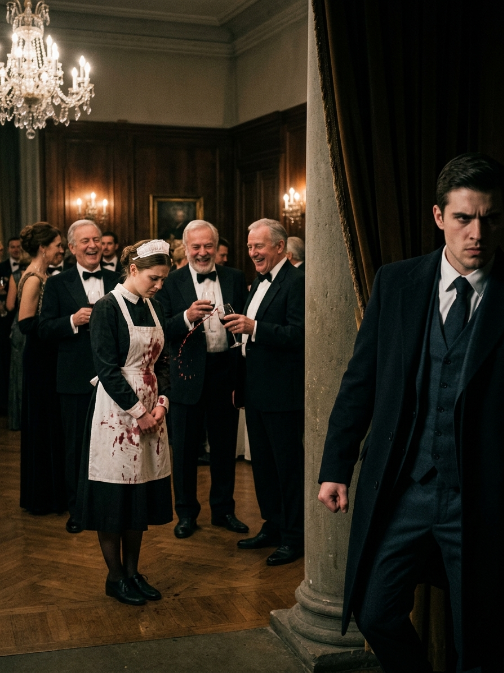
The Mafia Boss’s Mistress Sent a Selfie—His Wife’s Response Shattered Everything

## PART 1
She had been ready for two years.
That was the thing about being underestimated. It gave you time.
Nora Vance had used every minute of it.
While she organized her husband’s social calendar and confirmed his restaurant reservations and remembered which wine his business partners preferred and which ones shouldn’t drink at all, she was also doing something else. Something quiet. Something that required the same skills her husband dismissed as domesticity: precision, patience, and the ability to track details that powerful men considered beneath them.
The photograph arrived on a Tuesday morning while she was making lunches.
She heard the notification. Picked up the phone. Read the message from a number she didn’t recognize.
*Thought you should know where your husband spent the night. He seemed very comfortable. —A friend*
The image loaded slowly on the screen.
Nora looked at it.
She put the phone face-down on the counter.
She finished slicing the apples.
Then she picked up the phone again, walked to the pantry — she had always done her clearest thinking in the pantry, surrounded by the ordered rows of things she had stocked and organized and maintained — and typed one word back to the unknown number.
*Thank you.*
The woman in the photograph was named Daria. Nora had suspected for seven months. Not from evidence of infidelity, which Callum Vance was careful about, but from the particular shift in his behavior — the way he had become both more dismissive and more watchful, as though he needed to confirm she wasn’t noticing while ensuring she was beneath his notice.
That quality of attention, Nora had learned, meant something was being protected from her.
She had not panicked. She had paid attention in the opposite direction, toward the paperwork.
There was always paperwork.
Callum ran a real estate development company that appeared clean in the way that companies built by cautious men appeared clean: from the front, in daylight, at the approved angle. Nora had spent eleven years hosting his dinners, attending his events, presenting the correct version of their family to the correct rooms. She had always been good at rooms. She was quick with names, warm with wives, appropriately deferential to men who needed that from the women around them.
She had also been very quiet in his office late at night, when he was traveling.
She had found things that did not require expertise to understand. Wire transfers with improbable originations. Properties held through layers of entities. Payments to vendors who shared addresses with individuals she recognized from his phone contacts. Signed authorizations in her name for accounts she had never opened.
Those last ones had frightened her.
But they had also been useful.
She had photographed everything. Forwarded the photographs to a secondary email account under her maiden name, a name Callum had not thought about in years. She had contacted a forensic financial analyst through an organization that helped women in exactly her situation. She had met twice with an attorney named Priya Bakshi in a coffee shop three miles from their house while the children were at school, paying in cash, arriving and leaving through different doors.
Priya had said, on their second meeting: *You’re one of the most prepared clients I’ve ever had.*
Nora had said: *He taught me not to leave anything to chance.*
That was the irony that still sometimes caught in her throat late at night. Everything Callum had tried to make her into — the organized wife, the careful planner, the woman who tracked every variable and maintained every system — had become the exact skill set required to dismantle him.
She returned the phone to the counter, face-up now, and looked at the photograph one more time.
The woman in it was very beautiful. She had the specific confidence of someone who believed she had won something. Her expression said: *Look what I have that you don’t.* Her smile said: *I want you to hurt.*
Nora understood the intention.
She did not perform the expected response.
She sent a single email instead, with the subject line: *PROCEED.*
Priya replied in four minutes. *Confirming. Filing begins within the hour. Follow protocol.*
Nora turned off the stove.
Upstairs, her daughter Cora was singing something off-key while getting dressed — she always sang while getting dressed, had since she was three, a habit Callum found irritating and Nora privately treasured. Their son Marcus was somewhere on the second floor arguing about whose turn it was to use the bathroom mirror. Their youngest, Felix, was still asleep. He was six and slept with the determination of someone who had decided rest was his primary occupation.
Nora stood at the bottom of the staircase and listened to her children being alive in the morning.
Then she walked upstairs.
She helped Felix find his shoes. She settled the mirror argument. She braided Cora’s hair in the way Cora liked best, the French braid that Nora had practiced when Cora was a baby and had perfected over seven years of early mornings.
“You’re in a good mood,” Cora said, watching Nora’s face in the mirror.
“Am I?”
“You’re being extra careful with the braid.”
Nora met her daughter’s eyes in the reflection.
“I always try to be careful,” she said.
At 8:07 a.m., she loaded the children into the car she had arranged last week — a different car than the one Callum knew about, registered to a cousin who asked no questions. The bags were already in the trunk. The documents were already with Priya. The children’s school records, medical histories, and birth certificates had been copied and stored in a facility under her maiden name six weeks ago.
Marcus noticed the different car.
“Where’s the Audi?”
“Getting serviced,” Nora said.
“Can I have the window?”
“Yes.”
He was nine. He required a reason and a window. He was satisfied.
As she pulled out of the driveway, Nora looked at the house once in the rearview mirror.
It looked exactly like a home.
That had always been the lie.
—
## PART 2
Callum woke at nine forty-three.
The first thing he reached for was his phone.
He had six missed calls from his attorney. Four from his CFO. Two from a board member named Harris, who contacted him directly only when something was catastrophic. One from his accountant, marked URGENT, though the accountant considered most things urgent.
He sat up.
Daria was in the bathroom. He could hear her.
He opened the attorney’s voicemails.
The first one said: *Emergency filing. Call me before you do anything. Nora has a forensic report.*
The second said: *The properties. She has the documentation. Do not contact her directly.*
The third said: *I mean it, Callum. Do not call her.*
He called her immediately.
Straight to voicemail.
He called again.
Voicemail.
He called Priya Bakshi’s office number — he had encountered it in Nora’s emails three months ago and had not mentioned it, because mentioning it would have required admitting what he suspected — and a paralegal answered with the professional cheerfulness of someone expecting exactly this call.
“Mr. Vance,” she said. “Ms. Bakshi is unavailable, but she’ll be in touch through your counsel.”
The line went dead.
Daria came out of the bathroom and read his face.
“What happened?”
“She filed.”
“What does that mean?”
Callum looked at his phone. His hands, he realized, were shaking.
“She had a plan,” he said.
Daria waited.
“She built a case,” he said. “While she was there. While she was in the house. While she was—” He stopped. The words would not arrange themselves into something he could manage.
Because the thought forming was too humiliating to complete: while he was watching her to make sure she wasn’t watching him, she had been watching him better than he had ever been watched.
The accounts were frozen. Not all of them — she had not been able to reach the offshore structure — but enough. The domestic accounts. The company operating account. A family trust he had moved things through quietly, sure that her name on the documents would create just enough legal uncertainty to delay any action she tried to take.
Her name on the documents.
He had thought that was leverage over her.
It turned out to be leverage she had saved.
His attorney called back. He answered this time.
“Tell me where it started,” Callum said.
“Callum.” Richard Mende’s voice was the voice of a man who had seen everything and was currently unhappy about it. “She has recordings.”
“What kind?”
“You discussing using her mental health history in a custody action.”
The hotel room went entirely silent.
Daria looked at him.
He remembered the conversation. The restaurant near his office. Dominic from the legal team, two scotches in, speaking hypothetically about how mental health treatment history could be framed to support a fitness question if it ever came to that.
He remembered because he had felt clever.
“I was in a public restaurant,” he said.
“With a listening device three tables over,” Richard said. “Her investigator’s report suggests she had assets tracking you for eight months.”
Eight months.
Callum set the phone on the bed.
Eight months ago, Nora had made him a birthday dinner. She had decorated the table. She had given him a card the children made by hand.
She had also, apparently, already begun.
He picked the phone back up.
“Where are my children?”
“We don’t know yet,” Richard said.
The words arrived like something physical.
“Find them,” Callum said.
“There is a restraining order,” Richard said carefully. “Any independent effort to locate them will—”
“Find them.”
Richard went quiet for a long moment.
Then, in the tone of a man delivering news he has not enjoyed preparing: “Callum. She didn’t run. She filed. There is a significant difference. Running can be countered. Filing means she spent two years building something that cannot be undone in a hotel room.”
Callum stood at the window.
Outside, the city looked exactly as it always had.
He had always assumed it was arranged for men like him.
For the first time, he wondered if he had been wrong.
—
## PART 3
The first safe house was not beautiful.
Nora had chosen it specifically for that reason.
Beauty, in her experience, had always come with conditions.
The rental sat on a residential street two states over, a modest house with pale yellow siding, a kitchen with a cracked tile near the sink, and a backyard that needed attention. The beds were clean. The water was hot. The refrigerator held everything she had asked Priya’s assistant to stock.
The children discovered the backyard within four minutes of arriving and immediately began negotiating over territory.
Nora stood at the kitchen window and watched them.
Cora was claiming the garden beds. Marcus was debating whether the slope near the fence counted as his. Felix had already sat down in the grass and was looking at something small and interesting near the base of a tree with the focused curiosity that had characterized him since infancy.
She let herself breathe.
Not deeply. Not yet. But enough.
Priya arrived that evening with folders and food and the particular composure of a woman who had done this many times and understood that efficacy and warmth were not opposites.
“Eat,” she said, before anything else.
“I’m not—”
“I know. Eat anyway. Your children need you functional tomorrow.”
Nora ate.
The food tasted like nothing, which was fine. Her body needed fuel, not pleasure. Pleasure could come later, when the legal ground was more stable.
Priya spread documents across the kitchen table while the children watched a film on the small television in the living room, loud enough to make their conversation private.
“Emergency custody petition granted,” Priya said. “Temporary order is active. He cannot approach without prior judicial authorization.”
Nora’s shoulders dropped slightly.
That mattered more than the financial protections, more than the property filings, more than all of it. The legal barrier between Callum and the ability to use their children as instruments was the thing she had spent more nights calculating than anything else.
“The accounts?” she asked.
“Three domestic accounts frozen. The family trust is under review — the co-signature issue is complicated, but we anticipated that. The forensic team has enough to support the initial disclosure petition.”
“He’ll argue the recordings.”
“He will. We’ve already prepared for that.” Priya’s voice was steady. “In this jurisdiction, one-party consent covers them. But even if they’re challenged, their existence changes the conversation. He cannot now pretend he never considered using your treatment history. The conversation is documented.”
Nora looked at her coffee.
“He used to mention it sometimes,” she said. “When we argued. Not directly. But he had a way of bringing it up. The anxiety diagnosis. The medication. The way he’d pause before saying *you’re not yourself today* in front of people.”
Priya’s expression did not change. She was very good at receiving information without performance.
“That’s documented too,” she said. “Three statements from former household staff, two from school administrators who witnessed specific interactions.”
Nora looked up.
“You spoke to the school—”
“Your investigator did, six months ago. Carefully. The administrators were interviewed as part of a behavioral assessment study. No names attached. No connection to you until now.”
Nora looked at the table.
“I never asked you to do that.”
“No,” Priya said. “But when I read what you gave me in our first meeting, I expanded the investigation. I wanted to be sure we weren’t walking into court with half a case.”
For a moment, Nora had nothing to say.
The past two years rose in front of her: the documents photographed on her phone, the late nights in the pantry reviewing transfer records, the careful conversations with Priya in cash-paid meetings, the items moved gradually into storage, the children’s medical records compiled and secured, the singular discipline of appearing undisturbed while building an architecture of exit.
She had done all of that believing she was doing it alone.
“Thank you,” she said.
“Don’t thank me yet,” Priya said. “He’ll fight.”
“I know.”
“He has resources.”
“I know.”
“He’s going to make himself the wronged party. Emotional wife. Vindictive exit. Coached by an attorney.”
“I know all of this.” Nora folded her hands on the table. “What I need to know is whether what I built is enough.”
Priya looked at her for a long moment.
“What you built,” she said, “is the most thorough pre-filing documentation I have seen from a non-attorney in my career. You catalogued his financial structure through your household role. You preserved evidence of coercive behavior patterns over a documented timeline. You left nothing for interpretation that could have been left for interpretation.” She paused. “You are not a client who arrived hoping. You are a client who arrived prepared.”
Nora pressed her hands against the tabletop until the trembling stopped.
—
The first hearing was six weeks later.
Nora wore a gray dress Priya had suggested: serious without being severe, understated without disappearing. No jewelry. Her hair pulled back simply.
In the courthouse bathroom beforehand, she looked at her reflection under the flat overhead light.
She did not look like the woman in Callum’s family portraits. That woman had been arranged: hair by a stylist, makeup by someone else, expression by years of understanding what expressions were acceptable in public.
This woman had dressed herself.
That was not a small thing.
In the hallway outside the hearing room, she saw Callum.
He was with Richard Mende and an associate she didn’t recognize. He looked well-rested. He always looked well-rested. That was one of the many advantages of having someone else manage the children’s nighttime routines.
He saw her.
For a moment, his face arranged itself into the expression he wore when he was assessing something: not quite sympathetic, not quite cold, the neutral evaluative look of a man deciding what position served him best.
Then something else moved through it.
He had not expected her to look this way. She understood that immediately. He had expected distress. Disorganization. He had expected that the woman who sent a text saying *filed* would arrive at this hearing vibrating with the energy of someone who had made an impulsive, emotional decision she did not fully understand.
Nora held her shoulders back and looked at him without looking away.
He looked away first.
That was enough.
Inside, the hearing proceeded as Priya had outlined. Callum’s attorney made arguments Priya had predicted almost verbatim: emotional instability, vindictive motivation, coached interpretation of financial documents she lacked the expertise to understand.
Priya stood when it was her turn.
Her voice was moderate and entirely unimpressed.
“My client holds a bachelor’s degree in accounting and worked in corporate finance for four years before her marriage. She managed the financial administration of her household for eleven years and has direct knowledge of the accounts, entities, and transactions she is describing. She is not interpreting documents she stumbled upon. She is an adult woman describing the financial structure she helped maintain.” Priya paused. “The suggestion that she lacks expertise to understand her own signature is, frankly, an argument this court should find concerning for the reasons it implies.”
In the second row, a woman Nora didn’t know touched the arm of the woman beside her.
The judge made a note.
When Nora testified, her voice shook at the beginning.
Not enough to stop. Just enough to be visible.
She had decided not to manage that. Priya had suggested it. *Let them see the cost,* she had said. *Let them understand this was not performed.*
Nora described the household management. The documents. The account structures she had navigated. The night she had found the shell entity with her name on it for the first time.
She described the conversation she had recorded.
She described the morning of the photograph.
“Did you react immediately?” the judge asked.
“No,” Nora said.
“Can you explain why?”
“Because I had been preparing for a long time. I didn’t need to react. I needed to proceed.”
The judge looked at her.
“You sent the word *proceed* as your first response.”
“Yes.”
“Not to your husband. Not to the woman who sent the photograph.”
“No. To my attorney.”
A silence.
“Why?”
Nora considered the question.
“Because,” she said carefully, “I had learned that responding to provocation gives the person doing the provoking information about what wounds you. I didn’t want to give that.”
The judge wrote something down.
Callum, across the room, was absolutely still.
Temporary custody was confirmed with Nora.
Contact for Callum was restricted to supervised visits through a family services center pending full investigation.
Financial disclosure was ordered within thirty days.
When it ended, Callum stood quickly.
Richard touched his arm. Callum shook him off.
He crossed toward Nora in four strides.
Priya stepped smoothly between them.
“All communication through counsel,” she said.
“She’s my wife,” Callum said.
“She is the petitioner in this matter,” Priya said, in the tone of a woman who had said this many times and found it increasingly uncomplicated.
Callum looked past her.
“Nora.”
Nora looked at him.
She had been married to him for eleven years. She knew his voice the way she knew her children’s fevers — the gradations of it, the specific quality of urgency that was real versus performed. This was real. This was a man who had discovered, possibly for the first time, that the person he had spent years managing did not require his management.
“You should have talked to me,” he said.
She held his gaze.
“You should have talked to me,” she said. “For eleven years. You chose not to.”
His jaw tightened.
She turned and walked out.
—
Freedom arrived without ceremony.
That was the first surprise.
She had imagined it would feel large. Instead it felt ordinary in the way that fundamental things felt ordinary once you stopped carrying the extra weight you’d mistaken for normal: a morning where she woke without immediately calibrating her mood to his; an evening where she made dinner at whatever time she chose; a silence in the house that did not mean danger was approaching but simply meant the house was quiet.
She learned to inhabit it slowly.
The second surprise was how much the children noticed.
Cora asked, three weeks into their new routine, “Why is it different here?”
“How do you mean?”
Cora looked at the ceiling in the way she did when assembling a precise thought.
“At the old house,” she said, “you always looked like you were waiting for something.”
Nora was very still.
“And here?”
Cora shrugged. “Here you look like you’re already there.”
Nora smiled.
It was not a performance of a smile.
“That’s a very perceptive observation,” she said.
“I know,” Cora said, and went back to her book.
Marcus was more direct. One evening, while she was helping him with a school project, he looked up and said, “Is Dad coming back?”
Nora put down her pencil.
“He’ll always be your dad,” she said. “He’ll have visits. But he won’t live with us.”
“Because he hurt you?”
The question was precise enough that she paused to answer it precisely.
“He made choices that made it unsafe for our family to stay,” she said. “Those were his choices, not yours. Nothing that happened is because of you.”
Marcus nodded once, the way he processed difficult information — with a brief, total absorption, then a visible filing away.
“Okay,” he said.
“Okay?”
“I just wanted to know if it was something I did.”
Nora pulled him toward her.
“No,” she said, against his hair. “It was never anything you did.”
Felix, who was six, asked when they were getting a dog.
Nora said maybe.
He accepted this with considerably more satisfaction than she expected.
—
The legal process was not linear.
Callum’s attorneys filed objections to the financial disclosure timeline and challenged the admissibility of two recordings. They argued the forensic report overreached the scope of marital assets. They submitted a counter-petition questioning the stability of Nora’s housing situation and the adequacy of the educational arrangements she had made for the children.
None of it surprised Priya, who had a particular stillness when facing the expected that made her very difficult to disturb.
“He’s playing the same notes,” she said, after the counter-petition.
“He always does,” Nora said.
“What does that mean?”
“It means he has a standard approach to problems. Find the soft point. Apply pressure. If the pressure doesn’t work, apply more pressure.”
“And if you don’t have soft points?”
Nora looked at her coffee.
“He assumes I do,” she said. “He always has.”
“Is he right?”
“Everyone has soft points.”
“That’s not what I asked.”
Nora thought about it carefully.
“He’s right that I have them,” she said. “He’s wrong that they’re the ones he thinks.”
Priya smiled. Just slightly.
“That,” she said, “is what I wanted to hear.”
—
The full custody hearing came eight months after the first one.
By then, the financial investigation had produced enough documented concealment to expand the original filing into a comprehensive financial fraud matter. Three former employees had provided statements. An external audit had confirmed irregular transfers spanning six years. The shell entity bearing Nora’s forged co-signature had become, unexpectedly, the most consequential document in the case — not because of the fraud it represented, but because it had caused Callum’s own legal team to distance themselves from two of his primary defenses.
His attorney came to the hearing looking like a man who had been managing difficult information for several months.
Nora’s attorney came looking like a woman who had been preparing for two years.
The difference was visible.
Callum, for the first time since the process began, looked genuinely uncertain.
He kept glancing at her.
Nora did not look back.
When the judge read the custody determination — primary residence with the mother, structured contact for the father, supervised and reviewed quarterly pending continued cooperation with the financial investigation — Callum did not move.
Richard Mende leaned toward him and said something inaudible.
Callum shook his head once.
Nora looked at the ceiling.
Not victory. Not relief. A quieter thing than either.
Completion.
On the way out, Priya said nothing until they were in the hallway.
Then: “You understand you won.”
“I understand the children have what they need,” Nora said.
Priya looked at her.
“You know those are the same thing.”
Nora thought about it.
“I’m going to need a few days before I believe that,” she said.
Priya nodded. “Fair.”
—
Two years after the photograph arrived.
Nora stood in a community center meeting room on a Thursday evening, a stack of handouts on the table beside her, and looked at fourteen women in folding chairs.
She had not planned to speak to groups.
The work had started the way most useful things started — quietly, through a connection, because someone needed something and she happened to have it. The advocacy organization that had supported her during the financial investigation needed someone who could explain financial concealment patterns in accessible terms, without legal jargon, to women who were trying to understand their own situations.
Nora could do that.
She had been doing it for years without the formal name.
She did not stand up that first evening and announce herself as a survivor, a phrase she had complicated feelings about because it implied the primary work was enduring something, and she had done much more than endure.
She introduced herself as Nora.
Then she said: “The question I get most often is: *how did I not see it?* And the answer I want to give you — the honest one — is that you saw it. You just didn’t yet have language for what you were seeing.”
The room was quiet.
“Controlling financial behavior rarely looks like control at the start. It looks like care. It looks like a husband who handles the complicated accounts so you don’t have to worry. It looks like a man who signs the paperwork because it’s faster, more efficient, easier. And by the time efficiency has become invisibility, you have been made legally and financially dependent on someone who can now use that dependency against you.”
A woman in the third row was crying.
Nora kept her voice steady.
“What I want you to know is this. Whatever was taken from your understanding of your own life, whatever was made invisible or complicated or weaponized — that information still exists. The accounts have records. The transfers have dates. The signatures tell a story even when the story was designed to exclude you.” She paused. “You are not as uninformed as you were made to feel. You were managed. That is different.”
After the session, a woman waited while the others filed out.
She was in her mid-thirties. Careful eyes. A wedding ring she kept touching without seeming to realize it.
“My husband,” she said quietly, “handles all of it. I don’t even know what accounts we have.”
Nora looked at her.
“Do you want to know?”
A pause.
“I’m not sure I’m ready.”
“That’s okay,” Nora said. “Knowing you want to know is the first thing.”
The woman looked at her hands.
“Is it always this frightening?”
Nora thought about the pantry. The late nights. The photographed documents. The two years of preparation conducted behind the performance of normal life.
“Yes,” she said.
The woman nodded.
“But—” Nora waited until the woman looked at her. “Preparation is frightening from inside. Looking back, it looks like power.”
The woman took the handout Nora offered.
She folded it carefully and put it in her bag.
She left.
Nora packed up the remaining papers and turned off the conference room lights.
Outside, the evening was cool, the street lit by ordinary light.
She walked to her car, thinking about the woman with the careful eyes and the wedding ring she kept touching. Thinking about the room full of women who had arrived quiet and left quieter, which was not always a bad sign — sometimes people needed to get smaller before they could get larger.
She thought about Callum, who now had supervised visits in a family services center and had recently, through Richard Mende, requested a meeting to discuss the co-parenting arrangement informally.
Priya had advised against it.
Nora had agreed.
Not because she was afraid of him. She was not, or not in the way she used to be.
But because she understood now that there were requests for access that presented as requests for reconciliation, and she had spent enough years responding to the performance of vulnerability that she knew it when she saw it.
The children came first.
Everything else was secondary.
—
The house she owned now had a garden.
She had planted it the previous spring with Cora and Felix, Marcus helping in the intermittent and incompetent way of nine-year-old boys who were interested in the idea of gardening more than the practice of it. The tomatoes had come in well. The herbs were growing. The corner she had designated for flowers had yielded something she couldn’t entirely identify, sprawling and purple and apparently quite determined.
She liked that it grew without being arranged.
On a Saturday morning in October, she was pulling weeds from the vegetable beds when Priya called.
“Final settlement signed,” Priya said.
Nora sat back on her heels.
“He didn’t appeal the trust transfer?”
“No. Richard apparently advised strongly against it given the supplemental findings.”
The supplemental findings had been, in Priya’s understated assessment, *additionally clarifying* — a phrase she used when documentation revealed something worse than anticipated. In this case, additional shell entities, three more years of concealed transfers, and a partnership agreement with Nora’s forged signature on two pages that had been drafted fourteen months before she had ever met with Priya.
Callum had planned things too.
His plans had been built on her invisibility.
Her plans had been built on his assumption of it.
“So it’s done,” Nora said.
“The financial piece is done. The co-parenting arrangement continues.”
“Yes.”
“Are you all right?”
Nora looked at the garden. At the sprawling purple thing in the corner that had grown without being told to. At her hands in the dirt.
“I think so,” she said.
“You don’t sound certain.”
“I’m not,” she said. “But I’m in my garden on a Saturday morning and my children are making extremely loud noise inside the house and the tomatoes came in and I’m not afraid of what happens next.” She paused. “That might be the closest I get for a while.”
Priya was quiet for a moment.
“That,” she said, “is enough.”
—
Three years after the photograph.
Nora stood at the front of a hotel ballroom, two hundred people in the room, at an event she had helped organize: the annual conference of the financial safety initiative she now directed.
Her children sat in the front row.
Cora had a notebook. Marcus had his phone turned face-down as instructed. Felix had fallen asleep by the third speaker and was now leaning against Cora’s shoulder with the boneless certainty of a child who trusted his environment completely.
Priya was somewhere in the middle rows.
Nora looked at her notes.
Then she closed them.
“I want to tell you about a Tuesday morning,” she said. “An ordinary morning, except it wasn’t. I was making school lunches. My children were arguing upstairs about something small and important to them. The coffee machine was running. Everything was normal.”
The room settled.
“And then I received a photograph. Sent by a woman who believed she was giving me the worst news of my life.” Nora paused. “She was giving me, instead, the final piece of information I needed to act on something I had been building for two years.”
Absolute quiet.
“I typed one word back to her. *Thank you.* Not because I was grateful for the cruelty. Because she had given me what all the preparation had been waiting for: a documented event to attach the filing to.”
She looked at the room.
“I am not telling you this because I was strategic. I am telling you because I was afraid, every day, for two years, and I did it anyway. Because the alternative was continuing to live in a way that was teaching my children things I could not take back.”
Cora, in the front row, was watching her.
“The message I want to leave you with is this. The women who are most successfully controlled are often the most capable. The skills that make a person good at managing a household, at tracking schedules, at understanding financial structures, at reading rooms and people and moods — those are the same skills required to leave safely. What was used to make you useful can be used to make you free. What was called your submission was often your preparation.”
Felix was still asleep.
Marcus was looking at her with an expression she recognized — the evaluative look, the filing away.
Cora had stopped writing and was simply watching.
“I did not become brave,” Nora said. “I became organized. And in the end, the organization was enough.”
—
That night, after the conference, after the children were asleep, Nora sat on the back steps with tea she was actually drinking this time.
The garden was dark. October had taken the tomatoes. The purple sprawling thing had gone to seed and was waiting for spring.
She thought about the pantry.
The late nights.
The photographs on her phone.
The specific quality of performing normality while building toward its opposite.
She thought about the woman with the careful eyes from her Thursday evening session, who had come back the following week, and the week after that, and had eventually — quietly, carefully, with the deliberate pace of someone learning to trust her own instincts — begun to understand what she was looking at when she looked at her own life.
She thought about Callum.
Not with anger. Not with the compressed pain of early departure. With something she was not sure she had a precise name for — a settled understanding of what had happened, like a closed medical file: complete, documented, no longer requiring attention.
He would always be the children’s father.
That was not nothing.
It was also not an obstacle anymore.
Nora put her hand against the cold step and looked at the dark garden.
She had wanted, for a long time, to arrive at a moment she could call safety.
She had discovered that safety was not a destination.
It was a practice.
It required maintenance, like everything she maintained. Like gardens, like children, like the careful accounting of a life that belonged to her.
She was very good at maintenance.
The wind moved through the yard.
Somewhere inside, Felix called out once in his sleep — not frightened, just loud — then went quiet again.
Nora smiled.
She went back inside.
She locked the door.
Not because she was afraid of what was outside.
Because what was inside was hers.
—
—
—