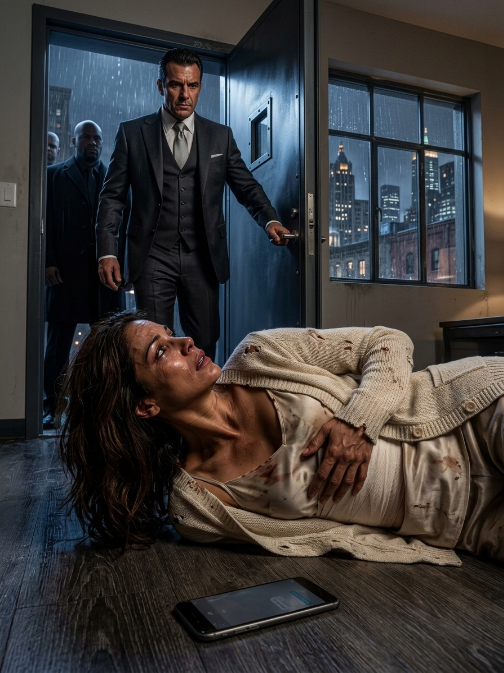
The Mafia Boss Entered the Hospital With His New Lover—Then Saw His Abandoned Woman With Their Child

## PART 1
I have thought about this moment before.
Not this exact version of it — not the antiseptic smell, not the fluorescent lights overhead, not Petra shifting restlessly in the chair beside me while I stared at my phone pretending to read words that weren’t registering — but a version. A version where the thing I buried came back up.
It always does, with men like me.
My name is Dorian Falk.
If you live in Chicago and travel in certain circles, you already understand what that name costs. What it buys. The kind of loyalty it generates, the kind of fear it sustains, the silence it purchases from men who would otherwise ask too many questions.
I was thirty-eight years old, sitting in a hospital VIP lounge with one leg crossed over the other, waiting for Petra Cavallo’s gastroenterologist to finish confirming what her own nutritionist had already suspected. The room smelled of lilies and recycled air. A television in the corner played a cooking competition on mute. Two of my men stood outside the glass doors in dark jackets, watching the corridor with the practiced stillness of expensive security.
Petra was the reason I was here.
Not because I loved her. Not anymore. But her father was Felix Cavallo, and men in my position did not neglect the daughters of Felix Cavallo.
“It’s getting worse,” Petra said, pressing her fingers against her abdomen. “Something is actually wrong, Dorian.”
I murmured something that could have been agreement.
I had a two o’clock with three division heads. A land transfer in Pilsen needed my signature by end of day. My attorney had left three messages. The hospital visit was a box on a list — necessary, politically considered, ultimately an inconvenience.
Then the corridor erupted.
Double doors at the far end crashed open. A gurney tore through the hall so fast the nearest nurse had to flatten herself against the wall. Someone in blue scrubs barked into a radio. Another voice called out blood pressure numbers that meant nothing to me.
I looked up, irritated.
Then I stopped breathing entirely.
She lay on that gurney like something broken being rushed back to a place where broken things were sometimes saved. Hair dark and sweat-matted against the pillow. Skin bleached of color. Her fingers clenched the side rail so hard her knuckles had gone white. An oxygen mask fogged and cleared with each shallow breath.
And beneath the hospital blanket, the unmistakable rise of a pregnancy so far along it looked like she had swallowed the entire future.
Nina.
Nina Reyes.
Who had once poured whiskey behind the bar at my club, Vantage, and told me I used too much ice with the calm authority of someone who didn’t know or didn’t care whose empire she was working inside.
Who had read crime fiction on her breaks and sang under her breath when she thought the kitchen wasn’t listening.
Who had cried quietly the night I left and turned away so I wouldn’t see.
My phone hit the floor.
I barely heard it.
Because I was doing arithmetic that required no calculator.
Nine months.
The back apartment above Vantage. The last night. The way she had said, *You think leaving is mercy, Dorian. But mercy doesn’t walk out without looking back.*
Nine months.
One answer.
Every cell in my body confirmed it before my mind had the nerve to.
Crane, my closest man, stepped through the doorway and leaned toward me.
“That’s the Vantage bartender,” he said quietly. “You want me to find out where they’re—”
“No.” The word came out before he finished the question. “Nobody touches her. Nobody approaches anyone. Nobody says her name. Stay back.”
Crane blinked. “Boss—”
“Back.”
Petra turned, her discomfort momentarily overtaken by the sharpness in my voice. “Dorian. What is wrong with you?”
I didn’t answer her.
The hydraulic doors sealed behind the gurney with a soft, irreversible sound.
I was on my feet before I registered standing.
The maternity corridor stretched ahead. I moved through it without plan, without calculation, without the armor of deliberate pace I had maintained through twenty years of dangerous rooms. At the central station, a nurse with silver-streaked hair looked up from her screen.
“How can I help you, sir?”
I stopped.
Behind her, monitors blinked. Phones clipped and rang. Beyond doors I could not see through, somewhere in the bright machinery of emergency care, a woman was fighting.
A woman I had abandoned.
With a child I had not known existed.
And I, Dorian Falk — who had made city councilmen choose their words carefully, who had ended negotiations by the weight of a pause, who had never once encountered a problem that money, fear, or controlled violence could not reshape — had absolutely nothing useful to offer.
“Sir?” the nurse repeated.
I opened my mouth.
And said the only truth I had.
“The woman they just brought in. I need to know she’s alive.”
—
## PART 2
The nurse’s name badge said *Patricia*, and she was not afraid of me.
That alone told me something.
“Patient information is confidential,” she said.
“I’m not asking for her chart.”
“You’re asking where she is and whether she’s stable. That is patient information.”
I leaned forward. “I’m family.”
The lie tasted like iron.
Patricia glanced at my left hand. No ring. Then at the men behind me in the corridor, who I had ordered to the far wall.
“Are you her husband?”
No answer.
“Emergency contact?”
No answer.
“Then I’m sorry.” She looked at her screen. “I cannot help you.”
Petra’s voice cut through the lobby behind me.
“Dorian.”
I didn’t turn.
“Dorian, I know you heard me—”
“Go back to the lounge.”
Silence.
Then her footsteps came anyway.
“The woman on the gurney,” Petra said, arriving beside me with the precision of someone who had learned to read rooms at her father’s knee. “You know her.”
I said nothing.
A younger nurse nearby developed a sudden intense interest in a supply cart.
Petra’s voice went quiet and brittle.
“Of course.”
I looked back at Patricia.
“Please,” I said.
The word sat wrong in my mouth. It always had. Men in my position didn’t say please because they rarely needed to.
Patricia studied me for a long moment.
Then, quietly: “She’s in emergency obstetrics. That’s all I can tell you. You cannot go in unless she authorizes it.”
“Can someone tell her I’m here?”
“When the team has a moment to receive messages.”
“When will that be?”
“When they’re not trying to keep her alive, sir.”
I flinched.
Petra saw it.
“Who is she?” Petra asked.
I turned.
“Not now.”
“You’re trembling.” Her voice was strange. Almost human. “I’ve never seen you tremble.”
I looked at the doors again.
Then Petra stepped closer and said, very quietly, “Is it yours?”
The corridor held its breath.
I turned to face her.
Her eyes held something I recognized: not just jealousy, but knowledge. The particular gleam of someone who has been watching a secret long enough to recognize its shape.
“Petra,” I said carefully. “What do you know?”
Her mouth tightened.
“My father said you had no attachments.” She said it too quickly.
I went still.
Because those words were not a denial.
They were an admission.
“What did Felix know about Nina?” I asked.
Petra looked away.
“Petra.”
“He knew enough,” she said.
The world narrowed to those two words.
*Enough.*
Nine months ago, Nina had appeared in my doorway with two packed bags and eyes like something already decided. She had said: *They know about me. It doesn’t matter who. Because you won’t choose me over them anyway.*
I had thought she was afraid of my enemies.
I had not asked the right question.
I was asking it now.
“Did your father threaten her?”
Petra’s silence was its own answer.
Before I could press further, a sound came through the maternity doors.
One cry — brief, broken, terrified.
Nina’s voice.
I was already moving.
—
## PART 3
### The Things You Can’t Buy at the Front Desk
Patricia stepped around the nurses’ station to intercept me, and Crane moved to intercept her, not touching, only positioning.
“Please,” she said. Not to me. To Crane. “You’ll make it worse.”
Crane looked at me.
I stopped.
Because she was right.
I had made it worse nine months ago.
A doctor burst through the doors, stripping gloves with efficient violence. He nearly collided with me, looked up, took in the suit, the stillness, the men flanking the corridor.
“Family?”
“Yes.”
He didn’t argue the word.
“Dr. Aldridge. She’s critical — peripartum cardiomyopathy presentation, possible pulmonary edema, severe fetal distress. We’re prepping for emergency cesarean.”
I processed the syllables without fully understanding them.
“Will she—”
“We’re doing everything available.”
“And the baby?”
“Same answer.”
“Can I see her?”
Aldridge hesitated. “She’s conscious, but she asked for no one.”
No one.
I had known that was coming. It still landed wrong.
“Tell her Dorian is here,” I said. “Just that.”
The doctor measured me once more.
Then disappeared back through the doors.
I stood in the corridor and became something I had not been since I was fifteen years old and watching my mother’s coffin lower into November ground.
Patient.
Completely, wretchedly patient.
Petra had gone quiet. Crane had gone still. The hospital moved around us in its particular rhythm of urgency and routine.
Then the doors opened again.
“She’s asking for you,” Aldridge said. “One minute. Nothing that raises her stress.”
I followed him through.
The suite was all light and motion and machinery. Nina lay at the center of it like someone the storm had already reached. Tubes. Monitors. A team of masked faces moving with the focused haste of people who understood exactly how much time cost.
Her eyes were open.
They found me immediately.
Dark. Furious. Terrified. Alive.
I stopped at the bedside.
She pulled the oxygen mask down before anyone could stop her.
“You were in the waiting room,” she said.
“Yes.”
“With her.”
“Yes.”
Anger moved through her face, then grief, then something more complicated.
“Don’t tell me it isn’t what I think.”
“I won’t.”
She breathed through the pain.
“Then why are you here?”
“Because I should have stayed before.”
Nina looked at me for a long moment.
“That’s not an answer, Dorian.”
“It’s the truest one I have.”
Her fingers found the blanket over her stomach.
“The baby,” she whispered.
“I know.”
“You don’t know anything yet.” Her voice frayed at the edges. “I tried to tell you. After you left, I tried. Came to Vantage three weeks later.”
My chest tightened.
“You weren’t there.” She swallowed hard. “But one of Cavallo’s men was. He told me—” Her breathing stuttered. “He said if I kept it, if I told you, Felix would pull my mother’s treatment. He knew everything. The clinic. The bills. The address.”
The machines beeped faster.
Aldridge touched my arm.
“Don’t,” Nina breathed. “Don’t become them in here.”
The words stopped me harder than any hand could have.
I nodded.
The mask went back over her face.
She found my sleeve with three fingers.
I bent close.
“If I don’t come through,” she whispered through the plastic, “her name is Calla.”
Her.
A daughter.
Nina’s grip tightened.
“And she is not yours to command.”
“No,” I said. “She isn’t.”
She searched my face.
Maybe she didn’t find the lie.
Maybe she just ran out of time.
Her hand fell.
They pushed the bed toward the OR.
Her eyes stayed on me until the doors closed.
I stood in the empty, too-bright room and felt the shape of everything I had refused to see.
—
### What Felix Knew
When I returned to the corridor, Petra was standing.
Her face was different now. The performance of anger had collapsed, leaving something more honest underneath.
“What did she say?” she asked.
I walked past her.
“Dorian.”
I stopped.
“You can’t do anything reckless,” Petra said. “Not against my father. You need to think.”
I turned.
“My daughter may be dying behind that door because Felix threatened her mother into silence for nine months.”
Petra’s face went bloodless. “Your daughter?”
“Yes.”
Something fractured in her expression, was quickly papered over.
“You don’t know that.”
I looked at her until she had to look away.
Crane appeared at my shoulder.
I held out my hand. He understood.
He placed Petra’s phone in my palm.
“Unlock it,” I said.
“No.”
“Unlock it, or I call your father from my phone and tell him you refused while my child is in surgery. Then I let him wonder what that means.”
Petra’s hand shook as she took it back.
She unlocked it.
I opened her recent calls.
Felix Cavallo. Four times before noon.
Then a text thread.
She reached for the phone.
Crane caught her wrist.
I read.
*Is she there?*
*Confirmed. He’s with me.*
*Keep him occupied. Complications can happen.*
The last line sat there clean and certain.
*Complications can happen.*
The corridor went cold.
I showed Petra the screen.
She said, barely audible, “I didn’t send that reply.”
I scrolled.
No reply sent.
But she had come here with me anyway.
“He told me to come,” she whispered. “He said he just wanted to know if she was really pregnant. He said it was only—” She stopped. “I didn’t think he meant—”
“Yes,” I said. “You did.”
Her eyes filled.
“Not this,” she said. “I didn’t think he would go this far.”
I handed the phone to Crane. “Copy everything. Get it to Hadley.” Hadley was my attorney and the only person who had regularly talked me out of choices I would have regretted. “Then secure Petra somewhere private.”
Petra’s chin came up. “You can’t—”
“Your father sent a message about surgical complications while my child is under a knife.” I stepped close. “We are no longer in the vocabulary of insult.”
Crane led her away.
She didn’t scream.
Women raised in rooms like hers knew when screaming weakened them.
I turned back to the maternity doors.
—
### The Doctor Who Noticed
Forty minutes later, Hadley arrived.
Elliot Hadley was my attorney, my counselor, and the closest I had ever come to a friend, though we had never used that word and likely never would. He moved through emergency with the composure of a man who had spent decades managing other people’s catastrophes.
“Crane sent me the texts,” he said.
“And?”
“Cavallo doesn’t move on a hospital unless he has an inside mechanism.” He kept his voice low, hospital-normal. “Someone with access. I’m already running vendor records, staff changes, recent hires connected to Cavallo business.”
My eyes stayed on the doors.
“She’s still in there.”
“I know.”
A beat.
“And the baby?”
“Also still in there.”
Hadley studied me.
“You’re terrified,” he said, with the mild surprise of a man who had thought himself done being surprised by me.
“Yes.”
“Good. Stay terrified. It’ll keep you from storming an operating room.”
I almost told him what Petra’s message had said about complications.
Before I could, a woman in navy scrubs broke from a side corridor, moving too quickly for the general pace of the floor.
She was heading toward surgical prep.
Hadley caught it.
“That’s not standard movement,” he said quietly.
Crane materialized at my shoulder. He had the eyes of a man who made his living reading rooms.
“She badged in from the staffing pool,” he said. “Replacement anesthesia technician. I ran the agency. Records were altered yesterday afternoon.”
I looked at Hadley.
Hadley pulled out his phone. “I have a cardiology contact on staff. I’ll route through her. Clean. No panic.”
“How long?”
“Faster than you’d like it to be slower.”
Three minutes passed like three hours.
Then an alarm.
Not loud from the corridor — muffled through walls — but unmistakable.
A rapid electronic cry.
The sound a machine makes when it stops trusting what a body is doing.
Mara Holloway — Nina’s mother, who had arrived during those terrible forty minutes, who had slapped me across the face so hard the corridor went silent, who had looked at my expensive coat and said *men like you think grief has a front desk* — stood and covered her mouth.
A woman in scrubs burst through the maternity doors.
Moving too fast.
Wrong direction.
She saw Crane and changed her trajectory toward the stairwell.
I was faster.
Six strides.
The woman hit the wall before she reached the door.
A scalpel in her hand, turned toward me.
I caught her wrist.
We strained for one terrible second.
Crane hit her from the left and drove her to the floor.
“Boss,” Crane said, breathless. “Let go.”
I didn’t.
“What did you do?” I asked.
She spit blood. “Ask Cavallo.”
I knelt.
“What did you do?”
She laughed. “She wasn’t the target.”
Crane’s face darkened.
“Then what was?” I asked.
Her eyes were strange. Distant. Already somewhere else.
“The baby.”
Hadley said, “Christ,” under his breath.
Hospital security swarmed in.
I released her and turned toward the doors.
The alarm had stopped.
That was worse.
Silence after an alarm is not peace.
It is either relief or something much larger.
—
### The Name She Was Given
Dr. Aldridge came through the doors with stains on his surgical gown and eyes too tired to be performing anything.
Mara grabbed the wall.
I could not move.
“The baby is alive,” Aldridge said.
Mara sobbed.
My knees nearly went.
“A girl. Small, stressed, but stable. NICU team has her.”
Calla.
Her name was Calla.
The relief lasted four seconds.
Then Aldridge’s expression changed.
“Nina went into cardiac arrest during delivery.” He spoke with the careful precision of a man who understood how much weight words could carry. “We brought her back.”
Mara made a sound I will carry the rest of my life.
“She’s on advanced cardiac support. The next twenty-four hours are critical.”
I tried to speak.
“There was an incident,” Aldridge continued. “A medication syringe was found mislabeled. One of our nurses caught it before administration. If she hadn’t—”
He stopped.
We all understood the end of the sentence.
“Can I see the baby?” I asked.
Mara turned on me instantly. “No.”
I looked at her.
She had every right.
“No,” she said again. “You don’t get to walk in there and claim her because tonight you feel things.”
Aldridge said, gently, “NICU access will follow Ms. Reyes’s designated contacts. She named her mother.”
“Of course,” I said.
Mara stared at me.
As if surprised I didn’t argue.
As if she had been bracing for the version of me she expected.
“Her name,” I said, “is Calla.”
Mara’s face crumpled. “I know,” she whispered. “Nina told me.”
She turned away before I could see more.
—
### What the Texts Didn’t Say
Crane found Hadley and me by the window at the end of the corridor an hour later.
“The technician’s in custody,” he said. “But there’s a problem.”
Hadley said, “How large?”
“She’s a contractor. Cavallo-adjacent but with enough separation that direct connection needs time to prove.”
“Which means?”
“Cavallo’s been calling Petra every twenty minutes. And one of his men was seen in the hospital parking structure thirty minutes ago.”
I looked at Chicago through the glass.
The city glittered below, indifferent as it always was. Somewhere inside this building, my daughter lay in an incubator under blue light with lungs the size of closed fists, fighting a war that had started before she had any say in it.
“Find the parking structure contact,” I said. “And every connection between him and what happened in that OR.”
“Quietly?” Hadley asked.
“Loudly,” I said. “I want Cavallo to know I know.”
Hadley went still. “That invites escalation.”
“Yes.”
“Dorian—”
“He tried to kill my daughter.” I turned from the window. “Quiet is over.”
Hadley studied me for a long moment.
Then he nodded.
Because he understood that some lines, once crossed, change the mathematics of everything.
—
### The Woman in the Bed
She woke during the quiet hours before dawn.
Mara found me in the corridor and said it the way you say things when they cost something.
“She’s awake. She asked for you.”
Mara stepped into my path.
“You listen first,” she said. “She is weak and frightened and she has been fighting alone for nine months. You will not bring violence into her room. You will not promise what you will not keep. And you will not make that child a piece of territory.”
I looked down at her.
“I understand.”
Mara’s eyes searched me.
“I don’t think you do,” she said. “But tonight maybe you can pretend well enough.”
Nina lay beneath low lights with tubes marking time against her skin. Without the weight of the pregnancy, she looked stripped of something — not smaller, but exposed. Breakable in ways I had refused to see before.
I stopped in the doorway.
Her eyes opened.
Drifted.
Found me.
“You stayed,” she whispered.
“Yes.”
“Why?”
“Because I should have nine months ago.”
Her mouth softened at the edges.
“That still isn’t an answer.”
“It’s the only honest one I have left.”
She was quiet.
Then: “Calla?”
“Alive. NICU. Stable.”
Nina closed her eyes.
A tear moved across her temple into her hair.
“Is she—”
“She’s beautiful,” I said. “She has your stubbornness. I could see it from across the glass.”
Nina almost laughed.
Almost.
Then she looked at me with something older in her eyes.
“I need to tell you something,” she said. “About the second person.”
I went very still.
“What second person?”
Her breathing changed — faster, shallower.
The monitor reacted.
I leaned close without touching her.
“Take your time.”
Nina swallowed. “After Cavallo’s man threatened me, someone else came.” She paused. “Older. A burn scar on one side of his face. Silver ring. He said—” another pause, “—he said Cavallo was only the beginning.”
Mara appeared in the doorway.
Nina’s grip on the blanket tightened.
“He knew your real name.”
The room contracted.
I had one real name.
Not Dorian Falk — that name I had built, layer by layer, over twenty years.
The name I had been born under.
The name that existed only in sealed records, one lawyer’s memory, and my own.
“He said your mother hid something,” Nina whispered. “He said if you had a daughter—”
The monitor screamed.
Nurses rushed in.
I was pushed back.
Mara cried out.
The room filled with urgent hands, and Nina disappeared beneath the motion.
Hadley caught my arm in the corridor.
“What did she say?”
I looked at him.
“She said someone knew my birth name,” I said.
Hadley’s face went white.
“No.”
“A burned man. Silver ring.”
The name we were both thinking moved between us without being spoken.
Then my phone vibrated.
Unknown number.
I opened it.
A photograph.
The NICU, shot from above through the observation glass.
Calla. In her incubator. Visible under the soft blue lamp.
Six words beneath the image:
*Your father’s sins find their daughters.*
Then the lights in the NICU wing went out.
—
### The Dark and What It Held
Not a flicker.
Not a malfunction.
Gone.
The entire NICU corridor went black for the three seconds it took emergency lighting to kick on — and those three seconds were the longest of my life.
Red. Low. Wrong color for a place that needed precision.
Mara screamed Calla’s name.
I was already running.
Crane materialized from the far end of the hall.
“NICU,” I said.
“I’ve got men there.”
“Past tense,” I said.
He understood immediately.
The NICU doors were locked — badge system showing error, power interruption scrambling the sequence. A nurse stood outside pressing her card against the scanner over and over like repetition could change what was happening.
I shoved through the emergency release panel.
Nothing.
Crane and two men drove a supply cart against the frame.
Once.
Twice.
Third time the doors gave.
Inside, the emergency lights painted everything amber. Incubators hummed on backup power. Nurses were at every station, checking lines, monitoring oxygen, talking their tiny patients through a blackout these infants had no language for.
I crossed to the glass station nearest the window.
Calla’s incubator.
Empty.
The door hung open.
A name card fluttered.
*REYES, BABY GIRL.*
I stood there for a moment that lasted longer than moments should.
“She was here,” a nurse said, her voice fractured. “Transport scrubs. I thought — there was a badge, I thought it was authorized—”
“Which way?” Crane asked.
She pointed to the service corridor.
“Dorian.” Hadley’s voice was sharp. “Don’t run blind. This was designed to make you run blind.”
“My daughter is gone.”
“And whoever took her knew exactly which version of you to expect.” He lowered his voice. “Think past the anger. A man who knew your birth name, who planned a power outage, who had someone inside this OR — that is an architect, not a thug.”
Mara was weeping behind me.
From the cardiac ICU, distantly, a monitor alarm fired and cut off.
Two impossible places.
One body.
Crane’s phone lit. He looked at it. “Message, unknown number.”
I held out my hand.
He gave it to me.
A video.
I pressed play.
Calla, inside a portable neonatal carrier, wrapped in a pale blanket, oxygen tube in place. A gloved hand adjusted the fabric with disturbing gentleness.
Then a voice.
Old. Amused. Patient in the way of men who have never needed to hurry.
*Hello, Dorian. Or should I say: Callum Hale.*
Hadley closed his eyes.
*Your father made a debt he couldn’t settle. You inherited it without knowing. And now you’ve given me something extraordinary — a daughter. Proof of line. The key he wouldn’t hand over.*
The voice paused.
*St. Clement’s, below the old rectory. Come the way your father should have come: alone, and honest.*
The video ended.
Mara looked at me with terror and fury braided into something beyond either.
“Who are you?” she whispered. “What have you done to my family?”
I had no answer that was fair or fast enough.
A nurse ran toward us from the ICU.
“Mr. Falk. Ms. Reyes is crashing again—”
Two places.
One body.
Hadley looked at me.
And said the thing I needed someone else to say.
“Go to Nina. I will find Calla.”
I stared at him.
“He wants you to choose,” Hadley said. “He wants you running toward Calla blind while Nina dies behind you. Don’t give him the full picture.”
I held out my phone.
He took it.
“Find the rectory route,” I said.
“I will.”
“And Hadley.”
“Yes.”
“If Calla’s oxygen—”
“She won’t stop breathing.” He said it with the conviction of a man who understood that some statements have to be made true by being said.
I turned and ran back to Nina.
—
### The Ledger That Lived in a Lullaby
Nina was barely there when I reached her.
Blue at the lips. Lashes motionless. The team around her moved with the fierce concentration of people who understood exactly how close the margins were.
Mara pressed both hands to the glass.
I stood in the doorway because there was nowhere for me to stand that would help.
Useless.
I had built everything I owned to avoid that word.
Here it was again.
Dr. Aldridge looked up. “Pressure responding. Barely.”
I exhaled for the first time in minutes.
Mara turned on me. “Where is Calla?”
“Hadley is working on it.”
Her face shifted into something I didn’t have language for.
“You let someone else find her?”
“Yes.”
She searched my face for the lie.
Found none.
Then Hadley appeared at the far end of the corridor.
His expression was different.
Complicated.
“Tell me,” I said.
He looked at Mara, then Nina’s room, then back at me.
“The man on the video. The burned scar, the ring.” He kept his voice low. “His name is Aldous Crane — no relation to yours.” A glance at my bodyguard. “He was your father’s financial strategist before your father died.”
I stared at him.
“My father had no strategist. He ran alone.”
“He ran what you could see.” Hadley held my gaze. “Your father’s real organization was not money laundering. It wasn’t protection. It was older and worse.”
The corridor felt smaller.
“Children,” Hadley said quietly. “Private transport. Undocumented. Runaways. People with no one to notice. Your father’s network was the infrastructure. Aldous was the architect.”
I heard the words.
I did not let myself feel them yet.
“My mother?”
Hadley’s jaw tightened.
“She was the one who found the records. She copied everything — names, buyers, police contacts, judges. She hid the evidence before they could stop her.”
“Before they killed her,” I said.
Hadley didn’t contradict me.
“She hid the access key in—” He stopped. “This is where it becomes extraordinary. She hid it in a song.”
I went very still.
“A lullaby,” Hadley said. “Encoded, distributed across recordings and memory. The full sequence required her voice, the melody, and a phrase only someone who had heard her sing it would know.”
The room tilted.
I thought of Nina’s mother.
Of Mara, who had arrived in her faded coat and slapped me across the face and looked at me with more clear-eyed fury than anyone I had ever faced across a table.
“Mara,” I said.
Hadley looked at me.
“Nina had recordings,” I said. “In the Vantage apartment. Old recordings. She played them sometimes on Sunday mornings when she thought I was asleep.” I looked toward the door where Mara stood. “Mara would have heard them too.”
Hadley was already moving.
And Nina’s eyes were opening.
I went back to her bedside.
“You’re still here,” she whispered.
“Yes.”
“Calla—”
“We’re getting her back.” I took her hand because she didn’t pull away. “I need to ask you something. The recordings in the apartment. My mother’s voice.”
Nina looked at me.
“You knew,” I said.
“I suspected.” Her voice was barely there. “The burned man — Aldous — he told me the lullaby mattered. He told me Calla would carry the key. He said that was why she had to disappear.”
“But you didn’t tell him the melody.”
Her eyes steadied.
“No,” she said. “I told your mother’s secret to the person who should have always had it.”
“Mara.”
Nina’s fingers tightened in mine.
“Your mother hid it for someone who would use it to end this,” she whispered. “Not to protect a crime family’s ledger. To expose one.”
The corridor door opened.
Mara stood in the frame.
In her hand: a phone with a recording playing.
A woman’s voice, low and unhurried, singing something I had heard once and never remembered clearly because I had been three years old.
My mother’s voice.
I closed my eyes.
Hadley had his phone to his ear. Talking fast, low, to someone at the federal task force he had been quietly cultivating for two years.
The evidence my mother had died to protect was finally walking into daylight.
—
### What Happens Below the Rectory
St. Clement’s rectory burned ten years ago.
The shell remained — brick and ash, boarded windows, a fence the neighborhood children had learned to navigate. Someone had cut the chain-link cleanly.
I came alone.
I looked alone.
Hadley had spent twenty minutes making very clear that this was designed to isolate me, and another ten minutes establishing backup positions with enough subtlety that Aldous’s team would not see them until it was too late.
Inside, beneath the rectory through a door hidden behind collapsed shelving, a passage ran toward foundations old enough to predate the building above them. Electric lamps had been run along the brick. At the bottom, the passage opened into a room.
And in the room, inside a portable incubator, lay Calla.
Alive.
Impossibly small.
Her fingers opened and closed against her blanket like she was practicing something.
I stopped.
Every carefully maintained surface in me broke straight down.
“Remarkable,” said Aldous, from across the room. “I assumed your type didn’t feel this particular wound.”
I looked at him.
He was older than I’d imagined from Nina’s description. A burn scar pulled one side of his face into a permanent expression of mild amusement. Silver ring on his right hand.
Alive, despite the funeral I had been told to believe in.
“Give me my daughter,” I said.
“In a moment.” He gestured toward the rows of sealed boxes. “Your mother spent a long time assembling something that was going to destroy a great many important people. I would like it returned.”
“You want the ledger.”
“I want the key.”
“The key,” I said, “was never in Calla’s blood.”
He smiled faintly.
“No,” I continued. “My mother was smarter than that. She hid it in something you’d never search because you thought it was worthless.” I watched his face. “She hid it in a song.”
Aldous went very still.
“A lullaby,” I said. “Which Mara Holloway just finished recording for federal investigators, along with the phrase that completes the sequence.”
The stillness became something else.
Rage, perfectly controlled, which was somehow worse.
“You’re lying.”
“My mother died for the truth,” I said. “I don’t have the talent for it.”
Aldous reached into his coat.
A door behind him opened.
Petra Cavallo stepped through.
I stared.
She looked terrible — gray-faced, bandaged at the side from a wound I hadn’t known she’d received, moving with the careful hesitation of someone in pain. But she was standing.
And in her hand was her father’s gun.
She pointed it at Aldous.
“Where is Felix?” I asked.
Petra looked at me with red-rimmed eyes.
“He’s with federal agents,” she said. “He’s talking.”
“Why?”
“Because I told him that if he didn’t, I would give them the texts myself.” She swallowed. “He protected me by giving up everything else.”
Aldous laughed softly. “Cavallo. Still saving his own skin.”
Petra’s gun hand shook.
“You used my father’s access to get into that hospital,” she said to Aldous. “You used his accounts. You nearly killed an infant.”
“Your father would have let the mother disappear if it kept his alliance intact,” Aldous said. “We are not so different.”
“Yes,” Petra said. “We are.”
She fired.
The shot hit the shelves above Aldous’s head, deliberately.
Aldous flinched.
I moved.
I crossed to Calla’s carrier in four steps, checked her oxygen — stable, temperature low but manageable — and lifted her with both hands.
She was so light I nearly didn’t trust my own arms.
Her eyes opened, unfocused and furious.
The most beautiful thing I had ever seen.
From the passage behind us, Crane’s voice thundered.
“Down!”
Aldous moved for a secondary exit.
Crane hit him from the left.
Hadley came through the passage with federal agents on both sides.
Aldous was on the floor.
I stood in the middle of the room holding my daughter while the evidence of a thirty-year crime was catalogued around me by people whose job it was to put such things in daylight.
Aldous looked up at me from the floor with eyes still calculating.
“You won’t finish it,” he said. “Men like your father never finish it.”
I looked at him.
“I’m not my father,” I said.
I walked out carrying Calla.
—
### The Heart That Kept Going
The sun was coming up over Chicago when I returned to Northwestern Memorial.
Pale gold. The kind of morning that pretends the night didn’t happen.
Mara saw Calla first.
She made the sound of someone returning from somewhere very far away.
The NICU team received Calla in the doorway — checking, adjusting, warming — and Mara’s hand pressed flat against the glass as they moved inside.
Aldridge appeared at my shoulder.
“She’s cold but stable,” he said after several minutes that felt like geological time. “She’s going to be all right.”
I looked toward Brin’s ward.
“Nina?”
Aldridge’s face moved through several things.
“Awake,” he said. “Stable. Asking for the baby.”
I followed him.
Nina turned her head when I entered.
“Calla,” she breathed.
“She’s here. She’s safe.”
Nina covered her face with both hands.
I sat in the chair beside the bed and said nothing until she was ready.
When she looked up, her eyes were red.
“You went alone,” she said.
“I looked alone.”
She almost smiled.
“Tell me.”
I told her.
All of it — Aldous, the passage, the evidence, Petra, Cavallo’s testimony.
When I finished, Nina was quiet for a long moment.
“Your mother,” she said.
“Yes.”
“She hid the truth for someone who would use it right.”
“Yes.”
“She was protecting you.”
“She was protecting every child who came after,” I said. “I just happened to be one of them.”
Nina looked at her hands.
“What happens now?” she asked.
“There will be investigations. My name will appear in things I’d prefer it didn’t.” I looked at her. “My empire is already cracking. I’m making it crack faster.”
Nina stared at me.
“Why?”
“Because Calla will ask me one day what I did with my life. And I’d like the answer to be something she can say aloud.”
Silence.
“That’s not who you were,” Nina said carefully.
“No,” I said. “It isn’t.”
Her expression was wary and considering.
“One night doesn’t make a person new.”
“I know.”
“I’m not going to forgive you because you had a heroic crisis.”
“I’m not asking for forgiveness,” I said. “I’m asking for a different conversation.”
She looked at me for a long time.
“What kind of different?”
“The kind where I’m allowed to try.”
Mara appeared in the doorway.
She looked between us.
Then at me specifically.
“Calla wants her father,” she said.
Nina raised one eyebrow. “She’s three days old.”
Mara shrugged. “She has opinions.”
I looked at Nina.
She looked at me.
“Go,” she said.
I stood.
At the door, I stopped.
“Nina.”
She waited.
“When I left,” I said, “I told myself it was protection. That keeping you away from my world was the kindest thing I could give you.”
Her jaw tightened.
“But you were right,” I said. “Mercy doesn’t walk out. It stays and figures out how to make something safe for the people it loves.”
Nina looked away.
Then, quietly: “Go see your daughter.”
I went.
—
### The Man Who Knocked
Six months later.
A small town by the water, two hours from Chicago.
Calla had discovered she had opinions about mornings. She expressed them loudly, with clarity, at whatever hour she decided was reasonable, which was never the hour anyone else had agreed on.
Nina had found a house with good light and a garden that needed more work than she had the energy for and did it anyway because the stubbornness was, apparently, genetic.
Mara lived five minutes away and showed up most days with something from the market and an opinion about the garden.
Hadley visited on alternate weeks and complained about the coffee.
Crane appeared every Thursday under the pretense of security review and stayed two hours past the point of any professional justification, helplessly devoted to Calla in the particular way of large men who believe no one notices their soft spots.
I rented a place down the road.
Not in the house.
Not yet.
Every morning, I walked to Nina’s porch with coffee or formula or something Mara had mentioned wanting.
Every morning, I knocked.
Even after Nina gave me a key.
Especially after.
Because there was a difference between having access and being welcomed.
I was learning the difference.
One afternoon in spring, Calla was in the garden strapped to my chest in a carrier, making sounds at the birds that were functionally criticisms, while I attempted to assemble a vegetable planter under Mara’s supervision.
“You’re building it backward,” Mara said.
“The instructions indicate otherwise.”
“The instructions are decorative.”
Nina appeared at the back door with two mugs, looking at us with an expression I had started to recognize.
The one she used when she caught herself being happy and hadn’t decided how she felt about it yet.
“You look terrified,” she said, handing me a mug.
“Your mother has declared a unilateral war on the instructions.”
“Good,” Nina said. “They were always wrong.”
Mara made a sound of vindication and took Calla from the carrier with practiced ease.
Calla regarded her grandmother with deep satisfaction.
Nina stayed beside me while the afternoon moved.
After a while, she said, “Aldous was sentenced.”
“I know. Hadley told me.”
“Life.”
“Yes.”
“You didn’t want it to be death.”
“I wanted him to live long enough to read every name in that ledger in a newspaper.”
Nina looked at her garden.
“And Felix?”
“Cooperating. Petra went with him.”
“Do you forgive her?”
I considered it honestly.
“She stepped in front of a bullet to keep Aldous from silencing Calla,” I said. “I don’t know what I call that. But I call it something.”
Nina nodded.
Then she said, very quietly: “I’m not ready.”
I looked at her.
“For things to be what they were.”
“They won’t be what they were,” I said. “I don’t want what they were.”
“Then what do you want?”
I reached into my coat pocket.
No ring. No box. No gesture calibrated to impress.
Just a folded piece of paper.
I held it out.
Nina took it.
She opened it slowly.
A custody agreement.
Not filed. Not binding without her signature.
I had signed my portion granting her full legal authority over every decision regarding Calla, with my access made contingent on her consent until Calla was old enough to speak for herself.
Nina stared at it for a long time.
“You’re giving her to me,” she said.
“She was never mine to give.”
Her vision blurred.
“Then what is this?”
“It’s me, saying: I know I don’t have a right to ask for anything.” I held her gaze. “But I’m asking. For the chance to be someone she can rely on. Someone who knocks before entering. Someone who shows up and stays.”
Nina looked at the paper.
At the garden.
At Mara bouncing Calla across the yard, both of them narrating something to the birds.
At me.
“Some mornings,” she said, “I wake up angry at you.”
“Good.”
“Some nights I remember being alone in that apartment and I hate the version of you that left.”
“You should.”
“And some mornings I see you standing outside waiting to be let in,” she said, voice unsteady, “and I think—I think people don’t become different all at once.”
“No,” I said. “They don’t.”
She folded the paper against her chest.
“But they can stay,” she whispered.
I looked at her.
She held out the key to the house.
I stared at it.
“You already gave me one.”
“This time,” she said, “I’m giving it to you without being afraid.”
I closed my hand around it.
Calla shrieked with delight across the garden.
Mara called, “She wants her father!”
Nina raised an eyebrow.
“She has very specific opinions,” I said.
“Terrifyingly specific,” Nina agreed.
I laughed.
A real laugh — the kind I had forgotten I was capable of, the kind Nina used to say was the only honest thing about me.
She took my hand.
We walked toward the garden.
Toward Calla, who had no patience for symbolism but plenty of opinions about being held.
Toward Mara, who would never fully forgive me and would make excellent coffee anyway.
Toward the quiet, persistent, deeply inconvenient work of staying.
Calla reached for me the moment I was close enough.
All trust. No memory. No ledger.
Just a small person who had decided, in the uncomplicated way of very small people, that I was someone worth holding onto.
I held on back.
And here is what Chicago never printed:
That the man who controlled its shadows did not die defending them.
That the woman who nearly died in a hospital corridor did not become a tragedy.
That the child born under threat grew up under morning light, with a father who knocked before entering every room, who attended every recital, who never once left without saying when he would return.
And whenever Calla asked — years later, with her mother’s eyes and her father’s stubbornness — why he always knocked even though he had a key, Nina would look up from whatever she was reading and say:
“Because the bravest thing your father ever learned was how to ask to be let in.”
**THE END.**
—
—