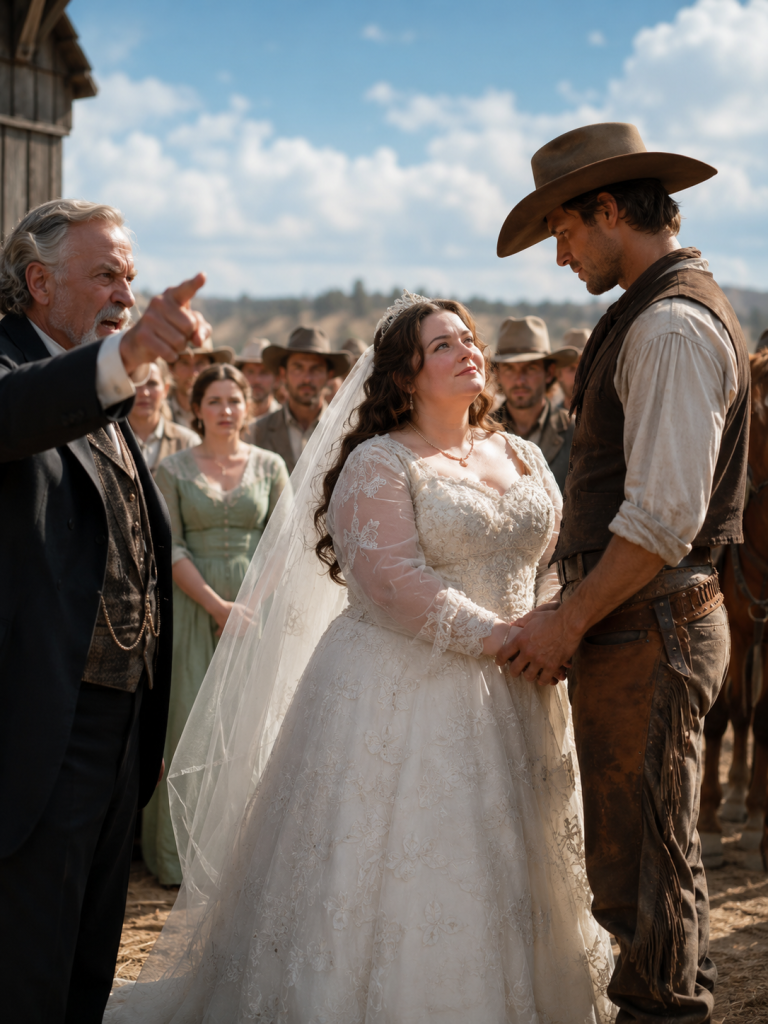
The Duke Forced the Maid Onto His Wildest Stallion to Break Her Pride—But When the Beast Knelt Before Her, the Whole Court Saw Who Truly Held Power.

Part 1
The Duke of Thornfield seized Margaret Wren by the elbow before she’d finished rising from her curtsy and marched her across the upper yard toward the stallion that had broken three grooms since Easter.
She didn’t pull away. Didn’t protest. She allowed herself to be led over the pale gravel with her back straight and her face composed, past the dairy maids standing open-mouthed near the scullery steps, past Mr. Thistlewood, the head groom, whose hand had frozen around a halter rope, past the boy sent to sweep the yard who now held his broom against his chest like a shield.
Margaret’s plain gray dress was wet to the knee from morning grass. Her white apron strings bore three stitched repairs. A loose strand of pale gold hair had escaped its pin near her temple. She was twenty-six, ivory-skinned, travel-worn, dressed like a housemaid who understood floors, grates, polish, and silence.
She did not look like a woman about to be humbled.
She looked like a woman calculating which fence she’d clear first.
Specter stood in the center of the yard, black as polished obsidian and nearly seventeen hands at the shoulder, a white star between his eyes like a dropped lantern. He rolled one eye toward them and flattened his ears against his neck. He’d thrown the duke’s best rider at the Easter trials and broken the man’s collarbone in two places. Since then he’d refused saddle, bridle, farrier, and reason in every possible arrangement.
Mr. Thistlewood had spent the past four mornings trying to persuade His Grace to sell the animal to a circus before he killed someone properly.
The Duke of Thornfield stopped beside the stallion and finally released Margaret’s elbow.
“You will mount him,” he said.
Margaret lifted her eyes.
Julian Ashworth, Seventh Duke of Thornfield, was twenty-eight, built like a man who’d spent two hunting seasons in the Highlands and most of the rest of his life outdoors with horses. He wore deep indigo wool, a cream cravat, and the expression of a man who’d slept too little and decided rage counted as judgment. His hair was dark brown, his jaw dangerously fine, his gray eyes gone the color of weather before a storm.
He’d been angry since approximately seven that morning, when his steward reported overhearing a kitchen maid tell a stable boy that the colt called Atlas was developing a throat infection and shouldn’t be worked.
By noon, Atlas had a throat infection.
Julian hadn’t slept. He’d paced his library before dawn, reviewed stable reports, questioned three men who should have noticed the colt’s symptoms, and settled on the conclusion most convenient to his pride: a housemaid had made his stable master, head farrier, and master of horse look foolish. Whatever Margaret Wren was, she would not remain in his household making pronouncements about his animals as though the wisdom of stable boys were hers to govern.
It was not the first time her quiet observations had proven correct, and that was precisely what galled him. Three weeks earlier, she’d mentioned to a footman, who mentioned it to the cook, who eventually let it slip to the steward, that the new bay mare favored her left foreleg ever so slightly when turning. The farrier had dismissed it. A week later the mare had gone properly lame, and the farrier’s reputation, along with Julian’s confidence in his own stable management, had taken a corresponding blow. He had told himself at the time it was coincidence. A lucky guess from a maid who’d grown up around horses, nothing more. But coincidence, repeated often enough, begins to look very much like competence, and competence in a housemaid who had never once been asked her opinion struck Julian, in his sleep-deprived and prideful state, as something dangerously close to insolence.
He’d decided to humble her in the only currency she seemed to understand.
It was not one of his better decisions.
“My lord,” Margaret said.
“You will mount him, Miss Wren, and hold your seat for one full circuit of the yard. At the end of that circuit, you will dismount and tell every soul on this estate that the wisdom of stable boys is no concern of housemaids. Do you understand?”
It was not really a question.
Margaret looked at the stallion, then at the duke. “My lord,” she said again, voice low and quiet, almost gentle, with a clean northern vowel beneath its polish, “if I mount him in this skirt, I will tear it, and the housekeeper will dock my wages.”
“I will pay for the skirt.”
“Then I shall require a leg up, my lord. The stallion is too tall for me to spring.”
Julian stared at her. He’d prepared himself for tears, fainting, anger, refusal, perhaps even a scene. Some small, buried part of him had expected and almost hoped she’d refuse outright, because then he could dismiss her and be done with the matter.
He had not prepared himself for practicalities.
For several seconds he found no sentence to release. At last he set both hands at her waist and lifted her.
Margaret’s hands closed in Specter’s mane as she settled astride him. She didn’t arrange her skirts, because — Julian realized too late — she’d already taken them up neatly beneath her sash. She didn’t reach for the reins, dangling unattached from a snaffle not yet buckled. She didn’t fuss with her seat or brace like a frightened woman.
She simply settled her weight into the small of the great black animal’s back as naturally as if she’d taken a chair by the kitchen fire.
Then she breathed out once, slowly, through her nose.
Specter’s ears came forward.
A sound moved through the gathered servants, too small to be called a gasp and too unified to be accidental.
Margaret leaned almost imperceptibly toward the stallion’s right shoulder. Specter turned. Then he walked — the perimeter of the upper yard, at a measured pace any drilling sergeant would have admired, his great neck arched, his ears flicking back and forth, attending not to shouting that never came, not to spur or rein, but to the quiet rhythm of the woman on his back.
Margaret clicked her tongue once at the cobbles. Specter lifted into a long-paced trot. She closed her left knee a fraction tighter. He balanced. She drew the smallest breath. He halted directly before the duke’s boots, lowered his head, and breathed warmly into Julian Ashworth’s lapel.
Margaret slid down. Her skirt hadn’t torn. She handed Julian the strand of mane she’d been holding the way a child might hand a tame rabbit to its mother.
“My lord,” she said, “I beg leave to return to my duties. The first floor still wants polishing, and Cook will be looking for me at half past.”
She curtsied, then walked back toward the kitchen door, exactly as straight-backed as she’d walked out.
The Duke of Thornfield stood in the cold spring sunshine with the breath of his unridable stallion soft on his cravat and watched her go. The burning sensation beneath his collar was no longer anger. At that moment, he could not have named what it had become.
Mr. Thistlewood found his voice first. “Would Your Grace like the stallion put up?”
Part 2
Julian did not answer at once. His eyes stayed fixed on the kitchen door, as though the answer to a question he’d never thought to ask had quietly walked away carrying a polishing bucket. Specter nudged his shoulder — not demanded, not impatient, simply waited.
For six weeks the animal had bitten stable hands, shattered fences, snapped halters, refused every rider placed on his back. Now he stood as still as a church carving.
“Put him away,” Julian said quietly.
“Your Grace?”
“Carefully.”
Mr. Thistlewood approached with the caution of a man expecting to lose a finger. Margaret hadn’t even bothered removing the rope looped loosely around Specter’s neck. The groom lifted it; the stallion followed without resistance. Silence spread across the yard. No one dared speak until both horse and groom had disappeared into the stable. Only then did the whispers begin.
That afternoon, Julian summoned Mrs. Caldwell, the housekeeper.
“How long has Miss Wren worked here?”
“Six months, Your Grace.”
“Where did she come from?”
“A recommendation from the north. Her references were unusual — signed by three different estates.”
“Why would a maid need references from three households?”
“Because she never remained long. Not dismissed — they all attempted to promote her. One wished her overseeing the breeding mares. Another wanted her managing the hunting stables. The third offered assistant stable master.”
“And she refused every one?”
“Every one. She always said the same thing: ‘I was hired to clean houses, not embarrass gentlemen.'”
Julian rode to the stables before sunset and found Mr. Thistlewood brushing Specter, the impossible stallion leaning happily into it.
“Explain.”
“I suppose I must. I knew — suspected, rather. I allowed Your Grace to make a fool of himself. No,” the old groom corrected himself, continuing his brushing, “I merely failed to stop you.”
“Who is Margaret Wren?”
Mr. Thistlewood looked toward the stalls before answering. “Not who. Whose daughter.”
Silence. Then: “Her father was Edmund Wren.”
The name struck like lightning. Julian had heard it since childhood — the greatest horse whisperer England had produced in nearly forty years, a man who’d gentled cavalry mounts soldiers declared possessed by devils, the man noble families quietly hired whenever valuable stallions became impossible. Dead almost eight years now.
“And Margaret?”
Mr. Thistlewood smiled. “Usually beside him.”
Part 3
The following morning Julian entered the stable before dawn. Margaret was already there, same gray dress, same repaired apron, sleeves rolled to the elbow. She wasn’t riding or training. She simply stood in Specter’s stall while the enormous horse rested his head against her shoulder like a sleepy child.
Neither noticed him at first. Margaret spoke softly. “I know.” The horse flicked an ear. “You miss him.” Another slow breath. “So do I.”
Julian remained perfectly still. Only after nearly a minute did Margaret notice him and step back immediately. “My lord.”
“You never told anyone.”
“There was nothing to tell.”
“You are Edmund Wren’s daughter.”
“I am.”
“And you became a maid?”
“My father taught horses. My mother taught dignity. When Father died, dignity paid better.”
The words landed harder than accusation. Julian realized something terrible: yesterday he had ordered England’s finest horsewoman onto a stallion to prove she knew nothing about horses.
“Why did you never correct me?” he asked. “Any of the times I spoke of horses as though I understood them better than my own stable hands. You must have known. You must have heard me say a dozen foolish things.”
“It was not my place, my lord.”
“It is exactly your place. More than mine, by every measure that matters.”
Margaret looked at him for a long moment, as though deciding how much honesty the conversation could bear. “My father used to say a man who has never been thrown rarely believes the horse. He believes his own hands instead. I did not correct you because men in your position rarely thank a maid for proving them wrong. I had seen it happen before, at other houses. Better to keep my place and my position than to win an argument and lose my situation.”
“And yet you mounted Specter without complaint.”
“You gave me no choice in that, my lord.”
“I gave you every choice. You could have refused. Could have wept, could have run, could have let me look the fool in front of my own household by failing outright and proving nothing except my own cruelty.”
“I considered it,” Margaret admitted, the faintest smile touching her mouth. “But I find I dislike losing more than I dislike being ordered about. Even on a stallion that had broken a man’s collarbone.”
Julian found himself, despite everything, almost laughing. “My father would have called that admirable stubbornness.”
“My father called it the only inheritance worth having.”
That evening, he did something no Duke of Thornfield had done in over a century. He apologized — not privately, but publicly, assembling every servant in the upper courtyard. Mrs. Caldwell, Mr. Thistlewood, kitchen maids, stable boys, gardeners, footmen, even Cook standing in the doorway with flour still on her hands.
The yard had gone quiet in the particular way a household goes quiet when something unprecedented is clearly about to happen. None of them had ever seen a duke called from his library to address the staff as a body, let alone seen one do it with his jaw set the way a man’s jaw sets when he intends to say something difficult and has decided not to flinch from it.
“I judged one of my household unfairly,” Julian said. “I mistook knowledge for insolence. I mistook humility for weakness.” He turned to Margaret, who looked startled. “Miss Wren. I owe you an apology. I was wrong.”
“My lord, it is forgotten,” she said, lowering her eyes.
“No,” Julian said, shaking his head. “It shall not be forgotten. It shall be corrected.”
He let that statement sit in the cold air a moment, looking out over the assembled faces of people who had served his family for years and decades, some of them since before his own birth. “I would ask further,” he continued, “that every person standing in this yard understand something plainly. Knowledge in this household will be rewarded, regardless of the uniform it wears. I have been a poor steward of that principle. I intend to be a better one.”
Nobody applauded. Nobody dared, in front of a duke delivering what amounted to a confession. But Mrs. Caldwell, standing near the kitchen door, pressed a hand briefly to her chest, and Mr. Thistlewood’s weathered face had gone uncharacteristically soft.
Three days later he offered her the position of Master of the Horse. Margaret refused, exactly as she’d refused every estate before.
“I am comfortable where I am.”
“I expected that answer,” Julian said, almost smiling. “So I have another proposal. You may remain exactly what you wish — a housemaid. But every decision regarding my horses requires your approval first.”
Margaret stared. “You cannot be serious.”
“I have never been more serious.”
She laughed — the first time anyone at Thornfield had heard it. Even Specter lifted his head at the sound.
In the weeks that followed, a strange new rhythm took hold of the estate. Margaret continued her duties exactly as before — the long gallery still needed its windows, the silver still needed polishing, the grates still needed blacking before any guest might see them cold. But each morning, before her regular work began, she walked the stable block from end to end, and grooms who had once rolled their eyes at a housemaid’s opinions now waited for her verdict on a horse’s gait or a feed mixture with something close to reverence.
Julian found himself, more often than he would have admitted to anyone, simply watching her work. There was a particular afternoon in late spring when a new gelding arrived from a breeder in Hampshire, a nervous, narrow-chested bay who shied from every hand that approached him. Three grooms had already failed to so much as halter him properly, and Julian, drawn by the commotion, arrived in the yard to find Margaret standing perfectly still at the rail, simply watching the animal circle and toss his head.
“Well?” Julian asked.
“He was beaten as a yearling,” Margaret said without turning. “Probably by someone in a hurry, not someone cruel by nature, but the horse can’t tell the difference. He doesn’t fear the hand. He fears the speed of it.”
“How do you know that?”
“The same way you’d know a man flinches from a raised voice if he grew up in a house where voices were raised before anything good ever followed. You watch what he flinches from, and you learn what came before you.”
She didn’t approach the gelding that day, not directly. She simply stood at the rail for the better part of an hour, moving nothing but her breathing, until the horse’s circling slowed, then stopped, then brought him three cautious steps closer to the rail of his own accord. Julian stayed the entire hour beside her, saying nothing, and found that he did not mind the silence in the least. It was, he realized later, the first time in years he’d spent an hour in another person’s company without once feeling the need to fill it with conversation.
It was around this same time that the whispers among the staff began to take on a different character. No longer simply astonishment at the maid who’d tamed the unrideable stallion, but something gentler and more knowing — the particular kind of gossip servants reserve for a courtship they can see forming before the two people involved have quite admitted it to themselves. Mrs. Caldwell took to finding reasons for Margaret to deliver messages to the stable yard personally rather than sending a boy. Cook began packing an extra portion into the basket meant for the grooms’ midday meal, on the theory, never stated aloud, that His Grace might find himself there at the right hour.
Julian noticed none of this, or pretended not to, which amounted to the same thing in a household that had learned to read him better than he read himself.
Part 4
Summer arrived with relentless heat. Then came the sickness.
It began among the younger mares — a cough, high fever, loss of appetite. Within days nearly half the breeding stable showed the same symptoms. Veterinarians from three counties examined the horses and offered different treatments, none of which worked. One quietly advised the duke to prepare for heavy losses. Thornfield’s bloodlines had taken generations to build; if the disease spread, everything his family had preserved for nearly two centuries could disappear before autumn.
Julian spent three sleepless nights in the stable himself, watching the mares grow weaker, listening to the rasping cough move from stall to stall like something with its own deliberate intention. He had brought in the finest veterinary minds money could summon from London and Edinburgh both, men with diplomas and instruments and Latin names for everything, and not one of them could agree on so much as a cause, let alone a cure. Mr. Thistlewood aged visibly during those days, the lines around his eyes deepening with every horse that went off its feed.
For the first time in his life, Julian did not summon another expert. He walked directly to the servants’ wing.
Margaret was polishing the long gallery windows. She set down her cloth the instant she saw his face.
“How many are ill?”
“I hadn’t spoken.”
“You didn’t need to.”
Within minutes she was in the stable, examining every horse herself, listening instead of merely looking, smelling the feed, inspecting the water troughs. Then she climbed into the hayloft. Ten minutes later she descended holding a handful of dusty hay.
“There.”
“The hay?”
“No.” She pointed upward. “The roof.”
A cracked beam had let weeks of rainwater seep unnoticed into one corner of the loft. The damp hay had begun growing mold. The horses weren’t suffering from some unknown plague — they were slowly poisoning themselves.
The spoiled hay was cleared out before sunset. Fresh feed arrived overnight. The healthy horses were separated from the sick. One by one, the sick recovered. Not a single mare was lost.
News traveled quickly through neighboring estates. Letters began arriving — prestigious positions, fortunes, one nobleman even promising a house of her own. Margaret declined every one.
Mrs. Caldwell finally asked why.
Margaret only smiled. “I’ve already found the place where I’m needed.”
Part 5
Months passed. The first snowfall covered Thornfield in silver. The estate had grown around its new arrangement so naturally that few of the staff could any longer remember a time when the duke made decisions about his stables without first walking to the servants’ wing to ask Margaret’s opinion. The neighboring estates had stopped sending their flattering letters, having long since accepted that whatever Margaret Wren’s price was, it could not be paid in titles or fortune. What they didn’t yet know, though several of the older servants at Thornfield had begun to suspect, was that her price had quietly stopped being about positions at all.
On Christmas Eve, Julian asked Margaret to walk with him through the quiet stable yard, Specter following behind them like an oversized dog.
The snow had settled thick and undisturbed across the cobbles, broken only by their own footprints and the stallion’s heavier ones trailing behind. Lantern light spilled warm from the stable windows, and somewhere beyond the wall the sound of carolers moved faintly through the village, the kind of distant music that makes a cold night feel less lonely rather than more.
“I have one last offer,” Julian said.
Margaret laughed softly, drawing her shawl tighter. “Another promotion?”
“No.” He stopped beneath the lantern light. “This one concerns only us.” He reached into his coat — not for a title, not for a contract, but for a small velvet box. “I once believed respect came from rank. You taught me it comes from character. I once thought I could command loyalty. You showed me it must be earned.”
He opened the box. Inside rested a simple sapphire ring, the stone catching what little light the lantern offered and turning it deep blue, the color, Margaret thought absurdly, of a stormy sky just before it clears.
“Margaret Wren. Would you honor Thornfield by becoming its Duchess?”
Tears filled her eyes — not because he was a duke, but because he had finally learned to kneel before kindness instead of pride.
“Only on one condition,” she said, smiling through them.
He laughed. “Name it.”
“You never make another decision about a horse without asking me first.”
“I swear it.” He paused, considering. “Though I should warn you, I intend to ask your opinion on a great many other things as well. Tenants. Investments. Whether the new wallpaper in the east wing is as hideous as I suspect it is.”
“It is,” Margaret said immediately. “Worse, if anything.”
“I knew it the moment I saw it. I simply lacked the courage to say so to the decorator.”
“You’ll find courage easier to come by,” she said, “once you’ve been thrown by a stallion and lived to tell of it.”
She placed her hand in his. Specter snorted loudly, as though granting the marriage his official approval, and stamped one great hoof in the snow as if signing his own name to the proceedings. The servants watching discreetly from the stable windows burst into applause that carried clear across the yard. Mr. Thistlewood wiped suspicious moisture from his eyes and pretended it was the cold. Cook declared, to anyone who would listen, that she had known it since the very day Specter bowed his head before the duke’s boots. Mrs. Caldwell merely smiled, as though she’d known longer than anyone, which, in fact, she had.
Some women entered great houses through the front door.
Margaret Wren had entered through the servants’ entrance carrying a bucket and a polishing cloth.
Yet she left her footprints on every heart within Thornfield.
The duke who had once tried to humble a maid spent the rest of his life quietly thanking heaven that she had humbled him first.