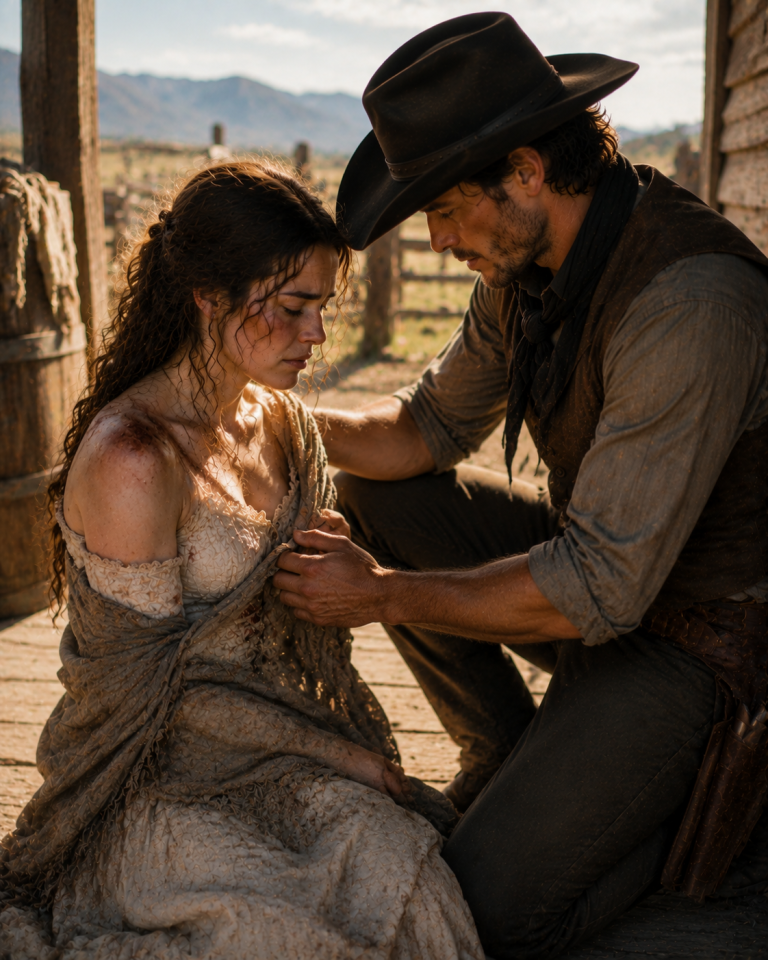
SHE WAS MAILED BACK LIKE UNWANTED CARGO WITH THREE WORDS SCRAWLED ON THE ENVELOPE — THEN A STRANGER ON HORSEBACK OFFERED HER SOMETHING NO ONE EVER HAD

PART 1
“No,” Naomi said, and the word cracked clean down the middle. “I was supposed to be.”
The stranger’s eyes moved from her face to the letter, then to the satchel at her feet, reading the whole of her circumstance in a few seconds without a trace of pity in his expression.
“Where’s home?”
“I don’t have one anymore.”
He nodded once, slow, and looked down the empty street like he was weighing something heavier than the question warranted.
“Name’s Thatcher Grady.” He said it plain, the way a man states a fact rather than offers an introduction. “Got a small place west of here. Some cattle. Two kids.” He paused. “My wife died three years back.”
Naomi’s eyebrows lifted despite herself.
“I ain’t looking for anything from you,” he went on, before she could form a question. “Just you look like you could use a place to rest tonight. You can leave come morning if you want.”
“I don’t even know you.”
“I ain’t asking for trust.” His voice stayed even, unbothered by her hesitation. “Just offering a roof and supper.”
She should have said no. Every rule she’d ever been taught about propriety told her to say no to a stranger’s offer on a train platform in a territory she didn’t know. But she looked at his face and found something there she hadn’t been shown all day — not pity, not calculation, not disappointment dressed up as courtesy. Just a man who’d noticed someone left out in the cold and decided, plainly, to do something about it.
“All right,” she said.
He helped her up onto his horse and walked beside it the whole way, leading the animal by its reins while the prairie opened wide and gold around them, the sun sinking low enough to turn everything the color of a held breath. By the time they reached his homestead, dusk had folded the land into soft shadow — a modest house worn at the edges but neat, a barn with a few cattle milling near the fence, and two children who came running barefoot into the yard and stopped short at the sight of her.
The boy looked about nine. The girl, maybe six, hid half behind her brother’s elbow before either of them said a word.
“Who’s she?” the boy asked.
“This is Miss Naomi. She’s staying the night.” Thatcher’s tone left no room for further questions. “Mind your manners.”
“I’m Fletcher,” the boy offered anyway, unable to help himself. “That’s my sister, Flora.”
Flora said nothing at all, watching Naomi from the safety of her brother’s shadow with the particular wariness of a child who had already learned that people could leave.
Inside, the house smelled of woodsmoke and coffee — plain furniture, a low fire, a stew pot going on the stove. Thatcher handed her a bowl once they’d settled at the table, and Naomi found she didn’t know how to speak around the ache still lodged in her chest. That morning she had been discarded like something returned to a shop. Now she sat eating supper with a stranger and his two solemn children on the edge of a world she hadn’t known existed twelve hours earlier.
“You said you had a wife,” she said finally, quiet.
“Clara.” He didn’t look away from the admission the way most men would have. “Fever took her. Left me with Fletcher and Flora. Been doing my best since.”
Naomi looked down at her bowl. “I was supposed to marry someone, too. He stopped writing after I sent my photograph.” Her voice thinned. “His sister told me I was too plain. Sent me back like a parcel.”
Thatcher didn’t flinch. He didn’t rush to comfort her either, the way men sometimes did when a woman’s pain made them uncomfortable enough to want it finished quickly.
“I had fancy once,” he said instead. “Clara was beautiful, sure. But it wasn’t her looks I missed most. It was how strong she was. How she listened. How she loved the kids.”
Naomi looked up at him.
“I don’t care about fancy,” he said. “I want real.”
She sat very still as those four words settled over her like something warm laid across her shoulders. No one had ever told her that what she was mattered more than how she looked — not her mother, not the man who’d sent her three thousand miles only to send her further still.
After the children had gone to bed, she stood awkward near the door, already composing an apology for the imposition. “I can sleep in the barn, if that’s better.”
“No.” Thatcher’s answer came without hesitation. “You’ll take the bed. I’ll sleep by the hearth.”
She wanted to argue. She could see, looking at his face, that his mind had already closed the matter. So she went to the small room instead, lay down on a quilt hand-stitched by a woman three years gone, and listened to the fire pop in the next room.
That morning she had been thrown away. Tonight she was warm, and fed, and — for reasons she couldn’t yet name — no longer entirely afraid to hope.
She fell asleep with the returned letter still folded in her satchel. Her heart, for the first time in longer than she could remember, felt just a little lighter than it had any right to.
Morning arrived with the smell of bacon and the quiet of two children already dressed and waiting at the table. Thatcher handed her a plate without ceremony.
“Sleep all right?”
“Yes. Thank you.” She meant to gather her things after breakfast, to thank him properly and be on her way to wherever a woman with nowhere to go was meant to go next.
“You heading back east?” he asked instead, watching her over his coffee.
“I have nowhere to go,” she admitted, because there was no use pretending otherwise to a man who had already seen the worst of her circumstances plainly.
He studied her for a long moment — long enough that she felt the weight of being truly looked at for what felt like the first time all day.
“You could stay.”
Her breath caught somewhere it hadn’t caught since the letter had come back unopened.
—
PART 2
“I don’t mean as a guest,” Thatcher said, before she could mistake his meaning for charity. “There’s work here. The children could use someone to read to them. I could use help with the house.” He held her gaze, steady, unhurried. “You could make this place home, if you wanted.”
Naomi’s throat tightened past speaking for a moment.
“Why would you offer that?”
“Because you’re kind,” he said simply. “And steady, and real. I’ve had fancy. I want real.”
Her hands trembled slightly at her sides. She looked at the children — Fletcher watching her with cautious calculation, Flora peering from behind her brother’s shoulder like she was deciding whether Naomi was the kind of person who stayed or the kind who left — and then back at the man who had asked her to consider a life she hadn’t known was possible twelve hours earlier.
“I could stay,” she said, quiet. “Just for now.”
He nodded, though something in his eyes said plainly that he hoped for longer than that. And though her heart still carried the bruise of that morning’s rejection, Naomi found she could not entirely dismiss the strange, unsteady feeling rising underneath it — that perhaps she had not been sent west to be discarded after all, but to be found by exactly the people who needed finding her.
It should have felt too fast. A widower’s offer, a dead wife’s kitchen, two children who weren’t hers and a house she’d known for less than a day. Every rule of propriety she’d been raised on said a woman didn’t simply *stay* — didn’t accept a stranger’s roof on the strength of one honest sentence about what he wanted instead of fancy.
And yet.
She thought of the boarding house woman’s mouth, tight and dismissive. *He said you were too plain.* She thought of the months of careful letters she’d written to a man who’d never once asked what she carried inside her, only what she looked like in a photograph. She thought of every door in her life that had closed on the simple, unbearable fact of her ordinariness.
And then she thought of four words spoken across a supper table by a man with nothing to gain from saying them.
*I want real.*
She didn’t know yet what staying would cost her, or what it would ask of her — whether Flora’s silence would ever soften into trust, whether Fletcher’s guarded politeness would become something warmer, whether a house that still smelled faintly of another woman’s cooking could ever become entirely her own without erasing the woman who’d built it first.
She only knew that when Thatcher Grady looked at her, he did not see something returned, unwanted, marked plain and sent back like cargo.
He saw someone worth asking to stay.
And for a woman who had spent an entire day learning exactly how little she was worth to the world, that single distinction was enough to make her set her satchel back down by the door instead of picking it up.
—
PART 3
The sun had already cleared the ridge the next morning when Naomi stepped outside with a tin pail in hand, the decision to stay settling into her chest like something she was still learning to carry. The air held the warmth of late summer, sagebrush drifting faint on the breeze. She shaded her eyes, searching the slope behind the barn where Thatcher had disappeared with a bridle slung over one shoulder.
She found Flora instead, crouched near the chicken coop, palms full of grain, humming low while the hens pecked around her boots.
“May I help?”
Flora nodded but didn’t speak, handing over a fistful of kernels and pointing toward the feed bin without a word wasted. Naomi filled a small sack and returned to scatter it gently across the yard, the chickens swarming in a flurry of feathers.
“Do you like them?”
Another nod. Then, after a pause long enough that Naomi had already given up on an answer, the girl spoke — quiet, solemn, entirely unexpected.
“They know when you’re gentle.”
Naomi blinked, caught off guard by the sound of the child’s voice after so much silence the day before. “That’s true of most things, I think.”
Flora tilted her head, considering this with the gravity of someone twice her age. “Papa says sometimes gentle things are stronger.”
Something in Naomi’s chest ached and softened at once. “He’s right.”
Later that morning, she found Fletcher hacking at a thistle with a hoe too long for his arms, his frustration evident in every graceless swing.
“You’re cutting the root sideways,” she observed.
“That’s how it’s done,” he huffed, without looking up.
She crouched beside him anyway, nudging the blade lower. “Try angling down, just there. You’ll get the base cleaner.”
He tried again. The stalk came up easier. He glanced at her, uncertain. “Are you a farmer?”
“I grew up helping my father on a parcel near the Ohio River. He passed when I was sixteen.”
Fletcher looked back at the ground, working a few more weeds loose before he found something to say that wasn’t quite a thank you. “I’m almost ten.”
She let the silence sit rather than fill it. Eventually, he added, almost accusingly, “Flora doesn’t talk much to strangers.”
“But she showed me the hens.”
He didn’t answer that directly, but something in his shoulders eased, just slightly, as if a decision had been made without him announcing it.
By midday Thatcher returned with a lead rope trailing behind him and a limping bay gelding at his side.
“Stone bruise,” he said, nodding toward the animal’s foreleg. “Stepped wrong near the creek bed.”
Naomi fetched a clean rag and the small tin of salve tucked near the hearth, kneeling beside the horse’s leg with careful, practiced pressure. Thatcher stood watching her hands work.
“You’ve done this before.”
“Our neighbor kept draft horses. He let me help if I brought his wife preserves.” She glanced up as he crouched beside her, his forearm brushing hers as he steadied the animal’s weight.
“Not many women would touch a lame horse.”
“I’m not most women.”
He looked at her, something unreadable passing behind his eyes. “I know.”
That evening, as she stirred cornmeal and the children stacked kindling outside, Thatcher came in from the barn, boots dusty, shoulders stiff with the particular exhaustion of a man who’d carried too much alone for too long.
“You work yourself to dark,” she said. Not an accusation. Just a fact laid gently on the table between them.
“There’s no one else to do it.”
“You shouldn’t carry all of it.” She set bowls down, watched him sit slowly, watched the children take their places without needing to be told. “I don’t know how to ask for help anymore,” he admitted.
“You didn’t ask yesterday.” She looked at him steadily. “You offered.”
“And you didn’t run.”
“I’ve done my share of that,” she said, voice low. “But I’m tired of being somewhere I’m not wanted.”
He didn’t answer right away. When he did, it was simple, unforced, and it landed somewhere deep in her chest.
“Then you’re wanted here.”
—
Autumn deepened into frost. Fine silver traced the fence posts each dawn, and Naomi learned the particular rhythms of a house that ran on necessity — stoking coals before light, mending shawls by lamplight, riding beside Thatcher to check fence lines that the elk or the wind had knocked loose overnight.
It was during one such ride, dismounted at a broken rail, that he asked her without looking up from his hammering, “You ever think about going back east?”
“No one left there to go back to,” she said. “And I don’t miss the way they looked at me. Like I took up too much space just breathing.”
He made a low sound in his throat. “You don’t take up space here. You make it steadier.”
She leaned against the fence post, watching him work, and asked the question she’d been circling for weeks. “You still think of her often?”
He paused. Nodded. “Not always the way I expect. Sometimes I smell her soap in the kitchen. Sometimes I say something she used to say and startle myself.” He didn’t flinch from the admission, and neither did she from hearing it. “But I don’t feel guilty anymore. Not when I look at you.”
Naomi’s breath caught at the plainness of it.
“I don’t feel discarded anymore,” she said.
He straightened, brushing sawdust from his palms. “Good.”
That night, mending by the fire while he oiled saddle straps across from her, she found the courage for something she’d carried unspoken for weeks. “I never pictured children in my life. Not because I didn’t want them. I just never thought anyone would think I was enough to raise them beside them.”
“You’re enough,” he said. “More than.”
She set her needle down. “I don’t need flowers or sweet words.”
“I wouldn’t know how to give them,” he admitted. “But I can give you a place that’s yours. A family that doesn’t leave. A man who won’t forget what it is to be alone.”
Naomi crossed the small room to where he sat. He set the leather aside, hands open on his knees.
“I don’t want to be a guest anymore,” she said. “I want to stay, if you’ll have me fully. Not out of kindness. Out of wanting.”
Thatcher rose and, for the first time, placed his hand at the small of her back.
“I’ve had fancy,” he said, softer now. “I want real. And you’re the most real thing I’ve ever touched.”
She leaned into him, and he held her the way a man holds something he’s already lost once and refuses to lose carelessly a second time.
—
The first snow drifted in slow and silent that winter, and the house settled into a rhythm that no longer needed much explaining between them. Naomi rode into town with the wagon Thatcher insisted she take, “time for herself” he called it, though he never said it unkindly. On her return, Fletcher told her proudly that Flora had read aloud the whole visit at Mrs. Tills’s without a single whisper of hesitation.
“She’s getting stronger,” Naomi said.
“You, too.” Thatcher pushed the door open for her, arms full of kindling.
“I haven’t changed.”
“You’ve settled your weight,” he said. “There’s a difference between standing still and standing steady.”
She saw the notice for the schoolhouse position in town not long after — a few afternoons a week teaching letters and arithmetic — and brought it home turning it over in her mind before she found the nerve to say it aloud.
“I could teach,” she said carefully. “But only if it didn’t take too much from here.”
“I’d never hold you back from something that made you feel useful.”
“I already feel useful. I just—” She hesitated. “I want to be part of the town, too. Be seen there, like I am here.”
He studied her a long moment. “Then take it.”
“I didn’t think you’d make it so easy.”
“You’ve always done what needed doing,” he said. “Now it’s time to do something you want.”
That night, in the shed thick with the smell of leather and beeswax, she told him what she’d never told anyone. “I wanted a window that faced west. A kitchen with more light. And someone who didn’t walk out the door when I opened my mouth.”
“You’ve got a window that looks west,” he said. “And I built a shelf last week. For more light over the sink.”
She stepped closer, lantern glow warm against her cheek. “You listen more than any man I’ve ever met.”
“I watch, too.” He set the harness down. “I’ve been thinking about the way you fill this house. How you know where everything goes without asking. How the children sleep deeper now. How I sleep deeper.”
Her breath caught. “I keep wondering when I’ll be asked to leave.”
“You won’t.”
“You’re sure?”
He reached for her hand. “Naomi, I’ve had a woman who was beautiful in ways that turned heads. But you — you’re the one I built hope around without even realizing it.”
“I wasn’t sent here to be claimed,” she whispered.
“No,” he said. “You were sent here to be seen.”
He kissed her then, slow and certain, the kind of kiss that had clearly been waiting weeks for permission it hadn’t wanted to assume. She didn’t pull away. When they parted, her forehead resting against his chest, his hand warm at the back of her neck, he said the words plainly, the way he said everything that mattered.
“I want to marry you. Not out of need. Because I choose you.”
She closed her eyes. “That’s all I ever wanted.”
—
The wedding came just after the thaw, when the cottonwoods along the creek bed unfurled their first pale buds and the last of the snow gave way to soft new ground. Thatcher had built the arch himself, wrapped in willow branches and early wild plum. Flora tucked a sprig of lavender behind Naomi’s ear that morning with the careful pride of a child who had chosen, finally and completely, to trust.
A handful of neighbors came — Mrs. Tills and her grown son, the Blackstone brothers from the next homestead, a quiet couple bearing warm bread and a jar of pickled onions. Fletcher stood beside his father with his hair combed flat despite a stubborn cowlick that refused to lie down, polished boots and all.
Naomi wore cream muslin she’d sewn herself, no lace, no ribbons — only what she wanted standing across from her, holding her gaze with the steadiness that had first made it easier to breathe.
Thatcher didn’t rush the vows. He took her hand slowly, as though memorizing the shape of her fingers, and kissed her once, gently, and she closed her eyes to feel it with everything else gone quiet around them.
Afterward, as neighbors said their goodbyes and dusk settled soft over the yard, Flora leaned into Naomi’s side on the porch.
“She said you’d come,” the girl whispered.
Naomi looked down. “Who?”
“Mama. When she was sick, she said someone would come who knew how to stay.”
Naomi didn’t answer. She only wrapped her arm tighter around Flora’s shoulders and held her there until the stars came out.
Inside, clearing the table with Thatcher, she said quietly, “I feel like home now.”
“Your daughter?” He dried his hands on a cloth.
“You are home.”
They stood a long moment in the quiet crackle of the fire before he turned, took her face in both hands, and kissed her again — this time with the reverence of a man who understood exactly what he’d been given a second chance to hold onto.
That night, Naomi didn’t sleep in the guest room. She lay beside her husband in the room she had once only passed through, her head against his shoulder, the quilt drawn around them both. Wind moved low through the trees outside, but the walls held strong. So did they.
—
Spring settled into summer with long days and earlier sunrises. Naomi took the position at the schoolhouse, walking the mile there and back with chalk on her fingers and stories to bring home each evening. Thatcher kept the cattle sound and mended fences against the heavy June rains, Fletcher taller now and steadier with a hammer than he’d ever been before. Flora spent her afternoons sketching hens and creek beds, her confidence no longer something that needed coaxing.
One evening in late July, Naomi stood barefoot in the garden, brushing dirt from her palms, the sun low and gold behind the ridge. Thatcher came up behind her, looping an arm around her waist.
“We’re nearly through the tomatoes,” she said. “I’ll start pickling tomorrow.”
He kissed her temple. “We’ll build more shelves.”
Flora called from the porch, waving a folded letter. Naomi opened it slowly — her cousin Ruth, from Ohio, the only one who had ever written her without being asked. Ruth had married a Cooper’s son and wanted to visit that fall, unable to believe her luck at Naomi’s news.
“She wants to see the place,” Naomi said, looking up at Thatcher. “Asked what you’re like.”
He brushed a curl from her cheek. “What’ll you tell her?”
“That you’re the kind of man who listens more than he speaks. That you built a shelf for my books without me asking. That you taught me how to braid rope and split ash logs.” She held his gaze. “And that you love me without needing to say it every day.”
“I love you every day,” he said.
She kissed him then, soft but deep, asking for nothing more, because everything had already been given freely.
By the time the sun dipped fully behind the hills and the lanterns were lit, Naomi and Thatcher stood together on the porch, arms around each other, watching the land they had shaped with their own hands. The children’s voices drifted low and easy from inside, the house behind them glowing warm.
There was nothing they lacked, and nowhere else either of them longed to be.
She had come west carrying a letter that told her she was unwanted, no longer needed, returned like something ordinary and unremarkable. She had ended up, instead, exactly where she was meant to be found — not chosen for how she looked in a photograph, but for everything a photograph could never show. Steady. Real. Home.
THE END