She Married the Rancher Everyone Called Broke — Then One Forgotten Ledger Destroyed a 15-Year Fraud

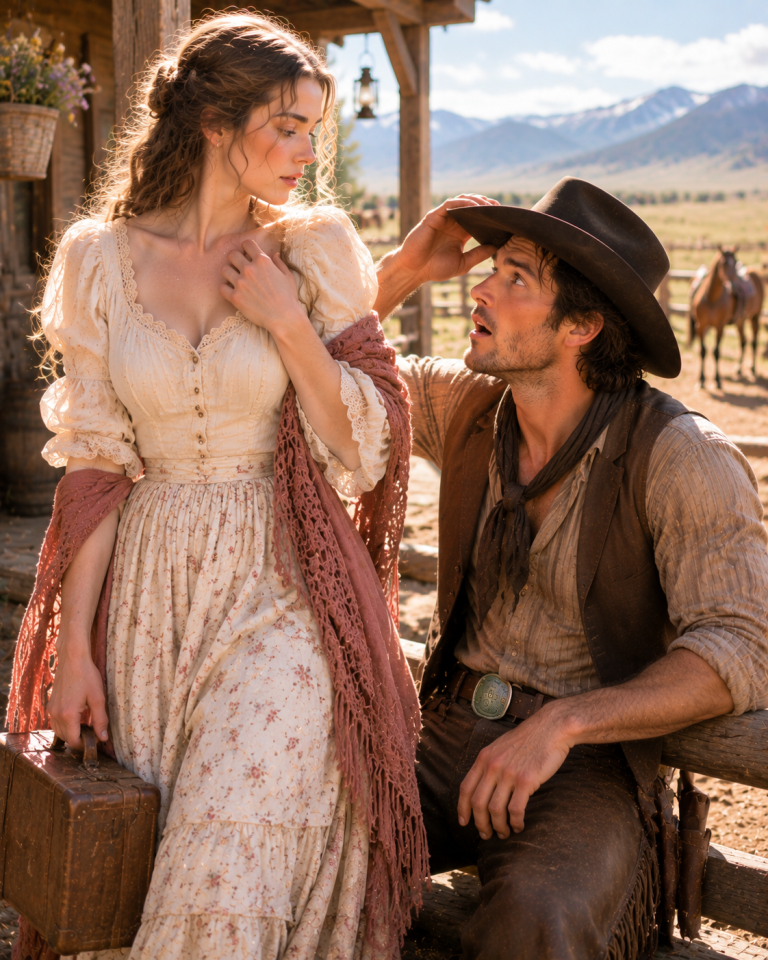
In the months between, a quiet man named Ror had shown up at the Red Hollow boarding house, asking careful questions about the Mercer ranch and about Norah specifically — how far out was the road, how many people lived there, whether she was planning to stay. Miss Graves noticed it first. “He asked about the Mercer ranch by name,” she told Norah outside the general store. “Land investors don’t usually ask about specific ranches before they’ve spoken to the land office.” Norah told Caleb that evening; he’d already heard the same from a hired hand who drank at the boarding house. “He’s gathering information,” Norah said. “Not planning anything physical yet. If Hail wanted to threaten us, he’d send someone harder looking.” Rather than wait to see what happened, she rode to town the next morning and found Marshal Samuel Cross doing paperwork. “I’m not asking you to run him out of town,” she told him. “I’m asking you to be aware of him, and to make sure he’s aware that you’re aware of him. Sometimes that’s enough.” Ror left town four days later without incident — whether Cross’s attention had made him uncomfortable or he’d simply gathered what he came for, nobody could say for certain.
Through all of it, something had been building between Norah and Caleb that had nothing to do with the fight against Hail and everything to do with the accumulated weight of five weeks, then three months, then most of a year spent solving an impossible problem side by side. He’d brought her food when she forgot to eat, sitting quietly while she worked through the evidence. She’d helped him fix a fence one afternoon when a ranch hand got sick. He’d told her about his mother leaving when he was nine, about a father who never talked about it and just worked harder, like he could fill the hole with labor, about growing up believing that’s what you do — you work and you endure and you don’t ask for things you’re not sure you’ll get. She’d told him about ten years in Philadelphia boarding houses, working for men who cheated her on wages because they knew she needed the job too badly to fight back, smiling and keeping her head down and telling herself it was temporary — until she’d finally added up three months of pay and realized she was still behind on rent despite working harder than she’d ever worked in her life, and never trusted an unchecked ledger again.
“I’m not the woman you expected to marry,” she told him one night on the porch, after the verdict, after the appeal notice had first arrived, in the strange quiet after the emergency but before the next one.
“No,” Caleb said, taking her hand, his palm calloused, his grip gentle. “You’re better than that.” “You don’t know that yet. We barely know each other.” “I know you’ve got more courage than any person I’ve ever met. I know you don’t break when things get hard. And I know you care about doing the right thing more than you care about being safe.” He squeezed her hand. “That’s enough.”
The restitution process crept forward through spring — Hail’s assets systematically inventoried, land and cattle and accounts assessed, the mathematics of restoration slower and messier than any verdict, because justice is always faster in theory than in execution. Henderson got back forty acres and a rebuilt barn, not the original but solid and new. Pritchard received a payment that wouldn’t fully replace what was lost but gave him something to start again with. Three other families who’d come forward after the newspaper story received smaller settlements proportional to what Hail had taken. The Kowalskis, already resettled in California, got a bank transfer and a letter that arrived six weeks after they’d started over somewhere nobody knew their name — Norah made sure to write it herself, because official notices didn’t carry the same weight as someone telling you they hadn’t been forgotten. She spent two weeks at the courthouse cross-referencing the asset inventory with the damages she’d calculated, correcting Foresight’s office more than once, making sure every family got what they were actually owed.
Word spread that Henderson was moving his family back to the territory — he hadn’t been able to make a go of it in Denver, kept feeling like a city man even after thirty years on land — and Caleb had quietly pointed him toward the old Whitfield place two miles east, a clean parcel Hail had never gotten his hands on. Watching the wagons arrive that September, three children scattering toward the barn like birds, Norah realized how long the ranch had been running on survival instead of life, how absent that particular kind of noise had been from a place that had spent fifteen years bleeding quietly. Clara Henderson took Norah’s hand in both of hers. “I’ve been wanting to thank you properly. The letter you sent explaining the restitution delay — you didn’t have to do that. Most people would have just waited for the official notice.” “I knew you’d need time to make arrangements,” Norah said. “The official notice wouldn’t have given you that.” “It didn’t. But your letter did.”
She and Caleb had never had the marriage conversation properly — there’d been no time, no real pause between crises. One evening in October, watching rain green the pastures, she finally said it plainly: “I’m not here because of the arrangement anymore. Not because of necessity or contract or having nowhere else to go. I’m here because I want to be. This is the first place that ever felt like it was actually mine.”
Caleb was quiet a long moment. “I think you’ve been worried for months you owed me an explanation for staying,” he said. “You don’t. This is your home, Norah. Has been since about the third night you spent working through my father’s files by candlelight. I just didn’t know how to say so without it sounding like I was telling you what to feel.”
They married in April — small, in the way that Norah had wanted, though “small” turned out to mean twenty-three people in the yard once the Hendersons told the Browers, who mentioned it to the Lindfists, who told the Oleander family down the valley, who showed up uninvited with a fiddle and a dried-fruit cake nobody had requested but everyone appreciated. Judge Carver performed the ceremony, which he denied arranging his schedule around, with the precise non-denial of a man who is technically not lying. Caleb lost the paper he’d written his vows on and spoke from memory instead, rougher and more honest for it: he’d spent most of his adult life not trusting anything, and trusting her was the one thing in recent years that had turned out to be not just right but necessary. He wasn’t promising ease, because they both knew better. He was promising he’d keep showing up. Norah, who’d drafted and discarded two versions of her own vows — one too formal, like a legal document, the other too poetic, which embarrassed her more than silence would have — finally just said, “I came here because I had nothing left to lose, and now I have everything to keep. I’m going to spend a long time figuring out how to deserve that, but I’m going to spend it here.” Someone, possibly Clara Henderson, made a sound that was either a laugh or a sob or both.
The fiddle started before the judge had quite finished speaking. There was food, and more of the good whiskey from the general store, and Henderson told a long story about a lost calf and a frozen creek that strained credulity but was apparently true. Lars Brower fell asleep in a chair by eight and nobody woke him. Henderson found Norah near the end of the evening, working up to something he clearly wasn’t sure how to say plainly. “When I was at my lowest point,” he told her, “after we lost the property, after my daughter was sick — I got your letter. The one explaining the restitution delay. You didn’t have to write that. You had your own fight.” He paused. “But you did. And knowing someone was still paying attention, still treating us like we mattered — that helped more than the money did, if I’m being honest.”