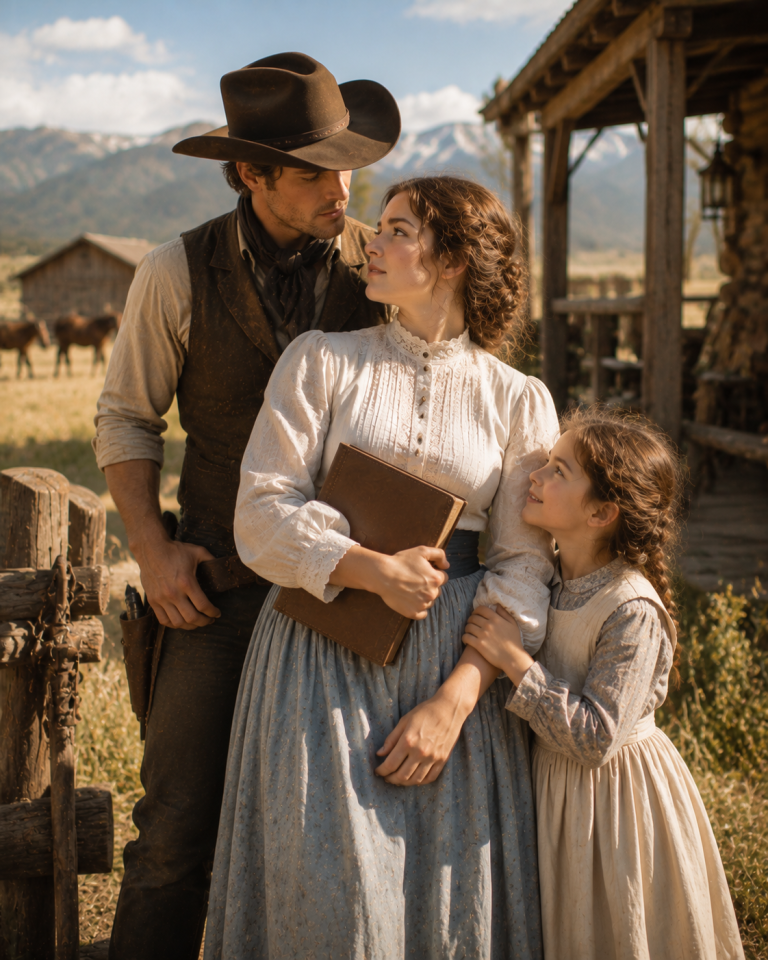
SHE CLIMBED OFF THE STAGE WITH THREE SISTERS NO ONE ORDERED — THEN A MAN IN A CITY SUIT CAME LOOKING FOR ALL FOUR

Part 1
The dust hadn’t even settled before Bo Dalton knew something was wrong.
Three brides. That was the arrangement. Three letters, three names, three women stepping off the Overland stage into a life his brothers had chosen sight unseen. His own bride wasn’t due for another month — plenty of time, he’d told himself, to get the other three settled before he had to face his own mistake.
Then the coach door opened a fourth time.
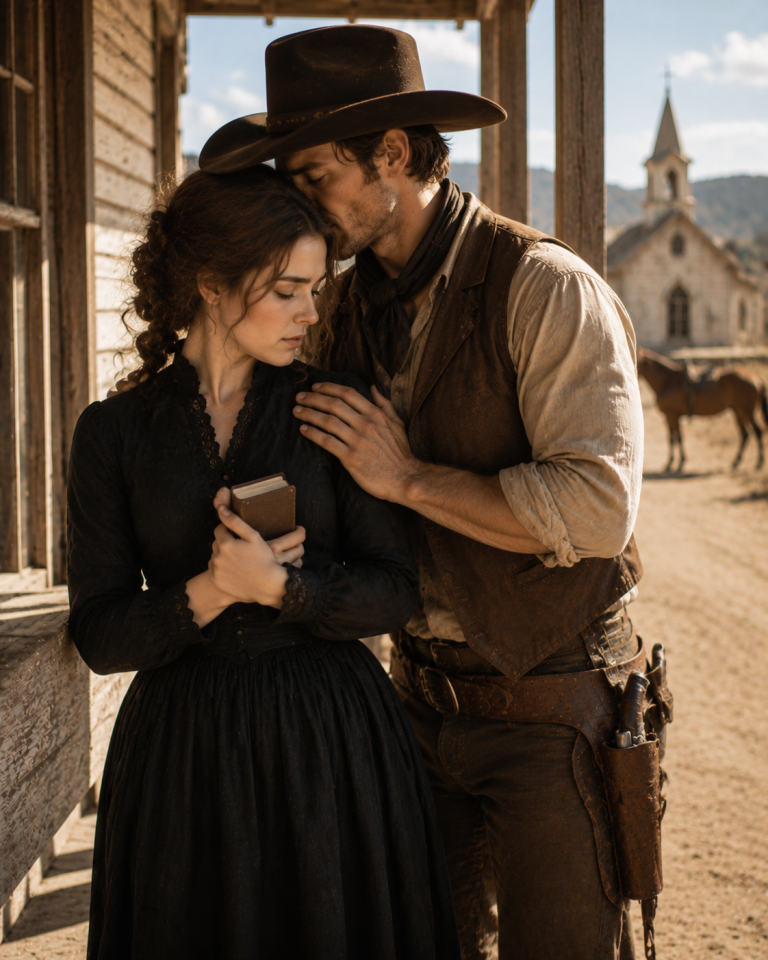
Bo stood on the platform with his hat pulled low, watching Finn shift his weight like the ground had gone hot beneath him, watching Owen’s fingers worry the spine of a book he wasn’t reading, watching Reed — barely twenty, and it showed — grin like Christmas had come to Montana in July. Four brothers. Four hopes, four separate kinds of scared. And now four women, when there should have been three.
They came down off that coach one after another, and the resemblance hit before the shock did. Same dark hair. Same set to the jaw. Same tired, stubborn pride sitting behind four sets of eyes that had clearly seen more road than any woman should have to see alone.
Sisters.
Gus, the driver, spat his tobacco and grinned like he’d delivered a punchline instead of four strangers. “Matched set,” he said. “All addressed to the Dalton ranch.”
Bo opened his mouth to correct it — there’s been some mistake, ma’am, we only sent for three — and the eldest of them looked at him before he got the words out. Not defiant. Not pleading. Just steady, in a way that made the sentence die in his throat.
“There’s no misunderstanding,” she said. “My name is Eleanor Vance. These are my sisters.”
She said it like a woman laying her last card on the table and daring him to fold.
The agency had made an error, she explained — printed four Dalton brothers instead of three, and rather than let it get sorted out by mail, rather than risk being split apart by whatever correction came next, the four of them had simply gone. Together. Because parting ways, it turned out, frightened them more than arriving as an inconvenience four brothers hadn’t asked for.
Bo looked past her at the other three. Reed’s bride — soft-eyed, hopeful, looking at the dusty street like it held something worth wondering at. Owen’s, holding a portfolio to her chest like it was the only thing she owned that mattered. Finn’s, chin already up, ready to argue with the first person who gave her a reason. And behind all of them, the trunks. Small. Few. A family’s whole life, packed down to what four women could carry on a train and then a coach into a territory that didn’t know them.
He felt the weight of it settle on him before he’d made any decision at all.
“Gus,” he said. “Load their trunks. They’ll rest at the ranch tonight.”
He didn’t say more than that. It wasn’t a promise. But Eleanor Vance’s shoulders came down half an inch, like it was the first breath she’d let herself take in days — and for four sisters who’d bet everything on a printing error, it was enough to call it hope.
What none of them said out loud — not the brothers standing stunned on that platform, not the sisters clutching what little they had — was the letter that hadn’t arrived yet. The one with a Boston postmark. The one that would turn a house too full of strangers into a house standing between four women and the man who believed he still owned them.
They didn’t know it yet. But trouble was already on its way west.
—
Part 2
By the end of the first week, the Dalton house didn’t feel like eight strangers under one roof anymore. It felt like something rebuilding itself, plank by plank, whether the brothers were ready for it or not.
Norah — Eleanor, though only her sisters still used the long version — had claimed the kitchen without asking anyone’s permission, and now the whole house smelled like bread instead of woodsmoke and neglect. Izzy was out arguing with Finn over how to hold a pitchfork, and losing that argument roughly never. Rose had found the quietest corner of the house and filled it with pencil sketches of a land she was only beginning to trust. And Reed followed Jenny’s questions about the stars like a man who’d finally found someone worth answering to.
It should have felt like peace. It didn’t, not all the way. Because every night, after supper, the same silence crept back into the room — the one that asked, without anyone saying it: *what happens when the month runs out?*
Then Owen came back from town with a single letter.
Boston postmark. Addressed to the Vance sisters.
Norah’s hands shook taking it. By the time she and her sisters came out of their room, whatever had been in that envelope had drained something out of all four of them — color, breath, the fragile ease they’d been building since the coach pulled in.
Bo cornered her by the stove that night, and for once, she didn’t have a ready answer.
“We just need more time,” she whispered. “Please.”
“Whoever they’re running from,” Bo said slowly, watching her face for the truth she wasn’t giving him, “they’re scared of him more than they’re scared of losing this place.”
She didn’t confirm it. She didn’t have to. Two days later, a stranger in a city suit rode into Promise Creek asking questions about four young women from Boston — and Norah said one word that turned the whole house cold.
*Pinkerton.*
—
Part 3
The knock came at first light, three sharp raps that didn’t ask permission — the knock of a man who already believed he owned whatever waited on the other side of the door.
Bo was up before the second knock finished. Around the table, the household went still the way a held breath goes still: Finn’s hand drifting toward the pistol on the wall without him seeming to notice he’d moved it there; Owen stepping half in front of Rose without a word; Reed positioning himself between the door and Jenny like his twenty years and his rope-callused hands were enough to matter against whatever was coming. The sisters didn’t move at all. They’d learned, somewhere back in Boston, that stillness could be its own kind of armor.
Bo opened the door.
The man on the porch was neat in a way Montana didn’t manufacture — bowler hat, city boots too clean for the walk up from town, eyes that had clearly spent years cataloguing rooms before he ever stepped into them.
“Mr. Dalton,” he said, and the politeness in his voice had no warmth in it at all. “Davies. Pinkerton National Detective Agency.”
Behind Bo, he heard Norah’s breath catch — quiet, but not quiet enough.
“What’s your business,” Bo said. Not a question. A line drawn.
Davies produced a folded paper from his coat with the unhurried care of a man who’d done this a hundred times and expected to do it a hundred more. “I’m looking for four missing women from Boston. Their guardian claims they were taken against their will. I have reason to believe they’re on this property.”
“Didn’t seem unwilling,” Finn said from behind Bo, “when they were cleaning our house and keeping us from poisoning ourselves on Owen’s cooking.”
Davies didn’t so much as blink at the joke. “I’m not here to argue about housekeeping, Mr. Dalton. Either they come with me now, or I return with the sheriff.”
Bo didn’t turn around. He didn’t need to see the sisters to feel the fear rolling off them like heat off a stove. He planted himself in the doorway instead, close enough that Davies would have had to go through him to get past.
“They aren’t missing,” Bo said. “And they aren’t leaving.”
“Are you refusing a lawful investigation?”
“I’m saying nobody takes anything off this ranch that doesn’t choose to go.”
Davies studied him for a long moment — the patient, unblinking study of a man who had stood between angry families plenty of times before and had learned not to flinch at the first show of teeth. Then his gaze slid past Bo, into the house.
“Ladies,” he said. “You may come forward, if you wish.”
Norah came forward.
Her hands were folded tight enough to bleach the knuckles, but her voice, when it came, didn’t shake. “We aren’t missing. We left Boston of our own will. We traveled here on our own money, our own choice. We are not property to be recovered, Mr. Davies.”
Davies looked at her — really looked, the way a man looks when he’s deciding whether a story holds together. Then at Izzy, chin already lifted like she was daring him to disagree. At Rose, quiet but not shrinking. At Jenny, young and frightened and standing her ground anyway.
“You understand,” he said, slower now, “your guardian is a man of considerable standing. He claims great concern for your welfare.”
“He doesn’t care,” Izzy said. Her voice cracked like a whip. “He *owns*. There’s a difference.”
“He ruined our father,” Rose said quietly.
“He wanted to own us next,” Jenny whispered. “We came here to be safe. That’s all this is.”
Davies said nothing for a moment. Whatever calculation was running behind his eyes, it wasn’t the one Sterling had paid for.
“I’ll be in Promise Creek a few days,” he said finally. “I intend to conduct my own inquiries.” He looked at Bo. “Until then, I’d suggest everyone stay exactly where they are.”
He tipped his hat and rode off. The sisters exhaled as one — a collective, ragged breath, like they’d all been holding it since Boston.
But nobody in that kitchen believed it was over. Davies had only been the knock before the door came down.
—
**Three days later**, the real danger rolled into Promise Creek behind a pair of hired horses, wearing an expensive suit and an even more expensive smile.
Thaddius Sterling didn’t announce himself the way Davies had. He didn’t need to. He bought a round of drinks at the saloon and let the story tell itself: four helpless girls, stolen off from a good Boston home, held against their will by a pack of desperate frontier bachelors who couldn’t get wives any other way. By sundown he’d charmed half the town into believing it. By the next morning, he’d done something worse — he’d bought the paper on the Dalton ranch’s mortgage, quiet as a snake moving through grass, and now he didn’t just have a story. He had leverage.
He arrived at the ranch with the sheriff at his side and Davies trailing a careful distance behind, his face giving away nothing at all.
Sterling smiled at the porch like he was greeting old friends at a garden party. “Girls,” he said, warm as poured honey. “I’ve come to bring you home.”
Izzy’s glare could have set the porch boards smoking. “We *are* home.”
“Choice?” Sterling laughed — an easy, practiced sound, meant to make her sound foolish for using the word. He unfolded a document, crisp and official and terrifying in its neatness. “These girls are penniless. Frightened. Confused. They scarcely know what they want.” He turned to the sheriff. “This order names me their legal guardian. These men have no claim to keep them here.”
The sheriff cleared his throat like the paper in Sterling’s hand outweighed everything he could see standing in front of him. “Looks to be in order.”
“They’re here by choice,” Bo said, stepping forward before the sheriff could take it any further.
“These women,” Sterling said, and something colder slid under the honey now, “belong with me.”
“No,” Bo said. “They belong where they feel safe.”
Owen’s voice came next, quiet but immovable. “Norah is twenty-five. Izzy’s twenty-three. Rose is twenty-two. Jenny’s nineteen. They are not children, Mr. Sterling, whatever paper you’re holding.”
Sterling’s smile finally cracked. “Sheriff. Remove them.”
The sheriff hesitated — and in that hesitation, Davies stepped forward from the edge of the yard where he’d been standing, silent, the whole time.
“Before anyone does anything,” Davies said, “you should know the Agency is reopening its inquiry into Mr. Sterling’s business dealings. There are inconsistencies in the guardianship filing that warrant a closer look.”
Sterling’s face lost its color in one long drop, like a lamp guttering out. “That’s — that’s absurd. Lies, all of it.”
“There’s a missing ledger,” Davies continued, unhurried, each word landing like a nail. “Names. Dates. Evidence suggesting the sisters’ father may have been falsely accused before his death — accused by the very man who became their guardian afterward.”
Sterling staggered back half a step, as if the words had physical weight.
“You may have bought influence in this town, sir,” Davies said, “but you cannot buy the law. Not from where I sit.”
The sheriff took his own step back — away from Sterling, which told everyone on that porch everything they needed to know about how this was going to end. Sterling’s rage, denied everywhere else, found Norah instead.
“This isn’t finished,” he hissed.
“It is,” Bo said. “Now leave.”
Sterling mounted his horse in a fury that had nowhere left to go, and rode out of Promise Creek the way he’d come in — loud, expensive, and, in the end, powerless. Not brought down by a gun. Brought down by the truth finally catching up to the lie he’d been telling for years.
—
The fear the sisters had carried across half a country lifted that afternoon and didn’t come back down. It simply drifted off, the way storm clouds do when the wind finally changes, and what was left underneath it was something none of them had let themselves imagine in months: room to breathe.
That night, the ranch filled with a kind of laughter it hadn’t held in years — not nervous laughter, not the careful kind that eight strangers manage around a shared table, but the real thing, loose and unguarded.
Out by the corral, under a sky gone the color of a bruise healing, Finn and Izzy were arguing about something that didn’t matter anymore — whose fault it was that the gate had been left open, probably, or some other nothing — and the arguing slid, the way it had been sliding all week, into something softer. Izzy still had fire in her eyes. Finn had stopped being afraid of it days ago. When the argument finally ran out of words, he didn’t fill the silence with more of them. Neither did she.
By the firelight near the house, Owen sat with Rose’s sketchbook open across both their laps, her pencil marks catching the orange light — the barn, the ridge line, his own face, drawn three separate times before he’d noticed she’d been looking at him at all. He didn’t say anything clever. He just took her hand, careful, like she was something that had chosen, against all odds, to stay.
In the garden the two of them had put in together — Reed’s idea, Jenny’s insistence on where the rows should run — the new shoots were barely inches high, but Reed talked about them like they were already something to be proud of, and Jenny let him, because it wasn’t really about the vegetables at all.
And in the kitchen, Bo found Norah exactly where he’d found her the night the letter came — leaning against the same table, in front of the same stove — except this time the exhaustion on her face had nothing left in it that looked like fear.
“You asked for a month,” he said.
She looked up.
“Take all the time you need.” He said it plainly, the way he said most things. “This is your home now, if you want it to be.”
Norah looked at him for a long moment — at the man who’d stood in a doorway between her and a detective, who’d stood on a porch between her sisters and a man with more money than conscience, who had never once, in three weeks, asked her to be grateful for any of it.
“This is my home,” she said, and this time there was no fear in the words at all. Just fact.
Bo took her hands in his. “Then stay,” he said. “Not because you have to. Because you want to.”
Her answer came with tears she didn’t bother hiding and a smile that hadn’t fully believed itself yet. “I want to.”
He pulled her in, and the lantern light moved with them, and outside the wind that had once carried the sound of a stranger’s coyote-cry warning now carried nothing at all but quiet — the good kind, the kind that meant nothing was coming for them anymore.
Not a bargain struck out of necessity. Not a contract signed out of desperation. Just four brothers and four sisters who had walked into each other’s lives by a printer’s mistake and stayed by choice — building, out of dust and fear and one impossible coach ride, something strong enough to call a home.
Their story didn’t stay inside Promise Creek for long. It moved the way good stories do — porch to porch, town to town, until the whole territory knew some version of it: the rancher brothers who took in four sisters running from a man who thought he owned them, and gave them a life instead.
The Dalton ranch didn’t just survive what came for it.
It became a family strong enough that nothing ever came for it again.
**THE END**