She Caught the Mafia Boss on a Night Patrol—Then He Smiled and Claimed She Already Belonged to Him

### PART 1:
The Porsche was doing ninety-four in a sixty.
I clocked it from the overpass and felt that familiar pull in my chest — not quite dread, not quite adrenaline. Something in between. Three years on the night shift will do that to you. It teaches you to read a speeding car the way a doctor reads a pulse: the *how* tells you more than the *how fast*.
This one wasn’t fleeing. Wasn’t weaving. It was moving with total, arrogant confidence — the way a man walks through a room he owns.
I hit the lights.
2:53 a.m. Route 9 North, twenty miles outside the city. The highway was empty except for a distant freight truck and whatever this was.
The Porsche pulled over immediately. Cleanly. No overcorrection, no hesitation. Parked as precisely as if it were a valet spot.
Of course it did.
I radioed my position to Dispatch, ran the plates while I walked, and approached the driver’s side with my right hand resting at my hip — not drawing, not idle. The posture that says I’ve done this ten thousand times and I am not afraid of you.
The window was already down.
He was not what I expected.
That’s not entirely true. I’ve learned not to expect anything. But if I’m honest: the face behind the wheel stopped me for exactly half a second in a way that no face on a traffic stop had stopped me before.
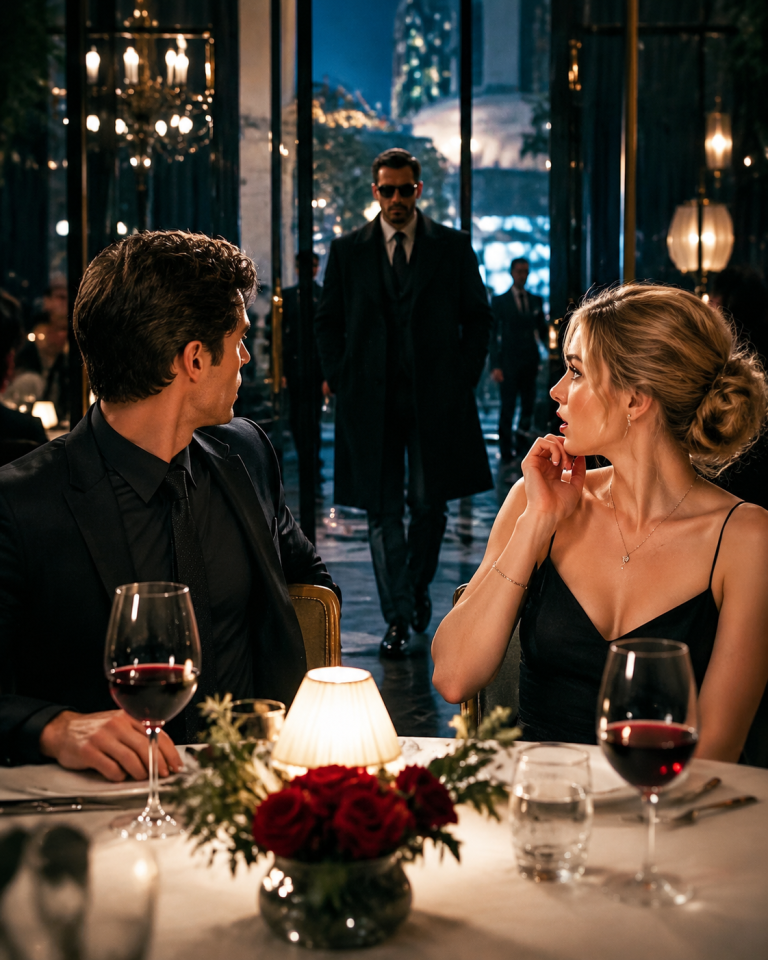
Late thirties. Dark blond hair slightly disheveled, like he’d been running a hand through it — the only thing about him that looked anything other than deliberate. Pale gray eyes. The kind of jaw that looks carved. He wore a deep navy dress shirt with the sleeves rolled to the forearms and a watch that probably cost more than my car.
His hands were on the steering wheel.
Both of them. Visible. Relaxed.
Too relaxed.
“Officer.” Not a question. His voice carried the trace of something Eastern European — Czech, maybe, or Polish, worn almost smooth by years somewhere else. He said the single word like a greeting between equals.
“License and registration.”
“I appreciate the efficiency.” He reached for the glove compartment slowly — so deliberately slow it was almost theatrical. Showing me every movement. “I should warn you that I left my wallet at the venue. The vehicle belongs to my company.” He produced the glove compartment contents: insurance card, vehicle registration. No license. “I can have someone bring documentation to whichever station you prefer within forty minutes.”
I studied him.
Normal people got nervous. They apologized too much or not enough. They over-explained. They fumbled.
This man was performing calm the way an actor performs it — technically perfect, which meant it wasn’t calm at all. It was control.
“Step out of the vehicle.”
He unfolded from the Porsche with the kind of ease that comes from being tall and knowing it. Six-one, maybe. The dress shirt was untucked on one side — that minor detail again, the only crack in an otherwise composed surface.
“Name.”
“Emeric Voss.”
He said it the same way people say *checkmate*. Like he expected a reaction.
I didn’t give him one.
“Mr. Voss. Do you know how fast you were going?”
“Ninety-four,” he said. “I was watching the gauge.”
“Then you know why I stopped you.”
“Yes.” A pause. “I simply didn’t slow down.”
My partner Reyes appeared at my shoulder, already shaking her head. She’d run the plates.
“Registered to Voss Holdings Group,” she said, voice neutral. “Insurance is valid. No outstanding warrants on the vehicle.” She glanced at me. “Driver’s another story — need to confirm identity.”
“He has no license on his person.”
Emeric Voss stood in the wash of my cruiser’s lights, hands loose at his sides, watching me work through this the way someone watches a chess problem they already know the answer to.
“Turn around, please. Hands behind your back.”
Something shifted in his expression. Not protest. Not surprise.
Attention.
Like I had done something that interested him.
He turned. I took his left wrist, then his right, and secured the cuffs. As I double-checked the fit, he angled his head slightly — not enough to be a problem, just enough to speak toward me.
“You have a cut above your left eyebrow,” he said quietly. “Three days old, approximately. You’re favoring your right side when you walk — old injury or recent?” A beat. “I’m asking because I want to know, not to unsettle you.”
I paused.
In twelve years of combined patrol experience between me and Reyes, I had been threatened, flattered, bribed, and cried at. I had never been *observed*.
“Walk to the vehicle, Mr. Voss.”
He moved without argument. I kept one hand on his arm — procedure — and felt him neither resist nor lean in. Just present. Precisely, deliberately present.
Reyes caught my eye over the roof of the cruiser. She raised one eyebrow. I gave her nothing back.
I opened the rear door. He ducked in, and just before I closed it, he turned those gray eyes up to me.
“I owe you an apology for the speed,” he said. “I don’t owe you one for this.”
“For what?”
The cruiser lights caught the edge of his expression — and for the first time, it wasn’t controlled. It was something else. Something that made the night feel suddenly quieter than it had any right to be.
“I’ve been watching you work this stop for four minutes,” Emeric Voss said. “You’re methodical. Fair. You don’t scare easily.” He held my gaze. “I need someone like that.”
I closed the door.
I told myself it was nothing. A rich man with a talent for reading people, running his mouth to get out of a citation.
I told myself that while I walked back to the driver’s side.
I told myself that when I pulled onto the highway.
I stopped telling myself that when Reyes looked up from her phone in the passenger seat, her face gone carefully blank — the expression she reserved for information she wasn’t sure how to deliver.
“Hey, Morgan.” Her voice was even. Too even. “I got his identity confirmed through the national database.”
“And?”
She turned her phone toward me.
The photo matched. The name matched. And underneath it, three lines of classification text that made my hands tighten on the wheel.
Emeric Voss wasn’t just a man in an expensive car who hadn’t bothered to slow down.
I had just put handcuffs on someone the federal government had been trying to build a case against for six years.
And he had spent the last four minutes deciding he needed me.
—
### PART 2:
The processing room at the 14th Precinct smelled like burned coffee and fluorescent light.
Voss sat across the intake table with the particular stillness of a man who had decided to be comfortable wherever he was placed. I’d removed the cuffs. He hadn’t rubbed his wrists. He just put his hands flat on the table and waited.
I set the printed database file between us.
“You want to tell me what this is?”
He looked at it. Not the way an innocent man looks at an accusation — searching for the mistake, the error in someone else’s logic. He looked at it the way you look at something you wrote yourself a long time ago.
“It’s accurate,” he said. “And it’s incomplete.”
“Federal persons of interest aren’t usually incomplete.”
“Federal files on federal operations usually are.” He looked up. “Sit down, Officer Morgan. I’ll explain what I can. But I need you to do something first.”
“You’re not in a position to make requests.”
“I know.” He said it simply, without deflection. “I’m making one anyway.” He glanced toward the door — the small window, the corridor beyond where Reyes had gone to pull additional records twenty minutes ago and hadn’t come back. “Ask her what she knew before she ran my plates.”
I went still.
He watched me go still and didn’t look satisfied about it. He looked like a man delivering a diagnosis he wishes he didn’t have.
“She recognized the name,” he said. “Before the database returned anything. I saw it — the quarter-second before she controlled it.” He paused. “You didn’t see it because you were watching me. Which is your job. But it happened.”
The fluorescent light buzzed once, then steadied.
I thought about Reyes’s voice on the highway. *Too even.* The expression I’d clocked as caution and filed as professionalism.
I thought about her suggesting we take him to the 14th specifically. Not the nearest station. The 14th.
I picked up the file and walked to the door.
—
### PART 3:
Reyes was in the corridor, phone to her ear.
She saw me coming and ended the call. Smooth, unhurried — the same composure she’d been carrying all night. I had worked beside this woman for three years. I knew the sound of her footsteps. I knew which cases kept her in the car an extra five minutes after a shift. I knew she took her coffee with nothing in it and kept a photo of her dog in her jacket pocket and laughed loudest at jokes that weren’t trying to be funny.
I thought I knew what she looked like when she was hiding something.
I’d been wrong about the specific shape of it.
“Who were you calling?” I asked.
“Dispatch. Checking on the tow for the Porsche.”
“We didn’t call a tow.”
She met my eyes. Held them. And then something in her face did what faces do when they’re done — not collapsing, just quietly giving up the performance.
“Morgan.”
“Tell me what you knew before you ran the plates.”
She exhaled. Looked at the floor once, the way people look at the floor when they’re choosing a version of the truth.
“I knew the car,” she said. “The registration. I’ve seen it in a file before.”
“Whose file?”
Silence.
Not the silence of someone thinking. The silence of someone who has already decided and is waiting to see if I’ll make it easier or harder.
“Reyes.” My voice came out quieter than I intended. “Whose file.”
“Hartwell’s,” she said.
The name landed flat and specific, the way names do when they mean something you weren’t ready to have mean something.
Deputy Commissioner Hartwell. Eighteen years on the force. The man who’d signed off on my transfer to nights, who’d shaken my hand at the division ceremony last spring, who kept a running tally of the precinct’s clearance rates on a whiteboard in his office like a coach who believed in visible accountability.
“He asked me to flag the vehicle,” Reyes said. “If it came up. He said it was part of an ongoing federal cooperation effort — that Voss was a person of interest and if we encountered him, we should bring him to the 14th and hold him while the bureau was notified.” She paused. “He said not to mention it until the stop was complete. Standard protocol for POI encounters.”
“That’s not standard protocol.”
“I know.”
“You know,” I repeated.
She looked at me directly. “I told myself it was procedural. That I didn’t need to understand the full picture to follow a deputy commissioner’s directive.” A beat. “I was wrong to tell myself that.”
I stood in the corridor for a moment. The processing room was fifteen feet behind me. Emeric Voss was inside it, sitting with his hands flat on the table, waiting.
I thought about what he’d said.
*Ask her what she knew before she ran my plates.*
He’d known she’d recognized him. He’d clocked it in a quarter-second and held onto it and handed it to me like a tool, not a weapon. Because he needed someone who was methodical and fair and didn’t scare easily.
Not to protect himself.
To protect me from walking into something without knowing what it was.
I went back into the processing room.
Voss looked up when I came in. He read my face the way he’d been reading everything since the highway — not intrusively, just with the attention of someone who relies on accuracy.
“Hartwell,” I said.
It wasn’t a question.
“Six years,” he said. “Moving money through shell intermediaries for three development groups with federal contracts. The surface is clean. The structure underneath is not.” He leaned forward slightly. “The federal file on me exists because I built it. I gave them the framework — the financial architecture, the chain of transactions. I am the case.” He held my gaze. “The bureau has been using my cooperation as cover for two years. Hartwell has a contact inside that bureau. He’s been receiving summaries.”
“He knew you were cooperating.”
“He’s been trying to discredit the cooperation for eighteen months. If I’m arrested on a state charge tonight, processed through the 14th, and held while he controls who gets notified — certain documentation I’ve been assembling goes dormant. The people holding it have instructions not to release it if I’m in custody.” He paused. “He doesn’t need to destroy the evidence. He just needs to freeze me long enough to move the accounts.”
The fluorescent light buzzed again.
I thought about Hartwell’s whiteboard. The clearance rates. The handshake at the ceremony last spring — firm, practiced, the grip of a man who had been performing trustworthiness for so long he’d probably stopped noticing it was a performance.
“How long,” I said. “How long until the accounts move if you don’t stop them.”
Voss checked the watch. The one that cost more than my car.
“Ninety-one minutes,” he said.
I stood very still.
Twelve years. Not just of shift work and traffic stops and paperwork — twelve years of believing that the system I operated inside was, on balance, worth operating inside. That its failures were friction, not function. That the people at the top of it had gotten there through something other than knowing which evidence to freeze and when.
I had believed that the way you believe something you’ve never needed to test.
I walked to the door. Opened it. Reyes was still in the corridor, phone in her hand, watching me come out.
“I need your keys,” I said.
She looked at me. At the phone. At the processing room door.
She put the phone in her pocket.
She handed me her keys.
—
I drove Voss to a parking structure four miles from the precinct — his choice of location, my choice of route. He made two calls in the back seat. I didn’t ask who he was calling because it was 4:07 a.m. and I was driving a man I had cuffed on a highway forty minutes ago to a location that wasn’t in any log, and asking questions felt less important than keeping my hands steady on the wheel.
“Old injury,” I said. “Right side. Since you asked.”
He looked up from his phone.
“Two years ago. On-duty.” I kept my eyes on the road. “I don’t favor it when I’m paying attention. I favor it when I’m tired.”
He was quiet for a moment.
“What happened?”
“Domestic call. It escalated.” I paused. “Standard answer is that I handled it fine and recovered quickly. Accurate answer is that it changed how I work nights — I run tighter procedure now than I did before. Less room for things I didn’t anticipate.”
“Is that why you’re not panicking right now?” he asked. “Because you closed the room for things you didn’t anticipate?”
I thought about it.
“No,” I said. “I’m not panicking because I’ve been watching this stop for four minutes and I’ve already decided what I think.”
In the rearview mirror, something in his expression shifted. Not calculation. Not confirmation. The specific quality of a person being understood correctly for the first time in a while.
“What do you think?” he asked.
“I think you’re telling the truth. I think I don’t need the full picture to act on that.” I turned into the parking structure. “I think Hartwell is going to know I didn’t follow his directive in about twenty minutes, and I need to be very clear about what my account of tonight is before that happens.”
“I can help with that.”
“I know you can.” I pulled into a space on the second level and cut the engine. “That’s not the same as trusting you.”
He accepted that without argument.
We sat in the parked car for a moment. The structure was quiet — a few other vehicles, the distant sound of the city doing its ordinary, continuous thing twelve stories below.
“The documentation,” I said. “The accounts. What happens if your people move fast enough?”
“Then it holds,” he said. “The whole case holds. And Hartwell’s contact in the bureau gets identified in the process.” He paused. “It’s not a clean ending. These things aren’t. But it’s an ending.”
“And you.”
“I go back to being a very boring private citizen who drives too fast.”
I looked at him in the rearview mirror.
“Ninety-four,” I said.
“I was watching the gauge.”
“You said that already.”
“It was still true.”
I got out of the car. He got out on the other side. We stood on the second level of a parking structure at 4:19 in the morning, and whatever this night had been — a traffic stop, an ambush, a choice I’d made without enough information and too much instinct — it was resolving into its shape now. Becoming the thing it had actually been all along.
“The cut above your eyebrow,” Voss said. He wasn’t looking at me. He was looking out through the concrete barrier at the edge of the city going pale at the horizon. “How did it happen?”
“Cabinet door,” I said. “At home. I wasn’t paying attention.”
He nodded once, like this confirmed something he’d already suspected. Like the gap between who I was on a traffic stop and who I was in my own kitchen was information he found relevant.
“Get some sleep,” he said. “After this.”
“I have a statement to write.”
“After the statement.”
I put Reyes’s keys in my jacket pocket. I’d give them back in person. That conversation was going to be its own thing — not a punishment, not an absolution. Just two people who had been working beside each other for three years figuring out what that meant now, honestly, in daylight.
I drove back to the precinct.
The sun was coming up off the highway the way it does in late spring — not dramatic, just persistent, filling in the dark by degrees until you look up and it’s already happened. I rolled the window down. Cold air, the smell of wet asphalt, the freight truck from earlier parked at a rest stop with its running lights on.
I hadn’t made the right call. I’d made *a* call, under incomplete information, with the tools I had.
That was the only kind of call there was.
At the precinct, I signed into the building, poured myself coffee from the machine in the break room — bad coffee, the kind that tastes like the container it came from — and sat down at my desk.
I opened a blank document.
I started with the time: 2:53 a.m.
I wrote exactly what happened, in order, without omission.
It took forty minutes. When I finished, I read it back once and didn’t change anything.
Then I drank the rest of the coffee, which had gone cold.
I didn’t make a second cup. I didn’t need to.
—
**THE END**