Mountain Man Won the “Worthless” Bride in a Poker Bet — Then Her Hidden Identity Changed Everything

—
## PART 1
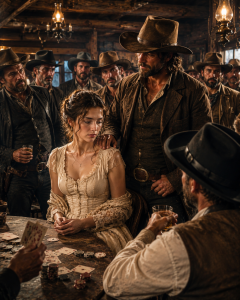
Smoke hung thick under the ceiling of the Silver Creek Saloon, and the whole room had the particular ugly cheer of men who suspected they were about to watch someone else lose something worth keeping. Cards slapped wood. Whiskey burned throats going down too fast. Across the table from Caleb Stone sat a drifter named Garrett — mean eyes, a crooked smile, and nothing left to bet after three bad hands running. No money. No cattle. No horse worth the ante.
“I’ve got a woman,” Garrett said, like it settled something.
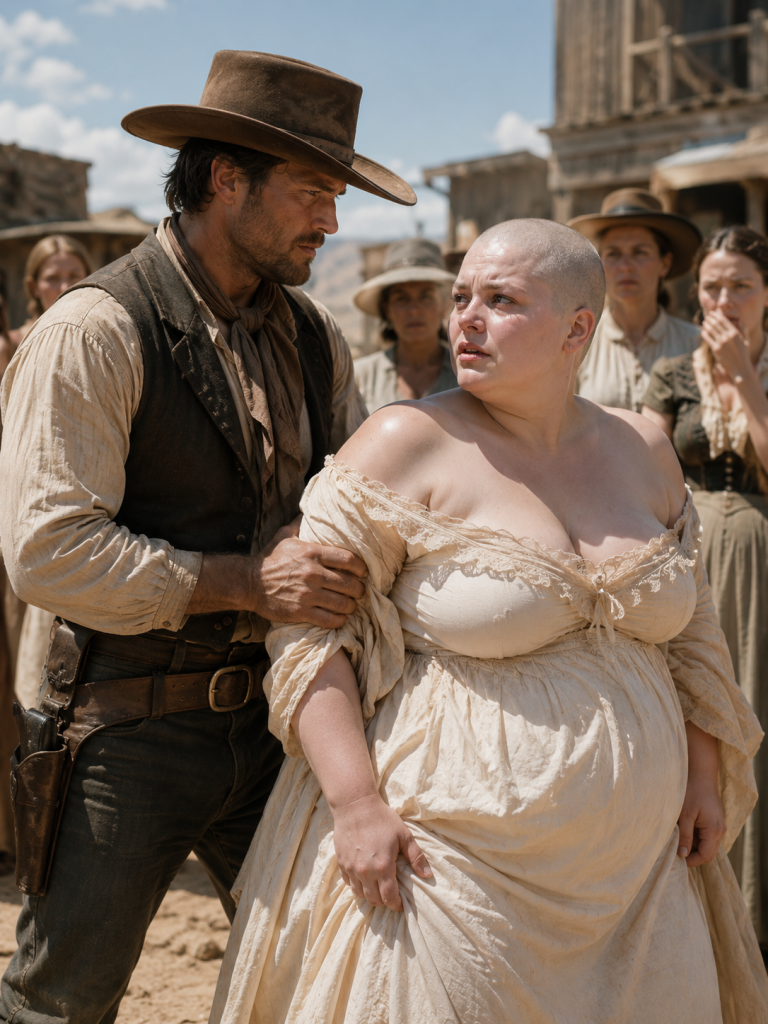
They dragged her in rough, hands bound with rope gone loose from wear rather than mercy, dirt ground into her face and dress. She kept her eyes on the floorboards. Some men laughed. Others looked at her the way they’d have looked at a horse up for auction — which was, Caleb understood later, closer to the truth of what was happening in that room than anyone wanted to say aloud.
Thomas Dalton studied her longest of anyone. The richest rancher in the territory sat with his drink untouched, his eyes moving over her the unhurried way a man appraises land he already half intends to buy. Then he shook his head and folded his hand.
“Not worth the pot,” he said, and something in how carefully he said it — not dismissive, calculated — would mean nothing to Caleb until months later.
“I’ll take the hand,” Caleb said.
The laughter got louder. Caleb Stone was forty-five years old, shoulders worn broad and hard by seven winters on rocky ground that fought him every season, a mountain man who’d buried a wife and a newborn son under the cottonwood behind his own cabin and hadn’t shared a table with another living soul since. He was not a gambler. That night, he played anyway, because something in the woman’s stillness had struck him harder than the whiskey had.
Garrett dealt. The room leaned in. When the last card turned, Caleb held a pair of kings against Garrett’s tens, and it was over before the noise in the saloon had finished rising.
“Worst bargain in Montana!” someone shouted as Caleb stood.
“Untie her,” he said, and didn’t wait to see whether the room approved.
Garrett cut the rope with a curse and left without looking back. Caleb looked at the woman properly for the first time. Her face was thin but held itself steady; her eyes, when they finally came up to meet his, weren’t broken — just tired, in the specific way of someone who has spent a long while deciding what she can and cannot afford to feel in front of strangers.
“What’s your name?” he asked.
She hesitated. “Does it matter?”
“It matters to me.”
“Eleanor.”
“Caleb Stone. I’ve got a homestead up in the mountains. Honest work, is all I’m offering. You’ll be safe there.” He said it plain, the way he said most things. “That’s the whole of it. Safe.”
She searched his face for the cruelty she’d learned to expect from men who said kind words in rooms like this one. She didn’t find it. They rode out into the cold Montana night while the saloon behind them kept laughing about the fool mountain man and his worthless prize — and neither of them saw Thomas Dalton, still seated at his table, watching the door long after it had swung shut behind them, his drink still untouched.
Caleb’s cabin sat at the edge of a hundred and sixty acres that had barely kept him alive seven years running — soil that fought every seed he’d ever put in it, mountains rising behind the place like judges withholding a verdict. Snow still clung to the high peaks though it was late April. Inside, the cabin was clean but hollow: a fireplace, a table, a bookshelf, and a small room off the back that had once been meant for a child who never lived to fill it.
“You can sleep there,” Caleb said quietly, nodding at the small room. “I’ll stay out here.”
She stepped inside without another word.
That night Caleb sat alone at his table longer than usual, wondering if he’d just invited trouble into a life that had finally, after seven years, stopped actively trying to kill him. He didn’t know yet that the woman sleeping in his spare room carried knowledge that would change both their lives past recognizing — and he didn’t know that somewhere down the mountain, Thomas Dalton had already sent the first of several telegrams east, quiet and unhurried, the way a careful man starts building a case long before he needs it.
Before dawn Caleb rose to light the fire, boiled coffee, and stepped to the window — and froze. Eleanor was outside, kneeling in his frozen field, hands pressed deep into dirt still hard with the last of the cold. For a moment he thought grief or shock had unmoored something in her. He grabbed his coat and went out to her, frost cracking under his boots.
She didn’t look up right away. Her fingers moved slow through the soil, testing, lifting a handful, letting it fall.
“I’m sorry,” she said quickly, noticing him. “I should have asked.”
“For what?”
“For examining your soil.” She brushed dirt from her palms, and when she spoke again her voice had lost the careful flatness of the night before. “Your land is alkaline. That’s why wheat keeps failing you. But underneath the mineral content is strong — the clay holds moisture better than you’d think. You’re fighting this ground instead of working with it.”
Caleb stared at her. The quiet, dirt-streaked woman from the poker table was talking like a professor. “How do you know that?”
“My father was Professor Edmund Hartwell, of Philadelphia. A botanist. We traveled the frontier for years studying plants and soil — he taught me most of what he knew, because there wasn’t a university in the territories that would enroll a woman to learn it properly herself.” The words came out steadier now, clearer, something coming back to life behind them. “He died six months ago. After that, most men stopped seeing a person with knowledge and started seeing an opportunity instead.”
Something tightened in Caleb’s chest that he didn’t have a polite word for. She reached into her coat and drew out a small leather pouch.
“Seeds,” she said. “Rare strains — hardy varieties my father collected across a dozen territories before he died. Planted right, they could change ground like this.” She looked out over his rocky, half-frozen field. “Not in straight rows. In communities. Some fix nitrogen back into the soil. Some repel pests without a hand ever touching them. Some shade the ground so it holds water through a dry month.” She glanced at him. “If you’ll let me.”
Caleb thought of the laughter still ringing in his ears from the saloon, of the word *worthless* thrown after them like a stone. He thought of the two graves behind his cabin and every Sunday he’d stood over them asking a God he wasn’t sure was listening for something like strength.
“This is your home now,” he said. “If you believe this land can live, we start today.”
For the first time since he’d met her, Eleanor smiled — small, and real, and entirely unguarded, the kind of expression a person only offers once they’ve decided a place is safe enough to risk it in.
They were still kneeling in the half-thawed dirt an hour later, sorting seed by strain, when neither of them noticed the glint of a field glass catching morning light on the ridge above the property line — Thomas Dalton, alone on horseback, watching the whole of it through a lens with the same unhurried patience he’d shown at the card table, already turning over exactly how a man went about proving a woman had belonged to him before she ever belonged to anyone else.
—
## PART 2
By midsummer, the men who’d laughed loudest in the Silver Creek Saloon were riding up Caleb Stone’s mountain road with wide eyes and empty wagons, hoping someone would explain to them what they were looking at. Ground that had looked tired and stubborn for seven straight years now rolled green and thick with life — beans climbing tall poles beside corn, squash leaves spread wide across the soil holding in moisture, bright marigolds bordering every bed like a line drawn on purpose. The dirt itself looked darker. Richer. Alive in a way rock-hard Montana ground had no business being.
“This was stone and dust last spring,” Mr. Pulson muttered, pulling a carrot from the earth thick and straight and sweeter than anything he’d tasted off his own land. “How in God’s name did you do this?”
Eleanor didn’t boast. She knelt in the soil the same way she had that first morning and explained it plain — how certain roots fed the ground instead of stripping it, how different plants stood guard for each other, how a season’s waste turned to strength if a person knew how to let it rot right. She spoke with a quiet, unhurried confidence, and men who’d have laughed her out of a saloon six months back listened like she was reading scripture. Caleb watched her teach half the territory how to survive its own dirt, and felt something swell in his chest that had nothing to do with the harvest.
When harvest came in, it shocked everyone. Potatoes twice the usual size. Beans hanging heavy on the vine. Word spread through the territory faster than the crops themselves, and families started riding for miles just to ask Eleanor’s advice. She never turned a single one away — shared seed, shared knowledge, shared whatever hope she had left over once her own field was seen to.
But success draws attention, and attention from a powerful man rarely stays harmless for long.
One evening Pulson rode up hard, his horse lathered white. “Dalton’s been asking about her,” he said, barely getting the words out even. “About Eleanor. About her father. Sending telegrams east for weeks now. He’s digging.”
Caleb felt the air in his own chest go tight. Dalton hadn’t laughed the night of the poker game — he’d watched, and folded, and Caleb understood now that both of those had been calculations, not indifference.
“What’s he want?” Caleb asked.
“What he always wants,” Pulson said. “Control.”
The following week a letter arrived in town — Dalton offering Eleanor a position on his ranch as an agricultural consultant, a generous salary, respectable arrangements, everything dressed up proper. Eleanor folded the letter without much ceremony and handed it to Caleb.
“I already refused him,” she said.
“Good,” Caleb said, and meant it, and neither of them yet understood that Dalton had never once, in his whole calculating life, accepted a refusal as an answer rather than an opening move.
Rumors started within the week. Whispers that Eleanor had once belonged to someone else. That her presence in Caleb’s cabin was improper. That a woman with her knowledge ought to be under better supervision, for the good of the territory.
One crisp October morning a carriage rolled into the settlement carrying Judge Blackwood down from the territorial capital, and by noon the whole town had crowded into the meeting hall to hear why. Caleb and Eleanor walked in hand in hand. Thomas Dalton stood at the front already, dressed fine, face calm as still water.
“Mr. and Mrs. Stone,” the judge began. “There are legal questions concerning your marriage, and Mrs. Stone’s status prior to it.”
“Our marriage is legal,” Caleb said, flat and certain.
Dalton stepped forward, smooth as a man who’d rehearsed the motion a dozen times in front of a mirror. “Your honor, I have documents showing that before Mr. Stone won her in that card game, Eleanor Hartwell was already bound to me — an indenture of service, signed by her late father to satisfy a debt owed for travel and equipment I’d advanced him. Mr. Stone acquired, unknowingly, an obligation that was already mine.”
Gasps moved through the hall like wind through wheat. Eleanor’s fingers tightened around Caleb’s hand hard enough to hurt.
Dalton laid the papers on the table — a signed contract, witness marks, a notary’s stamp pressed dark into the corner.
“Forgery,” Eleanor said, and her voice carried clean across the whole crowded room.
—
## PART 3
“My father owed no man in this territory a debt of any size,” Eleanor went on before Dalton could recover his rhythm. “He kept his own accounts to the penny his entire life. That paper is a lie dressed up in a notary’s stamp, and I’ll say so in front of any court you care to bring it to.”
Dalton’s calm didn’t crack — not yet. “According to this contract, your services were assigned to me for a term of five years. Mr. Stone’s marriage, whatever its intentions, was entered into against an existing legal claim. I’m not asking the court to punish anyone. I’m asking it to recognize an obligation that predates his.”
“I am not property,” Eleanor said, and the room went utterly still around the words. “I am the daughter of Professor Edmund Hartwell of Philadelphia. A free citizen of this country, same as any man standing in this hall.” She laid her own papers on the table beside Dalton’s forgery — her father’s will, newspaper clippings from three different cities documenting his lectures and his standing, the medal the Academy of Natural Sciences had struck in his name the year before he died. “These are not the papers of a man who died in debt to a Montana rancher he never once mentioned in six years of letters home.”
Judge Blackwood studied both sets of documents a long while, his face giving away little. Dalton leaned in, unhurried. “Then let the matter be settled properly, at the capital, thirty days from now.” His eyes moved, deliberate, to Eleanor. “Until then, perhaps Mrs. Stone should be placed under protective supervision, given the questions surrounding her status.”
The word *protective* landed in the room like a threat dressed in church clothes.
Mrs. Henderson was on her feet before the judge finished speaking. “That woman has done more for this settlement in six months than Thomas Dalton’s done in the six years I’ve known him,” she said, and other voices rose up around hers — farmers Dalton had squeezed on debts before, families who’d sat at Eleanor’s table learning how to save their own dying fields. The judge raised a hand for quiet, and it came, slow and reluctant.
“The hearing will take place in thirty days, at the capital,” he said. “Until then, Mrs. Stone remains with her husband.”
Thirty days. Outside the hall, Eleanor stood very still in the cold. “He won’t stop,” she whispered.
“Then we make sure he can’t take you,” Caleb said.
That night, under a sky gone hard and bright with stars, Caleb made a decision he’d been circling since the poker table without letting himself land on it. “Marry me properly,” he said. “Not the winning of a hand, not witnesses in a saloon full of men who’ll forget the night by morning. Legal and binding beyond any question a man like Dalton could raise.”
“Are you certain?” Eleanor asked.
“I lost a wife once,” he said, quiet. “I won’t lose another one to a piece of paper some fool notary sold for a price.”
They rode through the dark to Silver Creek, where a justice of the peace married them in his own parlor with his wife standing witness — no flowers, no music, just plain vows spoken without flinching. When Caleb slipped a simple gold band onto her finger, Eleanor’s eyes filled.
“Thank you,” she whispered.
“For what?”
“For seeing me.”
They rode home under the stars as husband and wife in fact as well as name. But even as they crossed their own threshold, Thomas Dalton was already three moves ahead of them, and the thirty days had already begun ticking down toward the capital.
Caleb didn’t spend those thirty days waiting. Two mornings after the hearing, he rode down alone before Eleanor woke, telling her only that he had business in town. He went further than town. He rode two full days to the territorial capital itself, carrying with him everything Pulson had told him about families Dalton had pressured out of their claims over the years, and asked, plain and blunt, to speak with the federal marshal’s office about a pattern of land fraud he had reason to believe ran deeper than one forged contract.
“I’ve got no proof beyond rumor and a bad feeling,” Caleb told the deputy marshal who finally agreed to see him. “But I’ve got names of three families who lost land to paperwork that came together awful convenient right when Dalton needed it to. Somebody ought to be looking at that, whatever happens with my own wife’s hearing.”
It wasn’t a promise of help. The deputy wrote the names down and said only that the office would look into it, and Caleb rode the two days home without knowing whether it had mattered at all.
Back on the mountain, Dalton worked his own thirty days just as hard. He rode to the families Pulson had named — quiet visits, no threats spoken plain enough to repeat in a courtroom, only reminders of debts still owed and favors that could still be called in. Two families went silent after those visits, unwilling to risk what little they had left. A third, the Millers, had sat at Eleanor’s table in June learning how to save a wheat crop that would otherwise have failed them entirely, and when Dalton’s man came around reminding them what they owed him, old Ada Miller sent her boy up the mountain instead, with a note asking only whether Eleanor thought it was worth the risk to speak plain when the time came.
“Tell your mother I can’t answer that for her,” Eleanor said, reading the note by lamplight, her hand not quite steady. “But tell her I’ll be standing up regardless, and I’d rather not stand up alone.”
It was during that same stretch of days that the first real crack opened between Caleb and Eleanor — not from Dalton’s doing, but from the ordinary weight of fear finding the wrong place to land. Eleanor overheard him one evening, low-voiced with Pulson on the porch, saying he didn’t know what he’d do if Dalton took her — *lose the only hand this land’s ever had that knows what it’s doing, on top of everything else.* She said nothing that night, but the next morning she was distant in a way he felt without being able to name, and by supper he’d noticed enough to ask.
“You said it yourself, plain as anything, to Pulson,” she said finally, not looking up from the stove. “If Dalton takes me, you lose the harvest too. Like that’s the shape of what frightens you most.”
“That’s not what I—”
“I know it isn’t all of it,” she said, cutting him off gentler than the words themselves. “But it was the whole of what you said out loud, and I’ve spent longer than I care to admit being valued for what I could grow instead of who I was underneath it. I’d hoped this house might be different.”
Caleb sat with that a long moment, turning his cup in his hands the way he did when a thing needed saying slow. “I buried Miriam and the boy without ever getting to say a proper goodbye to either of them,” he said finally. “Fever took them both inside four days, and by the time I understood how bad it was, there wasn’t a thing left to do but dig. I don’t talk easy about losing people, Eleanor, because talking about it plain means admitting how much it’d take out of me to go through it twice. What I said to Pulson was fear wearing the wrong words. I’m not scared of losing what you grow. I’m scared of losing you, and I said the coward’s version of that instead of the true one.”
Eleanor turned from the stove to look at him properly, and something in her face eased by degrees. “Next time,” she said, “say the true one first.”
“I’ll try,” he said, and she came and sat across from him, and it wasn’t fixed entirely in that one evening, but it was mended enough to hold.
The morning of the hearing came cold and sharp. Caleb and Eleanor rode down from the mountain before sunrise, frost clinging to fields that had once been barren and now stood green with everything her hands had built into them. Caleb looked back once before the trail turned and made a silent promise to the land as much as to her: whatever happened today, he would not lose her.
The settlement hall in the capital was already crowded past its benches when they arrived — farmers along every wall, women standing three deep at the back, even men who’d laughed loudest in the Silver Creek Saloon come to see how it landed. Thomas Dalton stood near the front, dressed in black, composed as ever, a man who still believed the world owed him its patience.
Judge Blackwood took his seat. “Let us proceed.”
Dalton went first, laying the same forged indenture on the table, speaking smooth and reasonable about legal transactions and territorial order, making the theft of a person sound like nothing more than a contract dispute between honest men. Caleb felt the old anger rising and made himself sit still through every word of it, the way he’d learned to sit still through a bad winter — not because the cold didn’t matter, but because moving too soon only wasted what strength he had.
Then Eleanor stood, and this time she did not shake.
“I was kidnapped,” she said, clear enough to carry to the back wall. “My father had just died. We were alone in the wilderness with nothing left to defend ourselves. Three men attacked our camp, took what little we had, and dragged me away. I never signed a contract. I never agreed to serve anyone. What those men did to me was a crime, your honor, and what Thomas Dalton is attempting in this hall today is the same crime, dressed up in a notary’s stamp instead of rope.”
Dalton’s lawyer — a thin, careful man who had said little until now — rose to object that the accusation was unsupported. Eleanor didn’t wait for the judge to rule on it.
“Ask your notary,” she said, turning on the man directly, “how he came to be in this territory at all. I’ve spoken with the county recorder’s office myself this past month, your honor, and the man whose stamp appears on this contract wasn’t appointed to his post until four months after the date written on that page. He could not have witnessed a signing that, by his own commission, hadn’t happened yet.”
A murmur went through the room. Dalton’s composure held, barely, but his lawyer’s face had gone the particular gray of a man realizing his case had a hole in it he hadn’t checked for.
Before the judge could rule, the doors of the hall opened, and every head turned. A tall man in a federal marshal’s coat stepped through, two deputies behind him.
“Marshal Clayton,” someone near the front whispered, and the name moved back through the crowd like a struck match.
The marshal walked straight to the front. “My apologies for the interruption, your honor,” he said, calm and unhurried, “but this matter’s grown considerably larger than a single contract dispute over the past thirty days.” He set a folder of his own papers beside the disputed indenture. “We’ve had ink and paper analysis done on this document at the territorial office. The stamp doesn’t match dates the notary himself can account for — a fact Mrs. Stone appears to have already established for the court. We’ve also taken sworn statements from three families in the Silver Creek district describing a pattern of forged land transfers going back better than five years, and from a man named Garrett, found working a claim two counties over, who states under oath that Thomas Dalton paid him to leave the territory the same week he lost a card game he’d never intended to actually lose.”
The room went dead quiet.
“This is absurd,” Dalton snapped, the first crack finally showing plain in his voice.
“You’ll have the chance to say so under oath,” the marshal said. “Thomas Dalton, you’re under arrest for fraud, forgery, and conspiracy.”
“You can’t do this,” Dalton said, backing a step as the deputies came forward. “I built half this territory.”
“You stole a good part of it too,” the marshal replied, “which is what we’re here about.”
The deputies had irons half raised when Dalton twisted sideways, faster than a man his age had any business moving, and pulled a small pistol from inside his coat. The shot cracked through the hall like a roof beam giving way.
Caleb moved without thinking. He put himself between the barrel and Eleanor a half-second before it fired, and the bullet caught him high in the shoulder and dropped him to the floor in a spray of splinters and noise. Screams broke out across the hall. The deputies had Dalton pinned before he could bring the pistol level a second time, the weapon clattering loose across the boards.
Eleanor was on her knees beside Caleb before the echo had finished, her hands pressed hard against the wound, her voice steadier than her face. “Stay with me.”
“I’m here,” Caleb managed through his teeth.
The doctor’s office was three buildings down. They carried him there while Eleanor walked alongside, refusing every offer to be moved out of the way. The wound was bad but not fatal — the bullet had missed the bone by a margin the doctor called plain luck and nothing more. When the bandaging was finished, Caleb looked up at her.
“Told you,” he said, quiet. “Wasn’t going to lose you.”
“You took a bullet to keep that promise,” Eleanor said, tears sliding down even as her voice held. “I’d have you keep it a gentler way next time, but I’ll take it however you mean to give it.”
Back in the hall, Judge Blackwood restored order and delivered his ruling before the crowd had fully settled. “The marriage between Caleb Stone and Eleanor Hartwell Stone is fully legal and recognized by this court. The claims brought by Thomas Dalton are fraudulent and void, and this court finds no obligation, past or present, binding Mrs. Stone to any man but her husband.” Applause broke out before he’d finished the sentence.
It wasn’t only their marriage the ruling saved. In the weeks that followed, the marshal’s investigation opened the whole of Dalton’s dealings to daylight — years of forged transfers, families quietly bled off their claims through debts manufactured the same careful way the indenture had been, silence bought with fear where it couldn’t be bought with money. Families came forward one by one, emboldened by the first crack in a wall they’d thought unbreakable. Land was returned where it still could be. Dalton was tried, convicted, and sentenced to a term in the territorial prison that would keep him well clear of Silver Creek for the whole of it.
Winter came quiet to the mountains that year, but the cabin didn’t feel cold the way it once had. Six months on, spring returned in earnest — snow melting off the high peaks, green pushing up through soil that had spent seven stubborn years refusing to give a man anything before Eleanor knelt in it and asked it properly instead of fighting it. She stood in the field one evening with a rounded belly beneath her dress, expecting their child by summer, the seed catalog she’d finished compiling from her father’s notes already printed and spreading through three territories, letters of thanks arriving from settlers as far off as Wyoming and Idaho.
Caleb’s shoulder still ached when the weather turned, and he’d come to welcome the ache rather than resent it — a reminder, plain and physical, of exactly what he’d fought to keep.
“Do you remember,” Eleanor asked one evening, standing beside him in the same field where she’d first knelt in the frost, “when they called me worthless?”
“They said I’d made the worst bargain in Montana,” Caleb said, and something almost like a smile pulled at his mouth.
“And what do you think now?”
He put his hand over hers, resting where it lay against the curve of her belly. “I think I won the best thing that’s ever happened to me, and I didn’t understand what I was holding until long after the cards were already down.”
The mountains stood tall behind them the way they always had, no longer looking like judges withholding a verdict but like something closer to witnesses. The fields stretched green in front of the cabin where a crib now waited by the window. A drunk hand of cards had brought them together by accident. Everything after that — the trust, the truth-telling, the thirty days of quiet work neither of them had done alone — was what had actually kept them.
As the stars came out over Silver Creek, Caleb held Eleanor close, and neither of them needed to say out loud that the world sometimes laughed loudest at exactly the thing it would later turn out to owe the most to.
**THE END**