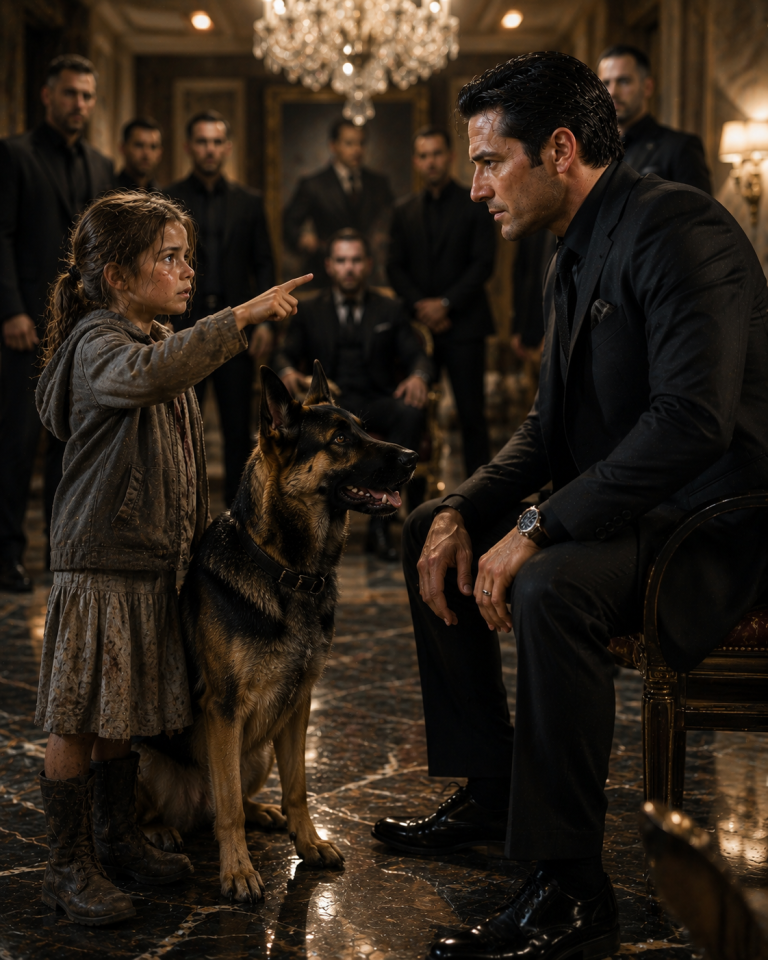
Mafia Boss Stunned When a Little Girl Spills His Coffee—Then the Truth About His Dead Wife Hits Him

## PART 1
I had been sitting in the same chair at the same table in the same café every Monday and Wednesday afternoon for three years, and in all that time nobody had touched me.
Nobody touched the coffee either, until it was in my hand.
My name is Cormac Riordan, and I am the kind of man Boston’s North End describes in whispers and denies in daylight. The harbor has heard my name. Certain judges have heard my name. Men who owed me debts and men who wished they didn’t have both heard my name spoken in their direction exactly once, which was always enough.
I say this not out of pride.
I say it because the afternoon a child changed my life, it is necessary to understand what the room was.
Gallagher’s was a corner café on Salem Street that had existed in some form since before my father was born. The coffee was mediocre and the lighting was amber and the owner, a woman named Brigid O’Halloran, put out fresh flowers every Tuesday whether anyone noticed or not. I came for the silence. I came because Caitlin had loved it here, and for three years coming to the place she had loved was the closest I had found to something that did not feel like moving away from her.
I came every visit at the same time.
I sat at the same table — corner, back to the wall, clear sightline to the door.
My coffee arrived in the same cup. Brigid’s late husband had painted the bottoms of all her crockery with small individual markings — a habit from a large family of identical dishes — and mine had a ring of pale blue around the base that Caitlin had noticed first and called it *the sky cup*. She had told Brigid, and Brigid had reserved it, and three years after Caitlin’s death it still came to my table because Brigid understood that certain small continuities were the architecture of surviving grief.
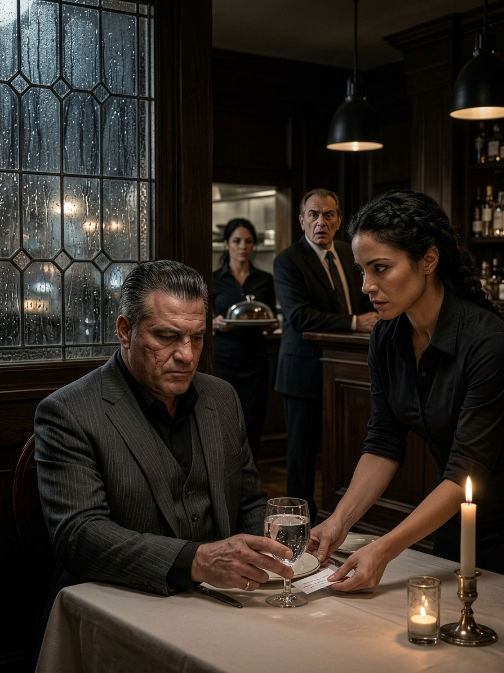
My security, four men this particular afternoon, were positioned with the professionalism of people who had been doing this long enough to make it look like they were simply eating pastry.
Across the table sat Frank Moran.
Frank controlled the waterfront unions from Charlestown to Eastie, which made him either my most necessary ally or my most dangerous problem depending on the week. Last month, two of my men had been hurt in a cargo dispute that had his name on the edges without his hands on the center. We were here to decide whether the edges were enough to burn everything down or whether the money was better than the grievance.
I had decided, somewhere over the drive here, that it was probably better.
Frank appeared to have decided the same.
I reached for the coffee.
That was when the girl hit my wrist.
She came from the left, between two tables, fast enough that my security were still processing the movement when her small palm connected with the side of my hand and sent the cup across the tablecloth.
It fell from the table in what felt, absurdly, like slow motion.
Hit the floor.
Broke.
Coffee spread across the worn tile in a dark, still pool.
The café went silent the way rooms go silent when something wrong has entered them.
Four sets of hands were moving under four separate jackets.
Frank Moran had pushed back his chair.
And the child — eight years old at the most, copper-haired, in a blue wool sweater two sizes too large, with gray eyes that were currently fixed on my face with the terror of someone who has done a brave thing and is now absorbing the consequences — stood very still beside the shattered cup and said nothing.
I raised one hand.
The hands under the jackets went still.
Everyone waited.
I leaned forward slowly and looked at the broken pieces on the floor. There was a particular shard near my foot, curved from the base of the cup, and I turned it over with two fingers.
The base was smooth.
Unmarked.
No ring of pale blue.
This was not the sky cup.
This was not my cup at all.
I straightened. The room was still so quiet I could hear the street outside, the particular November sound of Boston traffic in the cold.
I looked at the child.
She was trembling inside the too-large sweater but she had not looked away from my face, which told me everything I would eventually need to know about her.
“What’s your name?” I asked.
“Nell Carey,” she said.
Her voice was steady. I respected that.
“How did you know that wasn’t my cup?”
She hesitated for one beat. “Yours has a mark on the bottom. A blue circle. This one doesn’t.”
Frank laughed. Once, without warmth. “Cormac, she’s a child.”
I kept my eyes on her. “What else?”
Nell’s chin lifted slightly. “The flowers are wrong. Mrs. O’Halloran always puts the red ones on your table. These are white.”
I turned my head to the small vase between me and Frank.
White carnations.
I had not noticed.
Nell said, in a voice small enough that only I could properly hear it: “My grandmother says white flowers mean someone is already gone.”
The air in the café changed.
My security felt it. I could tell by the way they stopped performing inattention and started being actually, specifically alert.
I looked at the white flowers.
I looked at the wrong cup, broken on the floor.
I looked at the child, who was still watching me, and in her gray eyes I saw the very particular expression of someone who knows more than they’ve said and is trying to decide if the rest of it will land safely.
“Who carried the coffee to this table?” I asked.
And Nell’s face went pale.
Not with guilt.
With recognition.
The kind that comes when something you thought was only a feeling suddenly hardens into fact.
Whatever she had seen, she had not yet said.
And I understood, from the way the color left her face, that what she was about to tell me was going to split the afternoon in two.
—
## PART 2
“Not Mrs. O’Halloran,” Nell said. “The new man. He has a tattoo on his inside wrist. Like a small anchor.”
At the counter, Brigid O’Halloran put her hand flat on the surface to hold herself steady.
Frank Moran reached for his own espresso.
“Don’t,” I said.
He stopped.
His expression moved from irritation to something more honest. A single second of recalculation.
I stood. “This meeting is postponed.”
“We had terms.”
“We had terms before someone changed my cup.” I looked at Frank squarely. “If that was you, you should leave now and we’ll settle it differently. If it wasn’t, then you have a problem you don’t know about yet, and you should be as interested in finding it as I am.”
Frank held my gaze for three full seconds.
Then he sat back.
“Find it,” he said. “Then we talk.”
I turned to Nell.
She was still standing beside the broken cup, very upright, waiting for the verdict.
“Sit at this table,” I said. “My table, not yours. Do not touch anything. Do not eat or drink anything that wasn’t already in your hand when you came over.”
She crossed to the chair and climbed into it, feet dangling above the floor.
I walked to the counter.
The new barista had his back to the room, wiping the same square of steel counter with the fixed attention of a man who is concentrating on not being noticed. He was young, with sharp shoulder blades visible through his shirt and a stillness that was entirely the wrong kind.
“What’s your name?” I said.
He turned. The smile that appeared died before it completed itself.
“Owen.”
“Owen what?”
“Trainor.”
I looked at his wrist. Above the cuff, barely visible, a small dark anchor.
I nodded once to my security.
They moved without theater.
Owen Trainor didn’t run. He looked at the door, calculated, and looked back at me, and made the sensible decision.
Brigid crossed herself quietly from behind the counter.
My phone was already in my hand.
“I need a full tox screen on coffee and broken cup. Porcelain and liquid. Priority. Discretely.”
I ended the call and went back to the table.
Nell was sitting exactly where I’d told her. Her hands were folded on the tablecloth. She had a book in a bag under her chair — I could see the spine — but she hadn’t reached for it. She was watching the room with the patient, cataloguing attention of someone who had been sitting in adult spaces and learning them for a long time.
“You come here often,” I said. It was not a question.
“My mom works in the kitchen on Wednesdays. I come after school and do homework.”
“And you noticed my cup.”
She shrugged with one shoulder. “You always have the same one. I noticed a long time ago.”
“Why pay attention?”
She looked at the window, then back at me. “You looked lonely. Lonely people have habits. It’s easy to learn their habits because they don’t change them.”
I sat with that for a moment.
“Your mom works here,” I said.
“Yes.”
“What’s her name?”
“Meg Carey.”
The kitchen door opened at that exact moment, and a woman came through still tying her apron, her eyes going immediately to the child at my table with the specific targeted urgency of a parent who has registered something wrong in the room and is triangulating her child’s location at speed.
I had sent men into burning buildings.
I had watched negotiations that determined whether fifty people went home or didn’t.
I had never seen anything move quite like a mother who doesn’t yet know what has happened but knows enough to run.
She stopped two feet from the table.
“Nell—”
“I’m okay,” Nell said immediately. “I didn’t do anything bad, Mom.”
Meg Carey looked at me.
I looked at her.
And then, because I had been watching people’s faces tell the truth for thirty years, I understood two things at once:
She had not known about the cup.
But she knew who had sent Owen Trainor here.
The guilt on her face was not a criminal’s guilt. It was smaller, older, more human than that — the guilt of someone who had been asked to do one thing and had not known what it would be used for, and had just understood.
She was already about to tell me everything.
But before she spoke, my phone buzzed.
The lab.
The fastest result I had ever received.
Because what was in that coffee was something you did not slow-walk results on.
—
## PART 3
Foxglove extract.
Digitalis purpurea. Processed, concentrated, low-dose in the cup.
My doctor, when I called from the office behind the kitchen, was very specific. In a healthy man my age, the likely result would have been a difficult night and questions. In a man with a compromised heart — recent cardiac event, existing condition, pacemaker — it could stop the muscle in under half an hour with the presentation of natural failure.
Frank Moran had had a cardiac stent placed nine months ago.
I had known about it because I knew most things about men I met for important conversations.
Whoever had arranged this had known it too.
Frank had not been meant to survive this afternoon.
And when he didn’t, every South Boston and waterfront connection Frank had would have looked at the last man he was seen with. The last table. The last cup of coffee, poured at my usual table, on my usual afternoon, in my usual café.
Not an assassination.
A frame.
The knowledge of it settled into my chest with the weight of something I had been carrying for longer than this afternoon, even if I hadn’t known that yet.
I sat in Brigid’s office on a small chair, the kind meant for filing and admin and not for moments like this, and thought through who had the necessary architecture of information.
My schedule. My cup. My table. Brigid’s flower habits. Frank’s heart. The camera system that, when I checked it twenty minutes later, had been manually paused at three fifteen — forty minutes before I arrived. The temp agency, which had sent Owen Trainor that morning in place of Brigid’s regular Thursday help.
Not an outsider guessing.
Someone close.
The list of people with this much knowledge was short.
My father, Eamon Riordan, retired and spending most of his time between Brookline and Florida and his own considerable history.
My cousin, Donal, who handled logistics and had access to my schedule.
And Thomas Keane.
Thomas had been my head of security for eleven years. He had been at Caitlin’s funeral. He had been the man I called the night two of my people were hurt in Charlestown. He was methodical, loyal, experienced, and had received from me, approximately fourteen months ago, a refusal.
He had come to me about his brother-in-law.
Patrick Meehan, who had married Thomas’s sister Siobhan two years earlier, had a reputation that predated the marriage and had not improved after it. Siobhan had come to Thomas with photographs. Thomas had come to me.
I remembered the conversation.
I had been in the middle of a negotiation about a container dispute at Pier Seven. Thomas had come in during a break — which itself was unusual, Thomas understood timing — and laid out the situation in precise language. Siobhan. Patrick. The photographs. A request.
I had told him it was a family matter.
I had told him the timing with the Pier Seven situation was too sensitive to bring us into conflict with the Meehan connections.
I had said Siobhan was an adult who had made her own choices and would need to resolve her own circumstances.
Then I had asked Thomas to drive me to the next meeting.
I had not thought about it again until now, sitting in Brigid’s office with my phone in my hands, running the list.
I gave Thomas a false instruction that afternoon.
“Friday evening,” I said. “Pier Four. The Limerick containers, four only. I want you present personally. Minimum team, client requests discretion.”
Thomas’s response came without inflection. “Understood.”
I sat with what I had done for a moment.
Then I drove to Holyhood Cemetery in Brookline and stood in front of Caitlin’s grave until the cold was genuinely uncomfortable.
She had a good stone. White granite, her name in clean letters, the dates too close together for how long they had felt.
*Caitlin Marie Riordan. She made light out of plain days.*
I had written that line.
It had taken me three weeks.
My father was already there when I arrived, which I had not expected.
Eamon Riordan was seventy-four, thin in the way men go thin when they’ve burned everything excessive, built from decades of cold Boston winters and the particular discipline of a man who had survived by reading rooms before he entered them.
He said nothing when I walked up.
We stood together for a moment.
“You’re asking the wrong question,” he said finally.
“I haven’t said anything yet.”
“You’re listing who hates you enough.” He looked at the grave marker. “Hatred is a fire. You can see it coming. What you want to ask is who is afraid enough. Fear works quietly. Fear hires boys from temp agencies.”
I looked at him.
He looked at me, those pale sharp eyes that had always seen farther into me than I wanted them to.
“You told a lie to one of them,” he said. “It isn’t a question.”
“I told Thomas about Pier Four.”
“Then wait for Friday.”
—
Friday night, I sat in an unmarked car one street back from Pier Four.
At ten forty, a white transit van arrived.
At ten fifty-eight, Thomas Keane’s car rolled in behind it.
He stepped out and crossed the open concrete to the van with the gait of a man keeping an appointment he had made himself. The van’s side door opened. Two men stepped out into the light from the pier’s security floods.
I recognized neither of them personally.
But the Meehan family name had a visible architecture — posture, pattern of deference, the specific way certain men stood when they were confident they were operating on home turf — and I had been reading it in rooms for long enough.
These were Meehan men.
Thomas greeted the taller one with the brief handshake of people who had met before.
I drove away before they saw the car.
—
The answer came through Donal two days later.
He was in my kitchen with a folder and the expression of a man who had discovered something and spent several hours deciding whether to bring it to me immediately or whether to make sure first.
“Siobhan filed a police report nine months ago,” Donal said. “Then withdrew it the same afternoon. Hospital visits, twice. Once with a fractured wrist documented as a fall. Once with a rib.” He set the folder on the table. “Patrick Meehan’s uncle runs three piers on the South Shore. Thomas asked you for permission to handle Patrick, you told him it wasn’t the right time. Three weeks later, the Meehan family moved Siobhan and her daughter to a house in Providence. They paid the rent advance.”
I looked at the folder.
“The price,” I said.
“One quiet afternoon in a café,” Donal confirmed. “No bodies. Just a frame. A dead Frank, a guilty Cormac, a harbor war, and the Meehans picking through what was left.”
The room was quiet for a moment.
“Thomas didn’t want to kill me,” I said.
“He wanted you to lose what he lost.” Donal paused. “His sister.”
—
That night I summoned Thomas to the house.
He arrived at eight precisely. He was composed in the way of people who have been preparing for a conversation for weeks and have accepted all possible outcomes. He looked at the three things I placed on the desk — a photograph of him at Pier Four, a record of the agency that supplied Owen Trainor, a financial thread from the Meehan family through two accounts to a third — and he made no attempt to reframe them.
“Why?” I asked.
He sat in the chair across from me without being invited.
“Siobhan came to me on a Sunday morning,” he said. “She had her daughter in a bag on her shoulder and a broken wrist in a splint and she didn’t have anywhere else to go. I brought her to my apartment. I called her doctor. Then I came to you.”
He was looking at the desk, not at me.
“You told me it was a family matter. You told me the harbor situation made this the wrong time to create noise near the Meehan connections. You said Siobhan was an adult. Then you put your hand on my shoulder.”
He looked up.
“And you went back to your meeting. And I drove you there, and I sat outside for two hours, and my sister called me from a bathroom because Patrick had found out she’d left and come looking.”
I said nothing.
“Three weeks later, the Meehans offered to move her. Paid her rent. Made sure Patrick understood distance was non-negotiable.” His voice was level, which made it worse. “They asked me for one afternoon. I thought — you’d survive. You’d lose the harbor. You’d lose the peace with Frank. You’d lose the trust. But you’d understand what it cost.”
“One man’s carelessness,” I said.
“One sentence,” he said. “You said ten words and then drove away.”
The study was very quiet.
Donal stood by the wall, motionless.
I looked at Thomas — eleven years, every difficult room, Caitlin’s funeral — and I thought about what I was about to decide and what it would say about whether anything had changed.
“Donal,” I said. “Leave us.”
—
“I’m not going to kill you,” I said.
Thomas stared at me.
“I’m also not going to tell you that’s forgiveness. It isn’t. Not today. I don’t know when.”
He said nothing.
“You could have come back,” I said. “After the Meehans moved Siobhan. You could have come to me and told me what you’d done. You chose not to.”
“No,” he said. “I chose to let you feel it first. I wanted one Tuesday afternoon where something went wrong that I had arranged, so you would understand what it feels like to have someone you depended on decide your situation wasn’t worth their full attention.”
The honesty of it landed cleanly.
“I deserve that,” I said.
He looked at me.
“There are men who would say you deserve worse,” he said.
“Yes.”
“And you’re still not going to kill me.”
“I’m tired,” I said, “of making decisions that end the same way. I’m tired of building graves and calling them solutions.”
Thomas bowed his head.
I stood.
“You’re going to leave Boston. Tonight. I have a number in Providence — not Meehan territory. There’s money in an account under your name. Enough to start over. Not enough for a war.” I paused. “If you come back, I won’t be the one who decides what happens. There are men in my organization who still believe in the old accounting, and I can’t protect you from them once you’ve been sent.”
He looked up at me for a long moment.
“How is your sister?” I asked.
“Safe,” he said. “She’s finishing her nursing program in the spring.”
“Good.” I moved toward the door. “That’s what you should have told me fourteen months ago. Not the problem. The stakes.”
“You were busy.”
“Yes,” I said. “I was.”
I left him in the study.
—
I did not sleep.
Near dawn, I stood outside the door to Caitlin’s room, and then I opened it.
Three years of it being closed. Flowers that had dried on her desk. A book with a bookmark still in the pages. Her reading glasses on the nightstand, folded.
I stood in the middle of the room and spoke to the air.
“I became exactly what you would have argued with me about becoming,” I said. “I thought grief was a good enough reason to stop paying attention to people. I told myself I had too much at stake to attend to every human situation that crossed my door. I told myself that caring about everyone was a vulnerability.”
I touched the back of her desk chair.
“Thomas’s sister had her wrist broken in two places and I told him it wasn’t my moment.”
I sat in her chair.
“A child sat twelve feet from my table for months and watched me with the kind of attention I stopped giving anyone, and I never once looked back.”
My father’s voice came from the doorway, which was the kind of thing my father did — arrived without announcing himself, which he had always said was a survival skill and which Caitlin had called rude with great affection.
“What will you do now?” he asked.
“I don’t know all of it yet.”
“The harbor.”
“The harbor will sort itself once the Meehan situation is resolved and Frank understands what was actually planned.”
“And the business?”
I looked at the room. Caitlin’s books. Caitlin’s glasses. The preserved dried rose between the pages of the novel she hadn’t finished.
“Caitlin spent three years asking me what I was building and for whom,” I said. “I told her I was protecting our future. She said future was a long word for what I was actually doing, which was protecting yesterday.” I paused. “I think she was right.”
My father was quiet.
“You’ll lose people,” he said.
“Yes.”
“Some men will call it weakness.”
“Let them.”
He looked past me to the room.
“She would have liked the child,” he said.
“Yes,” I said. “She would have.”
—
The investigation took six weeks from the evening at Pier Four to the morning federal agents arrived at Patrick Meehan’s uncle’s office in South Boston.
I did not initiate it.
A woman did.
Her name was Agent Lena Walsh, and she had been building a case against three harbor operations for twenty-two months, and the Meehan family’s interest in the Riordan-Moran situation had left financial fingerprints she had been trying to explain for the last quarter of that.
She called me from a number I didn’t recognize.
“Mr. Riordan,” she said. “I am not recording this. I know you have no reason to trust that, and I know you have even less reason to help me. But the Meehan family’s harbor interests are connected to a port authority redevelopment contract worth three hundred million dollars, and the man signing the letter of intent is on record saying that violence between your organization and Frank Moran’s would create the public justification he needs to push it through. If you handle this the way your world handles things, he wins even if he loses. The money moves. The contract survives. And in six months there are men making those decisions who make Patrick Meehan look approachable.”
I sat in my car in the dark outside Gallagher’s for a long moment.
I thought about Nell Carey, eight years old, watching from twelve feet away.
I thought about her mother working double shifts in a kitchen.
I thought about a harbor that had been carved up and set on fire for another man’s contract.
I thought about Caitlin, who had once told me that the difference between power and strength was whether you needed to break things to prove you had it.
“Where do we meet?” I asked.
—
The meeting with Patrick Meehan’s family took place in a private room at a restaurant in Somerville that had been neutral ground since before my father’s time.
Lena Walsh had given me a watch.
One button on the crown recorded audio to a receiver two blocks away.
I sat across from Colm Meehan — fifty-eight, silver-haired, the particular brand of civil that old money families used to dress up their methods — and beside him, a man I had not expected.
A city councilman named Philip Cross.
Cross had been pushing the South Shore port modernization legislation for two years. He had three committee seats and a brother-in-law in commercial real estate development. He had a smile that looked like it had been professionally fitted.
I gave them the bait.
“Frank Moran will be in New York next weekend,” I said. “Family event, minimal security. He’s been moving against the harbor consolidation plan. If certain guarantees are made about Pier Nine and Pier Eleven, I can ensure the opposition becomes less organized.”
Colm watched me.
The councilman folded his hands. “Mr. Riordan. I think we can be useful to each other.”
He spoke for nine minutes.
He described the port legislation, the committee structure, the development consortium, and the need to remove what he called “the legacy operations” from the primary berths. He never said anything incriminating for the first seven minutes. Politicians rarely did in the early portion of conversations about violence.
Then I said: “You’re asking me to let Frank die.”
Cross smiled slightly. “I’m asking you to recognize a changing landscape.”
I looked at him steadily. “Was my wife a changing landscape too?”
Colm Meehan’s gaze went to his wine glass.
The councilman’s smile changed.
I kept my voice even. “Caitlin Riordan was asking questions about a charitable fund used to move development money in 2021. She died of cardiac arrest. Her cardiologist told me her condition was manageable. He also told me that a pacemaker is a remarkably vulnerable device in certain conditions.”
The room had gone very still.
Cross looked at me with the eyes of a man recalculating.
“That is quite an allegation,” he said.
“It’s quite a question,” I said. “Answer it.”
He did.
Not in those words. Not with that directness. But in the way of men who believe they are speaking to a fellow traveler — with the easy specificity of someone describing logistics to someone who will need to understand them.
He described the device. The proximity required. The deniability of a woman with an existing condition. The fund Caitlin had been tracking, and why her questions had become a problem.
He said it the way people say things when they have decided the person across from them will never be able to use it against them.
The door opened before he finished.
I stood while the room became what it needed to become, and I walked to the exit while agents I had agreed not to look at directly moved behind me, and I stepped into the November cold outside the restaurant and stood on the pavement while rain fell on my face and for the first time in three years I understood what had happened to Caitlin and why and who had arranged it and that they would now be answerable to something more final than me.
I did not cry on the street.
I walked to my car, sat in the dark, and cried there, where nobody required me to be anything.
—
The months after were not clean.
They never were.
But they were different from the years before.
Colm Meehan and Philip Cross were both charged in the same federal package. The development contract collapsed when three of its signatories began cooperating to reduce their own exposure. Frank Moran, when he was told the full story, sent me a note that said, in its entirety: *Two funerals avoided. Not the worst Thursday I’ve had.*
That passed for peace in this city.
Thomas Keane was gone by the Saturday morning after our conversation. I did not hear from him.
I heard about Siobhan. Donal told me in March that she had passed her nursing boards. I sent an envelope to the address in Providence. I did not put my name on it. I put Caitlin’s.
I owed her that.
I owed him that.
—
The café changed in the way things change when a place passes from one kind of careful to another.
Brigid O’Halloran had owned Gallagher’s for thirty-one years. She had been using the building’s lease renewal as a reason to sleep poorly for the better part of two. I learned this through Meg Carey, who had worked for Brigid for four years and had been quietly terrified of the lease date since November.
I purchased the building through an attorney.
The café kept its name.
Brigid retired in February and moved to her daughter’s house in Medford.
The terms I gave Meg Carey were simple. She ran the café. I paid the lease. She knew, and I knew she knew, what my name attached to a lease meant in this neighborhood. Neither of us said it directly. Neither of us needed to.
The first morning Meg unlocked the door as the person responsible for the place, she stood behind the counter for a long moment before she did anything else.
I was already at table three.
Nell looked up from her homework. “You’re early.”
“By four minutes,” I said.
She considered this acceptable and went back to her workbook.
Meg brought the coffee to the table herself.
The sky cup.
I turned it over in my hands. Blue ring around the base, worn smooth in the years since Brigid’s husband had painted it, but still visible.
I wrapped my hands around it and drank.
—
Spring came late that year, the way Boston springs often do — grudgingly, in increments, the cold retreating by degrees rather than days, until one morning you step outside and the air has changed and you realize you had been waiting without knowing you were waiting.
By April, I came to the café on three mornings a week.
I sat at table three because table three had a window and a view of the street and Nell’s homework spread across one end and her library books stacked at the other, and because the table in the corner — my corner, three years of my corner — sat empty now without feeling like accusation.
It was just a table.
It had been a place I went to grieve and had started to mistake for a place I had to stay.
One afternoon in May, Nell looked up from a page she had been working through.
“Mr. Cormac.”
“Yes.”
“You’re different now.”
I looked at her. “Different how?”
She thought about it with the seriousness she brought to most questions.
“Before, you watched the door,” she said. “Now you watch the room.”
I looked out the window at the street, then back at the café. The morning light came in sideways through the glass and made everything warmer than it was.
“Is that better?” I asked.
“The door is just one thing,” she said. “The room is everything.”
She returned to her page.
I drank my coffee.
It was warm.
Outside, the street went about its business — people moving past, a delivery truck double-parked, a woman walking a dog that stopped to investigate something important on the corner — and I watched all of it with the attention I had been hoarding for years and finally decided to spend.
The Evelyn Riordan Foundation — named for Caitlin’s mother, not for any impressive reason, just because Caitlin had adored her — was incorporated in March. It funded scholarships for children of workers who had died in construction and maritime accidents. Its first award was to be determined in June.
Donal handled the administrative work.
I reviewed the applications.
One of them was for Nell Carey.
Her father, James Carey, had died on a scaffold in East Boston four years ago.
I stared at the application for a long time.
Then I approved it without telling Nell.
Meg would know eventually, because that was how these things worked, and Meg would tell Nell in the right way at the right time, and it would mean something different coming from her mother than from me.
Some debts you paid quietly.
—
In June, Nell showed me a drawing she had done for school.
It was a picture of the café, done in colored pencil with the specific commitment of a child who takes art seriously, all amber and blue and the warm brown of the wooden tables.
There were three people in it.
A man at a window table. A woman behind the counter. And in the corner, small but clearly intentional, a figure done in pale gold that didn’t quite touch the floor.
“Who is that?” I asked, pointing to the gold figure.
Nell looked at it.
“I don’t know her name,” she said. “But she was always here. I could tell by the way you looked at the room sometimes. Like you were looking for someone who was also there.”
I looked at the drawing for a long moment.
“Her name was Caitlin,” I said.
Nell nodded as if this confirmed something she had already decided.
“She had a good face,” Nell said. “I gave her a good face.”
I folded the drawing carefully.
I placed it inside my jacket, with the photograph I had carried for three years.
It was a better kind of weight.
—
Later that summer, sitting at table three while Nell read aloud and stumbled over words she refused help with until she did, I thought about what I had believed power was.
I had believed it was the ability to make men afraid enough to stay in line. The ability to end things when they needed ending. The intelligence to see betrayal coming before it arrived and the discipline to punish it when it did.
I had been mostly right about the mechanics of it.
I had been completely wrong about the purpose.
Caitlin had known this. She had tried to tell me in the way she told me things — not directly, not as argument, but by example. By being the person in every room who noticed what was being avoided and refused to avoid it. By sitting next to people who needed sitting next to and not worrying about what it looked like.
I had watched her do it for eight years.
I had believed she was the human side of something I supplied the structure for.
I had not understood that she was the structure.
An eight-year-old girl hit my wrist in a café and saved my life and also, in the specific way that the smallest honest things save you, showed me where I had been sitting wrong.
Not the table.
The orientation.
My back to the room. My eyes on the door. Waiting for the next threat with the patience of a man who had decided vigilance was love.
The room had been there the whole time.
Full of people I had not looked at.
Nell finished her chapter, put a bookmark in with the careful deliberateness of a child who takes books seriously, and looked up.
“Done,” she announced.
“Good work,” I said.
She accepted this without false modesty, which I had always found correct.
Outside, the June light was doing what June light does in Boston when it finally arrives — filling the street with something that had been owed all winter. The café smelled like coffee and old wood and the flowers Meg had started putting on the tables in rotating colors, which she had decided was a policy worth keeping.
Today’s were yellow.
Nell reached for her orange juice.
I reached for my coffee.
Warm.
Everything in the room, for one ordinary, impossible, permanent moment, exactly as it should be.
—