He Turned Away Every Bride in the County — Then One Woman Asked Why He Feared Winter Alone

—
## PART 1
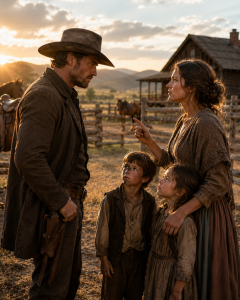
The October wind whipped across Montana’s barren plains as Miriam Hayes stepped down from the dusty stagecoach, her two children clutching her worn skirts. Eli Grant had been leaning against the corral fence for the better part of an hour, watching the horizon with the patience of a man who’d waited for nothing in particular for ten years straight. At thirty-four, he’d built a reputation as solid as the mountains bordering his ranch — dependable, stubborn, and utterly immune to the charms of every marriageable woman in Silver Creek County.
“Here she comes,” muttered Tom Morrison from the store’s porch. “Another widow heading west. Third one this month.”
First came a boy, maybe ten, sandy-haired and travel-worn, who jumped down and turned to help someone else. Then a girl, younger, dark-braided, clutching a cloth doll like it held all the security in the world. Then the woman herself — Miriam Hayes, perhaps thirty, her mended brown dress worn with a dignity that suggested she’d chosen not to notice its patches, her eyes carrying the weight of both laughter and tears, though the tears had been winning lately.
She surveyed the town, then found Eli. He expected her to look away, the way most women did once his reputation reached them. Instead, she studied him with an intensity that made him straighten despite himself — and then, to the astonishment of the entire street, she took her children’s hands and walked directly toward him.
“You’re Eli Grant,” she said. Not a question.
“I am. I’m Miriam Hayes. These are my children, Thomas and Clara.” She paused, gathering herself. “I hear you’re looking for a wife.”
Tom Morrison snorted. “Ma’am, that’s the last thing Eli Grant is looking for.”
Miriam didn’t acknowledge the interruption. “Is that so? You’ve turned down every woman?”
“I’m not looking for a wife, Mrs. Hayes,” Eli said, arms crossed. “I’ve got a ranch to run.”
“And winter coming on,” she observed. “Hard to run a ranch when you’re trying to keep house too. Hard to mend fences when you’re mending clothes.” She shifted Clara to her other side, the movement practical rather than nervous. “Managing isn’t living, Mr. Grant. And from what I hear, you’ve been managing for a long time.”
The crowd had grown. Eli felt their eyes, their entertainment at his expense. “Mrs. Hayes, I appreciate your directness, but I’m not in the market for a wife. I suggest you try Pete Sawyer.”
“Pete Sawyer drinks,” she said flatly. “Jim Thompson has a temper. Carl Brennan already has his eye on the schoolteacher, though she doesn’t know it yet. And Ben Wallace is sweet but weak — he’d fold at the first hard winter.” Eli blinked. She’d been in town less than five minutes and had already catalogued the available men like a ledger.
“I have two children, Mr. Grant,” she said. “I can’t afford mistakes based on romantic notions. I know what you’re thinking — another widow looking for a meal ticket, another romantic fool who believes love conquers all.”
“And you’re not?”
“No.” The word was sharp and clean. “I buried my husband two years ago. Fever. Left me with two children and debts I’m still paying. I’ve worked as a seamstress, a laundress, a cook. I’ve sold everything of value except my mother’s wedding ring.” She held up her left hand, the simple gold band catching the light. “I’m not here for love, Mr. Grant. I’m here for survival. Mine and my children’s.”
The honesty was brutal, refreshing, and somehow more appealing than any flirtation he’d ever received. “I wish you luck, Mrs. Hayes—”
“Let me ask you something,” she interrupted, taking a step closer, close enough that he could see the gold flecks in her brown eyes. “And I’d appreciate an honest answer, though I suspect honesty isn’t your problem. Do you want a wife, or do you just want another winter alone?”
The question hung in the air like a challenge. “Alone’s never bothered me,” he said, rougher than intended.
“No?” She tilted her head. “Then why do you come to town every week when your ranch doesn’t require it? Why do you stand at this fence watching the stagecoach arrive? Why do you have Tom Morrison order you books you don’t need?” Tom coughed guiltily. “You’re not waiting for supplies, Mr. Grant. You’re waiting for something else. The question is whether you know what it is.”
Eli felt exposed, like she’d peeled back his skin. “You don’t know me, Mrs. Hayes.”
“No,” she agreed. “But I know loneliness. I know what it looks like when it’s been carved into a person’s bones.”
Thomas tugged his mother’s sleeve. “Mama, I’m hungry.”
“In a moment, Thomas.” She kept her eyes on Eli. “I’m not asking you to marry me. I’m asking for honesty. You need help on your ranch. I need a safe place for my children. We could help each other without all the complications that seem to terrify you so much.”
“What makes you think complications terrify me?”
She smiled then — the first real smile he’d seen, transforming her face from handsome to something approaching beautiful. “Because you’re still standing here talking to me instead of walking away.”
—
## PART 2
“What are you proposing exactly?” Eli heard himself ask, and immediately wanted the words back.
“A business arrangement,” she said promptly. “I’ll keep your house, cook, mend clothes. Thomas is old enough for light chores. Clara’s learning to sew. In return: room and board, protection, a chance to build something stable instead of running from desperation. And time — time to see if two practical people might find something more than a business arrangement, without the pressure of promises neither of us is ready to make.”
It was the most sensible proposition he’d ever received, which somehow made it the most dangerous. “My ranch is seven miles from town. Isolated. The winter’s bitter.”
“I’ve survived two winters in a drafty boarding house with walls so thin I could hear six other families’ every argument,” she said. “Your ranch has a roof and walls that keep the wind out.”
“People will talk.”
“People are already talking. Talk doesn’t put food on the table.”
He was running out of objections. “I’d need to think on it.”
“Of course.” Her shoulders dropped, just slightly — the only sign of disappointment she allowed herself.
“Not here,” Eli said suddenly, aware of the crowd. “There’s a place a mile out of town. A creek with cottonwoods. We’ll talk there properly.”
An hour later, by the creek, Thomas insisted he wasn’t afraid of hard work, and Clara offered up a piece of quartz she’d found like a peace offering, and something in Eli’s chest shifted uncomfortably watching the girl’s delight. “One month trial,” he said finally. “You work. I provide room and board. After a month, we reassess.”
“That’s fair,” Miriam said, very still, as if afraid movement might make him reconsider.
That night, alone in his empty house, Eli stood in the doorway of a bedroom that had waited a decade for someone to occupy it, and admitted to himself what he’d never say aloud: he was tired of the silence. Tomorrow would bring three strangers to his door, and the beginning of an arrangement that already felt like something far more dangerous than business — though neither of them yet knew that the greatest test of what they were building wouldn’t come from each other, but from a neighbor named Jack Brennan, who had been watching Eli’s water rights, and Eli’s isolation, for years.
—
## PART 3
The month that followed rewrote the shape of Eli Grant’s life one ordinary day at a time. Thomas’s hands blistered and healed learning ranch work, his hero-worship of Eli deepening with every lesson in shooting, fence-mending, and horse handling. Clara named every chicken, left quartz and feathers on Eli’s windowsill in silent trade for the gifts he brought her, and declared with seven-year-old certainty that the house “talked” — that its creaks and groans during storms were the sound of a fighter, not a victim. Miriam transformed the kitchen and the bedrooms with things Eli had forgotten he owned, folding herself into the rhythms of the ranch with an efficiency that unsettled him more than any tears ever could have.
A sudden hailstorm tested them early, and Eli found himself kneeling beside a frightened Clara, inventing a story about the house’s bravery that left the girl fascinated instead of afraid — and left Miriam watching him with an expression he didn’t yet have a name for. When Clara later fell dangerously ill from eating pokeweed berries by the creek, Eli rode seven miles through the dark at reckless speed to fetch the doctor, and sat vigil through the night with a woman who was, by every practical measure, still just his hired help.
“This kind of caring,” the doctor told him as he packed his bag, “it’s not a weakness. It’s what makes us human.”
It was around then that Jack Brennan, the rancher to the east who’d coveted Eli’s water rights for years, began circling. He rode out with thin threats disguised as neighborly concern — hints that “accidents happen” to families out here alone, insinuations about Miriam’s virtue, veiled promises that winter was long and isolation made people vulnerable. Eli, recognizing the danger for what it was, began teaching Miriam to shoot.
“I don’t like guns,” she said, sighting down the barrel.
“Neither do I. Liking and needing are different things.”
She proved a quick study, and in the practice sessions, something else surfaced between them — Eli’s confession, unprompted and unguarded, about Elizabeth, the fiancée who’d left him eight years earlier for a wealthier man passing through town, taking with her his last attempt at trusting anyone completely. Miriam absorbed it without pity. “Good thing I’m not asking for any of that, then,” she said — though something in her voice suggested she was starting to want to, and that scared him more than any storm.
The fire came without warning: a column of black smoke rising from the eastern pasture where the winter hay was stored. The four of them fought it together for hours, bucket brigades and wet blankets against flames that seemed determined to consume everything they’d need to survive the season. They saved most of it — not all, but enough. Standing in the aftermath, soot-streaked and exhausted, Eli looked at the four of them and understood, with sudden clarity, that they weren’t employer and employees anymore. They were a unit. A family, whether he’d meant to build one or not.
Whether Brennan had set the fire himself couldn’t be proven, but the timing was too convenient to ignore. Eli began teaching Thomas not just ranch work but defense — how to barricade doors, where to take cover, how to protect his mother and sister if trouble came while Eli was away. “I won’t let him hurt Mama or Clara,” Thomas said fiercely one evening.
“That’s my job, Thomas.”
“No,” the boy said, with a steadiness that startled Eli. “It’s our job. All of us.”
Pete Sawyer arrived a few days later with two other ranchers from the valley, offering something Eli had never let himself need before: a community. Brennan had been quietly bullying half the valley for years over water and land, and the fire at Eli’s place had crossed a line even his neighbors wouldn’t tolerate. They organized a rotating night watch, spreading protection across every threatened ranch so Brennan could never again find one unguarded.
“That widow and her children,” Pete told Eli privately, “they’re good for you. You’ve smiled more in the past month than in the previous ten years.”
But Brennan’s true weapon arrived not by fire, but by mail: an official legal notice challenging Eli’s water rights in court, claiming an irregularity in the original land claim — a challenge with no real merit, but enough to bury Eli in legal fees until he couldn’t afford to fight anymore. That night, in the kitchen, Miriam produced a small leather pouch of money — proceeds from selling her late mother’s wedding ring, the last thing of value she owned, sold in secret the week before “for emergencies.”
“I can’t take your money,” Eli said, rough with the weight of what she was offering.
“It’s not my money. It’s our money. Our home. Our fight.”
Thomas emptied his own savings onto the table without being asked. Clara ran for her jar of pennies from helping at the store. Looking at the three of them, ready to sacrifice everything they had for a home he’d only ever promised them on a month-to-month basis, something in Eli finally, completely, gave way.
“This isn’t just about the water rights anymore, is it?” he said quietly.
“No,” Miriam agreed. “It never was.”
And so he asked her — not with flowers or romance, but with the same brutal honesty she’d offered him on the day they met. “If we’re going to fight for this ranch, it should be your ranch too. Legally. Properly.” He told her the truth of it: that somewhere between that first day and now, she and the children had become essential; that the thought of them leaving left him hollow in ways he’d forgotten he could feel; that this had stopped being business the moment she’d asked him if he wanted another winter alone, and he hadn’t been able to answer.
“That’s not exactly a romantic proposal,” Miriam said, fighting tears.
“You didn’t ask for romance. You asked for honesty.”
“Then honestly,” she said, “I stopped thinking of this as temporary the night you stayed up with Clara.” She said yes. Clara cheered. Thomas, more cautious, asked hesitantly whether he might also call Eli something else — and when Eli knelt to look him in the eye and told him he’d be honored to be his father, the boy’s careful maturity finally cracked into something younger and more grateful than either of them expected. Clara, delighted, declared that Eli would be her “Papa” too, and informed everyone matter-of-factly that the house had wanted this all along.
They married the next morning in town before Judge Harper, quick and legal, with only Tom and Mrs. Morrison as witnesses — a wedding with no flowers, which Clara loudly protested, but which settled something in Eli’s chest that had been restless for a decade. Word of the marriage reached Jack Brennan before the ink was dry on the license. Drunk and vicious outside the saloon, he made the mistake of insulting Miriam within earshot of her new husband, her son, and half the town — and left with a split lip courtesy of Eli’s fist and a bruised set of ribs courtesy of Thomas’s boot, and a public reminder, delivered calmly by Eli in front of a gathering crowd, that Silver Creek’s ranchers were done being afraid of him.
“You come at us,” Eli told him, “you come at all of us. This valley protects its own.”
Brennan’s legal challenge collapsed within the month — not from any single decisive blow, but from the accumulated weight of a united valley: ranchers who refused to sell him water access out of spite, a judge who found no irregularity worth the court’s time once he examined the original claim properly, and a community that had simply stopped extending him the credit, cooperation, and silence he’d relied on for years to operate unchecked. Facing debts of his own and no allies left to exploit, Brennan sold his spread within the year and left the valley for good, his threats amounting, in the end, to nothing more than the last gasps of a bully who’d finally run out of people willing to be afraid of him.
The wedding night that followed the courthouse ceremony was quiet and uncertain in the way that first nights of real things often are — two people who had built a marriage out of necessity discovering, gently and without any need to rush it, that necessity had become something neither of them had planned on and both of them wanted. There was no need for grand declarations. There was only the house, finally full, finally warm, finally exactly what it had been built for a decade too early and had simply been waiting to become.
By the time real winter closed in over Silver Creek County, the Grant ranch stood not as a fortress against the world, as it had been for ten silent years, but as a home in the truest sense — Thomas learning the full measure of the ranch he would one day help run, Clara’s quartz collection lining her windowsill beside pressed wildflowers, Miriam’s mother’s wedding band replaced, at Eli’s quiet insistence, by a new ring bought with money that finally felt like it belonged to something worth spending it on.
Tom Morrison, retelling the story at his store for anyone who’d listen, always ended it the same way: “Man asked her a simple question at that stage stop, and she turned around and asked him one right back. Neither one of them ever did get a straight answer that first day. Took them a whole winter’s worth of proving it instead.” And when travelers passed through Silver Creek and asked about the rancher who’d once turned away every woman in the county, the story they heard wasn’t about a cold man softened by a stranger’s charm. It was about two people who’d stopped asking whether they wanted a family, and started building one instead — proof that sometimes love doesn’t arrive with flowers at all. Sometimes it arrives with an honest question, a hard winter, and the simple, stubborn choice to stop being alone.
**THE END**