The Mafia Boss Fell to His Knees Beside His Injured Daughter—Until a Waitress Stepped In and Changed Everything

## PART 1
The little girl’s cry was what did it.
Not the sound of the crash, though that had been bad enough — the shriek of tires, then a concussion of metal and glass that rattled the diner windows and made every coffee cup in the place jump in its saucer. Jess Callahan had already moved toward the door by then, her apron still on, the order pad still tucked in her pocket. Twenty-eight years of watching the world decide whether to intervene or look away had made her fast.
But then she heard the child.
Small and high and ragged with terror, cutting through the steam and the smoke and the sound of a car alarm going off somewhere on Decker Street.
She was already outside.
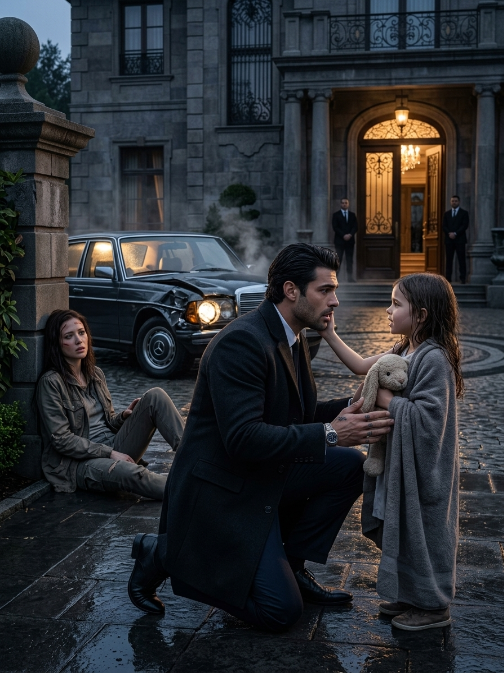
The SUV had jumped the curb and wrapped itself around a fire hydrant ten feet from the entrance to Sal’s Diner, front end folded like cardboard, hood steam rising in the morning cold. The driver’s door hung open. A man in a charcoal suit had gotten halfway out before his legs apparently stopped cooperating — he was down on one knee on the wet pavement, one hand braced against the asphalt, breathing in the labored way of someone fighting not to lose consciousness.
He was maybe thirty-eight. Dark-haired, expensive watch, a cut above his left eye that was painting the side of his face red. Not that any of that mattered to Jess. What mattered was the rear door, partially open, and the small hand visible through the gap — a child trying to push it wider, not quite strong enough.
“Call an ambulance,” Jess said, not to anyone in particular, to the city at large, to whoever was closest to a phone.
A crowd had already started forming. That was the thing about this neighborhood — people came out fast when something happened. They just didn’t always come forward.
Jess felt it the moment she got close enough. The shift in the air around the gathered people. The way they looked at the man on the ground and then looked away, some of them stepping back, one woman on the edge of the group actually turning and walking in the other direction.
Someone said a name. She caught it in pieces. Renata. Luca. Heard the word *family* used in a way that had nothing to do with children and Sunday dinners.
She didn’t slow down.
The rear door swung open when she reached it. A girl, small, maybe four years old, tumbled forward into Jess’s arms with the complete physical trust of a child who simply needed an adult and was willing to take whoever showed up. She was wearing a white dress now tracked with blood — from her nose, Jess assessed quickly, and a small gash on her forehead, neither one requiring more than time and a steady hand, but both of them terrifying to look at.
“I’ve got you,” Jess said. “I’ve got you.”
The girl gripped the front of Jess’s uniform with both fists and pressed her face against Jess’s collarbone. Her heartbeat was hummingbird-fast and her entire small body trembled.
“Luca.” The man’s voice from the pavement. Rough, struggling. “My daughter.”
Jess turned. The man on the ground had managed to raise his head. Even through the blood and the dazed look of someone who had hit something hard, the fear in his eyes was pure and unmistakable. Not the fear of a man worried about himself.
“She’s okay,” Jess told him. “Scared, but okay. Just breathe.”
His eyes closed. A second later, he went fully down.
The crowd didn’t move. Phones were up, a dozen of them, recording. A man she recognized from the hardware store two blocks over, Danny, caught her eye and shook his head in a tight, urgent gesture. *Don’t*, he mouthed.
Jess’s arms tightened around the little girl.
Then the second car arrived.
It came from the far end of the street, moving fast, parking at an angle that blocked both lanes. Two men in dark clothing got out. They moved with the practiced ease of people who were used to rooms rearranging themselves around their arrival.
The older one led. Gray at his temples, jaw set, eyes that swept the scene in under three seconds and landed on Jess — or more precisely, on the child in her arms.
“Give her to me,” he said.
Not a request. The grammar of the sentence was polite but the delivery was not.
The girl’s fingers dug harder into Jess’s uniform.
“She’s frightened,” Jess said. “The ambulance is coming.”
“Give. Her. To me.”
He stepped forward. The girl made a sound — barely a sound, almost no sound at all, a small suppressed whimper — and pressed herself deeper into Jess’s shoulder.
Something happened in Jess’s chest that she didn’t have a word for. Something that had been built over years of watching people fail the moment it cost anything to show up.
“No,” she said.
The word came out quieter than she intended and more final than she’d ever heard herself sound.
The man stared at her.
And somewhere in the distance, finally, a siren started.
—
## PART 2
The older man’s name, she found out later, was Vincent Renata.
She found out the hard way — through the way the paramedics went quiet when they recognized the name on the ID they pulled from the unconscious man’s jacket. Through the way the police officer who arrived first kept glancing between his radio and the black car like he was running calculations about his own career.
Vincent let the paramedics work. He stood back with his arms at his sides and watched everything with the patience of a man who knew he didn’t need to hurry. The sirens hadn’t scared him. The crowd hadn’t moved him. He was waiting for something specific.
Jess figured out what it was when the paramedics started preparing a gurney for the girl.
“She stays with me,” Jess said.
“Ma’am, we need to assess—”
“She’s already been assessed. No concussion. Nosebleed, stopped. Forehead lac, superficial. She’s in shock and she’s terrified, and if you try to take her from me right now she’s going to make this significantly harder for all of us.”
As if to confirm this, Maya — the girl, she had told Jess her name in a small voice during the chaos, *Maya* — locked her legs around Jess’s waist like a clamp.
The paramedic looked at Vincent. Vincent, after a pause, nodded once.
They let Jess carry Maya into the ambulance with her father. She rode with one hand on Maya’s back and one eye on the doors. Vincent’s car followed the whole way.
It was in the ambulance that Maya said it.
The girl had been quiet for several minutes, her breathing finally steadying, her grip gradually loosening. Then, very softly, with her face still half-buried against Jess’s shoulder, she said:
“He wasn’t supposed to drive us today.”
Jess kept her voice even. “What do you mean, sweetheart?”
“Our regular driver. Paulo.” A pause. “He was sick. So Daddy drove.” Another pause, shorter. “But they didn’t know that.”
Jess went still.
“Who didn’t know that?”
Maya looked up at her. Four years old, dark eyes full of something no four-year-old should be carrying.
“The men who made the other car hit us,” she said. “I saw them. Before the crash. They were watching.”
The ambulance rocked around a corner. Through the small window in the back door, Jess could see the headlights of Vincent Renata’s car following close behind.
She thought about what the girl had said. *They didn’t know that.* Meaning the crash had been meant for someone who wasn’t driving today. Meaning whoever arranged it had expected someone else to be in that seat.
Meaning whoever was in Vincent Renata’s car might not be the threat.
Or might be exactly the threat, having realized too late that the wrong Renata was unconscious in the back of this ambulance.
Jess looked at the little girl in her arms.
“Maya,” she said carefully. “The men you saw watching. Did you see their faces?”
The child nodded.
“Would you recognize them again?”
Another nod. Then, barely a whisper:
“One of them comes to our house.”
—
## PART 3
The hospital waiting room was the color of old institutional hope — off-white walls, plastic chairs, a television mounted too high on the wall cycling through morning news that nobody was watching. Vincent Renata sat three seats away from Jess with his elbows on his knees, and for the first time since the street, he looked like a man and not a monument.
“You saved her life,” he said, eventually. Not to her — to the middle distance. Like he was registering a fact.
“I helped a frightened child,” Jess said.
“In our world, those are the same thing.”
Jess didn’t answer that.
Maya had fallen asleep in Jess’s lap twenty minutes into the wait, her breathing finally evening into something close to peaceful. Jess hadn’t moved. She barely breathed too loudly for fear of waking her.
“She told me something,” Jess said. “In the ambulance.”
Vincent’s eyes moved to her without his head moving.
“She said it wasn’t an accident. She said she saw men watching before the crash. That they were expecting a different driver.” Jess kept her voice low and level. “She said one of them comes to your family’s house.”
A long pause.
“She is four,” Vincent said.
“She’s four and she has a very good memory and she wasn’t unconscious, so she saw things neither of us did.” Jess looked at him directly. “I think you should take what she’s telling you seriously.”
Something moved across Vincent’s face. Not surprise — men like this, Jess had decided, didn’t allow themselves surprise as a visible expression. Something more like the slow realignment of a picture frame that had been hanging slightly wrong for weeks.
“We had a meeting this morning,” he said. “Luca and his associate, Benedetto. Benedetto arranged the time and the location.” He stopped. “Paulo called in sick at five a.m.”
“And Benedetto knew Paulo was your regular driver.”
The silence that followed was the particular silence of something large and important settling into place.
Vincent stood. He moved to the hallway and made a phone call. Jess didn’t watch him. She kept her eyes on Maya’s sleeping face and tried to decide what she had gotten herself into and whether there was any path through it that didn’t involve her disappearing from her own life.
She thought about Sal’s. About the coffee she had brewed that morning, still sitting in the pot. About the regulars who would have come in and found nobody behind the counter.
She thought about the fact that she had been in the foster system until she was eighteen, and had spent the decade since building something small and real and hers, and that all of it — the diner, the apartment two blocks away, the slow careful construction of a life — could come apart if the wrong people decided she was inconvenient.
She thought about Maya saying *they didn’t know that* with the matter-of-fact clarity of a child reporting observable fact.
Vincent came back. He sat down differently this time — closer, his posture changed in some way she couldn’t precisely name. Less performance. More person.
“Benedetto has been contacted,” he said. “He will be… unavailable for the foreseeable future.”
Jess didn’t ask what that meant.
“The threat to you is real,” Vincent continued. “You have seen Maya. You have heard her. Men who arrange accidents do not leave witnesses standing around who might someday say something inconvenient.”
“I’m a waitress,” Jess said. “I don’t know anything.”
“You know a child told you she saw men watching. You know this was not an accident. You could tell that to a journalist, a police officer, a federal agent.” He looked at her steadily. “In our world, that is not ‘nothing.'”
“What are you suggesting?”
“That we keep you where we can ensure your safety.” He said it as if this were a straightforward and reasonable thing to say. “Temporarily. Until the situation resolves.”
“I have a job.”
“We will compensate your employer.”
“I have a life.”
“Which we would like you to continue having.” A pause. “I am not asking you to become part of this. I am asking you to not be exposed while we address a problem within our family.” Another pause. “You did something today that required real courage. The least I can do is make sure it does not destroy you.”
Jess looked at Maya. The girl stirred slightly, her small face pressing closer against Jess’s ribs in her sleep.
“She trusts you,” Vincent said. “Children her age do not trust easily. Not in this family.”
“She trusted me because I was there,” Jess said. “That’s all. I was the person who showed up.”
“In my experience,” Vincent said quietly, “that is everything.”
—
She stayed three days.
That was how she thought about it afterward — she stayed three days, which sounded simple and was not.
The Renata family occupied a brownstone in a neighborhood she had heard of but never visited, one of those blocks that was impeccable and slightly unreal, like a film set of what wealthy people were supposed to look like. She was given a room on the second floor with a window overlooking a garden. The housekeeper brought meals without being asked. Nobody explained the rules to her because they assumed she would figure them out.
She figured them out.
Don’t ask questions you don’t need answered. Be where you said you would be. If someone tells you to move, move. If someone tells you to stay in a room, stay.
Luca was in the hospital for two days with a concussion and two cracked ribs. Maya was brought home the same afternoon. The girl attached herself to Jess with a completeness that was both touching and practical — having decided that Jess was safe, she treated the decision as settled and moved on. She dragged Jess through the brownstone pointing out things she found important: the dog, a large indifferent retriever named Bruno; the kitchen, which had a breakfast bar at exactly the right height for a four-year-old; the small library on the third floor, where she kept her books.
“I like this one,” she said, holding up something battered about a girl who turned into a fox.
“I can see that,” Jess said. The cover had been opened so many times it had given up being attached to the pages.
“Will you read it to me?”
So Jess read it to her, twice, and then was roped into reading two other books, and by the end of the afternoon she had learned more about Maya’s inner life than she had learned about most adults she’d known for years.
Maya was precise and observant. She remembered specific details with the unsettling accuracy of someone who had grown up in an environment where details mattered. She was also, underneath the composure that had startled Jess from the first moment, just a four-year-old who wanted someone to sit with her and make things feel safe.
Jess sat with her.
On the third morning, Luca came home.
She had prepared herself for this — or she had tried to. She had a version in her head of what it would be like: formal, slightly stiff, a man reasserting authority over a situation that had briefly been out of his control. A handshake. A check, maybe. Thank you, you can go now.
Instead, he walked through the front door with his arm in a sling and his face still bruised and his daughter running at him full speed, and the look on his face when he caught her with his good arm and pressed his face into her dark curls was so completely unguarded that Jess looked away. It felt private. It felt like something she shouldn’t be standing five feet from.
“You’re Jess,” he said, when Maya had finally been persuaded to let go long enough for him to straighten up.
“Yes.”
“Thank you.” He said it the way the words had weight that normal usage didn’t account for. Not a pleasantry. “I understand you’ve been here three days. That was not — I hope it was not—”
“It was fine,” Jess said. “Maya and I worked our way through her book collection.”
Something shifted in his face. “She let you read to her?”
“She insisted on it.”
He looked at his daughter, then back at Jess, with an expression she couldn’t entirely parse.
“She doesn’t usually do that,” he said. “With people she doesn’t know.”
“She decided I was safe,” Jess said. “She’s very decisive.”
“She is.” A pause. “She gets it from her mother.”
He said it simply, with no invitation for follow-up, and Jess didn’t follow up. She filed it away with the other things she had figured out during three days in this house: that Maya’s mother was gone, that the absence was several years old and still shaped everything, that the brownstone was full of quiet evidence of someone who had made it a home and was no longer there to tend it.
Vincent found her an hour before she left.
“The situation with Benedetto has been resolved,” he said.
“I’m not going to ask what that means,” Jess said.
“That is the correct response.” He tilted his head slightly. “The threat to you is neutralized. You can return to your life. We will ensure that nothing reaches you through the usual channels.”
“The usual channels,” Jess repeated.
“Anyone who might have seen you as a loose end.” His voice was matter-of-fact. “It has been handled.”
She nodded. She picked up the bag someone had brought from her apartment two days ago.
“Your employer has been compensated,” Vincent added. “Generously. Do not be surprised if Sal has more equipment than he needs.”
“He’ll complain about it,” Jess said.
“Probably.” Vincent walked her to the door. “You are an unusual woman, Jess Callahan.”
“I helped a child.”
“You did considerably more than that. You held a line when everyone else stepped back. You kept Maya calm in a situation that could have cost her significantly more than a forehead cut.” He opened the door. “In forty years of navigating this family’s problems, I have rarely seen someone outside of it do what you did.”
“Then maybe,” Jess said, “the people outside it are worth more than you’ve been giving them credit for.”
He considered that.
“Perhaps,” he said.
—
A week later, she was back at Sal’s.
The regulars came in and absorbed the story through the usual neighborhood process of asking questions sideways and building the picture from fragments. Some of them had seen the crash. Some of them had seen Jess run out. Most of them had heard the name Renata and kept their distance, which was what people did.
“You doing okay?” Sal asked her, on the third day back, during a lull between the breakfast rush and the lunch crowd.
“Fine,” Jess said.
“You seem different.”
“I went through something.”
“Yeah.” He wiped down the counter, not looking at her. “You were always the kind of person who showed up. I guess you just — showed all the way up, this time.”
Jess didn’t answer. She refilled the salt shakers and straightened the menus and watched the street through the window, where the fire hydrant the SUV had hit had already been replaced, the new paint bright against the old sidewalk.
Three weeks after that, a car she didn’t recognize pulled up outside the diner at ten in the morning, a slow time, nobody in the place but Mr. Okafor from the hardware store nursing his coffee and pretending to read a newspaper.
Luca Renata came through the door.
He was in a plain jacket, no sling anymore, the bruises faded to yellow at the edges. He sat down at the counter without ceremony and looked at the menu, which was a single laminated card that hadn’t changed in twelve years.
“The eggs are good,” Jess said.
“Then I’ll have the eggs.”
She put the order in. When she brought the coffee, he wrapped both hands around the mug and looked at her.
“Maya asks about you,” he said.
Jess set down the pot. “What does she ask?”
“Whether you’re coming back. Whether you’re okay.” He paused. “Whether you have enough books.”
“I have books.”
“I told her that.” He looked at the mug. “She wants to show you something she found in the library. A different book about a girl who turns into an animal — a bird, this time. She thinks you’ll like it better because you can read it somewhere nice instead of in the middle of the Renata family’s disaster.”
Jess took that in.
“She’s a very particular child,” she said.
“She is.” Something crossed his face that was trying not to be a smile and losing. “She also told me that you’re the only person who ever read to her exactly as fast as she wanted, without going too slow or making the voices embarrassing.”
“High praise,” Jess said.
“It is, actually.” He looked up. “I’m not — I didn’t come here to ask anything of you. I know you’ve been through something because of my family, because of decisions I made that put my daughter in danger. I’m not going to pretend that’s a debt I can pay.” He paused. “But Maya wants to see you, and I thought you should know that.”
Jess thought about it. She thought about the three days in the brownstone with its thick rugs and quiet rooms and a small girl who had decided she was safe and proceeded accordingly. She thought about the book about the fox, held together by habit and repetition. She thought about showing up — what it cost, what it built, what it meant about who you were.
“Tell her I’ll come Saturday,” Jess said. “If she wants to show me the bird book.”
Something genuine moved across Luca’s face then, unguarded in the way she had seen once before, in the hallway of the brownstone when Maya had run to him.
“She’ll want to,” he said.
His eggs arrived. He ate them without pretension, at her counter, on a cracked vinyl stool in a diner that the city planners had forgotten. He tipped twenty-five percent, which Jess noticed and did not comment on. He said goodbye at the door and walked back to his car.
Jess watched him go.
Behind her, Mr. Okafor folded his newspaper.
“Friend of yours?” he asked, in the tone of someone who had drawn several conclusions already.
“I don’t know yet,” Jess said honestly.
She refilled his coffee. She straightened the menus. She looked out the window at the street, at the new fire hydrant gleaming in the October light, at the ordinary morning moving through Decker Street exactly as it always had, the laundromat opening, the mail truck making its rounds, the neighborhood persisting in its usual complicated way.
She had always been the kind of person who showed up. She’d never had a plan for what happened after.
Maybe that was the point. Maybe showing up was never supposed to be a calculation. Maybe it was just who you were, repeated over and over, until the life that grew around it turned into something you recognized as yours.
Through the window, the October sun came at a low angle that made even the worn pavement look briefly like something worth looking at.
Jess went back to work.