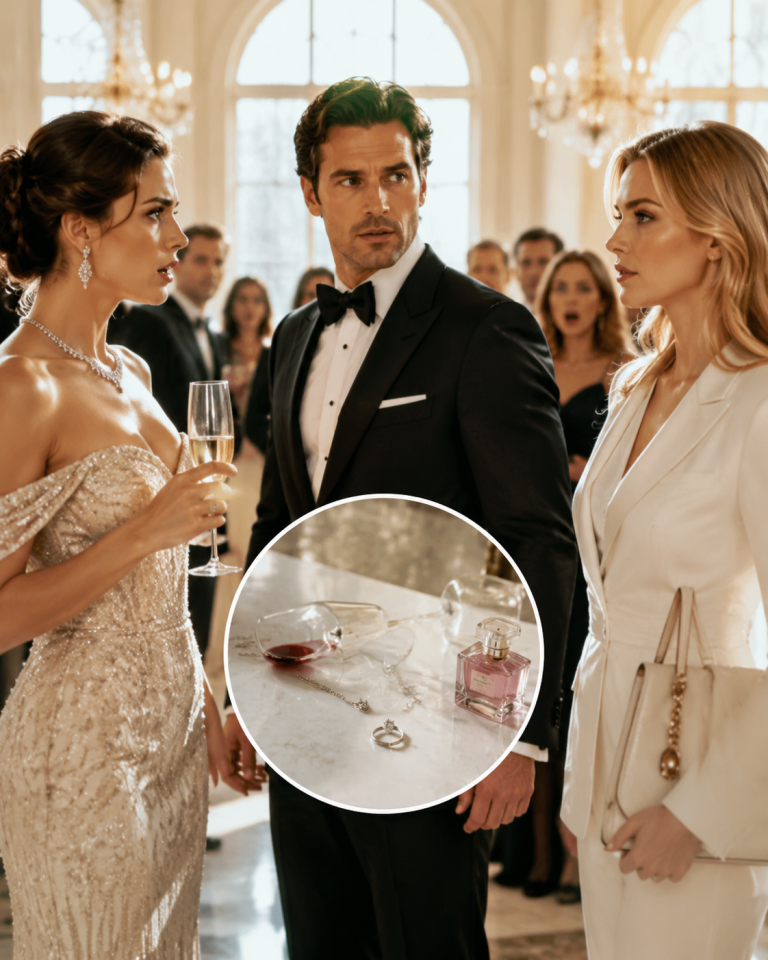
Bruised and Afraid, She Entered the Elevator—The Mafia Boss Knew Her Before She Spoke

## PART 1
The dress had cost more than her first apartment.
Nadia Voss knew this because Daniel had told her so, twice, on the night he gave it to her — the way he always told her the price of things he bought, as though love could be measured in receipts.
Now the left side of it was torn from hip to hem, and she was running through a corridor she wasn’t supposed to be in, thirty-two floors above a gala that no longer felt real, pressing one hand to her ribs like she could hold herself together if she just pushed hard enough.
Her feet were bare. She’d lost the heels somewhere in the penthouse suite. She didn’t remember dropping them. She remembered the glass cabinet. She remembered the sound it made when her back hit it, the neat, civilized shatter of something expensive breaking because of her.
That was always how Daniel put it.
*Because of her.*
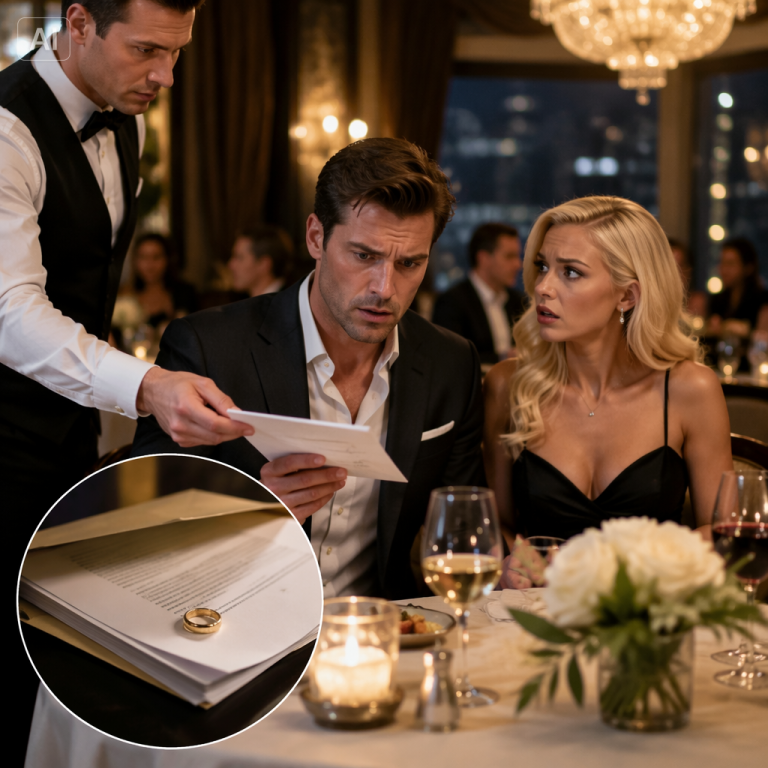
She’d found the folder by accident. An email chain she wasn’t meant to see, forwarded to the wrong address — his assistant’s mistake, not hers. The words had been clinical, bureaucratic, stripped of malice: *advise client to withdraw recommendation at this time.* But she’d recognized the project immediately. The Copenhagen residency. Eight months of applications, revisions, a portfolio she’d rebuilt from scratch after the last rejection. Approved three weeks ago. Then quietly, inexplicably, rescinded.
She had gone very still when she read it.
She had gone still the way a person goes still when the last piece of a puzzle drops into place and the picture it reveals is something they were never supposed to see.
When she asked him about it, Daniel had smiled.
Not his public smile — the one reserved for cameras and colleagues and the kind of people whose opinions he actually valued. This was his other smile. The one that meant she had said something he found genuinely funny.
*”You’d have been miserable,”* he said. *”You’re better here.”*
*”Here”* was wherever he decided to put her. She understood that now.
She’d thrown her wine glass. Not at him — she wasn’t brave enough for that, not yet — but near him, into the wall beside his left shoulder. He had gone very quiet in the way that preceded the things she didn’t let herself name, and she had run.
Down the service stairs. Wrong floor. Wrong corridor. Now here: a dead end, a single elevator bank, the doors parting like they’d been waiting for her.
She dove inside.
The elevator did not move.
She was not alone.
The man standing against the far wall was tall and unhurried, dressed in a charcoal suit that looked like it had been made specifically for him and never worn by anyone else. He held a crystal glass in one hand. His other hand was in his pocket. He was not startled by her entrance. He did not reach for a phone, or step back, or perform the small theater of discomfort that most people did when a disheveled woman in a ruined dress stumbled into their personal space.
He simply looked at her.
His eyes were pale gray and completely still.
Nadia’s first thought was that he was the most controlled person she had ever seen.
Her second was that control like that didn’t come from peace. It came from practice. From years of being the one thing in the room that nothing could touch.
“Sorry,” she breathed.
“You’re bleeding,” he said.
Not *are you all right.* Not *what happened.* Just the fact, stated quietly, like a man who dealt only in verifiable information.
She looked down. Her lip. She hadn’t felt it until now.
“It’s fine.”
“I didn’t say it wasn’t.”
She opened her mouth to say something — anything — but the elevator doors forced themselves back open before she could form the words.
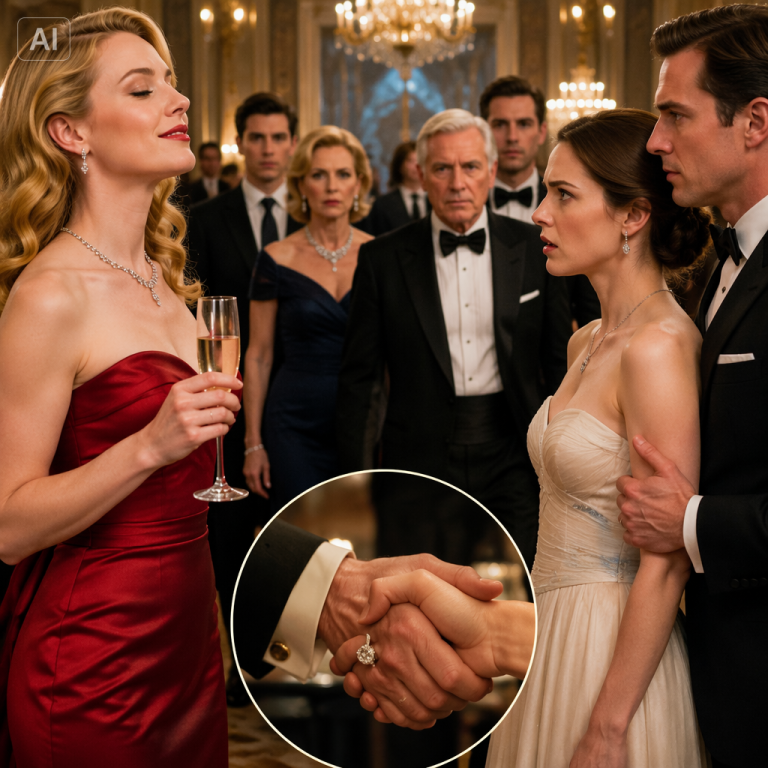
Daniel Reeves stood in the corridor.
He looked, as he always looked in public, completely composed. Jacket perfectly buttoned. Dark hair barely disturbed. Only his eyes gave anything away — that flat, glassy fury she’d learned to read the way sailors read the sky.
Behind him: two hotel security personnel, both visibly uncomfortable, both looking at the floor.
“Nadia.” His voice was warm. Concerned. He was very good at this. “You’re making a scene.”
She pressed herself back against the elevator wall.
The stranger observed this.
Daniel’s gaze moved to him with the practiced ease of a man who made quick calculations about everyone he met.
“I appreciate your discretion,” Daniel said. “This is a private matter.”
The man in the charcoal suit took a slow, unhurried sip from his glass.
“It stopped being private when you followed her.”
Daniel’s smile thinned. “You don’t know what you’re inserting yourself into.”
“Probably not.” The man set his glass down on the small elevator shelf with a sound like a period at the end of a sentence. “Introduce yourself.”
Daniel blinked. “Excuse me?”
“You assumed I didn’t know who you were. You were right. I’m asking you to fix that.”
Something flickered across Daniel’s face — the first real crack in the composure. He was accustomed to being recognized. He was accustomed to his name landing like a key in a lock.
“Daniel Reeves.”
A beat.
“Reeves Capital?”
“Yes.”
The man nodded once, as though confirming a minor piece of trivia.
“Calder Voss,” he said.
The name hit the corridor like a dropped stone hitting deep water.
One of the security guards stepped back without appearing to realize he’d done it. The other looked up for the first time, startled out of his practiced neutrality. Even Daniel — Daniel, who had once spent an hour explaining to Nadia why there was no one in this city he genuinely needed to fear — went completely, tellingly still.
Nadia had heard the name the way you heard rumors about weather systems in other countries. Vast, theoretical, not quite real. Calder Voss didn’t run a company. He ran the infrastructure beneath companies. Politicians returned his calls before they returned anyone else’s. The kind of man whose name appeared in documents that were never made public and in conversations that were never repeated.
He looked at Daniel the way you looked at a door you were deciding whether to open.
“The woman has a split lip,” Calder said. “Her wrist is bruised. She ran barefoot through a restricted corridor to get away from you.” He paused. “Tell me what version of tonight’s events makes those facts acceptable.”
Daniel’s jaw tightened. “You’re overstepping.”
“I haven’t started yet.”
He reached into his jacket and produced a card, which he handed to the nearest security guard without breaking eye contact with Daniel.
“My office number. I want the floor’s camera archive transferred there before midnight. All of it.” He glanced at the guard. “You understand me.”
“Yes, sir.”
Daniel’s voice dropped to something dangerous. “You’re making an enemy over a domestic disagreement.”
“No.” Calder turned to Nadia for the first time since Daniel had appeared. He slipped off his jacket and held it toward her — not pressing it into her hands, just offering. “I’m making a point.”
Nadia took the jacket.
It was warm, and it smelled faintly of cedar and cold night air, and she did not understand why that detail made her eyes sting.
Calder pressed the button for the basement garage.
The doors began to close.
Daniel’s hand shot forward. “Nadia, if you leave with him—”
“She’s leaving,” Calder said, and something in his voice made the hand withdraw.
The doors shut.
The elevator began its descent.
Nadia stood clutching the jacket around her shoulders, watching the floor numbers drop, her heartbeat slowly returning to something she could measure. Neither of them spoke. The silence wasn’t tense. It was something stranger — the absence of threat, which she’d forgotten was possible.
At the twenty-second floor, Calder said, without turning to look at her:
“Your name isn’t a coincidence, is it.”
Nadia went still.
—
## PART 2
It wasn’t a question.
“What do you mean?” she said carefully.
Calder looked at her reflection in the mirrored elevator wall rather than at her directly — the way you might approach a conversation you wanted to give someone room to exit.
“Voss,” he said. “Your last name.”
“It’s a common name.”
“In some circles.” He paused. “My father had a business partner named Voss. Thirty years ago. The partnership ended badly. The partner had a daughter.” He tilted his head slightly. “She’d be about your age.”
The floor numbers continued to fall.
Twenty. Nineteen. Eighteen.
Nadia said nothing.
“I’m not accusing you of anything,” Calder said. “I’m noting that if you came here tonight with a purpose beyond attending a charity gala in a dress Daniel Reeves paid for, now would be a reasonable time to tell me.”
The elevator slowed.
“And if I did?” she asked.
He considered this.
“Then I’d want to know whose side you’re actually on.”
The doors opened onto a private underground garage. A black car waited, engine running, a driver standing at attention who looked away from Nadia’s face with disciplined discretion the moment he saw it.
Calder guided her toward the car — a hand near her elbow, not touching, ready to steady her if she needed it. She didn’t need it. But she noticed the difference between that and the way Daniel had always gripped her arm as though she were an object he was transporting.
Inside the car, she caught her own reflection in the dark window glass. The dress. The jacket over it. Her split lip. The bruise forming along her jaw she hadn’t known was there until this moment.
She looked, she thought, exactly like what she was: someone who had run out of time to pretend everything was fine.
“My father,” she said, “worked with your father for eleven years. Then your father had him removed from the company, stripped of his shares, and buried under a non-disclosure agreement he couldn’t afford to fight.” She looked at the window, not at Calder. “He died three years later. Heart attack. But I’ve always thought it was closer to a broken man finishing the job the humiliation started.”
Silence.
“So yes,” she said. “I came here with a purpose. I came here to get close enough to Daniel Reeves — who helped your father structure the deal that destroyed mine — to find the documentation I need.”
She finally turned to look at Calder directly.
“And then your name walked into an elevator.”
Something moved behind his pale eyes. Not surprise, exactly. More like the expression of a man watching a chess game and realizing the board is more complicated than he’d understood.
His phone rang.
He answered it. Listened. His face went very still in a way that was different from his usual stillness — controlled, yes, but braced.
He lowered the phone.
“Daniel Reeves,” he said quietly, “has just made a formal complaint to hotel management. He’s claiming you stole something from him before you left.”
Nadia frowned. “I didn’t take anything.”
Calder watched her.
“He’s claiming,” he said, with the careful precision of a man delivering information he found significant, “that you’ve been living under a false identity. That the name Nadia Voss is a cover. And that your real name—”
He paused.
“Is on a document currently sitting in my family’s private legal archive.”
—
## PART 3
The car moved through wet streets, the city smearing past the windows in bands of light and rain. Nadia sat very still.
“That’s not possible,” she said.
“Which part?”
“Any of it. All of it.” She pressed her fingers together in her lap. “My name is real. Nadia Voss. My father was Martin Voss. I’ve lived under this name my entire life.”
“I believe you,” Calder said.
“Then why—”
“Because Daniel Reeves is a careful man.” He looked out the window. “He doesn’t make accusations he can’t support. Which means either he has manufactured something, or he knows something about your origins that you don’t.” A pause. “Both possibilities are worth investigating. Neither of them are good for him.”
Nadia let that settle.
She had spent four years building toward this night. A fabricated connection to Daniel’s social circle, established through a mutual acquaintance who owed her a favor. An introduction at a gallery opening. Eighteen months of proximity, of patience, of learning which rooms contained what information and who held the keys. She had been meticulous. She had been careful. She had been so careful that she’d lost track, somewhere along the way, of the cost of being careful — the things she’d said that she didn’t mean, the dinners she’d sat through, the night she’d let Daniel believe she needed him and realized the performance had started to feel like the truth.
She had not, in four years, factored in a man named Calder Voss.
“The archive you mentioned,” she said. “What does it contain?”
“Records of the partnership dissolution.” He turned to look at her. “Including, as of fifteen years ago, a sealed addendum. I was told it pertained to a private settlement. I never opened it.”
“Why not?”
“Because at the time I had no reason to.” He held her gaze. “Now I have a reason.”
The car stopped outside a building that didn’t announce itself — no visible signage, just a stone facade on a quiet street with lights burning in two upper-floor windows.
“My office,” Calder said. “If you want to see what’s in that addendum, now is when we do it. Once Daniel’s legal team starts moving, the window closes.”
Nadia looked at the building.
She thought about her father. About the particular quality of his silences in the last years of his life — not peaceful silences, not the silence of a man at rest, but the silence of someone who had learned that words cost more than he could afford. She thought about the box of papers he’d left her, the ones she’d spent three years cross-referencing before she found the thread that led to Daniel Reeves. She thought about the Copenhagen residency, and the email she wasn’t meant to see, and the smile on Daniel’s face when he told her she was better here.
She thought about the elevator doors closing on his furious face.
“All right,” she said.
—
The addendum was twelve pages long, sealed in a physical folder inside a locked cabinet that Calder opened with a key he kept, he said, separate from the rest of his office keys. He placed the folder on his desk without opening it, and Nadia understood without being told that this was a courtesy — giving her the choice of whether to read it herself.
She opened it.
It took her four minutes to get through all twelve pages. She read slowly, and then quickly, and then she went back to the beginning and read slowly again because the first time her brain had tried to soften what her eyes were seeing.
When she finished, she set the folder down.
“I have a trust account,” she said.
Calder, who had been standing by the window, turned.
“There’s a trust. Established as part of the settlement, funded at the time of the dissolution, and held in escrow pending…” She stopped. Looked at the page again. “Pending the beneficiary’s twenty-ninth birthday, or her request for release, whichever comes first.” She looked up. “I turned twenty-nine three months ago.”
“You didn’t know it existed.”
“My father never told me.” She heard her own voice, very quiet and very flat. “He signed away his shares, his claims, and his right to disclose the terms — in exchange for a settlement he put in trust for me. And then he never told me.”
She thought about him not telling her. She thought about what it must have cost him to carry that — to accept the settlement, to protect her, to spend the remaining years of his life in a silence that wasn’t peaceable. To die with the account still untouched because telling her would have meant explaining everything.
“He thought he was protecting me,” she said.
“He was,” Calder said.
“He was also keeping me from knowing that the thing I spent four years trying to reclaim was already mine.”
A long silence.
“The trust is substantial,” Calder said carefully. “Substantial enough that Daniel Reeves, if he has an interest in controlling it, would have strong motivation to move against you before you could claim it. Which would explain tonight.”
Nadia pressed her palms flat on the desk.
“He knew,” she said. “He knew who I was. The whole time.”
“I think he suspected. Tonight confirmed it.”
She thought about the eighteen months. The gallery opening, the dinners, the slow careful work of becoming someone he trusted. She thought about how thoroughly she had believed she was the one running the game.
“He moved faster than I did,” she said.
“He played a longer hand,” Calder said. “There’s a difference.”
She looked at him. He was watching her with the same quality of attention he’d had in the elevator — precise, focused, without the performance of concern that most people added when they wanted you to feel cared for. He looked at her the way someone looked at a problem they were genuinely interested in solving.
“Why are you helping me?” she asked.
He was quiet for a moment.
“My father made a bad deal,” he said finally. “I’ve known for a long time that the settlement was structured to benefit him disproportionately. I didn’t involve myself because I had no specific knowledge of harm.” A pause. “I have specific knowledge now.”
“That’s not a personal reason. That’s an ethical one.”
“I’m aware of the distinction.”
“I’m asking about the personal one.”
He looked at her for a long moment. Then, with the air of a man who did not often make this particular kind of admission:
“You walked into an elevator looking like everything had fallen apart, and you apologized for being there.” He moved away from the window toward the desk. “I found that unreasonable.”
Nadia held his gaze.
“I apologize too easily,” she said. “Someone pointed that out to me tonight.”
Something that was almost a smile crossed his face.
—
What came next was not fast, and it was not simple, and it did not resolve itself in a single night the way things only resolved themselves in the kind of stories that were not true.
Calder’s legal team filed a pre-emptive motion within forty-eight hours that effectively froze Daniel’s ability to touch the trust or manufacture any further claim against Nadia while the matter was under review. The hotel camera archive — transferred as requested, without argument, by security staff who had apparently been waiting for an excuse — documented enough to ensure Daniel Reeves would spend the next several years in a kind of professional and legal weather he had not prepared for.
Nadia met with Calder’s attorneys on a Thursday morning, in a conference room with too much glass and too much coffee, and walked out two hours later with documentation confirming that the trust was hers, accessible, and real.
She sat in the car afterward and did not cry, which surprised her. She had expected to cry. Instead she felt the particular weightlessness of someone who has been carrying something heavy for so long that the absence of it feels, at first, like a kind of vertigo.
She called the Copenhagen residency committee from the car.
They were cautious at first — her application had been rescinded under circumstances they were still untangling — and then, as she explained, progressively less cautious. By the end of the call they asked if she would consider a spring start instead of autumn.
She said she would consider it.
—
She saw Calder twice in the weeks that followed, both times in professional contexts — her attorneys, his attorneys, the careful work of documentation and deposition and the slow grinding of institutional accountability.
The third time she saw him was different.
He was in a coffee shop she went to on Saturday mornings, a small place on a side street that didn’t try very hard to be charming and succeeded anyway. He was sitting at a corner table with papers and a cup of something that had gone cold from being ignored.
He looked up when she walked in.
She considered pretending she hadn’t seen him. Then she considered that she was done performing things she didn’t mean.
She got her coffee and walked over.
“You look less like someone who just survived something,” he said.
“I’m working on it.” She sat down across from him without being invited. He did not appear to mind. “The residency is confirmed. I leave in six weeks.”
“Copenhagen.”
“Copenhagen.”
He nodded. Something in the nod was careful — the kind of careful that wasn’t indifference but its opposite.
“There’s something I’ve been meaning to ask you,” Nadia said.
“Ask.”
“The night in the elevator. Before Daniel appeared.” She wrapped her hands around her cup. “You were already on that floor. The restricted executive level. At midnight.”
“Yes.”
“That’s not a floor guests have access to.”
“No,” he agreed.
“So what were you doing there?”
He looked at her steadily.
“I had a meeting that ran late,” he said. “I was waiting for the elevator to go down.”
“And then I fell into it.”
“You fell into it,” he confirmed.
She studied his face for a moment. The pale gray eyes. The quality of stillness she had categorized that night as control and now understood was something slightly different — not the armor of a man afraid of being known, but the patience of one who had learned to wait for things to become clear.
“I’m going to Copenhagen in six weeks,” she said again.
“You mentioned.”
“I’ll be there for a year. Maybe two.”
“That’s a long time.”
“It is.” She tilted her head slightly. “I was thinking it might be a reasonable amount of time for two people to figure out whether an arrangement based on a shared interest in correcting old wrongs has any other foundation worth exploring.”
A beat.
“Remotely,” she clarified. “Through whatever means are available to people in 2026 who want to stay in contact across time zones.”
Calder looked at her for a long moment.
“That’s a very careful way of suggesting something,” he said.
“I’m a careful person.”
“You ran barefoot through a hotel corridor.”
“That was a temporary suspension of my usual approach.”
He was quiet for a moment. Then he picked up his cold coffee, considered it, and set it down again.
“I’ll still be here when you come back,” he said. “If that matters.”
Nadia looked at him across the small table, in the unremarkable Saturday morning light, in a coffee shop that didn’t try to be anything it wasn’t.
“It matters,” she said.
Outside, the city moved past the window, ordinary and ongoing and entirely indifferent to the quiet moment of two people deciding, without drama, that something had already begun.
—
*The dress had cost more than her first apartment. She never wore it again. She didn’t throw it out, either — it stayed folded in the back of a wardrobe, a relic of the last night she had tried to be someone she wasn’t, in a city that had given her, in exchange, the thing she had actually been looking for all along.*
—
**THE END**