The Mistress Claimed the Wife Was Finally Defeated — Then Her Family Entered the Gala and Changed Everything

—
## PART 1
Victoria Whitmore had known about the affair for one hundred and twelve days. She hadn’t stumbled across a text message. She hadn’t hired a private investigator. She had simply paid attention — and attention, applied by a woman like Victoria Whitmore, was a far more dangerous instrument than any private investigator money could buy.
She’d noticed the small things first. The way Daniel’s shirt smelled different — not another woman’s perfume yet, just the particular freshness of a man who’d showered before coming home. The way his phone, which used to live face-up on the counter like it had nothing to hide, now traveled everywhere with him, face-down, password changed to something she’d never been told. The way he laughed differently on certain calls — lighter, younger, almost unrecognizable — before stepping onto the terrace and pulling the glass door shut behind him.
She noticed. She cataloged. She said nothing, because Victoria Whitmore did not come from a family that screamed. She came from a family that watched, and then, when the moment was exactly right, moved.
The night of the Fairmont Royal York Gala began the way every major event in their world began — hours of preparation designed to look effortless. Victoria sat at her vanity at five in the afternoon, watching her reflection while her stylist worked. Her assistant Priya appeared with a tablet.
“The car’s confirmed for seven-thirty,” Priya said, then paused half a second. “Khloe Carter is also on the guest list tonight, under the Hayes Dynamics corporate sponsorship block.”
Victoria’s expression didn’t change by a millimeter. “I see. Leave it exactly as it is.”
Priya nodded and disappeared. She had worked for Victoria three years and had learned that when Victoria said *leave it,* she meant she had already handled it in ways that didn’t require anyone else’s involvement.
Victoria thought about Daniel — the man she’d married twelve years earlier, thirty-two years old then, brilliant in a scrappy, hungry way that had genuinely attracted her, ideas and ambition and a charm that felt real because it was backed by actual intelligence. She had loved him. She wanted that clear, at least to herself. This was not a woman who had married for strategy and was now executing an exit. This was a woman who had loved a man, watched him change in ways she couldn’t control, and was now doing what her family had always taught her to do when love was no longer enough to hold a situation together. *You protect what matters. You protect it quietly. Then you rebuild.*
Three days earlier, her brother Julian had called without preamble. “We’re ready. Dad signed off. Everything’s in position. We just need the signal.”
“Not yet, Julian. I’ll know when.”
“Okay. But Marcus at Meridian Capital’s already been briefed. The moment the word goes out, those credit lines freeze within forty-eight hours. His entire operating structure depends on that line.”
“I know. He doesn’t know that. I know that too.”
“You’re sure you want to go this route?”
Victoria had taken a measured breath. “He brought her to a public gala, Julian. A charity event with our names on the invitation.”
Julian had gone quiet, then said, “I’ll tell Dad.”
That conversation had been seventy-two hours ago. Now Victoria stepped out of the town car in front of the Fairmont Royal York, Daniel’s hand hovering at the small of her back in the performance of a gesture husbands made at public events, and she was thinking, quietly, clearly, with absolute certainty — *tonight is the night.*
The ballroom was six hundred people, ivory linen, white orchids, candlelight — a room designed specifically to remind you of your own smallness unless you belonged. Victoria and Daniel moved through it with the ease of people who had done this hundreds of times. She was forty-seven and the most composed person in the room, and she allowed herself that knowledge not as vanity but as preparation.
They’d been seated perhaps twenty minutes when the energy in the room changed. She didn’t see Khloe Carter enter. She felt it — the way you feel a shift in barometric pressure before a storm.
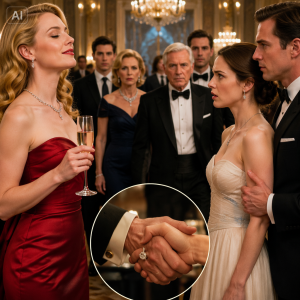
Khloe Carter was twenty-nine, wearing a dress the color of arterial blood, walking across the marble floor like she owned it — which Victoria understood instantly was precisely the point. This was a declaration. Daniel had gone still beside her, his glass stopped halfway to his mouth.
Khloe stopped in front of their table and extended her hand across the white linen. “Mrs. Hayes. I don’t think we’ve been formally introduced. I’m Khloe Carter. I’ve been working very closely with Daniel on the Nexus expansion project.”
The table went quiet. Victoria set down her wine glass with deliberate precision, took the extended hand, shook it once, and released it with a composure several onlookers would later describe as almost frightening.
“How interesting,” Victoria said. “Daniel has never mentioned you.”
Five words, delivered with a stillness that made them land like something physical. Khloe held her smile, glanced at Daniel, and said something about working practically around the clock. “I’m sure,” Victoria said, and turned her attention back to the woman beside her, as though Khloe Carter had become less interesting than the centerpiece.
It took Khloe a full three seconds to understand she’d been dismissed.
Daniel excused himself from the table twice in forty minutes, returning both times with the too-relaxed expression men wore when they thought they were hiding something. Margot, an old friend seated beside Victoria, leaned in under the pretense of reaching for the bread basket. “That woman is staring at Daniel like she’s already redecorating.”
“I noticed,” Victoria said.
“What’s happening right now?”
Victoria placed a piece of bread on her plate with the same precision she placed everything. “Nothing that isn’t already finished.”
At 9:47, Daniel Hayes stood up from his chair. He hadn’t signaled he was going to speak. He simply stood — and because he was Daniel Hayes, CEO, sponsorship board, the particular kind of space certain men occupied in rooms like this one, people looked, then quieted, then waited.
“I just want to say something,” he began, his voice carrying easily across the ballroom. “Tonight is about new beginnings. About having the courage to follow your heart, even when the path isn’t perfectly clear.” A pause. His eyes moved, briefly but undeniably, toward Khloe Carter’s table. “About being honest with yourself, and the world, about who you really are and what you really want. I think that’s a lesson we could all stand to embrace.”
The ballroom went quiet — not the appreciative quiet of an audience receiving a good speech. The other quiet. The held-breath quiet of a room that had simultaneously understood something it wasn’t supposed to understand yet.
—
## PART 2
Daniel sat back down. He reached for his wine. His hand was almost steady.
Then, from across the ballroom, a chair scraped back. Khloe Carter stood up, champagne glass in hand, smiling with something in her eyes that Victoria recognized instantly as premature, unearned, dangerously overconfident triumph.
“I’d like to add something to that beautiful sentiment,” Khloe said, her voice practiced to carry, warm and bright across the candlelit tables. “To new beginnings. To the courage it takes to claim what you actually want.” She let Daniel’s name sit in the silence, then turned and looked directly at Victoria Whitmore, smiling like a woman who believed she had already won. “And to the future — wherever it leads.”
She drank.
No one else reached for their glass. Six hundred people in a golden ballroom, and the only sound was the ghost of Khloe Carter’s voice fading into one of the most complete and suffocating silences Victoria had ever witnessed.
Khloe’s smile held for four full seconds. Then something crossed her face — not yet panic, but the first faint tremor of doubt. The room had not responded the way she expected.
Victoria rose from her chair — not dramatically, not quickly, but with the unhurried inevitability of tides, because the motion was simply the next thing that was going to happen. She set her napkin down, smoothed the front of her midnight blue gown, and began walking toward the center of the ballroom. Not away from Daniel. Not toward Khloe. Simply walking, with the perfect deliberateness of a woman who had designed this evening herself.
Every eye in the room followed her.
Then, from beyond the ballroom’s double doors, Victoria heard footsteps — multiple, purposeful, moving with the measured rhythm of people who had decided exactly where they were going and had no intention of being hurried.
The doors opened.
Augustus Whitmore walked into the ballroom, and six hundred people understood in an instant, with a collective wordless certainty, that the room they were in had just changed. He was seventy-three and walked like he was forty-five, and he carried himself with the gravity of a man who had spent five decades being the most important person in every room he entered and had simply never developed the habit of pretending otherwise.
Behind him came Eleanor Whitmore, silver-haired, elegant, cataloging and dismissing the room in a single sweep. Beside her, Julian Whitmore, forty-four, a legal mind like a surgical instrument, let his eyes move once, comprehensively, across the ballroom.
Daniel Hayes saw them and went the color of old chalk.
—
## PART 3
Victoria, standing in the center of the ballroom, did not turn around. She didn’t need to. She could see it in Daniel’s face — the exact moment the full weight of what he’d done, and what he hadn’t understood about the woman he’d done it to, came crashing down on him. He had thought he was leaving a wife. He had not understood he was picking a fight with a dynasty, and dynasties in the Whitmore family did not lose fights. They simply arrived, and the fight was already over.
Augustus reached his daughter and took her hand in both of his. “We’re here,” he said quietly.
“I know. Right on time.”
He looked at Daniel Hayes the way a man looks at a problem already solved — not with anger, not quite contempt, just detached assessment. Daniel hadn’t moved from his chair, wine glass still in hand, his face the color of old plaster.
Khloe Carter was still standing. She held her position a full agonizing ten seconds after the Whitmores entered, champagne glass still raised at a lower angle now, smile beginning to show hairline fractures of something she wasn’t equipped to name yet. She had done her research on Victoria Whitmore, the wife — the charity boards, the social calendar, the twelve-year marriage. She had not done her research on Victoria Whitmore, the daughter — on what it meant, in the specific financial and social architecture of this city, to be the eldest child of Augustus Whitmore of Whitmore Capital. She was about to find out.
Julian crossed the room and stopped near Daniel’s table, hands clasped, pleasant in the surgical way of a man who argued in front of federal judges three times a month. “Daniel. I hope the evening has been enjoyable so far.” He let a half-second land. “My sister’s name is on the invitation. As is yours. We’re here to support the foundation — and to support Victoria, of course, as we always do.” Not a statement. A perimeter drawn quietly around a woman some people in this room had underestimated in full view of everyone who would ever matter to them.
Augustus stepped beside his son. “Daniel.” Just the name — in the voice of a man who had personally approved the first line of credit that made Hayes Dynamics possible, twelve years earlier, as a wedding gift. “You and I have some things to discuss. Not tonight. Tonight is for the foundation.” He looked at Daniel with an expression almost kind, the way a precise doctor’s final diagnosis is almost kind. “But soon.”
No raised voices. No accusations. And somehow it was the most devastating thing that happened in that ballroom all evening. A hedge fund manager three tables over leaned to his wife and murmured three words: *call Marcus tomorrow.* A woman on Victoria’s foundation boards texted a colleague: *did you see that?* The reply came back in under thirty seconds: *I saw it.*
Eleanor Whitmore walked, unhurried, to Khloe’s table. “I don’t believe we’ve met,” she said, her voice even, carrying. “I know who you are. I also know what you thought you were doing tonight.” A pause, not theatrical, just long enough. “You mistook borrowed attention for power, my dear. It’s a common error. But the consequences of it—” she let her gaze move briefly across the six hundred watching people — “are rarely comfortable.” She turned away with the same unhurried ease and walked back to her husband’s side.
It was, several people would say later, the most effective thing anyone said all evening, including the foundation chairman’s professionally written speech.
Margot appeared at Victoria’s side. “Are you all right?”
“Yes,” Victoria said. “It’s strange. I thought I would feel more.”
“What do you feel?”
Victoria looked at Daniel across the room, finally looking back at her with an expression she hadn’t seen in years — not love, not guilt, something more complicated than either. “Finished,” she said simply. “I feel finished.”
She went to her father. “Thank you for coming.”
“We were always going to come. You know that.”
“I wanted to wait until he made it public. So there would be no ambiguity.”
“You were right to wait,” Augustus said. “Julian has everything in place. The Meridian line freezes at nine tomorrow morning, unless Marcus hears from me to the contrary. He will not hear from me to the contrary.”
She turned once more to look at the room — at Daniel staring at a half-full wine glass as though it contained information he needed; at Khloe Carter, no longer performing, arms close to her body, calculating an exit she hadn’t mapped yet. She let herself feel it — not triumph, not grief, but the particular clarity that comes after a difficult decision has been made and enacted and cannot be unmade. Then she turned and walked toward her family, and did not look back, even when she heard Daniel’s voice behind her — *Victoria. Please* — low and uncertain, almost young, the way he’d sounded in the early years when things were real between them.
—
Daniel Hayes woke up alone the next morning with the particular weight of something irreversible. Seventeen missed calls. He called Marcus at Meridian Capital back.
“The Whitmore Capital position on your credit facility,” Marcus said carefully. “The line’s been frozen, Daniel. Effective nine a.m. today. The instruction came directly from Augustus Whitmore’s office.”
“How much runway without it?”
“Eleven weeks. Maybe twelve if we defer Vancouver.”
Daniel called Julian. “You froze my credit line.”
“My father froze your credit line,” Julian said, with the precise accuracy of a man who did not make errors of attribution. “That’s an important distinction. The Meridian facility was always contingent on Whitmore Capital’s continued participation in your investor structure. That’s in the original agreement. You signed it. I drafted it. This isn’t a reaction to last night, Daniel. This is a contractual consequence of a decision you made when you restructured your priorities.” He paused. “Victoria will speak to you through our family’s legal representation. As of this morning, that’s me.”
By 9:47, Richard Pratt — the hedge fund manager from the gala — left a voicemail requesting a review of his Hayes Dynamics position. By ten-fifteen, a society blogger’s post describing the gala’s “stunning public confrontation” had been shared over two hundred times and climbing.
At the Hayes Dynamics offices, Khloe Carter’s key card no longer worked. HR handed her a severance envelope. “Given the circumstances,” the director said carefully. “Your conduct last night was considered a significant breach of professional standards. There have also been concerns raised at the board level about certain conduct over recent months.”
She called Daniel. It went to voicemail after two rings — which meant he’d seen her name and declined.
By Thursday’s board meeting, the questions had multiplied from two members to four. Patricia Osei, a director who had championed Daniel for years, asked him directly: “What is the current status of the Whitmore Capital participation in our credit structure?”
“The Whitmore line has been frozen,” Daniel admitted. “As of Tuesday morning.”
“On what grounds?”
“Personal grounds.”
“What happened at that gala is already on social media,” Patricia said, not unkindly, but immovably. “The separation between personal and professional you’re asking us to maintain is not a separation the market is making. I think we need to discuss a formal performance review. Today.”
That was the moment Daniel understood, in the full-body way real understanding arrives, that his company was not going to survive intact.
That afternoon he called Victoria directly rather than through Julian. “I made mistakes,” he said. “Multiple mistakes, over a long period of time. I know that’s not enough.” He asked if there was any version where they could talk, not through lawyers, just the two of them.
A long silence. Then: “Saturday morning. The Hazel Room. Ten o’clock. One hour.” A pause. “I’m not coming to negotiate the marriage, Daniel. That’s finished. I’m coming because we were together twelve years, and you deserved one real conversation.”
—
Saturday came with pale, clean fall light. Victoria arrived at 9:58 in dark jeans and a cashmere sweater — dressed as herself, not for performance. Daniel was already there. He stood when she entered, one of the genuine things about him that had survived every other deterioration.
“You look tired,” she said.
“I am.” He didn’t dress it up. “The board is moving toward a formal review. Pratt is circling. Vancouver is dead. The company’s in real trouble.”
“I know.”
“Was that the plan? To take the company down?”
“The plan,” she said carefully, “was to protect what my family helped build, and to make sure that when this marriage ended, it ended on terms that were clear. Julian built protective clauses years ago — standard protections for family capital. I didn’t weaponize them until you made it necessary. You made it very public. You made it impossible to handle privately.”
“Why?” she asked, not with anger but with genuine curiosity — the way a person asks a question they’ve been trying to understand for a long time.
He was quiet. “Because I was a coward. I didn’t know how to end it honestly, so I forced the situation to end it for me. That’s not an excuse. It’s just what happened.”
“Did you love her?”
He took a long time. “I was desperate, I think, for something that felt uncomplicated. No — I don’t think it was love. I think it was avoidance.”
Victoria nodded slowly. “I loved you,” she said. “For a long time, I genuinely loved you.” The past tense landed between them, gentle and final and complete.
“I know you did,” he said.
“What are you going to do after?” he asked. And for the first time in the conversation, something in her expression shifted — not toward grief, toward something forward-facing, with its own quiet energy.
“I’m building something,” she said. “A foundation. Women in tech and leadership. Dr. Sarah Chen and I have been working on the framework for months. It’s real. It’s good. I’m excited about it.”
He looked at her when she said it and saw the truth of it — the genuine, unperformed energy behind the words. “You’ll be extraordinary at it,” he said, and meant it.
“I know,” she said, not with arrogance, with the grounded certainty of a woman who had finally stopped waiting for permission to believe it.
She stood, put on her coat. “Take care of yourself, Daniel. I mean that.”
“Victoria.” He waited until she looked at him fully. “I’m sorry. I know it’s inadequate, but I need you to know that I know what I had, and what I did with it.”
She nodded once — not forgiveness exactly, not yet, but the acknowledgment of a woman willing to let something true be true without requiring anything further of it. Then she walked out into the pale morning light, and did not look back.
—
The divorce was finalized on a gray Wednesday in late October — clean and fast, because both parties had decided prolonging it served no one. Victoria signed the papers in Julian’s office, and afterward, uncharacteristically, he came around the desk and held his sister for a moment, briefly and completely. “Thank you,” she told him. “For all of it. Always.”
She called her mother from the sidewalk. “How are you?” Eleanor asked.
“Free,” Victoria said — the word surprising her as it arrived, unplanned, simply the accurate one.
“Good,” Eleanor said, something soft and unguarded in her voice. “That’s exactly how you should feel.”
Daniel, meanwhile, negotiated a partial acquisition of Hayes Dynamics with Richard Pratt — a fair offer, though not what the company had been worth at its peak, retaining a minority stake in the Nexus technology, the one thing genuinely his, the thing he’d built from actual intelligence and vision before the Whitmore scaffolding had become load-bearing. He signed it, took the proceeds of fifteen years of real work, and by November had started sketching, alone at his desk, notes for something new — the way he’d built the first company, in a bad-lit room with unlimited ambition. It felt, unexpectedly, like coming home to something.
Six weeks after the gala, the Whitmore Chen Foundation for Women in Technology and Leadership launched with twelve million dollars in initial funding — Victoria’s own voice, her own name first in the title, no publicist, direct across three platforms. Her phone started ringing at 9:04. Margot, crying in her kitchen. Her father: *I saw the announcement. Your mother is very proud.* A pause. *So am I.*
Within a week, the foundation had received four hundred and twelve applications for a first cohort projected at eighty.
A business-section profile ran three weeks later, mentioning Daniel Hayes once, in the seventh paragraph, as *Victoria’s estranged husband,* and the gala in half a sentence, before moving on. Victoria read that paragraph twice and found the reduction of twelve years to one sentence felt not like diminishment, but like accuracy — the story correcting its own proportions.
—
In January, she was invited to keynote a summit of four hundred women in finance and technology. She stood at the podium without notes — because notes were for uncertainty, and she was not uncertain — and spoke for thirty-five minutes about power and patience, about the difference between borrowed authority and built authority, about what it looked like to build something that lasted versus something that depended on conditions that could be removed.
She did not mention Daniel by name. She did not mention the gala. The room understood anyway — these were women who had spent careers navigating exactly the architecture she was describing, who knew the specific discipline required to convert being underestimated into momentum.
When she finished, the room stood. Not the polite applause of an audience fulfilling a social contract — the kind of standing that happens when something true has been said to people who recognize the truth of it in their bones before their minds finish processing the words.
Khloe Carter had raised a champagne glass in a golden ballroom and toasted the future, aiming it like a weapon at a woman she believed she’d already defeated, drinking it with the full confidence of someone who’d already won. She had not understood, in that moment, that the toast was not a defeat. It was a trigger — for a foundation, a stage, four hundred women standing, a life being built on ground that was entirely her own.
It was not revenge on Daniel Hayes. It was not a performance for anyone in any ballroom. It was simply Victoria Whitmore, finally, completely, without apology, taking up the full amount of space she had always been entitled to occupy.
Power does not beg. It does not perform. It does not raise its voice in a room full of people and demand to be seen. It builds, quietly and with absolute intention, until the building is so undeniable that the room has no choice but to recognize what was always already there.
Victoria Whitmore had not won the night of the gala. She had simply been the only person in the room who already knew how the story ended.
THE END