A Mountain Man Came Home for His Long-Awaited Bride — Then Found Her Freezing Alone in the Snow

The first rider came two weeks later — a lost-traveler story, eyes cataloging the smoke and the second set of bootprints by the door before he rode off. Ridge watched him go and stood a long moment looking at the empty trail. “We had a visitor,” he told Eliza when he went back inside. “Lost, he said. He saw the cabin. Saw two sets of tracks. He knows someone’s here.”
“Then we have a week to be ready,” she said, and picked her harness work back up without a tremor in her hands.
They rode down to Hatcher station together so people would see her — see that she stood in the world willingly, before Silas’s version of events could exist unchallenged. “If I’m a ghost nobody’s seen,” she said, “his story is the only one that exists. If people have met me, spoken to me, know I’m here by choice — it changes the math.” Cutter, the dry precise trading-post man who ran the crossroads of every kind of frontier traffic, took her statement and the top estate document without promising anything beyond memory. “I’m not putting a gun in anybody’s yard,” he said. “I’m asking you to remember this conversation,” she said. “I’ll remember it,” he said, and that was enough.
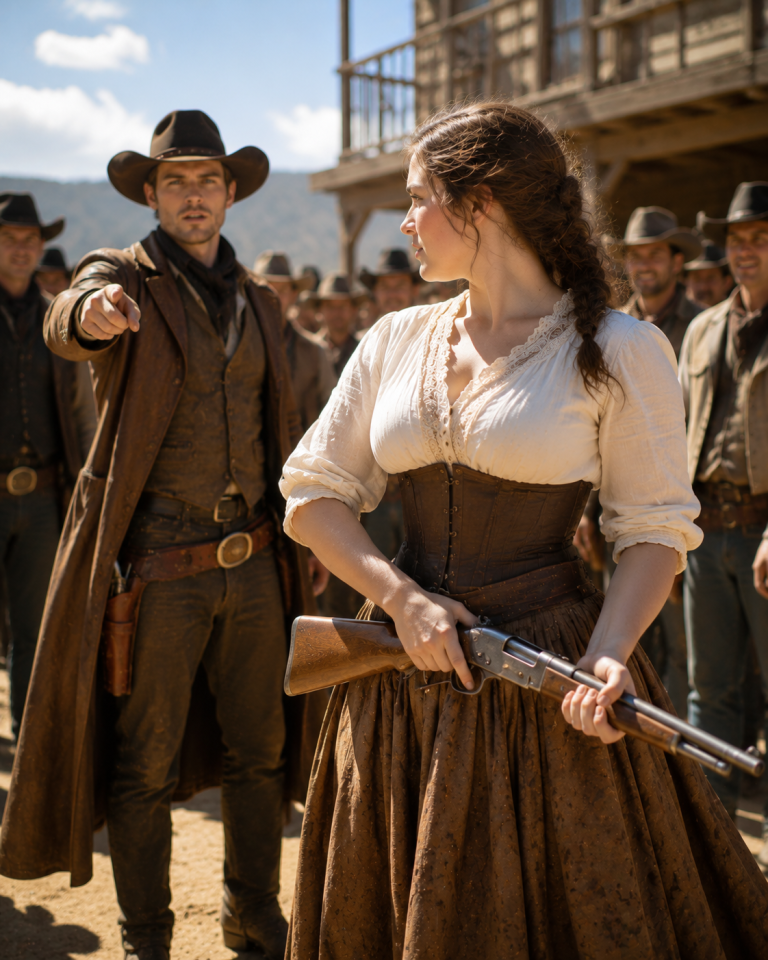
They came on a Thursday morning nine days later — six horses, six men, Silas at the front, riding loose and unhurried like a man arriving somewhere he already owned, his face arranged in careful, performed concern. Ridge had been outside for twenty minutes already, ever since the mule had gone still in the lean-to with that particular ear-forward alertness that had become, over the winter, a reliable early warning.
“You must be Mercer,” Silas said. “I’m here for my sister. She’s not well. I’m sure you meant no harm, but she’s not in any condition to be making decisions—”
The cabin door opened. Eliza came out and stood on the step with no expression at all — the most dangerous state Ridge had learned to recognize in her, the stillness of a woman who’d made all her decisions already and was simply executing them.
Silas’s face did a half-second recalibration; he’d expected someone diminished. “Eliza. Thank God I’ve been—”
“Don’t,” she said. One word, flat as stone.
“You look well,” he tried, adjusting. “Considering you left me under a tree to die in November,” she said. She walked down into the yard, stopped ten feet from his horse. “I remember all of it. Do you want me to say it in front of these men, or do you want to keep going with the story you’ve got?”
Something moved under Silas’s easy performance — the frightened thing underneath, encountering someone who’d stopped being afraid of him. He recovered fast, projecting now for the men behind him: trauma, confusion, a legal family member asking Ridge, man to man, to step aside.
“No,” Ridge said. Just that.
“There are six of us and one of you,” Silas said, voice thinning into something raw.
“Five,” said a voice from the back. A broad, weathered miner had shifted his horse sideways out of formation, looking at Eliza, not Silas. “You said your brother robbed you and left you in the snow. That true?”
“Yes,” she said.
“I signed on to help a man find his sister,” the miner said. “Not to drag a woman out of her own house.” He turned his horse. Silas turned on him, and in the suspended second that followed, Eliza held up the documents — not offering them, just making them visible, physical fact.
“This is a signed statement from the estate attorney,” she said, voice carrying across the yard. “Silas Vain received his full inheritance in September. He took his legal share and came after mine anyway. That’s the whole story.”
A second rider pulled back without being asked. Then a third. No declarations — just men reorienting toward the trail because the job had turned into something else and their time was worth more than the pay.
Silas watched them go, and everything performed in him collapsed into something uglier and more honest. “You think this is finished?” His voice cracked on it. “You were supposed to be nothing. Father’s money was supposed to—”
“It’s over, Silas,” she said, steady. “Take what’s left of your dignity and leave this mountain.”