A Lonely Rancher Knocked on a Widow’s Door—Then She Saw the Little Girl Standing Behind Him

—
## PART 1
The autumn wind moved across Montana like something alive — cold and restless, warning of a winter that would show no mercy. Abigail Thornfield stood alone on the porch of her ranch house, watching the sky burn dark red behind the mountains. Six months back she’d buried her husband behind the barn, and since then the land had felt heavier with every week that passed. Fences broke faster than she could mend them. Cattle pushed against weak posts. Every night the wolves reminded her exactly how alone she was out here.
At thirty-two, Abigail was still young, though grief had added years to her face that no amount of rest was going to give back. Her hands had gone rough from work that used to be split two ways. The neighbors had helped at first — brought food, offered kind words — but kindness thinned out once it became clear the work wasn’t going to end in a season. People whispered that a widow running three hundred head alone wouldn’t last past the first real snow.
She was turning to go back inside when she saw them: two riders coming up the dirt road at sunset, which nobody with good sense did out here unless they had a reason. Her body went still. She stepped to the rifle resting by the door without taking her eyes off them.
The man dismounted first at the gate — tall, a long coat faded by weather and miles, his movements careful and steady, not drunk, not careless. Behind him, still mounted, sat a child. He removed his hat.
“Ma’am,” he called. “Name’s Nathaniel Blackwood. I was told you might be needing a ranch hand.”
Abigail didn’t lower the rifle. “Who told you that?”
“General store in town. Fella said Widow Thornfield was running her place alone. Said she was too proud to ask for help, but might not turn it away if it came knocking.”
That sounded exactly like Henry from the store — always watching, always talking. “And you just happen to be passing through?”
Nathaniel glanced back at the child before answering. “My daughter and I have been riding three weeks. We need work and a place to winter. I can handle cattle, mend fences. I don’t drink, don’t gamble. You’ll get honest work for honest pay.”
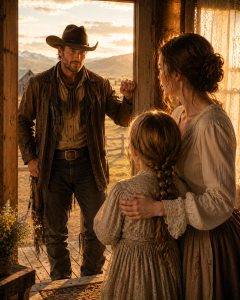
The girl slid down off the horse on her own, and something shifted in Abigail’s chest at the sight of her — maybe seven years old, dust thin across her dress, a worn cloth doll clutched tight against her body, dark eyes too big for her small face.
“Papa,” the girl whispered. “I’m cold.”
The word struck harder than Abigail expected. Her own house had been cold for months — not from weather, but from the particular silence of a place built for two people that only held one now.
“What’s her name?” she asked quietly.
“Evangeline. We call her Evie.”
Abigail studied them both. The man’s boots were worn thin at the heel. His coat had been patched more than once, but everything about them was clean, careful, honest in the way poverty sometimes was and desperation sometimes wasn’t. The child’s dress had been let down twice, different fabric stitched in at the hem by a hand that had run out of matching cloth partway through. It was their eyes, though, that finally decided it for her. She’d seen that particular look before, every morning, in her own mirror.
“You can put your horses in the barn,” she said finally. “There’s hay in the loft. When you’re done, come inside. I’ve got stew on the stove.”
Relief flickered across Nathaniel’s face before he could smooth it away. “We’re obliged, ma’am.”
As they led the horses off, the wind picked up, rattling dry leaves across the yard. Winter was coming. But for the first time in months, Abigail didn’t feel entirely alone facing it down.
Inside, she set three bowls on the table and paused with her hand still on the third one. Three. It felt strange. It also felt right in a way she wasn’t ready to examine too closely yet.
When the knock came, she opened the door to find them cleaned up as best they could manage — the girl’s hair hastily braided, Nathaniel standing straight with his hat in both hands.
“Come in,” Abigail said.
Evangeline’s eyes went wide at the fire and the quilts hung along the walls. “It’s pretty,” she whispered, then glanced quick at her father like she’d spoken out of turn.
“It’s all right,” Abigail said gently. “Would you like to help me set the table?”
The girl nodded eager and set her doll carefully on a chair before helping. Over supper, the cabin filled with something it hadn’t held in longer than Abigail wanted to count. Conversation. Nathaniel ate slow, grateful but careful, while Evangeline fought to keep her eyes open.
“How long since her mother?” Abigail asked softly.
“Four months. Fever took her.” Silence settled a moment. “We’ve been riding since. Working where we could. Most folks don’t want a hand who comes with a child attached.”
Abigail understood that particular truth better than she wanted to. People avoided complications, and a widow and a widower both knew exactly what that avoidance felt like from the inside.
After the meal, she showed them the small storage room off the kitchen. “It’s not much,” she said. “But there’s space for two bedrolls.”
Nathaniel looked at her sharply. “You’re offering us the job.”
“I’m offering a trial,” she corrected. “Two weeks. Thirty dollars a month and board. You earn it, you keep it. You have my word.”
They shook hands across the table, and it wasn’t only an agreement. It was two people deciding, separately and for their own reasons, to risk trusting a stranger with what little they had left standing.
Later that night, Abigail stood at her bedroom window watching the barn lantern glow in the distance, Nathaniel’s low voice carrying faint through the thin wall as he settled his daughter for sleep. The house didn’t feel empty anymore. Tomorrow would decide whether she’d made a wise choice or a foolish one. But tonight there was a child sleeping under her roof, and for the first time since she’d buried Samuel, the wind outside didn’t sound quite so lonely.
—
## PART 2
The first week passed in a blur of long days and early mornings. Nathaniel rose before the sun and found Abigail already awake, coffee brewing, ledgers open on the table, every dollar and sack of feed and head of cattle accounted for in a hand as careful as his own. He respected that about her from the start. She didn’t complain. She simply worked.
By the third day he’d repaired the worst stretch of fence in the north pasture and fixed the chicken coop’s broken hinges. The ranch had been holding together on stubbornness alone; now it started to breathe again. Evangeline changed the most of any of them — the shy, exhausted child who’d arrived clutching her doll began following Abigail everywhere, gathering eggs with careful hands, learning to scatter feed evenly, listening close while Abigail showed her how to stitch a seam tight enough not to tear.
“Small stitches make strong fabric,” Abigail said one evening, guiding the girl’s hands. Evangeline’s tongue poked out in concentration as she copied the motion, and across the room Nathaniel pretended to oil a saddle while his chest went tight. Martha had wanted to teach their daughter things like that. The fever had taken that chance along with everything else. Watching Abigail fill the space without ever once trying to replace anyone in it meant more than he had words ready for.
The real test came with moving the herd down from summer pasture — three hundred head, far too many for two hands alone. “We do it in stages,” Abigail said, jaw set. “Fifty at a time.”
Nathaniel hesitated, then said it plain. “Evie can ride sweep.”
Abigail looked at him sharp. “She’s a child.”
“She’s been riding since she could walk. She needs to feel useful, not hidden away.” After a long pause, Abigail nodded.
Evangeline’s face lit up at the news, and she rode between them the next morning sitting tall in the saddle, trying hard to look serious about it. She surprised them both — anticipating breakaways before they happened, guiding nervous cattle back into line with a quiet, steady voice that had nothing childish left in it by the end of the day. “You did professional work today,” Nathaniel told her that evening, and Abigail pressed a silver dollar into the girl’s palm.
“Professional workers get paid,” she said, and Evangeline stared at the coin like treasure.
That night the kitchen filled with flour and laughter as Abigail and Evangeline attempted bread and lost more than they won. “Bread’s a battle,” Abigail declared, dusted white to the elbows. “Sometimes you win. Sometimes the dough does.” For one evening, warm bread and easy laughter made it feel, briefly, like something none of them had dared call home yet.
Peace on the frontier never lasted long. The morning frost lay silver across the grass when Abigail spotted three riders coming up the road with purpose, and Nathaniel stepped beside her, pitchfork still in hand, as a large, pale-eyed man dismounted slow, a scar twisting his mouth into something close to a permanent sneer.
“Mrs. Thornfield,” he said. “Pike Morrison. I represent Mr. Cyrus Hartwell.”
—
## PART 3
Abigail kept her voice steady. “State your business.”
Morrison’s eyes flicked to Nathaniel. “Your cattle have been wandering onto Hartwell land.”
“That’s not possible,” Abigail said. “We moved them last week, careful, in stages.”
“Are you calling me a liar?”
Nathaniel stepped forward, calm. “Show us the strays. We’ll bring them back ourselves.”
Morrison’s eyes narrowed. “Mr. Hartwell believes a ranch this size might be too much for a widow alone. Winter’s coming. Accidents happen.” He let the word sit there in the frost between them.
Nathaniel went very still. “Sounds like a threat.”
“Just concern for neighborly safety.” Morrison’s gaze drifted past them to the house, to the window where Evangeline stood watching. “Dangerous country for children.”
Nathaniel’s voice dropped low enough that only Morrison and Abigail caught the whole of it. “Men disappear in this country too.”
For a long moment nobody moved. Then Morrison smiled thin. “Tell Hartwell you’ll check the fences,” Nathaniel added, level. “Any strays get returned proper.”
After they rode off, Abigail realized her hands were shaking. “Who is Hartwell?”
“Owns the largest ranch in the territory,” she said. “Buys up smaller ones any way that gets the job done.”
That night Nathaniel cleaned his rifle by the fire while Abigail watched from the doorway. “I hate this,” she admitted quietly. “Waiting for something bad to happen.”
“We won’t wait,” he said. “We’ll prepare.” He moved his bedroll into the main room, between the door and the hallway, so that if trouble came, it met him first. Later, tucking Evangeline into bed, she asked him softly whether he’d protect Mrs. Abigail too.
“I’ll protect everyone in this house,” he told her, and from the hallway Abigail heard it, and something inside her shifted for good.
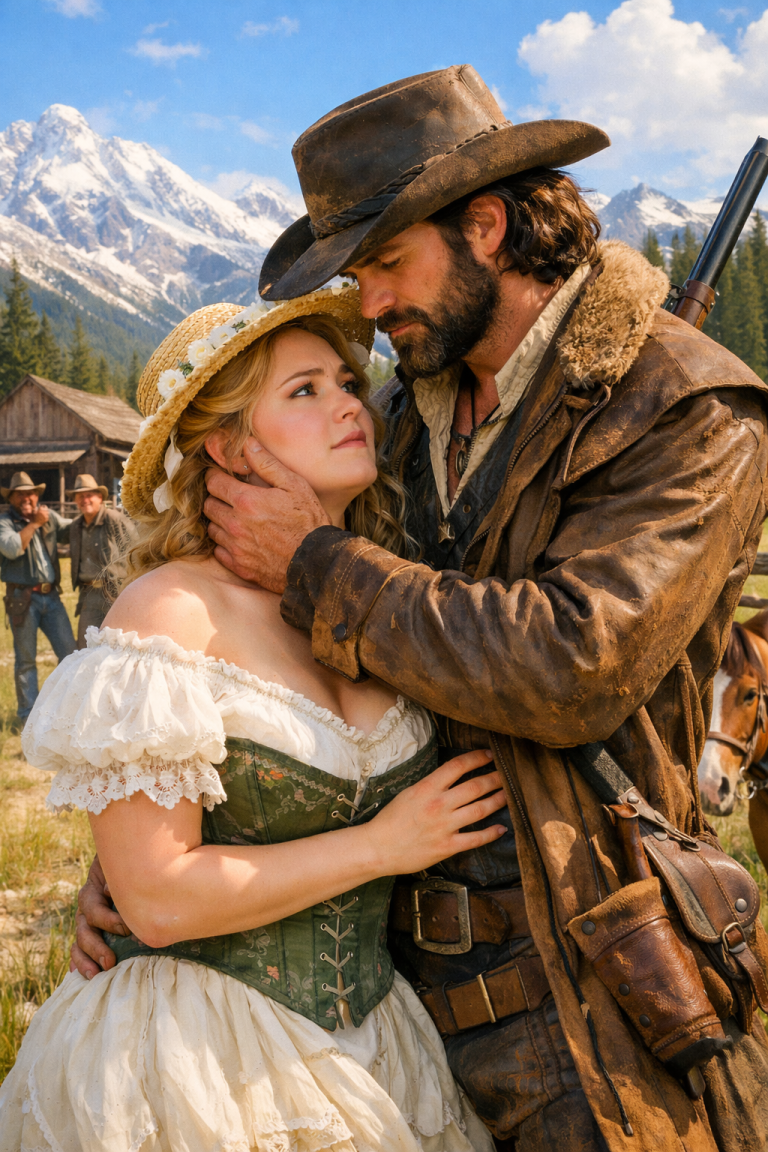
Later still, standing at the window with tears slipping down her face, she felt him join her. “We’re already a family,” she whispered. “Somewhere between that first knock and now.” He cupped her face gently.
“Then we protect what we’ve built,” he said, and outside the wind rose again — winter coming, but for the first time in a long while, Abigail Thornfield wasn’t facing it alone.
The smell of smoke woke Nathaniel before the shouting did. For half a second he thought he was dreaming, and then the cattle’s screaming and the horses kicking against wood told him otherwise. *Fire.* He was on his feet before the word finished forming.
“Abigail. The barn.”
She was already pulling on her boots, no panic in her face, only focus. “I’ll get Evangeline. You get the horses.”
Outside, the barn’s west wall was already burning, flames climbing fast through dry timber and old hay, sparks flying up into the dark like angry stars. Nathaniel ran straight into the smoke, heat slamming into him, throwing open stall doors and counting horses as they bolted past — one missing. Through the smoke he found her: Buttercup, Evangeline’s mare, frozen against the far wall. He threw a blanket over her head and hauled hard on the lead.
“Move!” A section of roof came down behind them just as the mare stumbled forward and clear.
Outside, Evangeline clutched Abigail’s skirt. “My kittens,” she cried. “They were in there.”
Abigail knelt and held her tight while Nathaniel turned to the cattle — the corral fence had broken under the weight of panicked animals, stock scattering into the dark, some charging straight toward the flames. The three of them worked together to push the herd clear, Nathaniel shouting commands, Abigail riding hard to block strays, Evangeline holding Buttercup steady close by rather than being sent inside to hide.
By dawn the barn was ash. Winter feed gone. Tools gone. A good piece of their future gone with it. Nathaniel walked the burned ground slow and found what he expected — hoofprints that didn’t belong, a charred torch stub thrown aside in the dark.
“This wasn’t an accident,” he said quietly.
Abigail didn’t cry. “They want us to break.”
Before noon, neighbors began arriving, smoke visible for miles. Tom Patterson rode in first, and nobody needed telling what had happened once they saw the ash. “They crossed a line,” Patterson said. “Burning out a widow and a child.” By evening, wagons loaded with lumber rolled into the yard. Men brought tools. Women brought food. Guards were posted at the property’s edge without anyone having to ask for them. “We raise a new barn,” Patterson declared. “Bigger. Stronger.”
For three days the valley worked as one — frame first, then walls, then roof — and when the last beam went up, the new barn stood taller than the old one had ever managed. Hartwell had meant to weaken them. Instead he’d united half the county against him, though none of them yet understood how far he was willing to go before that would matter.
Two weeks later, on a moonless night, riders surrounded the house. Nathaniel heard them before the knock came.
“Bolt the cellar door,” he whispered to Abigail.
Pike Morrison’s voice cut through the dark. “Blackwood. Come out.”
Nathaniel stepped onto the porch, rifle in hand. “What do you want at midnight with eight men?”
“Word says you’ve been stealing cattle.”
“Try again,” Nathaniel said, calm.
Morrison’s smile was thin even in the dark. “Come out or we come in.”
Before he could push it further, more riders thundered up the road — Tom Patterson, Marshal Brennan, and nearly a dozen armed neighbors who’d been watching the property in shifts since the fire. The yard filled with tension pulled rope-tight between the two groups.
“Show me the warrant,” Marshal Brennan said coolly.
Morrison hesitated. “There isn’t one,” Brennan continued. “So I’d suggest you ride out before I start making arrests tonight instead of asking questions.”
Morrison stared hard at Nathaniel. “This isn’t over.” But he rode.
That night, Nathaniel and the assembled neighbors understood something plainly: Hartwell wasn’t going to stop until somebody with real authority stopped him first. Abigail took the lead on what came next, riding out over the following weeks to every small ranch Hartwell had ever leaned on — collecting what people were willing to say once they saw that a widow and a handful of armed neighbors had already stood him down once. It was slow, careful work. Two families refused outright, too frightened of what Hartwell might still do to them even with Brennan’s badge standing behind the effort. A third agreed to speak only after Abigail sat with the wife an entire afternoon, listening before she ever asked for anything in return. Marshal Brennan built his case around what she gathered — records of threats, records of altered survey lines, three separate witnesses finally willing to swear to fraud in front of a federal judge rather than a county one Hartwell might still reach.
Hartwell didn’t sit idle while the case built against him. A land office clerk who’d agreed to testify about a forged boundary filing suddenly recanted after a visit from one of Hartwell’s men. Brennan lost two weeks chasing down a second clerk willing to confirm the same forgery independently before the case could move forward at all. Twice, offers arrived at Abigail’s door — generous ones, dressed up as neighborly concern, urging her to drop the whole business and sell quiet before anyone else got hurt. She turned each one down without much discussion.
Morrison came back once more before it was finished, and this time he didn’t come with eight men and a bluff about strays. He came alone, in daylight, while Nathaniel was working the far pasture, and found Evangeline gathering eggs near the new barn. Abigail heard the girl’s scream from the porch and was running before she’d fully understood why. By the time she reached the barn, Morrison had Evangeline’s arm twisted hard behind her, a knife low against his own leg, already backing toward a horse tied at the fence line.
“Leverage,” he said, when Nathaniel came around the corner at a dead run, rifle already rising. “Hartwell just wants the deed signed over quiet. Nobody else needs to burn.”
“Let her go,” Nathaniel said, and there was something in his voice Abigail had never once heard from him in five months under the same roof — flat, controlled, entirely without the warmth he saved for the rest of them.
Morrison’s grip tightened instead. Evangeline whimpered, and that was the sound that decided it. Nathaniel closed the distance faster than either woman had ever seen him move, and in the scramble that followed — the knife dropping, Morrison twisting for the horse, a single shot that cracked loud enough to send birds up out of every tree along the fence line — it was over almost before Abigail’s mind caught up to what her eyes had watched happen. Morrison lay still in the dirt. Evangeline was sobbing but unhurt, already wrapped tight in Nathaniel’s arms, and Nathaniel himself stood over the body with a stillness that frightened Abigail more than the gunshot had.
Marshal Brennan rode out within the hour once word reached town, and the inquiry that followed was thorough rather than quick — three neighbors gave statements, Evangeline’s twisted arm and torn sleeve were noted plain in Brennan’s own hand, and the knife Morrison had carried was entered as evidence before Brennan finally ruled it lawful self-defense in the protection of a child. It didn’t feel simple to Nathaniel regardless of the ruling. That night, long after Evangeline had finally cried herself to sleep between them, he sat on the porch steps with his head in his hands, and Abigail sat down beside him without a word first.
“I told myself I was done with that part of my life,” he said eventually. “Wore a badge two years back in Kansas, before Martha, before Evie. Killed two men in that job, both times telling myself it was righteous, and both times it cost me something I never got back all the way. I swore when I left that work I wouldn’t carry a gun with intent again. Tonight I didn’t hesitate for even a second, Abigail, and that scares me more than Morrison ever did.”
“You didn’t hesitate,” Abigail said, “because he had a knife against our daughter’s arm. That’s not the same man who wore a badge looking for reasons to prove himself. That’s a father.” She took his hand, steady the way she’d been steady with every hard thing this land had handed her since Samuel died. “I won’t pretend I’m not shaken by what I saw today. But I’m not afraid of you, Nathaniel. I’m grateful past telling that you moved as fast as you did.”
He let out a breath that seemed to have been held the better part of a decade. “Our daughter,” he repeated quietly, testing the shape of the word in his mouth for the first time.
“She’s been that a while now,” Abigail said. “Whether either of us said so out loud yet or not.”
Morrison’s death, and the inquiry that followed it, gave Marshal Brennan the last piece he needed — testimony under oath, in a formal proceeding, that Hartwell’s own hired man had attempted to kidnap a child to force a land transfer. Combined with the forged survey records and the witnesses Abigail had spent weeks gathering, it was enough finally to bring federal marshals riding in from the territorial capital. The trial itself dragged through most of the summer, Hartwell’s lawyers fighting every entry into evidence, two more witnesses needing federal protection before they’d agree to testify at all. But the weight of it, piece by piece, proved too much even for a man with Hartwell’s money to hold back forever. By harvest, Cyrus Hartwell’s empire had come apart in open court, his ranch broken up and sold off to the very smallholders he’d spent a decade trying to swallow whole.
The valley breathed again. Spring came early the following year, grass pushing up green through soil that had known both fire and blood, the ranch standing stronger for everything it had survived rather than despite it. One evening, as the sun set behind the mountains, Nathaniel stood beside Abigail on the porch while Evangeline chased fireflies through the yard below.
“I knocked on your door looking for work,” he said quietly.
“You knocked on my door looking for winter shelter,” Abigail corrected, soft, “and found a home instead.” He turned to face her fully.
“Marry me,” he said. “Not for protection. Not for survival. For love.”
Tears filled her eyes, though she was smiling before they fell. “Yes.”
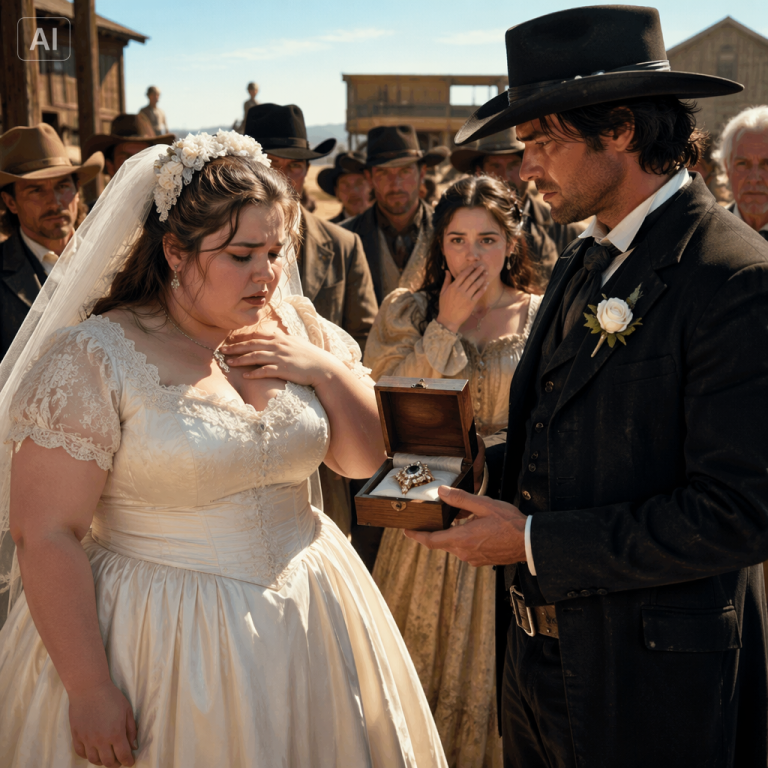
They married under a cottonwood tree with the whole valley in attendance, Evangeline scattering wildflowers ahead of them down the aisle. Afterward, while neighbors laughed and fiddles played long into the evening, Evangeline climbed up onto the porch beside them.
“Are we a real family now?” she asked.
Nathaniel pulled her close. “We were a real family the night I knocked on that door,” he said, and Abigail kissed the top of her daughter’s head.
“Some things just take a while to make official,” she added.
Years later, the sound of children’s laughter filled that same house — not only their own, but orphans and strays taken in one by one over the seasons, the way the ranch itself had once taken in a tired man and his daughter on a cold autumn evening. The barn stood strong against every storm that came after. And on quiet nights, when the wind moved across Montana again like something alive, Abigail would sit on that same porch and remember the lonely widow, the tired rancher, and the small girl holding a doll who had, between them, needed nothing more than a knock at the door and the courage on both sides of it to answer.
**THE END**