A Lonely Mountain Man Counted Her Seven Children — Then He Chose Every One of Them as His Family

PART 1
Black Ridge, Wyoming Territory. November, 1887.
The meeting had been going forty minutes before anyone thought to look at Evelyn. That told her everything she needed to know.
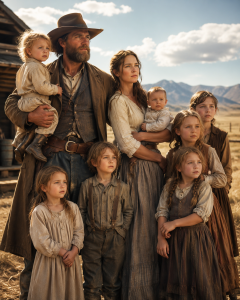
She sat in the third row of the old clapboard assembly hall, once a feed store before the rail company pulled out and took half the town’s purpose with it. The single iron stove in the corner fought a losing battle against the cold pressing through every crack in the walls. Evelyn held her youngest, Clara, against her chest under her coat — fourteen months old, running a low fever for three days, and not crying, which worried Evelyn far more than crying would have. Her other six children lined the bench beside and behind her, quiet in the particular way children go quiet when they sense the adults around them deciding something important. Tobias, thirteen and her oldest, sat with his arms folded and his father’s jaw set hard.
Her husband Thomas had been dead six weeks. Fever, fast and ugly. Tuesday he was coughing. Friday she was digging his grave herself, the ground so cold the shovel sparked on rocks. *Thomas, I don’t think you were wrong,* she’d thought, standing over it — remembering how he used to tease her, gently, that she’d rather drown than call for a rope.
Now Reverend Marsh stood at the front reading numbers. Two hundred fourteen pounds of flour, combined stores, against twenty-three households and a winter that hadn’t properly started yet.
“Get to the point, Marsh,” said Cal Dennit, who ran what remained of the trading post.
Marsh set down his paper and looked at Evelyn. “Mrs. Hart. This community cares deeply about you and your children. But the reality of our situation requires a frank conversation about what’s to be done with them.”
The room went very quiet. Evelyn felt Clara shift against her chest and kept her face still — the only armor she had left.
“I’m sitting right here,” she said. “You can talk to me directly.”
It was Lloyd Facet, who owned the livery, who finally said the actual words. “The children need to be placed. Separately. The Calhoun place would take the oldest boy for farmwork. The Morrisons said they’d take a girl, provided she’s useful in the house.”
“Stop.” The word came out of Evelyn so hard Clara startled. “You are standing here talking about my children like furniture you’re trying to find room for. You have names and prices worked out already, don’t you? Who gets Clara? She’s fourteen months old. She still doesn’t sleep through the night.”
“We’re not placing them,” Marsh said. “We’re ensuring their survival.”
“The alternative,” Evelyn said, “is that I take care of my own children.”
“With what?” Cal Dennit wasn’t cruel — that was the worst part, he was just accurate. “Thomas left you forty dollars in debt and a cabin with a leaking roof. Your stores are three weeks, maybe four.”
“I know what my stores are.” Her voice cracked and she pulled it back together with everything she had. “I need a week. Give me one week to figure something out.”
The men exchanged glances. Some silent negotiation passed between them. Marsh clasped his hands. “Mrs. Hart, I don’t think—”
The door opened. It didn’t bang. No dramatic gust. It just opened, the cold coming in before anyone registered who stood in the frame.
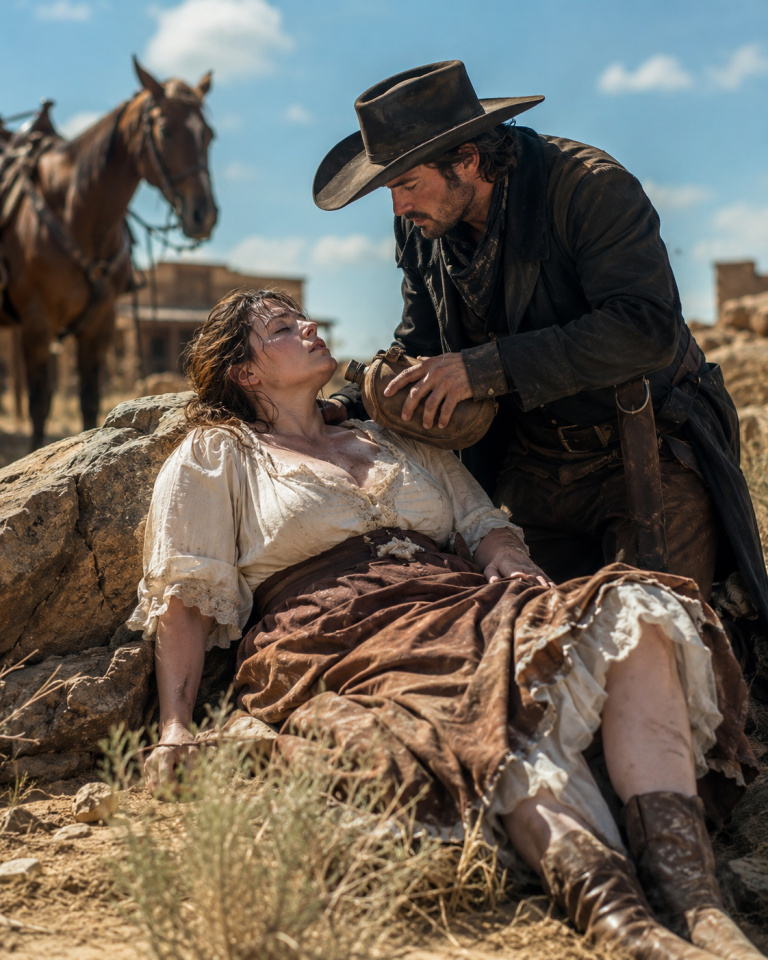
He was tall — taller than Lloyd Facet, broad through the shoulders in a way that suggested use rather than bulk. A dark beard going gray at the edges. A scar ran from his left cheekbone to his jaw, old and fully healed, but set in a way that gave that side of his face a permanent tension. He stood without speaking, taking inventory of the room the way a man checks for exits.
Tobias leaned close to Evelyn’s ear. “Mama. That’s Gideon Wolf.”
She knew the name the way everyone in Black Ridge knew it — half legend, half warning. A cabin somewhere above the timberline. Came down to trade twice a year. Spoke to no one more than necessary. A dead wife somewhere in the stories, though the details scattered after that.
“Wolf,” Cal Dennit said. “Didn’t know you were in town.”
“Heard you talking from outside,” Gideon said. “Thin walls.” He looked at the men. “You’re splitting up the children.”
“We’re making practical arrangements—”
“You’re splitting them up.” A statement, not an accusation. He looked down the row of them — Tobias with his folded arms, Samuel trying to look brave, the ten-year-old twins, James at seven gone quiet with exhaustion, little Nora asleep against Samuel’s shoulder, and Clara, just a pale face visible under Evelyn’s coat.
The look lasted three seconds. Then he turned back to the room.
“I’ll take all of them.”
PART 2
The silence that followed had a different texture than any that had come before it. Disbelief. Calculation.
“I beg your pardon,” Marsh said, not looking at Evelyn. “The woman and her children.”
“I’ll take them up to my place for the winter. I’ve got room and I’ve got stores. Enough.”
Lloyd Facet actually laughed, short and bewildered. “Wolf, you live alone on a mountain. You’ve never—”
“I know where I live.”
“There are seven children,” Marsh said, as if the man had miscounted.
“I heard you say it three times. Still seven.” Gideon finally looked at Evelyn. “Your choice, ma’am. I’m not forcing anything.”
She studied him, looking for the angle — the price, the exchange, the thing he wanted that she hadn’t found yet. Offers that looked like rescue rarely were, in her experience. Thomas had taught her to want to believe in people. The world after Thomas had taught her the other lesson.
“You don’t know us,” she said.
“No.”
“You don’t owe us anything.”
“No.”
“Then why?”
He was quiet — not searching for a good answer, but weighing whether an honest one was worth explaining. “Because they shouldn’t be separated,” he finally said. “That’s all.”
It wasn’t enough. It wasn’t nearly enough. But Cal Dennit was watching with his practical impatience, and the baby was warm and too quiet against her chest, and outside the wind was starting to say *winter, winter, winter* in a language anyone raised in this country could read.
“I need a moment,” she said, and turned to Tobias. His jaw was set, but his eyes — Thomas’s eyes — were asking her a question he was already too old, at thirteen, to say aloud. *Is this safe?*
She didn’t know. She genuinely didn’t know.
“Mama, we can’t let them split us up,” Tobias said.
She’d already known the answer. She’d just needed a moment to stand next to the knowing and be sure it was real.
She stood. “Mr. Wolf.” He looked at her. “I have seven children and nothing else. We’ll work for our keep, all of us old enough. But I want your word, in front of these people, that my children will be safe. Not promises about spring. Just the winter. Safe for the winter.”
He held her gaze. “You have my word.”
“Then I accept.”
PART 3
The room erupted — not violently, mostly noise, benches scraping, Marsh muttering something about irregularity. Evelyn didn’t listen to any of it. She was already calculating what to pack, what to leave, how to get seven children and whatever she could carry up a mountain before the storm building in the pitch of the wind arrived in earnest.
“I don’t like him,” Tobias said quietly.
“You don’t have to like him,” she said, folding her coat tighter around Clara. “You have to survive the winter.”
They left at first light. She’d packed through the night by lamplight — blankets, the cast iron pot, her sewing kit, six years of accumulated medicines, Thomas’s hunting rifle, taken not because she was a fair shot but because the alternative was leaving it behind. Gideon arrived an hour before dawn with a battered wagon and loaded their things without comment on how little there was.
“He’s scary,” Ruth said from the porch.
“He’s big,” Rachel corrected. She preferred accuracy.
Evelyn locked the cabin door and stood a moment with her hand on the wood. Six years of her life were behind it. Thomas was behind it, in some way she couldn’t explain and wouldn’t try to. She put the key in her coat pocket.
“All right,” she told her children. “Let’s go.”
The climb took most of a day. Where the grade steepened, Gideon redistributed the wagon’s load without being asked, without explaining. Evelyn sat beside him on the bench, a foot of space between them, and finally asked the only question she could find.
“How long have you been up here?”
“Eight years.” A pause. “Alone.”
She left room in case he wanted to fill it. He didn’t.
The cabin appeared in the last gray hour before dark — not what she’d expected. Solid. Log-built with real skill, a covered porch, a woodpile larger than she’d ever seen. Inside: one large room, a loft, shelves stacked with organized stores. One bed. One handmade chair.
“It’s so quiet,” Nora said, with the reverence of a child who’d shared a small space with six siblings her whole life.
Something moved across Gideon’s face — not regret, but the recognition of something long-settled about to change. “Loft sleeps four, maybe five,” he said. “Women and the little ones by the fire. I’ll—” He stopped, clearly not having thought that part through.
“The children can share the loft,” Evelyn said. “I’ll sleep down here with the baby.”
“And you?”
“Outbuilding has a cot.” He crouched at the fireplace, reaching for the tinder box. “It’s not heated. I’ve slept in worse.”
“You shouldn’t. This is your home.”
“It’s not a conversation.” He didn’t look back. “I’ll sort it.”
She stood a moment watching him build the fire, the children spreading cautiously behind her into the unfamiliar space, and thought: *I have made an enormous decision based on almost no information, in a desperate situation, and I have no way of knowing yet whether it was right.* And then: *But the fire is going, and the roof is solid, and at least we’re together.* It wasn’t hope. It was smaller than hope. It was just the next thing.
Supper was bean soup with dried venison, plain and adequate, eaten in a silence that came from exhaustion rather than misery. After the little ones were down, Evelyn came back to the table to find Tobias and Gideon sitting at opposite ends, not speaking, the silence between them carrying a specific unpeaceful quality.
“Tobias. Bed.”
He went, but not without one long look at Gideon carrying a dozen unasked questions. Gideon met it without expression until the boy looked away.
Evelyn sat down across from Gideon, her hands rough on the tabletop in a way they hadn’t been before Thomas died.
“He’s protective,” she said, not sure if she was explaining or apologizing.
“I know. He should be.”
“Why did you do it?” she finally asked — not the meeting-hall version of the question, the real one.
He was quiet a long while. “I heard Lloyd Facet say the Calhoun place, and I knew what that meant for the boy. Calhoun works children like equipment. I’ve seen it.” He looked at his cup. “And I heard you say *I know what my stores are* in that particular voice, and I thought you were going to try the impossible thing alone and fail, and they’d separate the children anyway after a worse winter. This way the odds are better.”
It was practical. Almost purely practical. She trusted it more than she would have trusted sentiment.
“Sleep while you can, Mrs. Hart,” he said, standing. “Weather’s coming.”
The first week was the hardest thing she’d done since digging Thomas’s grave — not because Gideon was cruel, but because nine people crammed into a space built for one creates friction that has nothing to do with anyone being wrong. It’s just the physics of too much life in too little room.
Gideon absorbed the chaos each morning with an expression Evelyn couldn’t read — not anger, not amusement, something closer to a man reading weather, making assessments, not taking it personally. The children sorted themselves around him in stages. Ruth and Rachel, bold in the way twins with built-in backup always are, started speaking to him directly by the fourth day, extracting facts — the horse’s name was Marshall, twelve years old, the logs had taken three weeks to notch, the shelf above the fireplace held “working tools” not to be touched. Nora feared him for five days, then found him crouched at her level one evening, asking the name of her cloth rabbit.
“Henry,” she said.
“Henry,” he repeated, like he was considering it. “Good name.” He stood and went to the fire, and after that she was less afraid.
Tobias was the harder problem — not openly hostile, but cooperative in a way that felt more like protest than participation. Gideon neither pushed nor retreated from it. He gave the boy real work, showed him once how to check snowshoe joints, told him plainly when he’d stacked wood wrong and why it mattered. He didn’t soften any of it. He also didn’t perform patience. He just treated Tobias like someone whose help was actually needed, and left the rest alone.
The rhythms of the cabin established themselves by repetition rather than agreement. Evelyn took over the cooking. Samuel, with an unexpected gift for patience, became the primary teacher for James and Nora’s lessons. In the afternoons Gideon took whoever was willing outside and taught them things without announcing he was teaching — how snow settled around a tree trunk to reveal wind direction, which ice would hold weight, what a rabbit’s tracks meant.
One afternoon Evelyn found him crouched beside James at a rabbit track, the boy leaning in with his full seven-year-old attention.
“Could you show me? Snares?” James asked.
Gideon glanced at Evelyn, who was watching from the porch. A level, waiting look that asked for nothing more than yes or no.
“Fine,” she said. “After lessons.”
James ran off in pure uncomplicated joy, and Evelyn stood on the porch thinking about a man who’d moved eight years of solitude aside to make room for a seven-year-old’s enthusiasm and called it a useful skill.
The real winter arrived at the end of the second week — not gradually, but as a commitment. Temperature dropped thirty degrees in a night. On the third day of the storm, with the wind loud enough to raise voices over and Clara feverish again, Gideon came in after midnight, snow-coated, and set a small tin on the table.
“Fever paste. Willow bark, mostly. My wife—” He stopped, started again the way a man does when he’s crossed into territory he didn’t intend. “I made it a while ago.”
“Your wife,” Evelyn said, leaving space, not pushing.
“She died. Eight years ago. Fever took her. Same winter I built this place.”
“I’m sorry.”
“It was a long time ago.” He sat down heavily. “Use it or don’t.”
She rubbed a little onto Clara’s chest. “What was her name?”
“Margaret.” A long silence, the wind working against the walls. “She hated the cold.”
Not *she was beautiful* or *she was kind* — *she hated the cold.* Evelyn felt the specific weight of that the way you feel a true thing.
“I’m sorry,” she said again, meaning it differently this time.
They sat a while in something that was, if not comfortable, at least honest — two people who preferred silence to noise, finding themselves in unusual proximity to both. Before he left for the outbuilding, she said Thomas’s name out loud for the first time in weeks, told him she’d been angry at her husband for dying, as if he’d had a choice, and that it wasn’t reasonable, and that didn’t stop it being true.
“No,” Gideon said. “It doesn’t.”
The storm broke on Wednesday, exactly as he’d predicted. The children spilled off the porch into three feet of new snow, even Tobias, whose face turned up to the pale sun with an expression that was, for one moment, simply thirteen years old. Evelyn told Tobias to help with the wood. He walked to Gideon, picked up a split log, and carried it to the stack.
“You’re stacking it wrong,” Gideon said. “Bark side down. Water runs off instead of in. Keeps it from rotting.”
Tobias looked at the stack, unstacked three pieces, restacked them correctly. Gideon split more wood without comment.
That was how it started. Not with warmth or a dramatic moment, but with bark-side down and the simple utility of a thing done correctly.
Weeks settled into routine — fire, lessons, outdoor work, supper, the necessary things said over coffee that tasted like willow bark. Evelyn learned his patterns: he never spoke before coffee, read the weather from the doorway each morning, kept a small blue ribbon on the high shelf that she was certain had been Margaret’s and never asked about. He learned hers too — stopped walking through the kitchen when she had hot things on the fire, started knocking before entering from the cold. Small adjustments, unannounced.
By the fourth week the cold had become the natural state of the world, and the wood consumption ran higher than Gideon had calculated for one person living alone. He didn’t complain about it. When she raised it, he only said, “We’ll be careful because we need to be. If managing isn’t enough, I’ll figure it out.” She would remember that certainty later, and how brutally it would be tested.
The food stores ran out the way a tide goes out — gradual, then suddenly final. By mid-January they had a partial sack of cornmeal, three jars of preserved plums, and twelve pounds of salt pork Gideon had found forgotten in the outbuilding. Not a food supply. A delay.
He did the accounting at the table one evening. “Two weeks,” he said, “if we reduce portions again.”
“James has lost weight. I can see it in his face.”
“I know.” He folded the paper. “I’m going to hunt. Higher. There’s a herd — I’ve seen their sign on the upper trails.”
“That’s avalanche country.”
“The risk is real. But the elk will be on the southern exposure, above the second draw. Different aspect, better stability. I’ve been on this mountain eight years. I know the safe lines.”
“You knew the safe lines when you were alone and could take risks for yourself.”
Something moved in his face, near acknowledgement. “The alternative,” he said quietly, “is that the children go hungry.”
She sat with that — true and terrible, no matter how long she looked at it. “How long will you be gone?”
“Two days. Maybe three. I want to go Thursday if the sky holds. There’s a front behind the next one.”
“Take the rifle. Not just the bow. And the emergency kit.”
“I was going to. I know where it is.”
“Gideon.” She waited until he looked at her directly. “Come back.”
It was a simple thing to say. She wasn’t entirely sure what she meant by it — all of it, probably. *Come back with food. Come back alive. Come back because I have moved my entire family into your life and none of us knows how to subtract you from it anymore.* She didn’t say any of that.
“Yes,” he said, and she believed him — not because she had any guarantee, but because in six weeks she’d learned that Gideon Wolf said what he meant.
Thursday came cold and clear. He was gone by the time the children woke, his tracks a straight line toward the upper treeline until the trees swallowed him.
The first day was manageable. The second, low clouds cut visibility and dropped the temperature further. Tobias stood at the window watching the treeline. “You said two to three days. It’s been two.”
“I know, Tobias.”
He wasn’t back by nightfall of the second day. Not by dawn of the third. The weather was moving faster than he’d predicted — the front coming in early. By mid-morning the sky had gone flat and hard, and Evelyn was standing on the porch when she heard something wrong coming from the upper treeline. Not footsteps. Something slower, lurching.
“There,” Tobias said, pointing.
She was down the steps and running through snow that wasn’t made for running before she’d decided to move. When she got close enough to see clearly, she stopped. He was upright, walking under his own power, but the pack on his back was enormous, his left arm held at a wrong angle, his coat dark across the shoulder and sleeve in a color that wasn’t snow or mud.
“I got the elk,” he said, his voice steady the way voices get steady when staying upright is a decision made every second.
“What happened?”
“Mountain lion. It wanted the elk.” He exhaled, controlled. “Deep scratches, mostly. One bite that needs cleaning. I don’t think anything’s broken.”
His eyes were clear — she checked deliberately, knowing clarity was the first thing shock took. “Can you walk to the cabin?”
“I walked from the second ridge.”
“That’s not what I asked.”
Something that might have been a very tired, very small appreciation crossed his face. “Yes. I can walk to the cabin.”
“Then walk.” She turned to Tobias, ten feet behind her, having obviously never stayed on the porch at all. “Get the fire up as high as it’ll go. Medicine box, third shelf. Boil water. Now — run.”
Tobias ran.
Getting Gideon inside was an exercise in managing two competing stubbornnesses. He made it up the steps without help, nearly went down at the threshold, let her take some of his weight without comment — which told her more than anything he’d said about how bad it was.
Inside, the children arranged themselves against the walls, watching, present but not underfoot. James looked at Gideon. “You’re bleeding.”
“I know I’m bleeding, son.”
*Son.* He’d said it without thinking, and she caught the flicker across his face when he heard himself say it.
She worked his coat off, carefully on the left. Underneath, the field dressing had soaked through and dried in places. Deep parallel lacerations across the shoulder blade, one puncture wound on the upper arm, deeper than the rest.
“This is going to hurt,” she said.
“I gathered. Tobias, hold the lamp.”
Tobias held it steady, jaw set, and didn’t look away from what the light showed. She cleaned everything with carbolic and closed what she could. Gideon held still and made no sound, except once, when his hand gripped the chair arm hard enough that the wood creaked.
“Thank you,” he said when it was done.
“Don’t thank me. Don’t move that arm for a week.”
“There’s meat in the treeline that needs bringing in before the storm.”
“Tobias and Samuel will go with me within the hour.”
He tried to object. “Bossy,” he muttered, not quite loud enough to be meant for the room, and something in his face wasn’t quite a smile but was close kin to one.
They hauled the cached meat in through rising wind — far more than she’d expected given the fight he’d described. He had killed an elk, fought off a mountain lion, and then spent the rest of the night dragging what remained close enough to the cabin to report its location before he’d collapsed on his feet.
*This man climbed back down avalanche mountain wounded in a deteriorating storm because he said he would come back.*
The storm held for two days. Gideon slept through most of the first, which told her more than any confession about how depleted he was. When he woke, disoriented for a moment before placing himself, James had already given Samuel a forty-five-minute account of the whole event, including the part where Gideon had called him son at least three times.
“He’s decided you’re his particular hero,” Evelyn told him. “I thought you should know before he tells you himself.”
“Evelyn,” he said — the first time without *Mrs.* in front of it, apparently without noticing. “The children are all right?”
“Yes. Good.”
Four days after his return, the fever came. She should have expected it — a puncture wound dressed in the field with torn cloth rarely took well to best efforts. She felt the heat changing his bandage on the fourth morning, pressed the back of her hand to his forehead, and held it there.
“You have a fever.”
“It’s mild. It’ll pass.”
“That is an infected bite wound in the middle of winter, two hours from the nearest doctor, who’s probably left Black Ridge by now. That is significant.”
By nightfall it had climbed. She packed the wound with everything the medicine box offered, which wasn’t much. Sometime around three in the morning, he started talking — not the fragmented mutter of someone half-conscious, but a conversation happening somewhere she couldn’t see. He said Margaret’s name twice. Something about a roof. Then, clear and unguarded: “I should have been there. I told her I’d be back before dark.”
Evelyn sat very still and listened to him tell her, without knowing he was telling her, what had happened eight years before. He’d gone down for supplies. Margaret had been alone. The roof had come down under a snow load while he was three hours late because of a problem with the horse on the lower trail.
“I know,” Evelyn said quietly, pressing the cool cloth to his forehead. “I know it wasn’t your fault.”
He wasn’t hearing her. He was somewhere else entirely. “I know,” she said again, anyway.
She sat with him through the rest of the night, and the next, replacing compresses, cleaning the wound, unable to be certain whether it was worse or holding. On the morning of the fourth day, the fever broke. She knew it before she registered knowing it — his breathing deepened, slowed. She sat back and put her face in her hands.
“You’re crying,” said a voice.
She looked up. His eyes were clear. Actually clear.
“I’m not,” she said, and her voice did something she couldn’t fully control.
“How long?” he asked.
“Four days.”
He processed the lost time silently. “The children are fine,” she told him. “Tobias managed the outside work. Samuel kept the fire. They were remarkable, actually.”
Later, once he’d recovered enough to talk about it honestly, he told her what had happened with Margaret in full — the three hours late, the roof, the doctor who said the impact hadn’t killed her outright. “I was three hours late,” he said, flat, to the ceiling.
“You didn’t cause the snow to come off the roof.”
“No. You couldn’t have known.” “No.” “Then I know,” he said, in the specific way you say *I know* when your head has accepted something your gut never has. “I’ve known that for eight years. Knowing it doesn’t change what I did with the knowing.”
“Thomas,” she said, not meaning to start a sentence, just needing to stand in the same territory as someone else. “I was angry at him for dying. For three weeks. As if he’d had a choice.”
“That’s not reasonable.”
“Doesn’t stop it from being true.”
“No,” he agreed. “It doesn’t.”
His recovery was slow, and he was a terrible patient, incapable of stillness while things needed doing. She caught him reaching for the axe on the second day and called Tobias to take it instead. “I’ll get the wood,” Tobias told Gideon — not deferentially, practically, the way one capable person tells another temporarily incapable one *I’ve got it.* Gideon looked at the boy a long moment, and let it go.
On the eighth day of his recovery he found her at the water barrel, cracking morning ice.
“I wouldn’t have made it,” he said. “Through the fever alone.”
“Probably not.”
“I’ve been alone eight years. It was a choice. I chose it. I want to be honest about that.”
“I know it was a choice. I’m not asking you to explain it.”
“The children,” he said. “They’re good. Tobias — he’s going to be a solid man.”
Something tightened in her throat. “Thomas would be glad to hear he had a good father figure. I’m not trying to be Thomas,” he said quickly. “I know you’re not. The boy needed someone to show him things. That’s all it was.”
“Gideon. You don’t have to explain yourself to me.”
“I don’t know what I’m doing,” he admitted.
“I know. Neither do I. Most of the time.” She picked up the bucket. “Come inside. I made biscuits. They’re not very good, but they’re hot.”
Spring did not arrive like a story. It came the way real things come — gradually, with setbacks, a warm week undone by three days of hard freeze, the creek moving under its ice in a low sound the children pressed their ears to the ground to hear. By early April the lower trail was passable.
“Roads are clear,” Gideon said one Thursday morning, at the door with his coffee. “If you wanted to go down, you could go down.”
Clara, walking now with fierce determination, wobbled toward the table leg. Evelyn watched her a moment before answering.
“I know the roads are open.”
“I told you at the start. When spring came, you could leave.”
“You did say that.” He set down his coffee. “If you want to go back, get the children settled somewhere. I can take you down in the wagon.”
“Gideon. Are you asking me to leave, or telling me I’m allowed to?”
A pause — the particular one that meant he was being careful with language because it mattered. “I’m telling you you’re allowed to. Those are different things.”
“Yes.” Clara reached the table leg, sat down hard, and looked triumphant about it. “I’m not going,” Evelyn said. “The children are not going. Not back to Black Ridge. Not anywhere.”
“Evelyn.” He said her name carefully. “This is my mountain, my cabin. You don’t owe me—”
“I know I don’t owe you.” Her voice came out sharper than she meant. She moderated it. “That’s not what this is. What are you staying for, then?”
She looked at him — the scar, the gray in his beard, the hands that had dragged an elk through snow and built this cabin log by log and held a lamp steady and turned bark-side down.
“Because this is home,” she said. “Whether you invited it to be or not, it became home. And I’m not taking my children away from that just because you’re standing there telling me I’m allowed to leave.”
“I don’t know how to do this,” Gideon said. “I’ve been alone eight years. I make mistakes. I’m not easy to be around.”
“I’ve noticed. I’m not asking you to change.” She held his eyes. “The children need exactly what they’ve been getting. They need someone who teaches them real things and tells them the truth. They are not the same children who came up this mountain in November. Tobias is learning how to be a man from someone who actually knows how. Do you understand what that means to me?”
He was very still. “What do you want?” she asked. “Not what you think is right. What do you actually want?”
The silence stretched — Gideon was not a man who answered that kind of question quickly, because he rarely asked it of himself.
“I don’t want you to leave,” he finally said. “Any of you. I don’t want you to go.”
It wasn’t romantic. It wasn’t poetic. It was a man who’d spent eight years building walls telling her plainly that the walls were no longer his primary interest.
“Then we’re staying,” she said. He picked up his coffee. That was that.
The confrontation with the past, when it came, arrived in May — not between Evelyn and Gideon, but between Gideon and what was left of Black Ridge. Lloyd Facet and Reverend Marsh rode up the trail one Wednesday, careful and unsure how they’d be received.
“We came to check on Mrs. Hart and the children,” Marsh said. “As a community, we felt—”
“Felt what?” Evelyn came down off the porch to stand beside Gideon. “You came up here in May to check whether I’d done something improper during a winter I was keeping seven children alive. You were not concerned in November. In November you were ready to send Tobias to the Calhoun place as farm labor. This is not your business anymore.”
Lloyd looked at the cabin, the framed-out extension, the garden beds, the evidence of a life fully underway. “For what it’s worth,” he said slowly, “we were wrong about what to do with this family.”
They saw the children — James talking Lloyd’s ear off about snare mechanics, Rachel showing Marsh her weather log with Gideon’s annotations in the margins. They ate on the porch in the spring sun, imperfect and a little awkward and entirely itself.
When the men rode back down, Evelyn felt something release that she hadn’t known she’d been holding — the low-level need to be vindicated by people who’d nearly scattered her family like seeds. She realized she’d stopped needing it months ago.
The cabin extension was finished by the end of May, a third of it built by Tobias’s own hands, work Gideon called, with rare restraint, *good*. Samuel’s garden came in — beans, one variety of squash, the best thing any of them had eaten since Black Ridge’s stores ran dry. Ruth had fixed the roof’s corner boards herself, hitting her thumb with the hammer and saying a word Evelyn chose not to have heard. Nora’s wildflower seeds came up yellow along the south-facing rocks, exactly as she’d promised, because she’d wanted them to be.
It was Tobias, in late June, who finally named the thing that had been building since November — walking in from outside one evening to find Gideon at the table working on some piece of equipment, and Evelyn across from him mending something that didn’t strictly need it, the two of them occupying the same space with an ease that no longer required negotiation.
“Are you two going to get married,” Tobias said, “or are you just going to sit across from each other like that forever?”
Gideon looked up. Evelyn looked up. Tobias stood in the doorway with the perfect equanimity of a teenager who has said the necessary thing and is prepared to live with the consequences.
“He’s not wrong,” Gideon said.
“I know he’s not wrong,” Evelyn said.
“Well,” he said.
“Well,” she said.
“This is painful,” Tobias announced. “I’m going back outside.” He went.
Evelyn looked at Gideon across the table — this man who was not easy and never would be, who had fed her children when she couldn’t, walked back through blood and snow because he’d said he would, said Margaret’s name in the dark and let her hear it, said *I don’t want you to leave* in the plainest words he had.
“I’m not looking for someone to save me,” she said. “I want to be clear about that.”
“I know.”
“And I don’t want either of us to be a replacement for what we lost.”
“No,” he said. “Neither do I.”
She reached across the table and put her hand over his, the scarred working hand, and held it there. He turned his palm up to meet hers, and held on.
That was how it started — not with a flourish, but with a hand across a table in the last light of a summer evening, on a mountain that had nearly killed them all and had turned out, against every reasonable prediction, to be home.
Nothing about it was ever going to be simple. Gideon was still not easy to live with. Evelyn was still not built for asking for help. Tobias was still thirteen, with all the friction that implied. But the cabin had two rooms now, the woodpile for next winter was already half-built, and a family that desperation and stubbornness had built out of a scarred man’s three words in a meeting hall had turned into something none of them would have chosen, and all of them, considering everything, would have called more than enough.
THE END