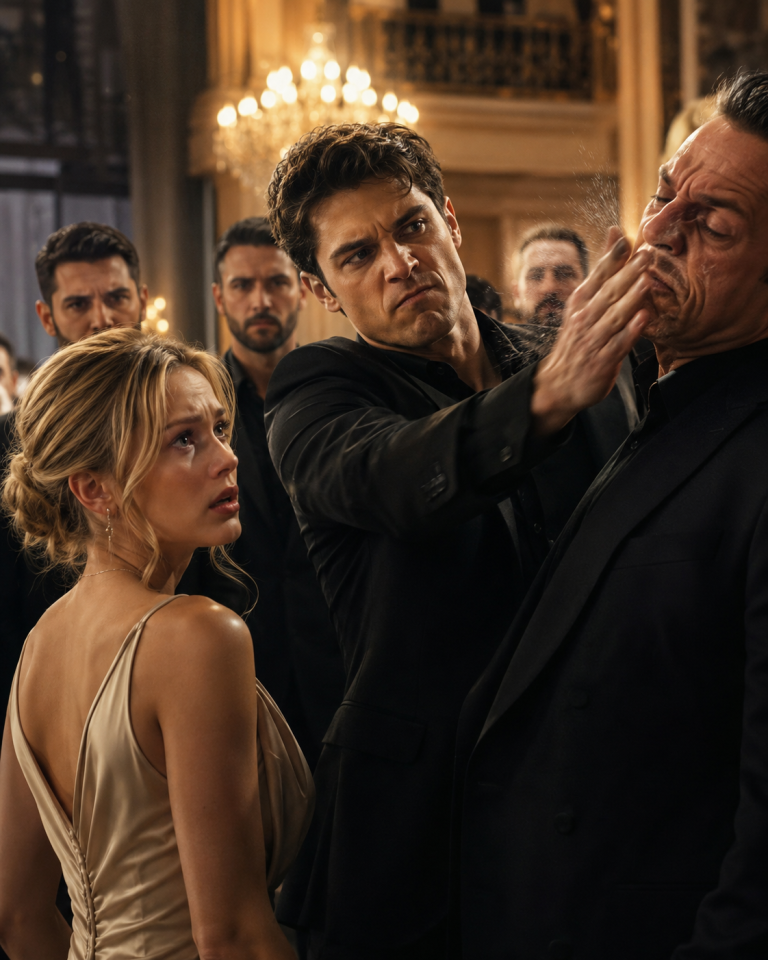
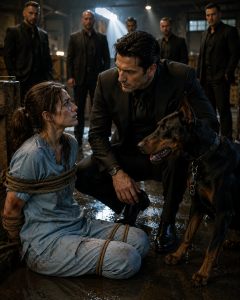
The Mafia Boss Rescued a Bound Nurse From an Abandoned Warehouse — Then His Dog Exposed the One Betrayer Nobody Suspected

—
## CHAPTER 1
Marin Quill sat bound to a wooden chair in the middle of her dead sister’s workshop, tape pulling at the corners of her mouth, and counted her own pulse the way she’d taught a hundred patients to. Ninety-two. Too high. She’d told them all, in the calm voice that only came after four years of walking into dark houses at two in the morning, that the body trusted rhythm more than words. Now she tried her own advice, and it didn’t work.
The men had emptied her canvas bag onto the concrete — stethoscope, gauze, a hardbound notebook — and left the notebook exactly where it fell, face down, spine to the ceiling. They hadn’t taken it. That detail chilled her more than the rope. They already knew what was inside, and they weren’t afraid of it.
On the workbench sat a stack of papers, already filled in, missing only her signature, every edge squared to the table’s edge. The man in charge had called her *sweetheart* the whole time, the same voice he used every week when he held the grocery door for her. Outside, glass had broken loudly enough for the entire row of shops to hear it. Every light on the street went dark within seconds. Every curtain drawn shut in near-perfect unison. In Cold Water Bay, everyone knew exactly what silence cost, and everyone paid it.
Across the street, behind her bakery curtain, Elsa Peton stood with one finger a knuckle away from the telephone, remembering the night three weeks earlier when Marin had come at 2:15 in the morning and simply held her hand until she could sleep. Now Elsa drew the curtain shut, slow, both hands, the way someone lowers a lid.
Two blocks away, a patrol car sat at the curb with its lights off. Chief Hollis Parr wasn’t dozing. He was working. A 911 call had come in at 10:47 — a young man reporting strange noises at the instrument workshop. Thirty seconds later, the call no longer existed in any system. By morning there would be a printed record proving Cold Water Bay had passed a quiet night. Here, silence wasn’t cowardice. It was a line item, paid monthly, and everyone knew the rate.
Three hours south, in a room on the twenty-second floor overlooking Boston Harbor, August Vance Rook stood with both hands clasped behind his back, watching container ships lie motionless under floodlight. It had started with a routine audit — one entry in the ledgers that wouldn’t balance. A debt had been sold to a third party without his signature anywhere on the paperwork. The buyer: Fenwick Dracott, a pawn shop owner in a town so small someone had needed a map to find it.
Silas Booth, fifteen years at Rook’s side, leaned in the doorway and gave him the rest. The original debtor — a fisherman named Wendell Voss — had drowned fourteen months earlier, body never recovered. The debt had transferred to his fiancée. That wasn’t how things were done. A dead name couldn’t pay, and everything attached to it became worthless — unless someone found a way to keep collecting anyway.
“What does she do?” Rook asked.
“Nurse. Home visits. Only one covering that whole area.”
Rook went still for exactly half a second. “No longer,” he said. Nothing else in his face moved. Only his clasped hands opened slightly, then closed again, and no one in the room understood why.
On the rug, the old dog rose without hurrying, dragged himself upright, and walked to the door, standing with his back to the room, facing the hall. Rook reached for his coat.
“Three hours,” he said.
“What are you planning when you get there?” Silas asked.
“See the damage.”
He said nothing more. The elevator doors closed, and Silas stood alone beside the open file, looking down at a woman’s name in Maine, and didn’t look at it for long.
Inside the workshop, the fog from the bay had climbed all the way up Ferry Street, thick enough to swallow the streetlights into murky, hanging orbs. Marin rotated her wrists as far as the rope allowed — barely a fifth of an inch — and held them there. Six hours like this and the damage could still be undone. Twelve, and it couldn’t. She knew the exact names of what she’d lose, had written them on other people’s charts a hundred times. Knowing didn’t help. It never had. It only showed her more clearly what was coming.
She looked up at the instruments hanging on the wall, their curved shadows motionless, and thought of her sister, and of a door somewhere out in the fog that hadn’t been locked — only barred, the crude way people barred a door when they meant to come back through it.
—