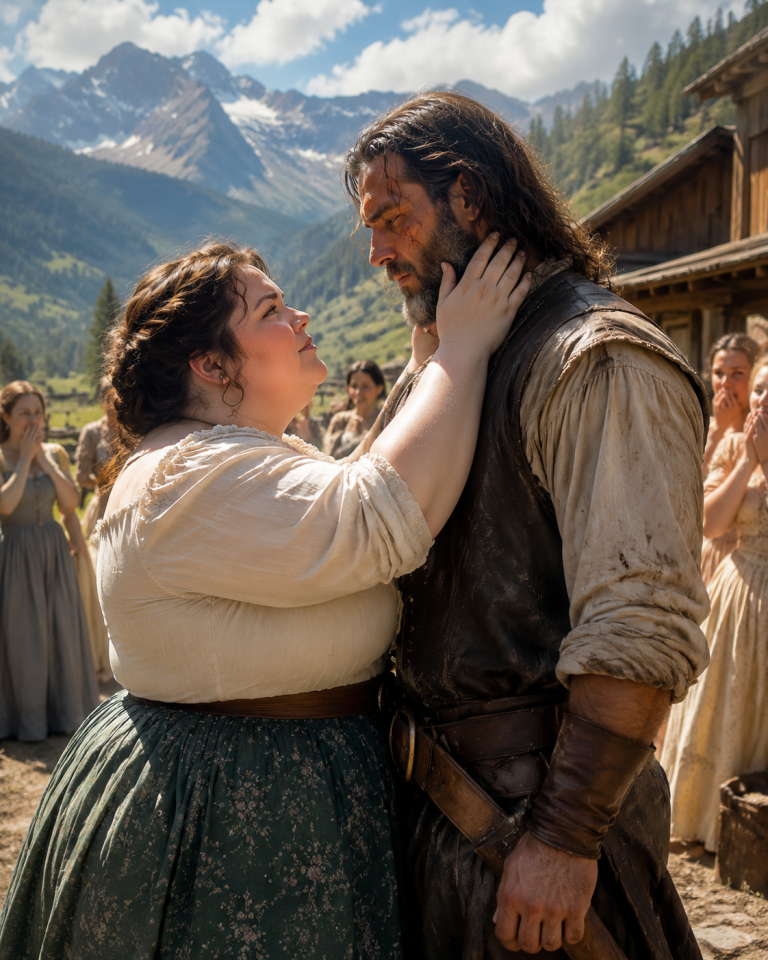
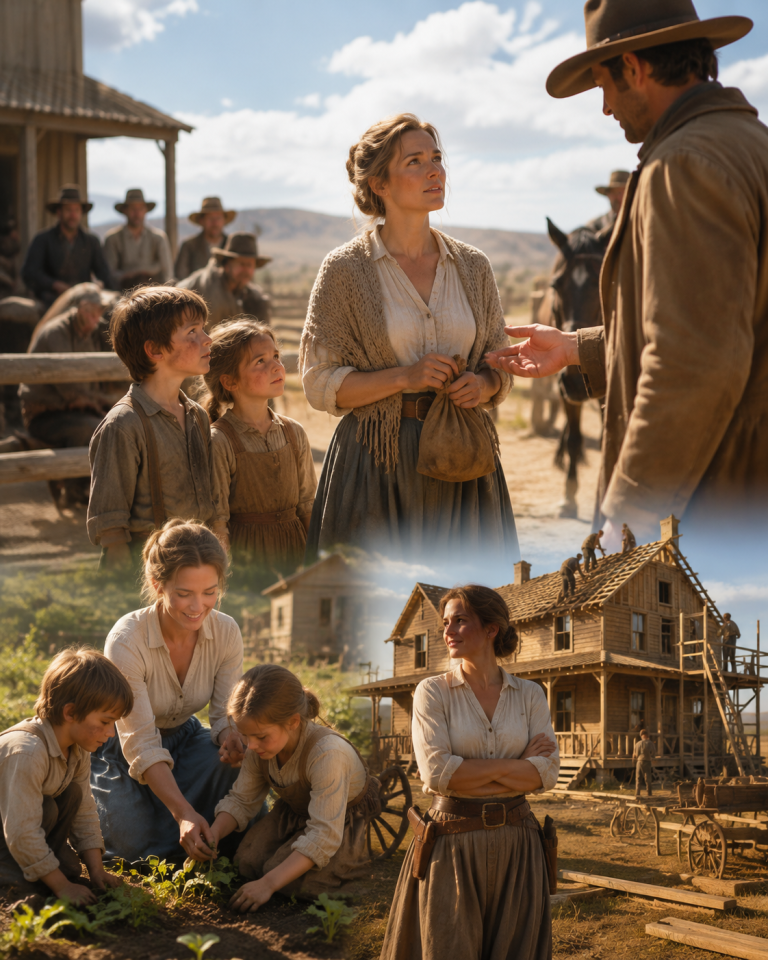
They Laughed as the “Ugly Daughter” Was Forced to Marry a Lonely Cowboy—Then He Chose Her Over Everyone Else


PART 1
The Bennett farmhouse smelled like burned bread and disappointment, and Eliza had learned to live inside both.
She stood at the kitchen window with her hands in dishwater gone cold an hour ago, watching her sisters cross the yard in their Sunday dresses. Caroline, the eldest, had blonde curls that took an hour to set. Margaret’s blue silk made her eyes look like summer sky. Even Ruth, barely seventeen, had the kind of effortless grace that made men trip over their own boots.
Then there was Eliza. Twenty-three. Brown hair that wouldn’t hold a curl. A face her mother once called “pleasant enough” in the same tone people used for overcooked vegetables. Not ugly. Just the kind of woman people’s eyes slid past on their way to something prettier.
“She’s woolgathering again,” Margaret’s voice drifted in from the parlor. “Honestly, mother, what are we going to do with her?”
“We’ll find her something,” her mother said, quieter, though Eliza heard it anyway. She’d gotten good at hearing things she wasn’t supposed to. “A widower, perhaps. Someone who needs a housekeeper more than a wife.”
The plate slipped from her hands and clattered into the basin.
That night, her sisters hatched their plan in the bedroom all four of them shared. Eliza kept her eyes closed, breathing steady, pretending sleep.
“It’s harmless,” Caroline insisted. “Just a bit of fun.” She had an old newspaper full of frontier advertisements — cowboys looking for wives. “Hardworking rancher seeks respectable woman for marriage. Must be of good character and strong constitution.”
“Can you imagine some poor rancher expecting a proper wife and getting our Eliza?” Margaret laughed, sharp as broken glass.
“Caroline, that’s cruel,” Ruth said, though her conscience didn’t stop it.
“It’s a joke. He won’t respond anyway, and if he does, we’ll simply tell him there was a mistake. Where’s the harm?”
The harm was in how easily they did it. How little they thought of her.
Three days later, the letter arrived. Eliza brought in the mail like she did every afternoon and found an envelope in unfamiliar handwriting: *Miss Eliza Bennett. Return address, Wind River Ranch, Wyoming Territory.*
“What’s that?” Caroline appeared at her elbow, too casual, eyes too bright.
Eliza took the letter to the hayloft where she used to hide as a child, hands shaking so badly it took three tries to open it. The paper was good, the handwriting clean and practical.
*Miss Bennett — I received your response to my advertisement. I’ll be direct, as I expect you prefer the same. I’m thirty-two, owner of the Wind River Ranch in Wyoming Territory. I have a son, age seven. My wife died three years ago. I’m not looking for romance. I’m looking for someone capable and sensible to manage my household and help raise my boy. In return, I can offer security, a roof that doesn’t leak, and treatment with respect and fairness. The work is hard, the winters are harsh, the nearest town is twelve miles and not much to speak of. But the land is mine, the house is sound, and I pay my debts. If you’re willing, I’ll send money for the train fare. Respectfully, Caleb Ror.*
She read it three times, then sat in the hay-scented dark and cried — not from sadness, but from the overwhelming shock of being seen, even by a stranger, even in such practical terms.
Someone had said yes to her.
“He said yes,” she told her family in the kitchen, hands shaking but voice steady.
“Absolutely not,” her mother said. “This has gone too far. Caroline, write to him and explain the mistake.”
“What mistake?” The words came out before Eliza could stop them. Something was cracking open in her chest, locked down for twenty-three years. “What exactly am I staying for? To wash dishes until my hands crack. To sleep in a crowded bedroom and listen to you all discuss which widower might be desperate enough to take me. Mr. Ror is offering exactly what you’ve all said I should expect. The only difference is he’s being honest about it.”
“You can’t go to Wyoming,” Ruth said, small. “You don’t know anything about him.”
“I know he was honest in his letter. I know that staying here means becoming exactly what you all expect. The maiden aunt. The extra mouth to feed. The daughter nobody wanted.”
“That’s not true,” her mother said, and the protest was weak, and they both knew it.
“Write him back. Tell him I accept. I’m not asking your permission, mother. I’m telling you my decision.”
Three weeks of half-hearted objections and neighborhood whispers later, the train ticket arrived along with instructions: bring practical clothing and sturdy boots, leave anything delicate behind. Eliza packed a trunk with almost nothing of value — a few plain dresses, a worn coat, her father’s book of poetry. She left her mother’s pearl earrings on the dresser. Those were meant for beautiful daughters.
The train ride took four days, through landscapes that flattened and opened into something vast and terrifying, through sleepless nights and cramped cars. On the fourth day, mountains rose in the distance, and the conductor called out, “Wind River. Next stop, Wind River.”
The station was barely a station — a wooden platform, a building that looked like a strong wind could take it. Eliza scanned the handful of people waiting, rising panic in her chest. Then she saw him.
He stood apart from the others, hands in his coat pockets, hat pulled low. Tall, broad-shouldered, maybe thirty-five though the hard lines of his face made him look older. Dark hair, a scar cutting through one eyebrow, and eyes gray as winter already locked on her.
She knew, impossibly, that this was Caleb Ror.
She walked toward him across the platform, aware of every whisper behind her, the train hissing steam like a dragon at her back. He didn’t move. Just watched her come with those cold, assessing eyes.
“Miss Bennett.” His voice was deep, rougher than she expected. He touched the brim of his hat. “Welcome to Wind River. Your trunk — the brown one?”
She blinked at the interruption. “Yes.”
“I’ll get it loaded. Wagon’s this way.”
He turned and walked toward the baggage area without waiting to see if she’d follow, and Eliza stood there for a moment, feeling the first crack in whatever romantic notion she’d still been carrying underneath the practicality. This wasn’t a meeting. It was a transaction.
Fine. That’s what she’d signed up for.
The ranch appeared at the crest of a hill as the light started to fail — a sprawling operation of corral, outbuildings, and a solid two-story house, cattle dotting the fields, men working in the distance. A small figure burst from the house and sprinted toward the wagon, dark-haired, with his father’s gray eyes.
Caleb’s entire demeanor changed. His face softened. “Hey, Tom.”
The boy skidded to a stop and stared up at Eliza with open curiosity.
“Is she the new Ma?”
“Miss Bennett,” Caleb corrected gently. “She’ll be staying with us.”
Thomas tilted his head, studying her with the total honesty of a seven-year-old. “You’re not very pretty,” he said.
PART 2
“Thomas,” Caleb’s voice sharpened, but Eliza surprised herself by laughing — really laughing, maybe for the first time since Missouri.
“No, I’m not,” she agreed. “But I make very good biscuits.”
The boy’s whole face lit up. “Better than Mrs. Garrett’s?”
“I guess you’ll have to judge that yourself.” He grabbed her hand and towed her toward the house before she could answer, narrating the whole way — the kitchen that needed better storage, the parlor they never used, his room with the magnifying glass — until he stopped at a closed door. “This was my ma’s sewing room. We don’t go in there.”
“All right,” Eliza said softly.
Her own room was small but clean, a narrow bed, a dresser, a window over the eastern pasture, and someone — Caleb, probably — had already left a picture of water and fresh linens on the bed.
“Supper’s usually around six,” he said from the doorway. “Kitchen’s stocked. Make what you want.” He started to leave, then paused. “Miss Bennett. Welcome to Wind River.” This time he almost meant it.
The first biscuits burned. Eliza stood over the charred remains at five-thirty the next morning, wanting to cry, until Thomas appeared in the doorway in his nightshirt.
“Those don’t look like good biscuits.”
“No,” she admitted. “They don’t.”
“Pa says the stove runs hot. You got to watch it. Can you make more?”
“Yes. But you have to help me.”
By the time Caleb came down, they were pulling a golden, edible batch from the oven, Thomas dusted in flour, cracking eggs with excessive force. “We made biscuits,” Thomas announced. “I helped.”
Something flickered in Caleb’s gray eyes. “I can see that.”
Over the following days, Eliza learned the house — well-built but unloved, functional but cold, like the man who kept it. She found his wife’s sewing room by accident, everything left exactly as it had been three years ago, and backed out with shaking hands. She met Helen Garrett, Mike’s wife, blunt and sharp-eyed, who told her flatly over coffee: “Sarah hated it here. The isolation, the work, the cold. It ate her alive. By the end, they barely spoke.” Helen studied her for a long moment. “You’re not what I expected. Most mail-order brides come in with stars in their eyes. You look like you know exactly what you signed up for.”
“I do.”
“Good. Then maybe you’ll last.”
A week later, she broke up a fistfight in the barn between Javier and Mike’s teenage son without flinching, and sent both men back to work with nothing but her voice and her nerve. That night, Caleb told her the men respected it. It wasn’t poetry, but from Caleb Ror, it felt like a victory.
Then came the Sunday social. Eliza wore her best dress, which still wasn’t very good, and walked into a church full of whispers.
“That’s her. The mail-order bride.”
“Poor thing, plain as flour.”
“I heard she answered an advertisement — desperate.”
The church ladies descended afterward with smiles full of teeth and questions wrapped in cruelty, until a gray-haired woman found her hiding in the yard.
“They’re all terrible,” the woman said. “I’m Dr. Margaret Chen. I run the medical practice here.” She studied Eliza with something that wasn’t pity. “Sarah didn’t last. She withered here like a hothouse flower in frost. They’re all waiting to see if you’ll do the same.”
“I won’t,” Eliza said.
“Good,” Dr. Chen said. “Because I think you’re tougher than you look, and this town needs more tough women.”
It was the first genuine kindness anyone in Wind River had shown her — and the first time anyone had said Sarah’s name to her like a warning instead of a rumor.
PART 3
On the ride home, Thomas chattered about his friends and Caleb drove in silence until, suddenly, he spoke.
“They were unkind,” he said. “The women at church. I saw their faces.”
“It’s fine.”
“It’s not. Sarah used to come home from those socials in tears. They made her feel small.” He glanced at Eliza. “You’re not Sarah.”
“No.”
“You’re not,” he agreed, and didn’t speak again until they reached the ranch — but when she climbed down from the wagon, he caught her arm. “What you did yesterday with Javier and the kid. That was good. Smart. The men respect that.” His hand dropped. “You’re doing well here. Better than well.”
Over the following weeks, Eliza found her footing — learning the stove’s moods, Thomas’s questions, the subtle shifts in Caleb’s face that meant a hard day. She helped Dr. Chen with medical records twice a week, earning money and friendship both. She hung curtains, built a shelf for Thomas’s rocks and feathers, learned to shoot from Helen because “every ranch woman needs to.” But Caleb remained careful, walled off — kind, never dismissive, but never quite reachable. They discussed Thomas’s schooling and household needs and nothing real.
Then November brought the first real cold, and with it the first storm — the wind rising to a scream at dusk, the barn vanishing behind sheets of white. Caleb and the hands were still out bringing in the last of the stock, and Eliza kept the fire burning and her eyes on the door for two hours before it burst open, all three men crusted in ice.
“Everyone’s accounted for,” Caleb said, voice rough. “We’re set.”
Later, thawing by the fire while Thomas slept, he looked at her with something new in his face.
“You were worried too,” he said. Not a question.
“Yes.”
“Why?”
She searched for words that wouldn’t reveal too much. “Because Thomas needs you. The ranch needs you.”
“Is that all?”
The question hung there, heavy with possibility, until Thomas stirred on the sofa and the moment broke.
The storm lasted three days, all of them trapped together — cards, stories, a broken chair leg fixed, small moments accumulating. His hand brushing hers over the salt. The night she woke to find him adding wood to her fire. On the third night, he found her kneading bread dough in the kitchen.
“These past few days,” he said, moving closer, close enough she could smell snow and leather. “It was nice having you here. Not just as help. As company.”
Her hands stilled in the dough. “I thought we had an arrangement.”
“We do. But maybe arrangements can change.” He ran a hand through his hair, frustrated. “I’m not good at this. Sarah used to say I was made of stone.”
“You’re not stone,” Eliza said. “You’re careful. There’s a difference.”
“Is that what you call it? Afraid.” The admission seemed to cost him. “Afraid of doing this wrong again.”
“I’m afraid too,” she said, catching his arm before he could leave. “That one day you’ll realize you made a mistake bringing me here. That I’m not enough.”
“You think I want you different?” His voice was low, intense. “Eliza, you stopped a fight between men who could’ve killed each other. You won over my son in a day. You’re the strongest woman I’ve ever met. And I—” He stopped, jaw working, and swallowed it back. “We should take this slow.”
“How slow?”
A ghost of a smile. “Slower than I want to.”
The days after moved differently, like the world had tilted off its axis — closer than strangers, not quite anything else. Then Helen came through the door one afternoon without knocking.
“Patterson’s making moves,” she said. Harold Patterson, land baron, had been buying up bank notes and calling in debts across the valley, and the Wind River ran straight through Caleb’s land — water rights he’d wanted for years, ever since Sarah was alive, when he used to point out how hard ranch life was for her, hoping she’d talk Caleb into selling. “He’s a snake,” Helen warned. “He’ll smile and act friendly, but he’s looking for weakness.”
Patterson himself showed up two days later on a fine black gelding, all false sympathy and expensive cologne. “I feel obligated to mention I’d be happy to make Caleb a fair offer,” he said, moving too close. “Take this burden off his shoulders.”
“This ranch isn’t for sale,” Eliza said.
“Everything’s for sale at the right price.” His smile flickered, showing something cold underneath. “When things get difficult — and they will — remember you have options.”
That night she told Caleb everything, and his face went hard. “He’s right about some of it,” he admitted. “The water rights are contested by the Simmons family. The bank’s breathing down my neck. Last winter nearly broke us.”
“Then we fight back.”
“We?”
“This is my home too, now. My future. Either tell me how to help or get out of my way.”
Something blazed in his eyes — surprise, maybe admiration. “All right, then. Let’s fight.”
They worked past midnight over deeds and old surveys, and somewhere in the papers Caleb finally asked her the real question. “Why are you doing this? You could walk away. Patterson would pay your way back to Missouri. You’d be free.”
“I don’t want to be free,” Eliza said. “I want to be here.” She searched for words that wouldn’t reveal too much, and failed. “Because for the first time in my life, I matter. Thomas needs me. The ranch needs me. You—”
“I see you, Eliza,” he said, his rough hand covering hers. “I’ve seen you since the day you stepped off that train, looking terrified and determined all at once.”
“I’m going to kiss you,” he said. “Unless you tell me not to.”
She didn’t tell him not to.
The next day they rode up into the hills to find old Tom Bridger, a surveyor who’d worked the territory since before the war and remembered exactly when a flood in 1856 had shifted the river’s course onto Caleb’s land, thirty years before the Simmons family’s outdated claim. Tom handed over yellowed maps and Army Corps flood records that would win the case outright — if it ever got that far.
It almost didn’t. They rode home to find the main barn on fire, flames climbing into the dark, horses screaming, men running with buckets. By the time they got it under control, hours later, the barn was a smoking ruin, and Caleb stood staring at it like carved stone.
“Could’ve been an accident,” Mike said. “Lantern knocked over.”
“Or it could’ve been Patterson,” Javier said. “Sending a message.”
Caleb turned to Eliza with fury in his eyes and fear underneath it. “This is what happens when you fight men like Patterson. You should leave. I’ll pay your way back to Missouri. Patterson was right — you deserve better than this.”
“Don’t you dare,” Eliza said, grabbing his arm. “Don’t you dare make this decision for me.”
“I’m trying to protect you.”
“I don’t need protection. I need you to stop running away.” She stepped closer, close enough to feel his breath. “You’re terrified that if you let yourself care about me, you’ll lose me like you lost Sarah. But I’m not her. I’m not fragile.”
“What if I can’t do this? What if I let you down?”
“Then you let me down, and we figure it out together.” She touched his face. “Stop trying to protect me from life, Caleb. I chose this. I chose you.”
Something cracked in his expression. He pulled her against him, and she felt him shake. “I can’t lose you,” he whispered. “I can’t go through that again.”
“You won’t.”
That night, after Thomas was asleep, Caleb told her the whole truth about Sarah — married too young, hating the isolation, growing weak and depressed by the time she was pregnant again, the baby that didn’t survive either. “I killed her spirit long before childbirth killed her body,” he said, raw. “And tonight, when I saw that barn burning, all I could think was I was doing it again.”
“Stop,” Eliza said, gripping his hand hard. “I am not Sarah. I chose this life with my eyes open. Nobody’s keeping me here against my will. If something happens to you, then something happens. That’s life. All you can do is be honest with me, trust me to make my own decisions, and fight beside me when things get hard.”
He was quiet a long time. “I don’t deserve you.”
“Probably not,” she said. “But you’re stuck with me anyway.”
He kissed her, desperate and grateful, and she stayed with him that night — fully clothed, talking until dawn about Sarah and Missouri and Thomas and whether they had any chance at all against Patterson. Somewhere around three in the morning, he said, “I think I’m falling in love with you,” and she said she was falling too, and neither of them pretended otherwise after that.
New Year’s Eve, Caleb led her to Sarah’s sewing room — emptied now, every trace cleared out. “I should have done this years ago,” he said. “But I was holding on to something that didn’t exist anymore. I’m letting her go, Eliza. Not forgetting. Letting go. Because I want to make room for something new. For us.”
He pulled out his grandmother’s ring. “Will you marry me? Actually marry me. Not an arrangement. A real marriage. I’m asking for everything — your heart, your trust, your future.”
“Yes,” she said, choked with tears. “You stubborn, impossible man. Yes.”
The water rights case went before Judge Morrison in Cheyenne in late January. Old Tom testified without wavering, the Simmons claim fell apart under Davis’s methodical cross-examination, and their real crisis surfaced in a back room during recess: even winning the case wouldn’t save them from a fifteen-thousand-dollar bank loan due in March — a debt Patterson had been quietly buying up for months, ready to foreclose no matter which way the judge ruled.
“What about the timber rights on the north section?” Eliza asked. “We don’t harvest it — we’ve never needed to. What if we lease the rights instead of selling the land? The northern section borders the rail line.”
Within a week, Davis had a Denver logging company offering five thousand dollars upfront for ten-year harvest rights — enough, combined with savings and a loan from Dr. Chen, to clear the debt outright. When Judge Morrison ruled in Caleb’s favor days later, Patterson cornered them on the courthouse steps with his snake-oil smile still in place.
“Even if you win, there’s still the matter of that bank loan,” he said. “March is coming faster than you think.”
“We’ll manage,” Eliza said, before Caleb could answer.
They did. The timber money paid off the loan in full, and Patterson made one last, desperate move in April — arriving at the ranch drunk and alone while Caleb was out checking fence and Thomas was at school.
“Where is he?” Patterson demanded, swaying in the saddle.
“Not here,” Eliza said, standing on the porch, hand resting on the rifle she’d learned to use. “You should leave, Mr. Patterson.”
“You’ve cost me a lot of money, Mrs. Ror. That ranch should have been mine. Everything in this valley is mine. I built this territory, and now some mail-order—”
The rifle came up before she’d thought about it, aimed steady at his chest. “Finish that sentence,” she said quietly. “I dare you.”
Patterson froze, and for the first time she saw real fear cross his face. “You won’t shoot me.”
“Won’t I? You’re drunk on my property, threatening me. I’d be within my rights.” She stepped forward, rifle never wavering. “Get back on your horse and ride away, or find out if I’m bluffing.”
He rode off at a gallop, and it was over — really over. He never came back. By Sunday, word had spread through Wind River, and the same church ladies who’d once whispered about her now spoke with grudging respect. The ranch hands started calling her “boss lady” when they thought she couldn’t hear.
Life at the ranch settled into something steady after that — until, in May, a wagon came up the drive carrying James, her mother’s hired man from Missouri, hat in his hands.
“It’s your sister, Caroline,” he said. “She’s ill. Real bad. Pneumonia. Your mother’s asking if you could come home.”
Eliza should have felt satisfaction, justice, something like it. Instead she felt sick. Caleb came with her without being asked — “You think I’m letting you face them alone?” — and they traveled east with Thomas, retracing the route Eliza had taken eight months before, everything looking smaller now, less intimidating, because she was different too.
Her mother was grayer, smaller, and cried when she saw Eliza climb down from the wagon with a husband and a grandson she’d never met. Caroline, pale and thin in the bed the sisters used to fight over, gripped Eliza’s hand like bird bones.
“I’m sorry,” Caroline whispered. “For everything. The advertisement, the jokes, the way we treated you. You were right to leave. Right to choose your own life. I was jealous you had the courage to go.”
Eliza stayed by her side for two days. On the third, her mother gathered the family in the parlor and said the words Eliza had waited twenty-three years to hear. “I owe you an apology. A real one. You were never less. I just didn’t see your strength because it wasn’t the kind I understood.”
“We mocked you because it was easier than admitting we were jealous,” Margaret admitted. “Jealous of how little you needed anyone else.”
“I don’t need your apologies,” Eliza said finally. “But I’ll accept them anyway. Holding on to anger takes too much energy.”
Caroline died three days later, peacefully, family around her. At the station, her mother pressed the pearl earrings into Eliza’s hands — the ones meant for beautiful daughters. Eliza looked at them, beautiful and useless, and handed them back.
“Give them to Margaret or Ruth,” she said. “I don’t need them anymore.”
On the train west, Thomas asleep against her shoulder, Caleb’s hand in hers, Eliza watched Missouri disappear and felt nothing but relief. “I made peace with it,” she told him. “All of it. And now I’m ready to go home.”
“To Wyoming?”
“To everything we’re building together.”
Wyoming had rebuilt itself in their absence — a new barn where the old one burned, fresh paint on the house, straighter fence lines. That summer, Dr. Chen recruited her to take over the schoolhouse when the teacher left, and Eliza stood in front of twenty skeptical children on her first day and found, to her own surprise, that she loved it — loved watching understanding dawn on a child’s face, loved Thomas beaming every time she praised his work, loved being useful in a way that went beyond cooking and cleaning. Even Mrs. Patterson, once the sharpest of the church gossips, came to apologize when her daughter came home talking about how Mrs. Ror made learning feel possible.
“You’ve changed this town,” Mrs. Patterson said. “Made it better.”
By August, at the summer social, Caleb pulled her onto the dance floor in front of the whole town and kissed her long enough that half the room stared — and then, instead of embarrassment, the room erupted in applause.
“You stopped waiting for permission to matter,” Helen told her afterward, sitting on the church steps. “You just started mattering. That’s real power.”
The following March, Eliza told Caleb she was pregnant, and he wept — great, gasping sobs he couldn’t explain except to say he’d never thought he’d have this again. Thomas was delighted, immediately planning everything the baby would need. The labor came fourteen hours long that September, with Dr. Chen steady and competent and Caleb gray with fear but present through every contraction, until a girl’s furious cry filled the room.
“She’s beautiful,” Caleb whispered, touching his daughter’s head with one finger.
“She’s angry,” Eliza laughed, exhausted. “Already mad at the world.”
“She’ll fit right in with this family, then.”
They named her Catherine, and she ruled the household from day one with an iron fist wrapped in soft baby skin. Thomas hovered over her cradle like a protective dragon. The ranch hands brought carved toys and promises to teach her to ride. And Caleb, watching his daughter sleep one night, turned to Eliza with the same raw gratitude he still hadn’t learned to say easily.
“Thank you,” he said. “For all of it. For being brave enough to say yes to a stranger’s letter, and stubborn enough to stay when it got hard. For turning my life into something worth living.”
“We turned it into something worth living,” she corrected. “Together.”
Years later, Eliza would still be teaching, shaping children who’d grow up thinking of Wind River as simply home rather than a frontier to be survived. Thomas would take over the ranch’s daily operations, every bit his father’s son. Catherine would grow up refusing to let anyone tell her what she couldn’t do. And people would tell Eliza’s story the way stories get told — the plain daughter, the joke, the mail-order bride who became a force nobody in that valley underestimated twice.
But sitting in the parlor they’d finally built with proper furniture and books lining the walls, listening to her children breathe upstairs, held by the man who’d said yes to a joke and meant it, Eliza knew the truest version of it. She hadn’t become someone new. She’d just stopped apologizing for who she’d always been.
That was the only kind of magic she’d ever needed.
THE END