She Begged a Stranger to Pretend He Was Her Husband—Then the Feared Mafia Boss Said, “I’ll Be Yours.”

—
## PART 1
Grease clung to the cuticles of Elena’s fingers. She’d scrubbed them three times with harsh industrial soap in the diner’s cracked ceramic sink, but the scent of old fryer oil felt tattooed into her skin. Her lower back throbbed, keeping time with the blinking neon sign over the back door. Eleven hours on her feet, carrying trays of meatloaf and lukewarm coffee, all for forty-two dollars in tips — and a manager who’d docked her pay because a customer complained her thighs brushed his shoulder when she served him.
Elena pushed the heavy metal door open into the alley. Cold November rain hit her face instantly, a shocking slap that made her gasp. She pulled her thin polyester jacket collar tight; it didn’t help. She was a big woman, soft in the places the world demanded sharp angles, and her uniform skirt dug into her damp, clinging waist. She just wanted her bed — a mattress that sank in the middle, a radiator that clanked like a dying engine.
“Thought you might sneak out the front, Piglet.”
Elena froze. Trent detached himself from the shadows by the overflowing dumpster, shivering in a soaked windbreaker, eyes bright with a frantic, ugly energy. He smelled of damp cigarettes and sour sweat.
“Trent, I don’t have anything,” she said, tighter than she wanted.
“Don’t lie to me.” He blocked the narrow gap to the street. “You just finished a double. Hand over the tips. I need two hundred tonight.”
“I made forty bucks and it’s going to my electric bill so I don’t freeze to death.”
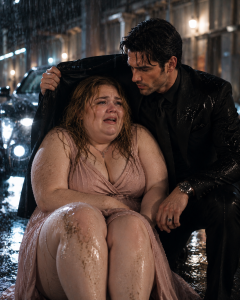
She tried to push past him — a mistake she realized the instant she moved. Trent grabbed her arm, fingers digging into soft flesh, and yanked her back hard enough to send her stumbling. Her work shoes slipped on wet garbage; she went down hard, palms slapping the asphalt, skin tearing at the base of her thumbs. Pain flared through her knees, ripping her tights.
“You stupid bitch.” He kicked her side — not full force, but enough to knock the wind from her lungs. “I owe men who don’t ask twice. You think I care about your electric bill?”
Elena curled inward, the wet gravel biting her cheek, tasting copper on her tongue. “Help!” Her voice sounded pathetic, small. She hated it. She hated him, but mostly she hated herself for being on the ground again. “Help!” Louder this time, cracking over the downpour.
Trent laughed, a wet, breathless sound, and squatted down, grabbing a fistful of her wet hair, yanking her head back. “Who are you yelling for? Look at yourself. You’re a fat, pathetic cow. Nobody is coming to save you. Who the hell would ever want you? You’re going to empty your pockets, or I’m going to break your jaw and take it anyway.”
Elena’s chest heaved. Rainwater mixed with blood trickling from her split lip. She closed her eyes. The humiliation burned hotter than the scrapes on her hands. He was right, and that was the most agonizing part of it.
“Let her go.”
The voice didn’t boom. It cut through the rain like a scalpel through tissue — low, quiet, perfectly calm. Trent froze, his grip loosening. Elena cracked her eyes open. A man’s silhouette stood backlit by the street lamp at the alley’s mouth. He didn’t walk like a cop. He walked like he owned the concrete beneath him.
As he stepped closer, the yellow light caught the details — a long dark wool overcoat, black leather gloves, a face carved from exhaustion and cold pragmatism. His eyes were the color of tarnished dimes, scanning the alley with absolute disinterest. Two massive men in dark suits materialized behind him, silent as ghosts.
Trent scrambled backward, all his bravado gone, replaced by raw animal terror. “Mr. Hayes. Arthur, please. I have the money. I was just getting it.”
Arthur Hayes didn’t look at Trent. He looked down at Elena — torn stockings, muddy thighs, bleeding knuckles. She braced for disgust, for the way men usually looked away when she looked back at them. His gaze didn’t waver.
“You owe me sixty thousand dollars, Trent,” Arthur said, his voice a low hum, finally turning to the trembling man by the garbage. “You’re in a puddle, shaking down a waitress for pocket change. It’s insulting. It offends me.”
“I was going to give her to the Russians,” Trent babbled, pointing a shaking finger at Elena. “She’s a pig, but they like them heavy at the docks. They’d pay. She’s payment. Arthur, take her.”
A suffocating silence dropped over the alley. Elena’s stomach twisted into a cold knot. She pushed herself up onto her elbows, ready to try to crawl away.
Arthur reached into his overcoat, pulled out a silver lighter and a cigarette, and lit it, the click deafening in the gloom. He took a slow drag. “You’re offering me a woman who just begged for help,” he said. “You think I traffic in collateral?”
“She’s nobody,” Trent cried, backing up against the brick wall. “She’s nothing. Nobody wants her.”
Arthur exhaled a plume of smoke and stepped forward — no rush, just deliberate, terrifying grace. He reached Trent and nodded to the man on his left. The larger man grabbed Trent by the throat and slammed his head into the brick. A sickening crunch. Trent slumped, unconscious before he hit the ground.
Arthur didn’t blink. He looked back down at Elena. She pushed herself into a sitting position, thighs trembling, wet skirt plastered to her legs. She wasn’t going to cower. If he was taking her to the docks, he’d have to drag her, kicking and screaming. She lifted her chin, wiping blood and rainwater from her mouth.
Arthur dropped his cigarette, crushed it beneath his shoe, and reached down, offering a gloved hand.
“He’s wrong,” Arthur said, flat, devoid of any theatrical romance. “I want you. I’ll be your husband.”
—
## PART 2
The Maybach’s interior smelled of leather, cedar, and gun oil, entirely too warm. Elena sat rigid, arms wrapped around her waist, terrified to lean back — her filthy uniform was ruining floor mats that probably cost more than her life insurance policy. She felt massive, the luxury of the car shrinking around her, amplifying every ounce of her weight. When she shifted, the leather squeaked beneath her thighs and her cheeks burned with hot, ugly shame.
“I’m going to ruin your seats,” she blurted, unable to bear the silence.
Arthur turned his head slowly, his tarnished-dime eyes scanning her face — not the seats. “Leather wipes clean.”
“Where are you taking me?” Her hands balled into fists. “If you’re taking me to the docks, just kill me now. I won’t go. I’ll fight you.”
“You’re exactly as heavy as you look,” Arthur said, the corner of his mouth twitching — not quite a smile. “And I have no business at the docks. I don’t sell women.”
“Then why am I here? People like you don’t save people like me for free.”
He pulled a clean handkerchief from his coat and held it out. She snatched it, pressing it to her split lip.
“I have a problem,” he said. “The FBI has spent three years building a RICO case against my family. They expect me to consolidate power — marry the daughter of a rival family, merge territories, prepare for war. They’re watching everyone who fits the profile of a mob bride. Socialites. Models. If I marry who they expect, they use it to fast-track an indictment.” His gaze turned ruthlessly analytical. “You are a waitress from the Southside. Sixty dollars in your bank account. No record, no syndicate ties, no social footprint. You are entirely, perfectly unremarkable.”
The word stung. “You want to marry me to confuse the FBI?”
“I want to marry you to break their narrative,” he corrected. “It buys me time to find the rat in my organization before the indictment comes down.”
“And what do I get?”
“You get to live,” he said flatly. “If I’d left you in that alley, Trent would have dragged you somewhere worse. You wouldn’t have survived the weekend.” He glanced at her bruised hands. “You need a dentist. A safe place to sleep. Money. I have an excess of all three.”
“I’m not a prostitute.”
“I don’t want a prostitute. I want a wife on paper. In public you live in my home, wear my ring, smile for the cameras. In exchange, your debts are cleared. Your future is secured.”
She looked down at her lap, muddy water pooling on the leather beneath her. Trapped between a freezing apartment and a man who killed people for a living. “What if I say no?”
“I drop you at the nearest police station. You file a report against Trent. I pay the officers to ignore it. We never speak again.” He was brutally honest, no sugar in the threat.
Elena closed her eyes. “Fine,” she whispered. “I’ll be your alibi.”
“Wife,” Arthur corrected softly. “If you act like an alibi, they’ll arrest us both.”
He drove her to a brutalist fortress of glass and steel on the cliffs above Lake Michigan — cold, silent, entirely unlike the Gothic mansion she’d imagined. In a guest room larger than her apartment, a doctor checked her over without asking a single question about the bruises, and Arthur laid a marriage certificate on the desk, already filed, already backdated by a judge on his payroll.
“Will you expect me to sleep with you?” she asked.
“I do not take things from women who are afraid of me,” he said, his voice not softening at all. “My bed is my own. Yours is this one. We share a last name, Elena. Nothing else.”
He knew her name. He hadn’t asked. Her hand trembled so badly she nearly dropped the pen as she signed her name beside his — tethering her bruised, broken life to the quiet monster sitting across from her.
“Get some sleep, Mrs. Hayes,” he said, standing. “Tomorrow we buy you a ring.”
She lay awake that night in sheets like spun silk, waiting for the clank of a broken radiator that would never come, understanding that whatever she had just signed away, there was no version of tomorrow that looked anything like the life she’d had yesterday — and no way to know yet whether that was a rescue or the start of something far more dangerous.
—
## PART 3
Morning bled weak light through floor-to-ceiling windows onto Elena’s new bedroom, and for three terrifying seconds she didn’t know where she was, waiting for sounds that never came — no radiator, no neighbor’s cheap weed drifting through vents. Only the crisp scent of eucalyptus and suffocating silence.
“Lift your arms, please.” Madame Rousseau’s voice was clipped, French-accented, impatient. Elena stood in the middle of Arthur’s vast slate-tiled living room in cotton underwear and a silk slip, two assistants buzzing around her with pins and measuring tape while Arthur sat thirty feet away on a leather sofa, reviewing financial documents, collar open. He hadn’t looked up since the tailors arrived, but Elena felt the weight of his presence in every shallow breath.
A tape snapped around her waist, digging sharp into soft flesh. “Forty-two,” the assistant called, neutral, but it sounded to Elena like a megaphone broadcasting her failures.
“Hips.” The tape slid down, struggling to stay level around her widest part. Elena closed her eyes, hearing Trent’s voice again. *Piglet. Cow.* She crossed her arms over her chest.
“Drop your arms, madame,” Rousseau sighed, tapping her elbow with a gold pen. “We cannot measure the drape of the bodice if you hunch like a frightened animal.”
Elena tasted the metallic tang of her healing lip and slowly lowered her arms, forcing her shoulders back.
“The shoulders are broad,” Rousseau murmured to her assistant, circling with a critical eye. “We must avoid capped sleeves. Deep V-necks to elongate the torso. We need to corset the midsection—”
“Leave her waist alone.”
The measuring tape dropped. Arthur hadn’t raised his head, his pen still tapping a slow beat against his knee. “Do not put her in corsets. Do not attempt to compress her into a shape she isn’t. You will build the garments around her, Rousseau. If she cannot breathe or sit comfortably, I will burn the dresses and find a tailor who understands basic human anatomy.”
A heavy stillness fell. “Of course, Mr. Hayes. I only meant to flatter the silhouette.”
“Her silhouette is fine.” He finally looked up, his gray eyes bypassing the tailor entirely and landing on Elena, steady and unflinching. “Measure her accurately. Do it quickly. She’s cold.” He returned to his papers.
Elena exhaled a breath she hadn’t realized she was holding. The tailor’s hands were noticeably gentler after that.
—
The next evening, Arthur dropped a small velvet box onto the dining table beside her plate. Inside, instead of the blinding diamond she’d expected, sat an antique piece — a brushed gold band holding a large square-cut emerald the color of pine needles at midnight, flanked by two cloudy diamonds.
“It was my grandmother’s,” he said, pouring sparkling water. “She brought it from Dublin stitched into the hem of her skirt. It has history. The FBI knows its provenance. When they see it on your finger, they’ll know this isn’t temporary.”
Elena slid it on. It fit perfectly, heavy and cold, anchoring her hand to the table like a shackle. “It’s beautiful,” she whispered.
“It’s a prop,” Arthur corrected. “Tonight we take it to the stage.”
The restaurant, Laura, smelled of shaved truffles and old money, its low amber light dimming the moment Arthur walked in — conversation dipping, forks pausing, eyes darting from his suit to Elena’s plum silk dress, sharp and assessing. Her heels pinched. Her grip on his arm was white-knuckled.
“Breathe,” Arthur murmured, his palm settling against her lower back, firm and grounding. “Look straight ahead. Do not look at their tables.”
“Who are they?” she whispered.
“Politicians, judges, rival associates. Everyone with a vested interest in my demise.”
A shadow fell over their table before the wine arrived. Agent Miller, in a cheap off-the-rack suit, smirked down at them, his eyes crawling over Elena’s jawline, her weight, her fading bruise. “And who is this? She doesn’t look like your usual type, Hayes.”
“Speak to my wife with that tone again, Miller,” Arthur said, closing his menu with precision, “and I’ll have my lawyers file a harassment injunction before your morning commute.”
“Wife?” Miller barked a laugh. “You’re slipping, Arthur. This is pathetic, even for you.”
The insult landed on her, not him. Elena felt the old, familiar sting of tears — but then she felt the cold weight of the emerald against her finger. She wasn’t in the alley anymore.
She folded her hands neatly on the table, looked Miller dead in the eye, and said, in the flat, exhausted cadence of a Chicago lifer who’d dealt with a thousand rude customers, “Did you need something? Because my husband and I are trying to order, and you’re blocking the waiter.”
Miller’s mouth opened, derailed. He scowled, cast one last venomous look at her, and stalked off. When Elena’s water glass slipped from her trembling hands moments later, spilling across the tablecloth, Arthur’s fingers closed over her wrist before she could scramble to clean it.
“Leave it,” he said. His thumb brushed her pulse point — analytical, measuring her racing heart. “You didn’t break. He pressed, and you bit back. You did perfectly, Elena.” Hearing her name in his low voice sent a strange shiver through her — not romance. Validation, from a predator who recognized teeth in someone else.
—
At three in the morning, unable to sleep in a house too quiet to trust, Elena found Arthur in the living room stripped to an undershirt, cleaning a handgun beside a half-empty bottle of whiskey. In the dim light, exhaustion carved deep canyons into his face. He looked, for once, less like a monster and more like an impossibly tired man.
“Do you ever sleep?” she asked, sitting on the sofa’s edge, ten feet of space between them.
“Sleep is a vulnerability. I take it in shifts.” He poured himself two fingers, didn’t offer her any. “The men outside are paid. Loyalty purchased with cash expires the moment someone offers more. Paul is loyal, but he’s one man. The FBI has the federal government behind it, and the Moretti family has three hundred armed soldiers who want my port contracts. Fear is the wrong word. It’s hypervigilance. The moment I relax, I am dead.”
“Why do it, then? You have the money to leave.”
“You cannot resign from a syndicate,” he said, a bitter, hollow smile touching his mouth. “You only retire to a pine box. I inherited this war from my father. I will end it, or it will end me.” He leaned forward. “What about you, Elena? Why didn’t you leave? The diner. The city. Trent extorted you for eight months. Why stay and let a street rat bleed you dry?”
Elena looked down at the healing scrapes on her knuckles. “Because poverty is a cage,” she said quietly. “It’s not a choice. You can’t pack a bag and leave when you don’t have a bus ticket, let alone first month’s rent somewhere new. Trent knew I was trapped. He knew nobody would care what happened to the fat girl pouring coffee.”
Arthur didn’t offer empty platitudes, didn’t tell her she was beautiful or that the world was wrong. “The world is built to punish weakness,” he said, standing, crossing to her silently. He stopped in front of her, and his knuckles brushed her cheek, feather-light, over the fading edge of her bruise. “You are not weak, Elena. You just didn’t have teeth. Now you share mine.”
He stepped back into the shadows. “Go to sleep, Mrs. Hayes. You have an interview with the Chicago Tribune tomorrow. We need to sell a love story.”
She pulled her knees to her chest, terrifyingly aware that the safest she’d felt in ten years was in the house of a murderer.
—
Reporter Sarah Jenkins arrived the next afternoon smelling of expensive dry shampoo and predatory ambition, her pen tapping against a digital recorder. “Elena, you must feel like Cinderella. How did he sweep you off your feet?”
*Cinderella.* The word was a trap. If she gushed romance, Jenkins would smell the lie. If she froze, the FBI would get their proof of a sham. Elena thought of the alley, of Trent’s boot, of Arthur crushing his cigarette out and offering a gloved hand instead of pity.
“He didn’t sweep me off my feet,” Elena said, her voice steadier than she expected. “I was drowning, Miss Jenkins. I worked seventy hours a week just to keep my heat on. Men looked at me and either saw a joke or an easy target. Arthur didn’t come into the diner and ask for my number. He found me on the worst night of my life, in an alley, being assaulted by a man I owed money to.” The room went silent; even the photographer lowered his camera. “I was on the ground. He didn’t ask what I’d done to deserve it. He just stopped it. He looked at me and he didn’t see a joke. He saw a person. I didn’t marry him for the house. I married him because he’s the only man who ever made me feel safe.”
Arthur laced his fingers through hers, tight, calloused, possessive. “My wife is a private woman,” he said. “She has endured things the people who read your paper couldn’t survive for ten minutes. I did not marry an heiress because I don’t need a woman who breaks when the wind blows. I need a partner who understands the reality of the world we live in.” He leaned toward the reporter. “Write your article. But understand — Elena is mine. Anyone who questions her place beside me will find out exactly why I am not a man to be speculated about.”
When the door clicked shut behind the journalists, Elena exhaled a long, shuddering breath. “I talked too much. I gave them too much.”
“You gave them exactly what we needed,” Arthur said, handing her water. “A truth the FBI can’t dismantle. They expect a financial transaction. They don’t expect trauma bonding. It was brilliant.” For the first time, his tarnished-dime eyes held a flicker of genuine respect. It felt heavier than the ring.
—
Two weeks passed. The Tribune ran the story on its Sunday front page. Agent Miller’s tail vanished from the Maybach. The house settled into a strange domesticity — Elena learned Arthur took his coffee black, slept in shifts between four and dawn, never walked past a window without checking the reflection. She learned the names of the guards: Paul, the stoic giant; Davis, the young driver; Collins, a man with nervous eyes who always seemed to be sweating.
It happened on a Tuesday night, the lake outside frozen into jagged gray slabs. Elena was boiling water for tea in her oversized sweatpants when a dull, heavy thud vibrated through the floorboards — not a dropped book. A body hitting marble in the front hall.
“Paul,” she called, barely a whisper. A sharp metallic pop answered — a silenced gunshot from the study, followed by breaking glass.
Adrenaline flooded her veins like ice water. The teacup slipped from her fingers, shattering. She didn’t scream — she’d learned long ago that screaming only agitated men who were hitting you. She dropped behind the massive kitchen island as heavy tactical boots crunched over the marble.
“Clear the ground floor. Find the Hayes woman.” A voice hissed — Collins. The nervous guard. The rat.
Gunfire tore through the east wing, unsilenced, deafening. Arthur was fighting back.
Footsteps entered the kitchen, slow, deliberate. “Come out, Cinderella,” Collins called, voice trembling with manic energy. “Moretti wants to see if you bleed gravy. Make it easy.”
Elena’s eyes darted around her hiding spot — no weapon, just broken porcelain and a cast-iron skillet on the lower shelf. She wrapped her fingers around the heavy handle. Eight pounds of iron.
Collins rounded the island, suppressed pistol raised, sweeping the far side of the room. He expected her cowering, crying. He expected a victim.
Elena didn’t think. She didn’t plan. She channeled ten years of rage — ten years of being pushed around, ridiculed, underestimated — and lunged upward, driving her full weight forward. Collins gasped, startled by the sudden motion at his knees. Before he could aim, she swung the skillet with both hands, every ounce of her broad shoulders behind it. Iron connected with his kneecap with a sickening crunch. He shrieked, his leg buckling, the gun firing wildly into the ceiling as he collapsed.
She didn’t stop — she knew from the alley that a man who could still breathe could still hurt her. She threw her weight onto him, knees slamming into his chest, pinning his gun arm. He thrashed, clawing at her face, tearing skin from her cheek, but he was compromised and she was immovable — her bulk, the very thing she’d been taught to hate, now her absolute anchor. She raised the skillet once more, and brought it down against the side of his head. He went limp.
Elena scrambled off him, chest heaving, hand slick with sweat and blood, grabbing his dropped pistol with shaking fingers, no idea how to work the safety.
A shadow filled the kitchen doorway. She whipped around, raising the gun, a sob tearing from her throat.
“Drop it,” Arthur said. He stood in the doorway, his dress shirt torn at the shoulder, crimson blooming across the fabric, a tactical pistol still smoking in his hand. He looked at her — shaking, covered in someone else’s blood, standing over the man who’d sold him out.
Slowly, Elena lowered the gun. It clattered to the tile. Her knees gave out; she slumped against the cabinets, burying her face in her hands.
Arthur walked over, kicked Collins’s weapon aside, and knelt in front of her, ignoring the blood dripping from his own arm. He pulled her wrists gently away from her face.
“Look at me.” She opened her eyes, wild, terrified. “I hit him. I think I killed him.”
“He’s breathing,” Arthur said, thumbs swiping tears and blood from her cheeks. “Paul got the other two. It’s over. The rat is caught.” He looked at the dented skillet, then back at her. “You fought back,” he murmured, a dark, profound awe in his voice. “You saved my flank, Elena.”
“I was just trying not to die,” she choked out.
“You lived,” Arthur corrected fiercely, gripping her chin, forcing her to look at the predator who had finally found a mate in the dark. “You are never going back to a diner, Elena. You belong to this house now. You belong to me.”
—
Dawn broke cold and gray over the wreckage of the estate — plaster dust on mahogany, splintered front doors, a private medical team that came and went, taking Collins and the bodies of the hitmen in unmarked vans, leaving the marble bleached and sterile once more.
Agent Miller arrived at seven, flanked by three tactical officers, banging on the barricade Paul had erected. Arthur sat in his armchair, shoulder stitched beneath a fresh black sweater; Elena sat across from him, a butterfly bandage on her cheek.
“We had reports of automatic gunfire, Hayes,” Miller barked, hand resting aggressively on his holster. “We know the Morettis made a move. Where are the bodies?”
Arthur sipped his coffee, wincing at the shoulder pull. “I have no idea what you’re talking about, Agent Miller. A transformer blew down the street. It startled my wife.”
“Don’t play games. We know Collins flipped. Where is he?”
“Mr. Collins abruptly resigned last night,” Arthur said flatly. “Mentioned moving to Florida. I suggest you check the airports.”
Miller’s eyes landed on Elena — exhausted, hair messy, bandage on her face. His voice dropped into a sickening, false gentleness. “You don’t have to cover for him. I know what he does to people. Tell me what happened here, Elena. I can put you in witness protection. Get you away from this animal, back to a normal life.”
Elena thought about her normal life — the freezing apartment, Trent waiting in the alley, the crushing weight of being poor and unprotected. She looked at Arthur. He wasn’t looking at her. He was staring at Miller, his face a mask of barely checked, terrifying violence. He wasn’t forcing her to stay. The door was open.
Elena set her coffee down, the emerald ring clicking against ceramic. “Agent Miller,” she said, her voice dropping into the same flat, cold cadence Arthur used, “it wasn’t an infiltration. It was an accident. My husband had a difficult night sleeping. I dropped a heavy pan in the kitchen, and a window broke from the wind. If you don’t have a warrant to inspect my kitchenware, I’d like you to leave my home.”
Miller’s jaw tightened, the faux concern replaced by pure hatred. He understood, in that moment, the narrative wasn’t a lie anymore. The diner waitress was gone. The woman on the sofa was Mrs. Hayes.
“You’re making a mistake,” Miller spat. “When the indictments come down, I’m taking you with him.”
“Then you better bring an army,” Elena replied softly.
Miller turned and stormed out, his officers trailing like whipped dogs. The barricade slammed shut behind them. Silence returned to the estate — and for the first time, it didn’t feel suffocating. It felt secure.
Arthur set down his coffee, crossed the room, and offered her his uninjured hand. She placed hers in it, and he pulled her up into his chest — smelling of medical alcohol, rich coffee, and survival. He didn’t kiss her. That wasn’t who they were. He rested his chin against the top of her head, his good arm wrapping heavy around her waist, pulling her solid, warm frame against his.
“You lied to a federal agent,” he murmured into her hair.
“I learned from the best,” she whispered against his sweater.
They stood together in the ruins of the living room — two broken, hardened people who had found the exact right pieces to fit their jagged edges. It wasn’t a fairy tale. Cinderella never bashed skulls with a cast-iron skillet. But as Elena stood in the arms of a mafia boss, feeling the steady beat of his heart against her cheek, she realized she had finally found something better than a rescue.
She had found a partner in the dark.
**THE END**