His Mistress Flooded My Phone With 60 Explicit Photos — Then One Calm Decision Turned Her Victory Into Public Ruin

—
**PART 1
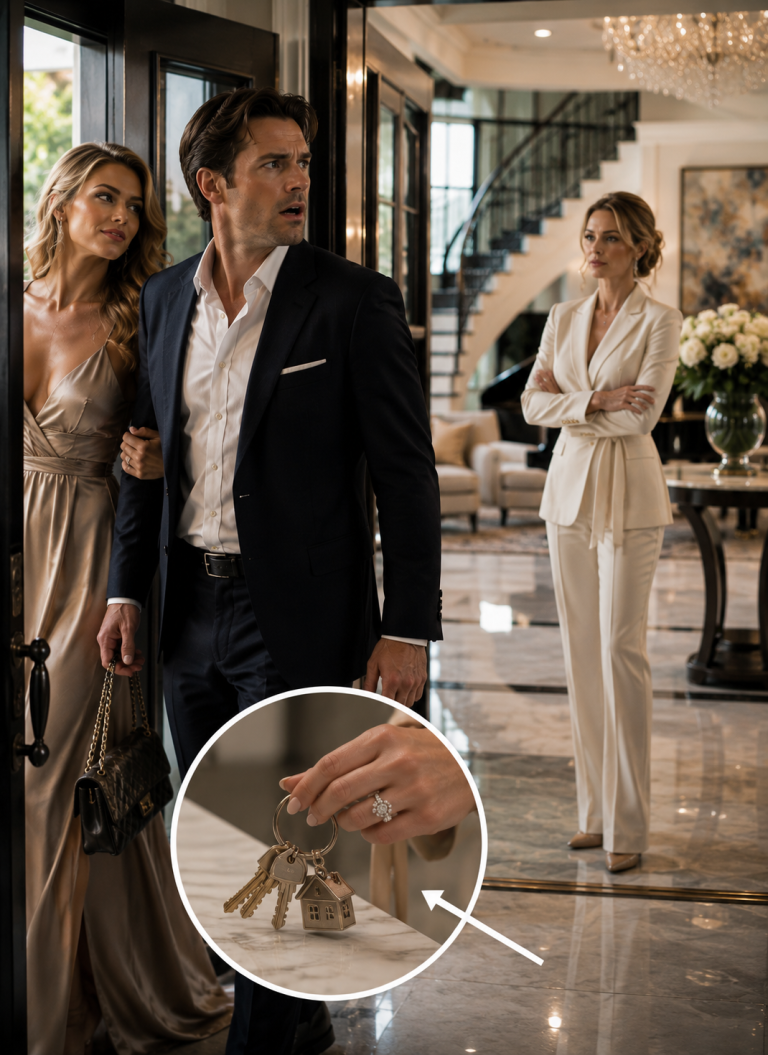
The photos arrived one after another, lighting the dark bedroom like small flashes of cruelty. In each one, Julian Hart smiled with an ease he hadn’t shown his wife in years. Beside him stood Bianca Vale — his mistress — wearing Evelyn’s pearl earrings, standing in Evelyn’s beach house, drinking from Evelyn’s late mother’s crystal glasses.
Bianca hadn’t written much. Just: *”Thought you should know what your husband really wants.”* Then a laughing emoji. Then: *”Try not to cry too loudly.”*
Evelyn sat up in bed without a sound. The phone trembled once in her hand — not from weakness, but because her body had reacted before her pride could stop it.
She was twenty-eight in the wedding photo on the dresser, Julian’s hand resting on her waist like she was something precious. Quiet. Hopeful. Foolish enough to believe a man who admired her calm would never turn it into a cage.
She opened the first photo again — not to look at their bodies, but at the background. The painting behind them was her grandfather’s. The blanket beneath them had been handwoven by women from a foundation Evelyn funded. This wasn’t just any room. It was the south suite of Rosecliffe House — the seaside property Julian had begged to use for company retreats because, he said, it made him look established.
Her husband had brought his mistress into her inheritance and let the woman believe it was his.
Another photo showed Bianca in a satin robe on the balcony, Evelyn’s mother’s pearl necklace around her throat. That necklace had gone through illness, board meetings, and a last birthday dinner before Eleanor Hart died. Julian knew that. Bianca knew only that it looked expensive.
Something hot moved behind Evelyn’s ribs — not tears. Tears would have been too easy. It was the old ache of being underestimated, the exhaustion of being soft-spoken among people who mistook volume for power. Julian had mistaken her patience for permission. Bianca had mistaken her silence for defeat.
The last photo was a mirror selfie in the entry hall. Behind Bianca, half-hidden by the frame, hung a brass plaque: *Heart Legacy Retreat — donated by the Eleanor Hart Foundation.* Julian had cropped that plaque out of every company brochure he’d ever printed. He hated being reminded the place was never his.
Evelyn didn’t scream. She didn’t call Julian. She didn’t answer Bianca. She turned on the small lamp, opened her laptop, and created a folder named **2:13**. By sunrise it held more than photographs — dates, access logs, receipts, staff messages, a record of every lie Julian had told while using her name, her property, and her money to build himself into a man the city admired.
At six, she chose a navy dress with clean lines, and pinned her mother’s pearl brooch to the collar instead of grieving over the stolen necklace.
Julian came home at seven, smelling faintly of someone else’s perfume, moving with the careful quiet of a guilty man who’d already rehearsed his excuse. “Long night at the office,” he said, loosening his tie, smiling like a man used to being believed.
Evelyn set the coffee pot down. Glass against marble, small and exact.
“Was it?”
That was all. No accusation. No scene for him to manage. Julian blinked, laughed once, opened the refrigerator as if hunger could cover shame.
Her phone buzzed. Bianca again: *Did you enjoy the album?*
Evelyn turned the screen face-down and picked up her coffee.
“You have a gala tonight,” she said.
Relief crossed his face too fast. He thought she’d chosen dignity over confrontation. He thought, as he always did, that she’d protect his image the way she always had.
“Yes. The Children’s Future Fund. Big donors, press. Nothing dramatic, please.”
*Nothing dramatic.* He’d said that to her before every event where he needed her family’s name nearby and her voice far away.
“Of course,” she said.
Julian studied her face, hunting for tears. When he found none, he mistook the absence for surrender. He kissed the air near her cheek and went upstairs.
Evelyn opened the folder again. Sixty photos — sixty small weapons meant to make a wife collapse alone in the dark. Bianca had wanted an audience of one.
Evelyn would give her a much larger one. Not with screaming. Not with revenge that dirtied her hands. She would let the whole city see exactly what kind of woman had posed proudly in stolen rooms, wearing a dead woman’s pearls, beside a man who had built his entire reputation on another woman’s quiet strength.
Tonight, at the gala neither of them had built alone, the seating chart was about to become the least of Julian Hart’s problems.
—
**PART 2
By noon, Bianca had grown impatient — Evelyn could tell because the messages stopped being polished. *Are you pretending not to care? Did he tell you he loved me there? You should see the ones I didn’t send.*
Evelyn read them in the back of her car, one hand resting on a leather folder, and didn’t reply. Silence made cruel people louder. She’d learned that a long time ago — back when Julian had still been charming in the hungry way ambitious men are, back when he’d praised her for listening more than she spoke, before the small corrections started. *Don’t wear that shade. It makes you look severe. Don’t mention your foundation. Smile more at my investors.*
Bianca had arrived eighteen months ago as his new brand consultant — bright-eyed, camera-ready, skilled at making envy look like confidence. She called Evelyn *graceful* in a tone that meant *old*.
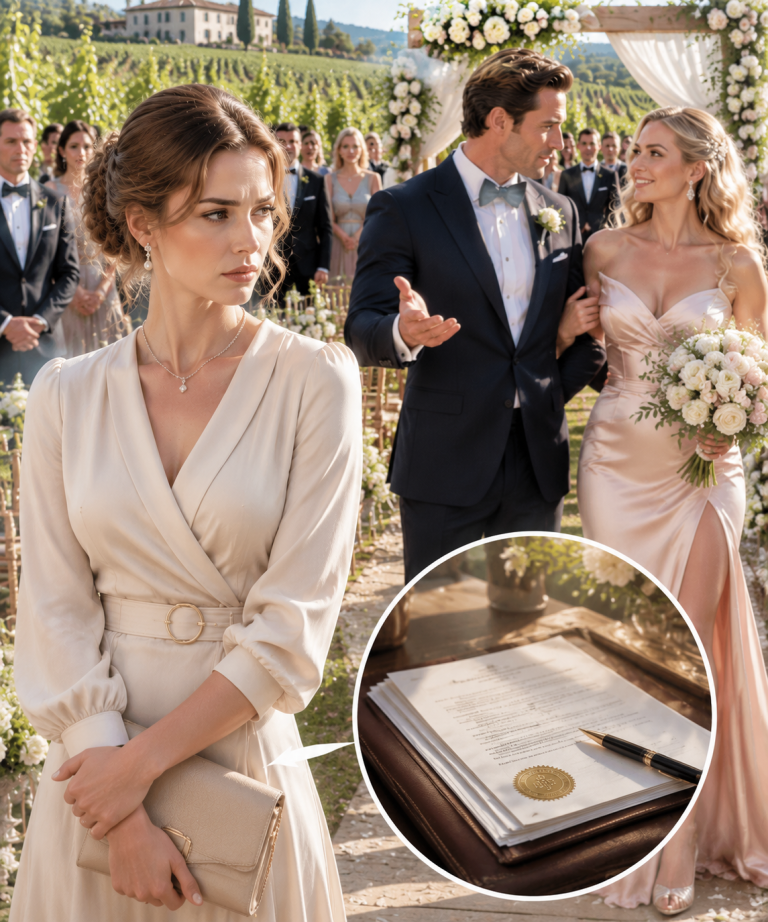
The first real humiliation had happened months earlier, at a donor luncheon, when Bianca wore a pale blue silk scarf — Evelyn’s mother’s — and told the table, “Julian has such generous taste.” Everyone had turned to Evelyn, waiting for her to react. She’d smiled and said nothing. Not acceptance. Just patience, waiting to decide what price to attach to his mistake.
Bianca had just supplied the price herself.
The car pulled up outside the Children’s Future Fund gala — glass and limestone, Julian’s name on a banner among the event chairs. What no one in that lobby knew was that Evelyn had funded the fund’s emergency grant program anonymously for five years, and that her mother’s foundation had paid for the pediatric wing the gala existed to celebrate. Julian had spent years accepting applause for attending what Evelyn had built.
Inside the small office reserved for legacy donors, Evelyn opened the folder — not the intimate photos, but the ones that mattered. Bianca in the restricted south suite. Bianca beside the memorial cabinet. Julian, careless and proud behind her, his face confirming every breach better than any confession could.
Her phone buzzed once more. Bianca: *He said you’d never leave. He said you need the Hart name.*
Evelyn almost laughed. The Hart name, the money, the estate, the foundation, the respectability Julian wore like a tailored coat — all of it had come through Evelyn’s side of a locked door. And yet he’d convinced his mistress that she was the dependent one.
At two, Julian called to remind her of the new seating arrangement — Bianca at the central sponsor table, because her campaign, he said, had helped the gala “reach younger donors.” Evelyn asked him to repeat that. He told her not to make that tone.
“I won’t make a scene,” she said.
“Good. Wear something simple. Let tonight be about the children.”
He hung up before she could answer.
Evelyn sat back, her hand closing once around a pen. He had used sick children as a shield while arranging a public insult — the kind of ugliness that only looks clean from a distance.
By evening, the ballroom would be full of donors, cameras, and one screen large enough to turn a whisper into a record. Julian believed her silence would protect him.
He had forgotten that silence could also be a locked door — and tonight, she had the key.
—
**PART 3
The gala began under chandeliers and soft music — the kind of expensive calm that makes cruelty look polished if no one names it. Evelyn arrived alone at seven-fifteen in a long black dress, no jewelry but her mother’s brooch, her hair drawn back so neatly every line of her looked intentional.
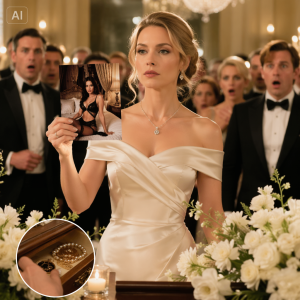
Julian stood near the entrance with Bianca at his side — the first insult of the evening. He didn’t hide her. He displayed her, in a white gown too bright for a charity event, Evelyn’s pearls glowing at her throat.
Bianca saw Evelyn first. Her smile widened, then softened into performance. She touched the necklace with two fingers, making certain Evelyn saw it.
“Evelyn,” Julian said, offering his cheek for the cameras. “There you are.”
She let the air near her face receive him. Not a kiss. Not a scene. Just absence.
“I hope you don’t mind the seating adjustment,” Bianca said. “Julian said I could help him host tonight.”
Evelyn looked at the necklace instead of answering her. Her mother’s clasp sat slightly twisted at the back, fastened by careless hands. A small ache opened. She let it open, then closed the door over it.
“It suits the evening,” Evelyn said.
Bianca blinked — she’d expected tears, or at least anger. Calm had cheated her of a victory.
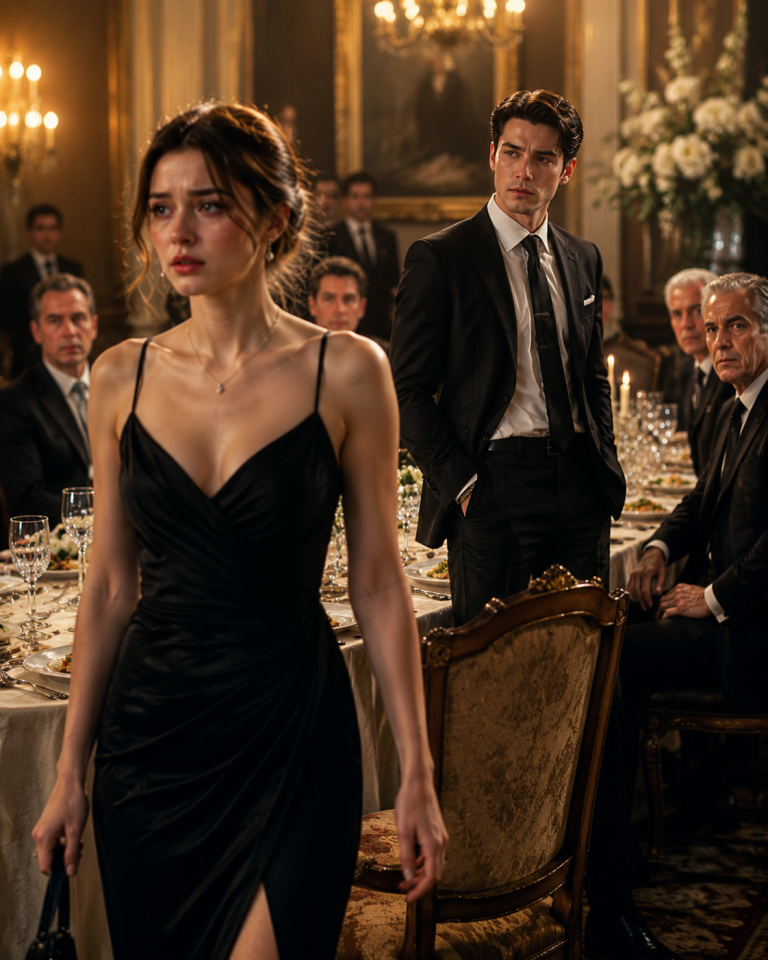
At the sponsor table, Evelyn’s name card had been moved two seats from Julian’s, facing a pillar — an insult designed to look accidental unless the victim made it visible. Bianca placed her clutch in Evelyn’s original chair. “Oh — I hope this is fine,” she said. “Julian said you prefer being away from the center.”
Evelyn rested one hand on the back of the chair by the pillar. “I prefer people to know where they belong,” she said, and sat down without argument.
It was a gift. Let them show the whole room exactly what they thought they could do to her.
Dinner began. Julian performed beautifully for the microphone — compassion, loyalty, the responsibility of powerful people to protect the vulnerable. He thanked the fund, the sponsors, the board, the families. He thanked Bianca by name for “youthful vision.” He did not mention Evelyn. That omission wasn’t new. What was new was how many people noticed.
At nine, the lights dimmed for the tribute video. Julian turned toward the screen expecting grateful families and his company logo. Bianca lifted her phone to record him — proof, she thought, that she’d chosen the winning side.
The first image was not a private photo. It was Rosecliffe House at dawn, white against the sea, with a simple caption: *Donated in memory of Eleanor Hart. Owned and protected by the Eleanor Hart Foundation.*
A murmur moved through the ballroom.
The next image showed the south door’s restricted plaque, then the entry log from the night before — names blurred except for two: *Julian Hart. Bianca Vale.* A timestamp, clean and undeniable.
Bianca lowered her phone.
The third image showed her in the entry hall, wearing the pearl necklace, the memorial plaque visible behind her. Someone near a table whispered Eleanor Hart’s name. The final image was Evelyn’s mother’s portrait — the same pearls, dated fourteen years earlier. No caption needed. Bianca’s hand flew to her throat as though the necklace had turned hot.
Julian looked for a technician to blame. No one moved to help him.
Evelyn stepped forward to floor level, where the whole room could see her without theatrics.
“Evelyn,” Julian said, too sharply. The word carried every command he’d ever given her — *stop, smile, protect me, stay in your seat.*
“No,” she said. The smallest word of the night. It landed like a door locking.
The screen changed to a plain list, stripped of jargon: *Rosecliffe House — not Julian’s property. Legacy donor funds — not Julian’s gift. The necklace — not Bianca’s accessory.*
Julian tried to laugh it off. “This is a private marital issue.”
“It stopped being private,” Evelyn said, “when you used my mother’s house, my foundation’s event, and my family’s name to humiliate me in public.”
Bianca stood so fast her chair scraped the floor, fumbling with the clasp. A camera near the aisle turned toward her — that small mechanical movement frightened her more than Evelyn’s voice had.
Julian stepped down from the stage, smiling too hard. “Ladies and gentlemen, please ignore this. My wife is emotional.” The word drifted through the room and died there; Evelyn looked neither frantic nor wounded enough to fit it.
He reached for her arm in front of two hundred witnesses. Before his fingers touched her, a security officer stepped between them. No words. Just presence. Julian stopped — the absence of an argument made it worse than any shouting could have.
Bianca finally unclasped the necklace. It slipped into her palm, trembling.
“Set it on the table,” Evelyn said. Bianca obeyed. Evelyn lifted the pearls with a folded handkerchief — not as a trophy, but as something rescued.
“You’re humiliating yourself,” Julian said.
“No, Julian. I’m returning your work to its true author.”
The next slide showed a photo Julian had posted months earlier, standing proudly in front of Rosecliffe House, captioned about “building his legacy” — beside the foundation record proving he’d never owned, funded, or managed the property. The contrast needed no further explanation. A donor pushed back his chair. Another lowered his phone in disgust.
Bianca stared at Julian as if seeing him without lighting for the first time. He’d told her Evelyn was dependent. He’d told her the house was his. Now she stood holding nothing but exposure.
Evelyn didn’t smile — triumph would have been easy, and easy wasn’t the same as clean. She turned to the room instead.
“Tonight’s program will continue,” she said. “The children this fund supports won’t lose a single grant because of one man’s vanity.”
No applause came at first. Then, from the back table where the pediatric nurses sat, one woman began to clap. Others followed — uncertain, then stronger. It didn’t feel festive. It felt like a verdict.
**The Reckoning**
Afterward, Julian caught up with her near a side corridor, his public face half-recovered, his eyes bright with panic. “We can fix this,” he said, low and fast. “I’ll handle Bianca.”
“You still think she’s the problem? She sent those photos, didn’t she?”
“She’s unstable. She wanted attention. You and I can present this as a misunderstanding.”
There it was — the turn. He’d flaunted Bianca in public, given her stolen symbols, and now, with the room’s approval slipping, he was ready to discard her as the sole villain. Evelyn felt no urge to protect Bianca from consequences. But she wouldn’t let Julian use another woman as a curtain again.
“You both made choices,” she said.
“Be careful,” he said. The warning would have frightened her once. Now it sounded almost nostalgic.
At the reception, an older donor who’d ignored Evelyn all evening stopped in front of her and lowered her voice. “Your mother would have been proud of the way you protected the fund.”
Evelyn’s composure softened, just once. “Thank you.”
Across the room, Bianca’s phone began buzzing — the image of her wearing the stolen necklace had already spread through private circles. She hadn’t become famous as the woman chosen over the wife. She’d become famous as the woman who wore a dead mother’s pearls into that dead woman’s own foundation event. Crueler, perhaps, because it was true.
Julian’s own phone lit with notifications faster than his fingers could answer them. It wasn’t the affair that would ruin him — powerful men survived affairs. It was the pattern underneath it: pretending to own what wasn’t his, using charity as a costume, humiliating the woman whose resources had carried him, and bringing his mistress into rooms built by the mother of the wife he’d mocked.
The next morning, headlines didn’t scream — they didn’t need to. *Chairman’s gala turns awkward after donor estate misuse revealed.* Bianca’s name spread faster than Julian’s; her photo touching the stolen pearls had become the symbol of the whole story.
Evelyn read the first few pieces, then put the tablet down and ate breakfast, her hands steady around the teacup. Julian hadn’t come home. The house felt different with him gone — not lonely, like a room after heavy furniture has finally been removed and the floor can breathe.
He called twelve times before nine. She answered the thirteenth.
“You need to release a statement saying this was a private misunderstanding,” he said. “My board is nervous. This affects hundreds of employees.”
The old shield, polished for emergencies — his company was his genius when he wanted praise, innocent workers when he faced consequences. Evelyn did care about the employees. That was exactly why she wouldn’t let him keep using them as hostages for his reputation.
“The employees will be protected,” she said, and ended the call.
By ten, an envelope reached his office: his company’s permission to use Rosecliffe House, foundation staff, and donor materials — withdrawn, effective immediately. Employee salaries tied to the charitable program secured for six months through a separate reserve. No dense legal maze. Just doors closing, one at a time.
At noon, Julian arrived at Evelyn’s townhouse without an appointment. The housekeeper wouldn’t let him past the foyer. Evelyn watched from the stairs as he stood below in yesterday’s suit.
“I am your husband,” he said.
“You sent documents to my office before speaking to me,” he added, when she descended halfway. “You sent another woman into my mother’s rooms before speaking to me,” Evelyn said. For one second, something like shame moved across his face. Resentment swallowed it.
“You’re going to destroy everything over photos.”
“No. I’m ending the arrangement that let you confuse my restraint with ownership.”
He laughed, sharp and ugly. “This cold performance — you think people admire it? They’ll call you bitter.”
Once, that word would have found the deepest bruise. Now it slid off her like rain. “People may call me whatever helps them sleep,” she said. “They won’t call your lies mine.”
“I made you visible,” he said.
“No. You taught me the cost of disappearing for someone unworthy.”
He threatened that Bianca would say Evelyn had planned the whole thing to ruin her. Evelyn looked at him for a long moment — the threat was clumsy. Bianca’s messages were saved. The entry logs existed. The necklace had two hundred witnesses.
“Then she can become even more famous,” Evelyn said. The sentence landed gently, which made it worse.
Julian left, slamming the door harder than dignity allowed.
**Bianca**
That afternoon, a message arrived from an unknown number: *I did not know the necklace was your mother’s.* Evelyn read it twice and put the phone away. Not every apology deserves an audience the moment it’s convenient.
Bianca’s apologies grew longer that evening, then careless — a public statement claiming she’d been deceived, that she never meant to hurt anyone. Within minutes, screenshots of her own earlier messages surfaced. *Try not to cry too loudly. Did you enjoy the album?* The internet didn’t need explicit photos to understand intention. Bianca deleted the statement. Deletion made it worse.
Days later, Bianca appeared at Rosecliffe’s gate alone, no cameras, no white gown, waiting because her name had been stripped from every access list. Evelyn let her into the plain front sitting room — no memory in its walls, no stage to perform on.
Bianca placed a phone and an envelope on the table, her hands shaking. “He told me which rooms to use. He told me what to send you,” she said. “He said if you saw enough, you’d agree to a quiet divorce.”
There it was — the plan beneath the cruelty. Julian hadn’t only betrayed her. He’d tried to engineer her private shame into public compliance.
“Why bring this now?” Evelyn asked.
“Because he’s blaming me for everything.” A pause. “And because I wanted to hurt you. I liked thinking I’d won. I liked thinking you were old news. I wanted you to feel small.”
“You did,” Evelyn said. Bianca flinched — the first honest reaction Evelyn believed all evening. “Then you gave me evidence.”
A staff member collected the flash drive and left without comment.
“Are you going to release everything?” Bianca asked.
“No. Not every truth needs to be thrown into the street to be useful.” What Evelyn wanted was cleaner — enough truth in the right rooms to end Julian’s control and protect the work, without feeding strangers every private wound.
At the door, Bianca paused. “I’m sorry about your mother.” It was late, but specific, which made it heavier than the rest.
“Don’t use dead women as decoration again,” Evelyn said. Bianca nodded and left.
**Restoration**
Julian’s downfall came in humiliating pieces rather than one dramatic collapse — a step back from the charity board, a sponsor review, his smiling company portrait replaced with a neutral statement about governance. He filed his own version of events, claiming Evelyn had approved his use of the house and was rewriting history. Her response was three documents: the original permission letter, the restricted-use clause, the withdrawal notice. The public loved the simplicity. She hadn’t said he lied. She’d shown the door, the rule, and the key.
At the company’s request, the board convened over Julian’s use of assets he’d represented as his own. Evelyn attended once, briefly — enough to answer one direct question with one direct answer. “He was permitted to support the work. Not to claim ownership of it.” Julian leaned forward. “You benefited from my visibility.” Evelyn looked at him with something almost like gentleness. “Visibility is not value.” He was asked to step back from public-facing charity partnerships pending review.
At the courthouse, during their separation, Julian tried one last performance. “Was I ever enough for you?” he asked, near the elevator.
“You were loved,” Evelyn said. “You decided that was smaller than being admired.”
Rosecliffe House closed the south suite for renovation. The retreat that had once hosted “corporate vanity weekends” reopened, three months later, as **Eleanor’s Harbor** — a recovery residence for families traveling with sick children, connected to the hospital fund her mother had loved. The balcony where Bianca had posed now held two sturdy chairs for parents who needed air. The memorial cabinet moved to the library, behind locked glass, as history rather than trophy.
At the quiet opening, a little boy in a blue hat asked if the ocean belonged to the house. Evelyn heard the question from the entry hall and smiled for the first time all morning.
Bianca became famous the way she’d wanted — but fame didn’t flatter her. For weeks her name meant stolen pearls and cruel messages, until the attention cooled and clients drifted away. She eventually issued a shorter, more honest apology, admitting she’d participated in harming another woman for personal gain. She didn’t ask for forgiveness. Evelyn didn’t offer it publicly. Privately, she found that hatred took more energy than Bianca deserved, and let her recede into the category of *lesson*, not *enemy*.
**One Year Later**
At the Children’s Future Fund gala one year on, Evelyn returned not as Julian’s quiet wife, but as the founder of a program that had housed over a hundred families during treatment. Her name card rested at the central table — not because she’d demanded it, but because no one in that room would ever again pretend not to know where she belonged.
A little girl from Eleanor’s Harbor handed her a crayon drawing of a white house by the sea, every window shaped like a heart, and whispered, “The ocean didn’t belong to the house. It belonged to everybody.” Evelyn laughed — a real, unguarded laugh that turned heads, people surprised to hear it from a woman they’d only known through restraint.
Across the room, Julian stood near the entrance as a minor sponsor’s guest, hair touched with gray. Their eyes met once. He nodded — not an apology, not enough to become one. Evelyn returned the smallest nod and looked away.
When she spoke from the stage, she didn’t romanticize what had happened to her. “Betrayal did not make me stronger,” she told the room. “I was strong already. Betrayal merely revealed where my strength had been wasted.” The applause that followed felt different from the year before — not a verdict this time, but a blessing.
Two weeks later, Julian tried once more to reclaim the story, in a glossy magazine interview that called him “complicated” and hinted he’d been punished by public emotion for a private mistake. Near the end, he claimed he’d helped build the charitable program at Rosecliffe and that Evelyn had cut him out of a “mission they’d built together.”
That sentence changed everything. Evelyn’s answer wasn’t emotional. The foundation posted a simple timeline — the original bequest, the renovation approval, the housing plan — with Julian’s name appearing nowhere, because he’d done none of it. Beneath it, one sentence: *The children housed at Eleanor’s Harbor deserve a record cleaner than anyone’s ego.*
He called her that night, past midnight, while she stood in the Harbor’s kitchen making tea during a storm. “You had to humiliate me again,” he said.
“You lied about the program. I gave it visibility. You gave it risk.”
A long pause. “There was a time you would have protected me.”
“There was a time,” she said, “when protecting you didn’t require betraying myself.”
“Do you hate me?” he asked, and for a second she heard the nervous, earnest man who’d once asked to see her again after their third date.
“No,” she said. “Hate would keep you too close. I’m finished carrying you.”
It was the last private sentence she ever gave him.
**Final Image**
Spring came to the coast slowly. At Eleanor’s Harbor, children left chalk drawings on the terrace — crooked hearts, impossible windows, a woman with a crown that one child crossed out and gave a key instead. Evelyn had the staff photograph every drawing before the rain took it — not for publicity, but because what gets recorded is harder to steal.
That evening, rain returned and softened the chalk suns until they blurred pink across the stone. Evelyn stood on the south balcony where a stolen photograph had once been taken, the sea dark blue under the falling night. The memory no longer struck like a blade. It felt like an old scene from a play whose stage had long since been dismantled.
Her phone buzzed once — a message from the foundation team: *First family settled in. Child asked for pancakes tomorrow. Parents cried when they saw the ocean.*
Evelyn held the phone against her chest and watched the rain fall over a house that had once been used to make her small, and was now simply, finally, hers.
THE END