A Widower Saved the Only Woman Left Alive After the Massacre — Then the Hunter Came Looking for His Bride

—
## PART 1
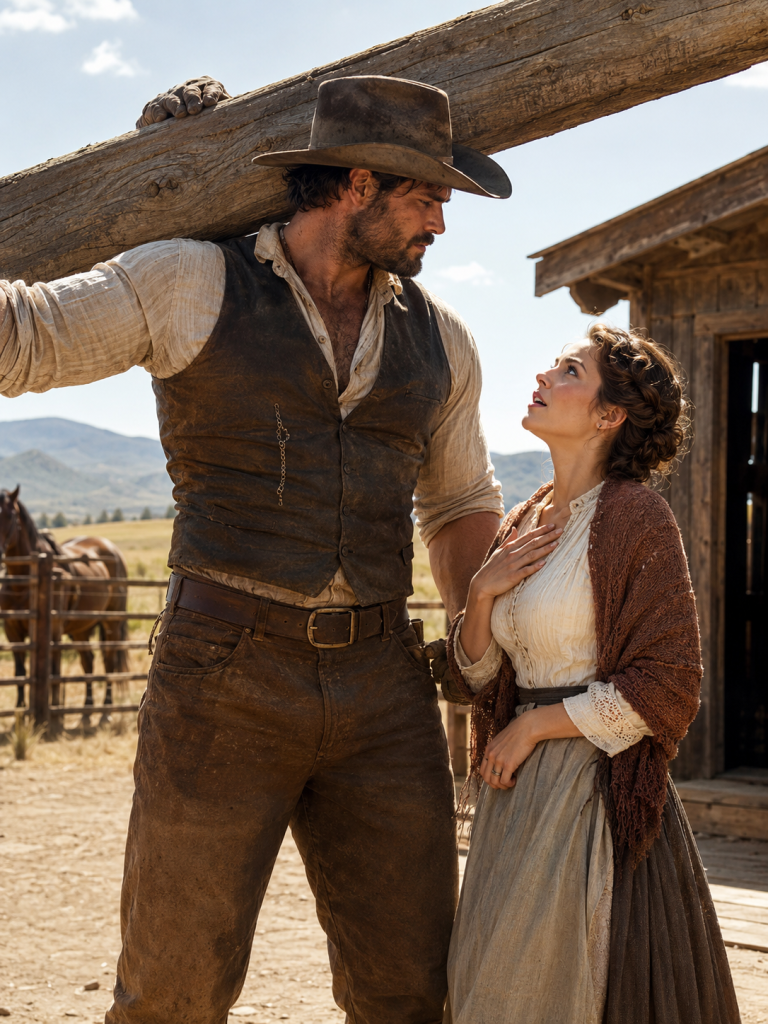
Caleb Mallister had not held another human being in three long years, and had told himself more than once during those years that he’d simply grown into the kind of man who no longer needed to. Not since the day he carried his wife Ruth out of their cabin and buried her beneath the cottonwood tree with his own hands, working through the whole of an afternoon rather than let anyone from town come help him with a grief that felt, at the time, like the one thing left that was still entirely his to carry alone. Since then the world had gone quiet around him — the chair across the table stayed empty, the bed stayed cold on one side. He told himself he’d made peace with it.
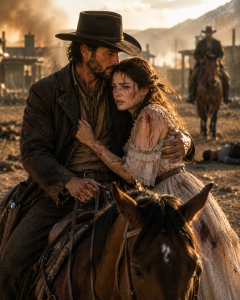
Then one hot July morning, he rode straight into hell. He saw the smoke first, rising slow and black against the Montana sky. Out here, smoke meant one thing. Trouble. Caleb narrowed his eyes and pushed his horse forward, the air growing heavier the closer he got — burnt canvas, gunpowder, and something worse he didn’t want to name.
Four wagons sat broken along the trail, wheels shattered, wood still smoldering, goods scattered across the dirt like someone had shaken the world apart and not bothered setting anything back down properly afterward. A man lay face down near the lead wagon, hat still on, a bullet in his back. A woman lay near the fire pit, dress torn, arms stretched wide like she’d tried to stop whatever was coming for her. Caleb moved slow, rifle in hand, checking each body. Six. Seven. Eight. No one moved.
He’d seen death before. He’d buried his own wife. But this wasn’t sickness. This was slaughter. Someone had wanted these people gone.
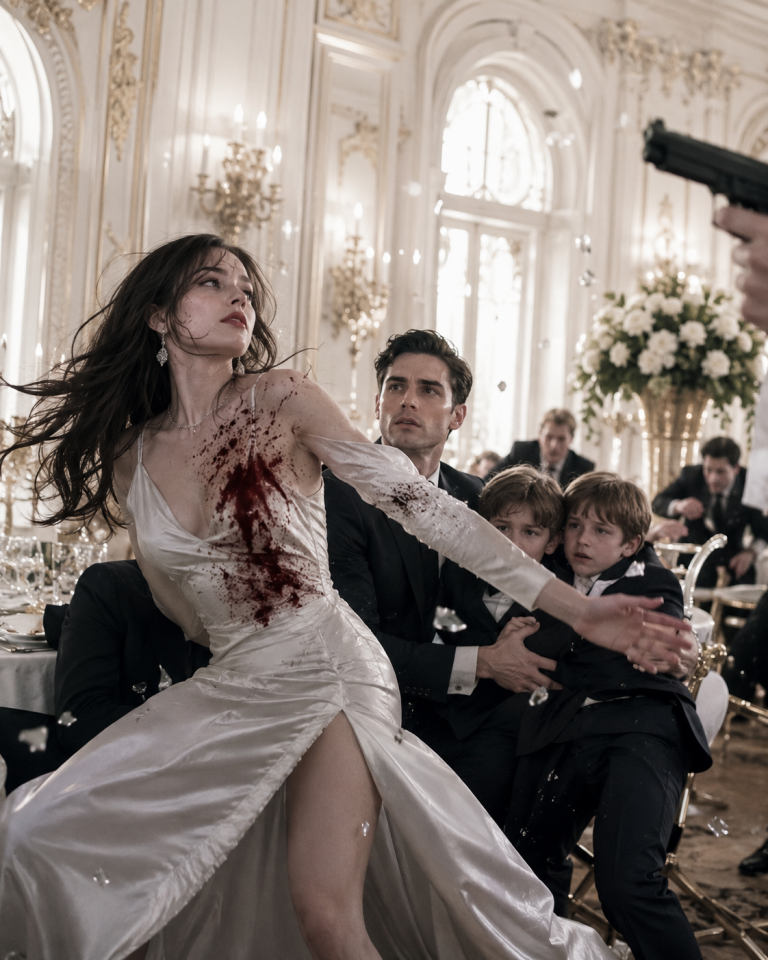
He turned to leave when he heard it — a sound so small he nearly mistook it for wind. A breath. Caleb froze, listened again. There. Faint, weak, coming from behind the last wagon. He moved fast, rounding the wheel, and found a woman curled in the dirt, half hidden by a broken trunk, blood dried dark in her hair, one side of her face bruised deep purple, her dress torn at the shoulder — fabric too fine for a simple wagon traveler. One hand clutched a leather satchel tight against her ribs like it was the only thing keeping her alive.
Caleb dropped to his knees. “Ma’am.” Her fingers twitched. He pressed his ear to her chest — a heartbeat, faint but steady. “You’re alive,” he muttered. He checked her quick: a deep cut above her ear, bruised ribs, scraped hands like she’d tried to crawl. But breathing. Whoever had done this thought she was already dead.
Caleb didn’t waste another second. He lifted her carefully — too light, like grief had already taken half her weight — her head falling against his chest, the satchel slipping until he caught it before it hit the ground. He didn’t open it. He just tucked it against her and carried her to his horse.
The ride home stayed quiet except for the steady beat of hooves. His cabin sat five miles west, tucked against a low hill where cottonwoods gave shade in the evening — built with his own hands after Ruth died, boards hammered into place to keep his own from shaking. He laid the woman on the cot in the spare room, cleaned the blood from her hair, wrapped the cut, washed the dirt from her hands, working in silence the way a man does when he’s afraid to think too hard about what he’s looking at.
Night came slow. He sat in a chair by the door and watched her breathe, the same watchful patience he’d once kept at Ruth’s bedside during her final fever, though he didn’t let himself dwell too long on that particular echo. She woke at dawn, eyes flying open wide with fear — gray-green, sharp, searching. She tried to sit up and gasped in pain.
“Don’t move,” Caleb said, hands staying where she could see them. “You’re safe. You’re in my cabin.”
She looked around at the log walls, the small window, the rifle in the corner. “The wagons,” she whispered.
He swallowed. “They’re gone.”
Something in her face changed. Not tears. Something deeper. A breaking that made no sound at all.
—
## PART 2
He stepped back. “There’s water on the table. I’ll be outside.” He gave her space, understanding grief needed room the same way a wound needed air.
For two days she barely spoke. He left food beside her and asked nothing. On the third evening she stepped onto the porch wrapped in a blanket despite the July heat.
“Why did you bring me here?” she asked.
“Because you were alive.”
“That’s not a reason.”
“It’s the only one I need.” She studied him like she was searching for a trap. “You could have left me.”
“Could have,” he said. “Didn’t.”
Her jaw tightened. “Men don’t do things for no reason.”
“I ain’t most men,” Caleb said, plain, the way he said most things when he’d decided they were worth the trouble of saying at all.
Silence stretched between them. “Margaret,” she said finally. “Margaret Holloway.”
“Caleb Mallister.” She nodded once, then said something that ran his blood cold. “My husband will come looking for me. He has money. Influence. He doesn’t leave things unfinished.”
“Things?” Caleb asked quietly.
“People,” she said, and held his eyes, and for the first time he saw it plain: the massacre hadn’t been bandits after supplies. It had been meant for her. “I have something he wants,” she said. “I could ruin him with it.”
The wind moved through the cottonwood leaves above them. Somewhere far off, a coyote cried.
—
## PART 3
Caleb looked out toward the long stretch of open land leading back to the trail. If her husband had sent men once, he’d send them again. “You should leave,” Margaret said. “This isn’t your fight.”
Caleb rested his hand on the porch rail. Three years he’d sat in that chair waiting for nothing. Three years of silence and dust. “I reckon it is now,” he said.
“You don’t even know me.”
“I know someone tried to kill you. That’s enough.” Margaret’s eyes softened just a little, fear still living underneath. “He’ll come,” she said.
“Then let him,” Caleb said, and meant it in a way that surprised even himself, three years of careful, deliberate distance from other people’s troubles collapsing quiet in the space of a single porch conversation.
The next morning he was already awake when the sun touched the hills, sitting on the porch with his rifle across his knees, watching the trail cut through open land like a scar. Inside, Margaret told him the rest of it over breakfast, the words coming easier now that the worst of the telling was behind her. Her father had built a shipping and textile fortune out of Boston before dying when she was nineteen, naming Edmund Holloway — a family friend twice her age, trusted, respected — as both her husband and the trustee of her inheritance in the same season, grief and convention leaving her little room to question either arrangement at the time. It had taken her three years of marriage to notice the discrepancies in the estate ledgers Edmund kept locked in his study, longer still to understand what she was looking at: a forged codicil to her father’s will, folding the whole of her personal trust into accounts Edmund alone controlled, bleeding it dry a little at a time into investments that existed only on paper. When she’d finally gathered proof enough to act — copies of the forged codicil, bank transfer records, a signed statement from the family lawyer who’d first noticed the fraud — Edmund had learned of it before she could reach Helena to file suit, and sent men to make certain the wagon train carrying her, her lawyer, and the evidence both never arrived anywhere at all.
“He wanted me afraid,” Margaret said. “Wanted it to look like bandits. A tragedy, not a murder.”
“We need to leave,” she said later that morning, stepping outside without the blanket this time, wearing one of Caleb’s spare shirts, sleeves rolled past her elbows, dark hair tied back tight, the bruise on her jaw faded to yellow but not gone.
“Not yet,” Caleb replied without turning.
“You can barely sit a horse.”
“I can ride.”
“You can ride,” he agreed. “But you can’t fight.”
Her eyes flashed. “I am not helpless.”
“I didn’t say you were.” She stepped closer. “Then why are we still here?”
Caleb finally looked at her. “Because this land is mine. I know every dip in the ground, every place a man can hide. If someone’s coming, I’d rather face them here than run blind into their hands.”
She studied him. “You’re not afraid.”
“I am,” he said honestly. “I just don’t let it move me.”
Margaret looked down at the satchel in her hands. “He won’t stop. Edmund Holloway does not lose.”
“Everybody loses,” Caleb replied. “They just don’t all know it yet.”
By midday, a line of dust appeared far out on the southern trail. Margaret saw it first, breath catching. “Caleb.”
He stood slow, narrowing his eyes. “Two riders, maybe three.” He walked to the barn without another word and came back with a second rifle, handing it to her. “Can you shoot?”
“I watched my brother hunt. I was never allowed to try.”
“You’re allowed now.” Her hands trembled slightly taking it. He led her behind the barn where the land dipped toward a dry creek bed, set three tin cans on the fence rail. “Shoulder firm. Don’t jerk the trigger. Breathe out when you squeeze.”
The first shot kicked hard into her shoulder, bullet hitting dirt. The second missed wide. By the fourth she hit the fence post. By the sixth, the can spun off the rail into the dust. She lowered the rifle, breathing hard.
“You learn fast,” Caleb said.
“I learn because I have to.”
That evening, while the light was still gold enough to work by, Caleb found her sitting on the porch steps turning the satchel over in her hands without opening it, like she needed to hold the weight of it a while longer before she trusted herself to look inside again.
“You don’t have to show me what’s in there,” he said, settling beside her at a respectful distance.
“I know.” She traced the worn leather strap. “My father gave me this the year before he died. Told me a woman ought to keep her own accounts, separate from whatever accounts a husband kept, because a man’s memory of what’s owed tends to shift convenient with time.” A faint, humorless laugh escaped her. “I thought he meant household money. Egg money, sewing money. I didn’t understand until years later he meant exactly what happened to me.”
“He sound like he knew Edmund’s kind before you married him.”
“I’ve wondered that myself, more nights than I’d like to admit.” She looked out at the darkening ridge line. “I keep waiting to feel something besides tired when I think about him. Rage, maybe. Grief for the life I thought I was getting. Instead I just feel tired, and then underneath the tired, something that scares me more.”
“What’s that?”
“Relief,” Margaret said. “That it’s finally out in the open instead of sitting locked in his study drawer where only I knew to be afraid of it.” She glanced sideways at him. “Does that make me a hard woman?”
“Makes you a woman who’s done being afraid alone,” Caleb said. “I don’t reckon there’s anything hard about that. Took me three years sitting in a chair by an empty bed before I understood the difference between grieving a thing and letting it own you the rest of your life. You’re getting there faster than I did.”
Margaret didn’t answer right away, but she leaned, just slightly, into the space between them, and Caleb didn’t move away from it either. They sat like that until the first stars came out, saying nothing further, the silence between them no longer the kind either of them needed defending against.
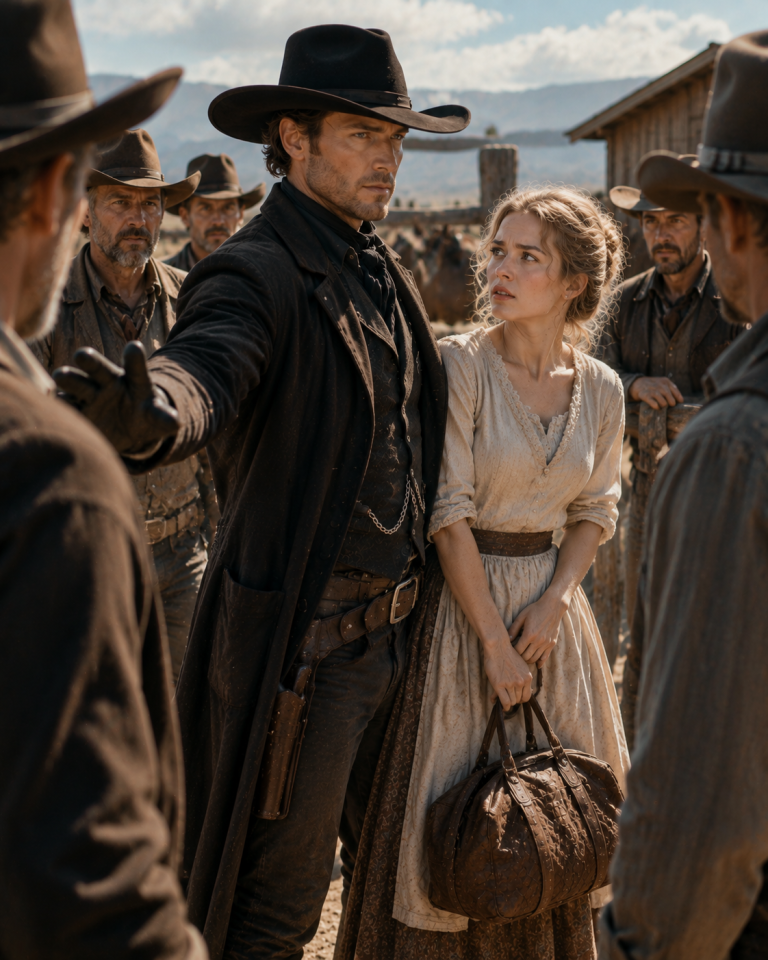
The riders grew closer by late afternoon two days later. Caleb moved them inside before the men reached the property line — didn’t hide Margaret, didn’t lock her away, just stood beside her. Two men rode up, well-dressed, clean boots that didn’t match the trail dust, one smiling too easy.
“Afternoon,” the taller one called. “Name’s Warren Briggs. I’m looking for my wife.”
Margaret’s body went still beside Caleb. “She’s been unwell,” Briggs continued. “Ran off in a confused state. I’ve come to bring her home.”
“Ain’t seen no woman like that,” Caleb said, calm.
Briggs’s eyes moved past him and landed on Margaret in the doorway. No surprise in his face — only satisfaction. “Margaret,” he said gently. “There you are.”
She stepped forward before Caleb could speak. “My name is Margaret Holloway,” she said, steady and clear. “And I am not going anywhere with you.”
Briggs sighed like she were a child refusing supper. “You are not well. You stole important documents. Your husband is deeply concerned.”
“My husband hired men who murdered eight innocent people,” she said. “Tell him I am done being concerned.”
The smile left Briggs’s face. “Mrs. Holloway. This is bigger than you understand.”
Caleb shifted, rifle loose but ready. “I understand enough,” Margaret said. “You can leave.”
Briggs’s eyes flicked to Caleb. “You realize you’re interfering in a lawful marital matter.”
Caleb’s jaw tightened. “You rode five miles onto my land calling for a woman who says she don’t want you here. That ain’t lawful. That’s trespass.”
The second rider reached slow toward his coat. Margaret raised the rifle and aimed straight at him. “Don’t,” she said, voice not shaking.
For a long moment no one moved. Something new entered Briggs’s expression — calculation, not doubt. “You’ll regret this,” he said softly.
“Maybe,” Margaret replied. “But not today.”
Briggs nodded once to his companion, and the two men turned their horses without another word, riding away slow at first, then faster. Margaret lowered the rifle only when they were small shapes in the distance, her hands beginning to shake hard.
“You did good,” Caleb said, quiet, meaning it plain and simple, the way he meant most things he bothered saying out loud at all.
“He’ll be back,” she whispered. “I know.” She turned to him, eyes wide and fierce. “You should have let them take me. You could die because of this.”
“I was already halfway there,” he said, and something broke in her face at that. She set the rifle down and walked toward the cottonwood tree where Ruth was buried, standing there a long moment.
“I am tired of being owned,” she said quietly.
Caleb walked to stand beside her. “You ain’t.”
She looked up. “If he brings more men, then we hold.”
“Why?” she asked.
“Because you deserve to stand somewhere without fear,” he said simply.
The sun dipped low behind the hills. Far out on the horizon, another faint line of dust began to rise — more than two riders this time. Margaret saw it first, and this time there was no doubt. They were coming back.
By sunset, Caleb counted five riders. Margaret held the second rifle without it looking foreign in her hands anymore. “That’s not Briggs,” she said.
“No,” Caleb replied. “That’s hired muscle. He thinks he can scare you.”
“He thinks he can scare me,” Caleb repeated, quiet. They didn’t hide. They didn’t run. Caleb moved them into position before the riders reached the fence, leading Margaret to the shallow ridge behind the barn where the land dipped into the dry creek bed for height and cover. “Remember,” he said. “Don’t waste your shots. Aim steady.”
She nodded. The riders slowed at the fence, one man riding ahead of the others, a scar across his cheek, eyes flat. “We’re here for the woman,” he called. “No need for anyone else to get hurt.”
Caleb stayed silent. The man laughed once. “You think one rancher and a half-dead lady can stop five of us?”
Margaret’s grip tightened. Caleb’s voice carried clear across the land. “You cross that fence, you ain’t riding back.”
The first shot cracked from the riders’ side, striking the barn, splintering wood. Caleb fired once — the lead rider jerked and fell hard into the dust. Margaret fired next, her bullet catching the second man’s shoulder; he cursed and dropped behind his horse. Gunfire exploded across the quiet Montana evening, horses screaming, dust rising thick and blinding. Caleb moved like a man who’d been waiting for exactly this, calm and measured, firing only on a clear shot. Margaret stayed low, heart pounding loud in her ears, forcing her breath and her hands steady the way he’d taught her that morning.
Another rider charged for the side of the cabin. She aimed, squeezed. He toppled before reaching the porch. Two riders broke away, retreating fast for the southern trail. Caleb stood, rifle trained on their backs, and didn’t fire. “Let them run,” he said.
Silence fell heavy. Three men lay in the dust. The other two vanished into distance. Margaret lowered the rifle slow, hands shaking now — not from fear, from realization. She stared at her own palms like she was trying to reconcile them with the woman who’d stepped off a Boston train four years earlier believing marriage meant safety rather than the opposite.
“Is it over?” she asked.
“For now,” Caleb said.
She stood breathing hard, staring at what she’d just done. She’d never fired a weapon before this week. Now she’d defended her own life with it. “He’ll know,” she said quietly. “Edmund will know. I won’t come quietly.”
“Good,” Caleb replied.
They buried the men the next morning beyond the far ridge, no markers, no words spoken over the graves beyond what decency required of any burial regardless of who lay in it. Caleb didn’t speak much through the digging. Margaret helped anyway, her palms already blistered from two days of rifle practice and now further roughened by the shovel, and she didn’t once ask to be spared the work on account of being a lady, which told Caleb something about her he suspected she hadn’t fully worked out about herself yet. When it was done, she stood looking at the long stretch of open land. “He won’t send more,” she said after a long silence.
“How do you know?”
“Because this was never about killing me,” she said. “It was about control. He wanted me afraid, dragged back quiet. If word spreads that his hired men were run off by the very woman they came for, it makes him small in front of every banker who’s ever trusted him with their own money. He can’t afford small. Not with what I still have in that satchel.”
Caleb looked at her differently then. “You ain’t afraid anymore.”
She thought about it — the massacre, the long ride, the man on the porch, the gun in her hands, the whole long unraveling of a marriage she’d once believed was simply the ordinary shape grief and duty took for a woman in her position. “No,” she said finally. “I’m not.”
They rode to Helena two days later. Margaret walked into the federal courthouse with her head high, the satchel pressed flat against her ribs, Caleb silent and steady at her side. The marshal listened first, in a plain back office that smelled of pipe smoke and old paper, taking down her account in careful longhand while a deputy sat quiet in the corner in case Briggs or anyone else connected to Edmund Holloway thought to try finishing what the wagon train massacre hadn’t.
The judge’s hearing, when it came two days later, was not the quick, sympathetic affair Margaret had half hoped for and half feared wouldn’t happen at all. Edmund’s own lawyers, wired ahead of the proceedings by a Boston associate who’d caught wind of the warrant request, sent a telegram of their own disputing every claim, calling Margaret an unstable woman who’d fled her husband’s care in the grip of hysteria and fallen in with a stranger willing to say whatever kept her under his roof. For a long, cold hour, Caleb watched the judge weigh that version of events against his own plain testimony as the man who’d pulled her half-dead from a massacre Boston’s lawyers were now trying to explain away as an unrelated bandit raid, and understood exactly how easily money could still bend even an honest court’s patience if a woman’s word stood alone against it.
It didn’t stand alone. The forged codicil was examined line by line against Margaret’s father’s genuine signature on file at the county recorder’s office back in Ohio, wired for and received within the week, the mismatch plain enough that the judge’s own clerk noted it aloud without prompting. The bank transfer records Margaret had copied by hand over eighteen months of quiet, careful work traced a pattern no innocent trustee could easily explain — funds moving from her personal trust into ventures registered under Edmund’s name alone, each transfer dated within days of a large withdrawal she’d never authorized or seen. And the murdered lawyer’s own prior sworn statement, the one he’d been carrying west inside that same satchel to file formally in Helena, corroborated every figure down to the dollar, his signature notarized three weeks before his death in a fashion Edmund’s own lawyers couldn’t credibly claim had been forged alongside everything else.
“Mrs. Holloway,” the judge said finally, setting down the last of the documents, removing his spectacles to rub the bridge of his nose like a man who’d read a great many fraudulent claims in his years on the bench and recognized, with some relief, that this was plainly not one of them. “I have sat this bench eleven years and heard a great many claims of fraud from a great many aggrieved parties. I have rarely seen one arrive this thoroughly documented, nor at this particular cost to the party bringing it.” He looked to the marshal. “Issue the warrant. Wire Boston authorities to hold Mr. Holloway for federal transport once he’s located.”
Warrants were issued within the week. Edmund Holloway was arrested in Boston three weeks later, found at his own club rather than in hiding, apparently confident enough in his money’s reach that he hadn’t thought to run at all until federal marshals were already standing in the doorway. The case against him drew on evidence from two territories and the sworn testimony of a widow who had, by then, stopped being anyone’s easy target — and drew, too, on three other families who came forward once word of the arrest reached the papers, smaller fortunes Edmund had bled the same slow way over the preceding decade, their trustees never questioned closely enough by anyone with the standing to do it until Margaret’s case cracked the whole pattern open for a federal prosecutor eager to make an example of exactly this kind of quiet, respectable theft.
When the telegram arrived at Caleb’s cabin, Margaret read it twice before handing it to him, her hands steadier than they’d been in months of waiting for exactly this kind of news to arrive one way or the other. “He’s in custody,” she said, her voice steady too, now that the waiting itself was finally finished.
They sat together on the porch beneath the cottonwood as the sun dropped low over the hills. “It’s done,” she whispered.
Caleb nodded. She looked at him then — really looked. “I thought surviving was enough,” she said. “But it isn’t. I want to live.”
He felt something shift in his chest. “And what does living look like?” he asked quietly.
She smiled for the first time without caution behind it. “It looks like this land,” she said. “Mornings without fear. Choosing who stands beside me.”
He swallowed. “And who’s that?”
She stepped closer. “You.”
Caleb had buried his heart once. He’d sworn he wouldn’t dig it up again. But standing there in the Montana dusk with a woman who’d fought her way back from death and refused to kneel for any of it, he understood something plain. Ruth had been his past. Margaret was his future.
“You sure?” he asked.
“I have never been more sure of anything.”
He reached for her then, not gently, not uncertain, and pulled her into his arms and held her like a man who’d nearly lost something he hadn’t known he still needed. Under the cottonwood tree, where he’d once buried grief, he found something else entirely. Hope.
They married that fall, a small ceremony under the same cottonwood where Ruth still rested and where Margaret had once stood telling Caleb she was tired of being owned by anyone. He didn’t see it as strange to marry beneath a tree marking his first wife’s grave, and neither did Margaret when he explained it to her plain — Ruth had loved that tree for its shade in the evenings, same as he did, and he’d rather build something new in a place that had already meant something good than pretend the past hadn’t happened at all. Margaret understood that kind of honesty better than most brides might have. She’d spent three years married to a man who’d curated every version of himself down to a performance, and she had no interest in starting a second marriage on any foundation less solid than the truth, cottonwood grave and all.
Edmund Holloway was convicted the following spring after a trial that ran the better part of six weeks, his fortune stripped and redistributed by court order to the trust’s rightful beneficiaries — Margaret chief among them, though she signed over a considerable portion of her own restored inheritance to the three other defrauded families whose cases had ridden in on the strength of hers. His name was dragged through every paper from Boston to Montana, the particular scandal of a respected trustee ordering a wagon train massacre to protect his theft proving too lurid for even the more restrained eastern papers to resist covering in full.
Margaret never went back east, not even for the trial itself, giving her testimony instead through a deposition taken in Helena and sworn before a traveling federal clerk, unwilling to set foot again in the city that had handed her over to Edmund in the first place at nineteen with no one thinking to ask whether she wanted the arrangement at all. She used part of the returned estate to build a small school in Stillwater instead, modest but sturdy, the kind of building that would still be standing decades on the way Caleb’s cabin had been built to last through anything the Montana weather cared to throw at it. She taught there herself some mornings, mathematics mostly, telling her students more than once that a person who understood her own numbers plainly was a person considerably harder for anyone else to rob blind.
She signed her name proudly on every document that crossed her desk from then on — not Mrs. Edmund Holloway, the name that had once made her small enough to be nearly erased entirely, but Margaret Holloway Mallister, both halves of it chosen rather than simply inherited.
At night, she and Caleb sat on the porch watching the sky turn gold over land that had once seen five armed men ride onto it meaning to drag her back into a life she’d already died once trying to escape. Sometimes she played the old piano they’d hauled in from Helena at considerable expense and greater stubbornness, the music carrying out across the prairie like something new being born where only silence had lived for three long years before her. Caleb had never much cared for music before she came, but he found he didn’t mind it now, especially on the evenings she played something slow and didn’t seem to notice she was humming along underneath it.
On quiet evenings, when the wind moved gentle through the cottonwood leaves, Caleb would look at her and remember the day he’d ridden into smoke and death and found one faint heartbeat still fighting in the dust behind a broken wagon wheel. He’d thought, at the time, that he was the one doing the saving — a lonely rancher finally given something worth the trouble of caring for again.
In truth, she’d saved him right back, pulling him out of three years of silence with the same stubborn refusal to stay buried that had kept her own heart beating behind that wagon in the first place. And that, Caleb had come to understand, made the whole trade — grief for hope, silence for a piano’s worth of ordinary noise, an empty chair for a woman who filled the whole cabin just by being in it — entirely even between them, the way the best trades usually turned out to be once a person stopped counting so carefully what each side had put in.
**THE END**