A desperate woman pulled the cowboy into the storm — then one impossible confession changed everything

—
## PART 1
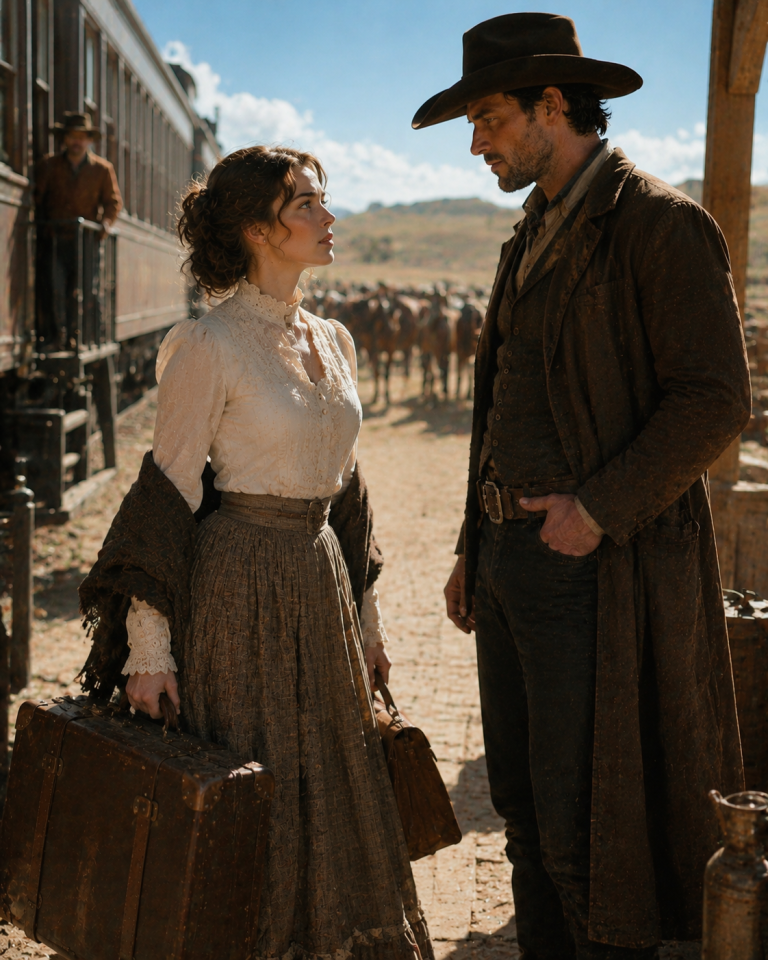
The sky over the plains looked wrong. Not just gray — heavy, like something was about to break. Clara Whitfield stood by the broken fence, hands gripping the rough wood so tight her knuckles went white, wind pushing cold and sharp against her dress, carrying the smell of dust and coming rain. The land stretched out in every direction, empty and unforgiving, same as it had been for two years running. A failing ranch. A dying herd. A note at the Cheyenne bank coming due in six weeks that she had no honest way yet of covering, not unless the herd came through this season better than it had the last two combined. Silence that never ended.
Her husband had been gone two years, buried on the small rise behind the cabin where the grass still refused to grow back over him. People in town said time healed things. Clara knew better by now. Time didn’t heal. It only made the quiet louder, and made the bank’s letters arrive a little more clipped each season she couldn’t quite catch up.
A low rumble rolled across the sky. She looked up. This wasn’t the kind of storm that helped the land. This was the kind that destroyed it. The cattle started moving uneasy, and Clara grabbed the rope and forced herself forward, pushing them toward the small corral near the barn, boots sinking into dirt already softening under the first drops. “Move!” she muttered, voice rough from disuse.
The first drop hit her cheek, cold and heavy. Then another. Within seconds the sky opened, rain crashing down in sheets, wind screaming across the plains until the world blurred into gray water and noise. Clara pushed harder, shouting, trying to hold the herd together, but fear spread through the cattle faster than she could contain it. Lightning split the sky. The herd scattered.
“No,” she whispered, heart dropping. Everything she had left, slipping away again — every head of cattle out there in the dark meant one more season of falling further behind on a debt that didn’t care about weather. Mud grabbed at her boots as she stumbled after them, useless against a storm this strong. She finally stopped, breathing hard, defeated, letting the rain soak through her clothes and hair and skin.
Then she saw it. Something dark near the fence. At first she thought it was a fallen animal. Then it moved. Her body froze. A man, face down in the mud.
Her first instinct was to turn away. Trouble always arrived wearing a stranger’s face, and she’d already survived more than her share of it. Then she saw the blood, dark and spreading into the rain. Her chest tightened. She took a step closer, then another, heart pounding as she reached him and nudged his shoulder with her boot.
He groaned. Alive.
Clara closed her eyes a second, as if arguing with herself, then let out a breath and knelt into the cold mud. “Damn it,” she whispered, grabbing his shirt and pulling. He was heavy, dead weight, the storm fighting her every inch of the way toward the barn. Twice she slipped and fell. Twice she got back up. She didn’t know why, exactly. Maybe because she knew too well what it felt like to be left alone in weather like this.
By the time she reached the barn, her strength was gone. She dragged him inside and collapsed beside him, breathing hard, rain pounding the roof above them. Then she forced herself up. The lantern flickered to life, casting warm light across the man — younger than she’d expected, not much past thirty, face rough from a life that hadn’t been kind to it, dark hair stuck to his forehead, skin pale under the dirt and blood. His eyes opened. Light gray. Sharp. Alert. Dangerous.
Clara felt it instantly. This wasn’t just some traveler.
She found the wound at his side — a gunshot. Her stomach tightened, but her hands kept moving anyway, cleaning the blood, wrapping it tight. She’d done this kind of work before, once, on Samuel’s arm the year a fence-mending accident had nearly cost him the limb, and the old habit of steady hands under pressure came back to her without her needing to think it through. He watched her the whole time.
“You should’ve left me,” he said, voice dry and weak.
Clara didn’t look at him. “Maybe I should have.”
Silence filled the barn, broken only by the storm. “What’s your name?” she asked finally.
He hesitated. “Eli.”
She nodded once. “Well, Eli,” she said, standing slow. “You brought your trouble to the wrong place. I’ve got trouble enough of my own without borrowing more.”
“I’m serious,” he said, trying to move and failing. “Men will come looking for me.”
Clara finally looked at him. Something flickered in her eyes — fear, maybe — gone as fast as it came. “No one’s coming in this storm,” she said firmly. “You stay here tonight. Morning, you leave.”
She turned and walked back out into the rain toward her own cabin, pausing only to check that the root cellar door near the barn’s back wall still latched tight — the same dug-out pit she’d stocked every autumn since Samuel died, potatoes and jarred beans stacked deep enough to see her through a hard winter alone. She’d need it full again come fall, debt or no debt. That night sleep didn’t come. The storm didn’t stop, and somewhere between the thunder and the silence, Clara knew one thing for certain. That man in her barn was about to change everything, whether either of them wanted it to or not.
—
## PART 2
Morning didn’t come quietly. Clara stepped out before the sun tried to rise, boots sinking into thick mud, wind still moving hard. Her eyes went straight to the barn. Last night she’d acted without thinking. In the gray light of morning it felt different. Dangerous. She walked toward the barn slow, hand brushing the small revolver at her side.
She pushed the door open. Eli was sitting up against the wall now, one hand pressed to his side, face pale, jaw tight with pain.
“You’re still here,” Clara said.
“Didn’t get far,” Eli said. She knelt to check the bandage. Blood had soaked through again, darker now. “You moved too much.”
“Didn’t have a choice.”
“What’s that mean?”
He looked away, then back, and this time he didn’t make her drag it out of him. “I rode with the Black Creek gang the better part of two years,” he said. “Twelve of us at our worst. Most are dead now, or sitting in territorial prison after a run of bad jobs and worse luck. Crabbe’s the last one still free with any men willing to follow him, and there’s exactly three of them left besides himself. I turned state’s evidence against what remained of the gang six weeks back — dates, towns, names, everything I could put in a ledger worth trading to a federal marshal for my own neck. Crabbe found it in my saddlebag before I cleared his camp. That’s the whole of why I’m bleeding in your barn instead of riding clean to Laramie like I meant to.”
Clara sat back on her heels, absorbing it. “Four men left of a whole gang, and they still tracked you through a storm like this.”
“Four men with nothing left to lose is worse than forty with something to protect,” Eli said. “Crabbe knows if that ledger reaches Laramie, there’s no corner of this territory left for any of them to hide in. He’ll burn your whole spread down around both of us before he lets that happen.”
A low sound rolled in the distance. Not thunder. Hooves.
—
## PART 3
Clara froze, eyes snapping to the barn door. Eli saw it too — the way her whole body went still.
“That’s them,” he said.
Clara stood slow, heart pounding though her face stayed hard. “How many?”
“Three, most like. Crabbe won’t ride in front himself till he knows which way this goes.”
She nodded once and crossed the barn fast, grabbing a thick coat, reaching for the old rifle leaning by the wall.
“You should leave,” Eli said. “This ain’t your fight.”
Clara stopped, back to him, then turned. “This is my land,” she said firmly. “Everything that comes onto it becomes my fight, same as the bank’s letters and the scattered herd and everything else this season’s already handed me.”
Eli held her gaze, something shifting in his eyes. Respect.
The hoofbeats grew louder. Clara moved fast to the root cellar door she’d checked the night before, pulling it open. “Get in.”
“I’m not hiding while you—”
“You’re not doing anything,” Clara cut in. “You can barely stand.” He tried to argue, but a sharp wave of pain stole the breath from him. She stepped closer, voice softer now but no less firm. “If they find you, they burn everything. You, me, this ranch. All of it. Let me buy us both some time first.”
Eli looked at her, then nodded. She helped him down, covered the boards, scattered hay over it. “Don’t make a sound,” she whispered, and this time she added, low, “Don’t come up unless you hear me actually need you. Not before.”
The barn door creaked open. Three men stepped inside, boots heavy, coats dark with rain, guns drawn. The one in front stopped — tall, broad, face hard like stone, a thin scar running from temple to jaw that looked, Clara thought, like the kind of mark a man carried from the exact sort of betrayal he was here about now.
“You got someone here,” he said. Not a question.
Clara leaned against a post, rifle low but ready. “You’re on private land. Turn around.”
The man smiled slight. “Storm got us lost. Just looking for a friend who owes me something back.”
“No one here but me.”
He stepped closer. “Eli Boone rode with me three years,” he said, and something almost personal crept into his voice under the threat of it. “Taught him to shoot straighter than any man in my outfit. Man repays that kind of teaching by running to a federal marshal with my whole crew’s necks in a ledger, well. That’s not a debt that settles quiet.”
Clara kept her face even, though her grip tightened on the rifle. “You should leave.”
From beneath the floorboards, faint, came the sound of Eli shifting his weight against pain he could no longer fully swallow — the smallest creak of old wood. Crabbe’s head tilted, listening.
“Careful now,” he said, softer, almost pleased. “Floors talk plainer than people sometimes.”
“You’re mistaken,” Clara said, calm and steady. “You need to leave.”
“We don’t like being lied to,” Crabbe replied coldly. “Now step aside.” The two men behind him shifted, hands settling near their pistols.
“This is your last warning,” Clara said.
Crabbe chuckled. “You’ve got courage, lady. But courage won’t save you.” He took another step, and that was when Eli burst up through the boards, roaring past pain that nearly buckled him the moment his boots hit the floor, swinging a heavy iron tool wide and catching the nearest man across the jaw. The outlaw dropped.
Gunfire exploded inside the barn. Clara fired, the rifle cracking, recoil jolting her shoulder — but her aim went high in the chaos, the shot only grazing the second man’s arm and spinning him sideways rather than dropping him clean. He cursed and swung his own pistol toward her, and it was Eli, already staggering, who threw himself into the man’s legs and drove him down hard enough to knock the gun loose across the wet floor before either of them could fire again.
Crabbe came for Eli directly, and the two grappled violent across the barn, boots sliding, Eli’s strength failing fast with every second of blood he’d already lost. Crabbe got a hand around his throat and slammed him back against a post, and for a moment Clara saw plain that Eli wasn’t going to win this on his own — his knees already buckling, his grip on Crabbe’s wrist weakening by the second.
She didn’t hesitate. She grabbed the lantern off its hook and swung it two-handed into the side of Crabbe’s skull, glass shattering, flames catching fast across the scattered hay at their feet. Crabbe staggered, grip loosening enough that Eli tore free and drove what strength he had left into one final blow that put the outlaw down hard, his head striking the packed dirt floor and staying there.
The second man, arm bleeding where Clara’s shot had caught him, looked at his fallen leader and the fire already climbing the nearest hay bale and made the only sensible choice left to him — he ran, scrambling out into the rain without his gun, and didn’t look back.
Silence followed, broken only by rain on the roof and the crackle of fire. Clara stamped at the flames with her coat while Eli sagged against the post, barely upright, blood soaking fresh through his bandage. When the last ember died, the barn fell into an eerie stillness.
“You didn’t have to do that,” Eli managed, nodding weak at the lantern still smoking in her hand.
“You were about to lose,” Clara said, matter-of-fact, though her hands were shaking now that there was nothing left to point them at. “I told you. Everything on my land is my fight. That includes you, apparently, whether I planned on it or not.”
They didn’t kill Crabbe outright — Eli checked and found him breathing, if barely, and between the two of them they bound his hands with harness leather before either of them said another word about what came next.
—
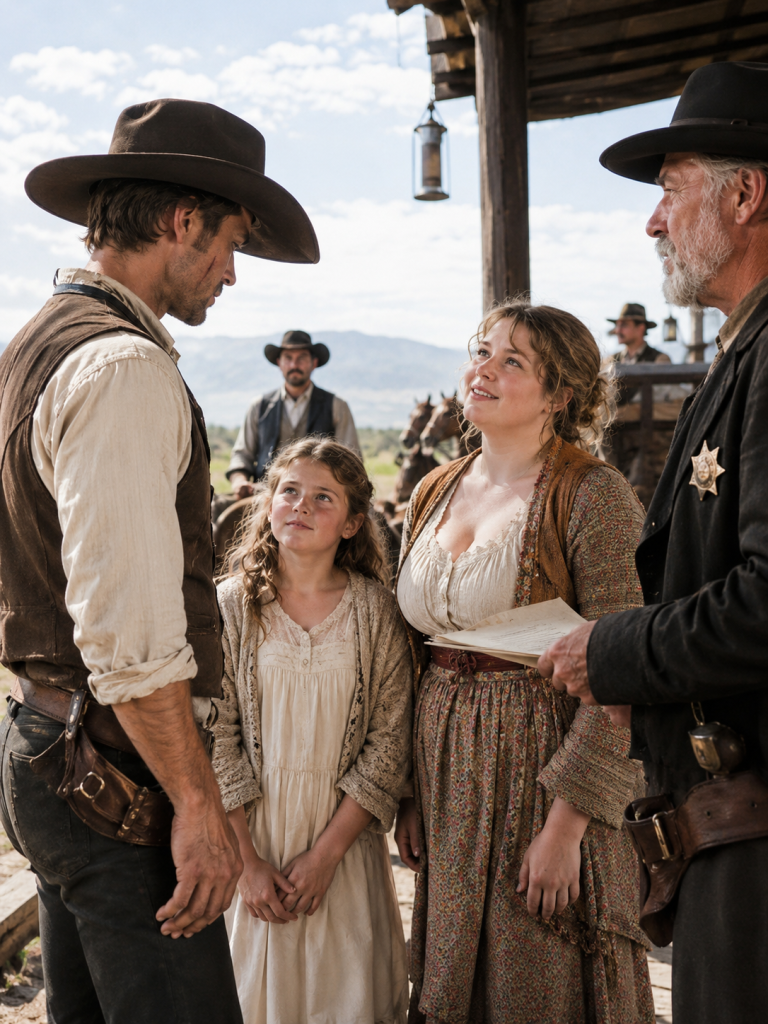
Sheriff Purnell rode out at first light the next morning, sent for by a neighbor, old Mrs. Alden from the next spread over, who’d seen smoke rising thin over Clara’s barn the evening before and come to check at first light out of the kind of watchfulness two isolated women had learned to extend each other over the years, debt or storm or otherwise. The sheriff took one look at the bound outlaw, the singed hay, and a wounded stranger who could barely stand, and didn’t sign anything on the spot.
“Man’s wanted paper matches a description out of three counties,” Purnell said, studying Crabbe’s slack face. “Yours doesn’t, Mr. Boone, not exactly, though I expect a federal marshal’s going to want a long conversation with you regardless of how this shakes out.” He looked to Clara. “You’ll need to come into town and give a formal account, ma’am. Both of you. This isn’t the kind of thing gets settled on a handshake at the fence line.”
It took the better part of two weeks. Clara rode into the county seat three separate times to give her account before a circuit magistrate, and found the town considerably less generous with its trust than Mrs. Alden had been — whispers followed her through the mercantile about the widow harboring an outlaw in her barn, a few of the more pious Sunday faces crossing to the far side of the street rather than greet her the way they once had. She held her ground through all of it the same way she’d held the rifle steady in the barn, answering every question Purnell and the magistrate put to her plain and complete, and refusing, when pressed twice by a lawyer representing what remained of Crabbe’s interests, to soften a single detail of what she’d witnessed to make the story easier for anyone to swallow.
The federal marshal came through from Laramie in the second week, drawn by wire once word of Crabbe’s capture reached the territorial office, and it was his own long-standing case file on the Black Creek gang — three years of scattered reports finally given a living witness to anchor them — that carried more weight in the end than Eli’s water-damaged ledger, though the ledger corroborated enough of it to close out two cold robbery cases the marshal had never expected to solve. Crabbe, once well enough to stand trial, was convicted on the marshal’s evidence and a dozen witnesses from three separate towns who finally felt safe enough to speak once his name stopped being one people whispered in fear. Eli’s own testimony against him, combined with the marshal’s assessment that he’d turned informant well before any arrest forced his hand, kept him clear of the gallows his old associates were riding toward, though it didn’t clear him of every debt owed for two years spent riding with men who’d done considerably worse than he ever had himself.
Clara’s own account, corroborated by Mrs. Alden’s testimony about the smoke and by Purnell’s read of the physical scene, closed the matter as self-defense before the month was out — but not before the whispers in town had done what whispers do, thinning out slow rather than vanishing all at once, the way most hard-won things did out here.
Eli’s wound healed slow over those same weeks, Clara changing the dressing every morning, the two of them talking more with each passing day than either had talked to another soul in longer than either cared to admit. He mended the broken fence once he could stand a full day’s work, and between the two of them and a loan Mrs. Alden helped broker through a cousin in Cheyenne — not charity, Clara made certain of that, a proper note with proper interest, the kind she could actually repay on a working ranch’s schedule — the bank’s deadline came and went without costing her the land after all.
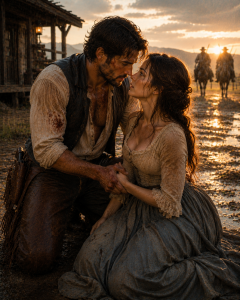
By the time autumn settled gold and quiet over the plains, the root cellar stood stocked deep again for winter, this time with two people’s hands doing the stocking instead of one. One evening, sitting on the mended fence rail watching the sun go down over a herd slowly building back toward what it had once been, Eli reached for her hand the way he had that first storm-lit morning, except steadier now.
“Still trouble?” she asked, echoing herself.
“Reckon I’ll always carry some of what I was,” Eli said. “But I don’t aim to bring any more of it looking for you again, if I’ve got any say left in the matter.”
“You already brought the worst of it, and the town still looked at me sideways for a month over it,” Clara said, “and we’re still standing regardless.” She leaned her head against his shoulder. “Don’t go easy on me from here on, Eli Boone. I’ve had enough of careful, cautious things this year to last me a good while. I’d rather build something honest and hard than something safe and small.”
“That,” Eli said, “I believe I can manage.”
Side by side, Clara and Eli watched the last light fade across the plains — not as strangers bound together by one violent, storm-soaked night, but as two people who’d chosen, through weeks of suspicion and testimony and slow-mending wounds both physical and otherwise, to keep standing in the same place on purpose. The ranch stood battered but rebuilt around them, debt answered honestly rather than erased by convenience, and as the prairie settled into evening, a new chapter had already begun writing itself into the same hard ground that had once held nothing but a lonely widow, a broken fence, and two years of silence too heavy to hear past.
**THE END**