An Abandoned Mail-Order Bride Saved a Broken Cowboy — Then He Gave Her the Family She Never Dreamed Of

—
## PART 1
The Arizona sun hung low and blazing over Copper Springs the afternoon the train finally shuddered to a stop, sending up clouds of steam and dust that hung in the heat like something solid. Passengers stepped down one by one, eager to escape the cramped cars. Among them was a young woman in a faded blue calico dress, one gloved hand gripping the railing as she descended with careful, deliberate steps.
Her name was Eliza Turner, and she had come more than a thousand miles from Ohio to begin a life she’d built almost entirely out of a bundle of letters tied with ribbon, tucked safe in her pocket. Harlan Cobb had written that he wanted a hard-working wife — not beauty, not wealth, just a partner willing to build something out of hard country. Eliza had believed every word of it, the way a person believes the only door still open to them.
Her boots touched the platform and her heart pounded with a fear she couldn’t fully name. The heat pressed down on her shoulders. She paused, steadying herself, her left leg dragging slightly behind the right — an old injury from childhood she’d spent years learning to carry with dignity rather than apology, though she’d long since given up expecting strangers not to notice.
She scanned the platform. Families reuniting in loud, joyful knots. Travelers greeted by friends. And then, near a buckboard wagon at the edge of it all, a tall man with his hat pushed back and a neatly curled mustache, matching the photograph folded soft with handling in her pocket.
Harlan Cobb.
Eliza raised a hand and started toward him, leaving her trunk on the platform behind her, hope flickering warm in her chest when his eyes first met hers. Then she took another step, and the uneven rhythm of her walk became plain, and something in his face closed over like a door shutting on its own weight. He looked down at her leg, back up at her face, and shook his head — once, quiet, final, a decision he’d apparently already half made from a photograph that hadn’t shown him everything.
He climbed onto the wagon without a word and snapped the reins. The wheels creaked away down the dusty street, and Eliza stood frozen with her hand still half raised, watching the man she’d crossed a continent to meet disappear around a corner without a single syllable spent on her.
The platform emptied around her. The sun kept burning. Her fingers trembled as she lowered her hand and pressed it flat against her skirt, willing herself upright by sheer stubbornness where nothing else was offering to hold her up.
“Ma’am,” a gentle voice said. “Are you expecting someone?”
She turned to find an elderly station master watching her with more kindness than the moment strictly called for, his cap tilted forward, his weathered face creased with concern.
“I was,” she said, forcing a small smile though her throat had gone tight. “It seems I’m not any longer.”
“That was Harlan Cobb’s wagon, wasn’t it.”
“Yes.” No anger in it. Only a weary kind of acceptance she’d apparently been practicing longer than she wanted to admit. “Is there a boarding house in town?”
“Widow Harmon takes boarders. Fifty cents a night, meals included.” He watched her count the coins from the small purse tucked in her sleeve — two dollars and thirty-seven cents, enough for a handful of nights and little else — and something in his weathered face softened further. “A man ought to at least have the decency to speak his mind,” he said, more to himself than to her.
“It’s done,” Eliza said, and lifted her trunk with effort, her limp more pronounced under its weight, and walked away without looking back, because looking back had never once fixed anything in her whole life and she didn’t imagine Arizona would be the place it started.
Four days later, with her funds down to coins that barely rattled in the purse, Eliza stood at the edge of the Holloway ranch. The station master had mentioned it in passing — a man named Gideon Holloway, fallen ill, in need of help nobody in town seemed eager to provide. The place looked half-forgotten: shutters hanging crooked, the garden choked with weeds gone to seed, no smoke rising from the chimney despite the hour. She’d walked two miles under a sun that didn’t care one way or another whether she made it, her leg aching with every uneven step, and she had, by that point, precisely no other options left to weigh against the risk of a stranger’s sickroom.
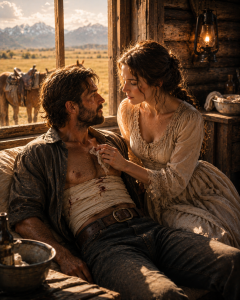
She knocked. No answer. She pushed the door open and stepped inside, and the sour smell of sickness hit her before her eyes had adjusted to the dim light. A man lay on a cot against the far wall, skin pale and slick with fever, dark hair plastered to his forehead, breath coming shallow and uneven. His arm was wrapped in bandages gone filthy and stained through with infection in a way that told her, before she’d even crossed the room, exactly how close to the edge he’d already drifted.
Eliza set down her bag without hesitation and crossed to him. Her grandmother had spent years teaching her to tend the sick back in Ohio — fevers, wounds, the slow patient work of pulling a body back from where it had started to give up — and she recognized this particular kind of dying the moment her palm touched his burning forehead.
She fetched water from the well. Lit the stove. Began cleaning the wound with hands that didn’t shake even when the smell of it turned her stomach, because shaking hadn’t ever once helped anyone she’d nursed before and she didn’t imagine it would help this stranger either. He stirred and groaned under her care but didn’t wake. Hours passed — bathing the arm, changing the dressing, brewing willow bark tea and coaxing it past cracked lips a spoonful at a time.
Night fell. The small cabin glowed by the light of a single lamp. Eliza sat beside him, exhausted down to her bones but not yet willing to stop, and murmured into the dark the way she imagined her grandmother might have.
“You’re not alone,” she said quietly. “I’m here now.”
Outside, the desert wind moved past the walls like it was looking for a way in. Eliza kept her vigil through the worst of the night, with no way yet of knowing that the broken, fevered stranger she’d walked two miles on a bad leg to save was about to become the first person in longer than she could remember to look at her without flinching.
—
## PART 2
Morning light crept through the thin curtains, painting soft gold across the worn floorboards. Eliza stirred in her chair beside the cot, neck stiff, body aching from too many hours holding still in one position. For a moment she didn’t remember where she was. Then she felt the weight of a warm hand near hers and looked up.
His eyes were open — clear gray-green, steady but cautious, watching her the way a man watches a stranger who’s wandered uninvited into the middle of his life. The fever flush had faded from his face, leaving behind only exhaustion and the faint color of returning strength.
“Who are you?” His voice came out rough and thin.
“Eliza Turner.” She brushed a loose strand of hair back, straightening slowly. “I found you here a few days ago. You were sick. Real sick.”
“How long?”
“Three days. Blood poisoning, from the look of that arm. I cleaned the wound and kept your fever down best I could. You’re through the worst of it now.”
He studied her a long moment, his gaze dropping briefly to her uneven stance before returning to her face — and there was no pity in it, only something closer to plain, unhurried understanding, which was rarer than pity and worth a good deal more.
“You walked all this way to help a stranger?”
“I had nowhere else to go,” Eliza said, with a small shrug that cost her more than it looked like it did. “And you needed help.”
He nodded slowly, accepting the truth of it without further argument. “Name’s Gideon Holloway. This is my ranch. Or what’s left of it.”
The days that followed settled into a rhythm neither of them had asked for outright but both seemed grateful to fall into anyway — Eliza rising before dawn to tend the fire, Gideon’s strength returning by careful degrees, the ranch itself beginning, in small unremarkable ways, to remember what it had once looked like before grief had let it go to seed. Neither of them yet understood how much further the rest of it still had to travel, or how much of that distance the town of Copper Springs meant to make them cover the hard way.
—
## PART 3
By the fifth day, Gideon could sit up on his own. By the seventh, he managed a slow, careful lap around the room, one hand braced against the wall, his jaw set the whole way through it. Eliza watched him from the doorway, the broom still in her hand, and said nothing about how much the effort was costing him, because she understood by then that a man like Gideon Holloway needed to be allowed his pride back in pieces, not handed it whole.
She cleaned the cabin floor to ceiling in those first two weeks — scrubbing away months of neglect until the dusty windows gleamed and sunlight poured properly into rooms that had been sitting in half-dark since before she’d arrived. She washed the worn curtains and hung them in the desert wind to dry.
“You don’t have to do all this,” he said one afternoon, leaning in the doorway while she swept.
“I know.” She rested on the broom handle, meeting his eyes without apology. “But it matters to me.”
He studied her for a moment, then nodded, something in his face working through an adjustment she couldn’t yet name. “Looks different,” he admitted.
“Feels different too,” he added, quieter, a moment later, like the second half of the sentence had cost him something the first half hadn’t.
Beyond the cabin she found a garden gone to weed and dry soil, and spent long hours coaxing it back — tomatoes ripening under her care, squash growing heavy on the vine, rows of green pushing up out of ground that had clearly given up being anything before she arrived to argue with it. In the evenings she cooked what she could manage from what little the pantry held: warm cornbread, thin vegetable stew, strong black coffee that Gideon drank every drop of without once complaining it wasn’t better.
It was on one of those evenings, going through the ranch’s account book while Gideon slept off the last of his fever, that Eliza discovered the second wound underneath the visible one — a stack of unpaid notes from the feed merchant in town, a mortgage payment two months behind, the whole operation drifting toward a debt that would finish what the infection in his arm had nearly started, only slower, and with no fever to break it. She sat with the ledger a long while by lamplight, the numbers plain enough that even a stranger to ranch business could read the shape of the trouble in them, and decided, before she’d fully thought through whether it was her place to decide anything on this property at all, that she wasn’t going to sit quiet about it.
She brought it up the next morning, the ledger open on the table between them.
“You’re two months behind at the mercantile,” she said, “and the bank note’s due before the month’s out. You’ve been sick, Gideon. That’s not a character failing. But somebody’s got to answer these before the answering gets done for you, and it doesn’t look like there’s been anybody but you to do it.”
Gideon’s face closed over, the same way it had, she imagined, closed over plenty of times before she’d arrived. “That’s not your concern.”
“It’s the concern of anybody living under this roof and eating off this land,” Eliza said, steady, not backing down from the sharpness in his voice the way she suspected most people in his life had learned to. “My father kept books for a mill back in Ohio before he passed. I know my way around a column of figures better than most men twice my size. Let me write to the bank. Ask for thirty days on the note, on account of your illness — banks grant that more often than you’d think, if somebody asks plain instead of avoiding the letter till it’s too late to ask at all.”
“I don’t need charity.”
“This isn’t charity,” she said. “This is a woman who’s eating your cornbread offering to do the one thing she’s actually good at, instead of only the things you assumed a woman traveling alone would be good for. You can be proud about the sickness, Gideon. I understand pride like that fine. But don’t be proud about a column of numbers you’re too tired to add up straight right now, when there’s someone right here able to add them for you.”
He was quiet a long moment, and something in the quiet wasn’t quite defeat and wasn’t quite agreement either — something closer to a man recalibrating, in real time, what kind of help he was willing to let himself accept.
“Write the letter,” he said finally.
She did, that same afternoon, in a clear steady hand that would have looked entirely at home in any counting house back east, and when the bank’s reply came back three weeks later granting the extension exactly as she’d asked, Gideon read it twice through without saying much of anything, and then set it down and looked at her the way a man looks at something he’s revising his whole understanding of.
“You’re stronger than you look,” he said, one afternoon not long after, while they worked side by side repairing the chicken coop.
Eliza laughed, soft and unguarded. “My grandmother used to say strength isn’t measured by how we walk. It’s measured by how we keep going.”
“She sounds like a wise woman.”
“She was. Taught me everything I know about caring for people — and, apparently, everything I know about arguing a man out of his own pride when the situation calls for it.” She glanced sideways at him, testing whether the joke would land.
It did. Something close to a real laugh moved through him — brief, rusty with disuse, but real.
Their bond deepened the way most true things do, in small increments rather than grand gestures — shared meals, quiet evenings under a wide desert sky, the particular ease of two people who had stopped needing to fill every silence between them. One evening, as the sun dipped low and painted the hills orange and crimson, they sat together on the porch, the desert air finally cooling after a long day’s heat.
“My sister Margaret used to sit here,” Gideon said, his gaze on the horizon, thoughtful and far away. “She passed two years back.”
“I’m sorry,” Eliza said gently, and waited, because she’d learned by then that Gideon told the truth in his own time or not at all.
“She took a fever,” he said after a while, “out here on the ranch, same as I nearly did off that arm. I rode two days to fetch the doctor from Prescott, and by the time I made it back with him, she’d already gone. I’ve thought more than once these past weeks that if you hadn’t walked up that road when you did, I’d have gone out the same way she did — alone in this cabin, waiting on help that wasn’t coming fast enough.” He looked at her then, something raw and unguarded in his face. “You didn’t just save my life, Eliza. You stopped this place from taking a second person the same way it took the first.”
Eliza reached over and covered his hand with hers, rough from work, steady with a purpose she’d only found again since arriving here. “Sometimes fixing things is the only way forward,” she said quietly. “I believe that more than I believe most things.”
Weeks passed, and the ranch came back to life around the shape of that belief. Gideon mended fences as his strength returned. Eliza tended the garden, cared for what animals remained, kept the account book square, and the two of them settled into a working partnership that felt, more days than not, like something neither of them had dared to expect walking into it.
But peace, in a town like Copper Springs, rarely lasted without being tested.
One morning Eliza rode into town for supplies, determined to pull her weight in keeping the ranch running rather than simply keeping the cabin clean. The town greeted her with curious stares and hushed whispers that followed her from the livery to the mercantile door. Inside, she felt the weight of judgment in every glance, and it sharpened considerably when she recognized, across the aisle, the cold, assessing eyes of Harlan Cobb’s mother.
The words spoken behind her back — not quite low enough to miss entirely — cut deeper than she let herself show. *Living out there with a man not her husband. No shame left in some women once the first door’s shut on them.* Eliza finished her errands with her chin level and her hands steady on the counter, and rode back to the ranch without a single tear, though her heart had gone heavy with the old, familiar sting of being sorted and judged before anyone had bothered asking her a single question about herself.
Gideon sensed the change in her the moment she came through the door — the controlled, distant way she unpacked the supplies, saying little.
“Something happened in town,” he said.
“It doesn’t matter,” Eliza said.
But that night, alone in what had once been Margaret’s room, the pain she’d carried in silent all afternoon finally broke loose. She pressed her face into the pillow and let herself cry — for the life she’d lost on a train platform, for the uncertainty of the one she’d stumbled into instead, for the particular exhaustion of being made to feel, twice now in the same small town, like a woman whose worth needed defending rather than simply existing plain on its own terms.
On the other side of the thin wall, Gideon lay awake listening to her quiet sobs, his hands closing into fists at his sides, helpless against an injustice that wasn’t his to fix by force. The next morning he rode into town himself, jaw set, and came back hours later with his face carrying a quiet, deliberate resolve that Eliza didn’t ask him to explain and he didn’t offer to.
She was packing when he came through the door — her small trunk open on the floor, her hands moving with the particular careful efficiency of someone trying not to think too hard about what she was doing while she did it.
“I’m leaving,” she said, voice trembling despite her best effort to hold it steady. “I won’t be the reason you lose everything you’ve got left in this town.”
“You’re not ruining my life, Eliza.” Gideon stepped forward, his voice firm in a way she hadn’t heard from him since the fever broke. “You saved it.”
“I don’t belong here.”
“You do.” He said it plain, no dressing it up. “This place feels like home again because of you. Not because of the garden, or the account book, or any of the things you keep insisting are the only reasons a person might want you around. Because of you.”
Eliza hesitated, her hands still resting on the edge of the open trunk. Slowly, she closed it and set it aside, though her heart hadn’t caught up yet to the decision her hands had just made without fully consulting her.
“Stay,” Gideon said quietly. “Not because you’ve got nowhere else to go. Because this is where you belong.”
She met his gaze, searching it the way she’d searched Harlan Cobb’s face on the platform all those weeks ago, except this time she found no pity waiting for her in it — only sincerity, and something that looked a great deal like respect. Her heart softened, though the fear didn’t fully leave her chest. She nodded, faint but real, and chose, for now, to stay.
Neither of them yet understood how much further the town still meant to test that choice.
Sunday morning rose gentle over Copper Springs, painting the desert gold and amber. Eliza stood before the small mirror in Margaret’s old room, smoothing the folds of her faded blue dress, her hands trembling slightly as she tied the ribbon at her collar. Today was the church social. Her heart sat heavy with doubt, but she’d carried enough doubt these past weeks to know it wasn’t going to be the thing that stopped her from walking out her own front door.
From the doorway, Gideon watched her quietly. He’d shaved, pressed his one good white shirt, fastened the old string tie neat at his collar. For a long moment neither of them spoke, the air between them thick with unspoken fear and quiet resolve in equal measure.
“You don’t have to go,” he said gently.
Eliza lifted her chin. “If I run now, I’ll always be running. I’m tired of being afraid.”
Something like a smile touched his mouth. “Then we’ll face them together.”
They rode into town side by side in Mr. Tatum’s borrowed buckboard. The church hall stood at the end of Main Street, white walls glowing in the sun, wagons lined up in the yard, fiddle music drifting soft through the open doors. Eliza’s grip tightened around Gideon’s arm as they stepped inside, and the room fell quiet around them — conversations fading into whispers, every pair of eyes finding its way to the doorway at once.
Eliza felt the familiar sting of being watched and sorted, and did not falter. Gideon’s arm stayed steady at her side, guiding her forward without hurry, and they crossed to the refreshment table where lemonade and pies sat waiting, untouched by either of them, while no one in the room quite worked up the nerve to approach.
Then the door creaked open again, and Harlan Cobb strode in, his presence carrying the same heavy arrogance it had on the train platform weeks before. His mother followed close behind, her sharp gaze finding Eliza across the room and settling there.
“Well,” Cobb said loudly, his voice cutting clean through the fiddle music and hushed talk alike. “Looks like the stray found herself a home after all.”
Eliza stiffened. Before she could answer, Gideon stepped forward, his voice calm but pitched to carry the whole length of the hall.
“That’s enough, Cobb.”
The room went still, holding its collective breath while Gideon faced the man who’d left Eliza standing alone on a train platform without a single word of explanation. His posture stayed steady, his eyes level and unhurried.
“This woman,” Gideon said, “walked two miles through Arizona heat on a bad leg to save my life when I was too far gone with fever to save myself. She cared for me when I had nothing left and had already half given up on having it. She scrubbed my house clean, brought a dying garden back to life, and set my accounts right when I was too proud and too sick to do it myself.” A murmur moved through the crowd. Cobb’s expression hardened, but Gideon didn’t stop. “You judged her by the way she walks,” he said, quieter now, but no less certain. “I judge her by the strength of her heart. She’s worth more than any promise you ever made and broke in the same breath.”
The silence that followed sat thick and heavy across the whole hall. Cobb’s confidence visibly buckled under the weight of it, and without another word he turned on his heel and walked out, his mother trailing behind him in a silence of her own.
One by one, the townsfolk began to step forward. Mr. Tatum offered a respectful nod. The schoolteacher smiled kindly. The pastor’s wife came over with a warm, unhurried greeting that cost her nothing and meant a great deal. Not everyone in that hall welcomed Eliza that afternoon — some eyes stayed cool, some backs stayed turned — but the kindness of the few who did step forward was enough, finally, to break the wall of fear that had been standing around her since the moment she’d stepped off that train.
The fiddle music picked back up, soft and inviting. Gideon turned to her, his expression gentle.
“May I have this dance?”
Eliza hesitated only a moment before placing her hand in his. As they moved slow across the floor, she felt something she hadn’t let herself feel in longer than she cared to count — the whispers fading into the background, replaced by the plain, steady warmth of being wanted rather than merely tolerated.
That evening, as the sun sank below the horizon in a wash of crimson and violet, they rode home together, the ranch appearing ahead of them with its windows glowing warm against the coming dark. Gideon stopped the wagon atop the ridge overlooking the land, the desert stretching out quiet and endless beneath a sky just beginning to fill with stars.
“Eliza,” he said, turning to face her fully. “I don’t have much to offer. This ranch is still struggling, and the road ahead of us won’t be easy. But I can promise you honesty. Respect. A life built side by side instead of one handed down from above it.”
She listened, her heart steady but full. “I never planned any of this,” she admitted. “I came here expecting one life and found something else entirely. But somewhere along the way, this place became home. And so did you.”
Gideon reached for her hand, his calloused fingers warm and certain around hers. “Then stay,” he said. “Not because you’ve got nowhere else to go. Because you choose to.”
Eliza looked out over the ranch below — the garden she’d coaxed back from ruin, the house glowing with lamplight, the account book squared away and settled, the quiet strength of the man sitting beside her who had never once, not from the very first fevered morning, looked at her leg before he looked at her heart. She thought of the platform where she’d once stood alone, abandoned without so much as a word, and found she no longer recognized the fear that had held her there.
“Yes,” she whispered, certainty settling warm and quiet through her chest. “I choose to stay.”
Gideon’s eyes softened with something like relief, something like gratitude too large for either word alone to hold. He drew her into a gentle embrace as the first stars came out over the ridge, and in that moment, beneath the vast unhurried Arizona sky, Eliza understood that she hadn’t simply found shelter after all. She had found a home built by her own two hands, a partnership that valued every part of her rather than sorting through her for the parts worth keeping, and a heart that would never again have to stand alone on a platform waiting for someone else’s permission to belong somewhere.
They rode down the ridge together toward the ranch, where warm light spilled from the windows and welcomed them both home. The future ahead of them wouldn’t be easy — struggling land rarely turns generous overnight, and a town slow to forgive is slower still to forget — but it would be theirs, built the same patient way the garden had been: with steady hands, honest work, and the kind of love that grows out of choosing someone, again and again, rather than simply being left to them by chance.
**THE END**