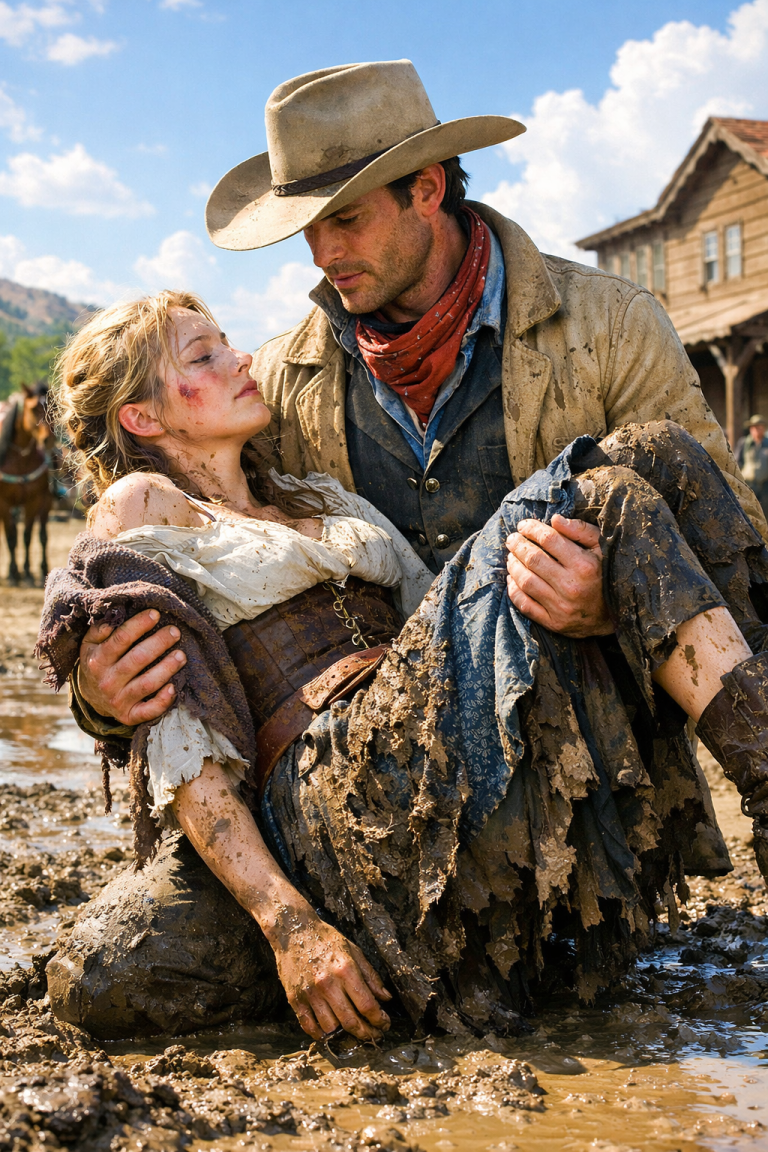
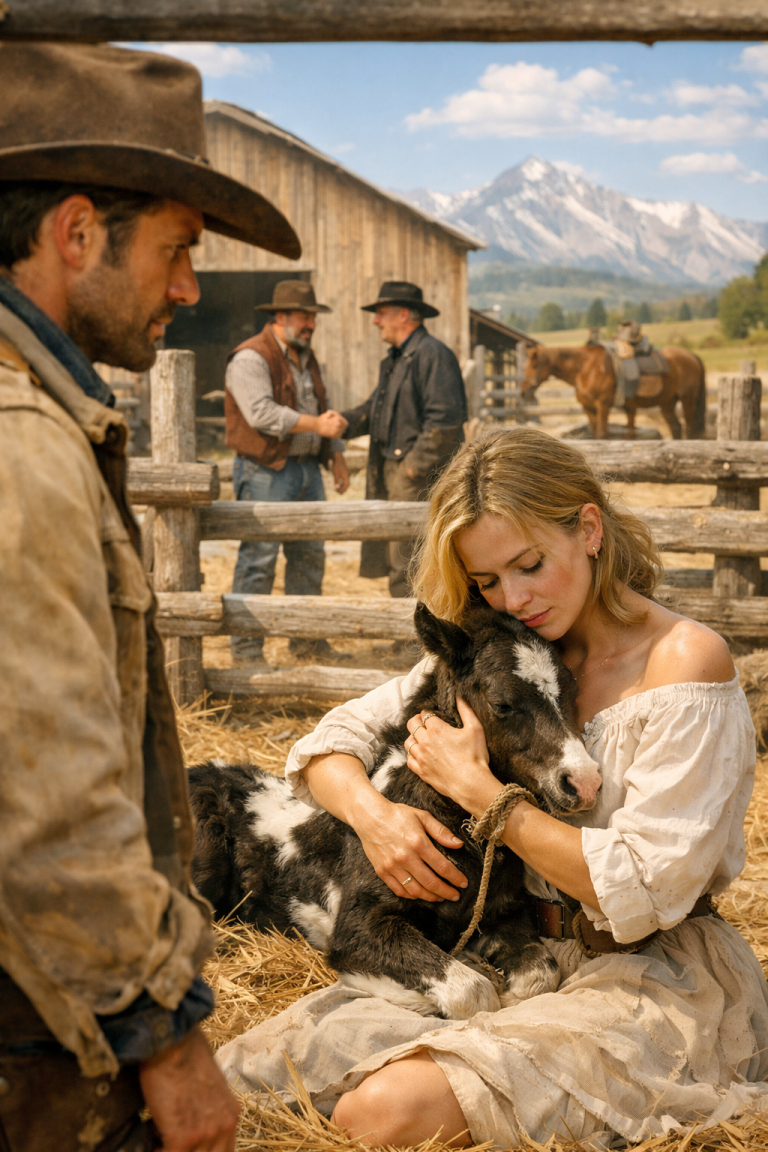
Mountain Man Bought an Abandoned Cabin for Just $1 — Then He Found a Woman Who Had Been Waiting for Him

—
## PART 1
The wind came down off the granite peaks smelling of snow before the clouds ever turned gray, and it followed Jonah Crow the whole ride into Silverton. His bay gelding was as weathered as he was — all bone and stubborn grit, blowing steam through cold nostrils. Jonah’s buckskin coat carried the stains of a season alone on the trap line: pine pitch worked into the seams, a dark smear of elk blood along one cuff that hadn’t fully scrubbed out. His eyes moved the way a hunted man’s eyes move, checking doorways out of habit rather than fear.
He did not like towns. He did not like the press of boots on boardwalks or the way men in clean coats looked at him like he tracked something contagious behind him. But a man could not live on silence forever, and Jonah had grown tired of drifting like smoke from one valley to the next. There had been a time, years back, when he’d had a claim worth keeping — a strip of bottomland in the Nations his sister Sarah had loved enough to plant apple trees on. A cattle baron’s hired men had burned those trees to the roots the same week they’d burned the fence line, and Jonah had been three days out on a hunt when it happened. By the time he’d ridden back, Sarah was already gone north with what she could carry, and the winter had taken her before spring did. He hadn’t been there. That was the whole of it, and it had never once let him alone.
He wanted a door he could shut behind him and mean it when he called the ground on the other side his own.
The courthouse smelled of old paper and cigar ash. A clerk read off a list of tax-seized properties in a flat, bored voice while cattlemen and speculators shifted their weight and waited for something worth bidding on. Then the clerk called lot forty-two — a cabin and surface claim on Black Pine Ridge, seized for tax default — and a ripple of laughter passed through the room like a draft under a door.
Black Pine Ridge was brutal country. Buried in snow half the year, its one trail washed out every spring. The cabin, men said, was cursed — an old trapper had lived up there and died talking to nobody, and nobody wanted to find out why. What none of the laughing men in that room knew, and what Jonah wouldn’t learn until later, was that Sheriff Boone had spent eight months quietly inflating the tax assessment on that parcel through a clerk he owned outright, meaning to let it default and buy it himself through a proxy for pocket change. He hadn’t counted on a stranger with a silver dollar walking in before his man could raise a hand.
The clerk asked for a bid. Nobody answered. A man near the stove spat into a brass cuspidor and said the wind up there screamed like something with a throat. Another allowed the roof had probably caved by now.
“One dollar,” Jonah said.
The room went still. Heads turned toward the shadow at the back where he’d been standing, unremarked, since he walked in. He stepped forward without hurry, the old scar along his jaw catching the light through the high windows. He didn’t smile. He didn’t explain. He laid a single silver dollar on the clerk’s desk and let it speak for him.
At the front of the room, a thin man in a brown vest — the clerk’s cousin, though Jonah had no way of knowing it — went rigid and looked toward the door as if expecting someone to walk through it and stop this.
The gavel came down like a pistol shot. *Sold.* The clerk told him, not unkindly, that he’d bought himself a grave. Jonah folded the deed into his coat — a surface claim only, the paper said plainly, mineral rights reserved pending prior filing — and said nothing. If it was a grave, at least it would be his.
By late afternoon he was climbing, snow already hissing sideways into his face, the trees growing older and more twisted the higher the trail rose. The world narrowed and quieted around him until there was only the sound of hooves breaking crust and his own breath fogging the air. When he came into the clearing, the sky behind the peaks had bruised itself purple and orange, and the cabin sat waiting like something the world had forgotten to finish burying — a sagging porch, logs silvered by weather, tin patches hammered crooked across the roof. Rough. But his.
He tied off the gelding and started toward the door already running repairs through his head — new chinking before first thaw, a hinge that wanted oiling. Then he stopped.
A thin gray ribbon of smoke rose from the chimney.
His hand found the knife at his belt without him telling it to. The deed in his pocket said *abandoned.* The smoke said otherwise. He crouched at the porch steps and found bootprints in the fresh snow — small, and recent enough that the wind hadn’t softened their edges yet. He went up the steps without a sound and listened at the door. Inside, metal scraped faintly against iron — someone working a stove lid.
Jonah lifted the latch and pushed the door open.
The cabin was close and dim, lit orange by the stove and a low kerosene lamp, the air thick with woodsmoke and something else underneath it — fear, old and familiar to a man who’d smelled it on trapped animals more times than he could count. A woman stood in the far corner. Thin. A wool dress mended so many times the mending had become the dress. Dark hair braided over one shoulder. Her hands trembled around the stock of a Winchester rifle, but the barrel held dead level at his chest, and it did not waver.
“Get out.” Her voice didn’t rise. It didn’t need to. It was the voice of someone who’d learned a long time ago that screaming changed nothing.
Jonah lifted both hands, slow. “This is my cabin,” he said. “Bought it in town today. Surface and structure — that’s what the deed says.”
Something shifted in her face at the word *surface*, quick and sharp, like he’d stepped closer to a wound than he knew. “You’re lying.”
“Paid a dollar for it myself.” The wind slammed the wall behind him hard enough to rattle the single window. He didn’t move his eyes from hers. That was when he saw the bruising at her wrists, the careful way she favored her left side like her ribs had been taped under that dress, the hollow places beneath her cheekbones that only hunger carves.
“I’m not leaving,” he said, quieter now. “There’s a storm coming and I’ve got food. I’m not putting anybody out into that.”
Her gaze flicked, just once, to the sack of flour he’d left on the porch. Hunger crossed her face before she could smother it.
“Put your knife on the table,” she said.
A man didn’t hand over his blade easy. But he saw the shake in her hands get worse the longer she held that rifle up, and he understood she was running on will alone. He unbuckled the sheath and set it down. She let the barrel drift a few inches off his heart. Not lowered. Just — off.
“What’s your name?” he asked.
A pause, long enough that he thought she wouldn’t answer.
“Millie,” she said. “Millie Larue.”
“Jonah Crow.”
Outside, the wind found a new and uglier voice, and somewhere beneath its howl, faint but unmistakable, came the sound of boots crunching through snow — more than one pair.
—
## PART 2
Millie went white to the lips. “They’re here,” she whispered. “They’ll drag me back.”
Jonah didn’t ask who. Didn’t ask what she’d done to be hunted in a snowstorm on a ridge nobody wanted. There’d be time for that, or there wouldn’t be, and either way the answer changed nothing about what came next.
“Kill the light,” he said.
The lamp went dark. He smothered the stove’s glow with a damp cloth and pulled her down behind the heavy table by the wrist — the first time he’d touched her, and she let him, which told him more than her name had. Outside, men’s voices argued over the gale. One swore the place was empty. Another said he’d seen smoke plain as day not an hour back. The latch rattled once, hard, testing.
Jonah’s thumb found the hammer of his revolver and drew it back slow enough that the click nearly disappeared under the wind.
“Probably rusted shut,” a voice outside said, disgusted.
A long, terrible pause. Then boots retreating, grumbling, swallowed by the storm.
Jonah didn’t relight the lamp until he’d counted a full two minutes of nothing but wind. When the light came back, Millie was still shaking on the floor, arms wrapped around her knees.
“That’s the third time this month they’ve come up,” she said, and there was exhaustion under the fear now, the particular tiredness of someone who has been afraid for so long it has become a kind of work.
“Start at the beginning,” Jonah said.
“Etienne was my uncle. Mother’s brother — he raised me after she passed.” Her voice steadied as she talked, like the telling itself was ground she could stand on. “He filed a mineral claim on this ridge four years back. Witnessed proper, by the pastor and two of the Odell brothers who worked the Comstock diggings before they came here. There’s silver under this ridge, Mr. Crow, and Etienne found it before Boone’s surveyors ever set a boot on it.”
“And the tax seizure?”
“Boone’s man clerks the assessor’s office. He ran the taxes on this parcel up past what Etienne could pay, year over year, quiet enough nobody noticed but us. Etienne knew what was happening. Before he died he told me — plain, not riddles — *if the county ever sells this place, it won’t be for what it’s worth. Watch close who buys it, because Boone will only let the sale go through if he’s certain the buyer’s a fool who’ll turn around and sell the mineral rights back to him cheap.*” She looked up at Jonah. “You weren’t supposed to be a stranger who’d fight for it. You were supposed to be easy.”
Jonah’s jaw worked once. “The deed I bought’s surface only. Structure and standing timber.”
“I know.” She reached beneath a loose floorboard by the stove and drew out an oilskin packet, worn soft with handling. “The mineral claim’s separate. It’s mine — Etienne left it to me by will, filed the same day as the claim itself, so Boone can’t call it abandoned no matter how long he sits on the tax record.” She set it in his hands. “That’s why they want me gone more than they want this cabin burned. Dead or run off, and there’s nobody left alive to contest the claim. Boone can walk in with his own paper and swear the ground’s unclaimed.”
Jonah opened the packet and studied the seal, the witnesses’ names, the careful hand Etienne had used. Not worthless land. Not cursed land. A fortune sitting under two people’s feet, and only one of them fully understood, until tonight, what the other actually owned.
“So we’re not fighting over the same ground,” he said slowly.
“No,” Millie said. “We’re fighting to keep it from being the same man’s.”
A crack split the night outside — not thunder. Wood.
Jonah was on his feet before the sound finished. Three shapes at the treeline had come back, and this time they hadn’t brought a locked door to test.
“That’s not deputies,” Millie said, going pale in a different way now — recognition instead of fear. “That’s too many for deputies. That’s Boone himself.”
—
## PART 3
Jonah looked at her hard. “You’re certain?”
“I know his gray gelding’s stride in the snow. I’ve listened to it coming up this ridge in my sleep for two winters.” She was already moving, pulling her boots on, the rifle slung rather than held now, her hands steadier than they’d been all night. “He’s stopped sending men to do it. He means to finish it himself tonight, because he can’t risk waiting for a circuit judge to ask questions about a dead trapper’s mineral claim.”
“Then we don’t wait on him neither.” Jonah reached for his coat. “You said the Odell brothers witnessed the claim.”
“They still work the Comstock cut, three miles down past the fork. And the pastor keeps his own copy of every will he’s witnessed — always has, since a fire took the county archive two years back. Boone doesn’t know that.”
“Can you reach them in this?”
Millie’s mouth went thin and certain. “There’s a trapper’s cut behind the springhouse. Etienne showed it me the first winter I came here — cuts the ridge in half the time the main trail does, comes out near the Odells’ claim. I’ve walked it in worse than this.” She looked at him. “You can’t hold this cabin and fetch witnesses both. I can do the second. You do the first.”
It went against every instinct he had to let her out into a night with armed men circling, but he had learned enough of her in one storm to know that arguing would cost more than the risk itself. “Take my revolver,” he said. “You know the cut. I don’t.”
“I know how to shoot, too,” she said, checking the rifle’s action. “I’ve had reason to learn.”
She was gone through the back window before he could answer that, dropping into snow already churned by boots, swallowed by dark and weather inside three strides.
Jonah turned to the door he’d built a life’s worth of habits around defending, and set to work. He dragged the heavy table across the frame. He wedged the shutter Millie had nailed over the window months before he ever arrived. And then, because he’d spent a season alone on a trap line and knew what desperate men and desperate ground could do to each other, he did the one thing his sister’s death had taught him better than any gunfight ever could: he did not wait to be attacked. He went to the springhouse cistern Millie had shown him not an hour before, hauled the loosened stones from its collapsed roof, and wedged them into the packed snow along the only clear approach to the porch — a false crust over open water three feet down, invisible under an inch of fresh powder, the kind of trap a man who knew the ridge would never walk into and a man who didn’t would never see coming.
Boone’s voice came first, out of the dark, carrying easy over the wind the way a man’s voice carries when he no longer cares who hears it.
“Crow! I know you’re in there with what’s mine!”
“It was never yours,” Jonah called back. “Not the cabin, not the claim, not the girl’s life. Ride home, Sheriff.”
“That claim died with an old fool who couldn’t pay his taxes.” A lantern bobbed at the treeline, and behind it, the unmistakable slosh of a kerosene can. “And that girl’s wanted for theft of county property. I’m within the law tonight, mister. You ain’t.”
“Funny law that burns a man’s roof before it reads him his rights.”
Boone laughed, short and ugly. “Ain’t nobody up here to see what law does what.”
He was wrong about that, though neither of them knew it yet.
The two men with Boone came first, angling wide around the porch the way trained men do, and the lead man’s boot broke through Jonah’s false crust with a crack loud enough to carry over the storm. He went down hard into cistern water gone half to ice, screaming in a way that had nothing to do with courage and everything to do with cold that could kill a man in minutes if he stayed in it. His partner grabbed for him, cursing, and the kerosene can went over sideways, its contents lost into the snow before a single drop reached the cabin.
Boone himself stayed back, smart enough not to have led with his own boots, and that caution was the only reason what happened next mattered at all.
“Get him up, get him up,” Boone was shouting, some of the command bleeding out of his voice for the first time, and it was in that gap — men floundering, cold biting through wet wool, Boone’s attention split between his ruined plan and his half-drowned deputy — that lantern light came bobbing up the trapper’s cut behind them, and voices that weren’t Jonah’s or Boone’s carried through the trees.
“Sheriff Boone!” That was the pastor’s voice, thin but carrying, a man used to being heard over congregations larger than this. “We’ll thank you to explain to Silas and Ezra Odell here why you’re standing on a mineral claim their own signatures witnessed, with a can of coal oil at your feet!”
Millie came out of the dark behind the three men, breathing hard from the run, snow crusted white to her knees, the revolver Jonah had given her held level and steady in a way it hadn’t been the night before. Behind her, the Odell brothers carried lanterns of their own, and the pastor held something wrapped in oilcloth against his chest that everyone present understood, without being told, was a second copy of Etienne Larue’s will.
Boone’s face did something complicated in the lantern light — the particular unraveling of a man who has built his authority on nobody watching closely, discovering all at once that several people now are.
“This is county business,” he said, but it came out thinner than he meant it to.
“County business doesn’t carry kerosene,” the pastor said mildly. “I’ve buried enough men in this county to know the difference between the sheriff’s business and a man protecting his own greed. Etienne Larue came to me eighteen months before he died and told me exactly what you’d try, Boone. I didn’t believe an old trapper capable of such foresight.” He looked past the sheriff to the half-drowned deputy being hauled, shuddering, out of the cistern water. “I believe it now.”
One of the Odell brothers spoke up, quiet but unmistakable. “We’ll swear to that claim in front of any judge you care to bring, Sheriff. Won’t be hard to find one, seeing as the circuit rides through in a fortnight regardless of what you’d prefer.”
The remaining deputy — the one still dry, still upright — looked at his employer for a long moment, and then took one deliberate step away from him, putting himself equidistant between Boone and the porch instead of behind either. It was a small motion. It was also the whole verdict.
Jonah came down off the porch at last, his own rifle low but no longer needed, and stood beside Millie instead of in front of her — a choice he made on purpose, and one she felt land the way it was meant to.
“You’ve got two ways off this ridge tonight, Boone,” Jonah said. “Riding, or carried. Your man there needs a fire before that water finishes what it started. I’d get moving.”
Boone looked at the wet, shuddering deputy. He looked at the pastor’s oilcloth packet, at the Odells’ steady lanterns, at his own remaining man standing apart from him in the snow. Whatever calculation he ran behind his eyes ended the only way it could.
“This isn’t finished,” he said — the same words he might have said a dozen times to a dozen men he’d broken, except this time nobody in the clearing believed him, least of all himself.
“It is on this ridge,” Jonah said. “And it’ll be finished in front of a judge in two weeks besides. You might want to spend that fortnight getting your tax rolls in order, Sheriff. I hear the circuit court takes an interest in that sort of thing.”
Boone turned without another word, hauling his ruined deputy up behind his own saddle, and the three of them went down off the ridge into the dark, the dry deputy leading, none of them looking back.
—
The pastor and the Odell brothers stayed the rest of that night, crowded around Jonah’s stove with coffee Millie brewed strong enough to strip paint, and by the gray hour before dawn there was a signed and countersigned account of the night’s events tucked inside the pastor’s oilcloth alongside Etienne’s will — testimony enough, the pastor said, to see Boone’s tax manipulation laid bare in front of any judge worth the title. It would take the fortnight, and then some, before the circuit court made it official. But the shape of the outcome was already set the moment three witnesses walked up a mountain in a snowstorm to say what they’d seen.
In the days after, while word of that night worked its way down into Silverton faster than any of them expected, Jonah found himself standing at the porch rail more evenings than not, still not fully used to having somewhere to stand still in. Millie tended a shallow cut along his forearm — a graze from splintered wood when the door had taken a stray shot before the cistern trap did its work — with a steadiness in her hands that hadn’t been there the first night, and a directness in the way she looked at him while she worked that he wasn’t sure what to do with.
“You could still sign the mineral claim over,” she said one evening, not looking up from the bandage. “Take the money Boone would’ve paid for it, once this is settled proper. Buy land somewhere the winters are kinder.”
“Could,” Jonah agreed.
“You don’t sound like a man considering it.”
“I had land once,” he said, and the words came slower than he meant them to, dragged up from somewhere he didn’t visit often. “Down in the Nations. My sister planted apple trees on it. A man with more money than right burned the fence and the trees both while I was off hunting, and by the time I got back she’d already gone, and the winter after took her before I found her again.” He looked out at the dark treeline instead of at Millie. “I wasn’t there. That’s the whole shape of it. I’ve been not-there for the people who needed me not to be, and I told myself for six years that not owning anything meant nobody could ever burn it out from under somebody I loved again.”
Millie’s hands went still on the bandage. “Is that what you meant,” she said quietly, “when you said you were afraid of yourself?”
He didn’t answer right away. When he did, it came out plain, the way things came out of him when he’d stopped guarding them. “I’m afraid of what I’ll do if I let myself care about keeping something and then fail at it again. I put a bullet near a man’s boot two nights back and didn’t think twice. I dug a trap that near drowned another. I’m not sorry for either. That worries me some, how easy it came.”
“It came easy,” Millie said, “because you weren’t protecting land that night. You were protecting a person. There’s a difference, and you know it, or you wouldn’t be sitting here telling me about apple trees instead of about the silver.”
He looked at her then, and something in his chest that had stayed clenched since a burned fence line in the Nations loosened by a degree it hadn’t in six years.
“I’m not leaving,” he said. “Not the ridge. Not this.”
“I didn’t ask you to explain yourself,” Millie said, but she was smiling when she said it, small and unguarded, tying off the bandage with hands that didn’t shake at all anymore. “I asked if you were staying.”
“I am.”
“Good,” she said. “Because I already told the Odells you’d be the one working the claim alongside me, once the court sorts Boone. Didn’t think to ask you first. Figured you’d have opinions about somebody speaking for you.”
“I’ve got one,” Jonah said. “Don’t stop.”
The weeks that followed carried the slow, unglamorous work of two people learning a life could be built rather than merely defended. Jonah repaired the roof board by board while the claim worked its way through the circuit court, Boone’s manipulated tax rolls laid open for a judge who had, it turned out, been waiting a long while for cause enough to look into Silverton’s assessor’s office. Millie argued Jonah out of selling timber rights to a company man who came sniffing around before the ink on the court’s ruling was even dry, and won the argument outright, which told him everything he needed to know about who’d be handling the ridge’s business going forward. They did not agree on everything. She thought he babied the horses; he thought she worked past what her body could carry and said so, loud enough that the first real fight of their life together happened over a half-mended fence and lasted the better part of an afternoon before they came back around to each other over supper, neither one of them sorry for having said their piece.
Down in Silverton, Boone did not vanish so much as diminish — stripped of his office within the month, the tax fraud plain enough on paper that even men who’d owed him favors stopped offering to carry them. He rode out of the territory before the summer circuit came through again, and nobody troubled themselves to ask where.
One evening near the end of that first thaw, the sun went down behind the peaks in a wash of gold and rust, and Millie stood on the porch watching Jonah split wood in the last of the light. He set the axe against the stump and crossed to her, unhurried, the way he did most things now.
“You ever regret that dollar?” she asked.
He reached into his coat, out of habit more than need, and found the same silver dollar’s twin — he’d kept the one from that day, hadn’t spent it, though he’d never told her so until now. He held it out on his open palm.
“No,” he said. “Bought more with it than I knew I was buying. Turns out that’s the only kind of purchase worth making.”
Millie closed his fingers back over the coin instead of taking it, her hand staying on his a moment longer than the gesture required. “Keep it,” she said. “Something worth remembering ought to stay with the man who paid for it.”
The wind moved through the pines the way it always had on Black Pine Ridge — but it no longer sounded like a warning.
It sounded like home.
**THE END**