They Sent a Rejected Woman to a Widowed Mountain Man — Then His Three Children Chose Her First

—
## PART ONE
The town didn’t have a name worth remembering. Eliza stepped off the supply wagon just after noon, and the dust hadn’t even settled before the stares began.
She stood at the edge of the main road with her traveling bag at her feet and her late husband’s coat folded over one arm, and she could feel the weight of every pair of eyes. She’d expected curiosity, maybe suspicion. What she got was something colder. A woman in a faded blue dress whispered to the man beside her, and they both turned away. Two men leaning against the post office didn’t bother whispering — they looked her up and down like she was livestock and found her lacking. A boy no older than ten threw a rock that skittered past her boots, and when she looked up, his mother pulled him inside without a word of apology.
Eliza had been a stranger before. She’d never been this kind of stranger.
She picked up her bag and started walking. The general store was the first stop — it always was. If you could get credit, you could get a foothold. If you could get a foothold, you could survive long enough to figure out what came next.
The bell above the door let out a flat, joyless clang as she pushed inside. A man behind the counter kept his eyes on his ledger, one finger dragging down a column of numbers.
“Excuse me,” Eliza said. “I’m looking for work. Anything you might need. I can keep books, stock shelves, clean.”
“Not hiring.” Flat. Final.
“I don’t need much, just enough to—”
“I said no.” He looked up, and his expression didn’t change. “You’re the widow, aren’t you? Heard about you. No husband, no family, no business being here.” He went back to his ledger. “Don’t care what you’re looking for. We got enough problems without taking on somebody else’s.”
She nodded once, thanked him for his time, and left before she could say something she’d regret.
The mayor’s office was a cramped room above the land office — a desk, two chairs, a window overlooking the street. Mayor Samuel Drake had a thick mustache and the kind of gut that came from too many years sitting still, and he didn’t stand when she knocked.
“I know who you are,” he said before she’d finished introducing herself. “Word travels fast in a town this size. The widow who came in with nothing. No references, no connections, no plan.”
“I have a plan. I’m looking for work.”
“Doing what?”
“Anything. I cook, clean, mend clothes, tend to children. I kept a household for eight years. Managed a boarding house kitchen before that.”
“Where?”
“St. Louis.”
“So why aren’t you still there?”
She’d prepared for this question. It didn’t make it easier to answer. “My husband passed. I couldn’t afford to stay.”
“No family? Friends?”
“No.”
Drake let out a long breath through his nose, already tired of the conversation. “Mrs. Hart, I’ll be straight with you. This town doesn’t have room for charity cases. Every family here is working twice as hard just to keep food on the table. Nobody’s got the resources to take on a stranger who can’t pull her weight.”
“I can pull my weight.” She let the edge into her voice this time. “I’m not asking for charity. I’m asking for a chance to work.”
“And I’m telling you there isn’t any.” He leaned forward, resting his elbows on the desk. “Let me make this simple. You’ve got three days. Find work, find a place, or find your way out of town. Still here after that, I’ll have the deputy remove you.”
“Remove me? For what? I haven’t done anything.”
“Vagrancy. Loitering. Take your pick.” He picked up his pen. “Three days, Mrs. Hart. I suggest you use them wisely.”
Eliza didn’t remember leaving the office. One moment she stood in front of Drake’s desk; the next she was outside with the sun beating on her shoulders and her chest so tight she could barely breathe.
The church was across the street. Inside, cool air, soft golden light through the windows, rows of empty pews. A man in a black coat looked up from arranging hymnals, and for a second she thought she saw kindness in his face.
“I’m new in town,” she said, “and I’m looking for work. I thought maybe—”
“We don’t have any positions available.” The kindness vanished so fast she wondered if it had ever been there. “I understand you’re in a difficult situation, but this community is already stretched thin. We don’t have the resources to take on someone without connections.”
“Connections?”
“Family. References. A history.”
“I have a history.”
“Not here.”
Something cracked inside her chest, small and sharp. “So that’s it. I’m a stranger, so I don’t matter.”
“I didn’t say that.”
“You didn’t have to.”
By the time the sun started to sink, Eliza had knocked on fourteen doors. Some people were polite. Most weren’t. One woman told her to try the saloon. Another told her to try the next town over. A man with a face like old leather told her she should have thought about that before she came out here alone.
She reached the edge of town with her feet screaming and her throat dry as sand, and sat down on a bench outside the livery stable. She pulled out the small pouch in her coat pocket and counted the coins. Five cents. Not enough for a room. Not enough for a meal. Barely enough for a cup of coffee.
She closed her eyes and let herself think, for the first time since stepping off that wagon, about what happened if she failed. If the deputy came in three days — would it be a jail cell, the edge of town, or would they simply leave her in the desert and let the heat finish the job?
A door slammed somewhere behind her, and she opened her eyes. A man was walking toward her — tall, broad-shouldered, hat pulled low. He stopped a few feet away and looked down at her with an expression she couldn’t read.
“You the widow?”
“I am.”
He nodded slowly, like he’d expected the answer. “Heard you were looking for work.”
“I am.”
“What kind?”
“Any kind.”
He studied her for a long moment, and Eliza forced herself to hold his gaze. She didn’t know who he was. But she knew desperation when she smelled it, and right now she smelled it on herself.
“You any good at cooking?”
“Yes.”
“Cleaning? Mending?”
“Yes. Yes.”
“Ranch work?”
She hesitated. “I’m willing to learn.”
The man let out a breath that might have been a laugh. “You got a name?”
“Eliza Hart.”
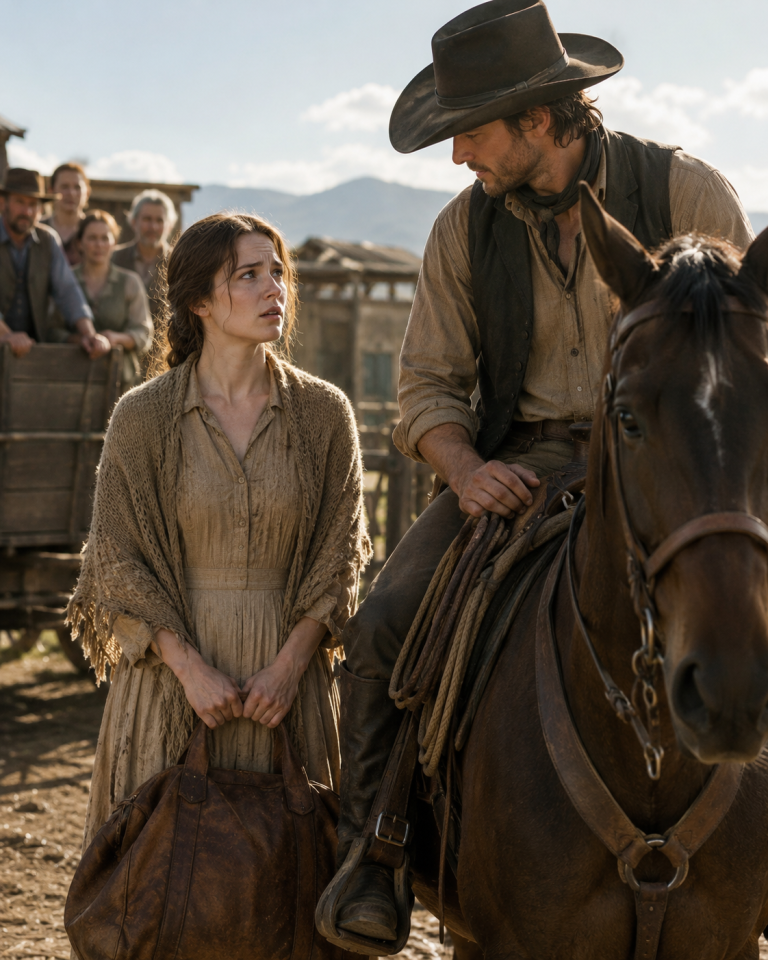
“Cole Turner.” He tipped his hat. “I got a ranch about an hour north of here. It’s not much. Falling apart, and I got two boys who don’t know how to cook anything that doesn’t come out of a can. I need help. You need work. Seems like we might figure something out.”
Eliza felt her heart kick against her ribs. “You’re offering me a job?”
“I’m offering you a week. You work hard, you can stay. You don’t, you leave.” He paused. “Fair?”
It wasn’t fair. It wasn’t even close to fair. But it was more than anyone else had offered.
“Fair,” she said.
“I’ll be back here at dawn. You’ll be ready.”
He walked off, and Eliza sat back down on the bench and let out a breath she didn’t know she’d been holding. Three days to prove she was worth keeping. She wasn’t going to waste a single one.
That night she slept in the livery stable, in a corner where the hay was piled high, and thought about the man who’d said yes when everyone else had said no. She didn’t know if he was kind or cruel, fair or ruthless. But she knew one thing: he’d said yes.
Dawn came cold and sharp. Cole was waiting where he’d said he’d be, a horse beside him, and he didn’t show any surprise at finding her ready. He pulled her up onto the saddle behind him, and they rode north as the sun cleared the horizon, the town falling away, the land opening into something wide and empty. Eliza wrapped her arms around his waist and tried not to think about what she was riding toward — a ranch, two boys, a week to prove herself.
It wasn’t much. But it was all she had.
The ranch appeared as the sun cleared the horizon fully — a small weathered house with peeling shutters and a sagging porch, a tired barn, a fence missing more posts than it had. Chickens scratched in the dirt. A gray-muzzled dog dozed in the shade of a broken wagon wheel.
Cole swung down and looked at it all with something almost apologetic in his voice. “Welcome to the Turner Ranch.”
—
## PART TWO
“It’s not much,” he said. “But it’s mine.”
“It’s fine,” Eliza said, though the place wasn’t just run down — it was exhausted, neglected in the way of somewhere nobody had had the time or the will to care for in a long while.
Inside, the boys came out twenty minutes later — identical, dark-haired, wary. One had a hole in his shirtsleeve; the other had dirt smudged across his cheek. Cole put a hand on each of their shoulders.
“This is Mrs. Hart. Noah, Luke, say hello.”
Noah mumbled something. Luke just stared. They sat at the table without a word, and Eliza set plates in front of them — eggs, warm biscuits, a little jam she’d found at the back of the cupboard. Noah looked down at his plate like he wasn’t sure what to do with it, took a bite, then another, then looked up with something like surprise.
“It’s good,” he said quietly.
Something loosened in Eliza’s chest. “Thank you.”
Halfway through the meal, Noah looked up again. “Where’d you come from?”
“Noah,” Cole said sharply.
“It’s all right,” Eliza said. “Town. I needed work.”
“Do you got a husband?”
“I did. He passed away.”
“Oh.” Noah looked down at his plate. “Our ma passed away, too.”
The room went very quiet. Cole’s jaw tightened; Luke stopped chewing. Eliza didn’t say anything, because there was nothing to say that wouldn’t sound hollow. After a long moment, Cole stood.
“Finish eating. Then get your chores done.” He walked out without another word.
The first day was the hardest — dishes scrubbed until her hands were raw, floors swept until her back ached, water hauled until her arms felt ready to fall off. But by nightfall the house was clean, supper was on the table, and when Cole came in and stopped in the doorway, something shifted in his expression.
“Smells good,” he said.
After the boys were in bed, he told her about his wife — fever, three days, no time to say goodbye, two years gone. “I’m telling you this so you understand,” he said. “Those boys have been through hell. They don’t need someone who’s going to leave. So if you’re planning on running, do it now. Don’t wait until they get attached.”
“I’m not planning on running.”
“Good.”
Over the following days, the boys began to talk to her — small things at first. Noah asked her to fix a tear in his shirt. Luke asked if she knew any songs. On the fourth day, Noah brought her a charcoal drawing of the ranch on the back of a feed sack. “This is really good,” she told him, and watched his face go red as he tried to hide a smile.
On the fifth day, three men rode up to the house — town clothes, unfriendly faces, a badge on the man in front.
“Cole Turner. I’m Deputy Carson. Got a complaint about you harboring a vagrant.”
Eliza’s blood went cold. Cole’s expression didn’t change.
“She’s not a vagrant. She works for me.”
“Mayor wants her gone, Turner. You’re just making this harder on yourself.”
“Mayor doesn’t get to tell me who I hire.”
Carson’s hand moved toward his belt. “You want to make this difficult? We can make it difficult.”
Cole didn’t move. “Get off my property.”
The air went still. Carson stared at him, then spat in the dirt and swung back onto his horse. “This isn’t over.”
—
## PART THREE
The deputy’s visit changed something in the air that Eliza couldn’t quite point to — in the tightness that stayed in Cole’s shoulders long after the men rode off, in the way the boys got quieter at supper. Three days later, a wagon rolled up carrying three women in carefully pinned hair and pressed dresses.
“You must be Mrs. Hart,” the one in front said. “I’m Mrs. Brennan. This is Mrs. Colby and Mrs. Finch. We’re from the town council. We thought we’d come by and see how you were settling in.”
“That’s kind of you.”
“Is it? Because from what we’ve heard, you didn’t ask permission before inserting yourself into this family.”
“Mr. Turner offered me work. I accepted. I didn’t realize I needed permission from the town council.”
“You don’t,” Mrs. Brennan said smoothly, “but you do need to understand how things work here. A stranger shows up with no history, no references, and people get concerned. Mr. Turner is a widower with two young boys. He’s not exactly in a position to make sound decisions about who he lets into his home.”
“With all due respect, ma’am, that’s not your decision to make.”
“No,” Mrs. Brennan said, her smile turning cold. “But it is our responsibility to protect the vulnerable ones. If we hear even a whisper of impropriety — anything that suggests you’re taking advantage of Mr. Turner or those boys — we will not hesitate to intervene.”
The wagon rolled away, and Eliza stood there with her heart pounding, feeling the difference between this and the ordinary cruelty she’d grown used to. This was a warning.
That night, when she told Cole what happened, he listened without interrupting and was quiet for a long time afterward. “This is what I was afraid of,” he finally said. “They’re not going to let this go.”
The next morning came apart in broken glass. Eliza bolted upright at the sound and ran to the window — three men on horseback circling the house in the pale dawn light, one of them hurling a bottle that shattered against the barn. Cole was already outside, rifle raised.
“Get off my land.”
The scarred man in front leaned forward in his saddle. “This is a warning, Turner. Get rid of her, or we’ll do it for you.”
“I’m not going to tell you again.”
“You going to shoot us, old man?”
“If I have to.”
For a long moment nobody moved. Then the man spat and rode off, laughter trailing behind him. Cole came back inside pale, his hands shaking on the rifle.
“Who were they?” Eliza asked.
“Drifters. The kind of men who show up when they smell weakness.”
“Maybe I should go.”
“No.” His eyes were blazing. “You want to leave, Eliza, fine — walk out that door. But don’t do it because you think you’re protecting us. Do it because you want to go.”
“I don’t want to go.”
“Then don’t.”
Cole rode into town that afternoon to talk to the sheriff and came back grim. “Half the town thinks I’m being reckless. If they get enough people together, they can petition the mayor. Force me to let you go.”
Eliza looked down at the wet shirt in her hands. “Then what do we do?”
“We keep going. We don’t give them a reason to push harder.”
That week, Mrs. Callaway made herself known — an old woman, white-haired, bent with age, whose sharp voice had cut through the crowd at Sunday service to let Eliza and Cole through the door when Mrs. Brennan tried to bar it. “Walk with me,” she told them afterward. “You’ve got guts, girl. This town doesn’t forgive easy, and it doesn’t forget at all. I’ve seen women like you before, desperate, running, trying to find a place to land. Most of them don’t make it.”
“I’m not most women.”
Mrs. Callaway’s eyes narrowed, then she smiled, just a little. “No, I don’t think you are.”
—
The letter came nailed to the barn door a few days later: *Town meeting, Saturday evening, attendance mandatory. Subject: The Turner situation.* Mayor Drake wanted a public vote on whether Cole could keep her on.
“They’re going to make an example of us,” Eliza said.
“Yeah, they are.”
The meeting hall was packed the following Saturday, every seat taken, people three deep along the walls. Drake sat at the front with Deputy Carson on one side, Mrs. Brennan on the other.
“Mr. Turner has taken it upon himself to employ a woman of unknown character and questionable morals,” Drake announced. “Tonight, we’re going to hear from anyone who has something to say, and then we’re going to vote on whether this arrangement should continue.”
“This is ridiculous,” Cole said. “You don’t have the authority to tell me who I can hire.”
“Actually, we do,” Drake said. “Town charter gives us the right to intervene in matters of public concern.”
Mrs. Brennan leaned forward. “She sleeps in your house, eats at your table, spends every waking hour with your children. If that’s not living there, I don’t know what is. An employee you can’t afford to pay.”
“That’s none of your business.”
“It is when it affects the whole community.”
Eliza stood. “I’m standing right here. If you have questions, ask me.”
Drake turned to her. “Where did you come from?”
“St. Louis.”
“Why did you leave?”
“My husband died. I couldn’t afford to stay.”
“Family? Friends? References?”
“No.”
“So you showed up here with nothing. No connections, no proof of good character, and you expect us to just take your word that you’re trustworthy?”
“I expect you to judge me by my actions, not by what I don’t have.”
The room started to fracture into shouting — some in agreement, some in protest — until a voice cut through it.
“Stop it.”
Everyone turned. Noah stood in the middle of the aisle, hands balled into fists, face red. Luke stood beside him, tears on his cheeks.
“Stop saying mean things about her,” Noah said, his voice shaking. “She’s not bad. She makes us breakfast and fixes our clothes, and she doesn’t yell at us even when we’re stupid. She’s the only person who’s been nice to us since Ma died. So stop it.”
The room went dead silent.
“You don’t know her,” Noah went on. “You just decided she’s bad because she’s new. But she’s not. She’s good. And if you make her leave, I’m never going to forgive you.”
“Me neither,” Luke said, wiping his eyes.
Eliza felt tears spill down her cheeks and didn’t bother wiping them away. Cole looked at his sons, and something that had been locked away in him for a long time finally broke free. He stood.
“My boys are right. Mrs. Hart is good. Hardworking, honest, kind. She’s taken care of my family when nobody else would. She’s earned her place on my ranch, and I’m not going to let a bunch of scared, judgmental people take that away from her.” His voice went hard. “You want to know if she’s part of my family? Yeah, she is.”
He took Eliza’s hand and led her out, the boys following, and the room’s noise swelled behind them as they walked into the night.
At home, in the yard, he stood staring at the ground. “You didn’t have to do that,” Eliza said quietly.
“Yes, I did. Because you belong here. Because those boys need you. And because—” he stopped, his jaw working. “Because I need you, too.”
—
The town’s response to that night was mixed. Some warmed slowly — a nod from the shopkeeper, a woman at the well who no longer turned away. Mrs. Finch caught Eliza in the street weeks later to apologize outright: “I judged you without knowing you. My husband reminded me we were strangers here once, too.” Others never bent. Mrs. Brennan’s disapproval only sharpened, and one evening Cole came home late, tired, having turned down a neighbor’s offer of free spring labor in exchange for letting Eliza go.
“I told him to go to hell,” Cole said simply.
Eliza saw how thin he was stretched — the tension that never quite left his shoulders, the way his hands shook when he thought no one was watching — and resolved to make herself necessary in ways nobody could argue with. Her chance came when one of the ranch horses came up lame. Cole, cursing, was ready to write off a week’s plowing. Eliza knelt, worked a stone free from the mare’s hoof with a patience Cole hadn’t seen in her before, and had the animal sound again within days.
“How’d you know how to do that?” he asked, staring at her like he was seeing something new.
“I told you. I grew up around horses. You never asked.”
After that, he started asking her opinion on things that mattered — which field to plant, whether to sell the extra chickens, how to handle the boys’ troubles at school. It felt like building something real.
Mrs. Callaway noticed before either of them said a word. “That man in there cares about you,” she told Eliza one afternoon, setting down a basket of apples on the porch. “And those boys worship you. Question is, what are you going to do about it?”
A few days later, Cole asked her to ride out with him to check the far pasture. He brought his horse to a stop near a cluster of trees at the edge of the property. “This is where I proposed to my wife,” he said quietly — the first time he’d spoken of her like that. “She said it felt like the edge of the world. Like nothing bad could touch you out here. I haven’t been back since she died.”
“Why now?”
“Because I wanted to share it with you.” He swung down and walked to her. “I don’t know what this is, Eliza. I don’t know where it’s going. But I know I don’t want to lose it.”
“I don’t want to lose it either.”
He kissed her, and it felt, she thought, like coming home.
They didn’t tell anyone right away — it felt too new, too fragile to expose to the world before it had grown roots. But the boys knew. “Are you and Pa together now?” Luke asked while she helped him with his schoolwork, and when she asked what would happen if they were, he said simply, “Yeah, I think Ma would have liked you.” Noah took longer, cornering her in the barn a week after. “If you and Pa get married, does that mean you’re staying forever?”
“If that happened,” Eliza said, “I would stay forever.”
“Not ever?”
“Not ever.”
The town noticed before anyone announced it, and Mayor Drake called a second meeting — moral character of the Turner household, the letter said, on account of concerns raised about improper conduct. This time, when Eliza walked into the packed hall, she wasn’t afraid. She was angry — at the hypocrisy, at people who claimed to care about morality while tearing apart anyone who didn’t fit their narrow definition of acceptable.
Cole didn’t wait for Drake to begin. “Let’s get one thing straight,” he said, standing as soon as they walked in. “I’m here because I was told I had to be. But I’m not here to justify my life to any of you. You’ve questioned her character, her intentions, her right to exist in this community. And you’ve done it all while pretending you’re concerned about my boys. You’re not concerned about them. You’re concerned about control.”
“We’re concerned about the example you’re setting,” Mrs. Brennan said. “The example of living in sin.”
Cole laughed — not a kind laugh. “That’s rich, coming from you, Helen. You want to talk about sin? Let’s talk about the sin of cruelty. The sin of turning away someone in need.” He turned to face the room fully. “You want to know what’s happening in my house? Eliza Hart is the best thing that’s happened to me and my boys since my wife died. She’s my partner, my equal. And if I have my way, she’ll be my wife.”
The room erupted. Eliza’s breath caught in her throat.
“I know this isn’t how I planned to ask,” Cole said, quiet now, just loud enough for her to hear over the noise. “But I mean it. Will you marry me, Eliza?”
“Yes.” The word came out barely a whisper, but he heard it. He crossed the space between them and pulled her into his arms, and the room went silent. Then Mrs. Callaway rose, leaning on her cane, and started clapping — slow at first, her weathered hands coming together in steady rhythm. Others joined. Not everyone. Mrs. Brennan sat with her arms crossed, her face like stone. But enough people clapped that it didn’t matter.
Outside, under the stars, Cole looked down at her. “I meant what I said in there. I want to marry you. Build a life with you. Make this real.”
“It already is real,” Eliza said, and he kissed her while the boys made exaggerated gagging noises behind them, and for the first time in months, Eliza laughed until her sides hurt.
—
They married three weeks later — no big ceremony, just Mrs. Callaway, a handful of neighbors who’d become friends, and the boys standing up front in their good shirts with dirt still under their fingernails. A traveling minister who asked no questions read the words. Eliza became Eliza Turner.
The town’s reaction stayed mixed. Some congratulated them. Some pretended it hadn’t happened. A few made their disapproval plain and permanent. None of it mattered, because Eliza finally had what she’d been searching for since her husband died — a home, a family, a place where she belonged, not because it had been handed to her, but because she’d fought for every inch of it.
Two years later, on an evening after the boys had gone to bed, Eliza told Cole she was pregnant. He stared at her like she’d told him the sky was falling.
“A baby.”
“Yes. Our baby.”
His eyes went wet. “I don’t know if I can do this again, after what happened with Sarah.”
Eliza knelt in front of him and took his hands. “I know you’re scared. I’m scared too. But we’re going to do this together. Whatever happens, we’ll face it.”
The pregnancy was hard, and there were days Eliza could barely get out of bed. Cole took on more of the housework; the boys helped where they could. When the baby finally came, it was a girl. They named her Sarah, after Cole’s first wife — not to replace her, but to carry her forward. Noah held his sister with exaggerated care, like she might break. Luke insisted on checking her cradle every night to make sure she was breathing. And Cole looked at Eliza holding their daughter with an expression that made her chest ache.
“We did it,” he said quietly.
“We gave each other our lives back,” Eliza said.
That night, once Sarah was finally asleep and the house had gone quiet, Eliza stood on the porch and looked out at the land that had once been a stranger’s ranch and was now, unmistakably, hers. Cole came and stood beside her.
“You know what I think people get wrong?” she said. “They think belonging is something you’re given. Like a gift someone hands you, and all you have to do is accept it.” She shook her head. “It’s not. Belonging is something you build, brick by brick, day by day. Sometimes you have to fight for every single inch of ground.”
“And sometimes the people around you fight just as hard to keep you out,” Cole said.
“Yeah. But if you’re stubborn enough — if you refuse to disappear, if you keep showing up even when they tell you not to—”
“You win,” Cole finished.
“No,” Eliza said. “You don’t win. You just survive. And then one day you wake up and realize you’re not just surviving anymore. You’re living.”
Inside, Sarah began to fuss, and Noah and Luke started arguing about something in the next room. Cole chuckled. “Sounds like they need you.”
“They always need me,” Eliza said. But she was smiling as she turned and walked back into the house — into the noise, the chaos, and the beautiful, messy reality of the life she’d built with her own two hands.
She didn’t look back. There was nothing behind her worth looking at. Everything that mattered was right here.
**THE END**