Her Own Family Sold Her as “Useless” — Then a Silent Mountain Man Asked to Marry Her Instead

—
## PART ONE
The Rusty Nail smelled like cheap whiskey, wet wool, and the particular kind of desperation that settled over Red Hollow every February, when the cold squeezed hard enough to make men bet things they couldn’t afford to lose. Clara stood with her back against the rough-hewn wall, fingers twisted into the fabric of her skirt, and watched her father lose the last of what he had.
“Another hand,” Thomas Whitmore said, slamming his glass down hard enough to spray the felt. His voice had that dangerous, too-loud pitch it always got by the fourth drink — loud enough to convince himself he was still in control, slurred enough to prove he wasn’t.
The men around the table traded glances. Jacob Miller, who ran the grain store and charged interest that could break a man’s spine. Samuel Yates, whose ranch sprawled across half the valley, and whose first two wives had a habit of not surviving him. Thomas Brennan, the blacksmith. Warren Price, a drifter with too much gold and no history anyone dared ask about. And Frank Nolan, dealing the cards, who owned the saloon and everything that happened inside it.
“You got nothing left to bet, Tom.” Frank wasn’t unkind about it. He was a businessman first, and broke men were bad for business. “Unless you got something else to put on the table.”
His eyes slid past Thomas. Landed on Clara like a physical weight.
The piano stumbled, found its rhythm again, and now the melody sounded like a warning.
“Your daughter’s of marrying age, ain’t she?” Samuel Yates leaned back until his chair creaked. “Strong girl. Could work a homestead. Bear children. Worth something to the right man.”
Clara’s breath caught. Her legs had turned to stone.
“Clara’s not for sale,” her father said. There was no conviction in it. Just the reflex of a man trying to remember what shame used to feel like.
“Everything’s for sale, Tom. You taught us that.”
Laughter rippled through the room — not kind laughter, the ugly sound of men who’d found someone smaller to kick. Heat flooded Clara’s face, that old familiar shame she’d carried since childhood. Too big. Too much. Taking up too much space in a world that wanted women small and quiet and easy to overlook.
“I’ll take her.” Yates stood, chair scraping the floorboards. “Clear your debt to Frank. I’ll take her off your hands. Legal marriage, all proper-like.” He counted bills onto the table. “Two hundred dollars, Tom. More than you’ve seen in months. All you got to do is sign over the girl.”
The silence that followed was absolute. Even the piano stopped.
“Daddy, no.” The words came out smaller than she meant. A child’s plea from a grown woman’s throat. “Please.”
He wouldn’t meet her eyes. “Clara, honey, you don’t understand. Sam’s got a good spread—”
“Two dead wives,” she cut in, steel finding its way beneath the fear. “Or did you forget about them?”
“Watch your mouth, girl.” Yates took a step toward her, and she saw the flash of rage that promised exactly what her life would become. “You’ll speak respectful to your future husband.”
“I’m not marrying you.”
“You don’t get a say.” He turned back to her father. “We got a deal or not?”
Thomas Whitmore looked at his daughter for one long moment. Clara saw everything in his face — the calculation, the relief, the cowardice. He’d made his choice before they’d ever walked through that door.
“We got a deal.”
The words hit her like a blow. Yates reached for her arm. “Come here, wife. Let’s seal this proper.”
“Get your hands off her.”
The voice came from the doorway, and it stopped everything — not because it was loud, but because it carried the particular weight of a man reminding the room there were things in these mountains more dangerous than desperate fathers.
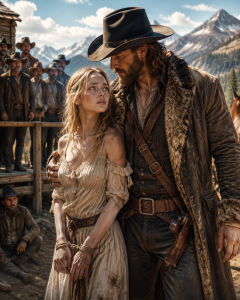
Clara turned. The man in the doorway had to duck to clear the frame. Six and a half feet of solid muscle and hard angles, a bearskin coat dusted with snow, a scar running from his temple to his jaw that pulled the corner of his mouth into a permanent hint of a snarl. His eyes were gray as storm clouds, and they looked at her like she was the only thing in the room worth seeing clearly.
“Silas Boon,” Frank said, careful, the fear wrapped tight in politeness. “Ain’t seen you in town for near six months.”
“Heard talk in the mercantile.” Silas’s voice was rough, like it didn’t get much use. “Man selling his daughter to clear his debts.”
“Ain’t your concern,” Yates said, though his certainty had thinned.
“Making it my concern.”
He crossed the room, men parting without meaning to, and pulled a leather pouch from inside his coat. Gold hit the poker table with a sound like a verdict.
“Three hundred. That’s more than Yates is offering. I’m buying her contract, or her hand, or whatever you’re selling. She comes with me.”
Yates surged to his feet, purple with fury. Thomas stared at the gold like he couldn’t believe it was real.
And Clara — Clara stood frozen between horror and something that felt too dangerous to name.
Silas’s eyes never left her face. “Well, girl. You’d rather go with him, or take your chances with me?”
It was the first time in her life anyone had asked her opinion. The first time anyone had treated her like she had a choice in what happened to her own body.
She looked at Samuel Yates, cold-eyed and cruel-mouthed. Then at the scarred stranger who had just offered her something that felt, for the first time in twenty-two years, like a decision that belonged to her.
“I’ll go with him,” she heard herself say.
Yates’s laugh was ugly. “She didn’t choose nothing. She’s been bought and sold like the property she is.”
“Then I guess,” Silas said, offering Clara his arm, “we got something in common.”
She took it. Felt the solid muscle beneath rough wool, the steady calm of a man who’d made a decision and would not be moved from it. As they walked toward the door, the crowd parted like they were dangerous.
Maybe they were.
“Clara.” Her father’s voice stopped her at the threshold. He stood by the table with his gold, looking suddenly small. “I’m sorry. I had no choice.”
“Yes, you did.” Her voice was steady, though her heart hammered. “You just made it.”
—
## PART TWO
The cold hit her like a slap the moment they stepped outside. Without a word, Silas shrugged out of his coat and settled it over her shoulders — heavy, still warm from his body, smelling of woodsmoke and pine.
“Thank you,” she said quietly.
He grunted. She was already learning that might be his version of *you’re welcome*.
They walked to the edge of town, to two horses tied outside the mercantile — a massive roan stallion and a sturdy mountain pony with patient eyes.
“You ride?”
“A little.” She hadn’t, not since her father sold their horses years ago.
“Good. That’s Rosie. Won’t spook easy.” He handed up a thick blanket. “It’s fifteen miles to the cabin. Gets colder as we climb.”
Fifteen miles into the mountains, in the dark, with a stranger. But what choice did she have — go back to her father’s non-existent protection, to Samuel Yates’s cold hands? She wrapped the blanket tight and they rode out of Red Hollow in silence, leaving behind the last lights of civilization.
The trail climbed and climbed, switchbacking into darker and colder air. Clara’s thighs burned. Her hands went numb inside her gloves. She didn’t complain. She’d made her choice, and she’d live with it.
After what felt like hours, they crested a ridge, and she saw it — a cabin tucked against the mountainside, smoke curling from a stone chimney, warm light bleeding through the shutters.
*Home or prison.* She wasn’t sure which yet.
An old woman appeared in the doorway before they’d even dismounted — weathered skin, eyes sharp as flint. “So you did it,” she said, looking Clara up and down. “Bought yourself a wife.”
“Bought her freedom from worse,” Silas corrected. “Mary, this is Clara Whitmore.”
Mary, Clara would learn, lived two ridges over and had come to make sure everything was proper — some fragile piece of decency salvaged from an indecent night.
Inside, the fire hit Clara like a benediction. Mary pressed a mug of something hot and bitter into her hands while she and Silas spoke in low voices by the door — words like *proper marriage* and *let her choose when she’s ready* — words Clara was too exhausted to fully parse. Sleep dragged her under before she could try.
Her last conscious thought was simple, and devastating.
*What have I done?*
She woke to the sound of an axe. Sharp, rhythmic, relentless. Memory crashed back — the saloon, the gold, the ride through darkness. Through gaps in the shutters she watched Silas splitting wood in nothing but his shirtsleeves despite the cold, every swing precise and economical, and she understood, with a strange, cold clarity, that whatever this arrangement was — rescue or trap — she was about to find out exactly what kind of man had bought her.
—
## PART THREE
Mary had breakfast waiting when Clara finally dressed — bread, eggs, coffee strong enough to strip paint. Silas came in from the yard, washed his hands, and sat across the table with the same economy of motion he brought to everything.
“First thing,” Mary said, taking charge like a woman used to being obeyed. “What exactly is this arrangement?”
Silas looked at Clara. “What do you want it to be?”
The question caught her off guard. “What?”
“I paid your father for your freedom. Not for you. You don’t owe me anything. You want to stay here, you stay. You want me to take you to the next town, give you stake money to start over — I’ll do that too. Your choice.”
“I don’t understand. You paid three hundred dollars—”
“Money’s no use up here.” He paused, searching for words like a man unused to explaining himself. “I saw what was happening in that saloon. I couldn’t let it stand. So I made it stop. That’s all.”
*That’s all.* Clara’s laugh came out sharp, edged with something close to hysteria. “You bought me like livestock and you’re saying that’s all.”
“I bought your freedom from a man who would have broken you.” His voice didn’t rise, but there was steel under it. “Samuel Yates. You know what happened to his wives? One walked into doors so often her face wasn’t recognizable at her funeral. The other ran and they found her frozen three miles from his ranch. That was your future. So yeah — I paid three hundred dollars to make sure it wasn’t. You want to call that buying you, go ahead. I call it giving you a choice you didn’t have before.”
Mary cleared her throat. “Boy’s got a point, even if he’s terrible at explaining it. Question stands, Clara. What do you want?”
What *did* she want? She had no money, no skills anyone would pay for. Going to another town meant landing in the same trap, or worse.
“I could work,” she said slowly. “Earn my keep. Pay back the three hundred.”
“Don’t need paying back.”
“I need to pay it back.” Her voice firmed. “I won’t be property, and I won’t be charity. If I stay, I work. Fair exchange.”
Something that might have been respect flickered across Silas’s scarred face. “Fair enough.”
—
What followed was a crash course in mountain survival that left Clara’s head spinning — the root cellar, the springhouse, the hen house, the trapping gear, the ammunition. Mary taught her to bank a fire so it lasted till dawn, to melt snow slowly so it didn’t taste dead, to make a week’s supplies last a month when the nearest store was a day’s ride away.
By the time Silas returned at dusk, Clara had scrubbed the cabin raw and had a pot of stew bubbling that smelled like food instead of desperation. He stopped in the doorway, looking around with an expression she couldn’t read.
“You didn’t have to do all this.”
“Yes, I did.” She didn’t look up from the stew. “Fair exchange.”
“Storm coming,” he said over supper. “Big one. We’ll be snowed in a few days.” He nodded toward the bed in the corner. “You’ll sleep there. I’ll take the floor.”
“You don’t have to sleep on the floor.”
“Yes, I do.” His tone left no room. “You may be here by choice now, but choice means you get to feel safe. Can’t feel safe if I’m in the bed next to you.”
She studied him across the rough table — this man paying, again, with his own comfort. “Why did you really buy me from my father?”
He was quiet a long moment, his scarred face turned toward the fire.
“Had a sister once,” he said finally. “Younger than me. Pretty. Sweet. Our pa got into debt like yours did. Man came to collect. Took her instead of money.” His jaw worked. “I was off fighting the war. Didn’t know till I came home. By then she’d been married off, worked till she broke, buried in an unmarked grave.” He looked at Clara. “When I heard what was happening at the Rusty Nail, when I saw you standing there looking like my sister probably looked — I thought, *not again. Not if I can stop it.*”
“I’m sorry.”
“Not your burden.” He stood, began arranging his makeshift bed. “But you’re safe here, Clara Whitmore. That’s a promise. I don’t break my promises.”
Outside, the first snow began to fall.
—
The storm hit three hours after midnight, screaming around the cabin like something wounded and alive. Clara lay awake, listening to timbers groan, until Silas’s voice came calm through the dark.
“Cabin stood twelve years through worse. It’ll stand tonight.”
“How can you be sure?”
“Because I built it to last.” There was quiet pride in it. Over the following hour, prompted by her questions, he told her about it — cutting logs for four months so none would warp or crack, digging the foundation down to bedrock with just a shovel and pickaxe, raising the walls slow and careful, chinking every gap with mud and moss. Finished three days before the first big storm hit, and he’d sat exactly where he sat now, wondering if he’d done it right.
“But I didn’t wake up dead,” he said. “Woke up warm and dry with snow piled six feet against the door. First thing I’d built in years that wasn’t meant for killing.”
Clara understood, then, that the cabin was his redemption — every log a kind of prayer, every storm survived a proof he could survive anything. When she finally slept, it was to dreams of walls raised against chaos and a stubborn refusal to break.
—
Morning brought silence so complete it felt sacred. Four feet of snow, maybe five, glittering under a hard blue sky. They dug for hours — to the barn, the springhouse, the hen house — Clara’s muscles screaming, her palms blistering despite the gloves.
“You’re going to hurt yourself,” Silas said, passing her with an armful of cleared snow.
“Then I’ll build tolerance.” She drove the shovel in again. “How else am I going to get stronger?”
He studied her, then nodded. “Fair point. But when your body tells you to stop, listen. Mountain doesn’t care about pride. It’ll break you if you let it.”
He was right about the breaking part. By the time the paths were clear, she was shaking, and he steadied her with a hand on her elbow, voice gentler than she’d heard it. “That’s enough for today.”
He knelt beside the fire afterward, working salve into her blistered palms with surprising gentleness for such rough hands.
“You don’t have to prove yourself all at once,” he said. “Winter’s long.”
“I already know what I’m made of.” Her voice was quiet. “I’m made of everyone who ever looked at me and saw weakness. Too big, too soft, too much. I’m tired of being what other people decided I was.”
“You already matter.” He set the salve aside. “But I understand the need to prove it to yourself. Just don’t kill yourself doing it.”
Something settled in her chest that evening. Not quite belonging. But the beginning of it.
—
The weeks that followed fell into a brutal, comforting rhythm. Silas checked trap lines; Clara transformed the cabin into a home, scrubbing away years of bachelor neglect, learning to bake bread in the coals, to stretch meager supplies into meals that tasted like something. Slowly, the mountain began teaching her its language — reading the sky for storms, telling green wood from dry, feeling the pressure drop that meant more snow was coming.
Mary rode up when the weather broke, sharp eyes taking in Clara’s reddened hands and windburned face. “You’re doing good, girl,” she said. “Better than I thought you would.” Then, quieter: “And Silas — he’s different. Talks more. Smiles occasionally. You’re good for him whether he admits it or not.”
Heat rose in Clara’s cheeks. “I’m just doing the work we agreed on.”
“Sure you are.” Mary’s smile was knowing.
Silas came in from the barn as Mary was leaving, and something crossed his face that might have been pleasure. “Town thinks she’s your wife,” Mary said, deliberately provocative, watching his jaw tighten.
“She’s not my wife. Clara’s here by choice, working for her keep, free to leave whenever she wants. That’s the truth.”
“And when spring comes, and she wants to go back down?”
The question hung, heavy. Clara realized she hadn’t thought about spring at all.
“That’s her choice to make,” Silas said finally. “Not mine. Not yours. Not the town’s.”
That night, lying in the dark, Clara found herself thinking about the future for the first time since the Rusty Nail — and found the decision that should have been easy was anything but.
—
One evening, mending a shirt while Silas worked on snowshoe frames, he said, “You’re adapting. Mountain’s accepting you.”
“Mountain doesn’t have much choice,” Clara said, biting off thread. “I’m too stubborn to let it kill me.”
“Stubborn’s kept more people alive than sense ever did.” He tested the flex of a wooden frame. “You’re stronger than you know, Clara. Stronger than anyone in that saloon ever gave you credit for.”
Her hands stilled on the mending — the first time he’d really referenced that night.
“They saw what they wanted to see,” she said. “Someone weak. Their blindness doesn’t make it true.”
“No.” He met her eyes. “But it made me believe it for a long time.”
“Want to know what I see?” He set down the snowshoe frame. “Someone who rode fifteen miles up a mountain in the dark without complaint. Someone who’s worked herself raw learning to survive one of the harshest places on earth. I see strength. Real strength. The kind that matters when everything else falls away.”
Something broke open in Clara’s chest — some longheld knot of shame loosening. “Thank you.”
“Just telling the truth.”
—
Danger announced itself the next morning. Silas woke armed, checking his rifle with a care that meant trouble.
“Tracks outside. Mountain lion, big one, been circling. Storms make hunting hard on predators. They get desperate.” He handed her a rifle, showed her how to load it. “You stay inside. I track it, make sure it moves on. If I’m not back by morning, take the horses and head for Mary’s. Don’t try to find me.”
“Silas—”
“This mountain will kill you if you give it the chance.” His eyes were intense. “Don’t give it the chance.”
“I promise.”
He slipped out into gray dawn, and Clara spent the day straining her ears at every sound, the rifle never out of reach. Nightfall came with no sign of him. She sat at the table, coffee going cold, watching the door.
The knock, when it came, made her jump. “Clara — it’s me. Open up.”
She threw back the bolt and gasped. Silas leaned heavily in the doorway, face gray beneath his beard, blood staining his coat dark and spreading.
“Caught up to the cat,” he said through gritted teeth. “Killed it. Got a piece of me first.”
She got him to the chair by the fire. Beneath his shirt, three parallel gashes ran deep enough to show muscle.
“Talk me through it,” she said, and her voice came out steadier than she felt. He did — cleaning the wounds with whiskey that made him hiss, stitching the deepest gash with a needle sterilized in flame, bandaging everything tight. Clara found a competence in her hands she hadn’t known she possessed, because there was no one else, and the work had to be done.
When it was finished, Silas’s face was white with sweat, but the bleeding had stopped.
“Don’t ever do that again,” she said, her voice breaking now that the crisis had passed. “Don’t come back bleeding and half dead.”
He caught her hand with his good one. “I’m sorry. Was stupid and reckless. Won’t happen again.”
“You better mean that.”
“I do.” A small, pained smile. “Can’t have my best worker worrying herself sick.”
“I’m your only worker.”
“Still the best.” His thumb brushed her knuckles. “Thank you, Clara. For being stronger than you think you are.”
She looked at their joined hands, at this dangerous, damaged man who’d saved her from one fate and was teaching her to survive another, and felt something warm unfold in her chest that had nothing to do with the fire.
—
Silas healed slowly while Clara nursed him through fever, took over his chores without being asked, and met every test the mountain threw at her in his absence — late storms, frozen springhouse water, coyotes at the hen house. She learned to shoot with real accuracy, to read tracks, to treat fear as something to work through rather than surrender to.
“You’re going to kill yourself trying to do everything,” Silas said one evening, watching her collapse into a chair, gray with exhaustion.
“Someone has to.”
“That doesn’t mean you need to work yourself to death proving something.”
“I’m not proving anything.” She met his eyes. “I’m surviving. There’s a difference.” She thought a moment. “That girl from the Rusty Nail — she died somewhere between here and there. I’m what’s left.”
“And what’s that?”
“Someone who survived. Someone who’s done surviving and started living.”
The sound of horses broke the quiet before he could answer. Multiple horses, moving fast.
“Could be Mary. Could be trappers.” But the tension in his voice said he didn’t believe it. Through the shutters, Clara’s blood ran cold. Six riders. Samuel Yates in the lead. Beside him, Sheriff Brennan. Trailing behind, small and drunk even at a distance — her father.
—
Yates’s voice carried cold through the evening air. “Silas Boon. Been a while.” He’d brought Sheriff Brennan and, behind him, a stranger who introduced himself as Deputy Marshal Crawford out of Helena, carrying a warrant for kidnapping and unlawful imprisonment.
“Sworn statements from three Red Hollow residents,” Crawford said, holding the paper up, “including this man’s own father, say Miss Whitmore was removed against her wishes and family protest. Judge signed it two weeks back. It’s a legal warrant, Mr. Boon, and I have to serve it whether I like the smell of it or not. You can surrender peaceful, or—”
Gunfire cut him off. By the time Clara threw open the door against Silas’s order, he was on his knees in the snow, blood streaming from his temple, four guns trained on him. Yates dismounted with a smile that made her skin crawl.
“There she is,” he said. “Has he been treating you well, or have you been suffering, waiting for rescue?”
“I haven’t been suffering,” Clara said clearly. “I’ve been free.”
“You call being held prisoner on a mountain free?”
“I call making my own choices free. Silas didn’t kidnap me. He gave me an option my own father denied me, and I took it.”
“Lower the rifle,” Crawford warned, but Clara barely heard him.
“My situation,” she said, “was spending twenty-two years being told I was too much and not enough all at once. Then Silas gave me a chance to have a future. That’s not kidnapping. That’s liberation.”
Crawford’s eyes moved to Thomas Whitmore, hunched and sober-faced on his horse for once. “Your own father swore this statement, Boon. Says Yates cleared his debts in exchange for it.”
“My father,” Clara said, “will sign anything that keeps a roof over his head. Ask him what Yates promised him for that signature.”
Thomas wouldn’t meet anyone’s eyes. Crawford’s jaw tightened — a flicker of something like doubt — but a signed and sealed warrant wasn’t undone by a look on a drunk man’s face, not out here, not today.
“Enough talk.” Yates raised his own rifle at Silas. “Tie him up.”
They bound Silas’s wrists, threw him across a horse like grain sacks. Yates backhanded Clara across the face when she protested, splitting her lip. “You’ll watch Boon hang. You’ll watch him die knowing it’s your fault.”
They rode her down the mountain bound to a saddle, storm catching them halfway, and threw Silas in the Red Hollow jail. Clara was locked in her old room at the boarding house, guarded, while Yates promised a trial by noon and a hanging by sundown.
But Clara had survived a mountain winter. She had learned patience, and how to move quietly, and how to think three steps ahead. She worked the old warped window frame loose through the night, squeezed through at three in the morning with her dress tearing and her arms bleeding, and crossed Red Hollow in shadow to the barred window of the jail.
“Silas.”
His bruised face appeared. “Clara — what the hell are you doing here? They catch you, they’ll lock you up too.”
“I’m not leaving you to hang.”
“Please, Clara, don’t let my mistake trap you too.”
“Your mistake was saving me. I’m about to return the favor.” She gripped the bars. “Listen. When you hear the fire bell, be ready. Don’t try to be noble. Just survive. Promise me.”
“I promise.”
She left him and made her way to Yates’s general store — the place he kept his kerosene, his whiskey, his profit built on other people’s desperation. The lock was cheap, the wood rotten. Inside, she worked fast and steady, soaking floor and shelves in kerosene and whiskey, telling herself this was destruction of property, was probably a hanging offense — and that they’d already decided to destroy her life first.
She struck the match and ran.
The fire caught faster than she’d imagined, racing up the walls with a hunger that felt alive. The bell started clanging within minutes, and Red Hollow woke to chaos — bucket brigades, shouting men, the deputy guarding the jail abandoning his post to join the crowd fighting the blaze.
Clara didn’t hesitate. She crossed the street, grabbed the keys off the office wall, found Silas’s cell by feel.
“Clara — is that fire? Did you—”
“Don’t ask questions.” The lock clicked open. “Now move.”
They ran through the smoke and confusion to the livery, mounted, and rode out of Red Hollow with gunfire cracking behind them and the sky burning orange at their backs.
Clara felt something she hadn’t felt in years. She felt alive.
—
They pushed the horses hard through the night, Silas leading trails Clara barely recognized, until they reached a plateau where he finally let the animals catch their breath.
“Yates won’t let this go,” he said grimly. “You burned down his livelihood, freed a condemned man, made him look a fool in front of the whole town. He’ll hunt us until he catches us or we’re both dead.”
“Then we don’t let him catch us.”
By dawn, pursuers were visible on the trail below — eight riders in hunting formation. Silas led them into a narrow defile between rock walls, and when their pursuers entered behind them, he and Clara fired at the base of an unstable overhang until the whole northern wall came down in a roar that sealed the passage with twenty feet of broken stone.
They reached a high mountain valley by midday — a natural fortress, one way in, defensible, with water and shelter. It was also a trap: if Yates brought enough men, he could simply starve them out. Silas’s reopened wounds turned feverish by nightfall, and Clara kept watch through the dark, listening to Yates’s distant campfire crackle at the mouth of the pass.
“Boon!” Yates’s voice, ragged with fury, echoed off the cliffs sometime near midnight. “This doesn’t end until you’re both dead.”
Nobody came. Two days passed in tense, hungry stalemate, ammunition rationed, sleep taken in snatches, until Clara woke on the third morning to a silence that felt wrong. Yates’s camp was empty.
“It’s a trap,” Silas said immediately — and he was right. Moments later the northern cliff face exploded into a landslide, sealing the only pass, burying their escape route under tons of rock.
“He’s trying to bury us alive,” Silas breathed. Then, studying the wreckage: “No — he sealed himself out too. He doesn’t know about the northern trail.” An old hunting path, barely there, carved two hundred feet up the cliff face, leading down the back of the mountain toward Mary’s land.
“Can you make that climb? With your injuries?”
“I’ll make it or die trying.” His eyes held hers. “If I fall, if the fever takes me — you keep going. Promise me.”
“We make it together or not at all. That’s been the deal since the beginning.”
The climb took two brutal days — loose rock, a narrow ledge, cold that ate through Clara’s torn dress. On the second day, Silas’s strength finally gave out. He lost his grip, and Clara lunged, catching his wrist with both hands, her body slamming into the cliff face hard enough to drive the air from her lungs. For one terrible moment they both hung suspended over two hundred feet of empty air.
“Let go,” Silas said through gritted teeth. “You can’t hold us both.”
“I said together or not at all.” Her fingers were slipping, going numb. “Use me as an anchor and climb.”
He did — used her arm as a ladder, found new holds, and when he was secure, he caught her in turn as her own grip finally failed, his hand locking around her wrist with desperate strength.
“I’ve got you,” he said. “I’m not letting go.”
They clung to the rock, shaking, and when they’d caught their breath, Silas said quietly, “Thank you. For not letting go. For being exactly what I needed, even when I didn’t know I needed it.”
“Let’s finish this climb,” Clara said. “Then we can talk about what we mean to each other.”
—
They reached the far side at sunset, collapsing in exhaustion. Silas’s fever was raging by then, and Mary’s cabin was still five miles east. Clara looked at the man who’d saved her, who’d taught her that strength came in forms the world refused to recognize — and got her shoulder under his arm.
“Together or not at all,” she muttered. “Still the deal.”
She walked those five miles carrying most of his weight, past every point her body screamed to stop, because the alternative was surrender, and Clara Whitmore was done with surrender. When Mary’s cabin finally appeared in the moonlight, she pounded on the door with a bloody fist and collapsed the moment Silas’s weight left her shoulders.
“He’s still coming,” she managed, before darkness took her. “Need to be ready.”
—
She woke eighteen hours later to willow-bark tea and Mary’s sharp, assessing eyes. Silas lay across the cabin, fighting his own fever, alive but barely.
“You carried him five miles with your hands torn to shreds,” Mary said. “What made you keep going?”
“He didn’t leave me behind when he could have. I wasn’t going to leave him.”
“That’s not gratitude. That’s something else.” Mary’s voice was knowing. “You love him.”
“I don’t know what I feel. But I know I’m not the same person who left Red Hollow, and he’s part of why.”
They spent the day turning Mary’s cabin into a fortress — pits, snares, deadfalls, false trails through the trees. By nightfall, when Yates and his remaining six men rode up the southern trail, Clara was ready.
“Boon! I know you’re in there!” Yates’s voice cracked with exhaustion and something closer to madness. “You ungrateful bitch — I would have married you, given you a name, a purpose, and you burned down everything I built!”
“You offered me slavery dressed up as marriage,” Clara called back. “Silas offered me a choice. I’d rather die on this mountain a free woman than live one more day as your property.”
The first man who advanced triggered her ankle snare. The second vanished into a pit. Gunfire erupted, and Mary’s rifle ports proved their worth — one by one, Yates’s men broke and ran, until only he remained, alone among his dead and wounded.
“You think this is over?” he screamed. “I’ll hunt you until one of us is dead!”
“Then let’s finish it now.” Silas walked out into the clearing despite his wounds. “You and me. I win, you leave Clara alone forever. Witnessed by everyone here.”
They stood twenty paces apart. “She was mine by right,” Yates said. “Her father sold her, and I paid Judge Hollis and three drunks to swear it proper. That warrant was signed and legal.”
“A judge you own and witnesses you paid don’t make it law, Yates. They make it a lie with a stamp on it.” Silas’s voice was steady. “Was your pride worth all those bodies, all that money spent buying paper to cover a wrong?”
“Draw.”
Yates was fast. Silas was faster. The shot took him center mass, and he fell to his knees in the snow, blood spreading, understanding — too late — exactly how this would end.
“You could have let her go,” Silas said quietly, standing over him. “Could have accepted that some things aren’t for sale.”
Yates didn’t answer. He toppled into the snow and went still.
Clara met Silas at the door, and without words, they held each other — two survivors of a war neither had wanted, both had won.
“It’s over,” he said into her hair.
But she knew better. The fighting was over. What came next — building something from the wreckage, choosing a future instead of just surviving the present — that was only beginning.
—
Sheriff Brennan rode up four days later under a white flag, Marshal Crawford beside him, his shoulder still bandaged from the fight at the cabin. They wanted the truth so they could put the whole business to rest — the poker game, the sale, the winter, the hunt, the final confrontation. Mary corroborated it. The wounded men Brennan had already questioned matched every word, and one, facing his own charges, had admitted under questioning what Yates paid him to swear to.
“Judge Hollis has been removed from the bench,” Crawford said. “Took bribes from Yates on more than that warrant, it turns out — I pulled his other filings once I started looking. Your father’s statement was coerced; Yates cleared two hundred dollars of his debt for the signature. That warrant should never have been signed, and I’ll carry that with me a while.” He turned the paper over in his hands like it weighed more than it should. “As for the fire and the jailbreak — by rights, Miss Whitmore, you could hang for arson and I could make a case for it. But there isn’t a judge left in this county who signed anything honest, there isn’t a jury in Red Hollow who’d convict the woman who burned down Sam Yates, and there’s a dead man’s confederates already facing charges that’ll keep this territory’s courts busy for a year. I’m filing my report as: warrant improperly obtained, subsequently withdrawn, no further action.” He looked at her directly. “That’s the official version. Off the record — what you did, most anyone in your position would’ve done, if they’d had the nerve.”
“Yates’s ranch is in foreclosure,” Brennan added. “Nobody in Red Hollow is going to cry over him being dead.” He looked between them. “You’re free to go, Miss Whitmore, Mr. Boon. Took a hell of a journey for everyone else to recognize what was already true.”
That evening, on Mary’s porch, Silas asked her quietly: “So what now? You’re free. Truly free. What do you want, Clara?”
She thought of Red Hollow, of cities she’d never seen, of a mountain that had tested her and found her worthy, of a man who’d offered her freedom and then proven it by putting no chains on her heart.
“I want to go home.”
“Where’s home?”
“Fifteen miles up the mountain, in a cabin built to last, with a man who taught me strength comes in forms the world doesn’t recognize.” She took his hand, felt the calluses that matched her own. “I choose this. I choose you. Not because I owe you. Because this is where I’m strongest. This is where I’m home.”
—
They repaired the cabin through the melting spring, working side by side in a rhythm built from months of learning each other. One evening, Silas pulled a small leather pouch from his shirt — a simple gold band inside, bought with the same gold that had freed her.
“I’m not good with pretty speeches,” he said. “But I’m asking if you’ll marry me. Not because I own you in any way. Because I love you.”
“Yes,” Clara said. “Not because you freed me from my father. Because you gave me the greatest gift anyone ever has. You let me be strong. You let me be myself.”
They married three weeks later at Mary’s cabin, the mountains as witness. A letter came from her father that August — dying of drink, asking forgiveness he knew he hadn’t earned. Clara wrote back a single line: *I forgive you, but I don’t forget. Live what time you have better than you lived what’s past.* He died alone six months later, and she felt only a distant sadness for the man he might have been.
The following spring, Marshal Crawford rode up with paperwork — the last of it, he said, closing out a file he’d rather forget. Yates’s ranch had gone to auction to cover what remained of his debts after his creditors and his hired men’s lawsuits were settled; no family had come forward to claim what was left. Under territorial homestead statute, Crawford had filed on their behalf, citing three years of continuous, productive occupation and improvement of the land — the same statute, he pointed out dryly, that Yates himself had once used to justify claiming half the valley.
“It’s not a gift,” he said, setting the deed on the table. “It’s paperwork that finally matches what you already built. Five hundred acres, cabin included, clear title. You’ll pay territorial tax on it same as anyone.”
“You own a mountain,” he added, “and you’ll owe the government eleven dollars a year for the privilege.”
Other women began finding their way to the cabin door in the seasons that followed — women who felt trapped in lives they hadn’t chosen, looking for proof that another way existed. Clara gave them what she had: her story, her scars, her certainty that strength came from within and not from waiting to be rescued.
Two years into their marriage, on a cold February morning that echoed the night she’d left Red Hollow, Clara gave birth to a daughter in the cabin Silas had built to last. They named her Sarah, after the sister no one had saved in time — a promise that this child would grow up knowing her worth was never anyone’s to price.
Years later, when Sarah was old enough, Clara told her everything — the poker table, the gold, the fire, the cliff, the five miles carried through darkness. When her daughter asked why she’d risked everything for a future that wasn’t guaranteed, Clara pulled her close.
“Because I learned that being free was worth any price,” she said. “Because your father gave me a choice when no one else would, and I chose to become someone who made her own destiny. Sometimes the best revenge against a world that tried to make you small is to become bigger than anyone imagined possible — and come out the other side stronger than before.”
That night, lying beside Silas, listening to the wind fail against a cabin built to last, Clara thought of the girl who had stood in a saloon while men decided her price, and of the woman she had become instead. Sold in a saloon for three hundred dollars in gold. Bought back with blood, fire, and an absolute refusal to be anything less than free.
The mountain stood guard outside, eternal and unchanging. Inside, a family slept safe and whole, their future written in choices instead of chains.
The woman they tried to sell had become the woman nobody could buy.
**THE END**