Her Mother Forced Her to Marry a Disabled Mountain Man — Then She Discovered the Secret He Had Hidden for Years

—
## PART 1
The mountains didn’t care if you lived or died. Sarin had learned that young, watching her father’s body carried down from the timberline wrapped in canvas, his face already blue beneath the ice. She kicked snow off her boots before stepping inside, fingers numb even through gloves more patch than fabric. The trap line had yielded nothing for the third day running.
Danny didn’t answer when she asked where their mother was — just kept staring with those big brown eyes that seemed too large for his thin face. He’d stopped talking two weeks ago, right around when the last of the jerky ran out. The doctor, back when they could afford one, had called it shock. Malnutrition. The kind of thing that happened to kids whose bodies started eating themselves from the inside.
The woman in furs stepped aside from the darkened bedroom doorway. Silver hair pulled back tight, a face that might have been beautiful once, and clothes that screamed money in a way that felt obscene against the newspaper-stuffed walls.
“Your mother is resting,” she said, smooth and educated. “I gave her something for the pain. Laudanum. I hope you don’t mind.”
“Who the hell are you?”
“Eleanor Vance.” The name came out crisp, expecting recognition. When Sarin’s face stayed blank, something flickered — surprise, or annoyance. “Of the Vance Ranch. The largest cattle operation in three counties.”
“Never heard of it.”
“That’s because you’re dying up here.” Eleanor’s gaze swept the cabin — cracked windows stuffed with rags, empty pantry shelves, the rotted floorboards where the roof leaked. “Quite literally, from what I can see.”
Sarin moved past her into the bedroom. Her mother lay gray-faced on the narrow bed, breathing shallow and wet, lips tinged blue the way her father’s had gone before he died. “Mama, can you hear me?” A weak sound, more sigh than word.
“Pneumonia,” Eleanor said from the doorway. “Advanced stage. She needs a hospital. Proper medicine. Things I suspect you can’t provide.”
The truth of it hit like a fist. “What do you want?” Sarin stood, squaring her shoulders even though she was nearly a foot shorter. “People like you don’t show up with free laudanum out of kindness. What’s your angle?”
Something almost like respect crossed Eleanor’s face. “You’re smarter than you look. Good. I have a proposition. One that saves your mother’s life, keeps your brother fed, and gets you a roof that doesn’t leak.”
“I’m listening.”
“Marry my nephew.”
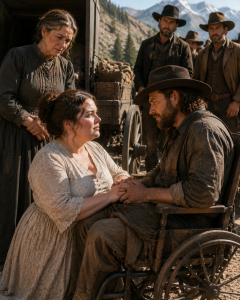
The words hung there, absurd and terrifying. Rowan, Eleanor explained, had been injured two years ago in a riding accident in the high country — his horse went over a ledge in a storm. He survived. His legs never fully healed. He’d driven off three nurses, two housekeepers, and a physical therapist from Chicago; he drank alone in his study and let the ranch fall apart around him because the hands no longer respected a man who could barely walk.
“You marry Rowan,” Eleanor said, voice hardening past its polite veneer. “Live with him. Manage the household. Give the appearance of a proper marriage. In return, I move your mother to the ranch — a doctor visits twice a week, warm fires, regular meals. Your brother gets food, education, a future that doesn’t involve freezing to death in a shack.”
“And what does your nephew get out of it?”
“A reason to stop feeling sorry for himself. Company, whether he wants it or not. Someone who won’t let him drink himself into an early grave.” Eleanor studied her like a horse she was considering buying. “You’re strong. Not prone to vapors. He doesn’t need another delicate flower wringing her hands over his condition. He needs someone who looks at a crippled man and still sees someone who can be useful.”
The words settled into Sarin’s chest like stones. A crippled man. A bitter drunk. A marriage that was really just servitude wearing vows instead of poverty. Every instinct screamed to refuse. Then her mother coughed, that wet rattling sound, and Danny whimpered from the other room, and Sarin understood she didn’t actually have a choice.
“How do I know you’ll keep your word?”
Eleanor produced a folded document — a legal contract guaranteeing care for her mother and brother for the duration of the marriage, and a five-thousand-dollar settlement and safe passage if the marriage ever ended. Sarin had never seen that much money in her life. Her father had died with seventeen dollars in his pocket.
“I need to think about it.”
“You have until morning.”
That night, holding her mother’s paper-thin hand, Sarin heard her whisper, “You’re so cold, baby girl. Ever since your daddy died. Don’t let it kill you.” But the cold had already won — had been winning for two years, eating away at their lives one frozen night at a time. This wasn’t about beating it anymore. It was about surviving it.
Morning came gray and bitter. Sarin dressed in her mother’s old wool dress, knelt in front of Danny, and made him a promise she intended to keep no matter what it cost her. Then she walked to town, signed her name to Eleanor’s contract with a hand that shook just slightly, and climbed into a carriage lined with leather and velvet, warmer than any room she’d occupied in months, heading toward a stranger she was about to marry.
—
## PART 2
The ranch appeared at sunset — three stories of white-painted wood against the mountains, barns and outbuildings sprawling, cattle dotting fields dark with snow. Wealth Sarin had only imagined, obscene when she thought of her mother dying in a one-room cabin.
Eleanor led her straight upstairs to a study lit only by a dying fire. A man sat in a leather chair, staring into the flames, a glass of whiskey in one hand and a cane propped against the chair arm. He didn’t look up.
“Go away, Eleanor. I’m not in the mood for a lecture.”
“I’m here to introduce you to your future wife.”
His head snapped up. Gray-green eyes, the color of a winter forest, found Sarin and looked at her with such open contempt she took a step back. “My *what*?”
“Your wife. This is Sarin Hail. You’ll be married this evening.”
He laughed — an awful, bitter sound with no humor in it. “You’ve finally lost your mind.” When Eleanor explained the arrangement in businesslike terms, he turned those cold eyes on Sarin. “Let me guess. One of those falling-apart cabins in the high country. Starving. Desperate enough to marry a man you’ve never met just to save your own skin.”
“Actually,” Sarin said, voice steady despite the rage building in her chest, “I agreed to marry a man I’ve never met to save my *mother’s* life. The fact that you can’t walk properly is just a bonus. Makes you easier to outrun when you get on my nerves.”
Silence dropped over the room. Rowan’s expression hardened into something worse than contempt. “Get out,” he said, and hurled his glass at the fireplace, glass and liquor spraying against the stone.
“I don’t need your charity, and I sure as hell don’t need some mountain rat playing nursemaid because you bribed her into it.”
The words hit like slaps, and Sarin let them land, then stepped forward anyway. “You want to know what’s suspicious, Rowan? My mother’s dying of pneumonia because we can’t afford medicine. My seven-year-old brother hasn’t spoken in two weeks because he’s starving. So yeah, I’m marrying you for the money and the security. But at least I’m honest about it. At least I’m not sitting in an expensive study drinking expensive whiskey and pretending it’s noble.”
His hands gripped the chair arms, knuckles white. “You don’t know anything about me.”
“I know you’re breathing. I know you’re not watching your family die by inches because you can’t afford firewood. We’re all suffering. At least you get to do it somewhere warm.”
Something in his face shifted — not quite hesitation, but he actually looked at her instead of through her. “This is insane,” he said, some of the heat gone from his voice.
“Probably. But I’m doing it anyway. And so are you — unless you’d rather explain to your aunt why you’d rather drink yourself to death than function like a human being.”
Justice Miller arrived within the hour. Rowan skipped straight to the vows. “Do you, Rowan James Vance, take this woman to be your lawfully wedded wife?” A pause that stretched too long, Sarin’s heart hammering — *he’s going to refuse, and my mother is going to die.*
“I do,” he said finally, flat and emotionless, like signing a contract.
“I do,” Sarin echoed when her turn came, thinking of her mother’s labored breathing, of Danny’s silence, of the slow death of hope.
“You may kiss the bride.”
“We can skip that part,” Rowan said. Sarin felt relief and humiliation in equal measure. “Fine by me.”
Married. Sarin Hail was now Sarin Vance, bound to a man who could barely look at her, led to a guest room by a husband who told her to keep the connecting door locked. *Stay out of my way. Don’t expect anything from me. Don’t try to fix me.*
“You should know something,” she told him, standing her ground in the doorway. “I didn’t agree to this because I had better options. I agreed because it was this or watch my family die. We don’t have to like each other. But we’re stuck together now, so we might as well try not to make each other completely miserable.”
She closed the door in his face before he could answer, and heard the uneven thump of his cane retreating down the hall.
—
## PART 3
The next morning, staff whispers followed her down the stairs — *poor mountain girl, married to a man who barely acknowledges she exists.* Pity, Sarin knew, was just contempt wearing a softer mask. She found her mother improved already under the ranch doctor’s care, breathing clearer, a fighting chance ahead of her. Danny was in the next room playing with a small carved wooden horse he wouldn’t say who’d given him — until he pointed, insistent, toward Rowan’s study. Left outside the door in secret, like Rowan couldn’t bear to be thanked.
It was something. A crack in the wall of resentment Sarin had started building.
She found him that afternoon at his desk, unlocked door, ledgers spread before him. “We need to talk.” “No, we don’t.” “This — the silence, the mutual resentment — isn’t sustainable. We’re married. We live in the same house.” She pressed until he agreed, grudgingly, to dinner. One hour. No expectations.
He arrived three minutes late, freshly shaved, in a clean pressed shirt — an effort, even if he wouldn’t admit it. Sarin moved her plate to sit directly across from him instead of at the absurd far end of the table. They talked, haltingly at first — about the ranch he used to run before the accident, about a foreman named Brennan who no longer took his orders seriously, about the way the men saw the cane and the limp and decided that meant weakness.
“That’s the stupidest thing I’ve ever heard,” Sarin said, when he explained why he’d stopped trying. “Your legs are damaged. Not your brain. You know this land, this business. So what if you can’t ride? You can still give orders. Unless you think Eleanor’s doing it wrong just because she’s old and a woman — in which case you’re not bitter, you’re a hypocrite.”
Anger flashed in his eyes, but he didn’t leave. “You don’t know what it’s like to lose everything that made you who you were.”
“You’re right, I don’t. But I know what it’s like to watch people give up. My father did it, after the first bad winter. Just went through the motions until the mountain killed him. And I’ll be damned if I watch you do the same thing.”
By the end of dinner, something had shifted — not friendship, not yet, but a fragile, tentative partnership. “Same time tomorrow?” she asked. “You didn’t hate it. I can see it on your face.”
—
A week later she confronted Brennan directly in the barn, in front of Rowan, when the foreman tried to use Eleanor’s authority as a shield against following orders on fence repairs. “How long have you worked for the Vances?” “Twenty-two years, ma’am.” “And is this ranch better, worse, or the same as before the accident?” A long pause. “Worse.” “Because Eleanor’s in charge, or because the man who actually knows this land has decided he’s too broken to do anything about it?”
Rowan’s jaw tightened — a warning she ignored. “You want respect?” she told him, in front of the crew now. “Stop asking for it. Take it. You know what needs doing. Give the order and make it stick.” Something hardened in his expression, replacing uncertainty. He turned to Brennan. “Crew on the north fence starting Monday. Four men minimum. From now on, when I give an order, you follow it.”
“Understood, sir.”
Walking back, Rowan admitted it had been necessary — Brennan would never respect him if he kept deferring to Eleanor’s shadow over his own. “He didn’t tell me to go to hell,” he said. “Because somewhere under all that testing, he still respects you,” Sarin said. “He just needed to remember why.”
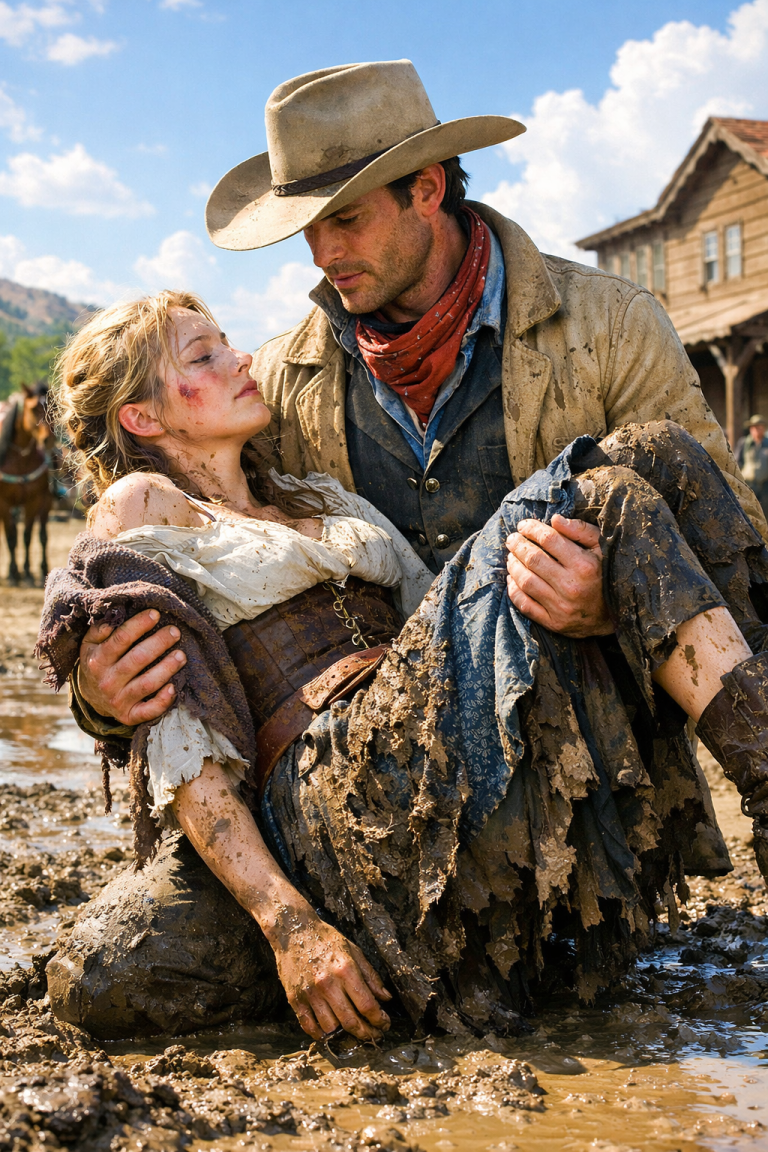
That night she woke to breaking glass through the connecting door — Rowan on the floor beside his bed, one hand gripping the post, the other clawed into his own thigh, a muscle locked rigid from an old break that never set quite right. He told her to leave. She didn’t. She’d seen her father seize up the same way after his back injury, knew you had to straighten the leg through the worst of it. “Stop, stop — almost there. Breathe through it.” The muscle finally released, and he slumped against the bedpost, trembling.
“How often does this happen?” “Often enough.” “Two, three times a week. Worse when the weather changes.” He hadn’t told anyone. Hadn’t wanted anyone to see.
She sat with him afterward — warm compresses, quiet conversation — and something new passed between them, an intimacy neither of them had signed up for. “Why are you being kind to me?” he asked. “I’ve been nothing but difficult.” “Because underneath the difficult, I can see glimpses of someone decent. Someone who gives toy horses to scared kids and keeps his word even when it costs him.”
—
Days later, over breakfast, Rowan admitted what actually scared him — not the ranch work itself, but the horse he hadn’t ridden since the fall. “I used to ride like it was breathing. Now I can barely look at the stables without my hands shaking. It’s pathetic.” “It’s human,” Sarin said. “But so is doing the thing that scares you anyway.”
That afternoon, in front of the stable hands, Rowan mounted his old mare Juniper for the first time in two years — hands shaking, face pale, breathing hard, but up. “How does it feel?” “Like I’m going to fall.” “You’re not going to fall. Juniper’s got you.” Curtis led the horse in slow circles around the training ring while Sarin walked alongside, coaching him through the panic one breath at a time. By the third lap, some of the rigidity had left his shoulders.
“I did it,” he said, when they finally stopped. “I’m on a horse and I didn’t fall apart.”
“You did good, Rowan.”
Over the following weeks, he rode further, took back the ranch operations piece by piece, and pushed himself hard enough that Sarin had to physically block his path one evening when he came back gray with exhaustion, refusing to eat. “You’re running yourself into the ground trying to prove you’re not who you were after the accident.” He crumpled against the wall. “I can’t go back to sitting in that study feeling useless. I can’t do it again.” “You won’t. But you also can’t run this ranch if you cripple yourself proving something.”
She nursed him through the compresses again that night, and this time when she went to leave, he asked her to stay until he fell asleep. She did — and left both connecting doors open after that.
The next morning, Danny found the courage to whisper his first words in weeks in the stable, palm flat under Juniper’s nose. *”She’s soft.”* Sarin cried openly. Rowan, keeping his voice carefully casual so as not to spook the moment, said, “Yeah, she is. Feel her nose, even softer,” and Danny giggled — actually giggled — and just like that, he was talking again, tentative bursts at first, then in a flood, like weeks of stored-up words finally spilling free.
—
By early March, snow melting into mud, Rowan asked Sarin to ride with him up to the ridge where he’d fallen. Standing at the edge, looking down at the rocks that had nearly killed him, he said quietly, “I thought I was going to die. Would have been easier if they’d just left me there — for Eleanor, for the hands, for you.”
“You don’t get to decide what’s easier for other people,” Sarin said. “I wasn’t forced into this marriage. I made a choice. Not one I wanted, but mine. Same as coming up here today was a choice. That’s not weak. That’s brave.”
“I don’t feel brave. I feel scared most of the time.”
“Brave people always are. That’s what makes it count.”
He laughed then — actually laughed, rusty but real — and something between them shifted permanently. Walking back to the house that evening, his hand found hers without either of them commenting on it. Eleanor met them on the stairs, taking in his flushed face, his straighter posture. “You went up to the ridge.” Not a question. “I did. And I’m still standing.” Something in Eleanor’s expression softened in a way Sarin had never seen. “It’s about damn time. Welcome back, Rowan.”
That night at dinner, hands linked across the table, Rowan asked her plainly if this was still just survival between them. “I don’t know what this is,” Sarin admitted. “But it’s more than that. It’s something.” He reached for her hand fully this time, no longer tentative. “I’m glad Eleanor forced this.”
—
The real declarations came weeks later, walking back from the stables under new stars, spring’s promise starting to cut winter’s bite. “I’ve been thinking about us,” Rowan said, stopping to face her. “It started as a transaction. But it’s become more than that, at least for me.” When she didn’t pull back, he took both her hands. “I want to choose you properly. Real vows, in front of everyone who matters, because we decided it — not because Eleanor bribed us into it.”
They planned a second wedding for late spring, wildflowers blooming, nothing fancy — family and hands and Justice Miller performing a ceremony that actually felt like one this time. Sarin wore pale yellow, sewn by her mother. Where the first wedding had shown contempt and resignation, this one showed joy.
“I do. Absolutely. Completely. Without reservation,” Rowan said, and kissed her properly in front of everyone, and the ranch hands cheered like they’d been waiting for it for months, because they had.
—
Life on the ranch found its rhythm after that. Danny thrived, started school in town, claimed his own future horse would come once he’d proven himself responsible with the pony Clover. Sarin’s mother recovered fully, helping run the household, finding an unlikely friendship with the cook. Eleanor, watching it all, told Sarin plainly one afternoon that she intended to sign the ranch over to them — “You’ve proven you can run it, proven you care about it. It should be yours” — and by summer, the papers were signed.
Not every season was gentle. One brutal January night, Rowan pushed himself into a blizzard rescuing stranded cattle and came back half-frozen, feverish for three days while Sarin nursed him, terrified she’d lose him the way they’d almost lost her mother. Their worst fight followed his recovery — *you could have died out there, was your pride worth making me a widow* — but it ended with an honest promise instead of silence: he’d trust his men, respect his own limits, stop trying to prove he wasn’t broken. It was the kind of fight that made the partnership sturdier rather than breaking it.
Sarin discovered she was pregnant that summer; their daughter, Hope, was born the following February during a snowstorm, small and red-faced and fierce. Eleanor lived long enough to hold her before passing quietly in her sleep three weeks later, buried on the ranch under a pine tree with a view of the mountains she’d loved. “She gave me everything,” Rowan said at the grave. “This land, this life, you.” “She gave us a chance,” Sarin said. “We did the rest.”
Sarin’s mother lived to see Hope’s fifth birthday before she, too, passed peacefully, surrounded by family, her last words a whispered thank-you for the good years at the end.
—
Years later, going through old ledgers in the library, Sarin found herself telling Rowan she’d been thinking about that first terrible night — the glass thrown at the fireplace, how certain she’d been she’d made a mistake.
“You had reasons,” she said. “You were hurt and angry.”
“But look at us now.” He sat beside her, his leg aching the way it always would, the pain a permanent fact he’d learned to work around instead of against. “I think about the man I was before you came. I was dying, Sarin. Not physically. In every way that mattered. And you dragged me back to life whether I wanted it or not.”
“You did the same for me.”
Outside, they could hear Hope’s laughter as Danny — grown now, capable, talking seriously about someday taking over part of the operation — taught her to lasso fence posts. The ranch hummed with the kind of ordinary, hard-won life neither of them had believed possible the night a rich stranger in furs walked into a freezing cabin with a proposition that sounded, at the time, like a life sentence.
It hadn’t been a sentence. It had been the beginning of everything that mattered — two desperate people, forced together by circumstance, who’d chosen, deliberately and daily, to become each other’s home.
**THE END.**