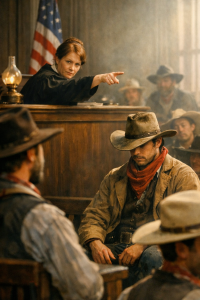
The judge ordered her to choose any husband — then she pointed at the silent cowboy everyone had ignored

—
## PART 1
The courtroom smelled like sweat, tobacco, and something Clara couldn’t name. Maybe contempt. She stood before Judge Halloway’s bench with her hands folded at her waist, trying to keep them from shaking, hating herself for noticing, hating herself more for caring.
“Mrs. Whitmore,” Halloway said, her name flattened by his nasal tone. “This court has reviewed your late husband’s debts. The sum is considerable.”
She’d known the number for weeks — $3,418. Might as well have been three million. “Yes, your honor.”
“The bank has filed for immediate seizure of your property. Under territorial law, a widow without means may be granted an extension if she can demonstrate financial support.” He said it like she were too dim to piece it together. “Meaning a husband, Mrs. Whitmore. Marry within the hour, and the court will grant a thirty-day stay. Refuse, and the farm is forfeit today. This minute.”
A ripple of noise rolled through the gallery. She didn’t turn around. She’d felt their eyes on her since she walked in, weighing her like livestock at auction — thirty men, maybe more, crammed into a room that barely held twenty.
“Gentlemen,” Halloway addressed the room, “if any man here is prepared to make such an offer, step forward now.”
A thick-necked man in the third row stood. “I’ll take her. Farm’s got good water access. I’ll marry her, pay half the debt. Rest she can work off.” Laughter rippled through the crowd — not loud, just enough to sting. An older man offered forty head of cattle that wouldn’t cover half. Three more stood in quick succession, each offer barely touching the debt, each man looking at her like a burden he’d tolerate if the price was right. Halloway dismissed them all with increasing irritation.
“Anyone else?” His voice had taken on a bored edge. He was already reaching for his gavel.
Silence. Clara closed her eyes. The farm was gone. The land her father had broken his back clearing. The house where she’d buried her mother. Gone. She’d be out on the street by sunset with nothing but the clothes on her back and a reputation that would follow her like a shadow.
“I’ll marry her.”
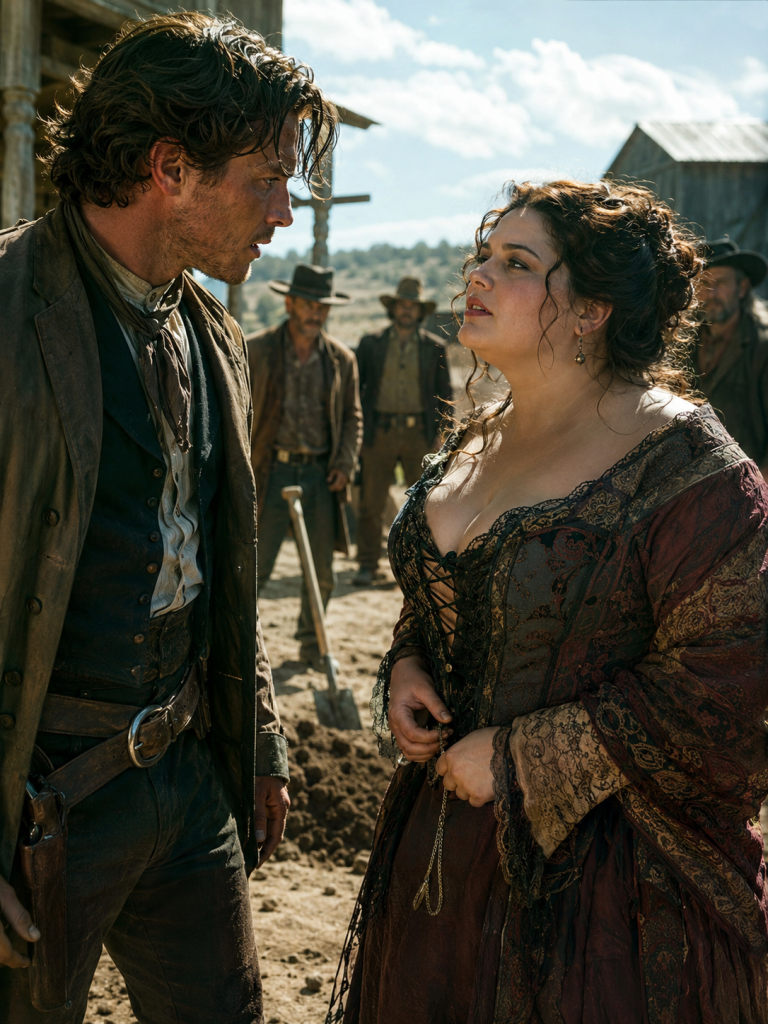
The voice came from the back corner, quiet but clear. Every head turned. A man stood near the rear door, half hidden in shadow — dust covering his coat, his hat, his boots, like he’d ridden straight through a storm to get here. Tall, lean in a way that suggested hardness rather than hunger, dark hair past his collar, unshaven and weathered.
“And you are?” Halloway’s irritation sharpened into suspicion.
“Elias Crowe.” He moved forward with an easy, unhurried gait that somehow made the room feel smaller. “I’ll cover the debt. All of it.”
The room went dead silent. Clara stared at him. She’d never seen this man in her life.
“You have three thousand dollars, Mr. Crowe? On your person?”
“No. But I can have it here by end of week.”
A snort of laughter from the crowd. “Sure you can, drifter.” Elias didn’t react — didn’t even glance toward the speaker, gaze locked on the judge, patient and unreadable.
Halloway frowned, weighing his options. He clearly didn’t like Elias. He also didn’t have a better offer. “This court requires proof of funds. Do you have any documentation?”
Elias reached into his coat. Half the room tensed, hands drifting toward belts. He only pulled out a folded piece of paper, worn soft at the creases, and handed it to the bailiff.
Halloway unfolded it, and his expression flickered — surprise, maybe unease. “This is a letter of credit from a bank in Kansas City. Signed by Charles Drummond.” A murmur ran through the crowd; Clara didn’t recognize the name, but clearly others did. *Drummond’s good for it. If Crowe’s got his backing, the money’s real.*
“Why?” Halloway asked finally. “Why marry a woman you don’t know to pay a debt that isn’t yours?”
It was the question on everyone’s mind. Elias turned and looked at Clara for the first time — gray eyes, the color of storm clouds, that didn’t linger on her body or catalog her flaws the way every other man’s had. Just her face, steady and calm.
“Because she didn’t ask for any of this,” he said quietly. “And she deserves better than what this room’s offering.”
Halloway made a disgusted noise. “Noble sentiments, Mr. Crowe. But sentiment doesn’t pay debts.”
“No,” Elias agreed. “Money does. And I’ve got it.”
The judge sighed heavily. “Mrs. Whitmore. Do you consent to marry this man?”
Clara’s heart hammered so hard she could feel it in her throat. This was insane. She didn’t know Elias Crowe from Adam. He could be a thief, a liar, a killer. He could take her farm and disappear. But he was also the only man in this room who’d looked her in the eye.
“Yes.” Her voice didn’t shake.
The gavel cracked down like a gunshot. “By the power vested in me by the territory of Nebraska, I declare you husband and wife. Mr. Crowe, you have seven days to deliver the funds. Court adjourned.”
The room erupted into noise. But Clara barely heard any of it. She was too busy staring at the man who’d just become her husband.
“We should go,” he said quietly, weaving through the crowd toward her, close but not touching. “Your farm. We need to talk.”
Outside, the sky hung heavy with unshed rain. Elias helped her into her wagon, took the reins without asking, and they rolled out of town in silence, the plains stretching flat and endless on either side, storm clouds gathering dark on the horizon.
“Why did you do that?” Clara finally asked.
“I told you. You deserved better.”
“That’s not an answer.”
“It’s the only one I’ve got right now.” He studied the road ahead like a man expecting trouble. “Do I need to be scared of you?” she asked.
That got his attention. He turned, meeting her gaze directly. “No,” he said. “But you might need to be scared of what’s coming.”
A chill ran down her spine. “What’s coming?”
The gunshot cracked through the air before he could answer.
—
## PART 2
The mare screamed and bolted, nearly throwing Clara from the wagon. Elias hauled her back as another shot rang out, closer, splintering wood near her head. “Hold on!” He snapped the reins hard, and the wagon lurched into a gallop over ruts and rocks.
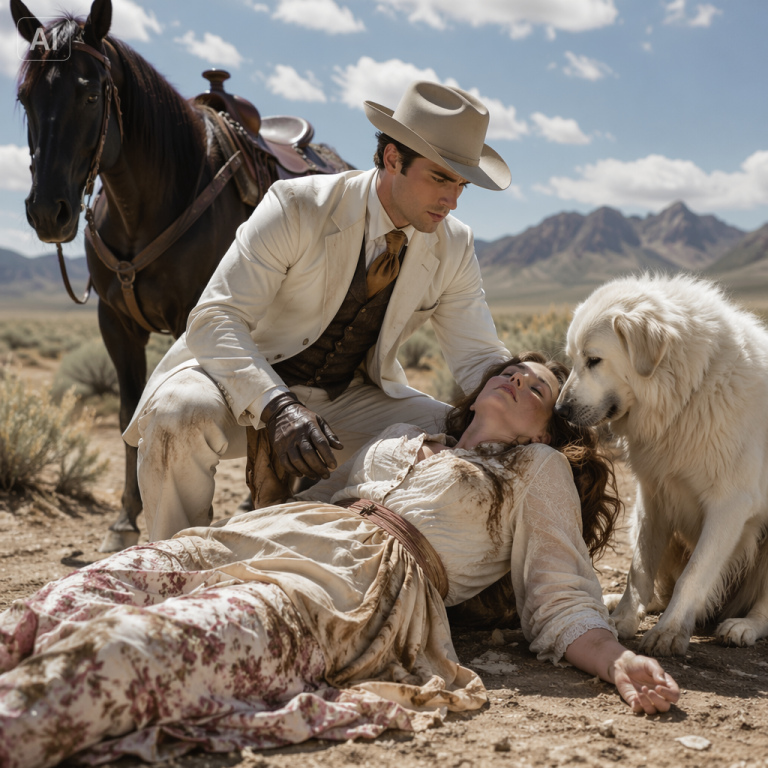
Four riders appeared on the road behind them, dark coats, hats pulled low. “Get down!” Elias shoved Clara into the wagon bed; she landed hard on feed sacks and pressed herself flat. He twisted in the seat, revolver out, firing three shots. The riders didn’t slow.
He yanked them off the road entirely, into open field, bone-jarring chaos, the riders spreading to flank them. One pulled alongside close enough for Clara to see his face — scarred, eyes like ice — and raised a pistol at her. Elias shot him first. The man tumbled from his horse. The other three didn’t stop.
The field narrowed into a bottleneck between hills; Elias forced the wagon through a gap that dropped into a steep-walled ravine, gravity pulling them faster than the mare could control, the brake screaming uselessly. They hit bottom in a bone-shaking crash. Behind them, at the ravine’s rim, the remaining riders reined in, stopped, and simply watched. One raised a hand — almost a salute. Then they turned and rode away.
Elias kept the horse moving another mile before he finally pulled up, breathing hard, hand shaking faintly as he holstered his gun.
“What the hell was that?” Clara demanded.
“A warning.”
“From who?”
He looked at her, and for the first time she saw something in his eyes that might have been fear. “People who think you have something they want.”
“I don’t have anything.”
“Your husband did.”
Clara’s blood went cold. “Thomas.”
Rain began to fall, cold and heavy, soaking through her dress in seconds. She stared at the stranger she’d just married and understood she’d traded one nightmare for another. “Tell me everything,” she said.
“Not here. We need to keep moving.”
—
## PART 3
They stopped for the night in a stand of cottonwoods, Elias rigging a canvas tarp against the rain while Clara sat shivering underneath it, eating stale cornbread with hands that wouldn’t stop trembling.
“Your husband,” Elias said finally. “What did he tell you about his work?”
“He was a farmer. That’s all. Sometimes he’d go into Omaha for supplies, be gone two, three days. That was normal.”
“Did he ever come back different? Nervous. Looking over his shoulder?”
Clara frowned, thinking back. The last few months before the accident, Thomas had seemed tense — locking the barn even though they had nothing worth stealing, burning papers in the stove one summer afternoon for no reason she could name. “The well,” she said slowly. “He was fixing it. The rope broke. He fell. I found him after.”
“I don’t think it was an accident,” Elias said quietly.
The words hung terrible in the air. “The men who came after us today — they’re professionals. They think you have something valuable enough to kill for, and that Thomas gave it to you before he died.” He told her the rest in pieces: he’d been tracking a man named Dalton Mercer for two years, ran most of the illegal operations between here and Kansas City — gambling, smuggling, extortion. Thomas’s name had surfaced in the investigation three months back. By the time Elias traced him to the farm, he was already dead.
“If I hadn’t stepped in at the courthouse,” Elias said, “someone else would have married you, paid your debt, and taken you somewhere private to ask questions. When you couldn’t answer them, they’d have hurt you until they were sure you were telling the truth.”
Clara pressed her hands to her face, trying to breathe through the panic. Thomas had been boring, predictable, safe. He couldn’t have been involved with criminals — and then a memory surfaced, sudden and sharp. His last morning. The barn. Him hunched over something at his workbench, shoving it into a leather satchel the second he heard her coming, locking it in his father’s old steamer trunk.
“The trunk,” she whispered. “He locked something in it the day he died. I never had the key.”
The words weren’t out of her mouth a minute before hoofbeats sounded through the rain. Elias was gone into the dark before she could respond. Voices, closer, then right on top of them — *saw the wagon tracks, they’re holed up close.* A man appeared through the rain with a rifle, and Elias came up behind him and clubbed him down without a sound. “Run!”
They fled into the trees, bullets tearing branches overhead, and burst into open ground straight into three waiting riders. Elias shoved Clara behind him.
The lead rider — scarred, dead-eyed — smiled around tobacco-stained teeth. “Smart move, Crowe. But not smart enough. Drop the gun.” Elias’s finger tightened on the trigger, calculating odds that didn’t exist: three armed men on horseback, no cover, no backup.
“No,” Clara said, stepping out from behind him. Anger had replaced the fear — pure, burning anger at a lifetime of being dismissed, underestimated, pushed around, and now about to die in the mud over something her dead husband had gotten tangled up in. “What is it you want?”
“Your husband had something that belongs to my employer. A map. You’re going to tell me where it is.”
“I don’t know anything about a map.”
“Wrong answer.” He drew a pistol. “But we’ve got all night to help you remember.”
They were bound and marched to a rotted shack two miles east, the ropes biting into Clara’s wrists with every stumble through the dark. Twice she fell in the mud; twice Elias tried to help her up and was shoved back by one of the men. Inside, the shack was worse than its sagging exterior promised — dirt floor, holes in the walls where wind whistled through, but it had a roof, and one of the riders got a fire going. The three men settled near it, passing a bottle, their leader’s hand never far from his gun.
“I’m sorry,” Elias murmured, low enough only she could hear, “for getting you into this.”
“You didn’t,” Clara said. “Thomas did. Or maybe I did it to myself, marrying a man I never really knew.” She leaned her head back against the wall, exhaustion pulling at her harder than fear now. “What’s on this map they want so badly?”
“If I had to guess — routes, names, locations of Mercer’s operations. Thomas must have been gathering evidence, planning to turn it over to the authorities.”
“Why would he do something like that?”
“Maybe a crisis of conscience. Maybe Mercer threatened him. Maybe both.” Elias shifted, trying to find comfort with his hands still tied. “Either way, he chose to fight back. That took guts.”
“It also got him killed.”
“Yeah. It did.”
They sat in silence, listening to rain and the low murmur of the men’s talk, Clara’s mind circling back to the trunk in the barn, to the possibility she’d been living beside something dangerous for months without knowing it. “If the map’s real and we give it to them, they’ll kill us anyway, won’t they?”
“Yes,” Elias said, flat and factual.
“So what do we do?”
“We survive the night. Then we figure out the rest.”
At dawn they were forced onto a single horse and ridden to the farm, Clara recognizing the landscape as it unspooled — the crooked oak marking the property line, the stone fence her grandfather had built, the barn standing like a monument to years of hard work. Home, or what used to be. The trunk sat where she remembered; the scarred rider shot the lock off himself, knelt, and pulled out a leather satchel stuffed with papers covered in symbols neither Clara nor Elias could read.
“It’s code,” Elias said, going pale. “Thomas encrypted it. The map’s here, but you can’t read it without the key.”
The rider’s face darkened. He grabbed a page and shoved it at Clara. “Then you decrypt it.”
“I can’t. I don’t know how. Thomas never—” He backhanded her across the face before she finished the sentence. Her head snapped sideways, stars exploding behind her eyes, blood filling her mouth. He grabbed her by the hair, yanked her head back, pressed the blade of a knife against her throat. “Last chance.”
Staring into those dead eyes, Clara felt something that should have terrified her settle into a strange, cold calm instead. She was going to die whether she talked or stayed silent. She might as well go out on her own terms.
“Go to hell,” she whispered.
His head exploded. The shot came from the barn loft — a gray-bearded stranger named Samuel Hayes, it turned out, working with a federal deputy named Frank Mason, both already deep in Elias’s investigation. The scarred rider’s body dropped like a puppet with cut strings; the remaining two dove for cover as gunfire erupted from multiple directions at once. In the chaos, Clara and Elias sawed each other’s ropes free with the dead man’s knife, and Elias shoved her toward the barn’s root cellar. “Stay until I say.”
The gunfire eventually stopped, the silence afterward more frightening than the noise had been. When Clara finally climbed out, she found Elias alive but bloodied, Samuel and Mason gathered around her kitchen table — and a full accounting, at last, of exactly what they’d married into. Thomas, it turned out, had been hired as a freight hauler by Mercer eighteen months earlier — legitimate cover work that let him quietly document an entire criminal network spanning six states: shipment routes, payoffs, corrupt officials from judges to state legislators. He’d apparently contacted a federal prosecutor about turning evidence before someone leaked it back to Mercer, who’d ordered the “accident” personally.
The cipher took hours to crack — Thomas had used his Bible as the key, underlining single words to spell out messages letter by letter, something Clara had mistaken for devotion. They’d barely started decoding when Mercer himself arrived with six armed men, silver-haired, cold-eyed, dismounting with practiced ease.
“Mrs. Whitmore. I believe you have something that belongs to me.” He backhanded her with his pistol when she stalled, shot Samuel in the leg when she stalled again, and finally got what he wanted — the papers, the Bible, the key — and raised the gun to her head with the calm of a man closing a transaction. “You’ve been very helpful. Unfortunately, you’re now a liability.”
“I hope it destroys everything you’ve built,” Clara told him.
The blast that saved her life came from the road — federal marshals, a dozen of them, hitting Mercer’s men in a hammer of gunfire and confusion. Elias tackled Mercer as he ran for his horse; they grappled for the gun, it fired twice, and Mercer went still, blood spreading across his fine coat. It was over.
—
Deputy Marshal Katherine Wells explained the rest once the smoke cleared: Samuel had been embedded in Mercer’s organization for years; when Elias reported the forced marriage and the road attack, they’d moved as fast as they could. Not fast enough to spare Clara the worst of it — but fast enough that she was alive to hear it.
Among Thomas’s papers, tucked inside the Bible, was a letter addressed to her. *If you’re reading this, I’m already gone… I thought I could fix it quiet, keep you safe by keeping you ignorant. I was wrong… You’re stronger than you know, Clara. Stronger than I ever gave you credit for.* She read it twice, then burned it in the yard. It didn’t bring him back. It didn’t undo anything. But it was, eventually, enough to let her stop hating him for it.
Thirty-seven people were ultimately convicted from Thomas’s documentation — judges, officials, gang members. Clara testified for three days, unshaken by defense attorneys trying to paint her as complicit or hysterical. “I’m done being underestimated,” she told Wells.
In the wreckage of it, standing in her ruined kitchen with smoke still drifting outside, Elias asked her the question that mattered more than any of it. “I go where the work takes me. Unless you need someone to go west with you.”
She should have said no — taken her fresh start alone, cut every tie to what had happened here. Instead: “I think I could use a partner. Someone who knows how to handle trouble when it comes calling.”
“Trouble has a way of finding me,” he warned.
“I noticed. But I’m starting to think I can handle more than people gave me credit for.”
“Yeah,” Elias said softly. “You really can.”
—
They joined a wagon train west three days later — a legal-fiction marriage becoming, mile by grueling mile, something neither of them was pretending anymore. Clara learned to shoot, to drive the wagon through Elias’s bout of dysentery, to haggle at trading posts, to bury a neighbor’s child outside Fort Hall and keep walking anyway, because that was what the trail demanded and what she’d apparently become capable of. By the time they reached the Willamette Valley in Oregon and staked 160 acres of timber and river frontage, the frightened widow from that Nebraska courtroom was someone Clara barely recognized in her own reflection.
Halfway back through Wyoming — after testifying, after watching justice, however imperfect, actually land — Elias stopped the wagon outside a small church in a town called South Pass. “Getting married for real this time,” he said. “I don’t want fiction anymore. I want you, Clara, for better or worse, as an actual partner. If you’ll have me.”
“Yes,” she said. “It’s enough.”
They built a cabin. By spring Clara was pregnant; by winter they had a daughter, small and loud and perfect, whom Clara named Sarah after the friend who’d shown her strength came in many forms.
—
The peace lasted eighteen months. Then three riders came over the ridge one morning while Clara weeded the garden with Sarah at her feet — men who moved like they were hunting, not visiting. Their leader, Gerard Whitlock, introduced himself as an associate of the late Dalton Mercer, come to collect what he called *restitution* — information Clara supposedly hadn’t handed the marshals, leverage for an operation quietly rebuilding out of the wreckage.
Clara met him with a rifle and a flat refusal. Elias backed her from the barn door, pistol drawn. Whitlock left promising it wasn’t over, and it wasn’t — the only way to end it permanently, they decided, sending Sarah to safety with her namesake in Portland, was to take the fight to him before he brought more men than they could shoot.
Samuel, retired from marshal work but still connected, tracked Whitlock’s front operation to a building in Omaha — legitimate import-export business on the surface, real dealings run out of the basement. Clara and Elias went in as customers, cased the guard rotations, and returned at midnight to photograph ledgers and shipment records with a smuggled camera, freezing behind a filing cabinet at one point while Whitlock himself walked through discussing, in Clara’s hearing, a plan to threaten their daughter to force their cooperation.
They got out with enough evidence — names, routes, a taped confession of intent — to hand Wells and the marshals probable cause for coordinated raids across four states. Whitlock was captured trying to flee Omaha with two suitcases of cash. The jury convicted him in under an hour.
“It’s finished,” Clara said, on the courthouse steps, and for the first time in two years, she believed it.
—
They collected Sarah from Portland, and the years that followed were, at last, ordinary in the ways that mattered. Two more children. A cabin that grew room by room into a real house. A farm that prospered slow and steady under two people who’d learned, the hard way, that peace wasn’t something you found once — it was something you kept choosing to protect.
Elias died at sixty-seven, his heart simply giving out one morning in the garden, Clara holding him as he went. She lived twenty years past him, long enough to see grandchildren, long enough to watch Sarah become a teacher and then a principal who fought for women’s education and never once let anyone tell her she was less than extraordinary because her mother had taught her, in a leather journal handed over on her eighteenth birthday, exactly what an ordinary woman was capable of when she refused to quit.
On her last day, surrounded by family in the house she and Elias had built with their own hands, Clara looked back on all of it — the courtroom, the gunfire, the years of building something real out of a marriage that had started as a legal loophole to save her life. She wouldn’t wish any of it on another soul. She wouldn’t trade it either.
Her last words to Sarah, leaning close to hear them, were five: *”Don’t let anyone make you small.”*
Sarah kept that promise, and taught it to her own children, who taught it to theirs, until the stone marker under the old oak tree on land the family no longer owned was the only thing left with Clara’s name on it — *Clara Whitmore Crowe, 1836–1903* — but not, by any measure that mattered, the only thing left of her.
**THE END.**