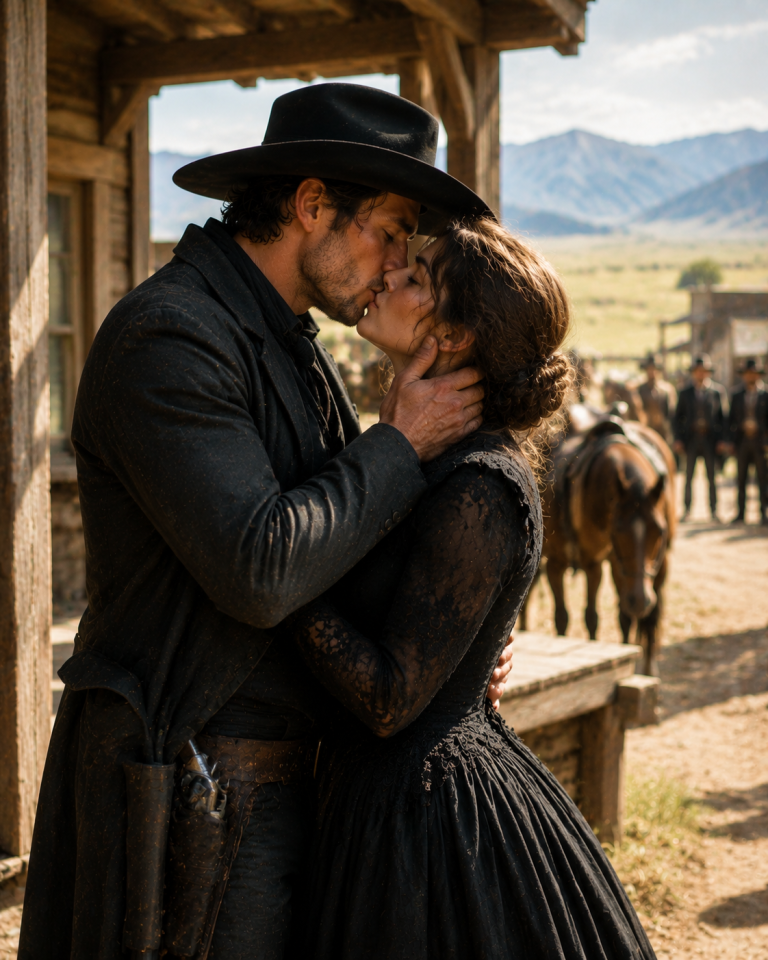
A Lonely Rancher Ordered a Wife — Then She Arrived Ready to Rewrite Every Rule

—
## PART 1
Henrik Lund ordered a wife the same way he ordered everything else on his ranch: by mail, with specifications.
He wanted a woman between twenty and thirty, healthy, willing to cook, clean, and keep a homestead running. Preferably quiet. He wrote all of this to a matrimonial agency in Chicago and enclosed a tintype photograph in which he looked stern, clean-shaven, and roughly forty percent more handsome than he actually was.
What arrived on the Northern Pacific three months later was a thirty-year-old German immigrant named Alma Brandt — five foot eight, opinionated, and privately determined, somewhere around the Wyoming border, to be absolutely nothing that Henrik Lund had ordered.
Henrik had come to Montana Territory in 1876 with eighty dollars, a plow, and the flat certainty that the frontier was a place where a man could build something with his own two hands and nobody would trouble him about it. He’d been right about the building. By 1882 he had a hundred and sixty acres of good land, a log cabin where a sod house used to stand, forty head of cattle, and a loneliness so complete it had developed its own geography — rooms in the cabin he simply didn’t use anymore because there was no reason to be in them.
He was thirty-five, tall, fair-haired, handsome the plain, unhurried way Norwegian ranchers tended to be handsome, without ever appearing to try for it. He didn’t smile often. He spoke in short sentences, on the theory that efficiency was a virtue and conversation, most of the time, wasn’t.
He’d tried finding a wife locally first. The problem was arithmetic. There were fourteen single men in the Billings area for every unmarried woman, and most of the women who’d wanted husbands had already chosen the ones who talked more. So Henrik wrote to the agency and described what he wanted the way he’d describe a horse he was in the market to buy — good temperament, sound constitution, willing to work. He didn’t mention love. He didn’t mention companionship. He mentioned that the winters were hard, and that a woman who couldn’t handle real isolation shouldn’t bother applying.
The agency matched him with Alma Brandt, whose application said she was thirty years old, in good health, experienced in domestic work, and willing to relocate west. None of it was false. All of it left out considerably more than it told him.
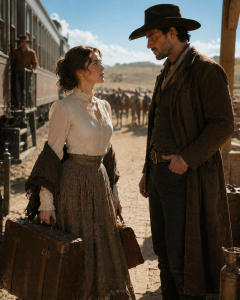
Alma stepped off the train at the Billings depot on September 14th, 1882, in a blue traveling dress a shade too fine for her surroundings, carrying two suitcases and a violin case. Henrik had expected a quiet woman.
“You are shorter than your photograph suggested,” Alma said, by way of introduction, “but your chin is better in person.”
Henrik had expected a compliant woman too.
On the ride out to the homestead, Alma asked him fourteen separate questions — about the property, the water source, the nearest neighbor, the nearest church, and whether there was a lending library within riding distance. Henrik answered twelve of them in a single word apiece. Alma took note of that and said, “You’re either very efficient or very boring. I’ll determine which by Thursday.”
He had expected a domestic woman, and in that much, at least, he’d been correct. Alma could cook, clean, sew, and manage a household with the precision of a quartermaster running a supply line. What he had not expected — had no way of expecting, from an application form — was that she also read Latin, played the violin, argued theology for sport, and had formed detailed opinions on cattle breeding from agricultural journals she’d read cover to cover on the train west.
That first evening she cooked supper, and it was excellent, and then she sat down across from him at the table and said, “We should discuss terms.”
“Terms,” Henrik repeated.
“I have come three thousand miles to marry a man I’ve never met,” Alma said. “This is a business arrangement. We should discuss it like adults.” She folded her hands on the table. “I will keep the house, cook, and help with the ranch. In exchange, I want three things. A room of my own until we’re properly married. A bookshelf. And the right to say no without having to explain myself.”
Henrik Lund had never once, in thirty-five years, been negotiated with by a woman. He had barely been negotiated with by men. He sat across from this tall, unapologetically direct German woman he’d known for four hours and felt something he hadn’t felt in six years alone on that land.
“Surprise,” he said.
—
## PART 2
“You can have the room,” he said. “And the bookshelf. The right to say no was already yours. It never needed my permission to exist.”
Alma looked at him for a long moment. She had come prepared to fight for those three terms, one by one, expecting resistance at every point. She had not expected a man who understood, immediately and without being told, that her autonomy was not his to grant in the first place.
“That’s the right answer,” she said.
“I know,” Henrik said.
It was more words than he had spoken in a single evening in three years, and it turned out to be only the beginning.
Within a week Alma had reorganized his kitchen, repaired his chicken coop with tools she’d found rusting in the barn, and built a cold frame out of scrap lumber to get winter kale started before the ground froze solid. Henrik came home one evening to find his woodpile restacked in a pattern more efficient than his own and stood looking at it for a long moment before he could bring himself to say anything.
“You restacked my wood,” he said.
“Yours was going to rot from the bottom up,” Alma said. “Air needs to move through it.”
He didn’t say anything else that night. The next morning he built her the bookshelf — pine, hand-planed, three shelves, with a carved edge along the top that served no function whatsoever except to be beautiful. By the standards of a man who measured every purchase against its usefulness, it was an act of wild extravagance.
Alma set it in her room and filled it with the twelve books she’d carried west from Chicago. That evening, for the first time since she’d stepped off the train, she took out the violin and played.
By November she was riding out with him to check the cattle. She’d never sat a horse before Montana, and her first attempts were ungraceful enough that Henrik had to look away more than once to keep from smiling. She fell twice. Got back up both times without a word about it. By the third week she was riding beside him in comfortable silence for two hours at a stretch, and then, without warning, she said, “This is the most beautiful place I’ve ever seen. Why didn’t you say so in your letter?”
“I didn’t think anyone would believe me,” Henrik said.
It was the most personal thing he had ever told another living person, and he said it before he’d had time to decide whether he meant to.
—
## PART 3
Henrik Lund was quiet the way deep water is quiet — not because there was nothing underneath, but because everything was. Alma found that out in December, when she came down with a fever that held on for four straight days.
Henrik didn’t send for a doctor. The nearest one was in Miles City, ninety miles off, an impossible ride in that weather with a sick woman waiting behind him. So instead he nursed her himself. He boiled broth. He kept the fire fed through the night, every night, checking it on an hour’s rhythm he never seemed to need a clock for. He sat in the chair beside her bed and read to her out of one of her own books, haltingly, because his English had been learned rather than born into him, and the book happened to be Tennyson, which isn’t easy going for anyone, let alone a Norwegian rancher sounding it out by lamplight.
When the fever finally broke, Alma opened her eyes to find Henrik asleep in the chair, the book still open on his chest, one hand resting at the edge of her blanket — not touching her, just near enough that she could feel the warmth of him through the wool.
She didn’t wake him. She lay there in the firelight and looked at his face for a long while and thought, plainly, without any drama attached to it: *I came here expecting a transaction. I found a person.*
But the moment that actually turned the arrangement into a marriage — the real one, the one neither of them had written into any letter — came a few weeks later, on Christmas morning, and it caught both of them off guard.
Henrik hadn’t celebrated Christmas in six years. No tree, no decorations, nothing left of the holiday that didn’t lead straight back to his mother’s kitchen in Norway, five thousand miles and a whole lifetime away. That morning he came out of his room and found the cabin transformed — not with anything bought, because there was no store within a full day’s ride. Alma had used what she had. Pine branches cut from the tree line. Candle stubs melted onto the lids of old canning jars. Strips of red fabric cut from her own petticoat and tied along the branches like ribbon. On the table sat a plate of *Springerle* — German spice cookies she’d baked at four that morning, using ingredients she’d been quietly hoarding in her trunk since Chicago, waiting for a reason.
Henrik stood in the doorway and didn’t move. He looked at the branches, the candles, the cookies, the woman standing beside the table watching him take it in, and something in him that had stayed locked shut for six straight years came open with a sound only he could hear.
“You did this,” he said.
“It’s Christmas,” Alma said. “Even in Montana.”
Henrik was quiet for a moment. “In Norway we have a word,” he said. “*Koselig.*” He stopped, searching for the rest of it in a language that wasn’t the one he’d grown up thinking in. “There is no English for it exactly. It means — the feeling of being warm when the world outside is cold. Of being home when you are very far from home.” He looked at her across the table. “This is *koselig.*”
Alma’s eyes filled. She had come to Montana braced for a cold man in a cold place, prepared for an arrangement with no warmth built into it at all. And this man — this quiet, stubborn Norwegian farmer who spoke in single syllables and built bookshelves with carved edges that served no purpose but beauty — had just handed her the most beautiful thing anyone had ever said to her in her life.
“In German we have a word too,” she said. “*Geborgenheit.* It means the same thing. The feeling of being safe, inside the warmth.”
They stood on opposite sides of the table. Neither of them moved to close the distance. They didn’t need to. The word had already done that work. A door had opened between them, and neither one had any intention of closing it again.
They were married on January 6th, 1883, by a circuit preacher who rode through a snowstorm to reach them. The ceremony took place in the cabin. The witnesses were the cattle outside, the violin resting in its case, and twelve books lined up on a pine bookshelf with a carved edge.
Henrik and Alma Lund ranched the Yellowstone Valley together for forty-one years. They had five children. Alma taught every one of them to read before they turned five; Henrik taught every one of them to work before they turned seven. The bookshelf, added to piece by piece over the decades, eventually grew to nine shelves lining an entire wall. The violin came out every Sunday evening for as long as Alma’s hands could still hold the bow steady.
Henrik died in 1924, at the age of seventy-seven. Alma lived until 1939, dying at eighty-seven. They’re buried side by side on the hillside above the homestead, where the two of them can still look out over the land they built together out of a mail-order arrangement neither one had expected to survive its first winter.
He had ordered a wife. What arrived instead was a woman who’d made up her mind, somewhere around the Wyoming border, to be nothing he’d asked for.
What they built together turned out to be better than anything either of them had planned — because the best things in a life like that one are almost never the things a person orders. They’re the things that show up anyway, and quietly refuse to be anything less than themselves.
**THE END**