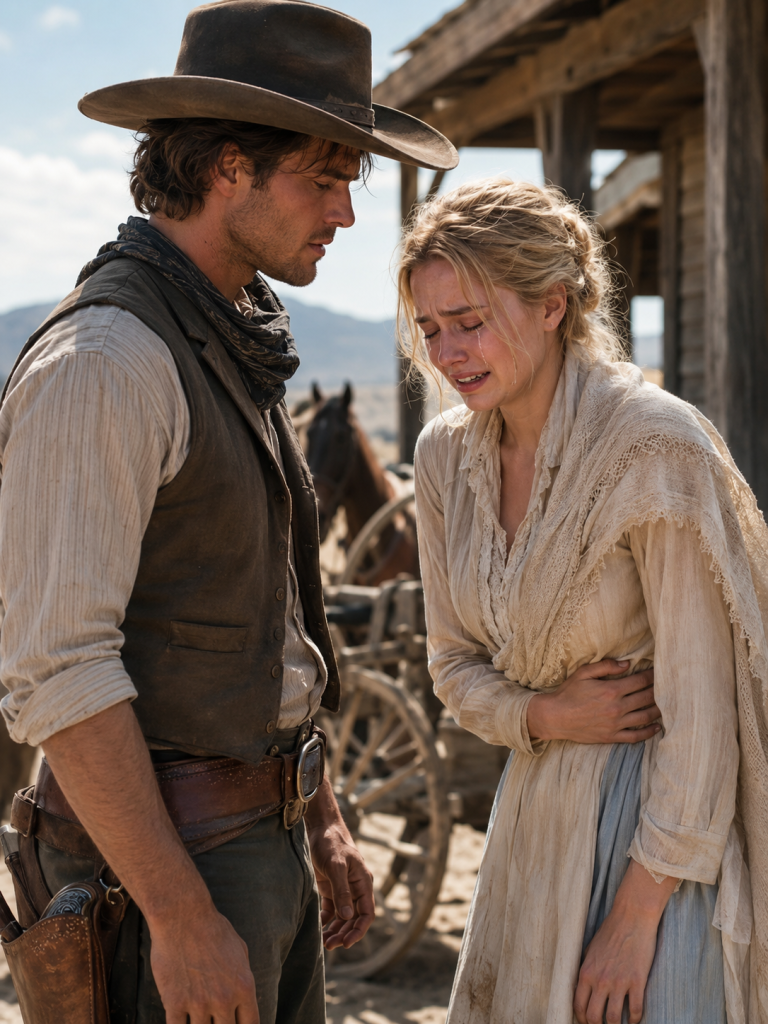
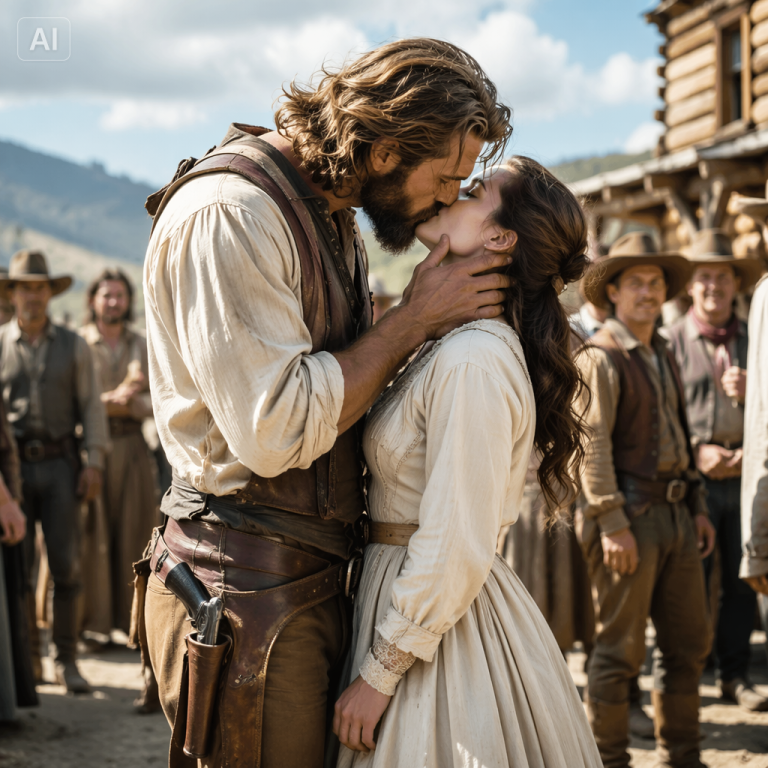
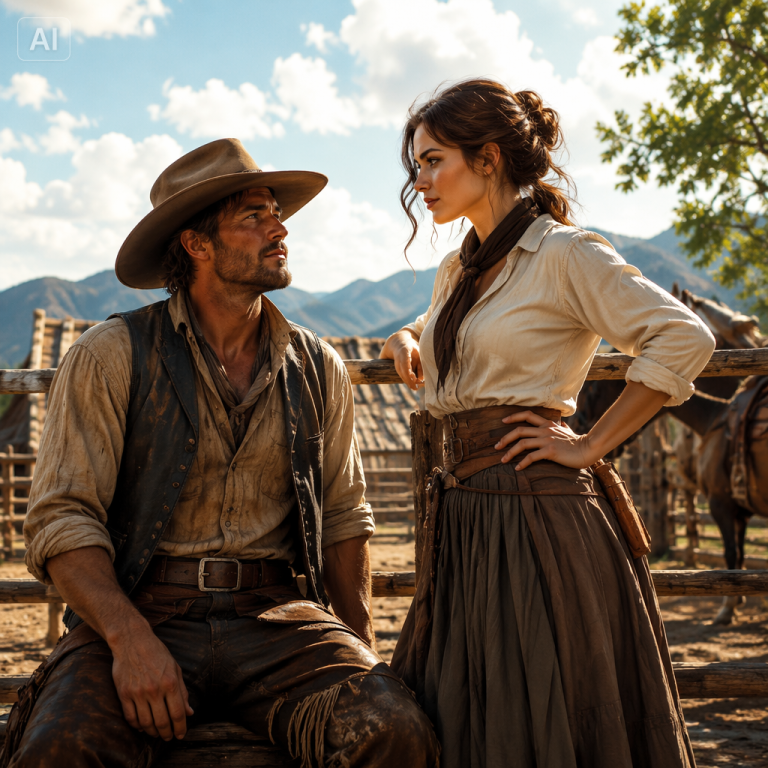
A Lonely Cowboy Rejected Every Christmas Bride Until One Quiet Mail Order Woman Changed Everything

PART 1
The iron horse screamed into Purgatory Creek like something dying, its wheels grinding against ice-slicked rails until the whole platform shuddered. December 12th, 1883. The kind of cold that didn’t bite so much as settle into a man’s bones and stay there.
Elias Thorne stood on the platform with his hat pulled low and his patience already spent. He wasn’t here for company. He was here for a crate of Henry rifles and two tons of grain, ordered from Chicago to deal with a wolf problem that had been picking his herd apart all winter. He looked like a piece of the landscape — weathered, mud-stained, unyielding, the Colt on his hip not for show.
“Mr. Thorne! Right on time,” the conductor called, checking his pocket watch with the nervous energy of a man who dealt with Elias often enough to respect him and rarely enough to be comfortable around him.
“Where’s my grain, Abernathy?”
“Cargo car, sure enough. But first —” Abernathy gestured toward the passenger stairs with the air of a man delivering good news he suspected wouldn’t be received as such. “Your delivery.”
“I didn’t order nothing else.”
A gloved hand appeared on the railing — pale blue kid leather, far too delicate for the rough timber of the station. Then a boot, polished and high-buttoned. Then a woman who looked as out of place in Purgatory Creek as a diamond dropped in a trough of slop — tall, dark mahogany hair tucked beneath a fur-lined bonnet, a coat cut in the latest New York fashion, and eyes a startling, searching shade of green.
She looked at the desolate, snow-buried town. Then at him. Her hands were trembling, but her voice, when she reached the bottom step and crossed the platform toward him, held steady.
“Mr. Elias Thorne?”
“Who’s asking?”
“I am Evelyn Sterling.” She squared her shoulders like a woman bracing for a blow she’d already decided to take standing up. “Your wife.”
The silence that followed was louder than the train’s engine. A few loafers near the depot stopped their chatter outright to watch. Elias laughed — dry, humorless.
“Lady, you must’ve hit your head when the train stopped. I ain’t got a wife. Buried the last hope of that three years ago.”
Evelyn’s chin didn’t drop. She pulled a folded letter from her reticule and thrust it at him. “I have the correspondence. Signed by you, or someone claiming to be. Letters from June to October. You asked for a companion. To help run the ranch. To build a home.”
Elias snatched the paper. He didn’t read well — never had much use for book learning beyond numbers and cattle brands — but he recognized the looping, flowery hand immediately, and it made something in his jaw go tight.
“Martha,” he growled, crumpling it in his fist.
“I beg your pardon?”
“My sister. Lives in St. Louis. Been pestering me to remarry since before the dirt settled on my wife’s grave.” He looked at Evelyn like she was a debt somebody else had run up in his name. “She wrote these. Not me.”
Evelyn’s face drained of color, leaving her looking even more like a ghost against the gray sky. “That cannot be. I sold everything I own. I traveled two thousand miles. I have nowhere else to go.”
“That ain’t my problem.” He turned. “Abernathy, load the grain. This lady’s getting back on the train.”
“Can’t,” Abernathy called, already uncoupling the cargo car. “Tracks iced over ten miles back. We barely made it through the pass. Storm coming in is going to bury the line a week, maybe two. This train isn’t going anywhere but the depot shed till it clears.”
The whistle blew — mournful, final. Elias looked at the sky, then at the woman who wasn’t crying, which surprised him. Most city women would have been in hysterics by now. Instead she stood gripping her carpet bag so tight her knuckles had gone white.
“I have no money for a hotel,” she said quietly. “And I will not freeze to death on this platform, Mr. Thorne.”
He cursed under his breath, a string of profanity that made Abernathy blush.
“Fine. Get in the wagon. But don’t get comfortable. First break in the weather, you’re gone.”
—
The ride to the Double T was three brutal hours through worsening wind. Elias drove the Clydesdales hard and didn’t look at the woman shivering on the bench beside him, though he threw a rough buffalo hide over her lap without a word. Evelyn held her tongue. She was terrified. She was also, underneath the terror, calculating — the way a person calculates who has already run out of easier options.
Purgatory Creek wasn’t a destination for her. It was a hiding place. Back in Boston, a man named Julian Vane had decided he owned her, having bought her father’s gambling debts and named her the payment. Her own family had agreed to the arrangement rather than argue with him. She’d sold what jewelry she had, answered the first advertisement she found, and let herself fall a little in love with the gentle, literate soul in the letters she’d been reading for months.
Looking now at the grim, scarred profile of the actual man, she understood the letters had been fiction. This man was stone.
They reached the ranch house at nightfall — a sprawling log structure, sturdy and imposing, built to survive the mountains around it. But the neglect hit her the moment they stepped inside. Dust on every surface. Dirty dishes stacked on a beautiful oak table gone gray with grime. Curtains drawn tight against the world. The smell of stale tobacco, wet dog, and something harder to name — loneliness, gone rancid with age.
“Barnaby!” Elias roared. An old man with a bird’s-nest beard and one good eye hobbled in from the kitchen, wiping his hands on a rag.
“What’s the hollering for, boss? I got the stew—” He stopped dead at the sight of Evelyn. “Well, I’ll be. Martha actually did it. She sent one.”
“She sent a headache,” Elias muttered, stomping snow off his boots. “She stays in the guest room. Eats what we eat. Works for her keep till the train runs again.”
Evelyn removed her bonnet. Her hair fell loose, rich against the dim lamplight. “I am not afraid of work, Mr. Thorne. But I expect civility.”
He stopped halfway to his own room and turned slowly. “Civility’s for guests. You’re an intruder.” He looked at Barnaby. “Show her the room. Lock up the liquor cabinet.”
His bedroom door slammed hard enough to rattle the floorboards.
Barnaby gave her a sympathetic wince. “Don’t mind him, miss. He’s got a heart. It’s just froze over, same as the creek.”
“What happened to him?”
Barnaby’s good eye softened as he picked up her bag. “Three years back, Christmas Eve. His wife Sarah and their little girl. Fever took ’em both inside three days. Man ain’t celebrated Christmas since. Ain’t allowed a carol or a ribbon of tinsel on this land.” He shook his head. “You walked into a graveyard, miss.”
Evelyn felt a chill that had nothing to do with the cold, and followed him down the dark hallway to a room that had clearly been used for nothing but storage — old saddles, crates of dry goods, a mattress thick with dust. She sat on its edge once she was alone, opened her carpet bag, and beneath the silk dresses she’d have no use for out here, her fingers found the cold steel of a small derringer.
It had been her only protection against the past she’d fled. Now it seemed she might need it for the present.
“I will not break,” she whispered to her reflection in the frosted window glass. “I survived Boston. I will survive Elias Thorne.”
—
PART 2
Morning came before dawn, in the form of crashing cupboards.
Evelyn dressed quickly and rushed to the kitchen, where Elias was tearing the room apart — tins of coffee and flour hitting the floor, Barnaby cowering near the stove.
“Where is it?” Elias roared.
“I told you, boss, I ain’t seen it.”
“What’s happening?” Evelyn asked from the doorway. Elias rounded on her, eyes wild.
“You take it? Take what?” She hadn’t moved. “The deed box. Lockbox from under the study floorboards. It’s gone.”
“I haven’t left my room until this moment. Why would I take a box I’ve never seen?”
He crossed the kitchen and loomed over her. “Because everyone wants a piece of this land. Caleb Vance has been trying to buy me out or burn me out for five years. Maybe he hired you. Maybe you ain’t a bride at all. Maybe you’re a spy.”
“I am no spy.” Her temper cracked through the fear at last. “I am a woman who was promised a home and found a prison instead. If your box is missing, perhaps look at who’s been coming and going while you’ve been wallowing in your own misery.”
He stared at her, genuinely stunned. Nobody spoke to him that way anymore.
A fist pounded the front door — not a knock, a demand. Elias’s hand went to his Colt, his fury replaced instantly with something colder and more practiced. “Stay here.”
He threw the door open. On the porch stood a man in a pristine buffalo coat, silver-tipped cane in hand, three armed riders behind him, and a smile that stopped well short of his eyes.
“Morning, Elias. Bit brisk for a social call, but I heard you had a visitor. Pretty one, from what the station master says.”
“Get off my porch, Vance.”
Caleb Vance chuckled, unbothered by the cocked hammer. “Just came to offer congratulations, and remind you the bank note’s due the twenty-sixth. Can’t pay, the Double T’s mine — and with cattle prices dropping, I suspect you’ll be needing a buyer soon.” His eyes drifted past Elias to the shadows where Evelyn stood, and he tipped his hat. “Ma’am. If you tire of the rough life, my ranch has steam heat and French wine. Think on it.”
He rode off. Elias slammed the door, locked it, and turned back to Evelyn — the accusation gone from his face now, replaced by a weariness that looked almost like defeat.
“The deed wasn’t in the box,” he admitted quietly. “Moved it to town a month back. But the bank note money — three thousand dollars — that was in there.”
“Stolen?”
“Gone.” He rubbed his face. “And if I don’t find it by the day after Christmas, you won’t just be homeless, Miss Sterling. We both will.”
Outside, the blizzard began in earnest, throwing itself against the log walls like a living thing demanding entry — and somewhere between Vance’s smile and the empty lockbox, Evelyn understood that whoever had taken that money had done it with a key to the house, not a crowbar. Which meant the thief hadn’t been a stranger at all.
—
PART 3
For two days the ranch was a white prison. Frost turned the windows into thick, blind patterns of ice, and the midday sun came through as a dull gray twilight that made the hours feel formless. Inside, the atmosphere was brittle enough to crack.
Evelyn had taken to cleaning — not from any sense of domestic duty, but because if she stopped moving, the full weight of her situation would catch up to her. Penniless. Trapped in a stranger’s house. Hunted, somewhere behind her, by a man who considered her his property. She scrubbed three years of grime off the floors. Polished the silver. Dared, on the second afternoon, to take down the curtains and wash them, hanging them to dry near the roaring hearth.
Elias watched her from his armchair, nursing black coffee spiked with whiskey. He wanted to hate her. He wanted to hate the way she hummed some soft, unrecognizable tune while she worked, the way the smell of lavender soap was slowly crowding out the stale grief that had settled into every corner of the house. Most of all, he hated that she wouldn’t break. He’d snapped at her. Ignored her. Threatened to put her back on the platform in the snow. Still she stayed, chin up, green eyes lit with a defiant fire that reminded him, painfully, of Sarah.
“You’re wasting your time,” he grumbled on the third morning, watching her polish the brass door handle. “Place is falling down anyway. Vance’ll have it by the New Year.”
“A home is worth fighting for, Mr. Thorne.” She didn’t look up. “Even when its owner has given up.”
“I haven’t given up. I’ve been outplayed. There’s a difference.”
“Is there?” She turned to face him fully now. “You let a thief walk out with your livelihood, and now you sit in a chair waiting for the end. In Boston we call that surrender.”
His face darkened, the scar on his cheek flushing red — and whatever he’d been about to roar back at her was cut off by a sound from outside that stopped both their hearts. The high, frantic scream of a horse.
“The barn!” He grabbed the Winchester off the mantle and plunged into the waist-deep snow. “Stay here.”
Evelyn hesitated exactly one second. Long enough to see Barnaby still fumbling with his boots by the kitchen fire, and to understand that if she waited for someone else to help him, she might be waiting to learn whether her husband — the word startled her even in her own thoughts — was alive or dead. She grabbed her coat and went after him.
The barn was fifty yards off, but in the whiteout it felt like miles. She followed the trench his body had carved through the drifts and found the doors ajar, chaos inside — the Clydesdales screaming and kicking in their stalls, three gray shapes moving in the shadows near the foal pen. Timber wolves, gaunt with hunger, had dug under the rotting back wall.
Elias didn’t hesitate. He fired. One wolf dropped. The other two spun, teeth bared, starving and past fear. One lunged while he was working the lever, and the force of his own swing — cracking the rifle stock across its jaw — sent him sliding on the ice-slicked straw. He went down hard, the rifle skittering out of reach, and the second wolf crouched to spring at his exposed throat.
The crack of a small-caliber pistol cut through the barn. The wolf jerked mid-leap, a bloom of red behind its ear, and collapsed inches from Elias’s boots.
He scrambled back, looking toward the entrance. Evelyn stood there, arm extended, the tiny pearl-handled derringer still smoking in her hand. Her face was pale. Her hand was steady as a rock. The third wolf, sensing the shift, bolted back through the hole in the wall and vanished into the storm.
Elias got up slowly, brushing straw from his coat. He walked to the dead wolf first — a clean kill, and studied it a moment before he looked at her. Really looked, for the first time.
“Thought I told you to stay inside.”
“You did.” Her voice trembled now that the adrenaline was fading. “I disregarded the order.”
He crossed to her, smelling of gunpowder and cold, and reached for the derringer. Inspected it — a two-shot, .41 rimfire, a toy by any serious reckoning. “Useless past ten feet,” he muttered, handing it back handle-first. “Good thing you were close.”
“I grew up with brothers,” she said, tucking it into her coat. “They taught me to shoot cans off a fence.”
“That wasn’t a can.” His voice had gone gruff, but the hostility in it was gone entirely. “You saved my hide, Evelyn.”
It was the first time he’d used her name.
—
**WHAT THE FIRE TELLS THE TRUTH**
Back inside, the dynamic between them had shifted in a way neither of them commented on directly. Elias poured two coffees this time and sat across from her, watching her warm her hands on the mug.
“You handle a gun well for a city girl. Why?”
She studied the dark liquid before she answered. “Boston isn’t all tea parties and balls. My father was a banker — and a gambler. He owed money to men who don’t care what the law says about collateral. I learned to carry protection because sometimes the collateral for a debt is a daughter.”
His jaw tightened. “That’s why you ran. A debt. A man named —”
“Julian Vane.” Her voice dropped to something quieter. “He bought my father’s debt and decided the payment was my hand in marriage. My family agreed. They sold me, Elias. Just like a heifer at auction. So I sold what jewelry I had left and answered the first advertisement I found in the paper.”
He looked into the fire for a long moment. “So we’re both running from ghosts.”
“Who stole the money, Elias?” she asked, sharper now. “The three thousand. Who knew it was there?”
“Only three people. Me. Barnaby. And my foreman, Jedediah Hayes.”
“Where’s Jedediah?”
“Took the herd out to the south pasture winter shelter three days back, before the storm hit. Holed up in the line shack.”
“Is he trustworthy?”
“I’ve known Jed ten years. Taught me to rope when I was younger than him.”
“Would you trust him with three thousand dollars if he was desperate enough?” Evelyn pressed, not unkindly. “Desperation makes wolves of us all.”
Elias stood, pacing. “No forced entry on the box. Whoever took it had a key or knew the spare’s hiding spot.”
“Let me see the study.”
He hesitated, then led her to the small room off the main hall — papers and ledgers in chaos, a loose board under a threadbare rug. Evelyn knelt and ran her fingers along the splintered edge.
“Elias. Look.”
Caught in the wood was a tiny torn scrap of fabric. Red flannel.
His face went pale. “Barnaby wears red flannel long johns. So does Jed.” He stopped. “So does the man who delivers Vance’s feed. I saw him in a shirt of it last week when he dropped supplies.”
“Why would Vance’s man be in your house?”
“He wouldn’t.” Elias’s voice dropped to something dangerous. “Unless someone let him in.”
The implication hung in the room like smoke. On a ranch this isolated, betrayal wasn’t just bitter. It was a death sentence, and neither of them wanted to say the name that fit the shape of it before they had proof.
—
**A SIEGE OF TWO, THEN THREE**
For the next twenty-four hours, the storm raged on, and the house’s siege footing quietly hardened into something like partnership. The kitchen pipes froze; Elias and Evelyn worked side by side heating water and wrapping burlap around them, passing tools and hot rags without needing to speak. When the work was done they sat by the fire, wrung out.
“Sarah hated winter,” Elias said quietly, watching her brush a stray lock of hair from her face. “Said it made the world feel dead. You seem to come alive in it. You fight it.”
“I don’t like the cold, Elias. I just refuse to let it win.” She looked at him. “I shouldn’t have said what I said at the station. About surrender.”
“No,” he admitted, voice rough. “I shouldn’t have said what I said, sending you back. I don’t know what I’d have done these last two days without you.”
She reached out and touched his hand — the first time, his skin rough and callused under her soft fingers. “You’re a good man, Elias Thorne. Buried deep, maybe. But you’re there.”
The moment went electric. He leaned in, drawn by the pull of her eyes, the lavender soap under the woodsmoke, and for one suspended second he forgot Sarah, forgot the debt, forgot everything but her.
A loud thump on the back porch shattered it.
Elias was up instantly, hand on his holster. “Stay here.” He unlatched the back door, kicked it open, gun raised — and a body tumbled in on a wave of snow and ice, face blue with cold, clutching his own side where blood seeped dark through his fingers.
“Jed!” Elias dropped to his knees. Jedediah Hayes, half-frozen, gutshot.
Evelyn was there in an instant with towels and hot water. “Help me get him to the fire.” Together they dragged him onto the rug. Barnaby came stumbling in, gasping at the blood.
“They hit the line shack,” Jed wheezed, pink froth on his lips, his grip on Elias’s shirt surprisingly strong for a dying man. “Vance’s men. Scattered the herd. Shot me when I tried to stop ’em. Rode all the way back.”
“Hush now,” Evelyn said, already cutting away his shirt to inspect the wound — a through-and-through, but he’d lost too much blood, and the frostbite was severe. “We need to cauterize this and get him warm.”
“The money, Elias.” Jed’s eyes were rolling back, fighting to stay present. “The money ain’t stolen by Vance’s men. I saw — before I left for the shack, Tuesday night — a rider leaving the house carrying the box.”
“Who, Jed? Who was it?”
“Not Vance’s men.” His voice was fading fast. “It was Arthur. Arthur Pendleton. I saw him meet Vance at the creek. Saw them shake hands.” His eyes fluttered shut.
“He’s in shock,” Evelyn said urgently. “Elias, whiskey and a knife. Now.”
Elias scrambled to obey, his mind already racing far ahead of his hands. Arthur Pendleton — the lawyer who’d drawn up the deed, the man who was supposed to be defending the Double T against Vance’s legal claims in town. He had a key to the house. He knew about the loose floorboard because Elias himself had shown him the hiding spot years ago, drafting his will the winter after Sarah died, too grief-numb to think twice about who he trusted with the knowledge.
Pendleton hadn’t just stolen the money. He’d sold Elias out to the man trying to ruin him. A conspiracy bleeding the Double T from both ends at once.
For the next hour the kitchen was an operating theater. Evelyn worked with grim precision — cleaning the wound, cauterizing it with a knife heated in the coals, binding Jed’s ribs like she’d done it before, though she never said where she’d learned. When it was done, Jed lay breathing shallow but steady, wrapped in blankets. Elias washed the blood from his hands and looked at his own reflection in the dark window. The grief that had lived there for three years had burned off entirely, replaced by something colder.
“Pendleton lives in town,” he said.
“You can’t go. The storm’s still blowing.”
“Wind’s dying. By morning the drifts’ll be hard enough to ride over.”
“If you go into town and kill a lawyer, you’ll hang,” Evelyn warned. “Vance owns the sheriff. You know that.”
“I don’t plan to kill him.” He strapped his gun belt back on. “I plan to make him talk. Then I’m going to get my money back.” He turned to her. “You saved Jed’s life tonight. You saved mine in that barn. I’m asking you for one more thing.”
“Anything.”
“Keep Jed alive. Keep Barnaby safe. If Vance’s men come here to finish what they started —” He crossed to the gun cabinet, pulled out a double-barreled shotgun, cracked it to check the shells, snapped it shut, and pressed it into her hands. “Don’t let them across the threshold.”
“Where are you going?” Barnaby asked, trembling.
“Purgatory Creek. I’m going to visit Mr. Pendleton. Then I’m going to pay Caleb Vance a visit.”
“Elias.” Evelyn stepped close, reaching up to trace the scar on his cheek with her thumb. “Come back.”
Something in him that had stayed frozen for three winters cracked all the way through. He kissed her — rough, desperate, tasting of fear and promise.
“I’ll come back,” he swore against her mouth. “I have a wife to provide for.”
—
**PURGATORY CREEK, TWO IN THE MORNING**
The ride into town was a descent into a frozen hell, the moon hanging high and indifferent over drifts that his horse Blackjack labored to churn through. The wind had died, replaced by a stillness more menacing than the storm had been. Twenty below — cold enough to freeze the moisture in a man’s nose, to make breathing feel like inhaling broken glass. Elias didn’t feel any of it. He was burning with three years of banked fury, freshly stoked.
Pendleton had sat at his table. Drunk his whiskey. Offered condolences at Sarah’s funeral with his hand on Elias’s shoulder like they were brothers. Learning that he’d been the architect of the Double T’s ruin the whole time was a violation that demanded blood — and Elias spent the whole ride reminding himself, in Evelyn’s voice, of the line he’d drawn for himself a long time ago and hadn’t crossed yet.
He reached town past two, the streets silent, saloons shuttered. He tied Blackjack loose behind the blacksmith’s shed and went the rest of the way on foot, sticking to boardwalk shadows he knew as well as the lines on his own hand. A light still burned in Pendleton’s second-floor office above the mercantile — a beacon of guilt in a sleeping town.
He didn’t take the stairs; the frost-brittle wood would have creaked. He climbed the icy drainpipe at the rear instead, hauled himself onto the narrow fire-escape balcony, and looked through frosted glass at Arthur Pendleton pacing his office in a velvet smoking jacket, gesturing to nobody, rehearsing some speech he clearly needed to believe himself. On the desk, lit by a kerosene lamp, sat a lockbox Elias would have recognized blind.
He didn’t knock. One kick below the latch and the frost-brittle door shattered inward with a crash like a gunshot. Pendleton shrieked, dropped his crystal tumbler, scrambled for a desk drawer he never reached — Elias was across the room in two strides, hauling him up by the lapels and slamming him into the wall hard enough to rattle picture frames off their nails.
“I can explain,” Pendleton squeaked, eyes bulging. “It’s not what it looks like.”
“It looks like you stole my future, Arthur.” Elias pressed his forearm to the man’s windpipe. “It looks like you sold me to Vance.”
“I was protecting it. Vance is crazy, Elias, he would’ve killed you—”
“So you decided to starve me out instead.” He threw Pendleton into the leather armchair and turned to the desk. The lockbox held the three thousand — and beside it, a rolled surveyor’s map of the territory, a thick red line cutting straight through the valley, straight through the heart of the Double T. The Union Pacific Railroad seal stamped in the corner.
“The railroad.” The realization landed like a hammer. “It’s not about grazing land at all. It’s the right of way.”
Pendleton, wiping his nose with a silk handkerchief, found his nerve just long enough to explain the rest, half out of terror and half, Elias suspected, out of a coward’s need to justify himself. “Spur line, connecting to the coal mines up north. Route runs right through your water source. Vance has been buying every parcel along the projected line for pennies. He needed the Double T to finish the chain.”
“How much is the railroad paying him?”
Pendleton hesitated. Elias set his Colt on the desk with a click louder than a shout.
“Fifty thousand,” Pendleton whispered. “He buys you out for a three-thousand-dollar debt and sells to Union Pacific for fifty the next day.”
Fifty thousand dollars. Enough to build a kingdom. Enough, evidently, for Caleb Vance to be willing to starve a rancher, shoot his foreman, and let a woman freeze to get it.
“Write it down,” Elias said. “Everything you just told me. The theft, the conspiracy, the railroad deal. Sign it. Stamp it with your notary seal.”
“Vance will kill me if I—”
“If you don’t write it,” Elias said, leaning close, his voice gone flat and empty, “you won’t live long enough to worry about Vance.” It wasn’t a threat he intended to carry out. But he let the silence after it do the convincing, because a line he refused to cross didn’t mean he couldn’t stand at the very edge of it when the moment called for it.
Trembling, Pendleton wrote. Ten minutes of scratching quill and ragged breath, and then a shaking hand pressed the notary stamp into wax. Elias rolled the confession and the map together, pocketed them, stuffed the cash into his saddlebags, and backed toward the shattered door.
“You stay in this room till sunup. I see you leave before then, I finish what I started.”
“You can’t win, Elias.” Something desperate and malicious crept into Pendleton’s voice as fear curdled into spite. “Vance isn’t alone. He’s got the sheriff. Hired guns from Cheyenne. They know you’re desperate. They’re watching the roads.”
“Let them watch.”
He was three rungs down the drainpipe when a shout rang out from the street — *someone’s on the roof* — and two deputies came running down the alley with lanterns swinging. Vance had bought the law after all. Elias dropped the last ten feet into a snowbank, sprinted for Blackjack, and was in the saddle and moving before the first shot chipped wood off the post beside his head.
He rode low over the horse’s neck, weaving through shadow, more shots buzzing past like angry hornets, and cleared the edge of town onto open plain with the wind tearing at his face and the weight of proof and cash both in his saddlebags. He looked back once. Signal fires were already being lit on the ridge above Vance’s estate.
They knew he’d been there. They knew exactly where he was going next.
The ride back to the Double T wasn’t a commute anymore. It was a race against men who wouldn’t just come after him — they’d go straight for the leverage. For Evelyn.
—
**THE SIEGE**
Dawn broke over the Double T with a blood-red horizon, the sun struggling through lingering storm clouds. Inside, the silence had a weight to it that made every settling creak of the house sound like a footstep. Evelyn hadn’t slept. She sat in a rocking chair by the window, the shotgun across her lap, eyes gritty but her focus absolute.
Jed, conscious now but weak, his fever broken by her constant care, wasn’t in any shape to fight. Barnaby sat in the kitchen sharpening butcher knives with a rhythmic shick-shick-shick that set her teeth on edge.
“He should be back by now,” she murmured.
“Snow’s deep,” Jed rasped from his blankets. “Takes time. Elias knows this land better than any man alive. He’ll make it.”
“It’s not the land I’m worried about.”
At ten in the morning, she saw them. Not Elias. Five riders cresting the eastern hill, silhouettes against glaring snow, moving with the slow, deliberate arrogance of men who expected no resistance. Tall mounts. Long duster coats hiding whatever weaponry they carried.
“Riders,” she called out, her voice steadier than she felt. Barnaby hobbled in clutching a cleaver.
“Is it the boss?”
“No. It’s company.” She stood, checking the shotgun’s load. “Help Jed up, give him a pistol. Move the table in front of the window.” She was barking orders like a general, the fear boiling under her skin but the survival instinct that had carried her out of Boston rising to meet it. She was not a damsel waiting in a tower. She was the commander of a fortress, however small.
The riders stopped fifty yards out. Their leader — black beard, a scar through one eyebrow — trotted forward alone. Blackjack Miller, a hired gun Vance kept on retainer for exactly this kind of work.
“House! Anyone home?”
Evelyn cracked the door an inch, chain still on, and leveled the shotgun through the gap. “This is private property. Turn around.”
Miller laughed. “Looking for a fugitive. Elias Thorne robbed a prominent citizen last night. We’re here to secure the premises till the sheriff arrives.”
“Elias isn’t here. And you’ve got no badge. Leave, or I fire.”
“Now, darling, don’t be difficult. We know you’re in there with an old man and a cook. Just want to come in and get warm. Wait for Elias together, maybe.” He signaled his men, who began dismounting, pulling rifles from their scabbards.
“I warned you.” She aimed at the ground in front of his horse and fired the first barrel. The buckshot tore up snow and dirt around its legs; the animal reared and threw Miller into a drift.
“You crazy witch!” he screamed, scrambling behind a wagon. “Boys, light it up!”
Gunfire tore into the log walls, splintering wood, one round shattering the front window. Evelyn ducked behind the overturned oak table.
“Keep your heads down!” Barnaby cowered in the corner, praying. Jed propped himself against the sofa and fired blind through the broken window with his revolver.
“Save your ammunition,” Evelyn ordered. “Wait for a target.”
The siege held for an hour, a stalemate — the ranch house’s thick logs stopping every round, but every attempt she made to return fire meeting a hail of bullets at the window frame.
“They’re moving,” Jed shouted. “Round back. Kitchen door.”
“Barnaby, wedge a chair under the handle. Go.”
He scrambled, and moments later the heavy thud of a shoulder against wood echoed through the house, followed by a gunshot blowing the lock clean off. A man in a gray coat stepped through, grinning at what he expected to find.
Evelyn didn’t hesitate. She raised the shotgun. His eyes went wide as he tried to bring his own rifle up too slow. The second barrel caught him full in the chest and threw him back out into the snow.
Her hands shook so hard she nearly dropped the gun. She had never killed anyone. Nausea rolled through her; she swallowed it down, slammed the door, and shoved the prep table against it.
“Reload!” Jed yelled. She fumbled shells into numb fingers.
“Burn it!” Miller’s voice, from outside. “Burn them out!”
A bottle of kerosene, rag burning at the neck, smashed through the front window and exploded across the rug. Flames licked up the curtains instantly.
“Fire!” Barnaby shrieked. Evelyn grabbed a wool blanket and beat it out, smoke stinging every eye in the room.
“We can’t stay in here,” Jed coughed. “Go out, they shoot us. Stay, we burn.”
Evelyn looked around at the home Elias had built and the home she had fought, in three short days, to make hers too.
“We are not leaving.” She grabbed Elias’s spare Winchester off the wall. “Jed, can you shoot if I prop you up?” He grunted assent. She dragged him to the front window. “Cover the front. Barnaby, the back — use the pistol, shoot anything that moves.”
Another Molotov cracked against the outer wall; they heard the logs begin to catch. Miller’s voice drifted through the smoke.
“Last chance, lady. Come out with your hands up.”
She racked the Winchester’s lever. “Go to hell.”
Miller rose from behind the wagon to line up a final shot at the window. A crack split the air from the ridgeline to the north — heavier, deeper than a pistol or standard rifle. A buffalo gun. Miller’s hat spun off his head, missing his skull by an inch, and he dove back into the snow.
“Sniper!” One of the men by the woodpile cried out and collapsed, clutching his leg.
Evelyn peered through the smoke. On the ridge, three hundred yards out, a lone rider sat silhouetted against the sun, a rifle smoking in the cold air behind him. Two massive Clydesdales pulled a supply sled — he’d stopped at the depot shed on the way back for exactly this.
Elias.
He dropped the reins, raised the Henry, and unleashed rapid fire, working the lever like a man born to it, forcing the attackers’ heads down. Then he spurred Blackjack straight down the slope, firing one-handed, riding directly into the teeth of their guns to reach the house.
Miller popped up to fire at the charging rider. Evelyn saw her chance — rested her rifle on the sill, breathed, and squeezed the trigger, catching the wagon wheel beside his face in a shower of splinters that sent him screaming, clutching his eyes, gun forgotten.
Elias reached the porch and didn’t dismount so much as leap from the saddle onto the planks, rolling up with his Colt drawn, kicking the door in.
“Elias!” Evelyn dropped her rifle and ran to him. He caught her, pulled her down as a bullet whined through the open doorway.
“You hurt?”
“No. We held them. But the house is burning.”
“Let it burn,” he said, eyes hard. “We have the cellar. Get Jed and Barnaby down there. Now.”
“What about you?”
He turned back toward the door, reloading. “I’m going to finish this conversation with Mr. Miller.”
—
**THE RECKONING**
The porch air smelled of sulfur and something like victory not yet earned. Elias stepped out, Colt leveled at the hired guns. Miller, blinded by splinters, screamed for his men to attack, but they froze under Elias’s stare — the look of a man who had run out of patience three years ago and had spent every day since waiting for a reason to spend it.
Sleigh bells cut through the tension. Caleb Vance arrived in a fine carriage, Sheriff Grady beside him, and smirked at the burning wall of the cabin.
“Surrender, Elias. House is finished. I’ll let you live if you walk away now.”
“House might burn.” Elias pulled the rolled documents from his coat. “Paper burns faster — good thing I’ve got this one memorized.” He held up Pendleton’s signed confession and the stolen surveyor’s map. “You’re not just cheating me, Sheriff. He’s defrauding the Union Pacific Railroad. You know what railroad detectives do to men who interfere with a federal expansion project? They bury them. All of them. Including whoever was wearing a badge while it happened.”
Grady went pale, looking between the documents and Vance. “He made me do it,” he stammered.
Vance’s composure cracked at last, and he raised his silver-tipped cane toward the sheriff — a threat, an order, something — but Evelyn stepped onto the porch first, soot-streaked, Winchester in hand like a queen defending her own gate.
“The fire is spreading,” she called out, voice carrying over the crackle of flame and gunsmoke both. “If we don’t put it out now, the evidence burns with it. Make your choice, Sheriff. Now.”
Grady, more afraid of federal marshals than of Caleb Vance, drew his own weapon and turned it on the man he’d been taking orders from for years. “You’re under arrest, Caleb.”
Vance screamed threats the whole time they cuffed him, but nobody in that yard was listening anymore. Elias rallied Barnaby and the wounded Jed into a desperate bucket brigade, and for two hours they fought the flames together, saving the structure though it came out scarred and blackened at the edges — not unlike the four of them.
Exhausted, Elias slumped onto the damp porch steps. Evelyn sat beside him with two mugs of coffee.
“We missed Christmas,” she said quietly. “It’s the twenty-sixth.”
He took the coffee, then took her hand instead of drinking it. “I was a fool,” he admitted, voice thick. “Thought my life ended with Sarah. But you fought for this place like you built it yourself.” He looked at her, the ice that had lived behind his eyes for three winters finally, fully thawed. “You aren’t just a mail-order bride, Evelyn. You’re the partner I didn’t know I needed.”
He reached into his coat and produced a simple gold ring set with a garnet — his mother’s, she would learn later, kept in a drawer for a decade waiting for a hand worth giving it to.
“Evelyn Sterling. Will you stay? Not because of a letter. Not because of a contract. Because you want to.”
She looked at the ring, then at the rugged, scarred man who had finally, fully let her in.
“I’m not going anywhere, Elias.” She slid it onto her finger. “I’m home.”
—
**ONE YEAR LATER**
Christmas Eve, 1884. The Double T stood rebuilt, warmer and brighter than it had been even before the fever took Sarah — the railroad spur curving respectfully around their land now, a concession negotiated personally, and rather sharply, by Mrs. Thorne, who had learned in Purgatory Creek that a woman who refused to be looked past could redraw the map of almost anything.
Inside, beside a spruce tree strung with the first ribbons the house had seen in four years, Elias watched Evelyn rock their newborn son, Samuel, in the same chair she’d once held a shotgun in.
The blizzard had brought them together. It was something steadier than a storm that had kept them there — the particular, unglamorous kind of love that shows itself best when the house is on fire and someone chooses, without being asked twice, to stand beside you instead of running for the door.
Elias thought his life had ended on a frozen platform three years and a lifetime ago. Instead, it had only been waiting there, for a train he hadn’t ordered and a woman he hadn’t known he needed, to begin again.
**THE END**